
Study Guides
Cambridge O Level Commerce (7100): Trade and commerce
Cambridge O Level Commerce 7100 sub-topic 1.1 in depth: trade versus commerce, home and international trade, aids to trade, logistics and types of commerce.
- Subject
- Commerce
- Level
- O LEVELS
- Topic
- Topic 1 – Commerce and Production
- Author
- Marlbridge Academic Team
- Updated
- Reviewed by
- Salman Ahmad (what this means)
Aligned to Cambridge O Level Commerce (7100), 2026-2028. Official specification .
Syllabus page (what it covers and how it is assessed): Cambridge O Level Commerce.
Syllabus points this page covers
7100
- 1.1 Trade and commerce
Found an error? Report a correction.
Need help with this topic? Request a free trial class for O Level Commerce (7100).
Sub-topic 1.1 of the Cambridge O Level Commerce (7100) syllabus sets out the vocabulary the rest of the course depends on. It has four parts: trade (1.1.1), aids to trade and logistics (1.1.2), types of commerce (1.1.3) and the relationship between production, trade and commerce (1.1.4). Almost every later topic assumes you can use these terms precisely, so marks lost here are often lost again in Topics 2 to 5.
For the whole of Topic 1 in one place, see the Commerce and Production overview. This page goes further into 1.1 only.
What the specification asks for
| Section | Content statements |
|---|---|
| 1.1.1 Trade | The meaning of trade and commerce and the differences between them; home trade (retail and wholesale); international trade (exports and imports) |
| 1.1.2 Aids to trade and logistics | The meaning of aids to trade; the six types; the meaning of logistics; the elements of logistics in a supply chain: transport, freight forwarders and warehousing |
| 1.1.3 Types of commerce | Traditional commerce, ecommerce, mcommerce and scommerce |
| 1.1.4 Production, trade and commerce | How the three are interdependent |
Trade and commerce: why they are not the same word
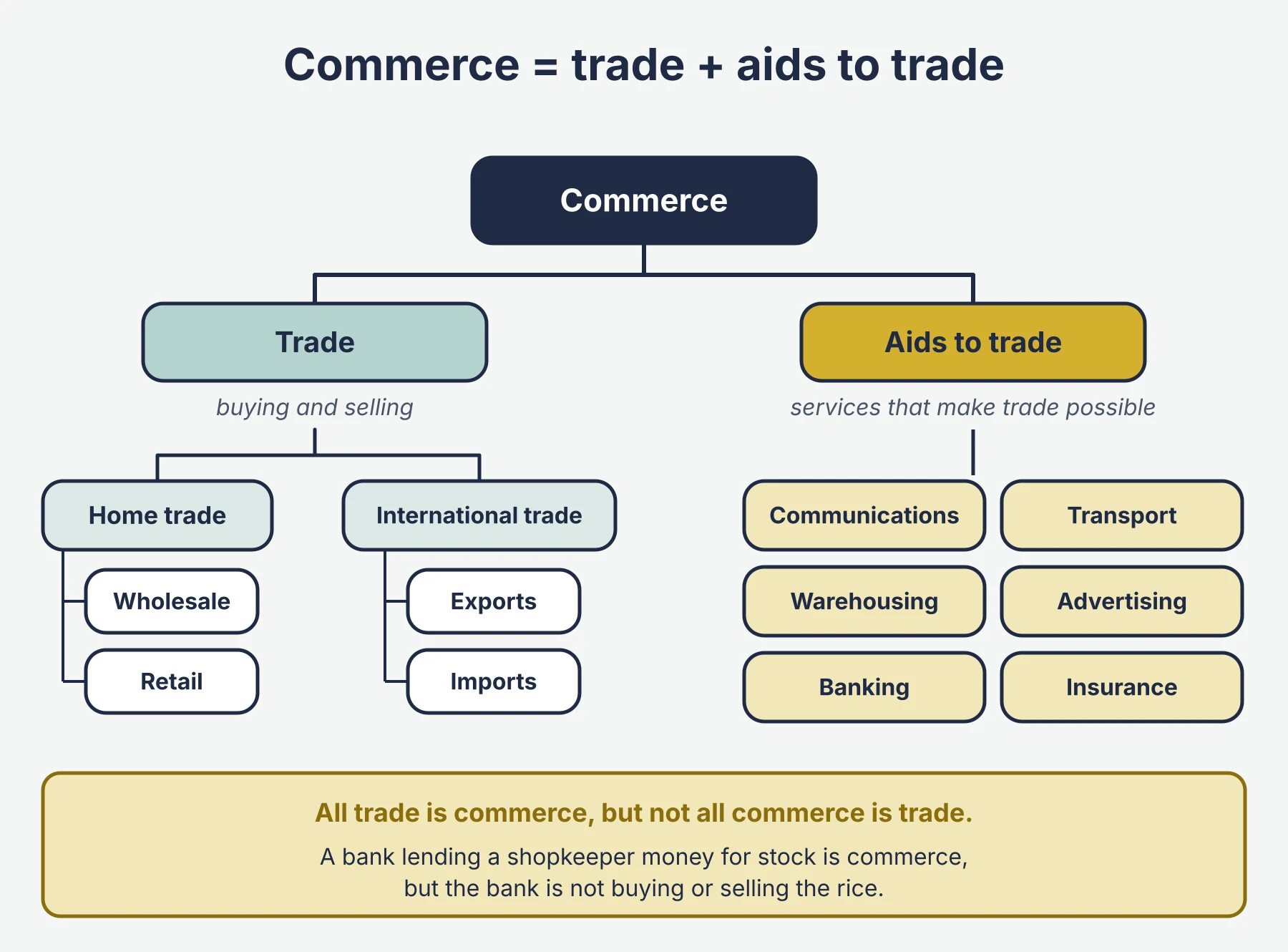
Trade is the buying and selling of goods and services. It is the exchange itself: a customer pays a shop for a bag of rice, or a shop pays a wholesaler for fifty bags.
Commerce is wider. It is trade plus all the services that make trade possible, the aids to trade. Commerce covers every activity involved in getting goods and services from the producer to the consumer.
The difference examiners look for is one of scope: all trade is part of commerce, but not all commerce is trade. A bank that lends a shopkeeper money to buy stock is part of commerce, yet the bank is not buying or selling the rice. A precise answer states the relationship in one sentence: commerce = trade + aids to trade.
Home trade and international trade
Home trade (domestic trade) is buying and selling within one country. The syllabus names its two branches:
- Wholesale trade: buying goods in large quantities from producers and selling them in smaller quantities, usually to retailers.
- Retail trade: selling goods in small quantities to the final consumer.
International trade is buying and selling between countries:
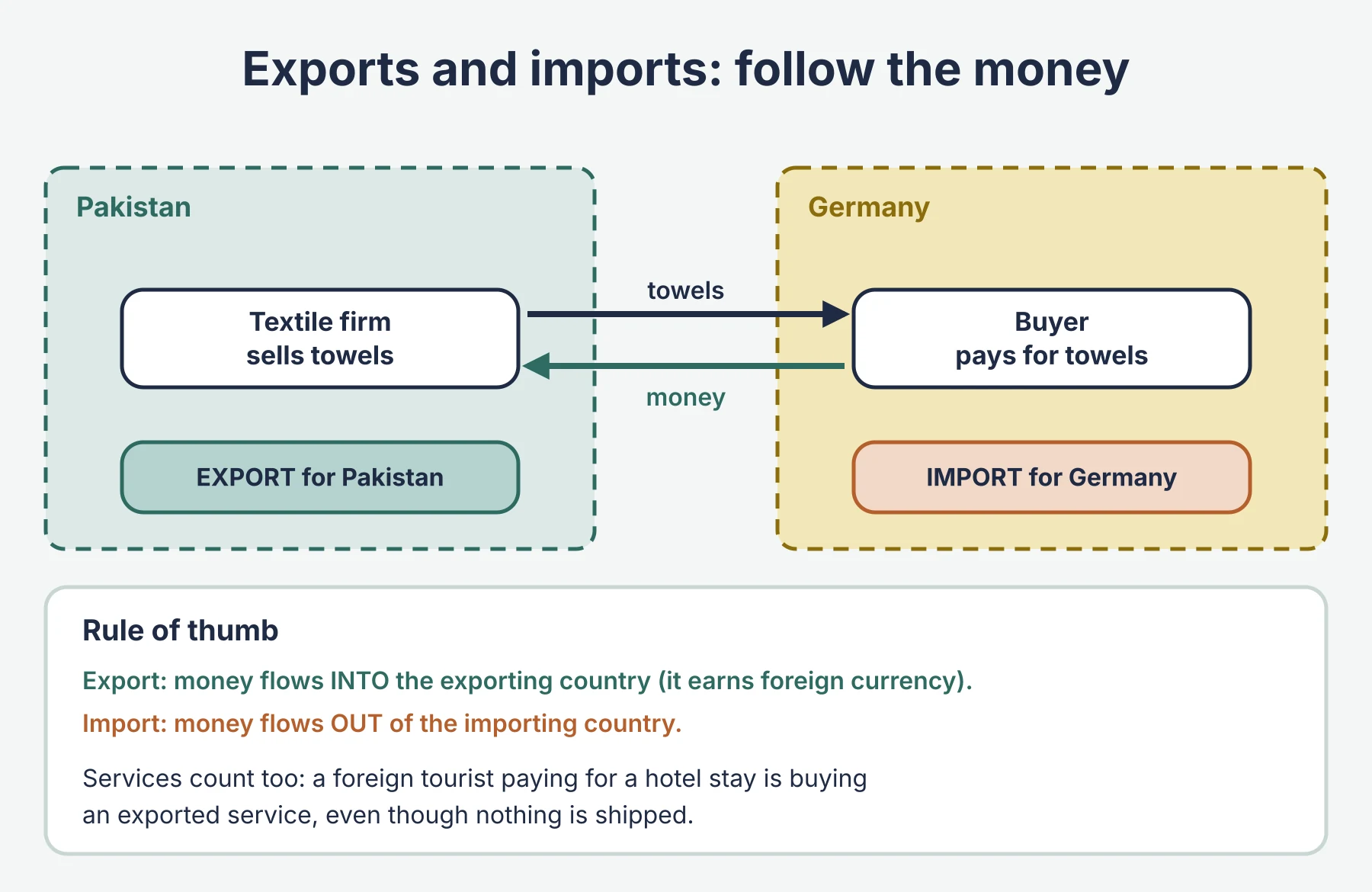
- Exports are goods and services sold to buyers in other countries. Money flows into the exporting country.
- Imports are goods and services bought from sellers in other countries. Money flows out of the importing country.
A frequent slip is to define an export by the direction the goods travel but forget the money: a textile firm in Pakistan selling towels to a buyer in Germany is exporting, and Pakistan earns foreign currency from the sale. The same transaction is an import for Germany. Services count too: a tourist from abroad paying for a hotel stay is buying an exported service, even though nothing is shipped.
Aids to trade
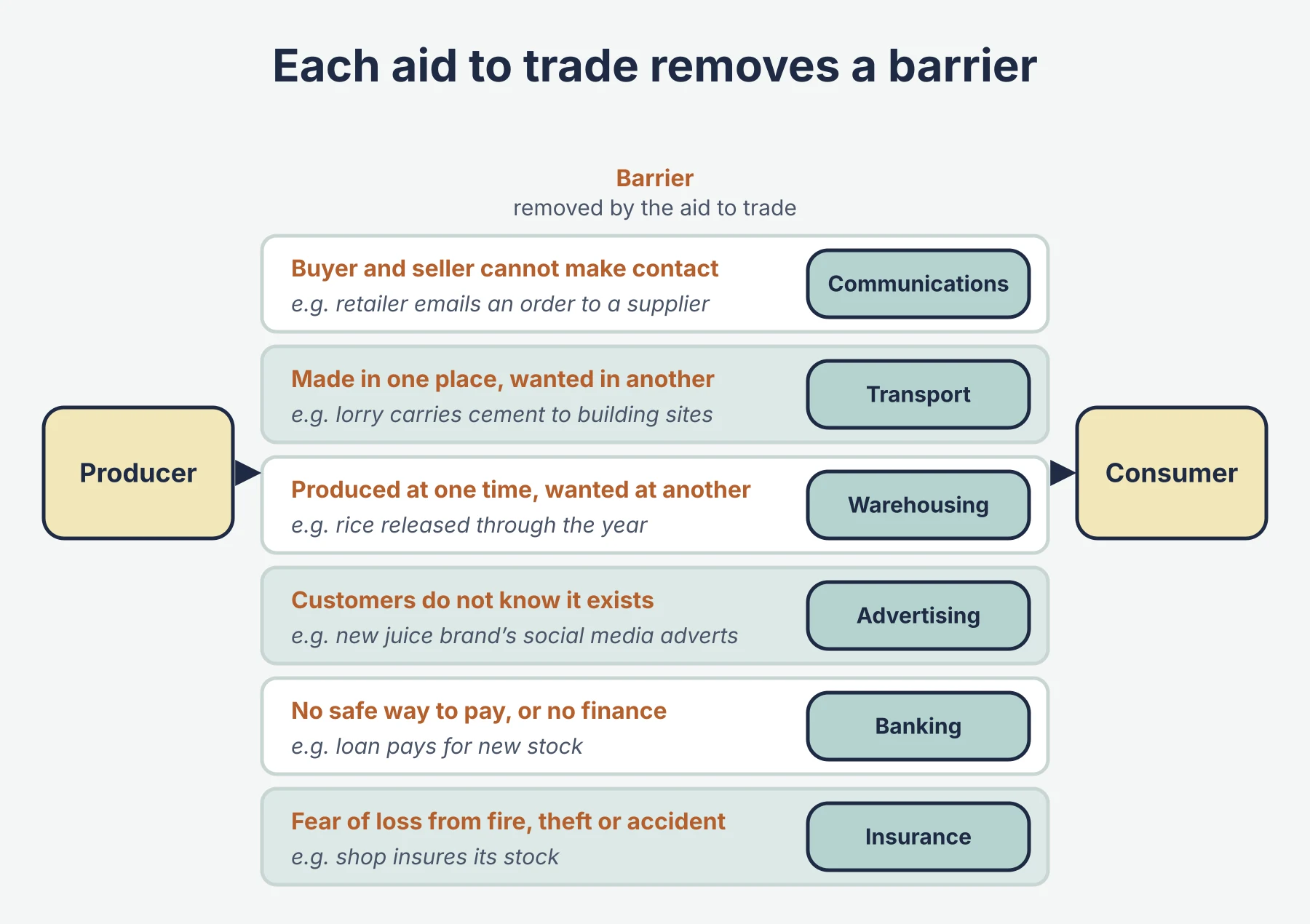
Aids to trade are the services that help trade to take place but do not themselves involve buying and selling the goods. The syllabus lists six, each removing a different barrier:
| Aid to trade | Barrier it removes | Short example |
|---|---|---|
| Communications | Buyers and sellers cannot contact each other | A retailer emails an order to a supplier |
| Transport | Goods are made in one place but wanted in another | A lorry carries cement from a works to building sites |
| Warehousing | Goods are produced at one time but wanted at another | Stored rice is released through the year after a single harvest |
| Advertising | Customers do not know a product exists | A new juice brand runs social media adverts |
| Banking | Buyers lack a safe way to pay, or traders lack finance | A loan pays for new stock; a card payment completes a sale |
| Insurance | Traders fear losses from fire, theft or accident | A shop insures its stock so a fire does not ruin the business |
Linking each aid to the barrier it removes is what turns a list into an explanation. Topic 5 covers advertising, banking and insurance in depth; transport and warehousing return in Topic 4.
Logistics and its three elements
Logistics is the planning and management of the movement and storage of goods through a supply chain, so that the right goods arrive in the right place, at the right time and at the lowest reasonable cost.
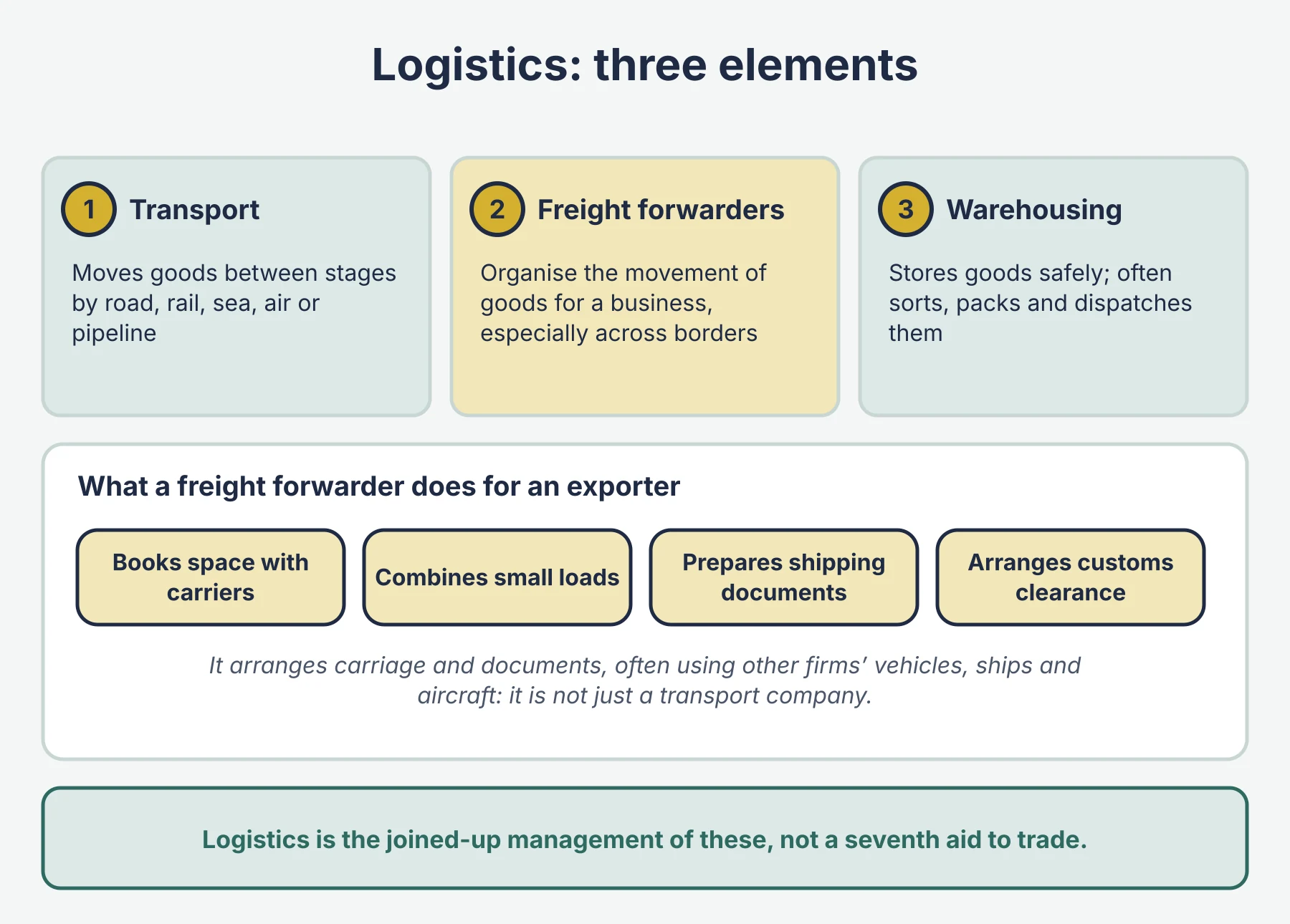
The syllabus names three elements of logistics in a supply chain:
- Transport: physically moving goods between stages, by road, rail, sea, air or pipeline.
- Freight forwarders: specialist firms that organise the movement of goods for a business, especially across borders. They book space with carriers, combine small loads, prepare shipping documents and arrange customs clearance. An exporter that has never shipped abroad can pass the whole task to a freight forwarder instead of dealing with each carrier and official separately.
- Warehousing: storing goods safely until they are needed, and often sorting, packing and dispatching them.
Notice the overlap: transport and warehousing are both aids to trade and elements of logistics. Logistics is the joined-up management of them, not a seventh aid to trade.
The four types of commerce
The syllabus defines each type by where or how the buying and selling happens.
| Type | Meaning (syllabus wording) | Example |
|---|---|---|
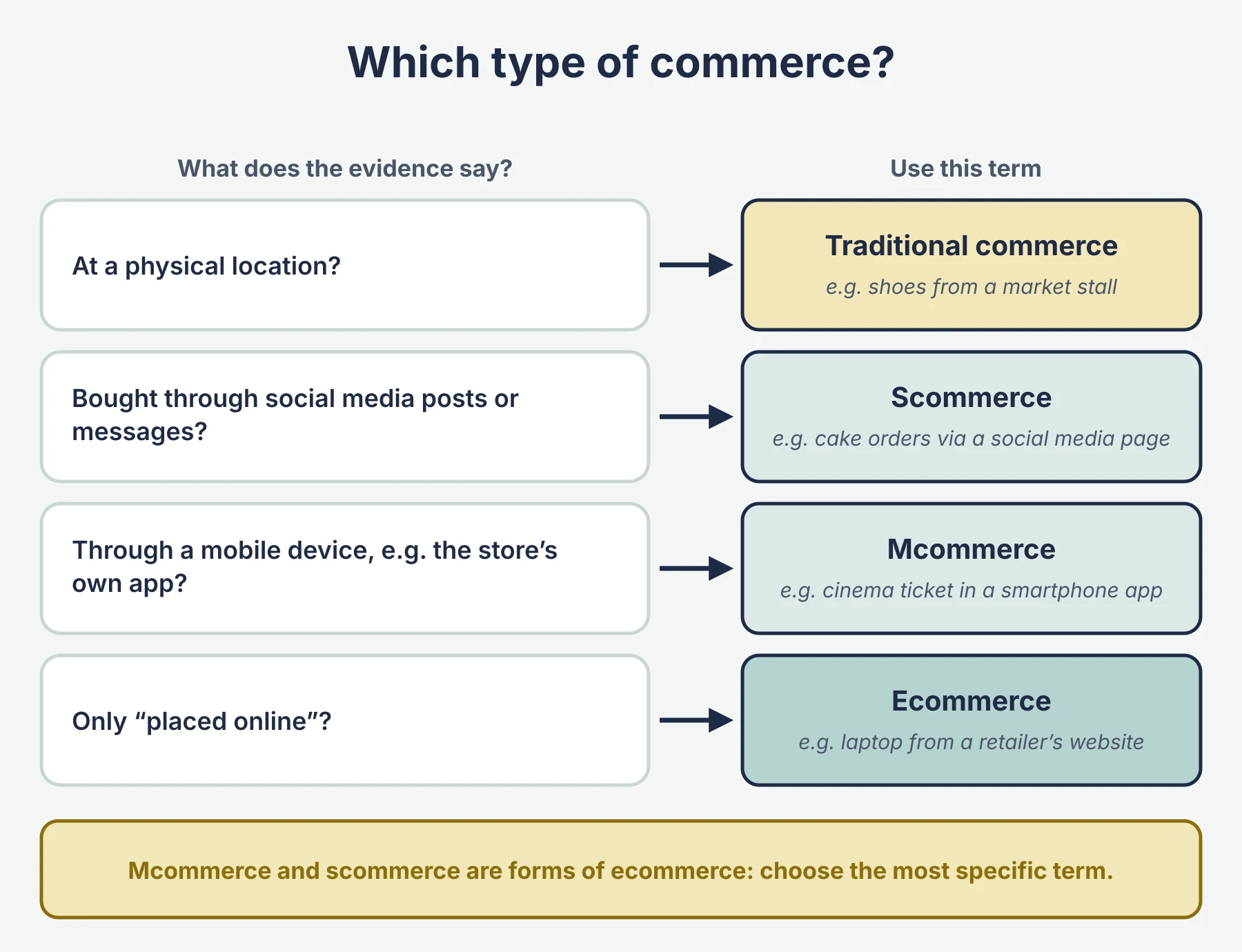
| Traditional commerce | Buying and selling goods and/or services at a physical location | A customer buys shoes in a market stall |
| Ecommerce (electronic commerce) | Buying and selling goods and/or services via the internet/websites | A customer orders a laptop from a retailer’s website |
| Mcommerce (mobile commerce) | Buying and selling via a mobile device, such as a smartphone or tablet | A customer pays for a cinema ticket in a smartphone app |
| Scommerce (social commerce) | Buying and selling via social media channels | A home baker takes cake orders through a social media page and its messages |
Mcommerce and scommerce are both forms of ecommerce, because they also take place over the internet. In an exam, choose the most specific term the evidence supports. If a case study says customers “browse the seller’s posts and buy without leaving the app”, that is scommerce. If it says “customers use the store’s own smartphone app”, that is mcommerce. If it only says “orders are placed online”, ecommerce is the safe answer.
Many businesses use more than one type: a furniture shop may sell in its showroom (traditional), on its website (ecommerce) and through a social media shop (scommerce).
How production, trade and commerce depend on each other
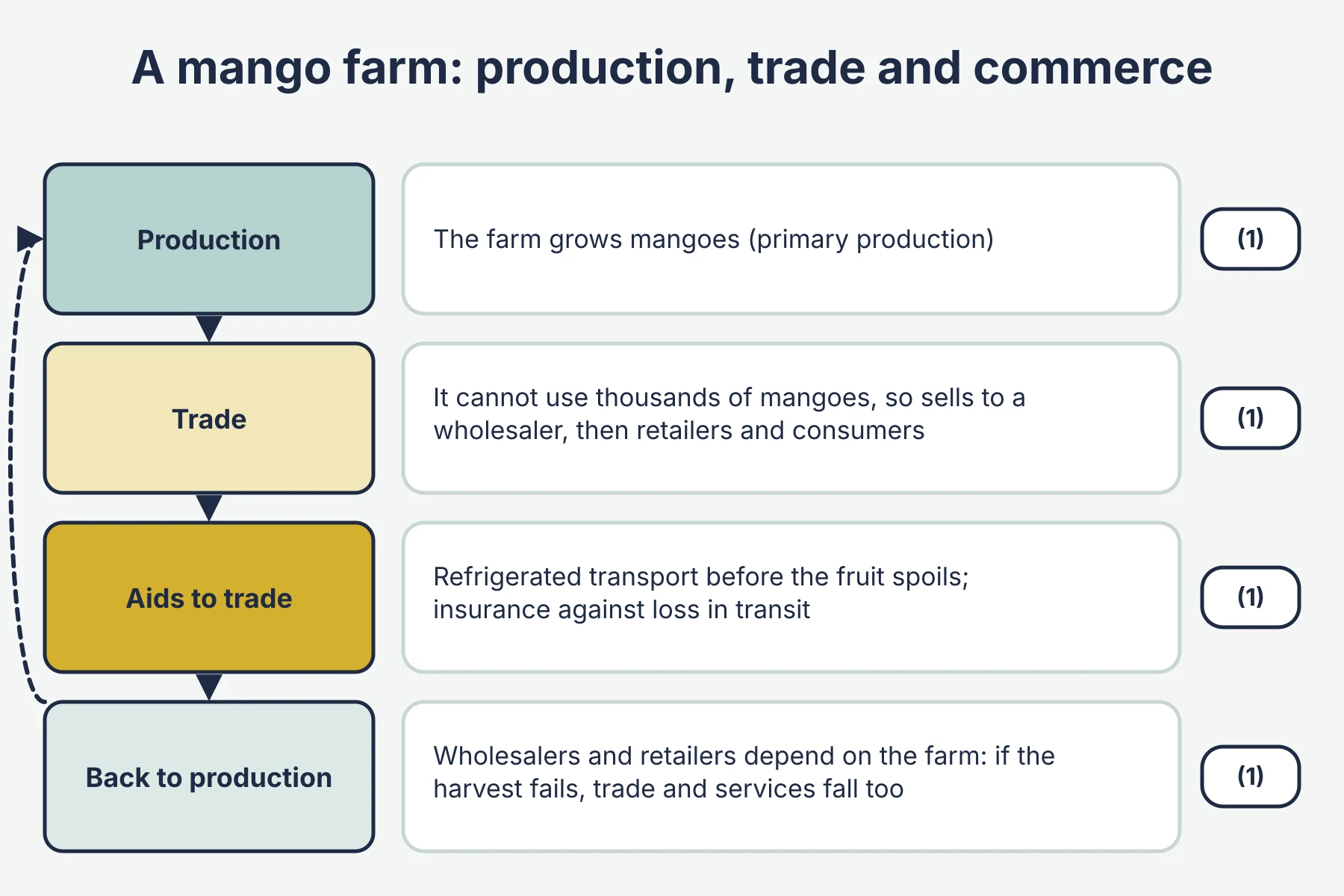
Production creates goods and services. Trade exchanges them. Commerce includes trade and the aids that make the exchange possible. Each needs the others:
- Producers need trade to sell their output; without buyers there is no reason to produce.
- Trade needs production, because there is nothing to buy or sell without it.
- Both need the aids to trade: goods must be transported, stored, advertised, paid for and insured.
- Commerce itself is a form of production, since commercial services are part of tertiary production.
This interdependence grows with specialisation: when producers concentrate on one product, they must trade to obtain everything else they need.
Worked example: an annotated model answer
Original question: “Explain how production, trade and commerce are interdependent, using the example of a mango farm.” (4 marks)
A mango farm produces fruit, which is primary production (1). The farm cannot use thousands of mangoes itself, so it needs trade: it sells them to a wholesaler, who sells to retailers and consumers (1). This trade depends on aids to trade, for example refrigerated transport to carry the fruit to cities before it spoils, and insurance against loss in transit (1). In turn, wholesalers and retailers depend on the farm for supplies, so if the harvest fails, trade and the commercial services linked to it fall as well (1).
Why it scores: each sentence makes a separate link (production needs trade; trade needs aids; trade needs production) and every point is applied to mangoes rather than stated in general terms.
Common mistakes
- Using “trade” and “commerce” as synonyms, or saying commerce is “trade plus production”.
- Defining home trade as “trade in the home” instead of trade within one country.
- Saying that an import brings money into a country.
- Listing aids to trade without saying how each helps trade take place.
- Calling a freight forwarder a transport company: it arranges carriage and documents, often using other firms’ vehicles, ships and aircraft.
- Calling every online sale “mcommerce” when the evidence does not mention a mobile device.
Exam technique for the command words
- Define needs a precise meaning; for ecommerce, “via the internet/websites” is essential.
- Identify or give questions want a named item from the case material, such as “scommerce”.
- Explain needs a reason or a link, for example how warehousing helps trade (it lets goods produced now be sold later).
- Discuss or assess questions on types of commerce need both sides and a judgement tied to the business described.
Practise this sub-topic
Condense the ideas with the trade and commerce revision notes, then test yourself with the trade and commerce practice questions. Sub-topic 1.2 continues in the production study guide.
Official syllabus
Cambridge O Level Commerce (7100) syllabus for 2026, 2027 and 2028, sub-topic 1.1 Trade and commerce: official syllabus PDF.
Related resources
-
Revision notes
Cambridge O Level Commerce: Commercial Operations — Revision Notes (7100)
Recall notes for Cambridge O Level Commerce 7100 Topic 2: enterprise types, multinationals, franchises, outsourcing, retail, wholesale and communication.
Commerce · Cambridge · O Level
Revise topic -
Practice questions
Cambridge O Level Commerce (7100): Trade and commerce – Practice Questions
Twelve original questions with mark-scheme answers on Cambridge O Level Commerce 7100 sub-topic 1.1: trade, aids to trade, logistics and types of commerce.
Commerce · Cambridge · O Level
Try questions -
Revision notes
Cambridge O Level Commerce (7100): Trade and commerce – Revision Notes
Recall notes for Cambridge O Level Commerce 7100 sub-topic 1.1: trade and commerce, exports and imports, aids to trade, logistics and types of commerce.
Commerce · Cambridge · O Level
Revise topic
Get free revision emails (optional)
Occasional emails with practice questions, worked explanations and links to free resources for the qualification and subjects you choose. No spam, and you can unsubscribe from any email. The free tools on this site never need an email.