
Revision Notes
Cambridge O Level Commerce (7100): Trade and commerce – Revision Notes
Recall notes for Cambridge O Level Commerce 7100 sub-topic 1.1: trade and commerce, exports and imports, aids to trade, logistics and types of commerce.
- Subject
- Commerce
- Level
- O LEVELS
- Topic
- Topic 1 – Commerce and Production
- Author
- Marlbridge Academic Team
- Updated
- Reviewed by
- Salman Ahmad (what this means)
Aligned to Cambridge O Level Commerce (7100), 2026-2028. Official specification .
Syllabus page (what it covers and how it is assessed): Cambridge O Level Commerce.
Syllabus points this page covers
7100
- 1.1 Trade and commerce
Found an error? Report a correction.
Need help with this topic? Request a free trial class for O Level Commerce (7100).
Fast-recall notes for sub-topic 1.1 Trade and commerce in Cambridge O Level Commerce (7100). For explanations and an annotated model answer, use the trade and commerce study guide.
The four content areas at a glance
- 1.1.1 Trade: trade versus commerce; home trade (retail and wholesale); international trade (exports and imports).
- 1.1.2 Aids to trade and logistics: the six aids; the meaning of logistics; its three supply chain elements.
- 1.1.3 Types of commerce: traditional, ecommerce, mcommerce, scommerce.
- 1.1.4 Interdependence: how production, trade and commerce rely on one another.
Key terms
| Term | Meaning to learn |
|---|---|
| Trade | The buying and selling of goods and services |
| Commerce | Trade plus the aids to trade: all activities that get goods and services from producer to consumer |
| Home trade | Buying and selling within one country, through wholesale and retail trade |
| Wholesale trade | Buying in bulk from producers and selling in smaller quantities, usually to retailers |
| Retail trade | Selling in small quantities to the final consumer |
| International trade | Buying and selling between countries |
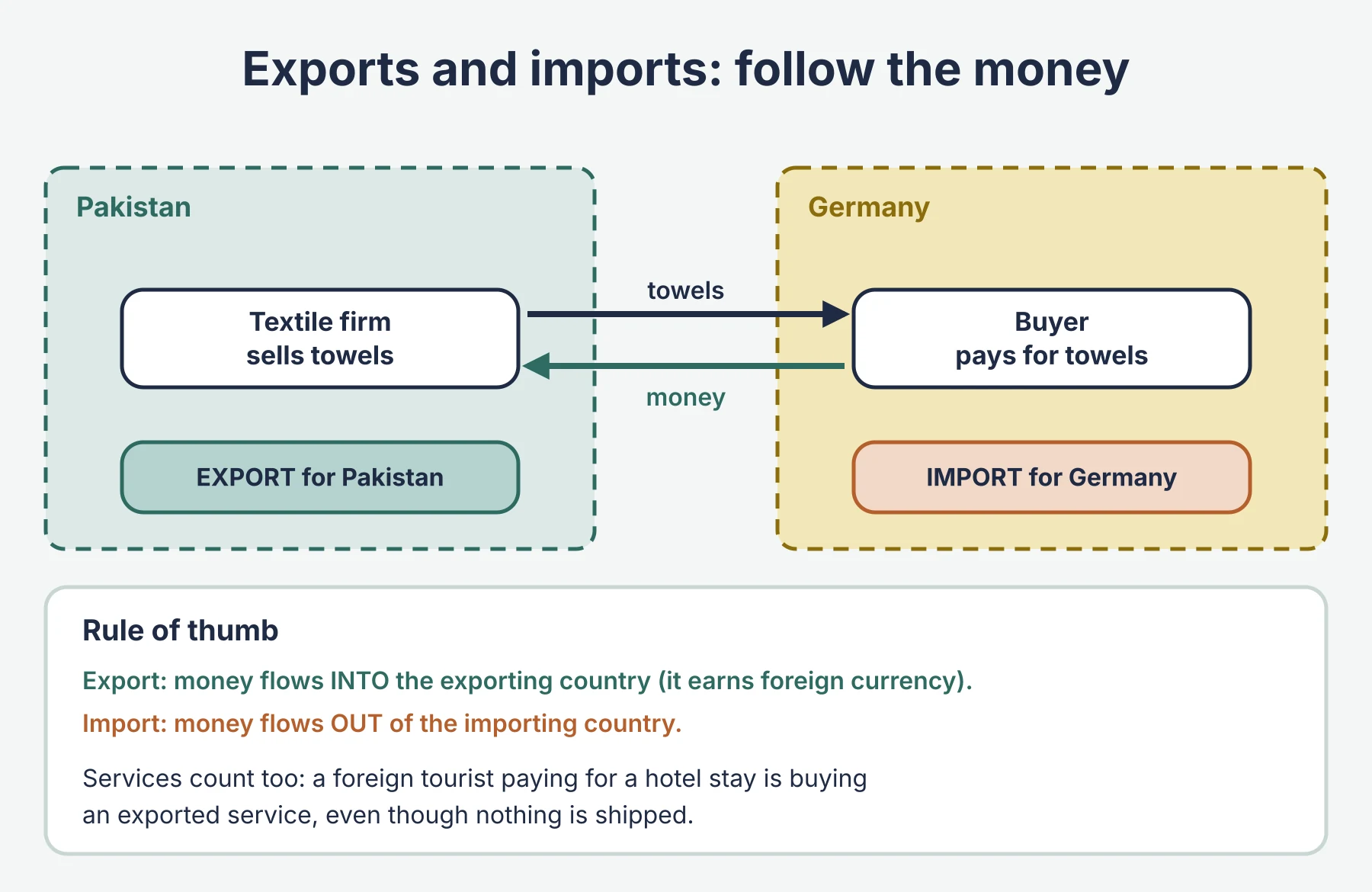
| Export | A good or service sold to a buyer in another country; money flows in |
| Import | A good or service bought from a seller in another country; money flows out |
| Aids to trade | Services that help trade happen without being the buying and selling itself |
| Logistics | Planning and managing the movement and storage of goods through a supply chain |
| Freight forwarder | A specialist that arranges the carriage of goods, documents and customs clearance for a business |
| Traditional commerce | Buying and selling at a physical location |
| Ecommerce | Buying and selling via the internet/websites |
| Mcommerce | Buying and selling via a mobile device such as a smartphone or tablet |
| Scommerce | Buying and selling via social media channels |
Trade versus commerce in one line
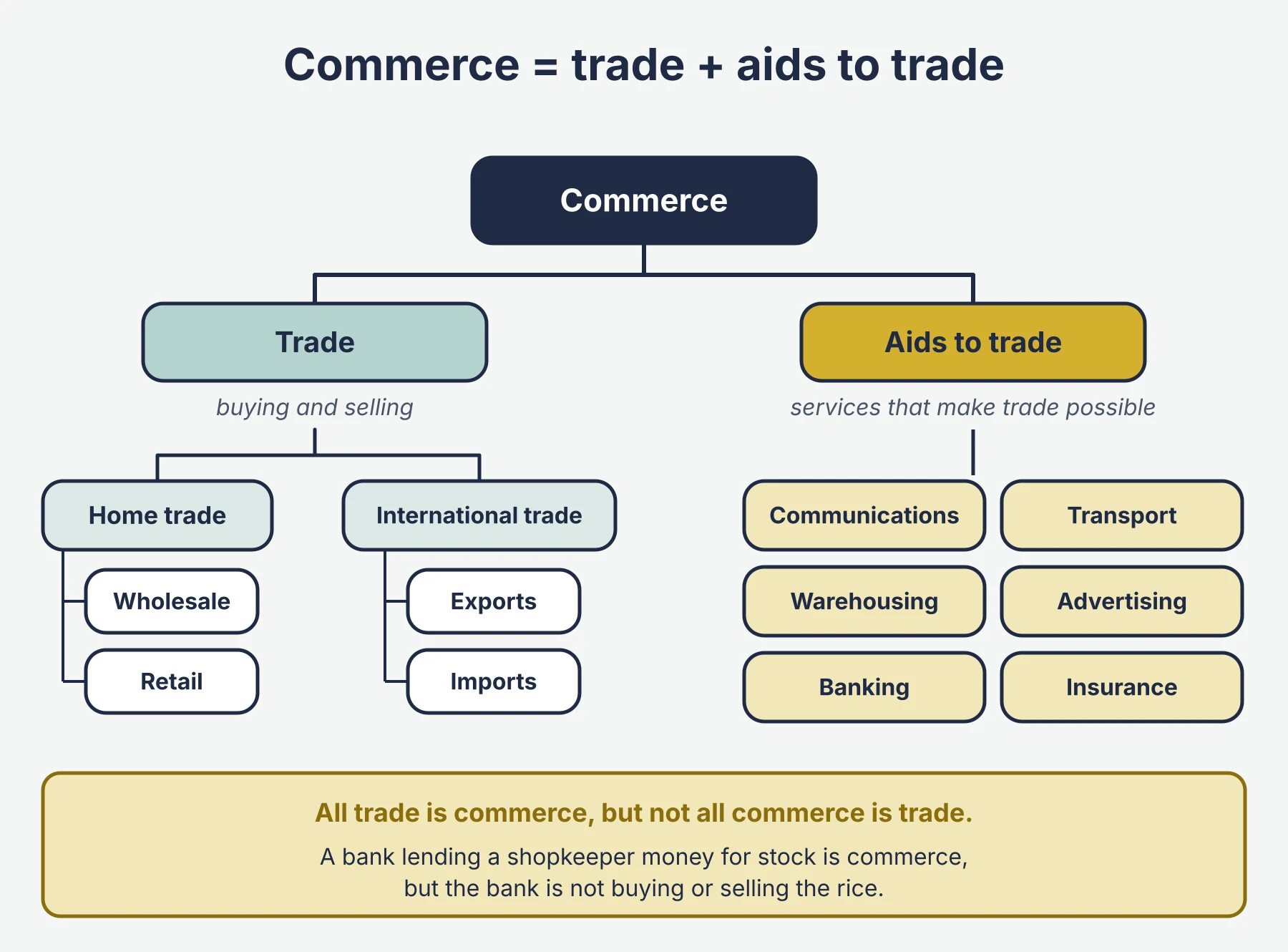
Commerce = trade + aids to trade. Every act of trade is commerce; a service such as insurance is commerce but is not trade.
The six aids to trade and the problem each solves
- Communications: buyer and seller can contact each other (orders, enquiries, complaints).
- Transport: goods reach the place where they are wanted.
- Warehousing: goods are available at the time they are wanted.
- Advertising: customers learn that products exist and are persuaded to buy.
- Banking: safe payment and finance for stock and equipment.
- Insurance: traders are protected from the financial effect of losses, so they are willing to take risks.
Memory hook: C-T-W-A-B-I, “Can Traders Win Any Big Investments?”
Logistics: three named elements
| Element | What it contributes |
|---|---|
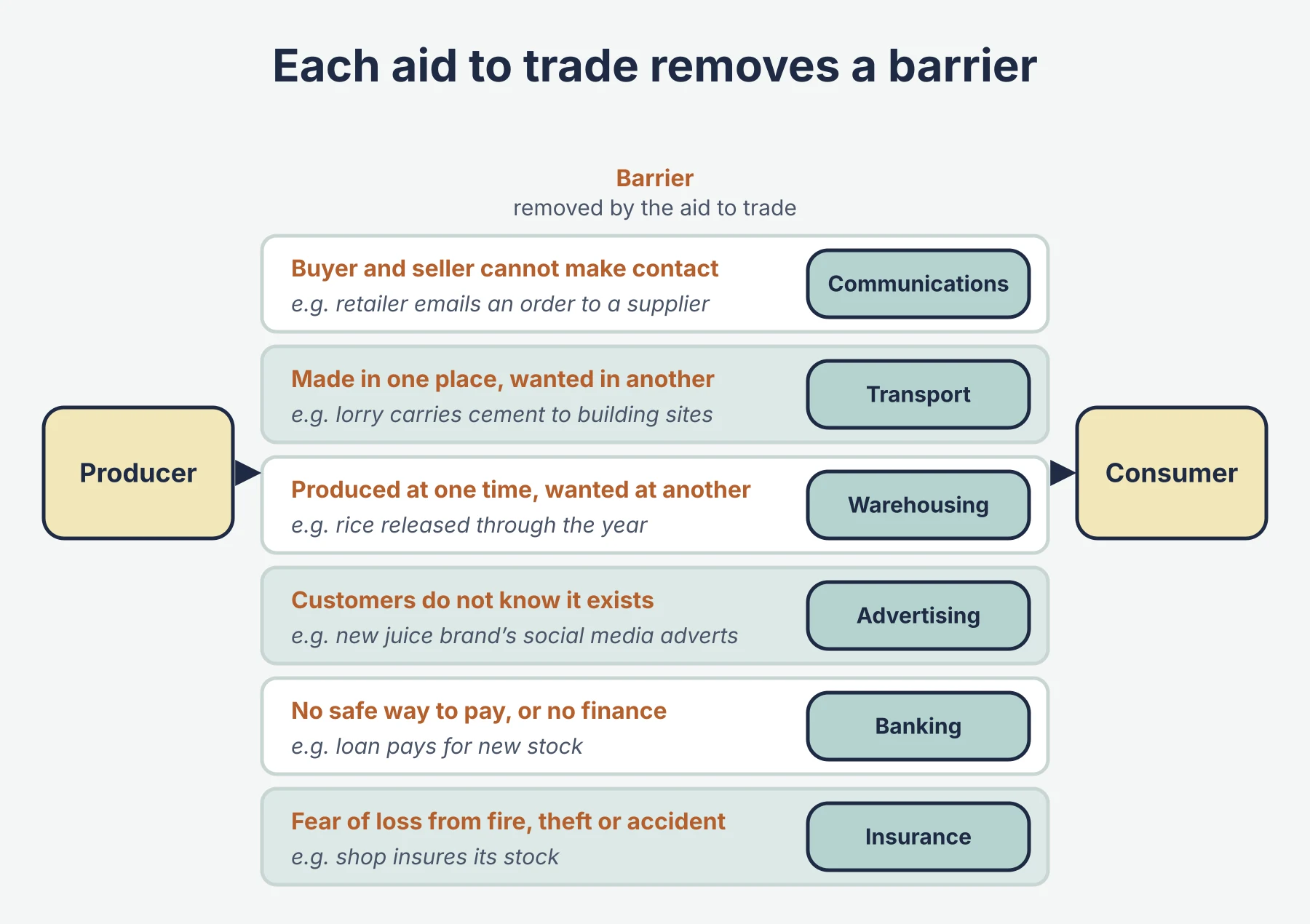
| Transport | Moves goods between producers, warehouses, retailers and customers |
| Freight forwarders | Organise the journey: book carriers, combine loads, prepare documents, clear customs |
| Warehousing | Stores, sorts, packs and dispatches goods until they are needed |
Transport and warehousing appear twice in 1.1: as aids to trade and as elements of logistics. Freight forwarders appear only under logistics.
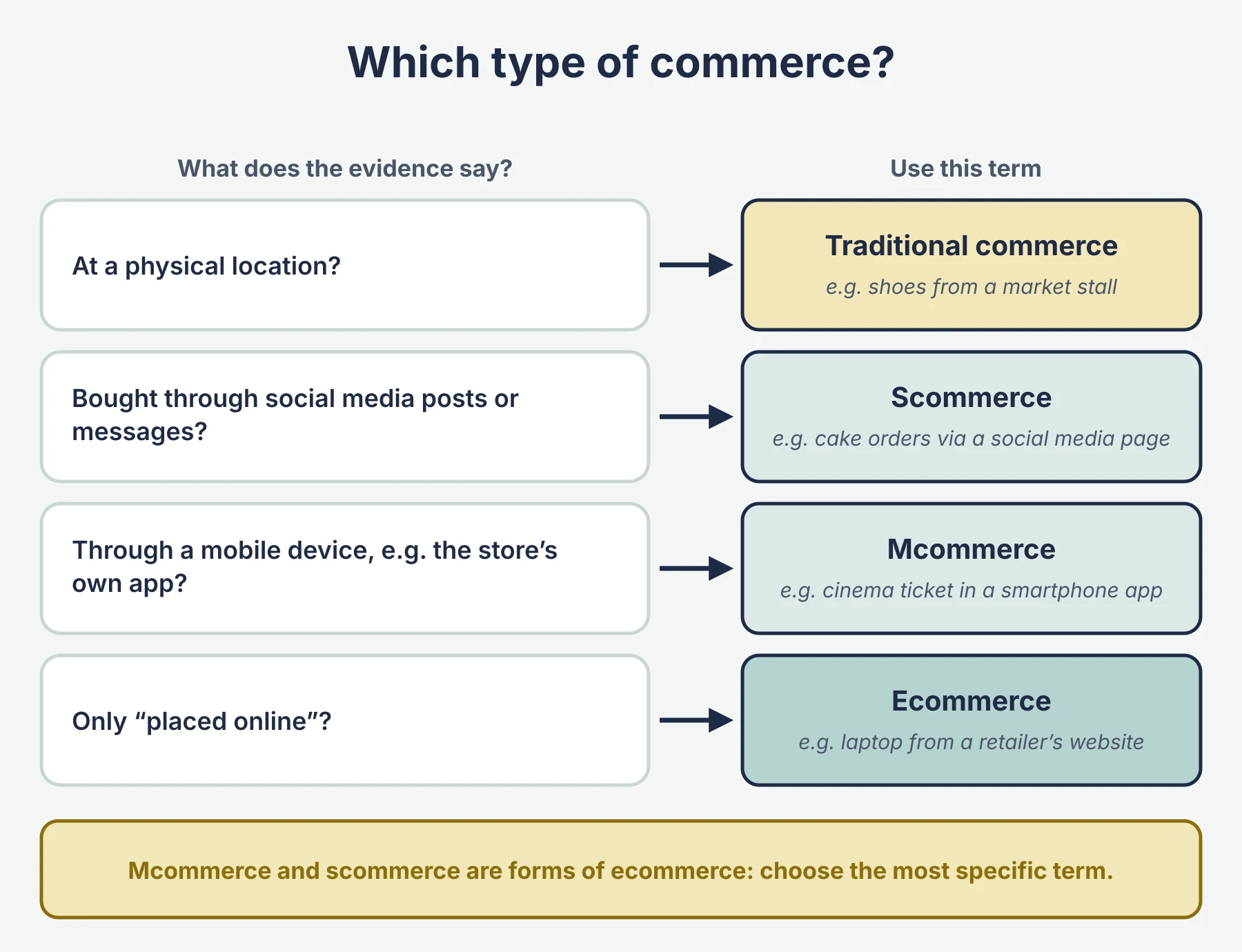
Choosing the right type of commerce
- Evidence of a shop, market, showroom or stall: traditional commerce.
- Evidence of a website or “ordered online”: ecommerce.
- Evidence of a smartphone, tablet or app: mcommerce.
- Evidence of a social media page, post, live stream or message: scommerce.
- Mcommerce and scommerce are kinds of ecommerce; use the most specific term the evidence allows.
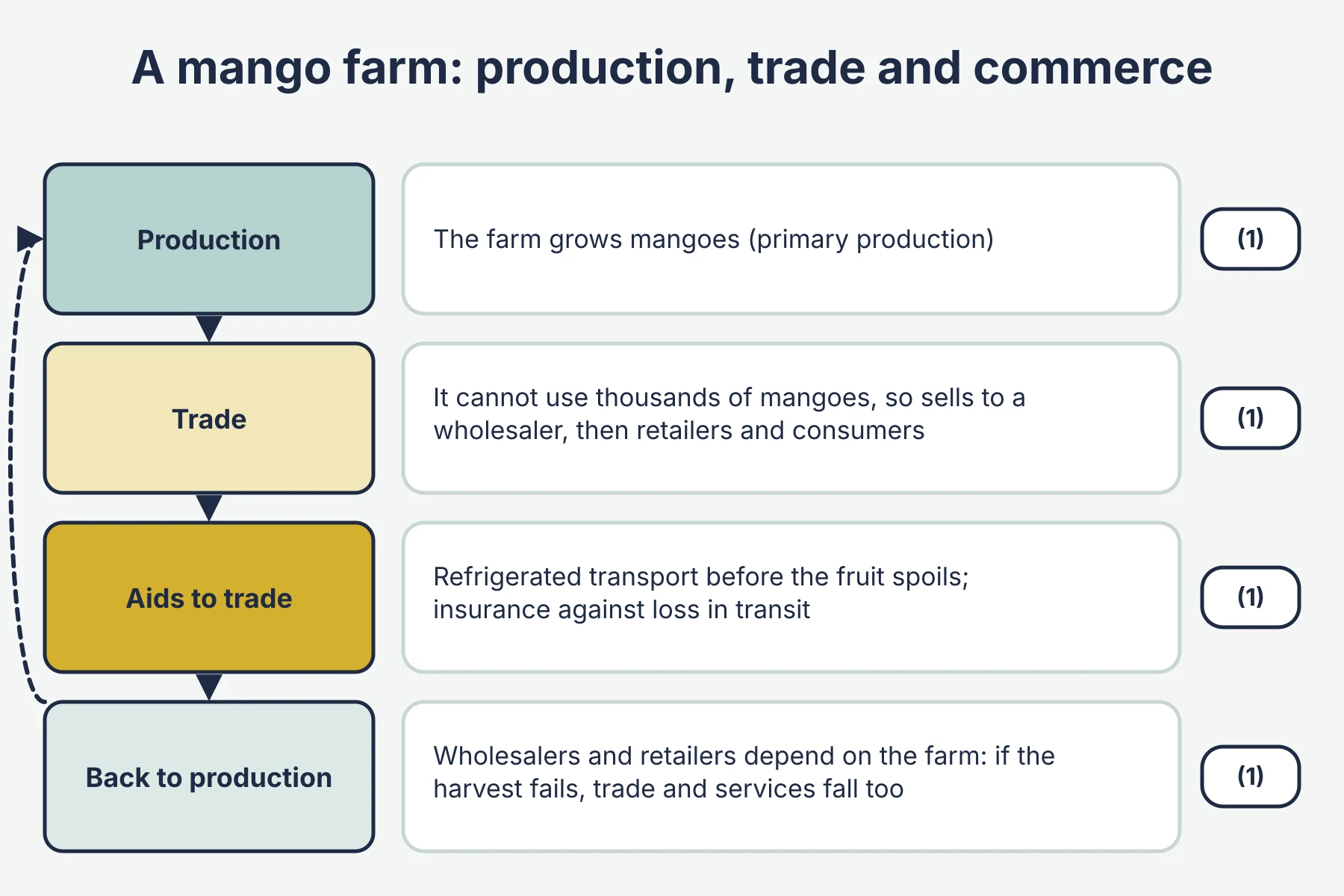
Interdependence chain
Production creates goods → trade exchanges them → aids to trade make the exchange possible → sales revenue pays for further production. Remove any link and the others suffer: a port strike (transport) stops exports, and producers then cut output. Specialisation strengthens the chain, because specialists must trade for everything they do not make.
Exam traps
- Money direction: exports earn money for the exporting country; imports send money out. Many candidates reverse this.
- Services can be traded internationally: a foreign tourist’s hotel bill is an export of a service.
- “Home trade” is not “domestic” in the household sense: it means within one country.
- Freight forwarder ≠ carrier: the forwarder arranges; the shipping line, airline or haulier carries.
- Logistics is not a seventh aid to trade: it is the management of transport and warehousing in a supply chain.
- Over-labelling mcommerce: an online order on a desktop computer is ecommerce, not mcommerce.
Self-test
- Define commerce.
- State the difference between trade and commerce.
- Name the two branches of home trade.
- A clothing firm in Bangladesh sells shirts to a retailer in Canada. Is this an export or an import for Bangladesh?
- Which aid to trade helps goods to be available at the time they are wanted?
- Give the three elements of logistics in a supply chain named in the syllabus.
- State two tasks a freight forwarder carries out.
- Define mcommerce.
- A seller takes orders through comments on a live video on a social media channel. Which type of commerce is this?
- Why are mcommerce and scommerce both forms of ecommerce?
- Explain one way in which trade depends on production.
- Explain how insurance helps trade to take place.
Self-test answers
- All activities involved in getting goods and services from producer to consumer: trade plus the aids to trade.
- Trade is only the buying and selling; commerce includes trade and the services that support it.
- Wholesale trade and retail trade.
- An export: Bangladesh sells the goods and receives payment from abroad.
- Warehousing.
- Transport, freight forwarders and warehousing.
- Any two: booking space with carriers; combining small loads; preparing shipping documents; arranging customs clearance.
- Buying and selling goods and/or services via a mobile device, such as a smartphone or tablet.
- Scommerce (social commerce).
- Both take place over the internet; they are defined by the device or channel used.
- There is nothing to buy or sell unless goods and services have first been produced, so a poor harvest, for example, reduces trade.
- It protects traders from the financial effect of losses such as fire or theft, so they are willing to hold stock and send goods to buyers.
Frequently asked questions
Is entrepot trade part of 1.1? The 7100 content statements for international trade name exports and imports only, so concentrate on those two terms.
Do I need to know which aids to trade are covered later? It helps: advertising, banking and insurance are developed in Topic 5, and transport and warehousing in Topic 4. In 1.1 you need the meaning of each and how it helps trade.
How detailed should a definition of logistics be? Include movement and storage of goods, and link it to the supply chain. A definition that mentions only transport is incomplete.
Try the trade and commerce practice questions, then move on to the production revision notes.
Official syllabus
Cambridge O Level Commerce (7100) syllabus for 2026, 2027 and 2028, sub-topic 1.1: official syllabus PDF.
Related resources
-
Revision notes
Cambridge O Level Commerce: Commercial Operations — Revision Notes (7100)
Recall notes for Cambridge O Level Commerce 7100 Topic 2: enterprise types, multinationals, franchises, outsourcing, retail, wholesale and communication.
Commerce · Cambridge · O Level
Revise topic -
Study guides
Cambridge O-Level Commerce: Commerce and Production (7100)
Guide to Topic 1 of Cambridge O Level Commerce 7100: trade and aids to trade, sectors of production, utility, specialisation, supply chains and intermediaries.
Commerce · Cambridge · O Level
Read guide -
Practice questions
Commerce and Production (O Level 7100): Practice Questions
Original exam-style practice questions with full worked answers on trade, commerce, production and specialisation for Cambridge O Level Commerce 7100.
Commerce · Cambridge · O Level
Try questions
Get free revision emails (optional)
Occasional emails with practice questions, worked explanations and links to free resources for the qualification and subjects you choose. No spam, and you can unsubscribe from any email. The free tools on this site never need an email.