
Study Guides
Cambridge O Level Commerce (7100): Communication
Cambridge O Level Commerce 7100 sub-topic 2.6 in depth: types and methods of communication and how to choose the right method using the six named factors.
- Subject
- Commerce
- Level
- O LEVELS
- Topic
- Topic 2 – Commercial Operations
- Author
- Marlbridge Academic Team
- Updated
- Reviewed by
- Salman Ahmad (what this means)
Aligned to Cambridge O Level Commerce (7100), 2026-2028. Official specification .
Syllabus page (what it covers and how it is assessed): Cambridge O Level Commerce.
Syllabus points this page covers
7100
- 2.6 Communication
Found an error? Report a correction.
Need help with this topic? Request a free trial class for O Level Commerce (7100).
Communication is one of the six aids to trade named in sub-topic 1.1: without it, buyers cannot place orders, sellers cannot answer enquiries and problems cannot be sorted out. Sub-topic 2.6 of Cambridge O Level Commerce (7100) develops it in three sections: types of communication (2.6.1), methods of communication (2.6.2) and factors that affect communication (2.6.3). The last section asks for the appropriateness of factors in given situations, so most marks come from choosing a method for a business and justifying the choice.
The outsourcing, wholesaling and communication overview summarises the factors. This guide gives each method’s strengths and weaknesses in detail and works through a full selection problem.
What the specification asks for
| Section | Content statements |
|---|---|
| 2.6.1 Types | The distinction between written, oral, electronic and visual communication |
| 2.6.2 Methods | Letter, telephone, face to face, videoconferencing, email, web-based chat (including chatbots), social media and posters |
| 2.6.3 Factors | Appropriateness of urgency, cost, security, distance, availability of networks and importance of the message in given situations |
The four types of communication
| Type | Meaning | Main strength | Main weakness |
|---|---|---|---|
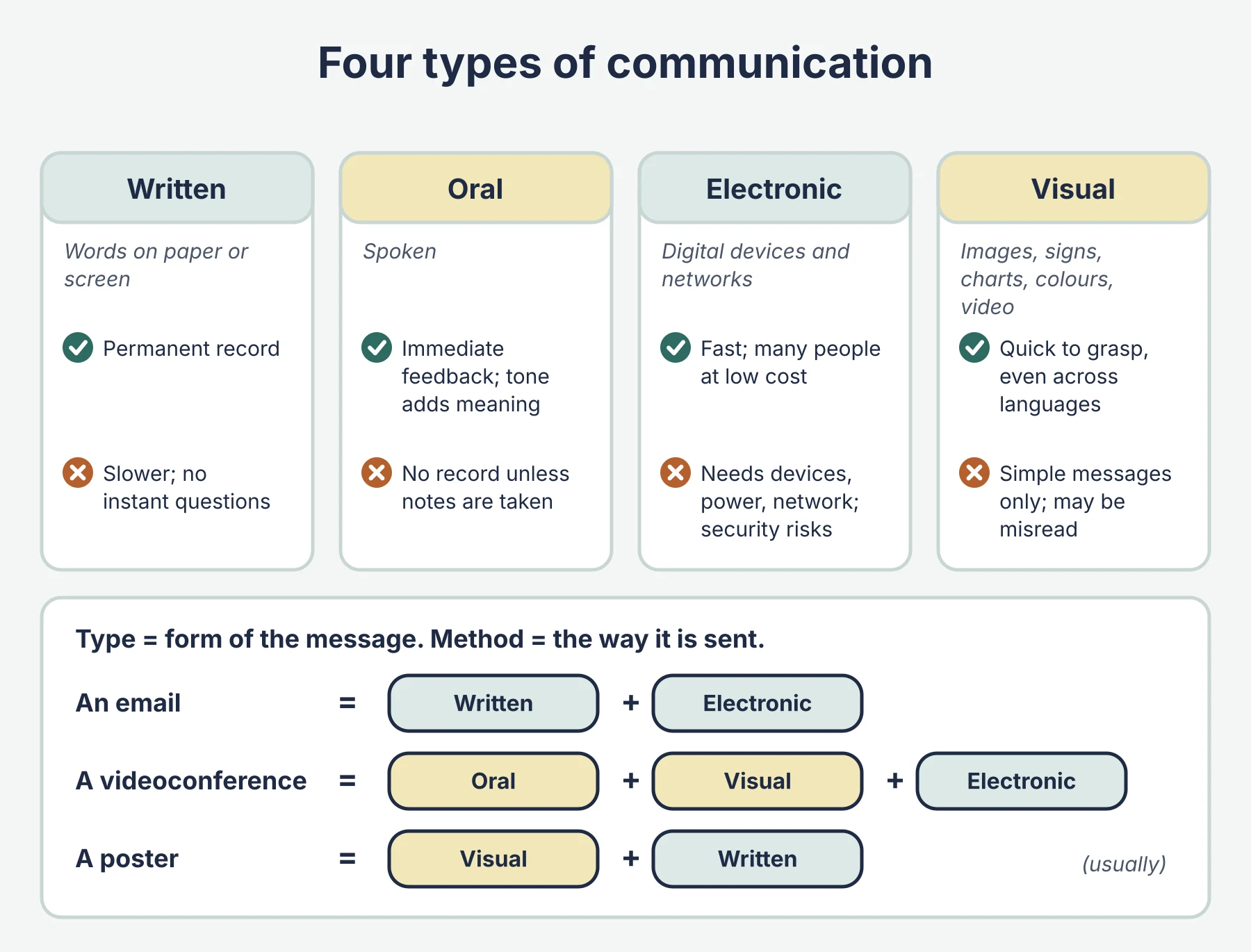
| Written | The message is set down in words on paper or screen | Gives a permanent record that can be checked later | Slower; no immediate chance to ask questions |
| Oral | The message is spoken | Immediate feedback; tone of voice adds meaning | No permanent record unless notes are taken |
| Electronic | The message is sent using digital devices and networks | Fast and can reach many people at low cost | Needs devices, power and network access; security risks |
| Visual | The message uses images, signs, charts, colours or video | Quick to understand, even across languages | Can carry only simple messages; may be misread |
A type describes the form of the message; a method is the way it is sent. One method can belong to more than one type. An email is written and electronic. A videoconference is oral, visual and electronic. A poster is visual and usually written. Naming the right type for a method is a common one-mark question.
The eight methods of communication
| Method | Advantages | Disadvantages | Typical commercial use |
|---|---|---|---|
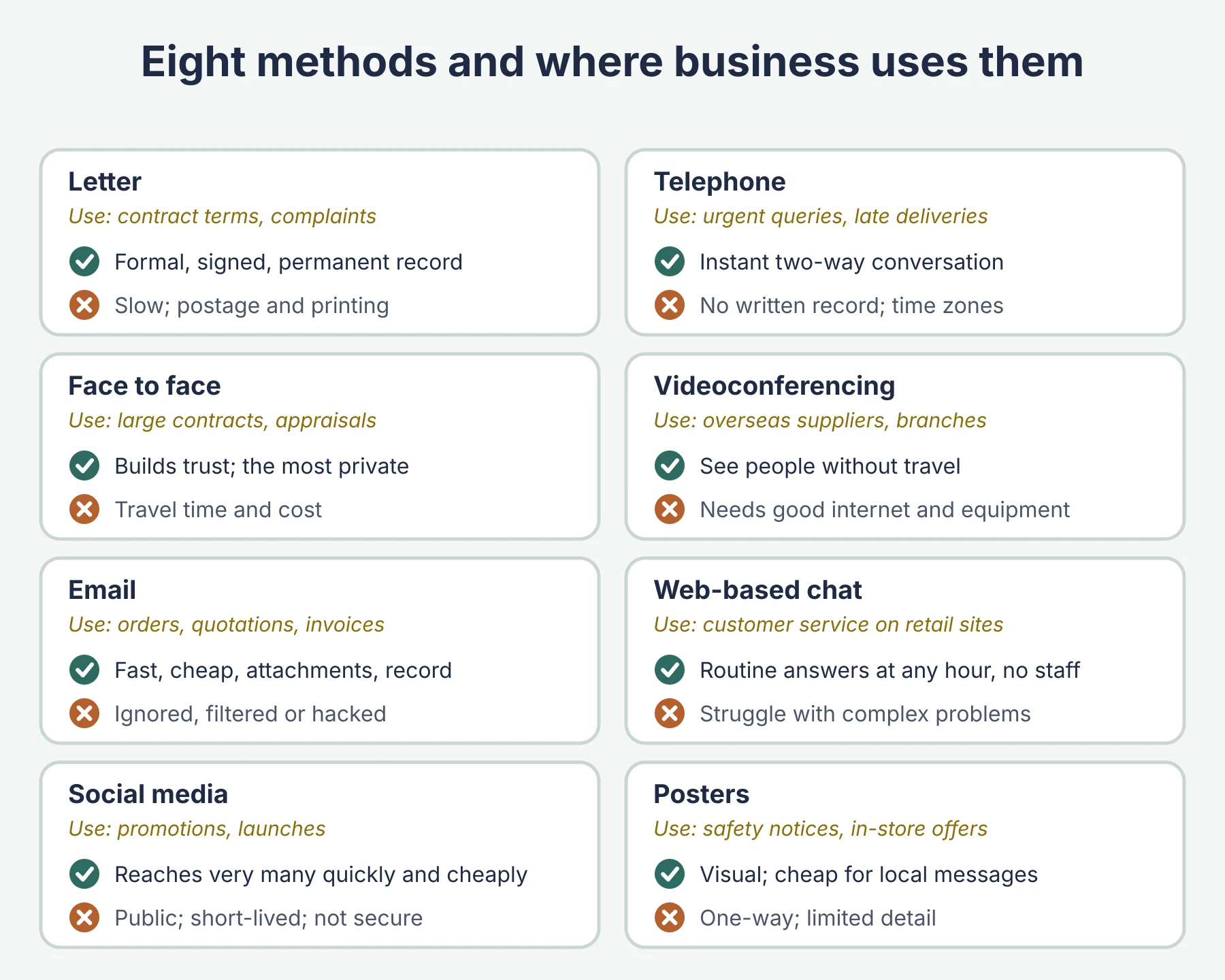
| Letter | Formal; signed; permanent record; works without internet | Slow; postage and printing costs; no instant reply | Contract terms, formal complaints, legal notices |
| Telephone | Instant two-way conversation; tone of voice helps | No written record; caller may not be available; time-zone problems | Urgent queries, chasing a late delivery |
| Face to face | Body language and tone help understanding; builds trust; most private | Travel time and cost; must be arranged in advance | Negotiating a large contract, staff appraisals |
| Videoconferencing | Seeing participants without travel; documents can be shared on screen | Needs good internet and equipment; technical problems; time zones | Meetings with overseas suppliers or branches |
| Fast; cheap; attachments; written record; send to many at once | May be ignored or filtered as junk; risk of hacking; tone can be misread | Sending orders, quotations and invoices | |
| Web-based chat (including chatbots) | Instant answers on a website; chatbots answer routine questions at any hour without staff | Chatbots struggle with complex or unusual problems; customers may find them frustrating | Customer service on retail sites |
| Social media | Reaches very many people quickly and cheaply; two-way; can be shared | Complaints and mistakes are public; messages are short-lived; not secure | Promotions, product launches, answering public questions |
| Posters | Visual; seen by everyone passing; cheap for local messages | One-way; limited detail; only reaches people at that place | Safety notices, in-store offers, staff notice boards |
The six factors and how to apply them
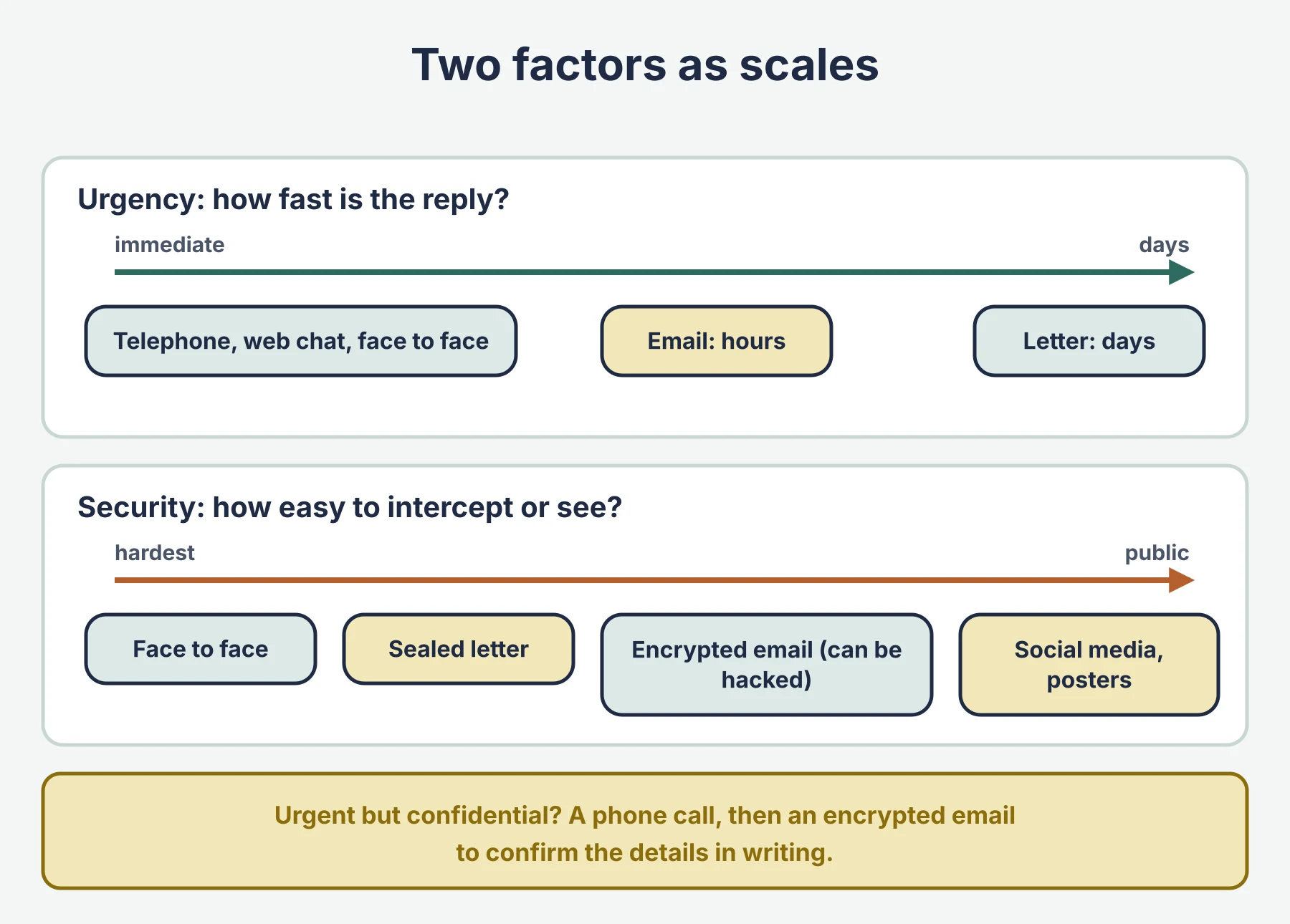
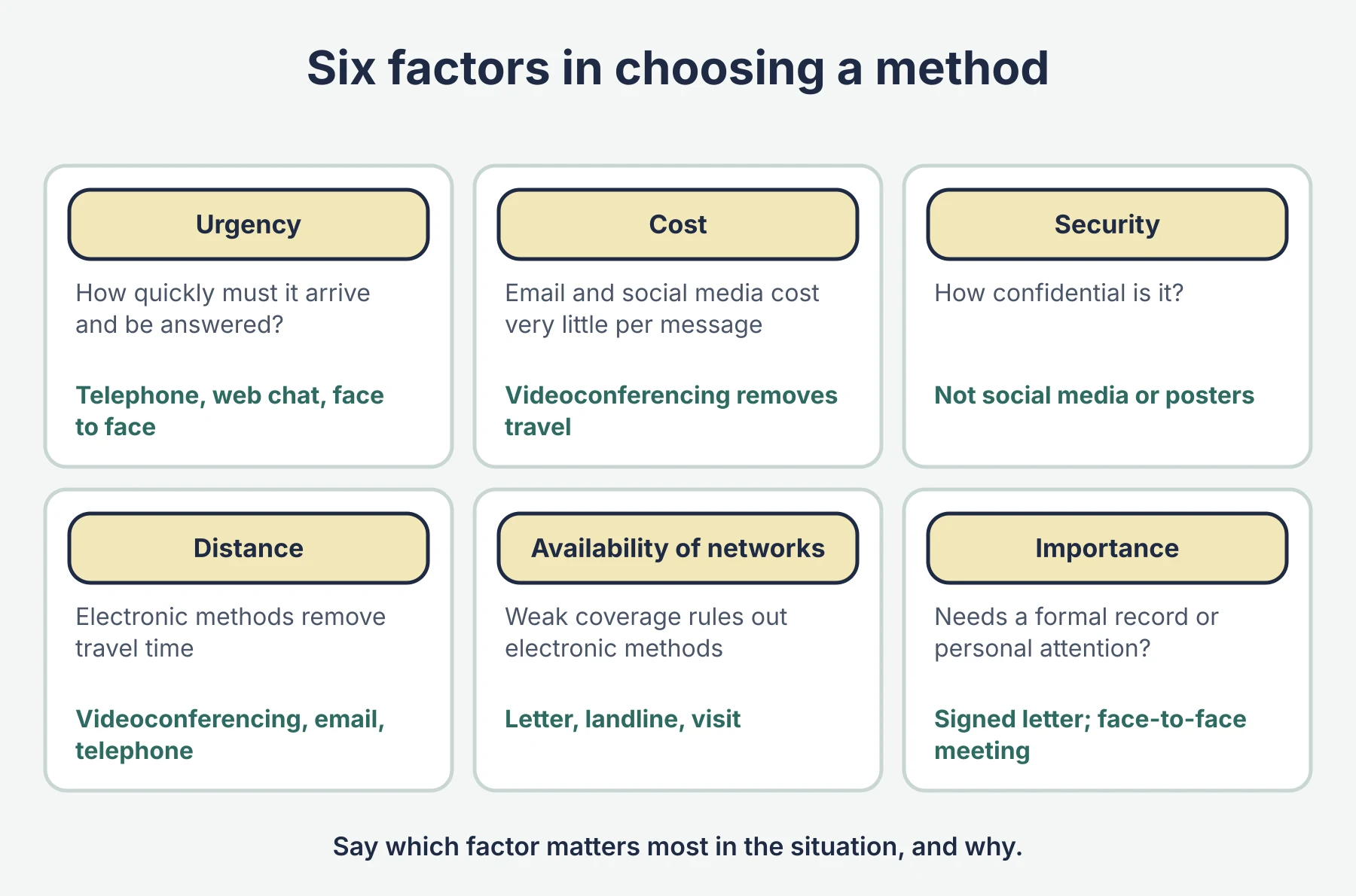
Urgency. How quickly must the message arrive and be answered? Telephone, web chat and face to face give immediate replies; email is fast but replies may take hours; a letter takes days.
Cost. Email and social media cost very little per message. Letters add printing and postage. Face-to-face meetings with distant people add travel and accommodation. Videoconferencing needs equipment but removes travel.
Security. How confidential is the information? Face to face is hardest to intercept. Letters can be sealed and marked private. Email can be secured with encryption and passwords but can be hacked or sent to the wrong address. Social media and posters are public and unsuitable for confidential matters.
Distance. For people far away, electronic methods remove travel time. Videoconferencing replaces many international meetings; email and telephone link offices in different countries.
Availability of networks. Electronic methods depend on internet coverage, mobile signal and power. In an area with weak coverage, a letter, a landline call or a face-to-face visit may be the only reliable option.
Importance of the message. Important matters often need a formal record or personal attention: a signed letter for contract terms, a face-to-face meeting to deal with a serious complaint or a staff matter.
The factors often pull in different directions. An urgent but confidential message might suit a telephone call followed by an encrypted email that confirms the details in writing. Good answers say which factor matters most in the situation and why.
Worked example: choosing three methods
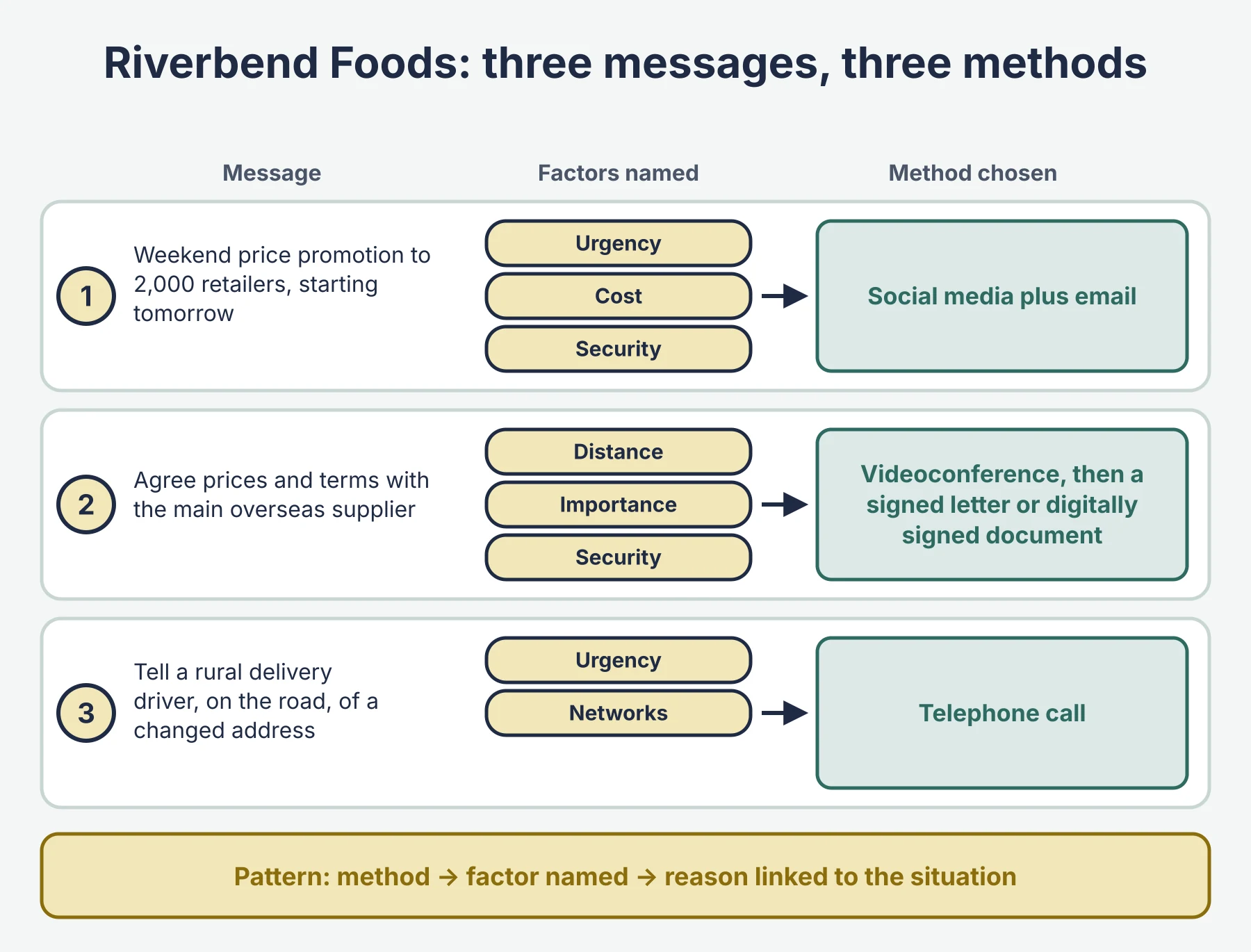
Invented scenario. Riverbend Foods, a food wholesaler, needs to send three messages.
Message 1: tell 2,000 retailer customers about a weekend price promotion that starts tomorrow.
Choice: social media plus email. Urgency is high, and the message must reach many people at low cost (cost). It is not confidential, so public channels are acceptable (security). Email to registered customers adds a written record of the prices.
Message 2: agree new prices and payment terms with its main supplier in another country.
Choice: videoconference, followed by a signed letter or digitally signed document. Distance rules out frequent face-to-face meetings, but the negotiation is important, so seeing each other and sharing documents helps (importance, distance). The final terms need a formal, permanent record (importance), and should not be sent on open channels (security).
Message 3: tell a driver who delivers to rural villages that a delivery address has changed, while he is on the road.
Choice: telephone call. It is urgent and the driver cannot read emails while driving (urgency). Mobile internet may be weak in rural areas, but a voice call can work on a basic signal (availability of networks).
Notice the pattern in each answer: method → factor named → reason linked to the situation. This is what “appropriateness in given situations” means.
Common mistakes
- Confusing types and methods, for example calling email a “type” of communication.
- Choosing social media for confidential information such as prices agreed with one supplier.
- Saying chatbots can deal with every customer problem.
- Ignoring the availability of networks when the case mentions a remote area.
- Recommending a letter for an urgent message without saying how the delay would be handled.
- Naming a factor without linking it to the business in the question.
Exam technique
- Identify or state: name the type or method precisely, as the syllabus words it.
- Explain why a method suits a situation: name the factor and show how it applies.
- Recommend or justify: choose one method, explain two factors that support it, and note a drawback that is acceptable in this case.
Practise this sub-topic
Use the communication revision notes for quick recall, then the communication practice questions. Communication as an aid to trade is introduced in the trade and commerce study guide.
Official syllabus
Cambridge O Level Commerce (7100) syllabus for 2026, 2027 and 2028, sub-topic 2.6 Communication: official syllabus PDF.
Related resources
-
Revision notes
Cambridge O Level Commerce: Commercial Operations — Revision Notes (7100)
Recall notes for Cambridge O Level Commerce 7100 Topic 2: enterprise types, multinationals, franchises, outsourcing, retail, wholesale and communication.
Commerce · Cambridge · O Level
Revise topic -
Practice questions
Cambridge O Level Commerce (7100): Communication – Practice Questions
Twelve original questions with full answers on Cambridge O Level Commerce 7100 sub-topic 2.6: communication types, methods and choosing the right method.
Commerce · Cambridge · O Level
Try questions -
Revision notes
Cambridge O Level Commerce (7100): Communication – Revision Notes
Recall notes for Cambridge O Level Commerce 7100 sub-topic 2.6: four types of communication, eight methods and the six factors for choosing a method.
Commerce · Cambridge · O Level
Revise topic
Get free revision emails (optional)
Occasional emails with practice questions, worked explanations and links to free resources for the qualification and subjects you choose. No spam, and you can unsubscribe from any email. The free tools on this site never need an email.