
Revision Notes
Cambridge O Level Commerce (7100): Trading documents – Revision Notes
Recall notes for Cambridge O Level Commerce 7100 sub-topic 2.5: home and international trading documents, discounts, online ordering and digital documents.
- Subject
- Commerce
- Level
- O LEVELS
- Topic
- Topic 2 – Commercial Operations
- Author
- Marlbridge Academic Team
- Updated
- Reviewed by
- Salman Ahmad (what this means)
Aligned to Cambridge O Level Commerce (7100), 2026-2028. Official specification .
Syllabus page (what it covers and how it is assessed): Cambridge O Level Commerce.
Syllabus points this page covers
7100
- 2.5 Trading documents
Found an error? Report a correction.
Need help with this topic? Request a free trial class for O Level Commerce (7100).
Recall notes for sub-topic 2.5 Trading documents in Cambridge O Level Commerce (7100). For a full transaction traced step by step, see the trading documents study guide.
Home trade documents in sequence
| Order | Document | Sent by | One-line purpose |
|---|---|---|---|
| 1 | Enquiry | Buyer | Asks for prices, terms and availability |
| 2 | Quotation | Seller | States prices, discounts, delivery and payment terms |
| 3 | Order | Buyer | Formally requests the goods on stated terms |
| 4 | Invoice | Seller | The bill for the goods supplied: amount owed and terms |
| 5 | Delivery note | Seller | Travels with the goods; buyer checks and signs |
| 6 | Credit note | Seller | Reduces the amount owed (returns, damage, overcharge) |
| 7 | Statement of account | Seller | Summary of the period’s transactions and balance due |
| 8 | Receipt | Seller | Proof that payment has been received |
Memory hook for the order: E-Q-O-I-D-C-S-R, “Every Quiet Owl Is Deep in Cool Silent Reeds.”
International trade documents
| Document | Key facts |
|---|---|
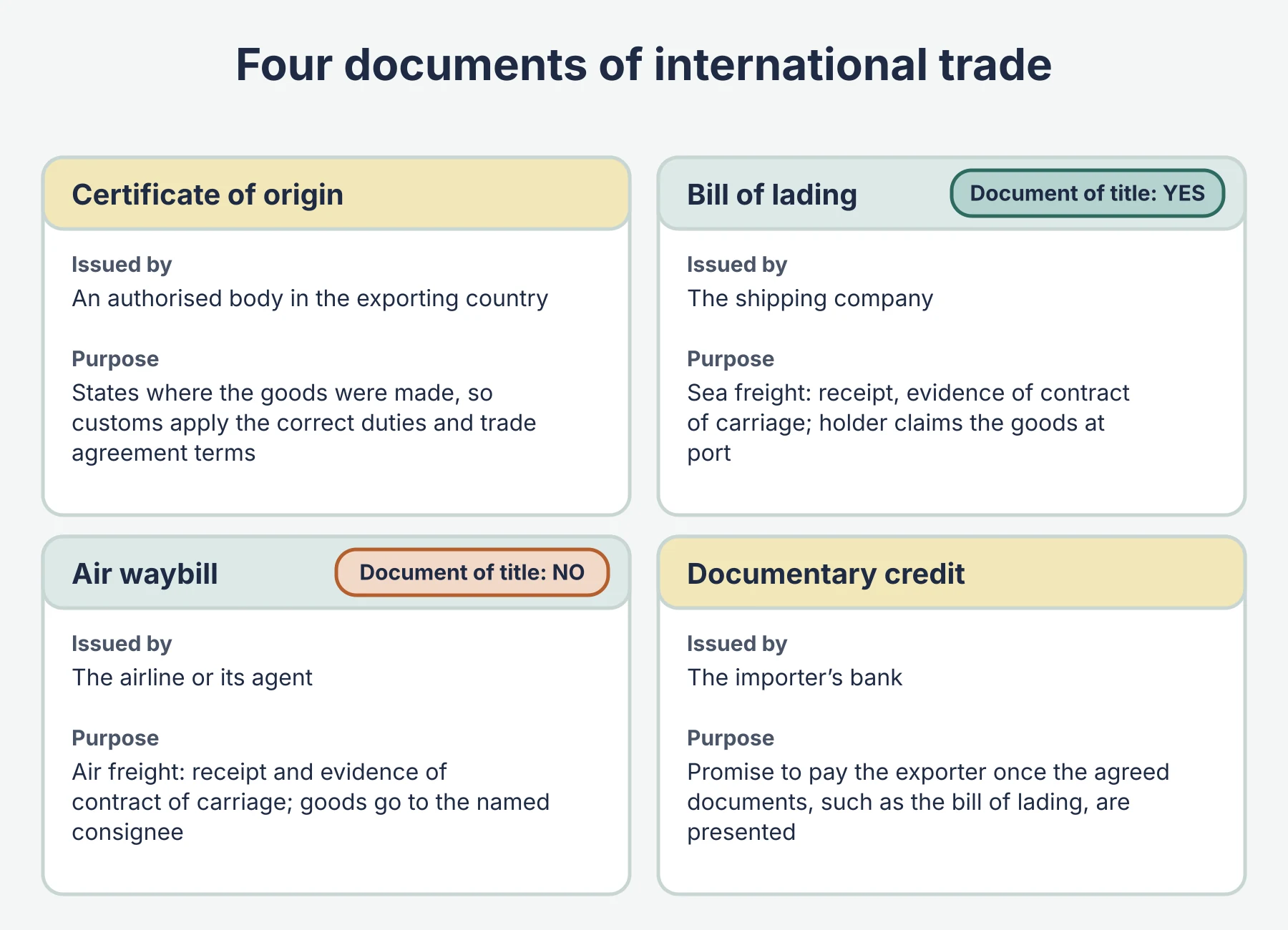
| Certificate of origin | States where the goods were made; used by customs to apply duties and trade agreements |
| Bill of lading | Sea freight; receipt for goods, evidence of the contract of carriage, document of title |
| Air waybill | Air freight; receipt and evidence of contract, not a document of title |
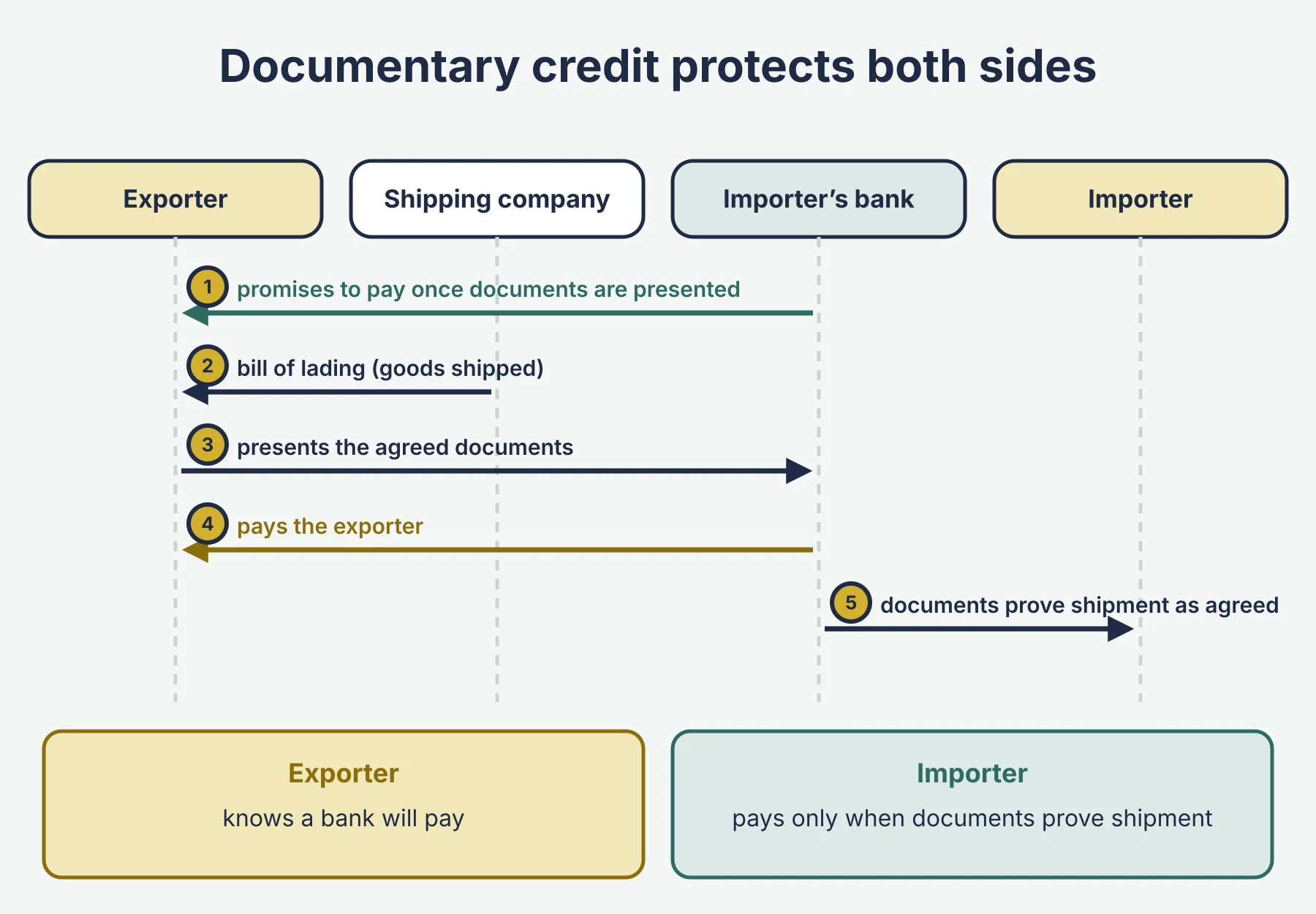
| Documentary credit (letter of credit) | Importer’s bank promises to pay the exporter when agreed documents are presented |
Key terms
| Term | Meaning |
|---|---|
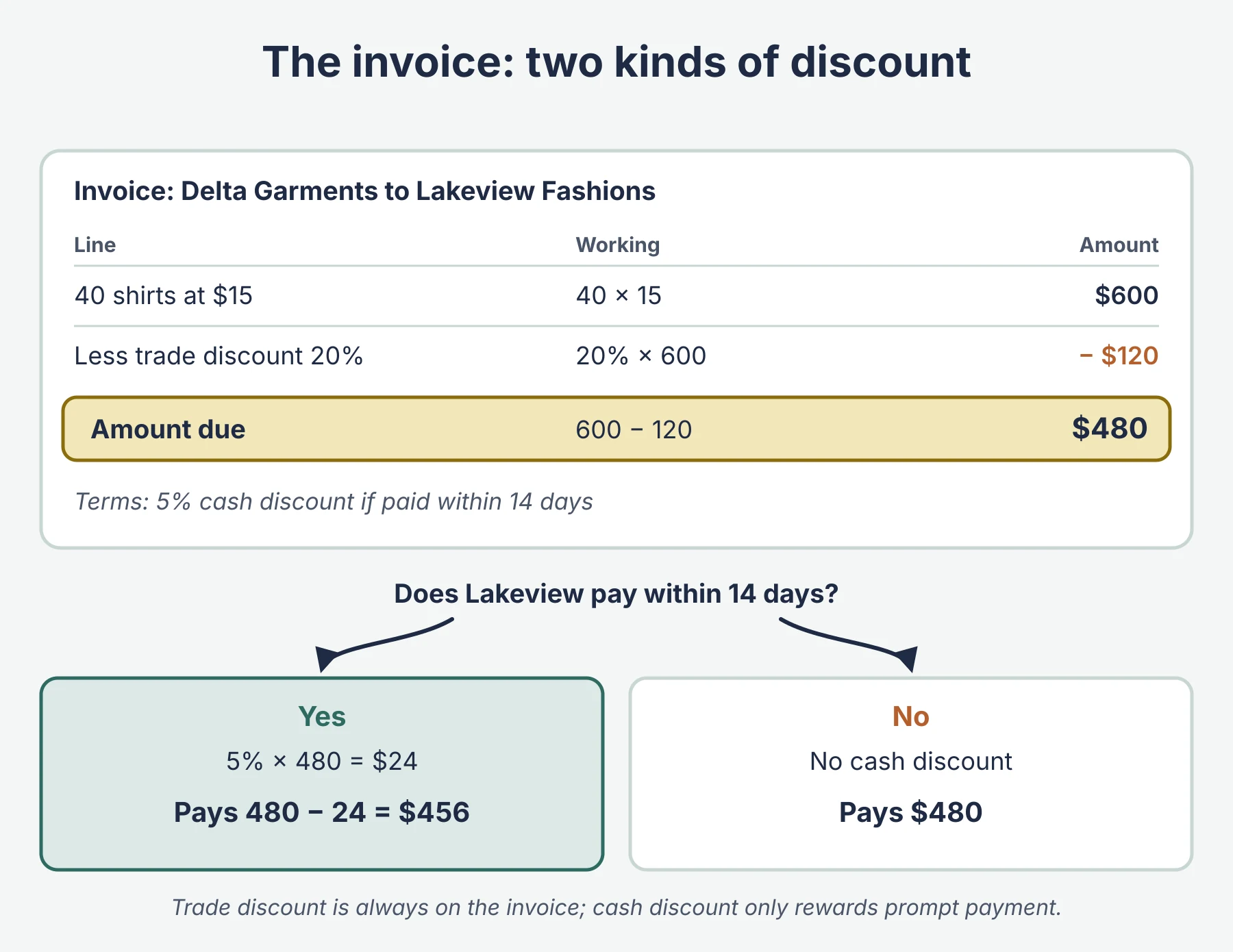
| Trade discount | Reduction given to traders buying for resale; deducted on the invoice |
| Cash discount | Reduction for paying within a stated period; deducted only if paid in time |
| Document of title | Document that gives the holder the right to claim the goods |
| Consignee | The person or business to whom goods are sent |
| Balance brought forward | Amount still owed from the previous period, shown at the top of a statement |
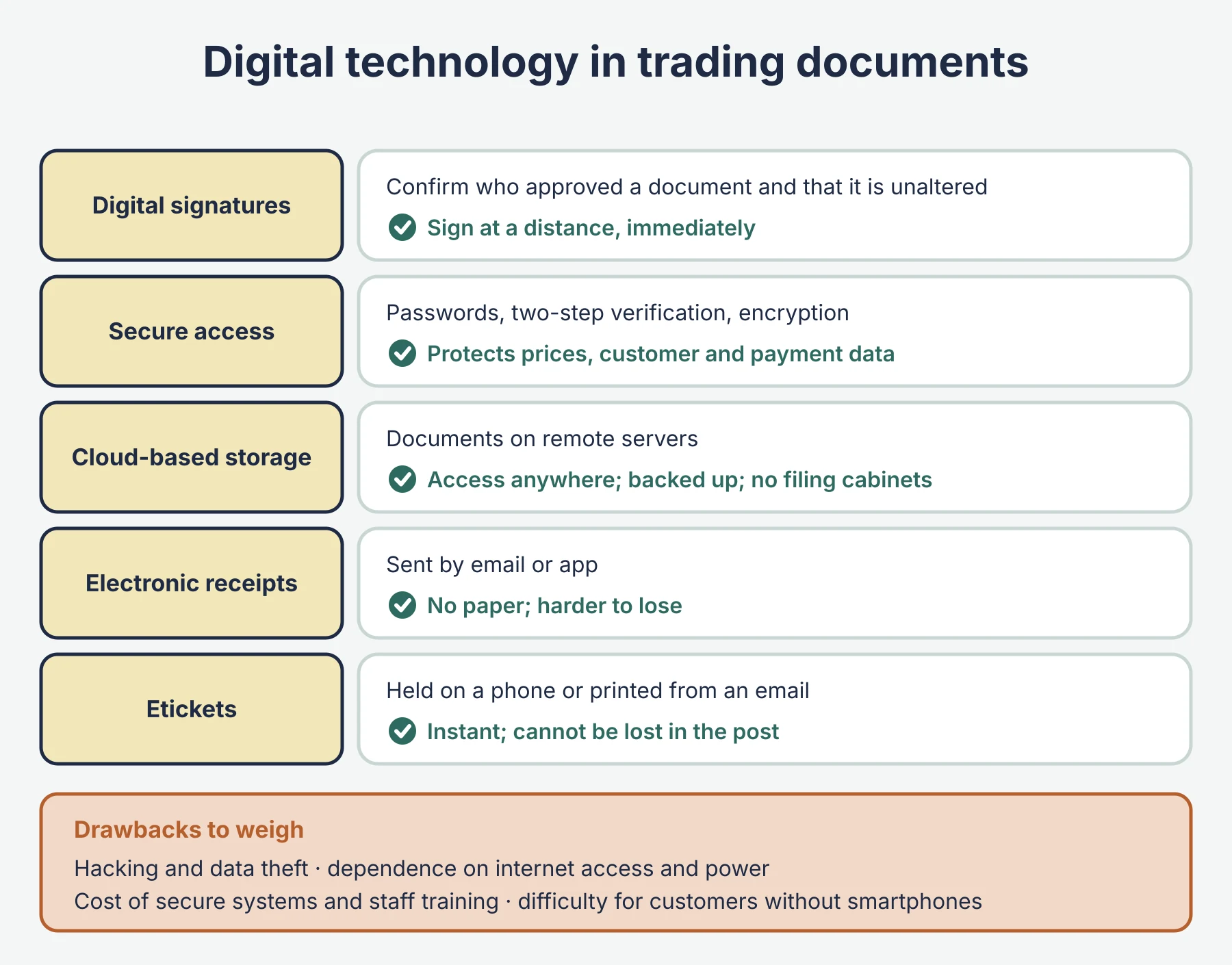
| Digital signature | Electronic signature confirming who approved a document and that it is unchanged |
| Secure access | Passwords, two-step verification and encryption that limit who sees documents |
| Cloud-based storage | Keeping documents on remote servers accessed over the internet |
| Etickets | Tickets held on a phone or printed from an email |
Calculation rules
- Trade discount first, on the list price: 50 items x $8 = $400; 25% trade discount = $100; invoice total $300.
- Cash discount second, on the amount after trade discount, only if paid in time: 4% of $300 = $12; pay $288.
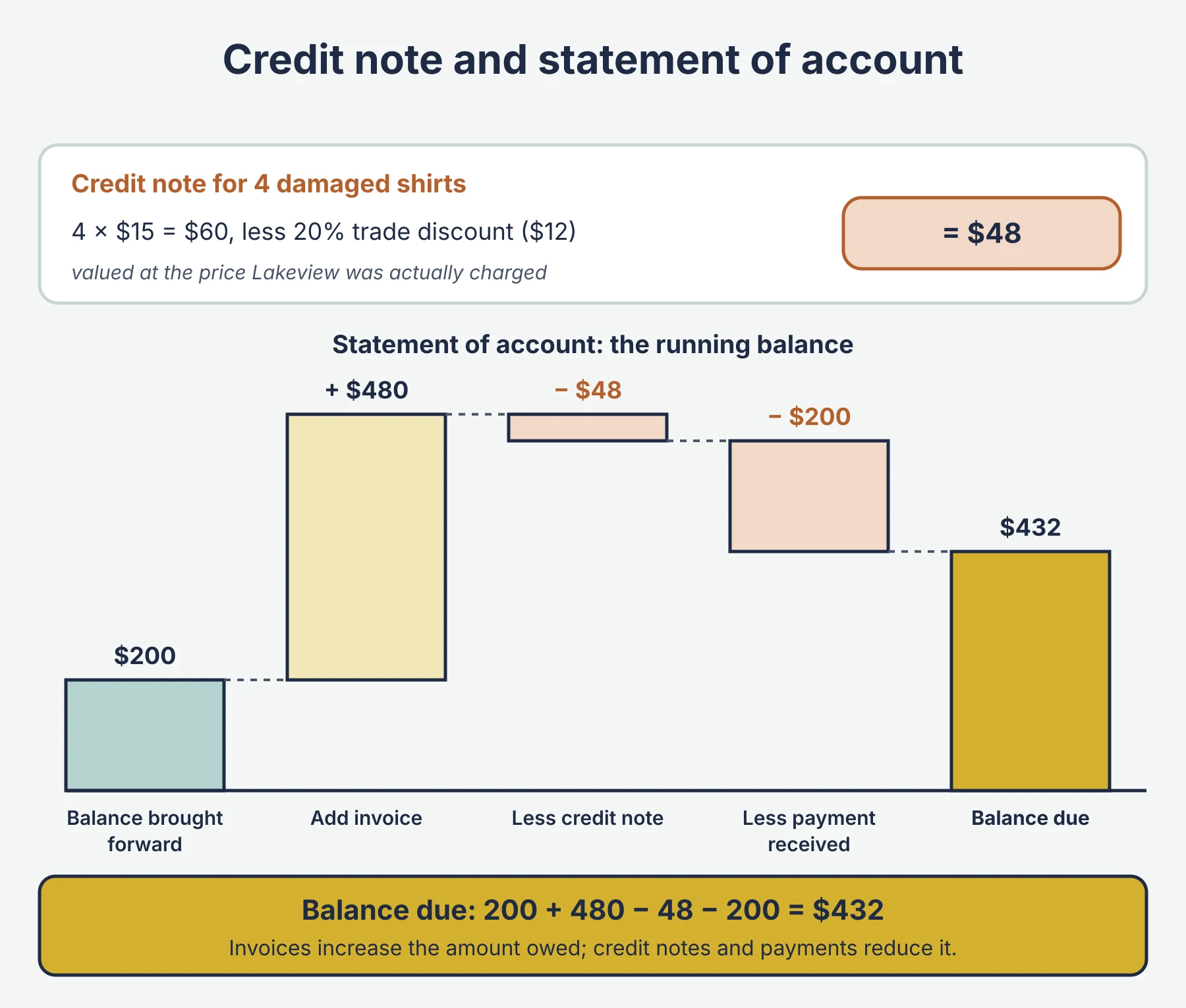
- Credit note value = returned quantity x price, less the same trade discount.
- Statement balance = balance brought forward + invoices − credit notes − payments.
(All figures invented.)
Online ordering stages
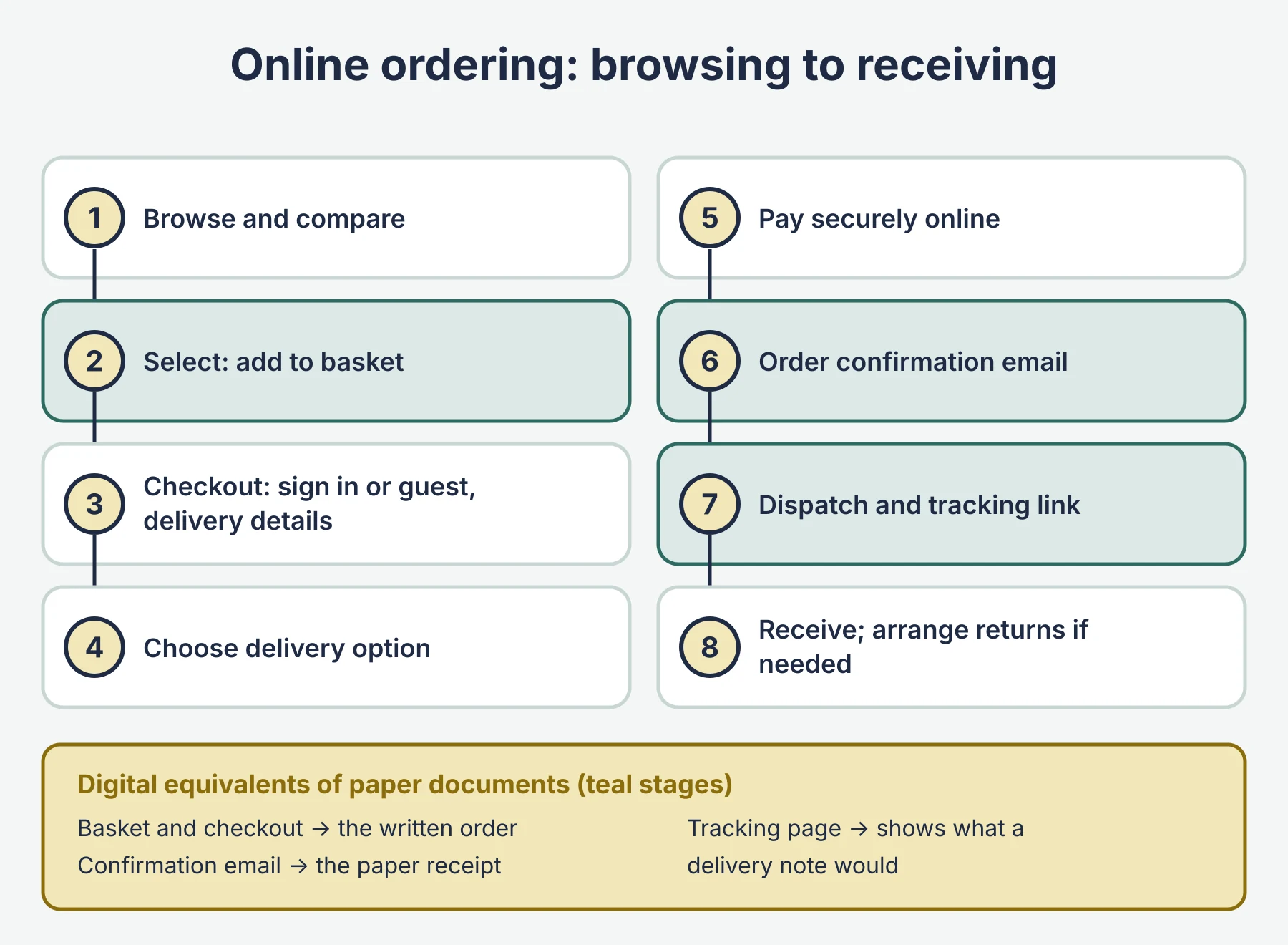
Browse → select and add to basket → checkout and delivery details → choose delivery option → pay securely → order confirmation (often an electronic receipt) → dispatch and tracking → receive order (returns if needed).
Digital technology: benefits and drawbacks
- Benefits: speed, no paper or filing space, access from anywhere, fewer lost documents, instant tickets and receipts.
- Drawbacks: hacking and data theft, reliance on internet and power, cost of secure systems and training, exclusion of customers without devices.
Exam traps
- Credit note ≠ credit: it reduces what the buyer owes; it is not a loan.
- Invoice ≠ statement: one transaction versus a summary of many.
- Air waybill is not a document of title; the bill of lading is.
- Cash discount is conditional: deduct it only if the question says payment was made within the period.
- Who sends what: only the enquiry and order come from the buyer.
Self-test
- Which document does the buyer send first?
- What is the purpose of a quotation?
- Which document travels with the goods and is signed by the buyer?
- When is a credit note issued?
- What is the difference between an invoice and a statement of account?
- What does a receipt prove?
- What is the purpose of a certificate of origin?
- Why is the bill of lading called a document of title?
- How does a documentary credit reduce risk for an exporter?
- List the stages of online ordering from browsing to receiving.
- An invoice shows goods worth $900 with a 10% trade discount. What is the amount due?
- The buyer in Question 11 pays within the period for a 5% cash discount. How much does it pay?
Self-test answers
- The enquiry.
- To state the seller’s prices, discounts, delivery and payment terms.
- The delivery note.
- When the amount owed must be reduced, for example after returns, damaged goods or an overcharge.
- An invoice is the bill for one supply of goods; a statement summarises all invoices, credit notes and payments for a period and shows the balance.
- That the seller has received payment.
- To show the country where the goods were made, so customs can apply the correct duties and trade agreement terms.
- Whoever holds it has the right to claim the goods at the destination port.
- The importer’s bank promises to pay once the agreed documents are presented, so the exporter does not rely on the importer’s promise alone.
- Browse; select and add to basket; checkout and delivery details; choose delivery option; pay securely; order confirmation; dispatch and tracking; receive the order.
- 10% x $900 = $90; $900 − $90 = $810.
- 5% x $810 = $40.50; $810 − $40.50 = $769.50.
Frequently asked questions
Must I memorise the exact layout of each document? No. Know what each one contains, who sends it, its purpose and where it fits in the sequence, and be able to read figures from one.
Where do discounts appear in the syllabus? Trade and cash discounts are financial terms in Topic 5 (5.4.1), but they are applied on invoices and quotations in 2.5.
Practise sequencing and calculations with the trading documents practice questions.
Official syllabus
Cambridge O Level Commerce (7100) syllabus for 2026, 2027 and 2028, sub-topic 2.5: official syllabus PDF.
Related resources
-
Revision notes
Cambridge O Level Commerce: Commercial Operations — Revision Notes (7100)
Recall notes for Cambridge O Level Commerce 7100 Topic 2: enterprise types, multinationals, franchises, outsourcing, retail, wholesale and communication.
Commerce · Cambridge · O Level
Revise topic -
Study guides
Cambridge O Level Commerce (7100): Wholesaling
Cambridge O Level Commerce 7100 sub-topic 2.4 in depth: wholesaler functions, its value to manufacturers and retailers, cash and carry, voluntary chains.
Commerce · Cambridge · O Level
Read guide -
Practice questions
Cambridge O Level Commerce (7100): Wholesaling – Practice Questions
Twelve original questions with full answers on Cambridge O Level Commerce 7100 sub-topic 2.4: wholesaler functions, cash and carry and voluntary chains.
Commerce · Cambridge · O Level
Try questions
Get free revision emails (optional)
Occasional emails with practice questions, worked explanations and links to free resources for the qualification and subjects you choose. No spam, and you can unsubscribe from any email. The free tools on this site never need an email.