
Study Guides
Cambridge O Level Commerce (7100): Trading documents
Cambridge O Level Commerce 7100 sub-topic 2.5 in depth: home and international trading documents, online ordering and digital documents, with invoice sums.
- Subject
- Commerce
- Level
- O LEVELS
- Topic
- Topic 2 – Commercial Operations
- Author
- Marlbridge Academic Team
- Updated
- Reviewed by
- Salman Ahmad (what this means)
Aligned to Cambridge O Level Commerce (7100), 2026-2028. Official specification .
Syllabus page (what it covers and how it is assessed): Cambridge O Level Commerce.
Syllabus points this page covers
7100
- 2.5 Trading documents
Found an error? Report a correction.
Need help with this topic? Request a free trial class for O Level Commerce (7100).
Every sale between businesses leaves a trail of documents: the questions the buyer asks, the prices the seller offers, the goods sent, the money owed and the money paid. Sub-topic 2.5 of Cambridge O Level Commerce (7100) has three sections: documents of home trade (2.5.1), documents of international trade (2.5.2) and digital use of trading documents (2.5.3). Exam questions often show part of a document and ask you to identify it, explain its purpose or work out a figure on it.
The Commercial Operations overview gives the order of the home trade documents. This guide follows one transaction from start to finish, with the calculations that appear on the documents.
What the specification asks for
| Section | Content statements |
|---|---|
| 2.5.1 Home trade | Enquiry, quotation, order, invoice, delivery note, credit note, statement of account and receipt |
| 2.5.2 International trade | Certificate of origin, bill of lading, air waybill, documentary credit (letters of credit) |
| 2.5.3 Digital use | Stages of online ordering, from browsing to receiving the order; digital signatures, secure access, cloud-based storage, electronic receipts and etickets |
Following one transaction
Invented example. Lakeview Fashions, a clothes shop, wants to stock shirts from Delta Garments, a manufacturer.
| Step | Document | Sender → receiver | What it does in this transaction |
|---|---|---|---|
| 1 | Enquiry | Lakeview → Delta | Asks for prices, sizes, discounts and delivery times for shirts |
| 2 | Quotation | Delta → Lakeview | States the price ($15 per shirt), trade discount (20%), cash discount (5% if paid within 14 days) and delivery date |
| 3 | Order | Lakeview → Delta | Formally asks for 40 shirts on the quoted terms, with an order number |
| 4 | Delivery note | Delta → Lakeview, with the goods | Lists what is in the parcel; Lakeview checks the shirts and signs a copy as proof of delivery |
| 5 | Invoice | Delta → Lakeview | The bill: goods supplied, price, discounts and amount owed |
| 6 | Credit note | Delta → Lakeview | Reduces the amount owed because four shirts arrived damaged and were returned |
| 7 | Statement of account | Delta → Lakeview | Summarises the month’s invoices, credit notes and payments and shows the balance due |
| 8 | Receipt | Delta → Lakeview | Confirms that payment has been received |
The invoice may travel before, with or after the goods; examiners accept that, as long as the enquiry, quotation and order come first and the receipt last. A credit note appears only if something needs correcting.
Worked example 1: the invoice
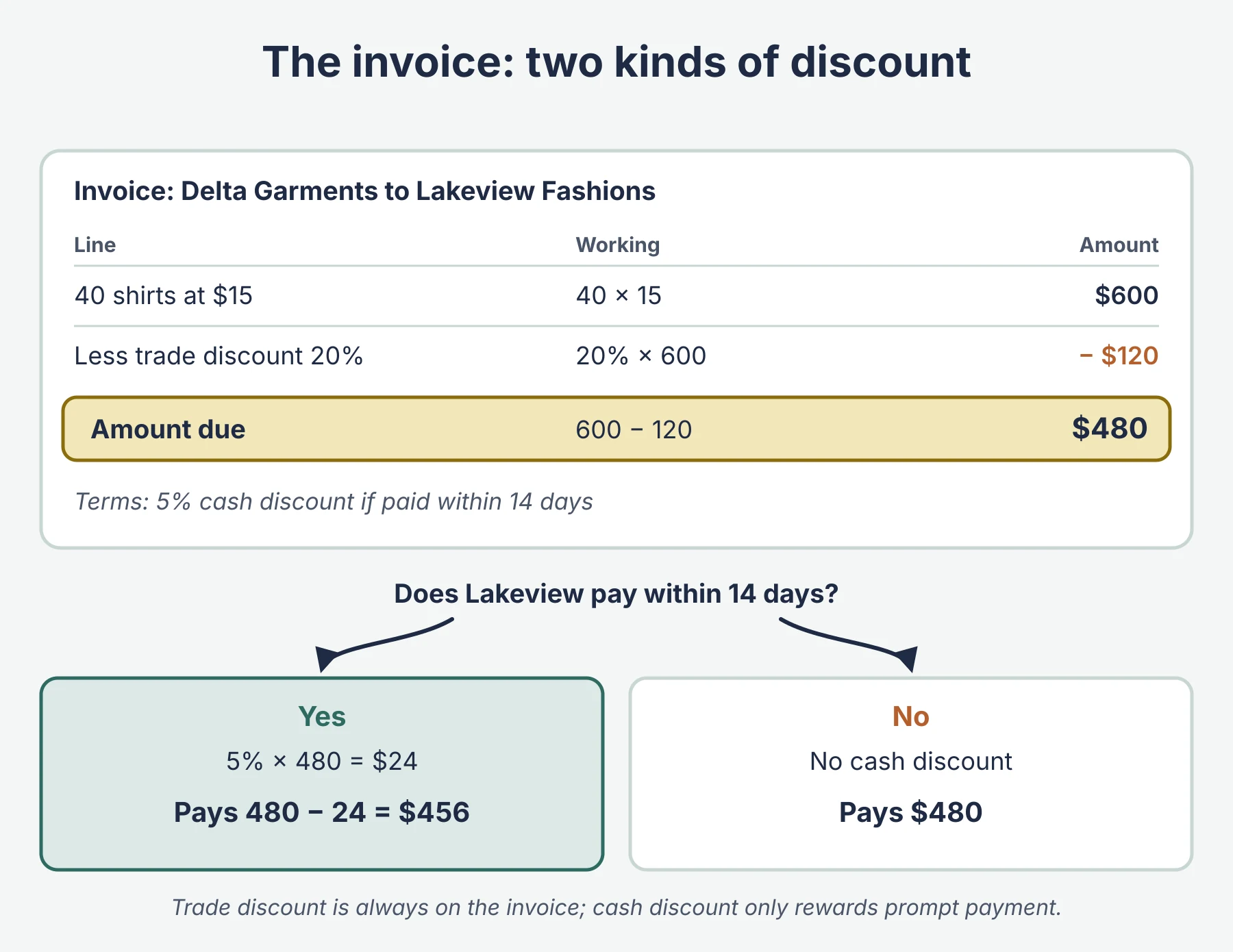
| Line | Working | Amount |
|---|---|---|
| 40 shirts at $15 | 40 x 15 | $600 |
| Less trade discount 20% | 20% x 600 | −$120 |
| Amount due | 600 − 120 | $480 |
| Terms | 5% cash discount if paid within 14 days |
If Lakeview pays within 14 days, it deducts the cash discount: 5% x $480 = $24, so it pays $480 − $24 = $456.
Trade discount is given to traders buying for resale and is deducted on the invoice. Cash discount rewards prompt payment and is taken only if the buyer pays in time. Both are financial terms in Topic 5 (5.4.1).
Worked example 2: credit note and statement
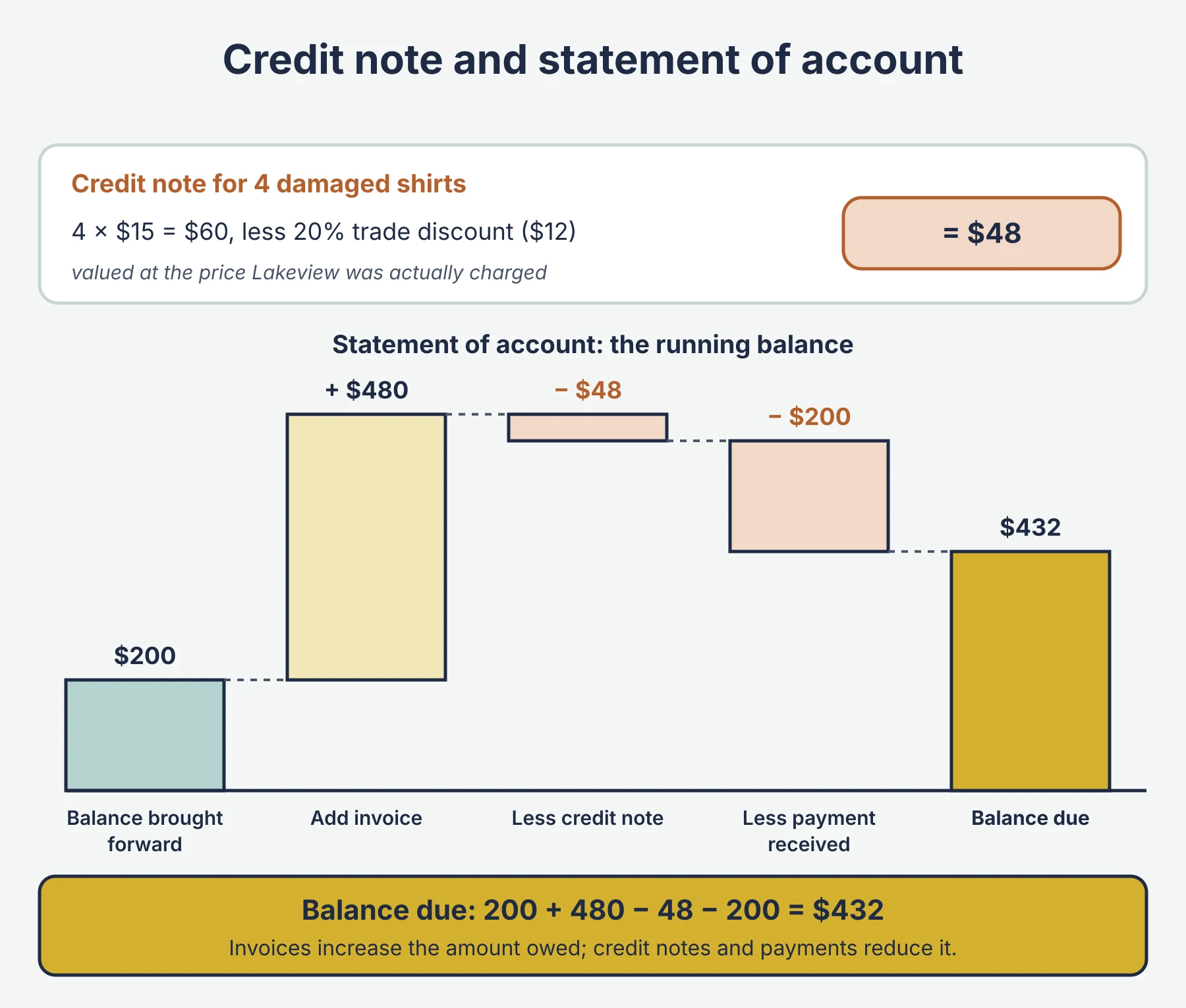
Four shirts were damaged. The credit note values them at the price Lakeview was charged: 4 x $15 = $60, less 20% trade discount ($12) = $48.
Suppose Lakeview owed $200 at the start of the month, received the invoice for $480 and the credit note for $48, and paid $200 during the month (not within the cash discount period).
| Statement of account | Amount |
|---|---|
| Balance brought forward | $200 |
| Add invoice | $480 |
| Less credit note | −$48 |
| Less payment received | −$200 |
| Balance due | $432 |
Working: 200 + 480 − 48 − 200 = 432. On a statement, invoices increase the amount owed; credit notes and payments reduce it.
Documents of international trade
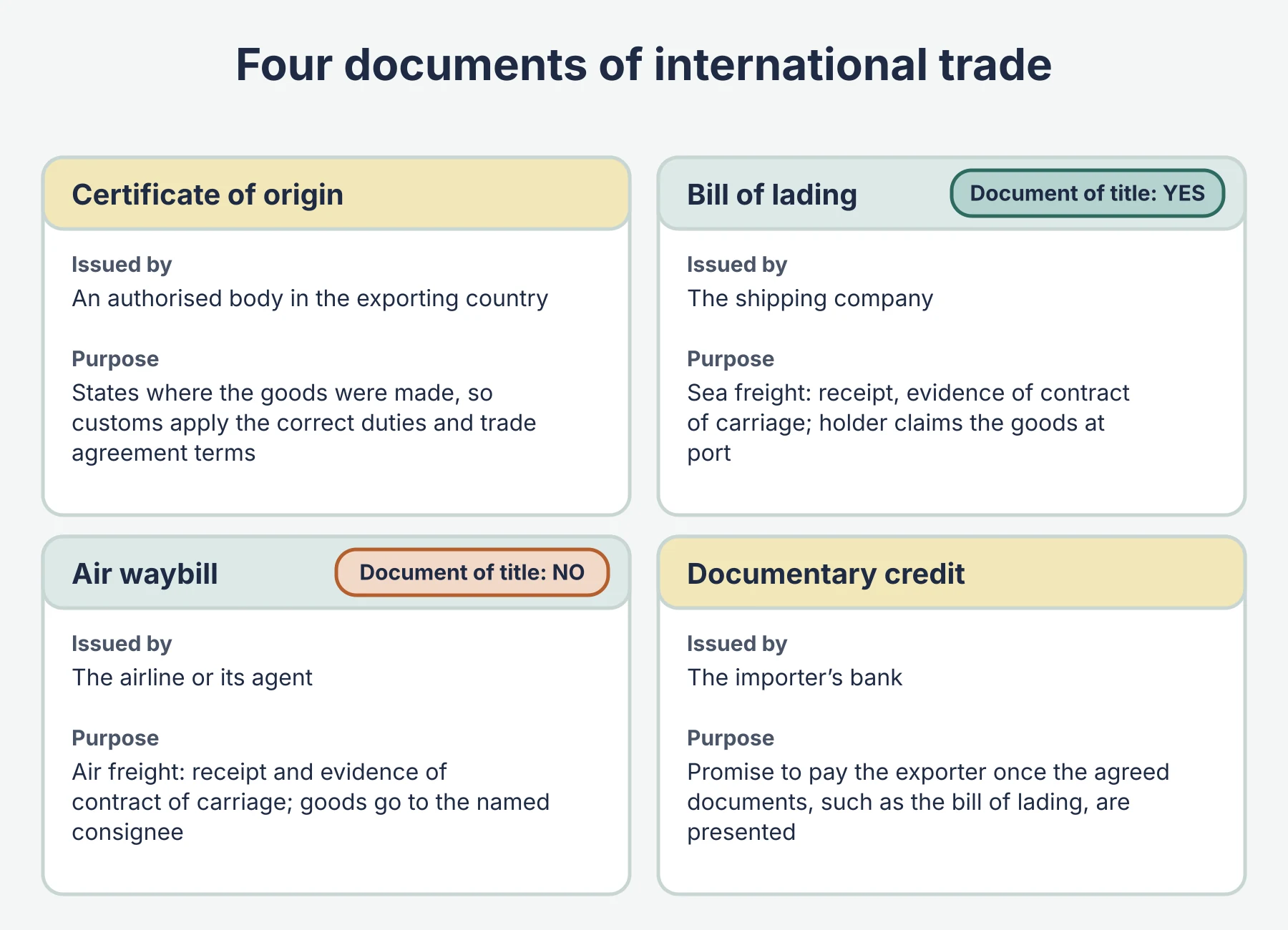
When goods cross borders, buyer and seller are far apart, often do not know each other, and goods pass through customs. Four documents deal with these problems.
| Document | Issued by | Purpose |
|---|---|---|
| Certificate of origin | An authorised body in the exporting country | States the country where the goods were made, so customs can apply the correct duties and trade agreement terms |
| Bill of lading | The shipping company | For goods sent by sea: a receipt for the goods, evidence of the contract of carriage, and a document of title, so the holder can claim the goods at the destination port |
| Air waybill | The airline or its agent | For goods sent by air: a receipt and evidence of the contract of carriage, but not a document of title; goods are released to the named consignee |
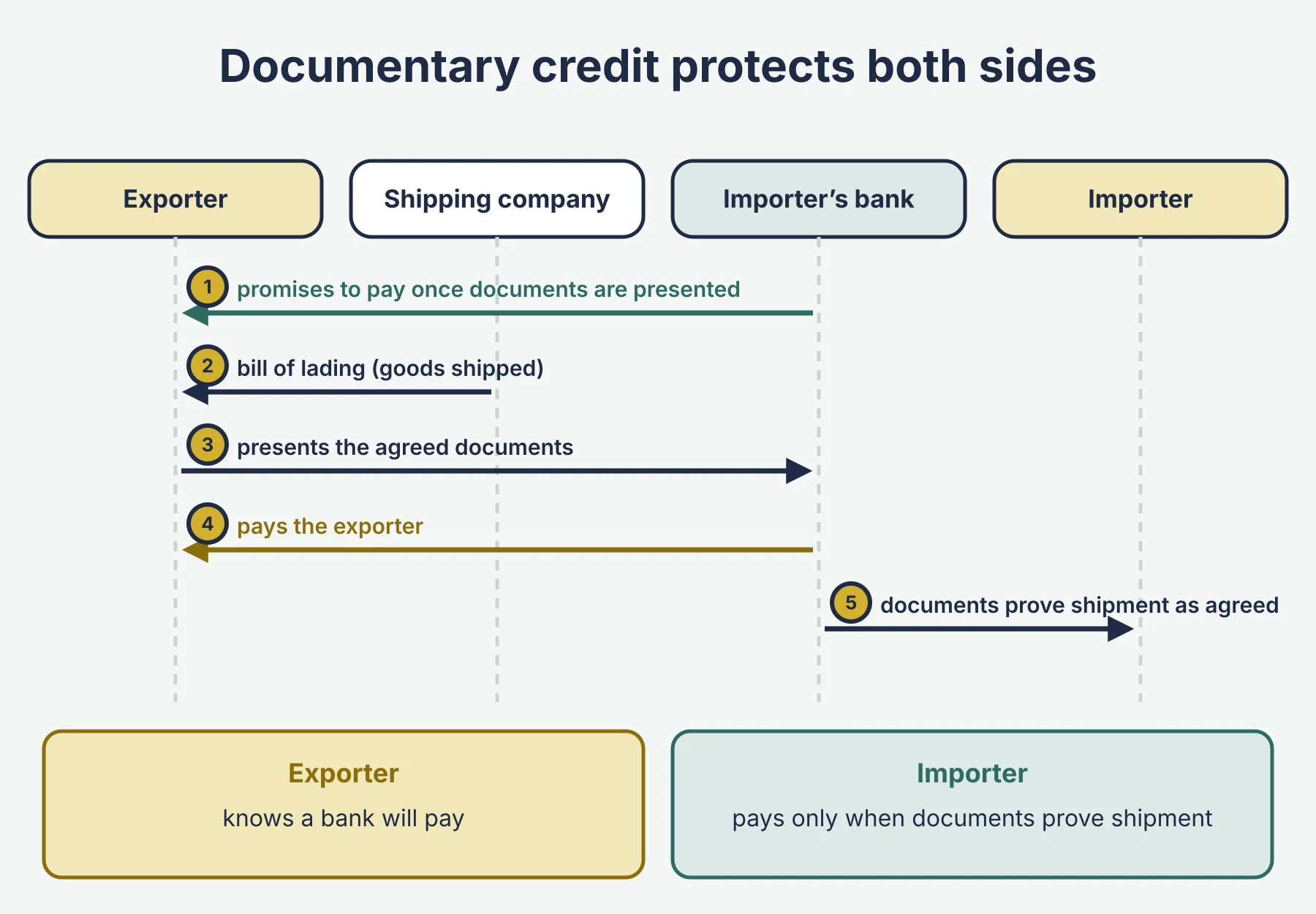
| Documentary credit (letter of credit) | The importer’s bank | A promise by the bank to pay the exporter once the exporter presents the agreed documents, such as the bill of lading |
The documentary credit reduces risk for both sides: the exporter knows a bank will pay, and the importer knows payment is made only when documents prove the goods have been shipped as agreed.
Online ordering: from browsing to receiving
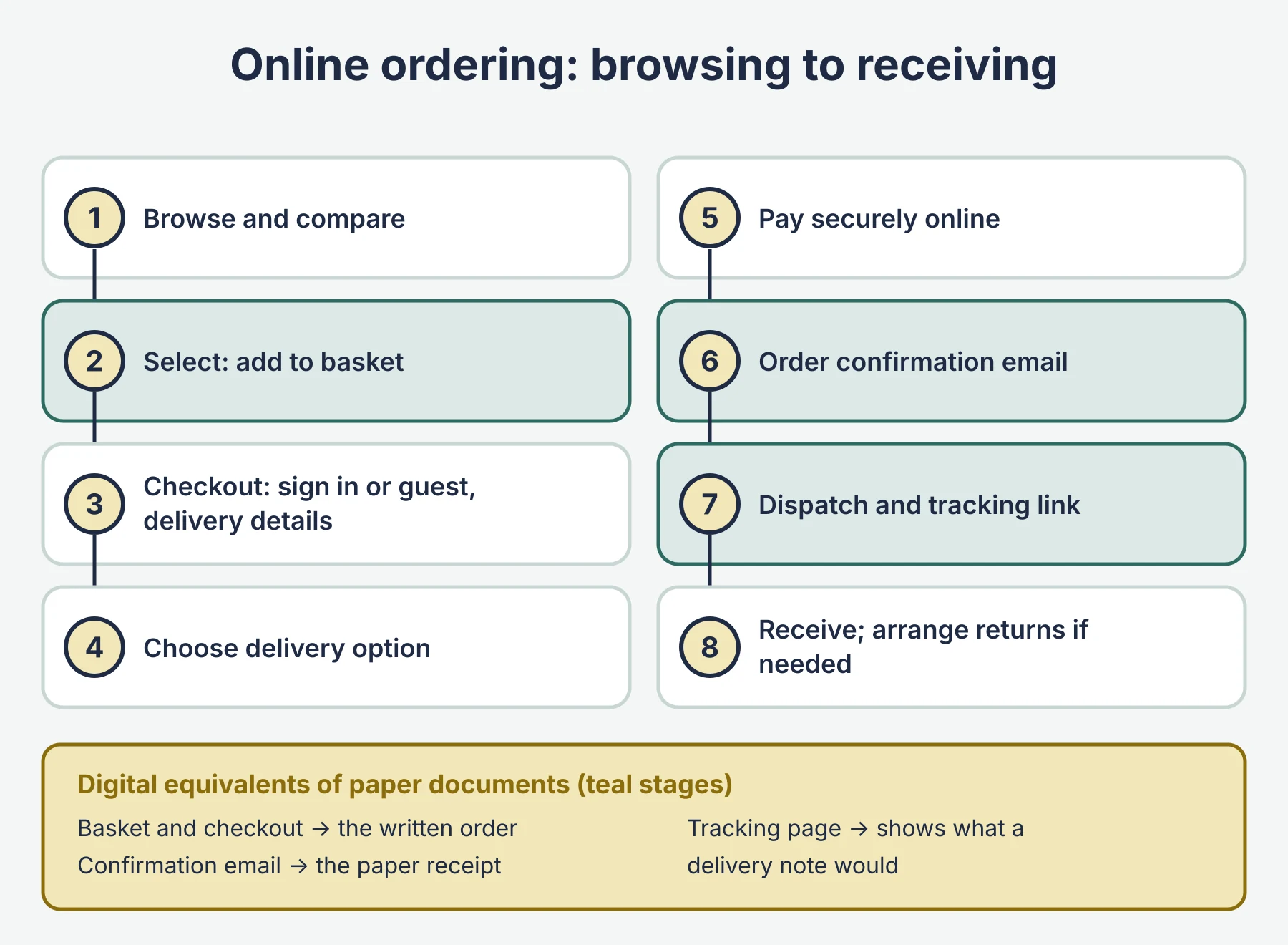
The syllabus asks for the stages of the online ordering process. A clear sequence is:
- The buyer browses the website or app and compares products.
- The buyer selects items and adds them to a basket.
- At checkout, the buyer signs in or continues as a guest and enters delivery details.
- The buyer chooses a delivery option, such as standard, express or click and collect.
- The buyer pays securely online.
- The seller sends an order confirmation, usually by email, often acting as an electronic receipt.
- The seller dispatches the goods and sends a tracking link.
- The buyer receives the order and can arrange returns if necessary.
Several paper documents have digital equivalents in this process: the basket and checkout replace the written order, the confirmation email replaces the paper receipt, and the tracking page shows what a delivery note would.
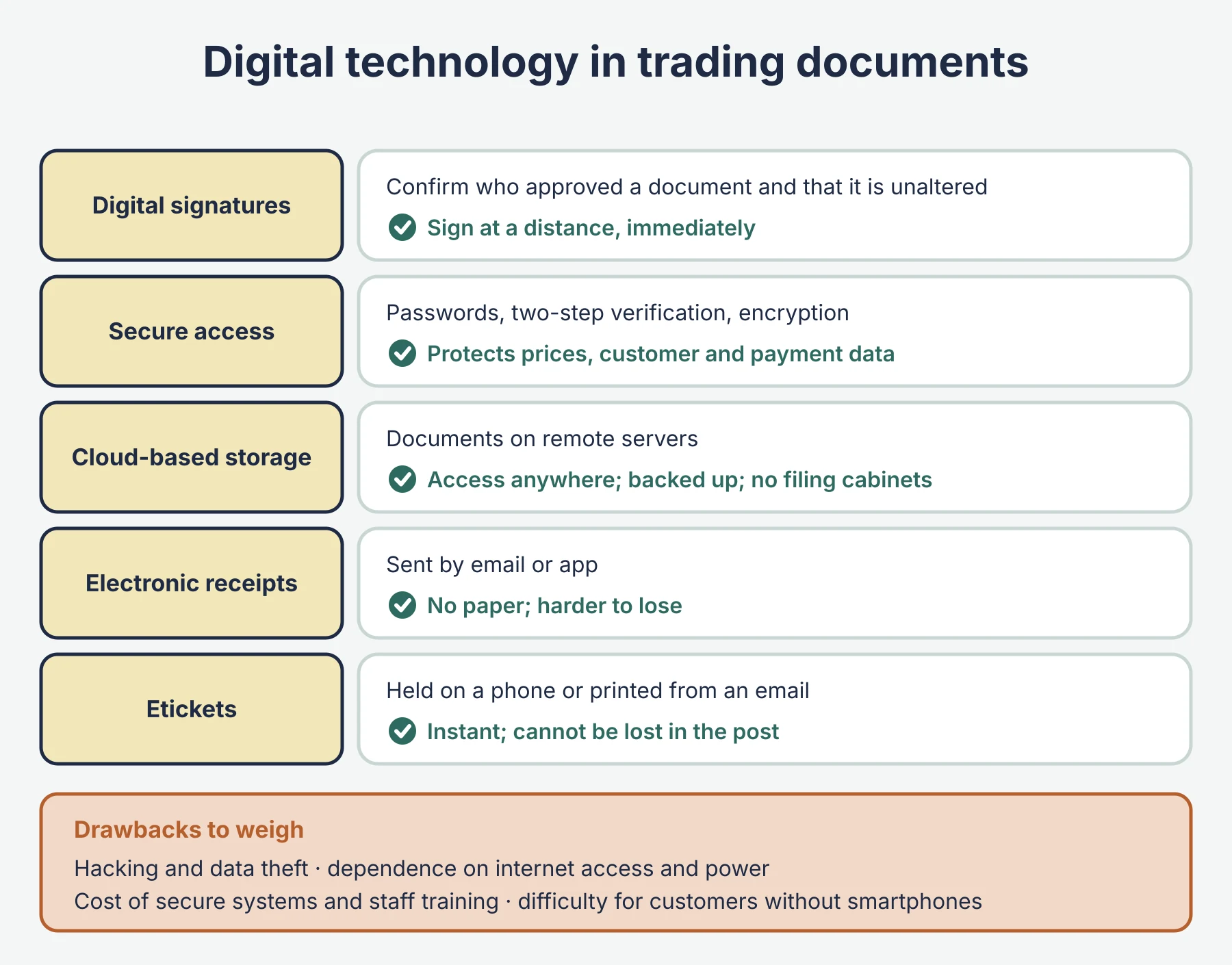
Digital technology in trading documents
| Technology | What it does | Benefit |
|---|---|---|
| Digital signatures | Electronic signature that confirms who approved a document and that it has not been altered | Contracts and orders can be signed at a distance immediately |
| Secure access | Passwords, two-step verification and encryption restrict who can view documents | Protects prices, customer details and payment data |
| Cloud-based storage | Documents stored online on remote servers | Accessible from anywhere; no filing cabinets; backed up |
| Electronic receipts | Receipts sent by email or app | No paper; harder to lose; easier to keep for returns |
| Etickets | Tickets for travel or events held on a phone or printed from an email | Instant delivery; cannot be lost in the post; easy to check at the gate |
Drawbacks to weigh: the risk of hacking and data theft, dependence on internet access and power, the cost of secure systems and staff training, and difficulty for customers without smartphones.
Common mistakes
- Putting the order before the quotation or the receipt before payment.
- Saying a credit note gives the buyer credit to spend; it reduces the amount the buyer owes.
- Confusing an invoice (one sale) with a statement of account (a summary of all transactions in a period).
- Calling an air waybill a document of title; only the bill of lading is.
- Deducting the cash discount on the invoice total when the buyer did not pay within the period.
- Applying a percentage discount to the wrong figure, for example calculating the cash discount on the price before trade discount.
Exam technique
- Identify a document from what it shows: a running balance means a statement; “returned goods” means a credit note.
- Explain the purpose of a document by naming who sends it, to whom, and what problem it solves.
- Calculate by setting out each step, as in the invoice table above.
Practise this sub-topic
Use the trading documents revision notes for quick recall and the trading documents practice questions for calculations and sequencing.
Official syllabus
Cambridge O Level Commerce (7100) syllabus for 2026, 2027 and 2028, sub-topic 2.5 Trading documents: official syllabus PDF.
Related resources
-
Revision notes
Cambridge O Level Commerce: Commercial Operations — Revision Notes (7100)
Recall notes for Cambridge O Level Commerce 7100 Topic 2: enterprise types, multinationals, franchises, outsourcing, retail, wholesale and communication.
Commerce · Cambridge · O Level
Revise topic -
Practice questions
Cambridge O Level Commerce (7100): Trading documents – Practice Questions
Thirteen original questions with full answers on Cambridge O Level Commerce 7100 sub-topic 2.5: document order, invoice sums, export documents, digital use.
Commerce · Cambridge · O Level
Try questions -
Revision notes
Cambridge O Level Commerce (7100): Trading documents – Revision Notes
Recall notes for Cambridge O Level Commerce 7100 sub-topic 2.5: home and international trading documents, discounts, online ordering and digital documents.
Commerce · Cambridge · O Level
Revise topic
Get free revision emails (optional)
Occasional emails with practice questions, worked explanations and links to free resources for the qualification and subjects you choose. No spam, and you can unsubscribe from any email. The free tools on this site never need an email.