
Revision Notes
Cambridge O Level Commerce (7100): Wholesaling – Revision Notes
Recall notes for Cambridge O Level Commerce 7100 sub-topic 2.4: wholesaler functions and importance, cash and carry and voluntary chains.
- Subject
- Commerce
- Level
- O LEVELS
- Topic
- Topic 2 – Commercial Operations
- Author
- Marlbridge Academic Team
- Updated
- Reviewed by
- Salman Ahmad (what this means)
Aligned to Cambridge O Level Commerce (7100), 2026-2028. Official specification .
Syllabus page (what it covers and how it is assessed): Cambridge O Level Commerce.
Syllabus points this page covers
7100
- 2.4 Wholesaling
Found an error? Report a correction.
Need help with this topic? Request a free trial class for O Level Commerce (7100).
Recall notes for sub-topic 2.4 Wholesaling in Cambridge O Level Commerce (7100). The wholesaling study guide explains each function and includes two worked examples.
Three things the syllabus asks for
- The functions and services provided by the wholesaler.
- The importance of the wholesaler to the manufacturer and to the retailer.
- Reasons why the independent wholesaler survives: cash and carry and voluntary chains.
Key terms
| Term | Meaning |
|---|---|
| Wholesaler | Buys in large quantities from manufacturers and sells in smaller quantities, usually to retailers |
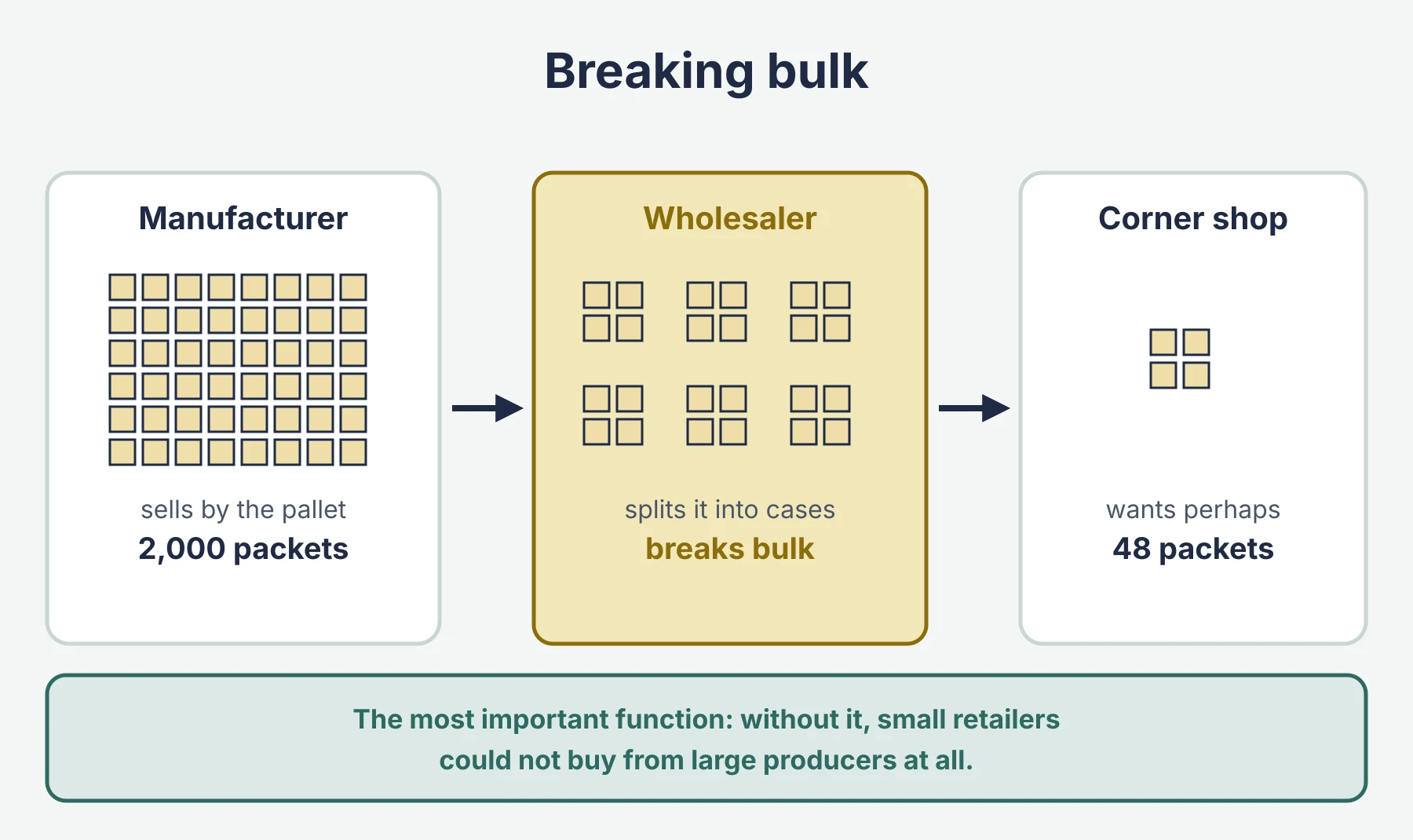
| Breaking bulk | Splitting large quantities into smaller amounts that retailers can afford and store |
| Risk bearing | Taking on the chance that goods are damaged, stolen or go unsold |
| Trade credit | Allowing a retailer to pay some time after receiving the goods |
| Chain of distribution | The route goods take: manufacturer → wholesaler → retailer → consumer |
| Cash and carry | Self-service wholesale warehouse; buyers pay at once and take goods away themselves |
| Voluntary chain | Independent retailers agree to buy mainly from one wholesaler and trade under a shared name with joint promotions |
| Independent wholesaler | A wholesaler not owned by a manufacturer or a large retail chain |
The functions (learn with a one-line reason)
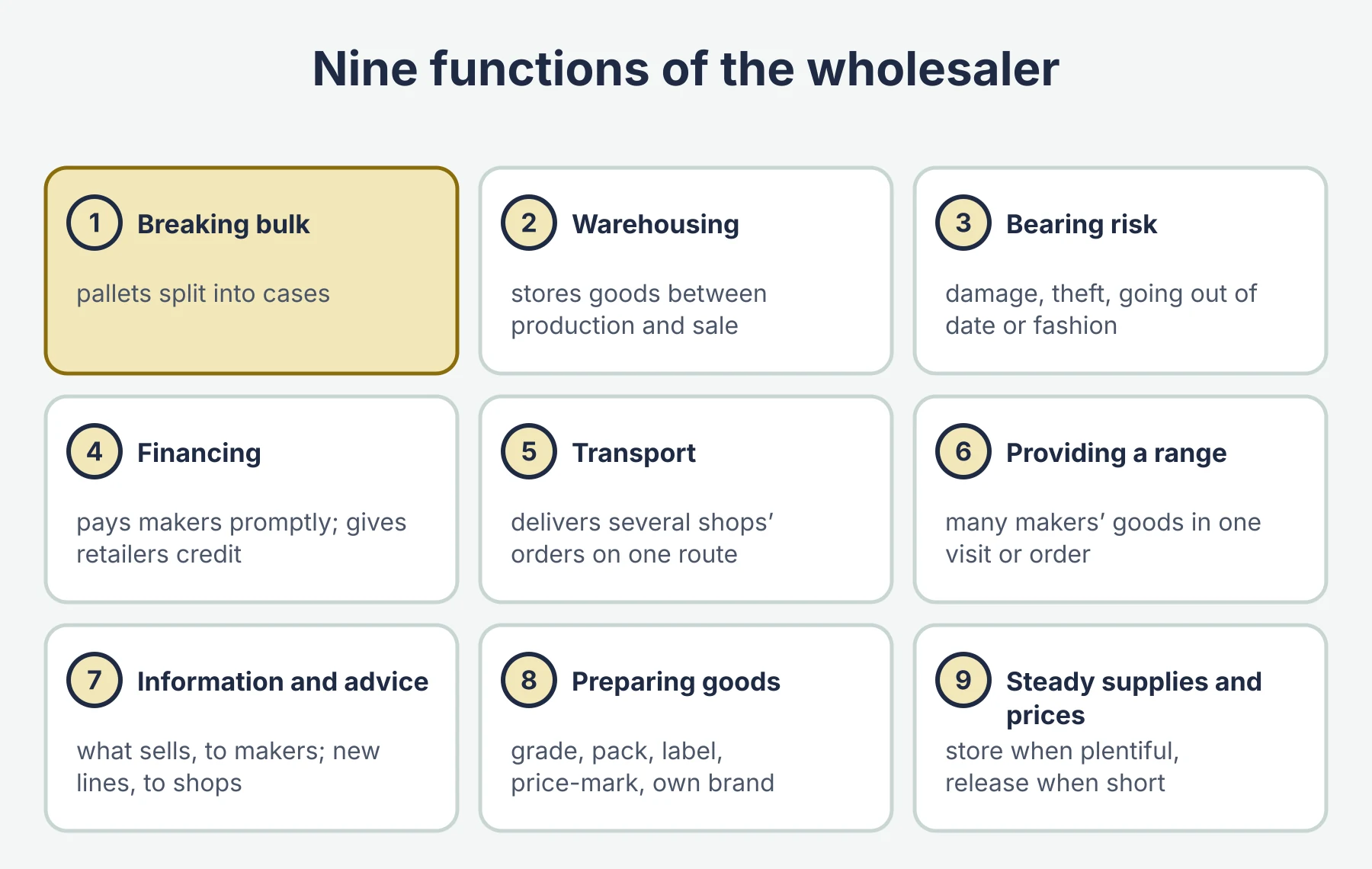
- Breaking bulk: small retailers can buy small quantities.
- Warehousing: manufacturers and retailers need less storage space.
- Bearing risk: losses from damage or unsold stock fall on the wholesaler.
- Financing: prompt payment to manufacturers and credit to retailers.
- Transport and delivery: combined routes cut costs for each shop.
- Wide range: many manufacturers’ goods in one place.
- Information and advice: feedback to manufacturers; advice to retailers.
- Preparing goods: grading, packing, labelling, price-marking.
- Steadier supplies and prices: storing seasonal goods and releasing them over time.
Importance: two-column recall
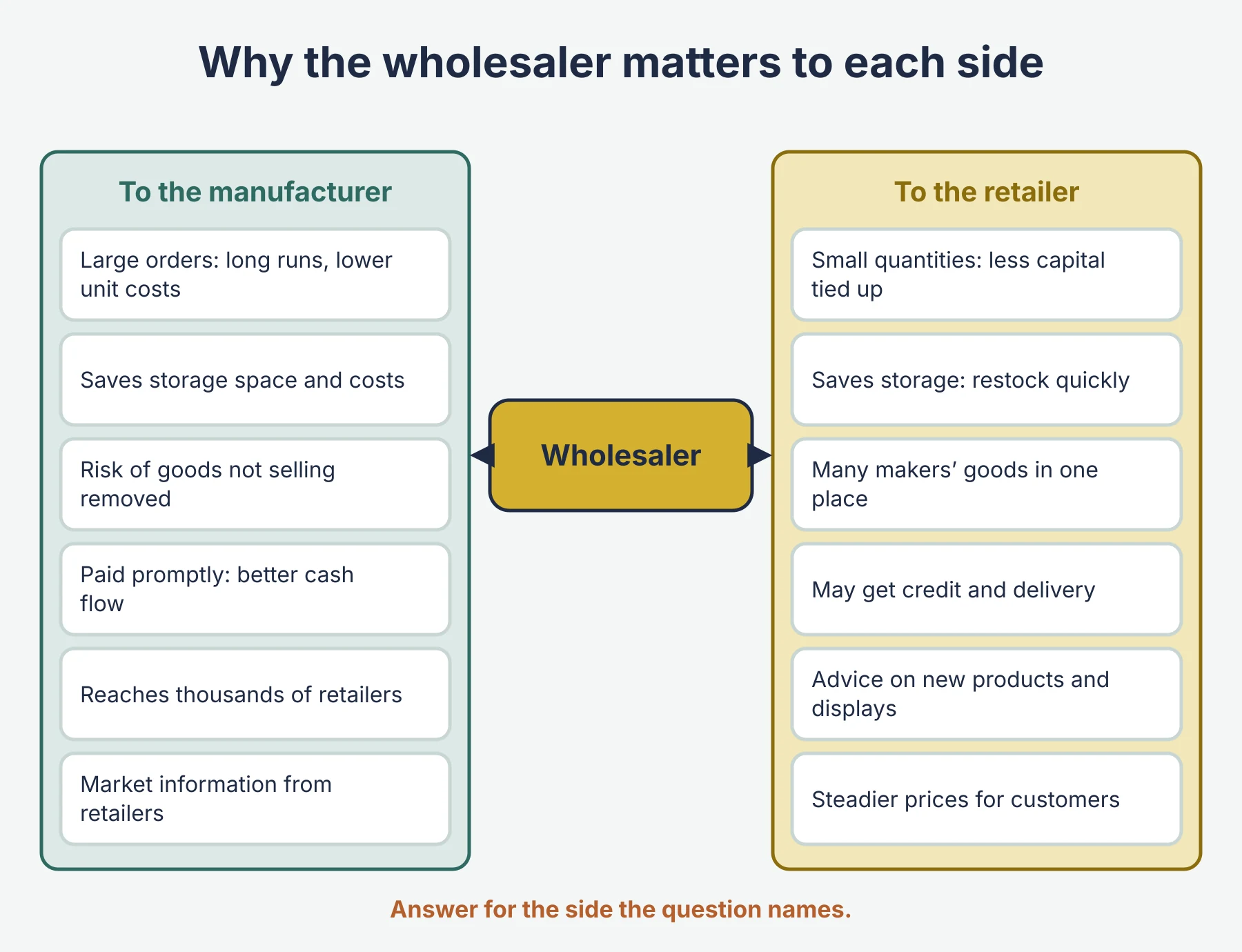
| Manufacturer gains | Retailer gains |
|---|---|
| Large orders and long production runs | Small quantities, less capital tied up |
| Less storage needed | Less storage needed |
| Risk passed on | Wide choice in one place |
| Prompt payment | Credit and delivery |
| Access to thousands of shops | Advice on products and displays |
| Market information | Steadier prices |
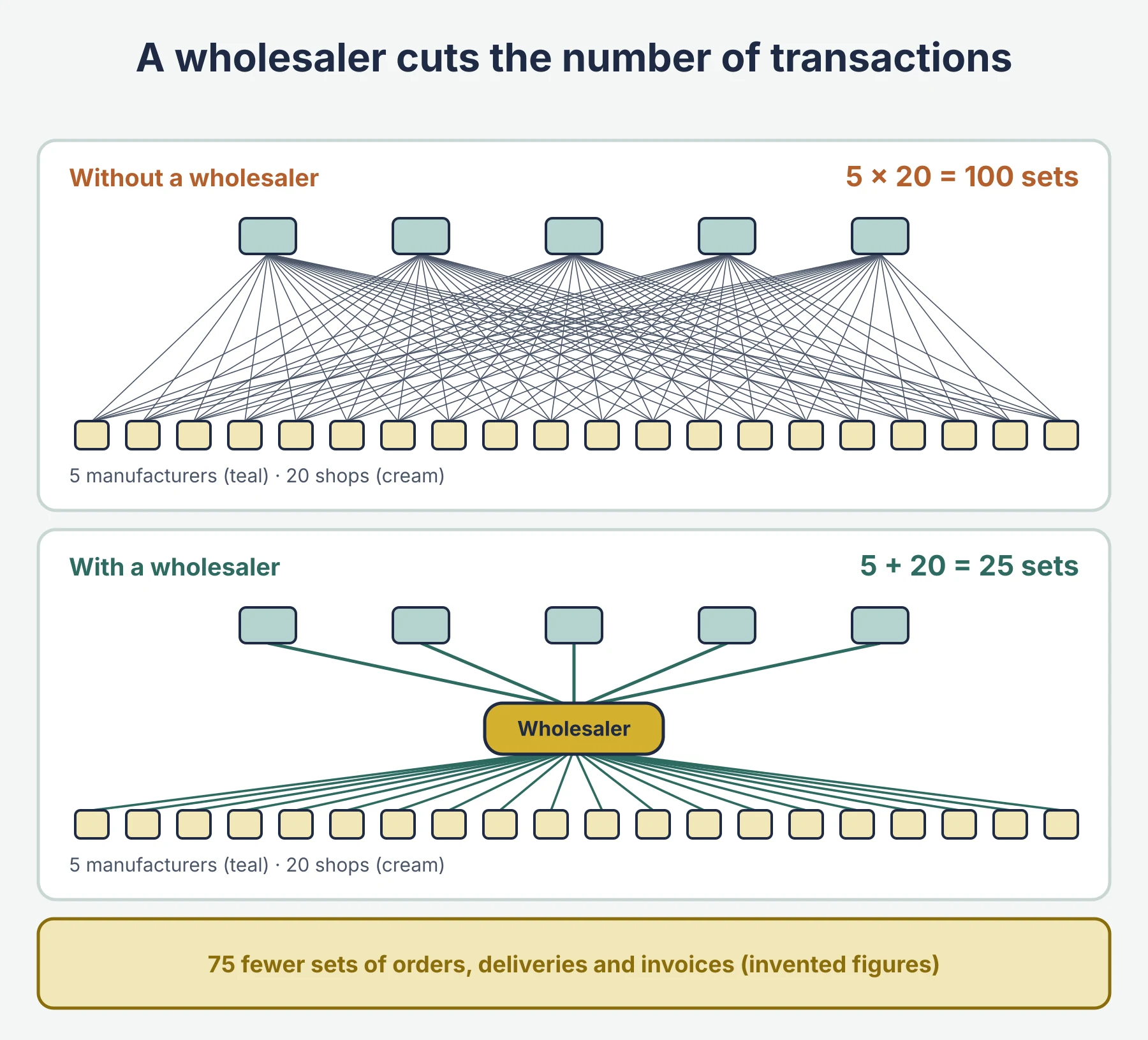
Transactions point: 4 manufacturers each supplying 25 shops directly = 4 x 25 = 100 transactions; through one wholesaler = 4 + 25 = 29. (Invented figures.)
How independent wholesalers survive
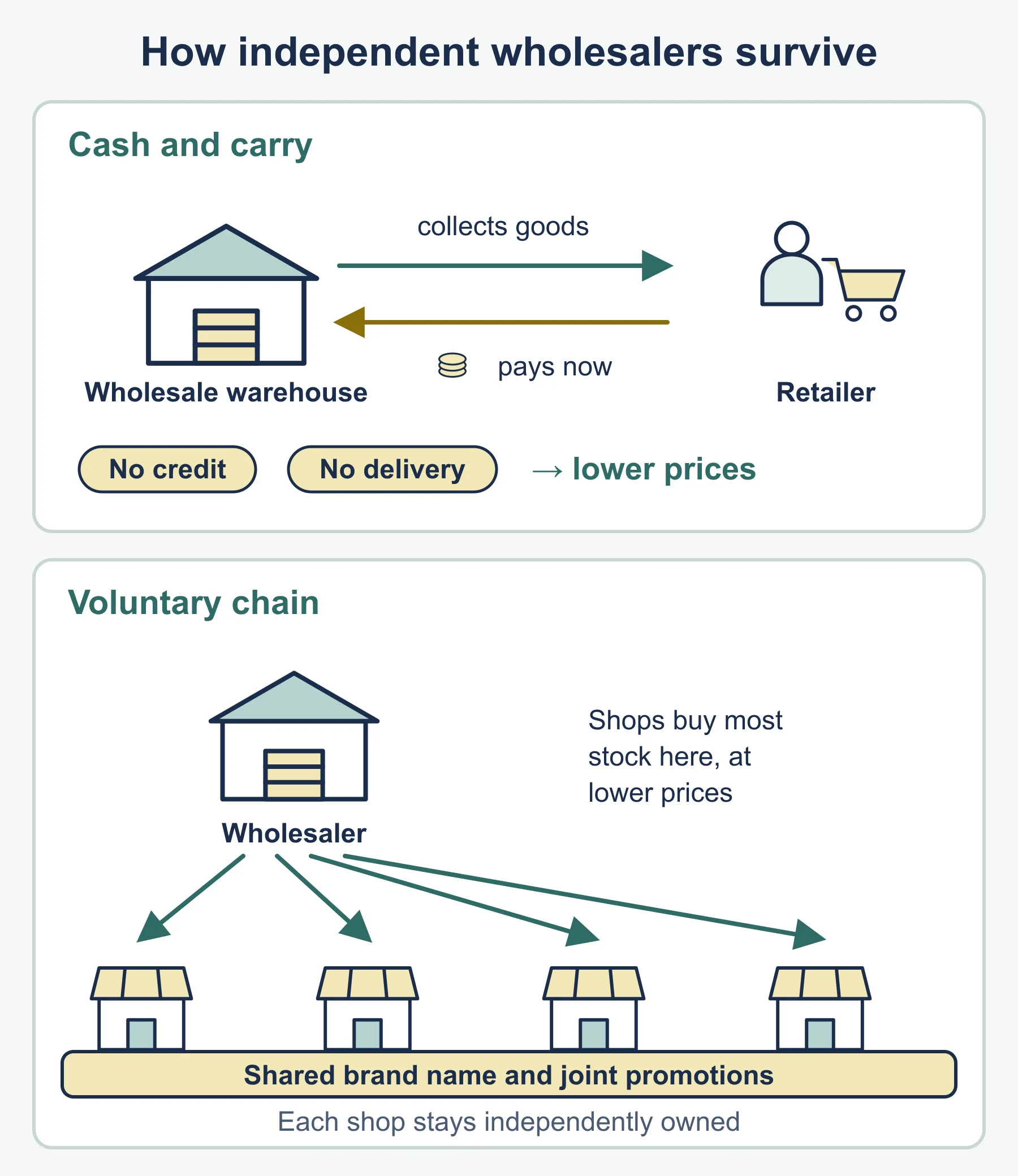
Cash and carry
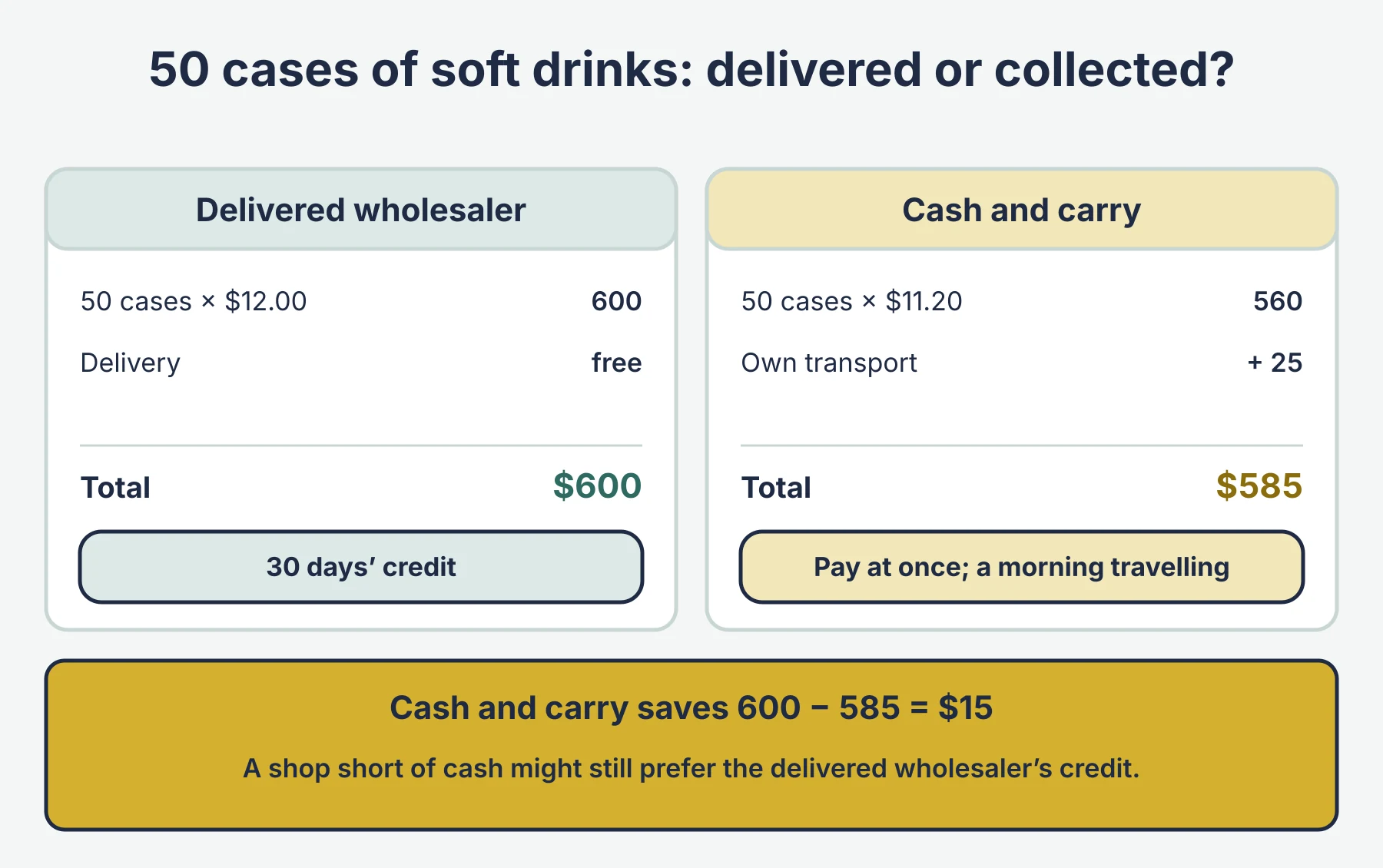
- Self-service; pay immediately; no credit; no delivery.
- Lower prices because delivery and credit costs are removed.
- Goods available at once; retailers can see what they buy.
- Drawbacks for retailers: need cash and transport; time spent travelling.
Voluntary chains
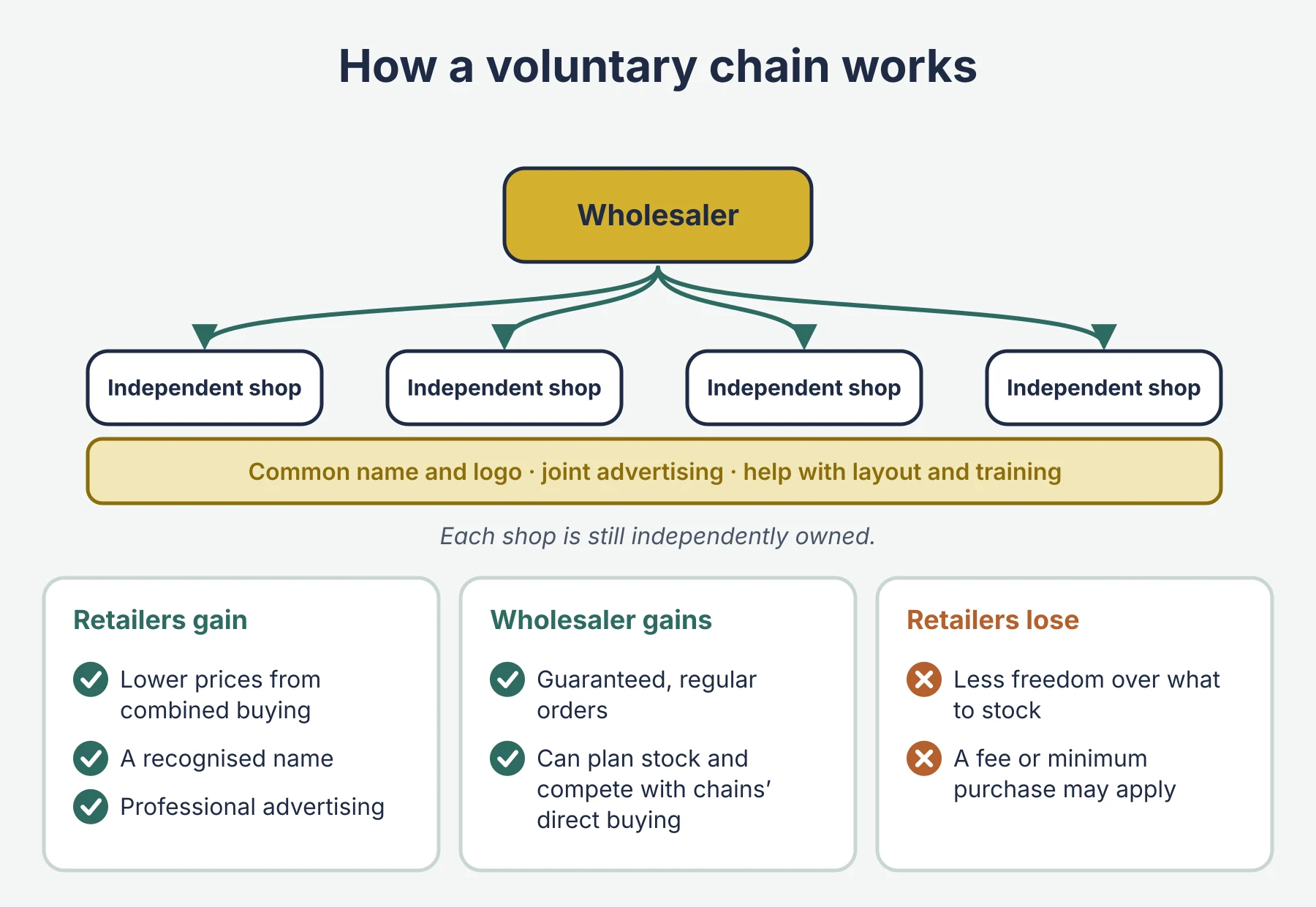
- Retailers agree to buy most stock from one wholesaler.
- Shared name, logo, advertising and promotions; help with layout and training.
- Retailers stay independently owned.
- Retailer gains buying power and a known name; wholesaler gains regular, loyal orders.
- Drawback: retailers lose some freedom over what they stock.
Why the wholesaler is under pressure
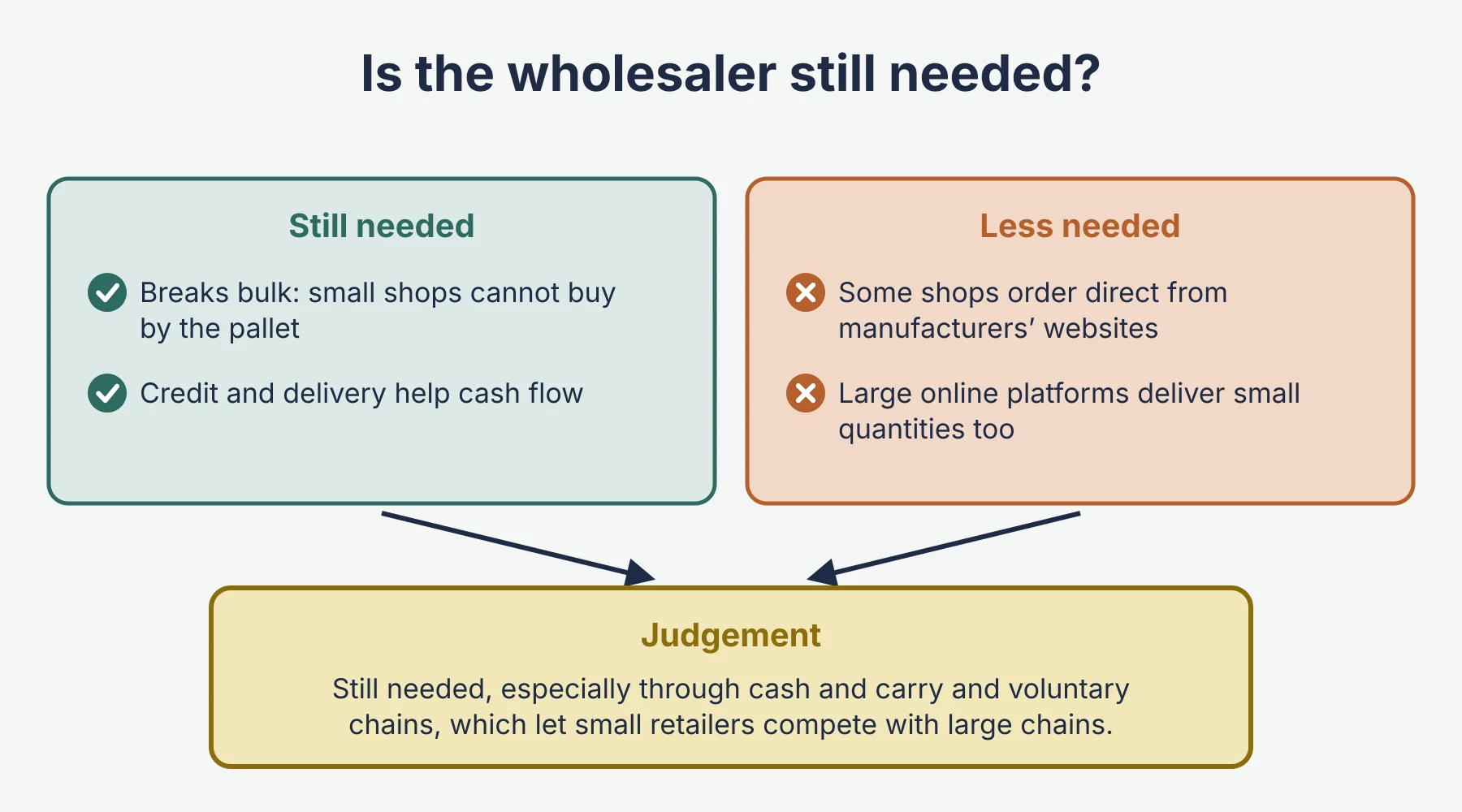
Large retail chains buy direct from manufacturers and run their own warehouses; manufacturers can sell direct to consumers online. Both cut out the wholesaler, which is why the survival methods matter.
Exam traps
- The wholesaler does not sell to the public. Its customers are retailers and other businesses.
- Match the side: manufacturer benefits and retailer benefits are separate lists; read which one the question wants.
- Cash and carry gives no credit and no delivery.
- Voluntary chain ≠ multiple chain: voluntary chain shops are independently owned; multiple chain branches belong to one company.
- Develop “breaking bulk”: say what it means and why it helps the business named.
Self-test
- Define a wholesaler.
- What is meant by breaking bulk?
- How does the wholesaler bear risk for the manufacturer?
- Give two services a wholesaler provides to a retailer.
- Give two ways a wholesaler helps a manufacturer.
- Why can a wholesaler help to keep prices steady?
- State two features of a cash and carry.
- Give one disadvantage of cash and carry for a small retailer.
- What is a voluntary chain?
- How does a voluntary chain benefit the wholesaler?
- Why are independent wholesalers under pressure?
- Three manufacturers each supply 30 shops. How many transactions are needed without a wholesaler, and how many with one?
Self-test answers
- A business that buys in large quantities from manufacturers and sells in smaller quantities, usually to retailers.
- Splitting large quantities bought from manufacturers into smaller amounts for retailers.
- Once it has bought the goods, it carries the loss if they are damaged, stolen or do not sell.
- Any two: breaking bulk; credit; delivery; wide range; advice; price-marking.
- Any two: large orders; storage; prompt payment; taking on risk; reaching many retailers; market information.
- It stores goods when supply is plentiful and releases them when supply is short.
- Any two: self-service; payment at once; buyers transport goods themselves; no credit; lower prices.
- Any one: cash needed at once; must provide own transport; time spent travelling.
- A group of independent retailers that agree to buy most stock from one wholesaler and trade under a shared name with joint promotions.
- It gains regular, guaranteed orders from loyal retailers.
- Large chains buy direct from manufacturers, and manufacturers can sell direct to consumers online.
- Without: 3 x 30 = 90; with: 3 + 30 = 33.
Frequently asked questions
Do I need to know other types of wholesaler? The 7100 statement names cash and carry and voluntary chains as the reasons the independent wholesaler survives; these are the two to know in detail.
Can a wholesaler sell online? Yes. Many take retailers’ orders through websites, but their customers are still businesses.
Try the wholesaling practice questions, then continue with the trading documents revision notes.
Official syllabus
Cambridge O Level Commerce (7100) syllabus for 2026, 2027 and 2028, sub-topic 2.4: official syllabus PDF.
Related resources
-
Revision notes
Cambridge O Level Commerce: Commercial Operations — Revision Notes (7100)
Recall notes for Cambridge O Level Commerce 7100 Topic 2: enterprise types, multinationals, franchises, outsourcing, retail, wholesale and communication.
Commerce · Cambridge · O Level
Revise topic -
Study guides
Cambridge O-Level Commerce: Commercial Operations (7100)
Ownership, public corporations, MNCs, franchises, location, retailing, trading documents and communication for Topic 2 of Cambridge O Level Commerce 7100.
Commerce · Cambridge · O Level
Read guide -
Study guides
Cambridge O-Level Commerce: Outsourcing, Wholesaling and Communication (7100)
Contract manufacturing and logistics, the wholesaler's role and survival, and choosing communication methods, explained for Cambridge O Level Commerce 7100.
Commerce · Cambridge · O Level
Read guide
Get free revision emails (optional)
Occasional emails with practice questions, worked explanations and links to free resources for the qualification and subjects you choose. No spam, and you can unsubscribe from any email. The free tools on this site never need an email.