
Study Guides
Cambridge O Level Commerce (7100): Wholesaling
Cambridge O Level Commerce 7100 sub-topic 2.4 in depth: wholesaler functions, its value to manufacturers and retailers, cash and carry, voluntary chains.
- Subject
- Commerce
- Level
- O LEVELS
- Topic
- Topic 2 – Commercial Operations
- Author
- Marlbridge Academic Team
- Updated
- Reviewed by
- Salman Ahmad (what this means)
Aligned to Cambridge O Level Commerce (7100), 2026-2028. Official specification .
Syllabus page (what it covers and how it is assessed): Cambridge O Level Commerce.
Syllabus points this page covers
7100
- 2.4 Wholesaling
Found an error? Report a correction.
Need help with this topic? Request a free trial class for O Level Commerce (7100).
The wholesaler sits in the middle of the chain of distribution, buying from manufacturers and selling to retailers. Sub-topic 2.4 of Cambridge O Level Commerce (7100) has one section, 2.4.1 Functions and importance of the wholesaler, with three content statements: the functions and services the wholesaler provides; its importance to the manufacturer and the retailer; and the reasons why the independent wholesaler survives, through cash and carry and voluntary chains.
The outsourcing, wholesaling and communication overview lists the main services. This guide explains why each function matters, adds a worked comparison and shows how to build a balanced argument about the wholesaler’s future.
What a wholesaler is
A wholesaler buys goods in large quantities from manufacturers (or importers) and sells them in smaller quantities, usually to retailers, but also to businesses such as restaurants, schools and hotels. The wholesaler does not normally sell to the general public. In 1.2.4 the wholesaler is named as a home trade intermediary.
The functions of the wholesaler explained
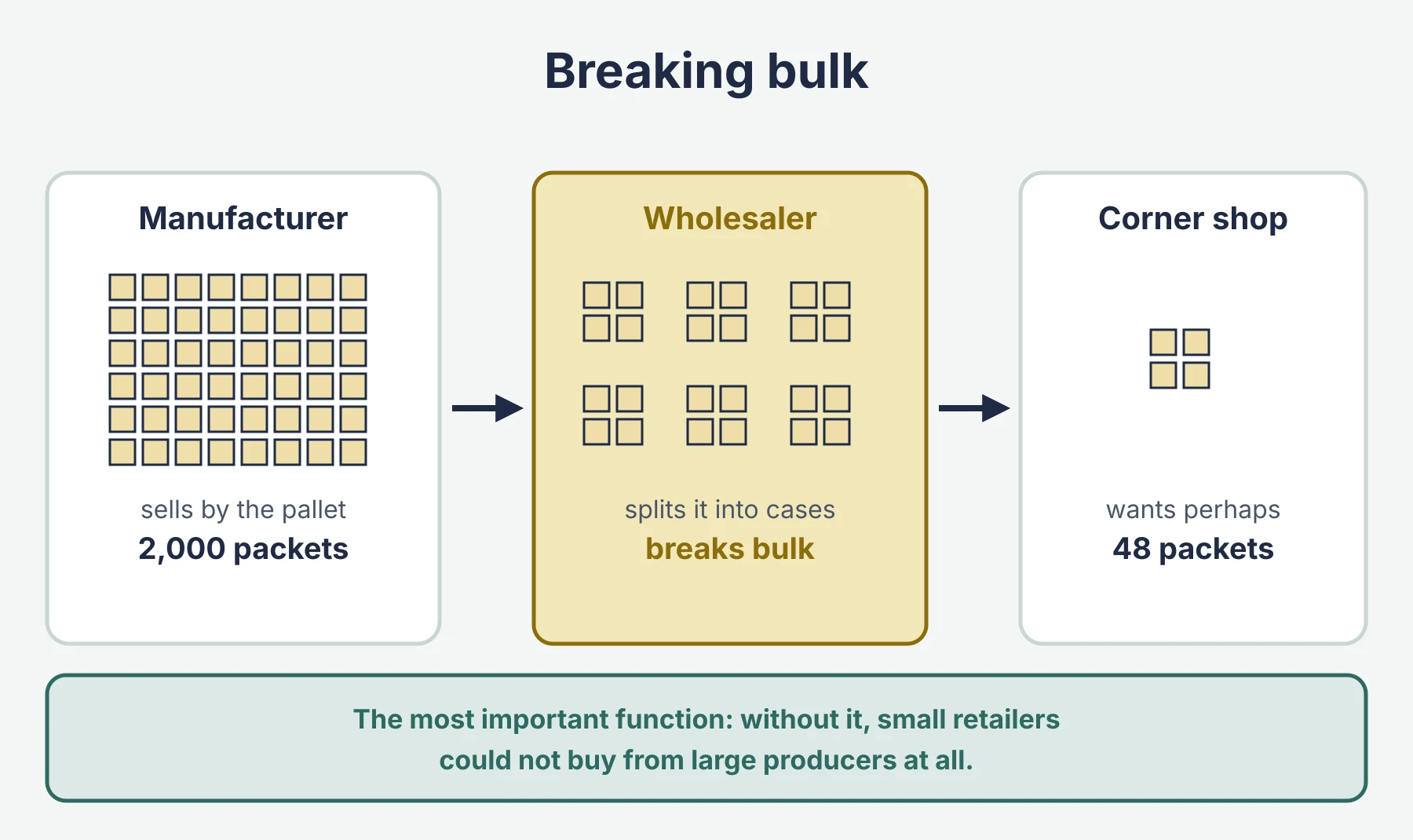
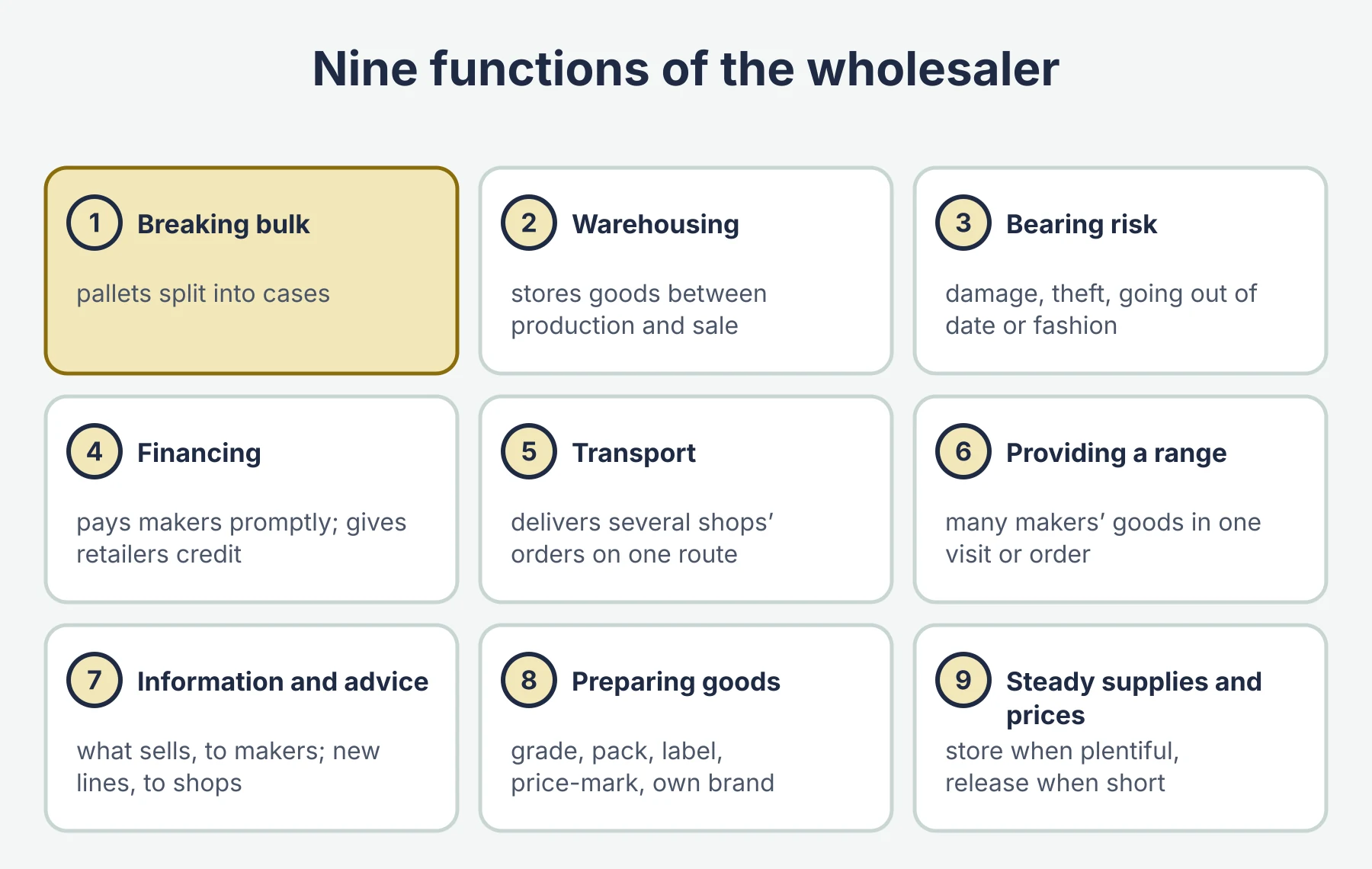
Breaking bulk. A manufacturer may sell biscuits by the pallet of 2,000 packets; a corner shop wants perhaps 48. The wholesaler buys the pallet and splits it into cases. This is the wholesaler’s most important function, because without it small retailers could not buy from large producers at all.
Warehousing. The wholesaler stores goods between production and sale. This frees space at the factory and means retailers can keep little stock in their small stockrooms, knowing they can restock quickly.
Bearing risk. Once the wholesaler has bought goods, it carries the risk that they will be damaged, stolen, go out of date or fall out of fashion. The manufacturer has already been paid.
Financing. The wholesaler often pays the manufacturer promptly, and may give retailers credit, letting them pay after they have sold the goods. It therefore finances stock on both sides.
Transport and distribution. Many wholesalers deliver to retailers, combining several shops’ orders on one route.
Providing a range. A wholesaler stocks goods from many manufacturers, so a retailer can buy soap, rice, cooking oil and batteries in one visit or one order.
Information and advice. Being in contact with many retailers, the wholesaler learns which products sell well and passes this to manufacturers. It also advises retailers about new products, prices and displays.
Preparing goods for sale. Some wholesalers grade, pack, label or price-mark goods, or pack goods under their own brand.
Keeping supplies and prices steady. By storing goods when supply is plentiful and releasing them when it is short, for example with seasonal crops, a wholesaler can make supplies more regular through the year and reduce sudden price changes.
Why the wholesaler is important to each side
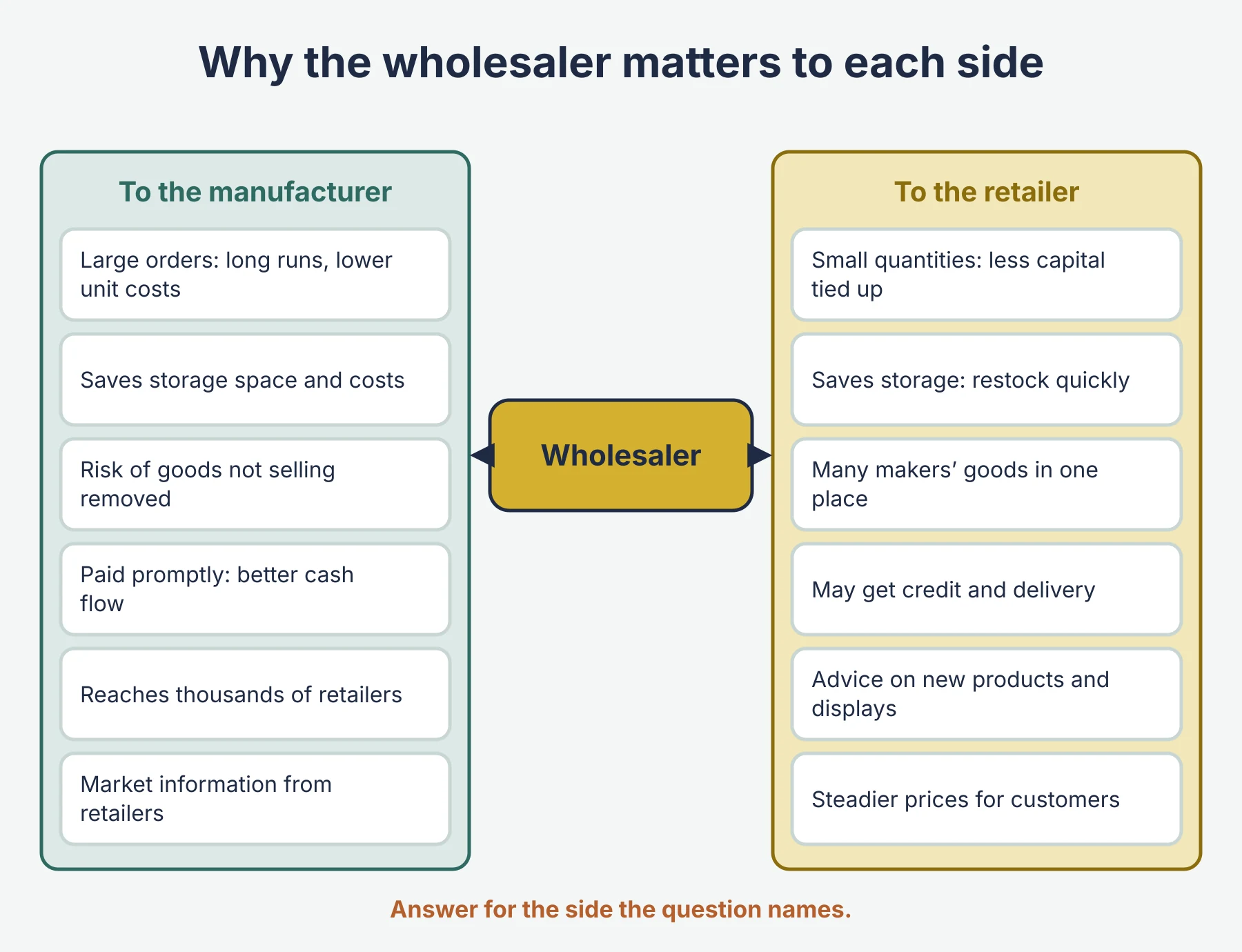
| To the manufacturer | To the retailer |
|---|---|
| Sells in large orders, allowing long production runs and lower unit costs | Buys in small quantities through breaking bulk, so less capital is tied up |
| Saves storage space and warehouse costs | Saves storage space because restocking is quick |
| Removes the risk of goods not selling once they are bought | Can choose from many manufacturers’ goods in one place |
| Receives payment promptly, helping cash flow | May receive credit and delivery |
| Reaches thousands of retailers it could not contact itself | Gets advice on new products and displays |
| Receives market information from retailers | Can keep prices steadier for customers |
Worked example 1: fewer transactions
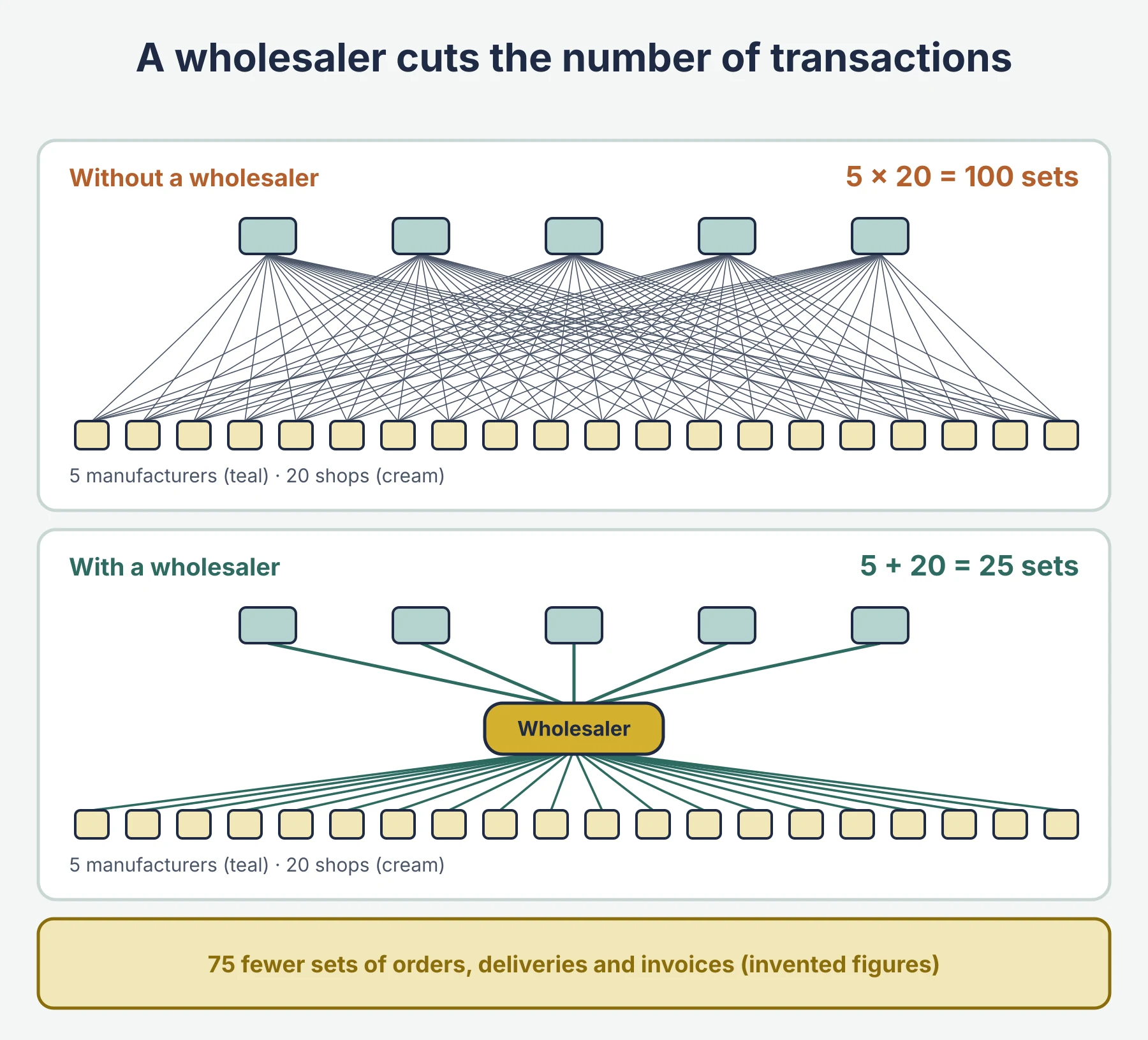
Invented figures. Five manufacturers each supply twenty small shops.
- Without a wholesaler: every manufacturer deals with every shop: 5 x 20 = 100 separate sets of orders, deliveries and invoices.
- With a wholesaler: each manufacturer deals only with the wholesaler (5) and each shop deals only with the wholesaler (20): 5 + 20 = 25 sets.
The wholesaler cuts the number of transactions by 75, which lowers transport, paperwork and administration costs across the chain. This is a strong point to use when a question asks why a wholesaler is still useful.
Why the independent wholesaler faces pressure
Large supermarket chains and multiple stores often buy direct from manufacturers, using their own regional warehouses. Manufacturers can also sell direct to consumers online. Both routes cut out the wholesaler and its profit margin. The syllabus asks how independent wholesalers survive despite this.
Cash and carry
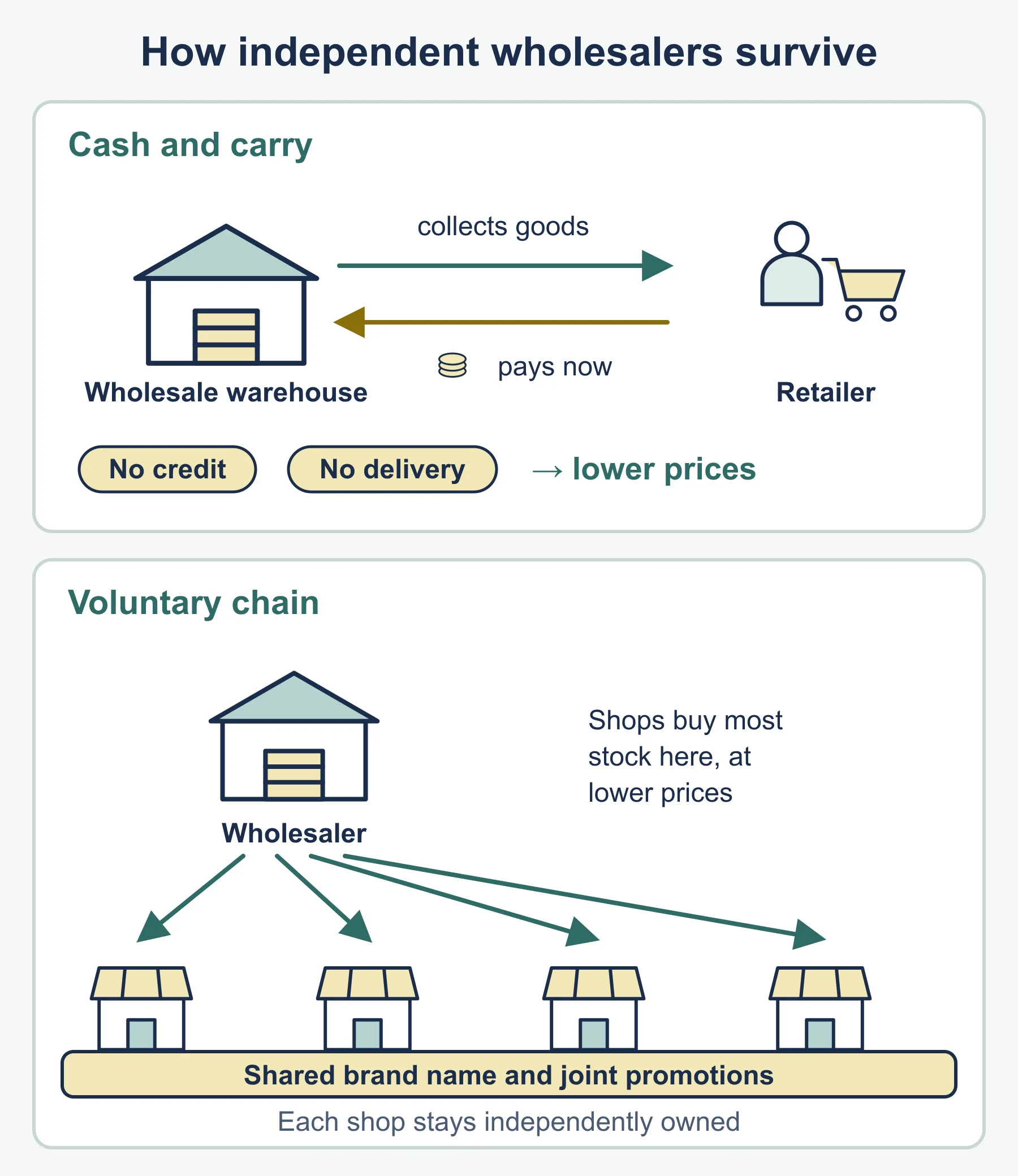
A cash and carry is a large self-service wholesale warehouse. Retailers and other trade customers walk round, select goods, pay immediately and transport the goods themselves.
- Benefits to retailers: lower prices, because the wholesaler saves on delivery and credit; goods available immediately, without waiting for a delivery day; retailers can see and choose goods; long opening hours.
- Drawbacks to retailers: no credit, so cash is needed up front; the retailer must spend time travelling and needs a vehicle; no delivery service.
- Why it helps the wholesaler survive: low operating costs let it offer prices close to those large retailers pay, so small shops keep coming back.
Worked example 2: delivered wholesaler or cash and carry?
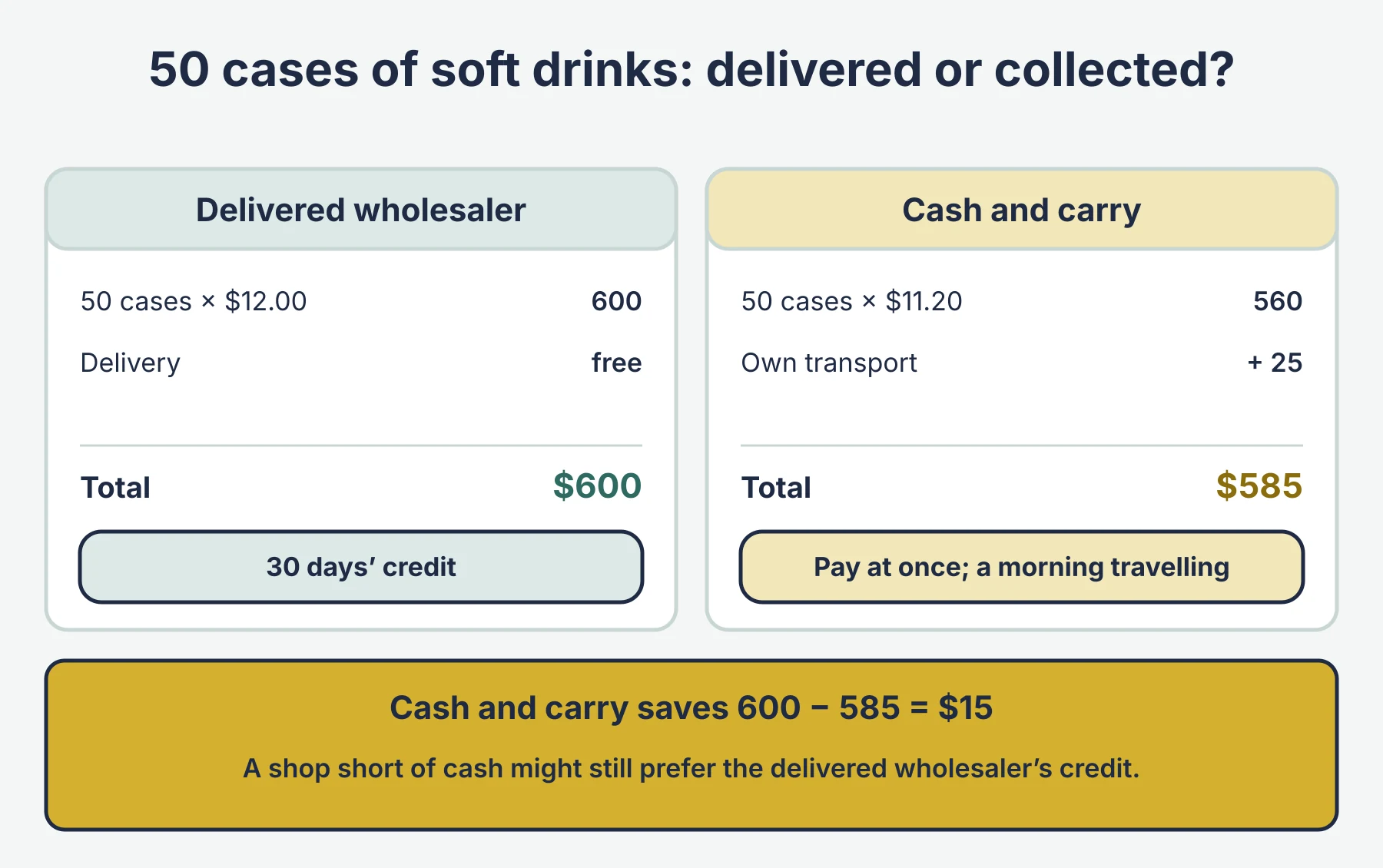
Invented figures. A shop needs 50 cases of soft drinks.
- Delivered wholesaler: $12.00 a case, free delivery, 30 days’ credit. Cost = 50 x $12.00 = $600.
- Cash and carry: $11.20 a case, plus $25 of the shopkeeper’s own transport. Cost = 50 x $11.20 + $25 = $560 + $25 = $585.
The cash and carry saves $15, but the shopkeeper must pay at once and lose a morning travelling. A shop short of cash might prefer the delivered wholesaler’s credit despite the higher price.
Voluntary chains
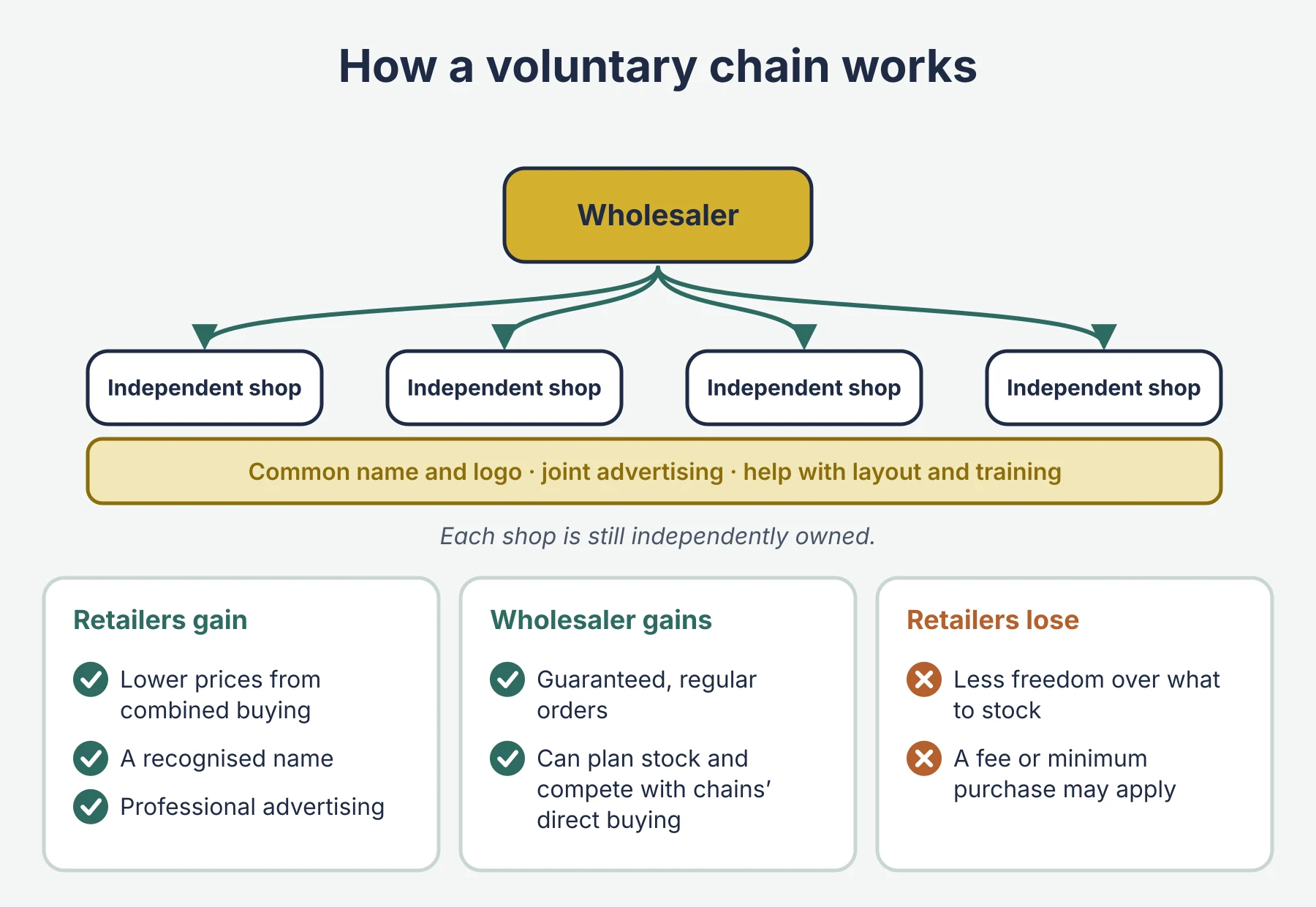
A voluntary chain is formed when a wholesaler and a group of independent retailers agree that the retailers will buy most of their stock from that wholesaler. The shops trade under a common name and logo, share joint advertising and promotions, and may receive help with shop layout and training. Each shop is still independently owned.
- Benefits to retailers: lower prices from the group’s combined buying power; a recognised name that attracts customers; professional advertising they could not afford alone.
- Benefits to the wholesaler: a guaranteed, regular flow of orders from loyal customers, so it can plan stock and compete with the chains’ direct buying.
- Drawbacks to retailers: less freedom over which products to stock; a fee or a minimum purchase agreement may apply.
Annotated model answer
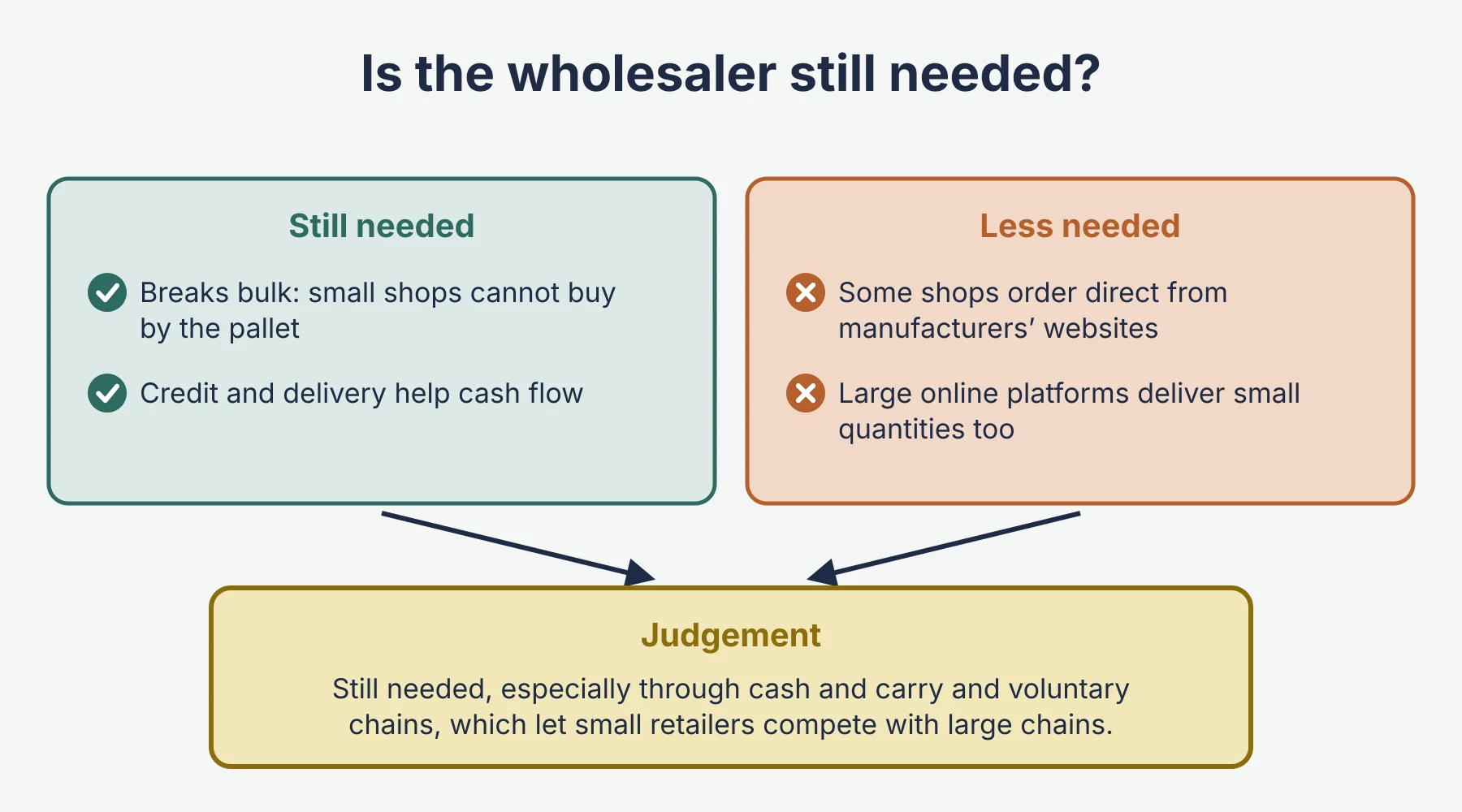
Original question: “Discuss whether the wholesaler is still needed by small retailers.” (6 marks)
Small retailers buy only a few cases at a time, so they rely on the wholesaler to break bulk (point); without it, they could not buy from manufacturers that sell only by the pallet (development). Wholesalers also give credit and delivery, helping cash flow (point). However, some small shops now order direct from manufacturers’ websites (counter-point), and large online platforms deliver small quantities too (counter-point). On balance, the wholesaler is still needed, especially through cash and carry and voluntary chains, because these offer prices and services that let small retailers compete with large chains (judgement).
Common mistakes
- Saying the wholesaler sells to the general public.
- Writing “breaks bulk” without explaining what it means and why it helps the retailer.
- Answering a question about the manufacturer with retailer benefits, or the reverse.
- Describing cash and carry as offering credit or delivery: it offers neither.
- Confusing a voluntary chain with a multiple chain store; voluntary chain shops are independently owned.
Practise this sub-topic
Recall the key points with the wholesaling revision notes and apply them in the wholesaling practice questions. Retail types are in the retailing study guide.
Official syllabus
Cambridge O Level Commerce (7100) syllabus for 2026, 2027 and 2028, sub-topic 2.4 Wholesaling: official syllabus PDF.
Related resources
-
Revision notes
Cambridge O Level Commerce: Commercial Operations — Revision Notes (7100)
Recall notes for Cambridge O Level Commerce 7100 Topic 2: enterprise types, multinationals, franchises, outsourcing, retail, wholesale and communication.
Commerce · Cambridge · O Level
Revise topic -
Practice questions
Cambridge O Level Commerce (7100): Wholesaling – Practice Questions
Twelve original questions with full answers on Cambridge O Level Commerce 7100 sub-topic 2.4: wholesaler functions, cash and carry and voluntary chains.
Commerce · Cambridge · O Level
Try questions -
Revision notes
Cambridge O Level Commerce (7100): Wholesaling – Revision Notes
Recall notes for Cambridge O Level Commerce 7100 sub-topic 2.4: wholesaler functions and importance, cash and carry and voluntary chains.
Commerce · Cambridge · O Level
Revise topic
Get free revision emails (optional)
Occasional emails with practice questions, worked explanations and links to free resources for the qualification and subjects you choose. No spam, and you can unsubscribe from any email. The free tools on this site never need an email.