
Revision Notes
Cambridge O Level Commerce (7100): Retailing – Revision Notes
Recall notes for Cambridge O Level Commerce 7100 sub-topic 2.3: retailer types, small shop survival, selling techniques, digital trends and ecommerce effects.
- Subject
- Commerce
- Level
- O LEVELS
- Topic
- Topic 2 – Commercial Operations
- Author
- Marlbridge Academic Team
- Updated
- Reviewed by
- Salman Ahmad (what this means)
Aligned to Cambridge O Level Commerce (7100), 2026-2028. Official specification .
Syllabus page (what it covers and how it is assessed): Cambridge O Level Commerce.
Syllabus points this page covers
7100
- 2.3 Retailing
Found an error? Report a correction.
Need help with this topic? Request a free trial class for O Level Commerce (7100).
Recall notes for sub-topic 2.3 Retailing in Cambridge O Level Commerce (7100). Full tables of features, advantages and disadvantages are in the retailing study guide.
The four named lists
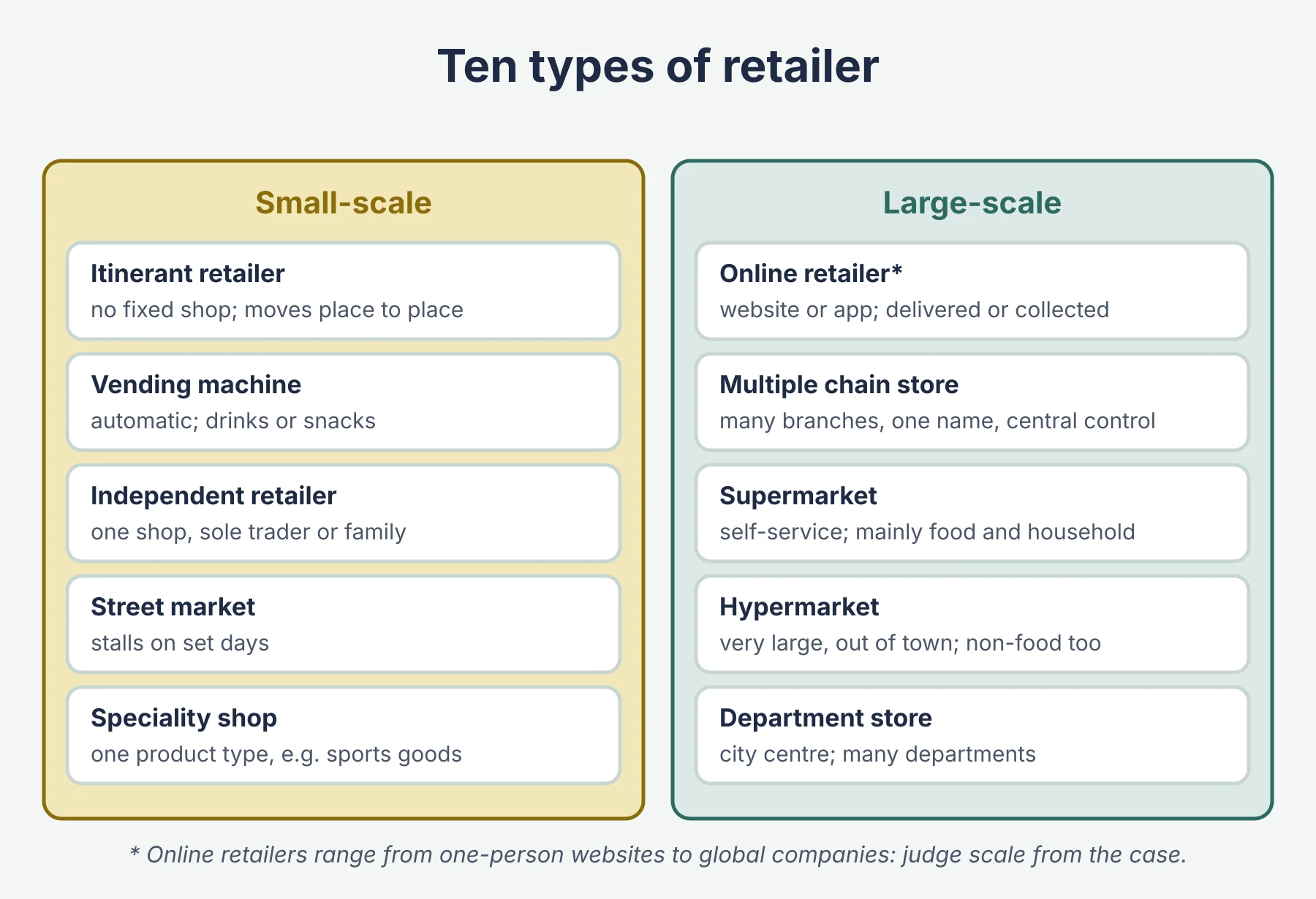
- Types of retailer (10): itinerant retailers, vending machines, independent retailers, street markets, speciality shops, online retailers, multiple chain stores, supermarkets, hypermarkets, department stores.
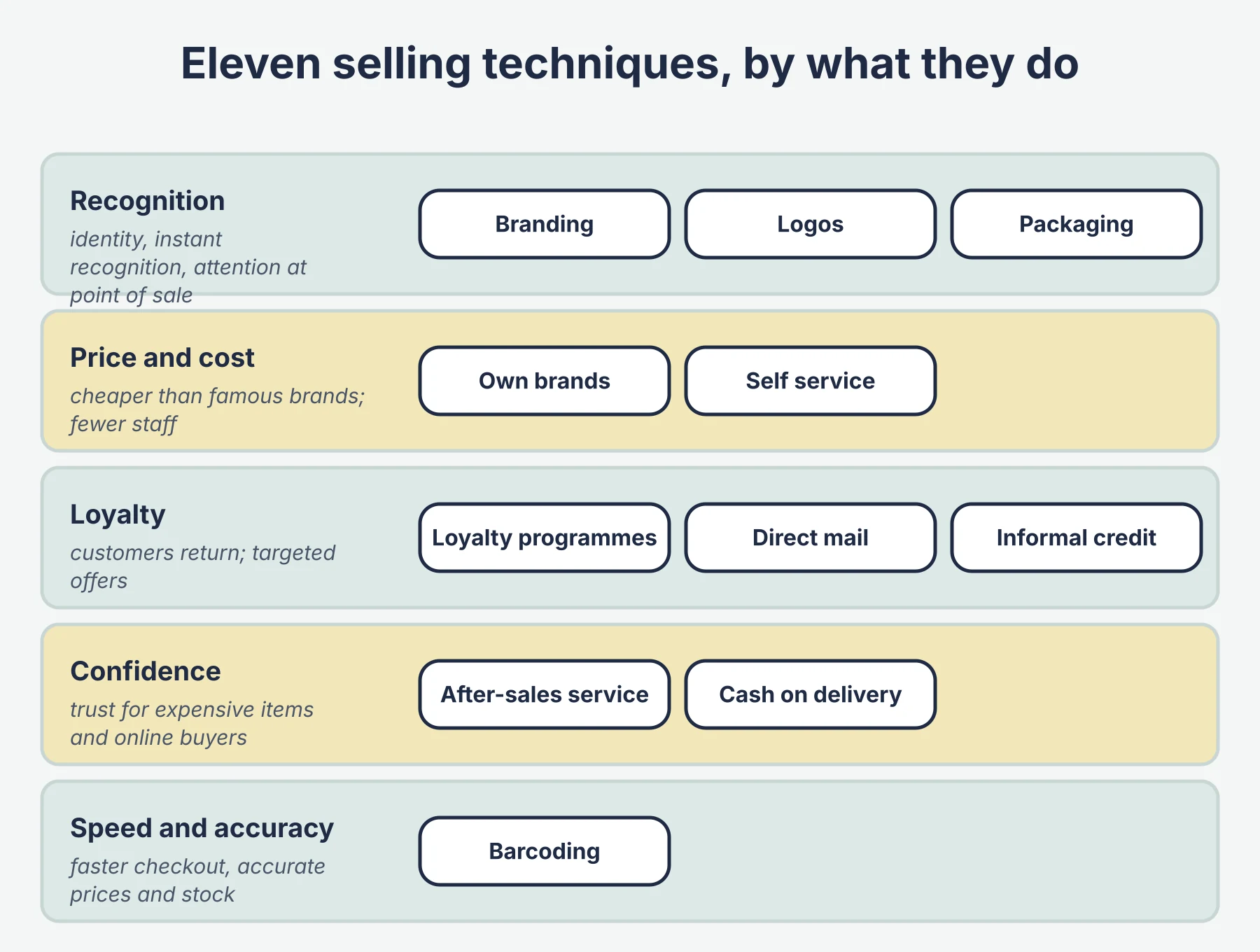
- Selling techniques (11): branding, own brands, logos, packaging, self service, after-sales service, barcoding, direct mail, loyalty programmes, informal credit, cash on delivery.
- Digital retail trends (11): omnichannel retailing, cashless stores, EPoS, click and collect, self-service checkouts, subscription commerce, QR codes, VR showrooms, dropshipping, smartphone apps, multi-channel retailing.
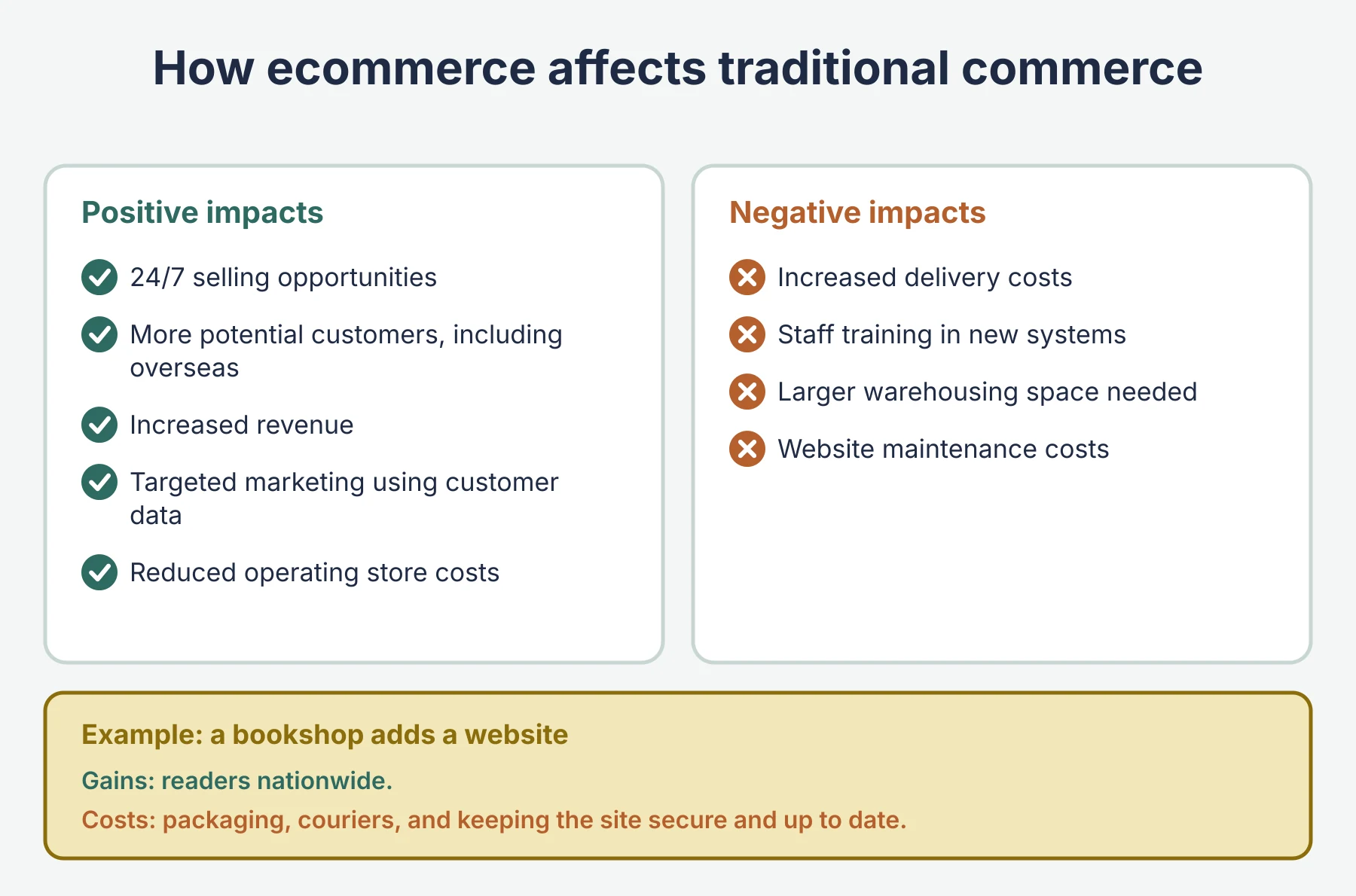
- Ecommerce effects: positives (24/7 selling, more potential customers, increased revenue, targeted marketing, reduced operating store costs) and negatives (delivery, staff training and larger warehousing costs; website maintenance).
Key terms
| Term | Meaning |
|---|---|
| Retailer | Business that sells goods in small quantities to the final consumer |
| Itinerant retailer | Trader with no fixed shop who moves from place to place |
| Speciality shop | Shop concentrating on one type of product with a deep range |
| Multiple chain store | Many branches under one name, centrally owned and run |
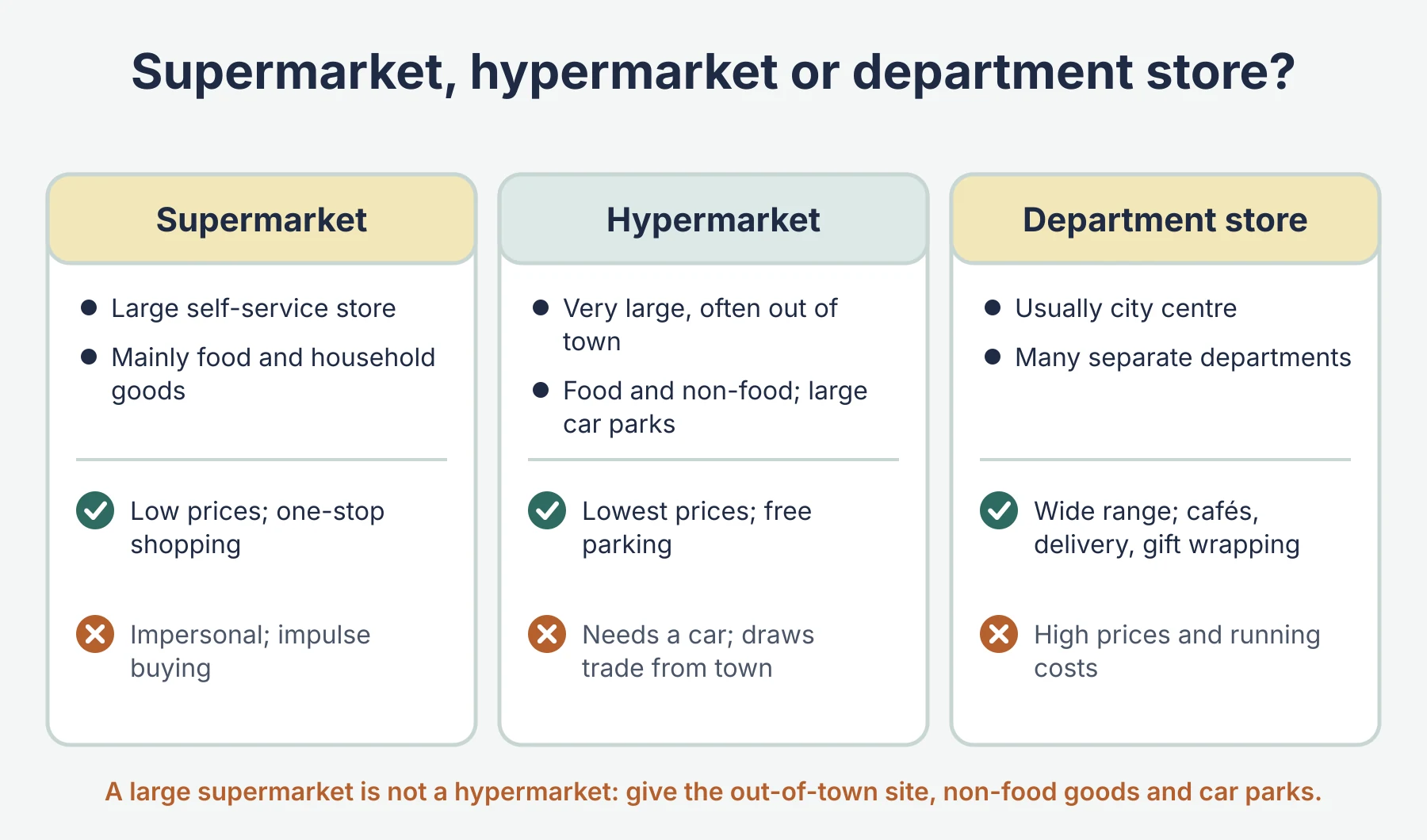
| Hypermarket | Very large, usually out-of-town self-service store selling food and non-food goods |
| Department store | Large store with many separate departments under one roof |
| Own brand | Product sold under the retailer’s name, made for it by a manufacturer |
| After-sales service | Delivery, installation, repairs or warranties after purchase |
| Informal credit | Letting trusted customers pay later without a formal agreement |
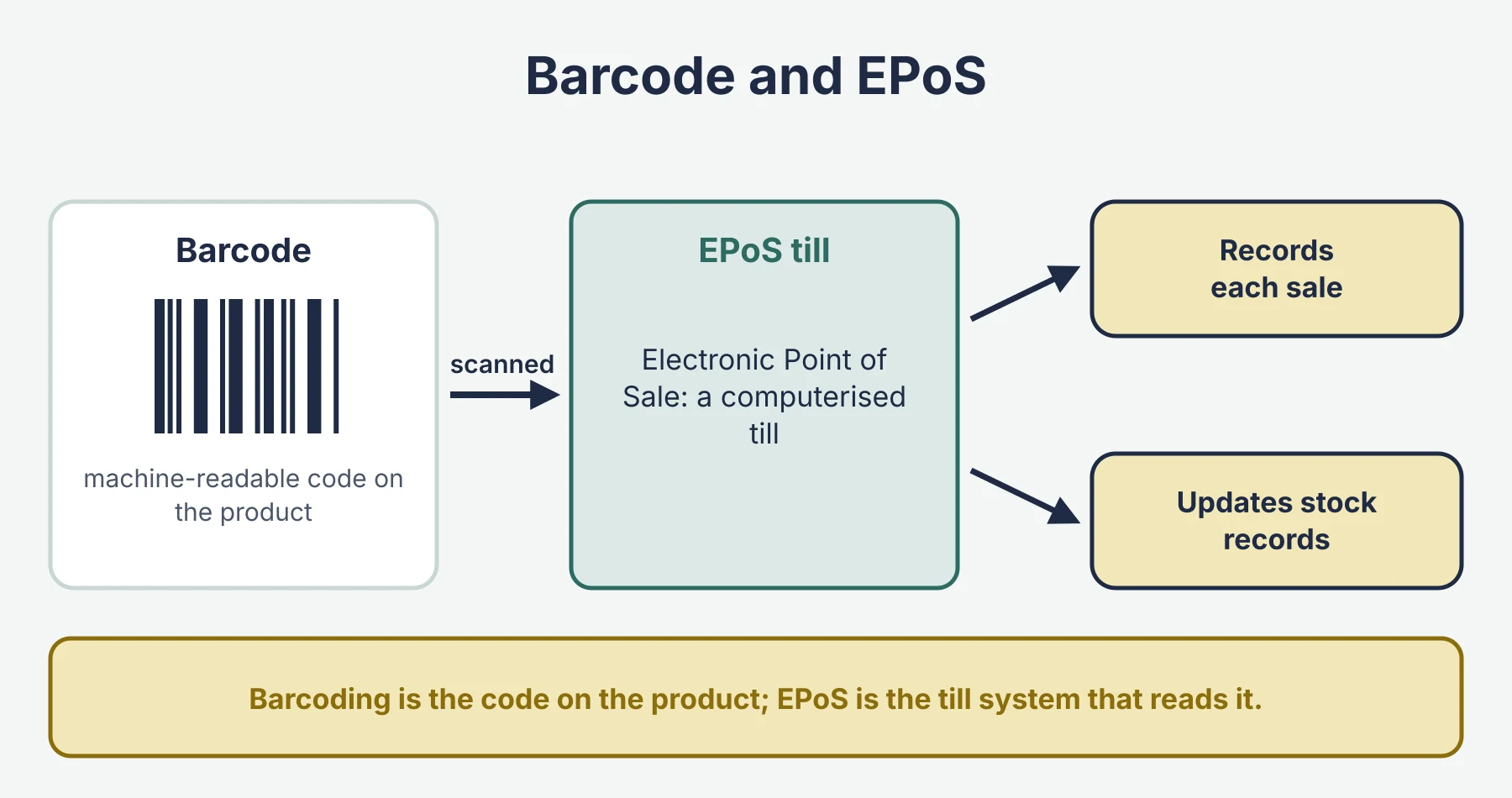
| EPoS | Computerised till system recording sales and updating stock |
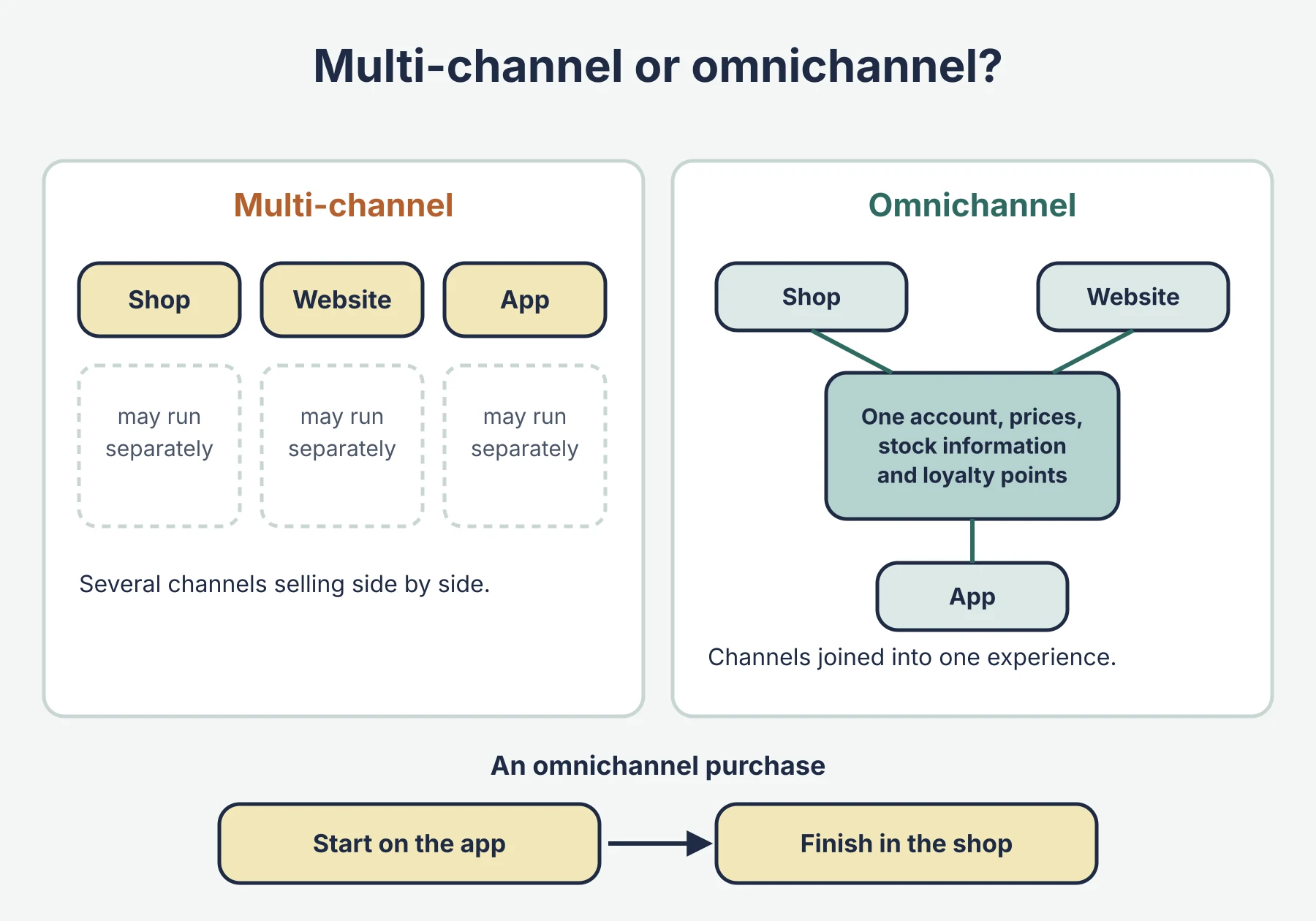
| Multi-channel retailing | Selling through several channels that may operate separately |
| Omnichannel retailing | Channels joined into one seamless experience (shared account, stock and rewards) |
| Subscription commerce | Regular fee for repeat deliveries |
| Dropshipping | Retailer sells without holding stock; supplier sends goods directly to the customer |
One-line profiles: best advantage and main drawback
- Itinerant: reaches remote customers / small stock, weather.
- Vending machine: 24-hour, no staff / narrow range, breakdowns.
- Independent: personal service / higher prices.
- Street market: low prices, bargaining / only on set days.
- Speciality shop: expert advice, deep range / narrow appeal.
- Online retailer: 24/7, huge range / cannot inspect, delivery wait.
- Multiple chain: bulk buying, known brand / ignores local tastes.
- Supermarket: low prices, one-stop / impersonal.
- Hypermarket: lowest prices, parking / needs a car, hurts town centres.
- Department store: range and services / high prices.
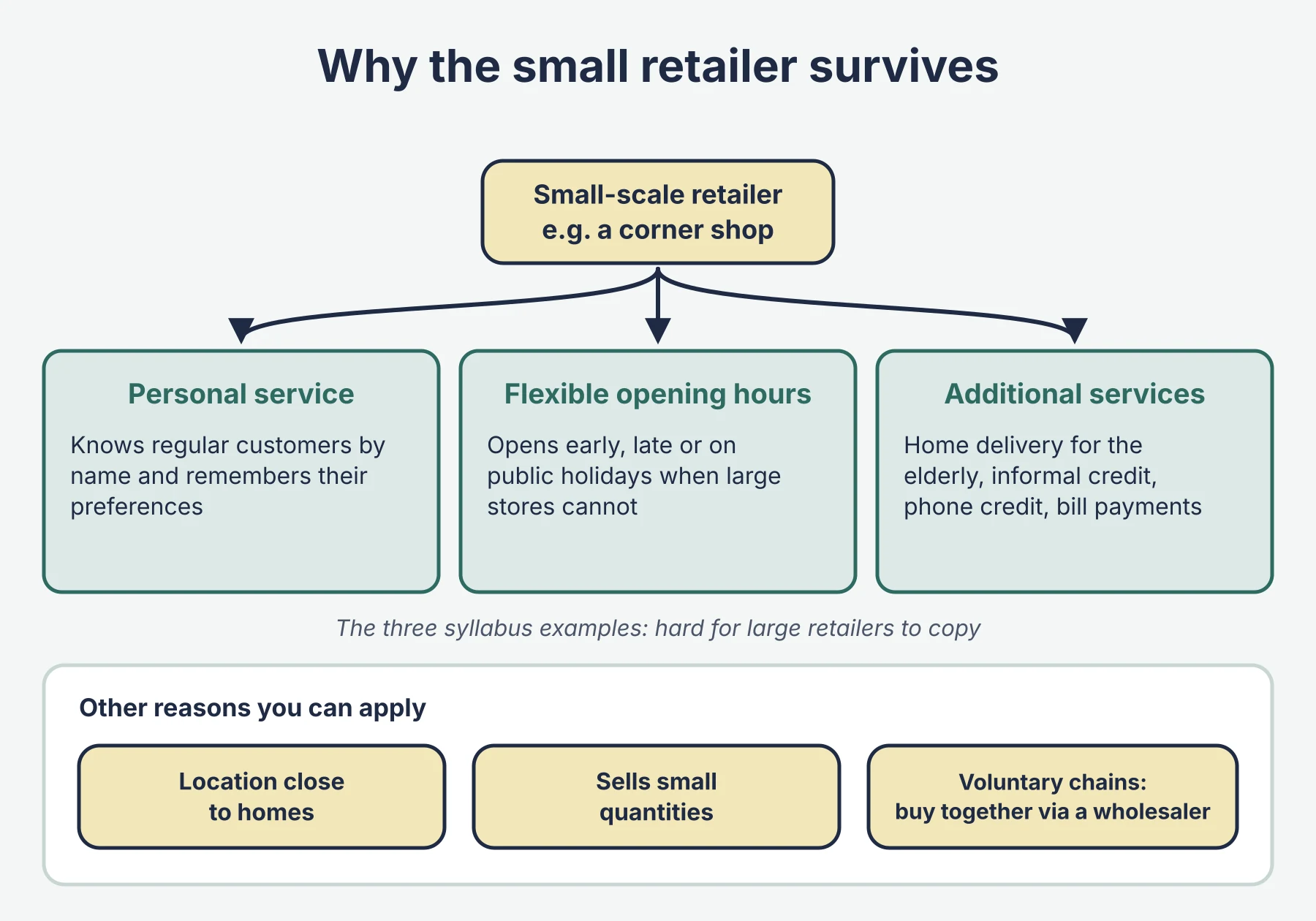
Why small shops survive
Syllabus examples: personal service, flexible opening hours, additional services. Also: convenient local location, selling small quantities, informal credit to known customers, and membership of voluntary chains.
Technique-to-purpose links
- Loyalty: loyalty programmes, branding, informal credit.
- Speed and accuracy: barcoding, self service.
- Attracting attention: packaging, logos.
- Confidence to buy expensive or online goods: after-sales service, cash on delivery.
- Higher margin: own brands.
- Targeting chosen customers: direct mail.
Digital trend pairs to separate
- Multi-channel vs omnichannel: several channels versus joined-up channels.
- EPoS vs barcoding: the till system versus the code it reads.
- Click and collect vs dropshipping: customer collects from the store versus supplier delivers for a retailer that holds no stock.
- Self service vs self-service checkouts: choosing goods from shelves (a technique) versus scanning and paying yourself (a digital trend).
Exam traps
- A large supermarket is not a hypermarket unless it is very large, usually out of town, with a wide non-food range.
- “Own brand” and “branding” are separate techniques in the syllabus list.
- Ecommerce questions need both impacts unless the question asks for one side.
- Name the specific retailer type: “small shop” is weaker than “independent retailer”.
- Cashless stores do not accept cash at all; do not describe them as “card-friendly shops”.
Self-test
- Define a retailer.
- Give one advantage and one disadvantage of a vending machine.
- What is the difference between a supermarket and a hypermarket?
- State the three reasons the syllabus gives for the survival of small-scale retailers.
- What is an own brand?
- Explain how barcoding helps a retailer.
- Why might an online seller offer cash on delivery?
- Define EPoS.
- Distinguish between multi-channel and omnichannel retailing.
- What is dropshipping?
- Give two positive impacts of ecommerce on traditional commerce named in the syllabus.
- Give two negative impacts of ecommerce on traditional commerce named in the syllabus.
Self-test answers
- A business that sells goods in small quantities to the final consumer.
- Advantage: sells 24 hours with no staff. Disadvantage: narrow range, or breakdowns and vandalism.
- A hypermarket is very large, usually out of town, sells many non-food goods as well as food and has large car parks; a supermarket is smaller and mainly sells food and household goods.
- Personal service, flexible opening hours and additional services provided.
- A product sold under the retailer’s own name, made for it by a manufacturer.
- Prices are read automatically, so checkout is faster and more accurate, and stock records update.
- Customers who fear online fraud can see the goods arrive before paying, so they are more willing to buy.
- Electronic Point of Sale: computerised tills that scan items, record each sale and update stock records.
- Multi-channel uses several channels that may run separately; omnichannel joins them, so accounts, stock and rewards are shared across all of them.
- Selling goods the retailer does not stock; the supplier sends them straight to the customer.
- Any two: 24/7 selling; more potential customers; increased revenue; targeted marketing; reduced operating store costs.
- Any two: increased delivery costs; staff training costs; larger warehousing space; website maintenance.
Frequently asked questions
Do I need examples of real retail companies? No. Describing the features of each type accurately and applying them to the case is what earns marks.
Is a self-service checkout a selling technique or a digital trend? The syllabus lists self service as a selling technique and self-service checkouts as a digital trend, so use the term the question asks about.
Test yourself with the retailing practice questions, then move on to the wholesaling revision notes.
Official syllabus
Cambridge O Level Commerce (7100) syllabus for 2026, 2027 and 2028, sub-topic 2.3: official syllabus PDF.
Related resources
-
Revision notes
Cambridge O Level Commerce: Commercial Operations — Revision Notes (7100)
Recall notes for Cambridge O Level Commerce 7100 Topic 2: enterprise types, multinationals, franchises, outsourcing, retail, wholesale and communication.
Commerce · Cambridge · O Level
Revise topic -
Study guides
Cambridge O Level Commerce (7100): Trading documents
Cambridge O Level Commerce 7100 sub-topic 2.5 in depth: home and international trading documents, online ordering and digital documents, with invoice sums.
Commerce · Cambridge · O Level
Read guide -
Practice questions
Cambridge O Level Commerce (7100): Trading documents – Practice Questions
Thirteen original questions with full answers on Cambridge O Level Commerce 7100 sub-topic 2.5: document order, invoice sums, export documents, digital use.
Commerce · Cambridge · O Level
Try questions
Get free revision emails (optional)
Occasional emails with practice questions, worked explanations and links to free resources for the qualification and subjects you choose. No spam, and you can unsubscribe from any email. The free tools on this site never need an email.