
Revision Notes
Cambridge O Level English Language (1123): Directed Writing – Revision Notes
Condensed notes for 1123 Paper 2 directed writing: task facts, use-develop-evaluate, source questions, the five forms, three purposes, traps and a self-test.
- Subject
- English
- Level
- O LEVELS
- Topic
- Paper 2 – Writing
- Author
- Marlbridge Academic Team
- Updated
- Reviewed by
- Ammar Bilal (what this means)
Aligned to Cambridge O Level English (1123), 2024-2026. Official specification .
Syllabus page (what it covers and how it is assessed): Cambridge O Level English Language.
Found an error? Report a correction.
Need help with this topic? Request a free trial class for O Level English Language (1123).
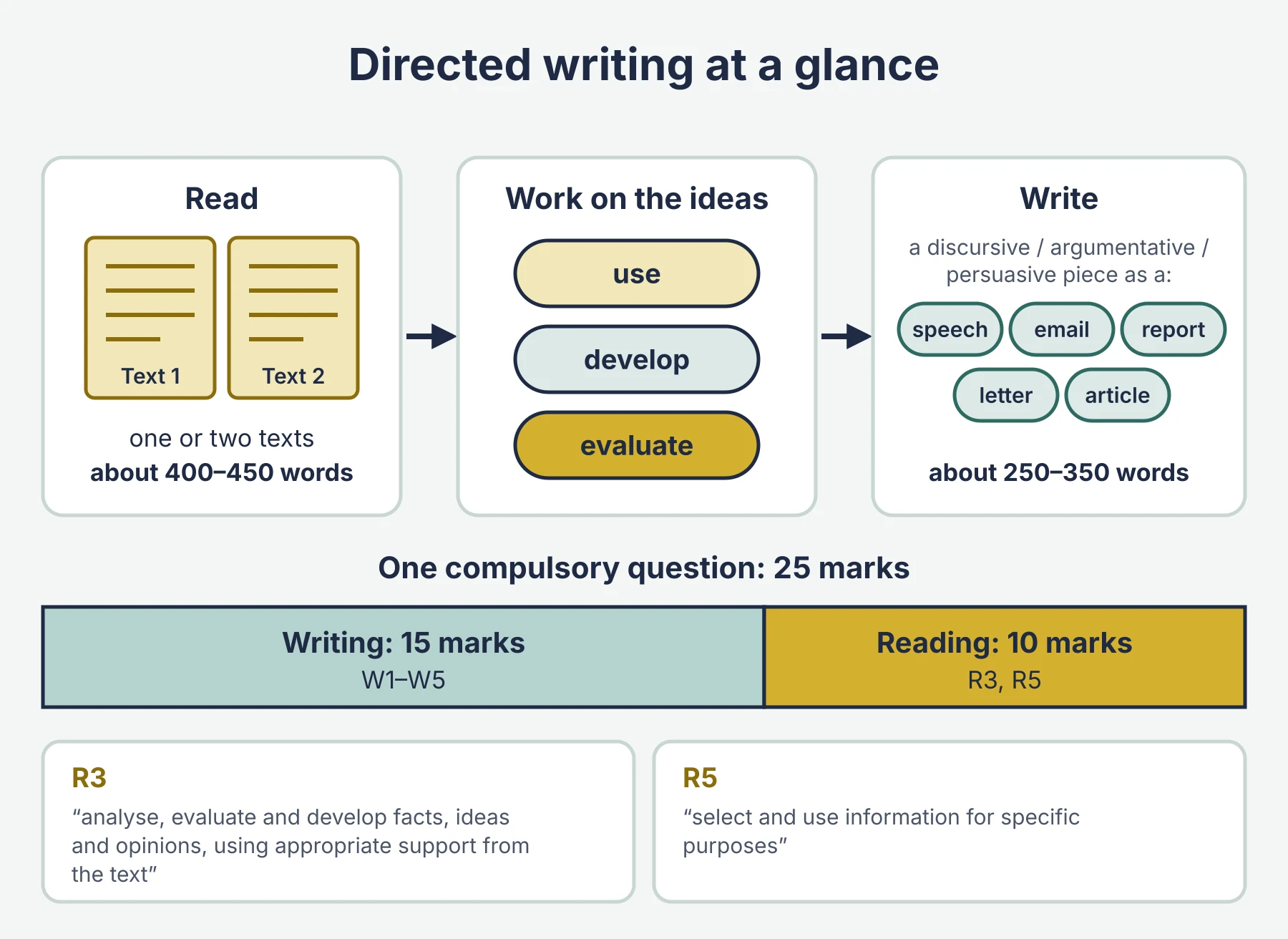
These notes cover Section A, Directed Writing, of 1123 Paper 2: candidates “use, develop and evaluate the information in the text(s) to create a discursive/argumentative/persuasive speech, email, report, letter or article”. The paper overview is in the Paper 2 Writing study guide; the full method and a model paragraph are in the Directed writing study guide.
Task facts
| Fact | Detail |
|---|---|
| Marks | 25: writing 15 (W1–W5) + reading 10 (R3, R5) |
| Sources | one or two texts, about 400–450 words in total, printed on the question paper |
| Length | about 250–350 words |
| Forms | speech, email, report, letter, article |
| Purposes | discursive, argumentative, persuasive |
| Choice | none: one compulsory question |
Reading objectives
- R3: analyse, evaluate and develop facts, ideas and opinions, using appropriate support from the text.
- R5: select and use information for specific purposes.
Use → develop → evaluate
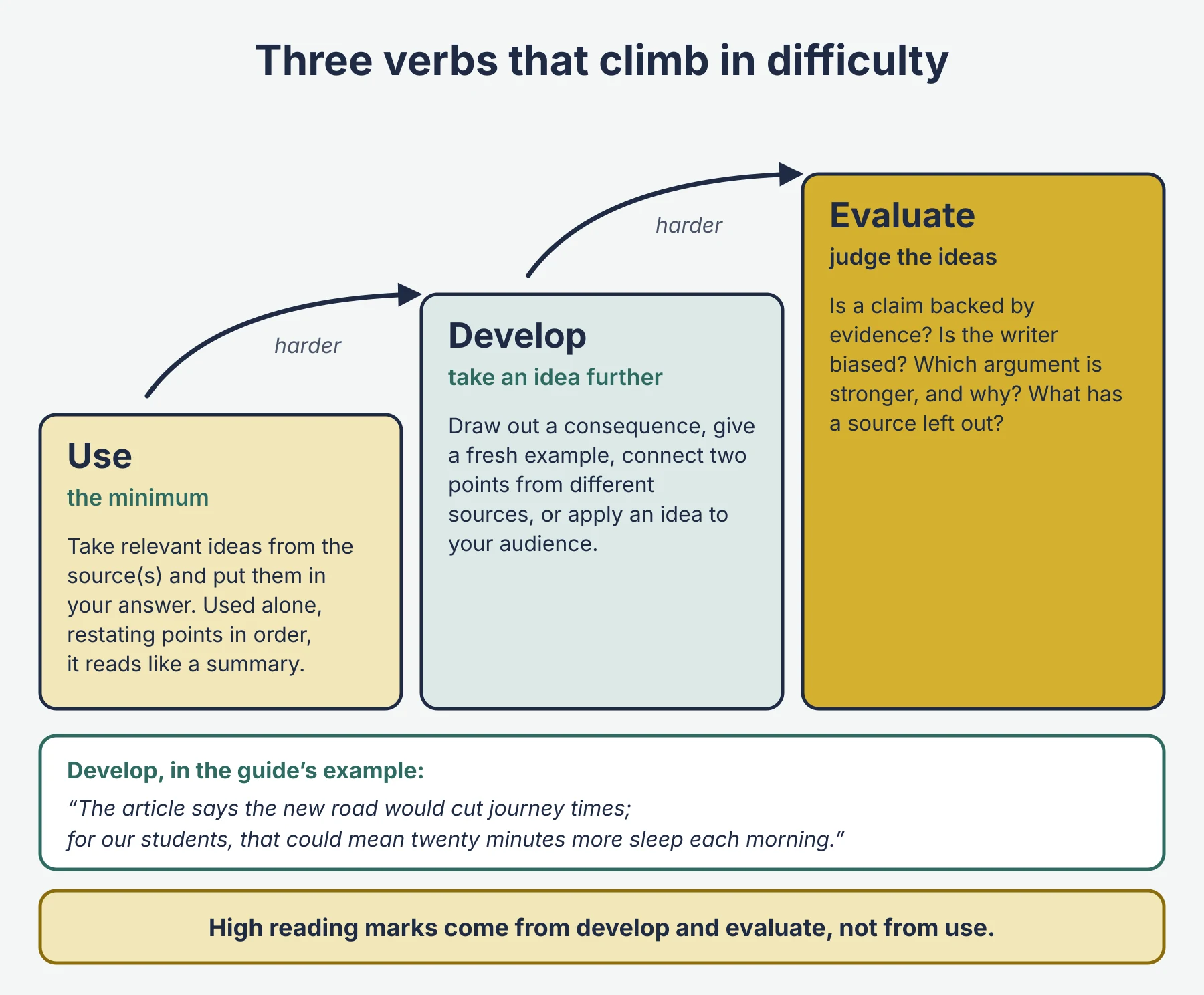
| Verb | What it looks like |
|---|---|
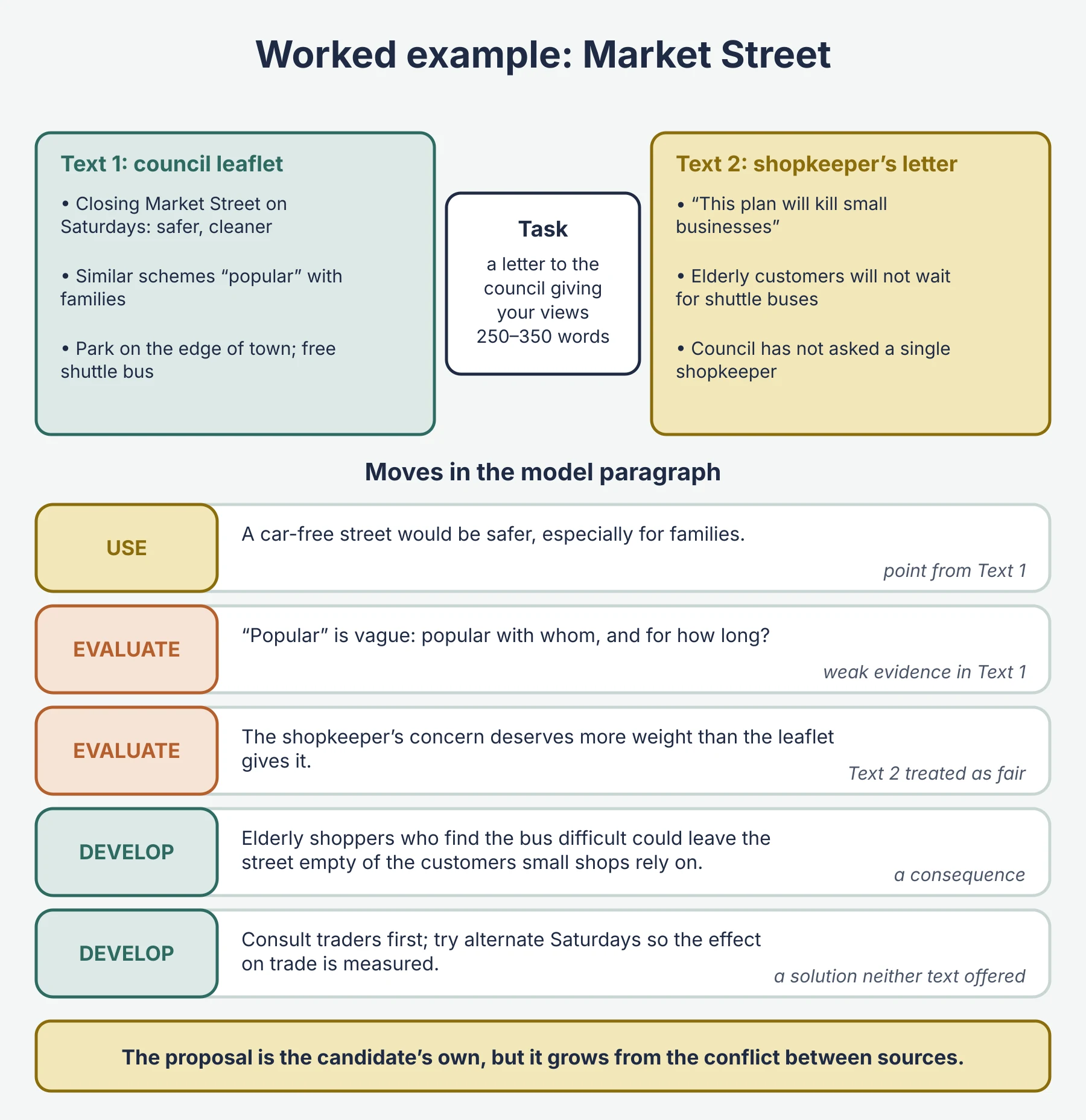
| Use | a source point restated in your own words |
| Develop | a consequence, example, connection or application to the audience |
| Evaluate | a judgement on evidence, bias, strength or importance |
Evaluate (syllabus): “judge or calculate the quality, importance, amount, or value of something”. Consider (syllabus): “review and respond to given information”.
Six questions for every source
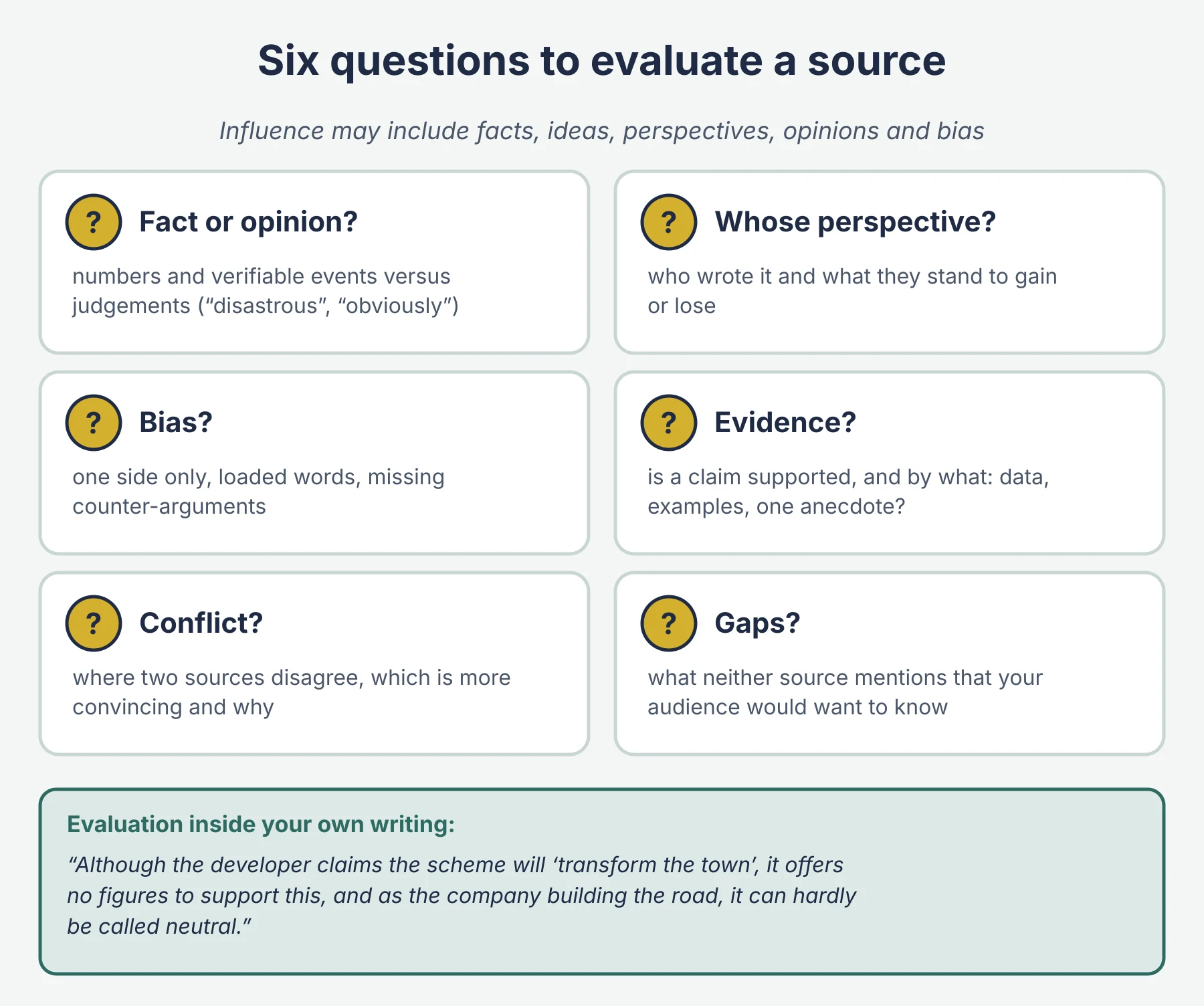
- Fact or opinion?
- Whose perspective, and what is their interest?
- Any bias or loaded language?
- What evidence supports the claim?
- Where do the sources disagree, and who is more convincing?
- What is missing?
Evaluation phrases
- “Although X claims…, it offers no evidence that…”
- “This view is understandable, but…”
- “The more convincing argument is…, because…”
- “Neither text considers…”
- “As the company behind the scheme, the writer can hardly be neutral.”
Form conventions
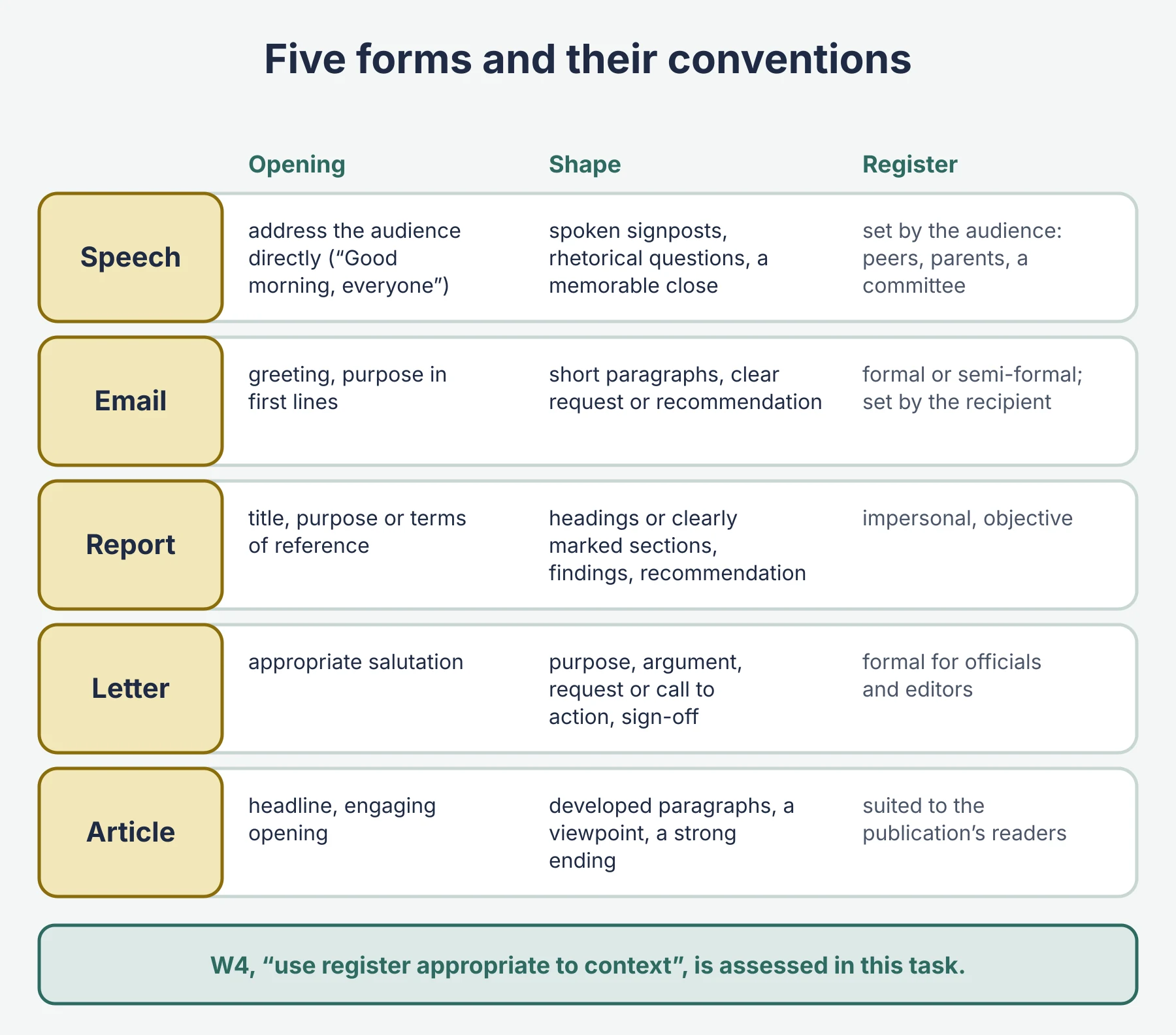
| Form | Must have |
|---|---|
| Speech | direct address, signposts, rhetorical devices, a strong close |
| greeting, early purpose, short paragraphs, clear request, sign-off | |
| Report | title, purpose, sections or headings, findings, recommendation, impersonal tone |
| Letter | salutation, purpose, argument, call to action, appropriate close |
| Article | headline, hook, viewpoint, developed paragraphs, memorable ending |
W4 (register appropriate to context) is assessed in Section A, not Section B. Check the question for bullet points it asks you to cover: each needs its own clear place in the answer.
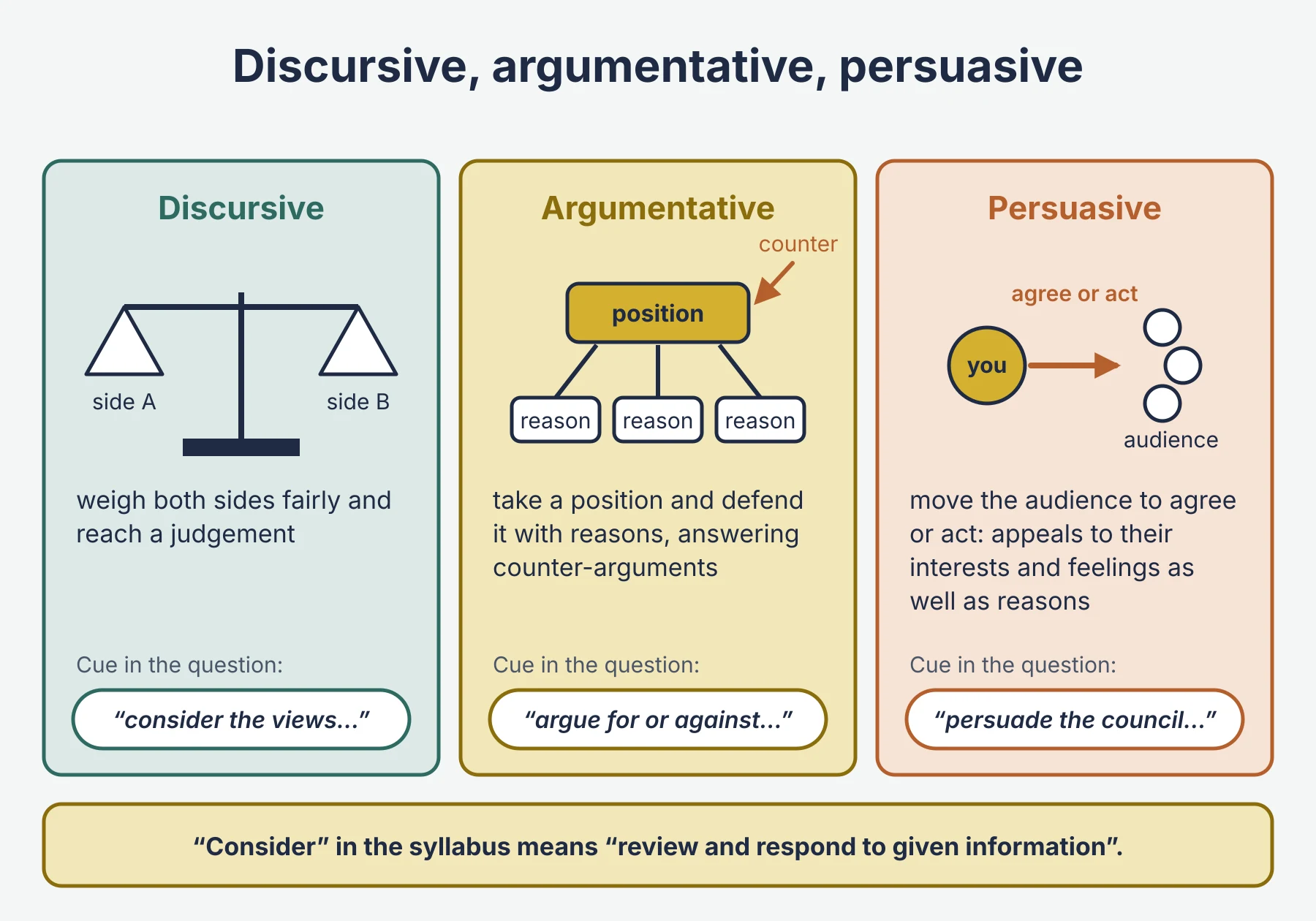
Purposes
- Discursive: both sides weighed, then a judgement.
- Argumentative: a position, defended; counter-arguments answered.
- Persuasive: reasons plus appeals to the audience’s interests and feelings; a call to action.
Paragraph recipe
Source point (used) → your development → your evaluation → link to the purpose or audience.
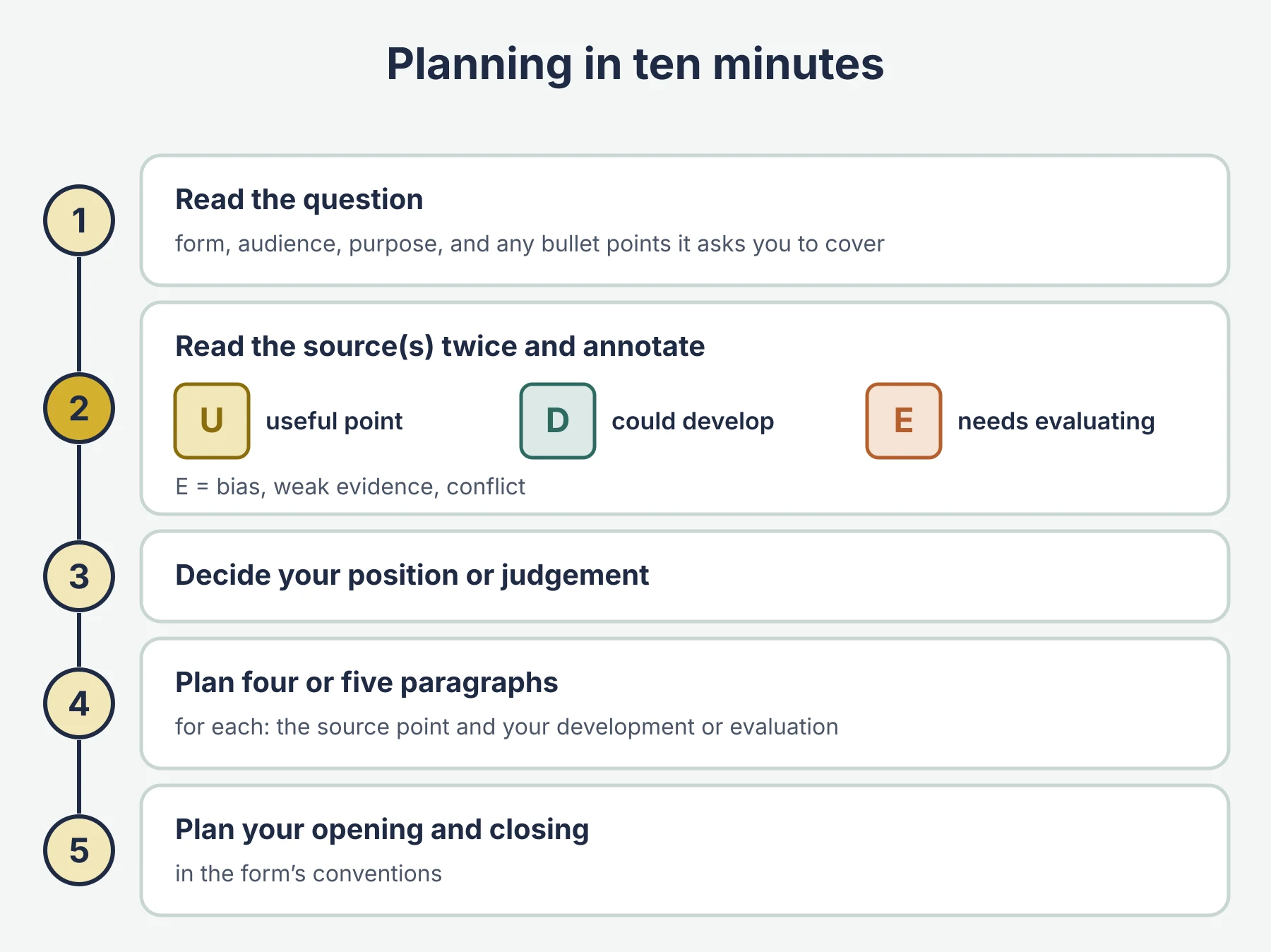
Ten-minute plan
- Question: form, audience, purpose, bullet points.
- Read sources twice; annotate U / D / E.
- Decide position or judgement.
- Four or five paragraphs: source point + development/evaluation for each.
- Opening and closing in the form’s style.
Mini example: annotating a source
Source sentence (original): “The new sports centre will be used by thousands of young people every week, according to the developer.”
- U (use): a new sports centre is planned for young people.
- D (develop): for students at our school, it could replace the overcrowded gym and allow more teams to train.
- E (evaluate): the figure comes from the developer, who profits from the project, and is a prediction, not evidence.
Register ladder
| Audience | Register |
|---|---|
| classmates (speech) | lively, direct, inclusive “we” |
| parents (letter, article) | clear, respectful, reasoned |
| head teacher (report, email) | formal, concise, objective |
| council or newspaper editor (letter) | formal, measured, persuasive |
Exam traps
- Summarising the sources in order.
- Using one source when two are given.
- Lifting long phrases from the texts.
- An essay instead of the form asked for.
- Register drift.
- A missing bullet point.
- Opinions with no link to the sources.
- Far beyond 350 words, leaving no time for Section B.
Self-test
- How are Section A’s 25 marks divided?
- How long are the sources in total, and how long should your answer be?
- Name the five forms.
- What is the difference between “develop” and “evaluate”?
- Define “evaluate” as the syllabus does.
- Give two questions you can ask to evaluate a source.
- Which writing objective is assessed in Section A but not in Section B?
- What must a report contain that a speech does not?
- How does a persuasive piece differ from a discursive one?
- Write an evaluation sentence about a source that says “Everyone agrees the park should close.”
- What does “consider” mean in the syllabus?
- Why is retelling the sources in order a weak approach?
Answers
- Writing 15 (W1–W5) and reading 10 (R3, R5).
- About 400–450 words in total; about 250–350 words.
- Speech, email, report, letter, article.
- Developing takes an idea further (a consequence, example or connection); evaluating judges its quality, evidence or importance.
- “Judge or calculate the quality, importance, amount, or value of something.”
- Any two: fact or opinion? whose perspective? any bias? what evidence? where do sources disagree? what is missing?
- W4, register appropriate to context.
- For example a title, a stated purpose, headings or sections, findings and a recommendation, in an impersonal tone.
- A persuasive piece aims to move the audience to agree or act; a discursive piece weighs both sides before judging.
- For example: “The claim that ‘everyone’ agrees is an exaggeration: the text names no one and ignores the families who use the park daily.”
- “Review and respond to given information.”
- It uses the material but does not develop or evaluate it, so it limits the reading marks for R3.
More resources on this topic
Related resources
-
Study guides
Cambridge O Level English Language (1123): Directed Writing – Writing a Speech
How to write the speech form in 1123 Paper 2 directed writing: spoken register, structure, controlled rhetorical devices and a model built from two sources.
English · Cambridge · O Level
Read guide -
Practice questions
Cambridge O Level English Language (1123): Directed Writing – Writing a Speech – Practice Questions
Original speech-writing practice for 1123 directed writing: register drills, reworking sources, model sections and a full 25-mark speech task on two new texts.
English · Cambridge · O Level
Try questions -
Revision notes
Cambridge O Level English Language (1123): Directed Writing – Writing a Speech – Revision Notes
Condensed notes on the speech form for 1123 directed writing: spoken features, audience and register, structure, reworking sources, traps and a self-test.
English · Cambridge · O Level
Revise topic
Get free revision emails (optional)
Occasional emails with practice questions, worked explanations and links to free resources for the qualification and subjects you choose. No spam, and you can unsubscribe from any email. The free tools on this site never need an email.