
Study Guides
Cambridge O Level English Language (1123): Directed Writing
How to use, develop and evaluate the source texts in 1123 Paper 2 Section A directed writing: the five forms, bias and evidence, planning and a model.
- Subject
- English
- Level
- O LEVELS
- Topic
- Paper 2 – Writing
- Author
- Marlbridge Academic Team
- Updated
- Reviewed by
- Ammar Bilal (what this means)
Aligned to Cambridge O Level English (1123), 2024-2026. Official specification .
Syllabus page (what it covers and how it is assessed): Cambridge O Level English Language.
Found an error? Report a correction.
Need help with this topic? Request a free trial class for O Level English Language (1123).
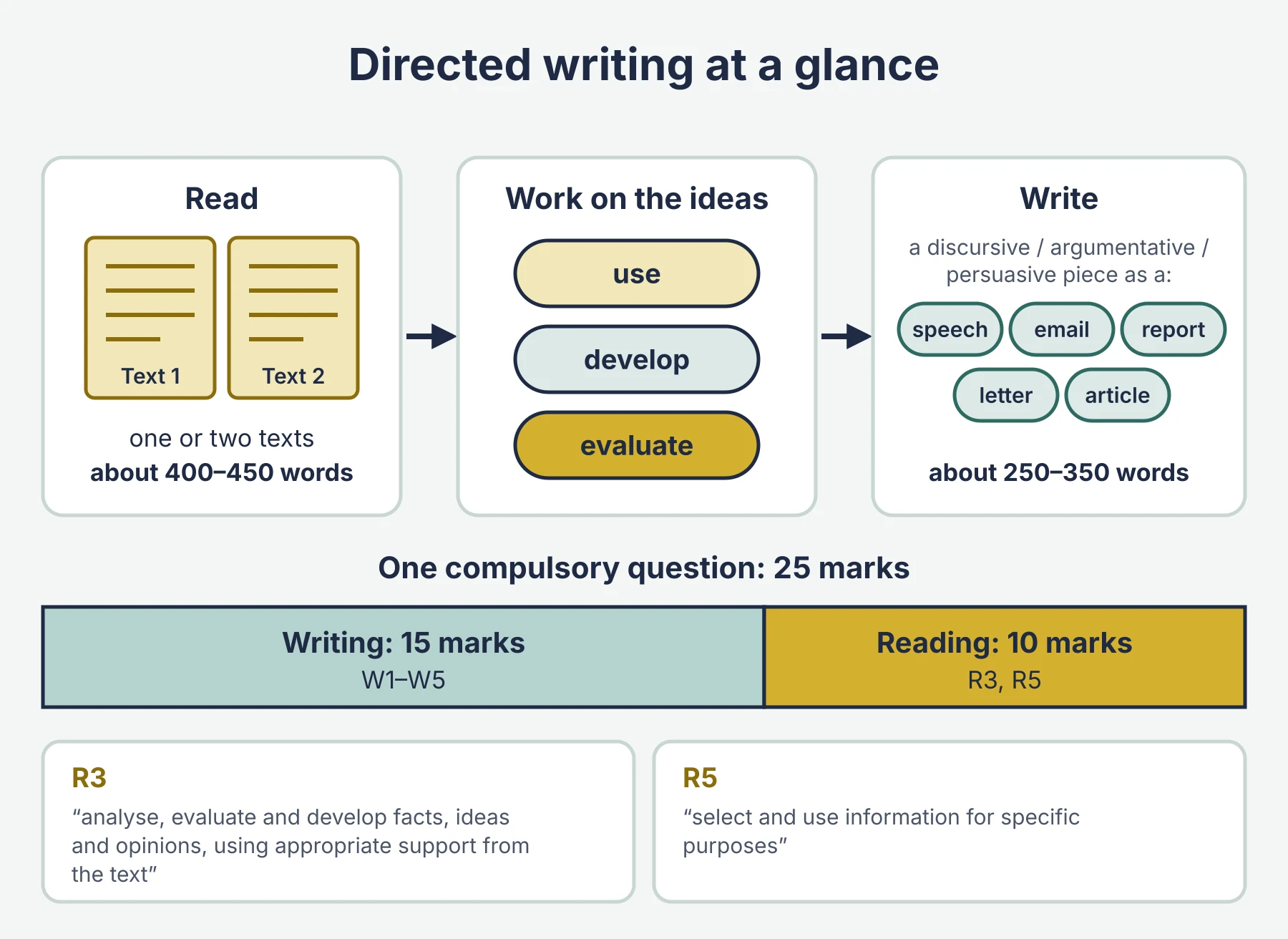
This guide covers Section A, Directed Writing, of Cambridge O Level English Language 1123 Paper 2 Writing. The syllabus says candidates “read one or two texts totalling approximately 400–450 words in length. They use, develop and evaluate the information in the text(s) to create a discursive/argumentative/persuasive speech, email, report, letter or article. Candidates write about 250–350 words.” It is one compulsory question worth 25 marks: 15 for writing (W1–W5) and 10 for reading (R3, R5). The structure of the paper and the marks split are set out in the Paper 2 Writing study guide; this page goes into the three verbs at the heart of the task.
Use, develop, evaluate
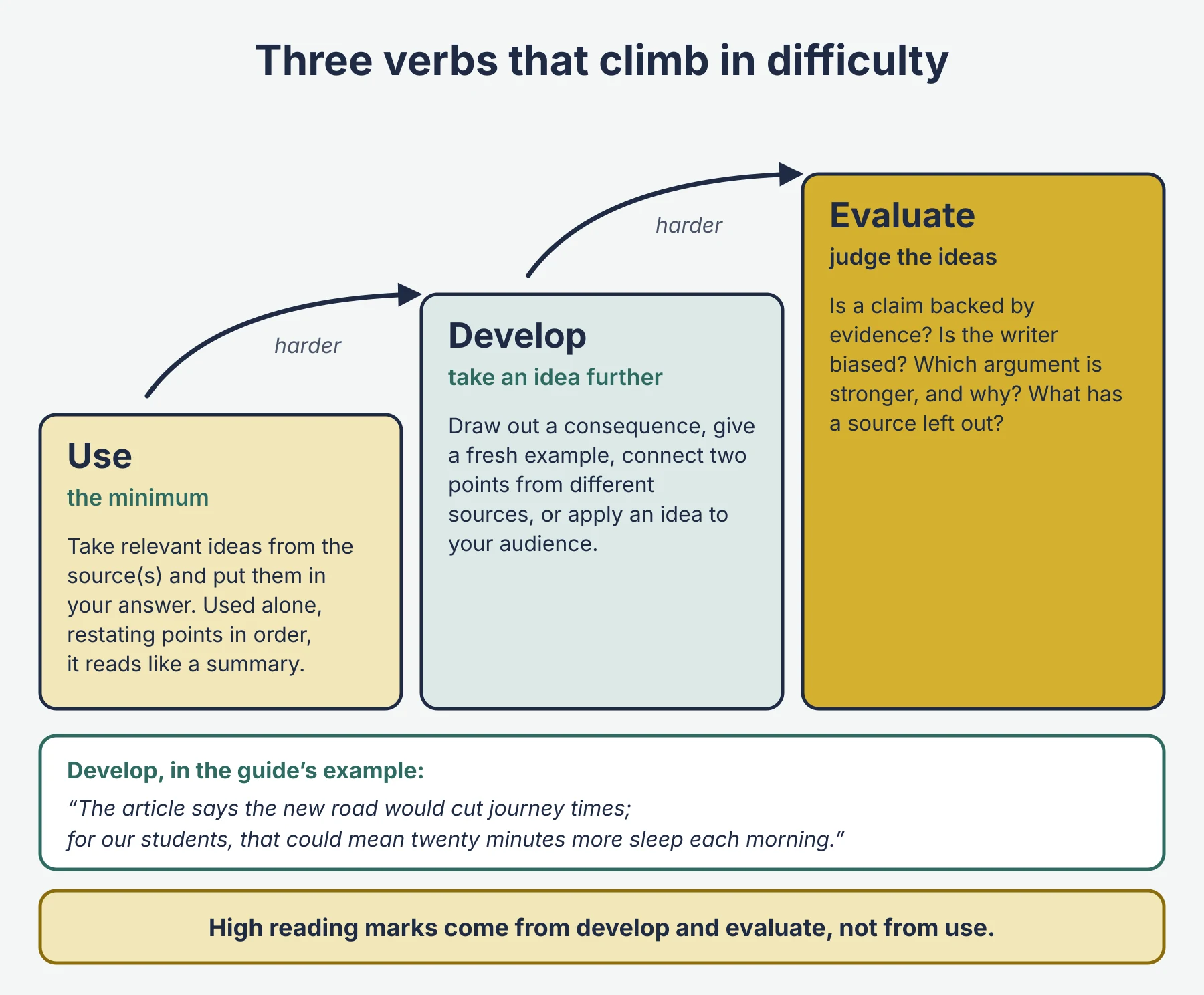
The reading marks test R3, “analyse, evaluate and develop facts, ideas and opinions, using appropriate support from the text”, and R5, “select and use information for specific purposes”. The three verbs in the task description climb in difficulty.
- Use: take relevant ideas from the source(s) and put them in your answer. This is the minimum. An answer that only uses, by restating points in order, reads like a summary.
- Develop: take an idea further. Draw out a consequence, give a fresh example, connect two points from different sources, or apply an idea to your audience. “The article says the new road would cut journey times; for our students, that could mean twenty minutes more sleep each morning.”
- Evaluate: judge the ideas. The syllabus defines Evaluate as “judge or calculate the quality, importance, amount, or value of something”. Is a claim backed by evidence? Is the writer biased? Which argument is stronger, and why? What has a source left out?
High reading marks come from the second and third verbs, not the first.
How to evaluate a source
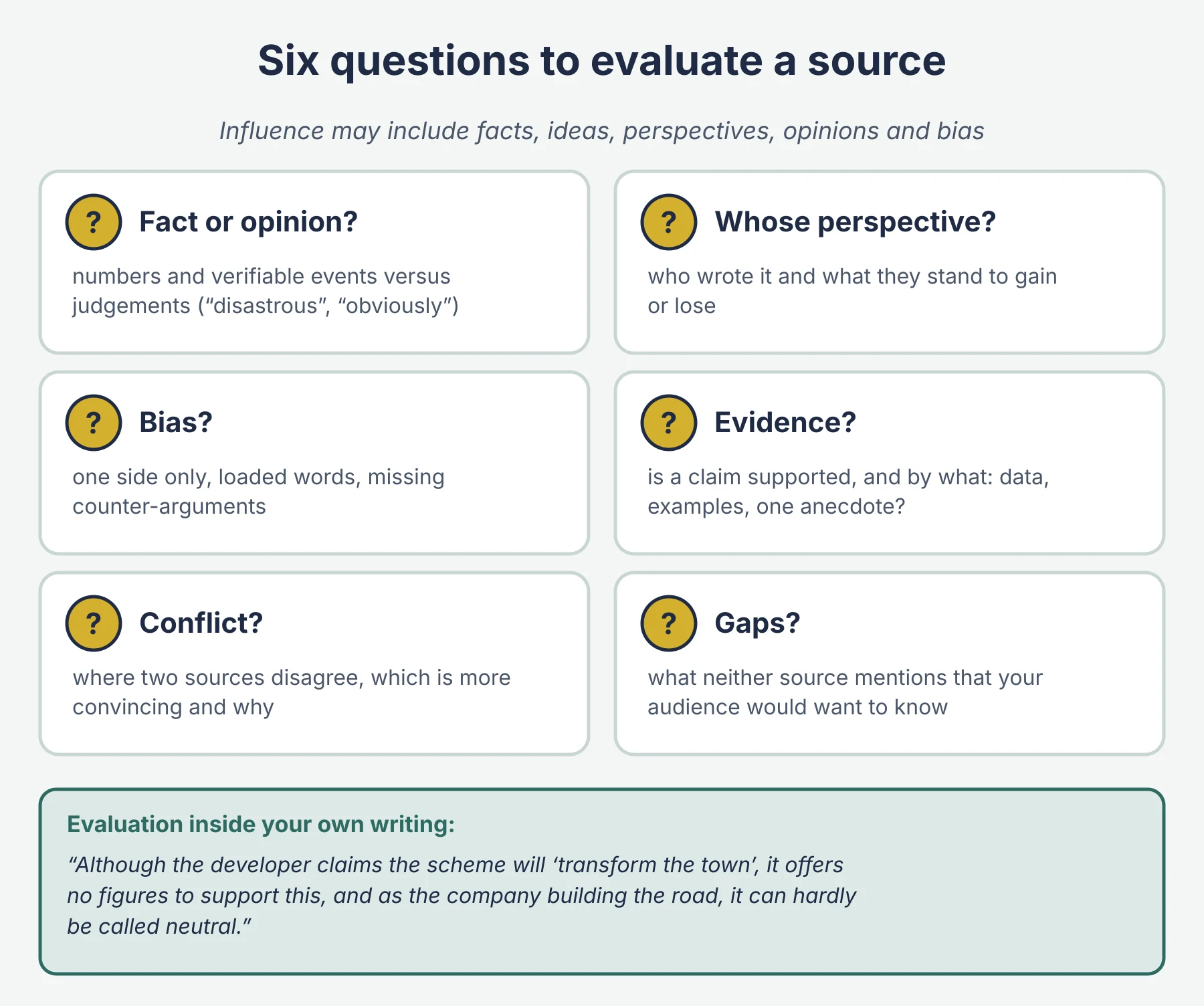
The syllabus asks students to “study how influence may include facts, ideas, perspectives, opinions and bias”. Apply those words as questions:
| Ask | Look for |
|---|---|
| Fact or opinion? | numbers and verifiable events versus judgements (“disastrous”, “obviously”) |
| Whose perspective? | who wrote it and what they stand to gain or lose |
| Bias? | one side only, loaded words, missing counter-arguments |
| Evidence? | is a claim supported, and by what: data, examples, one anecdote? |
| Conflict? | where two sources disagree, which is more convincing and why |
| Gaps? | what neither source mentions that your audience would want to know |
Evaluation sounds natural inside your own writing: “Although the developer claims the scheme will ‘transform the town’, it offers no figures to support this, and as the company building the road, it can hardly be called neutral.”
The five forms and their conventions
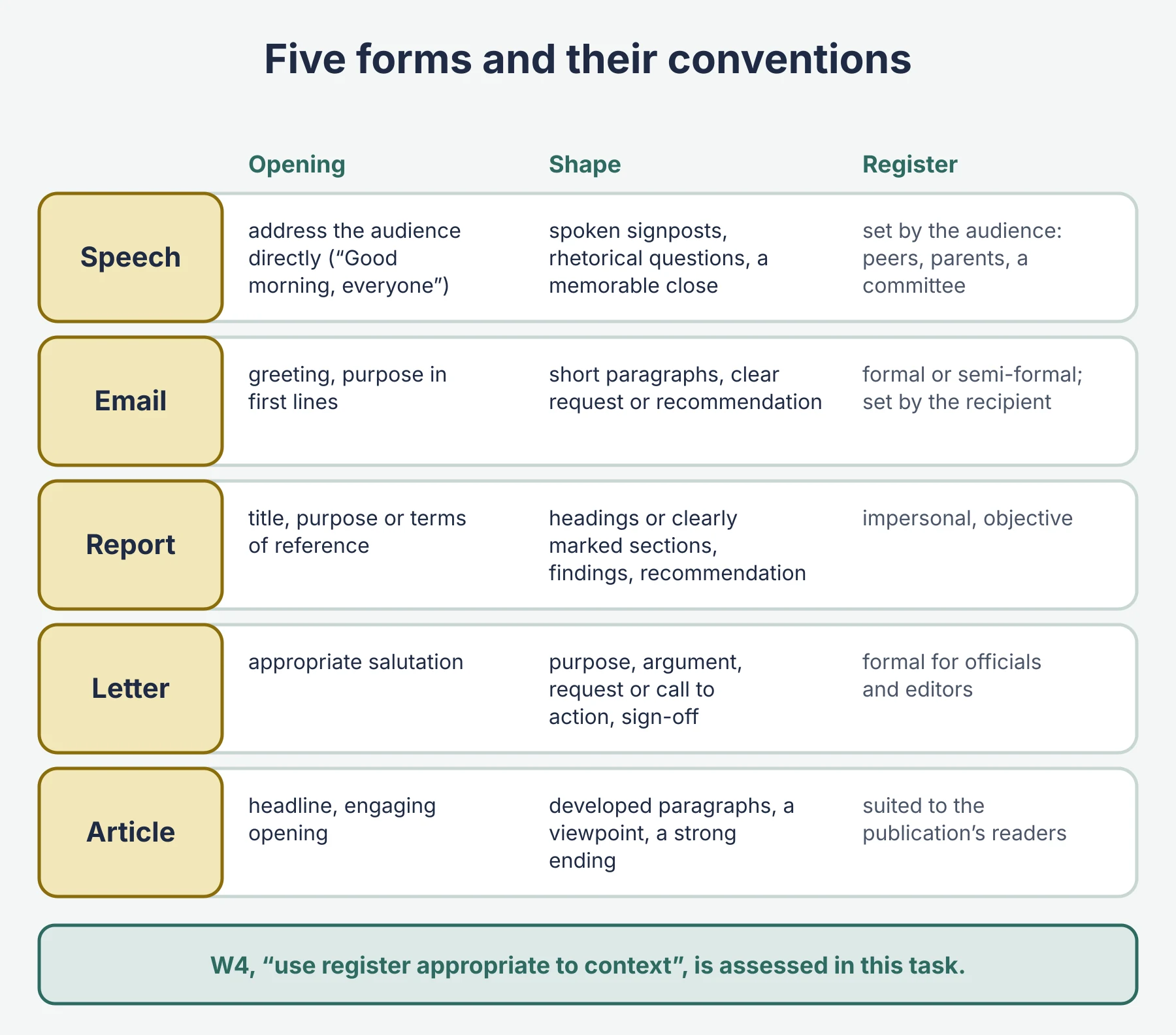
| Form | Opening | Shape | Register |
|---|---|---|---|
| Speech | address the audience directly (“Good morning, everyone”) | spoken signposts, rhetorical questions, a memorable close | set by the audience: peers, parents, a committee |
| greeting, purpose in first lines | short paragraphs, clear request or recommendation | formal or semi-formal; set by the recipient | |
| Report | title, purpose or terms of reference | headings or clearly marked sections, findings, recommendation | impersonal, objective |
| Letter | appropriate salutation | purpose, argument, request or call to action, sign-off | formal for officials and editors |
| Article | headline, engaging opening | developed paragraphs, a viewpoint, a strong ending | suited to the publication’s readers |
W4, “use register appropriate to context”, is assessed here (it is not in Section B), so the form and audience in the question shape every sentence.
Discursive, argumentative, persuasive
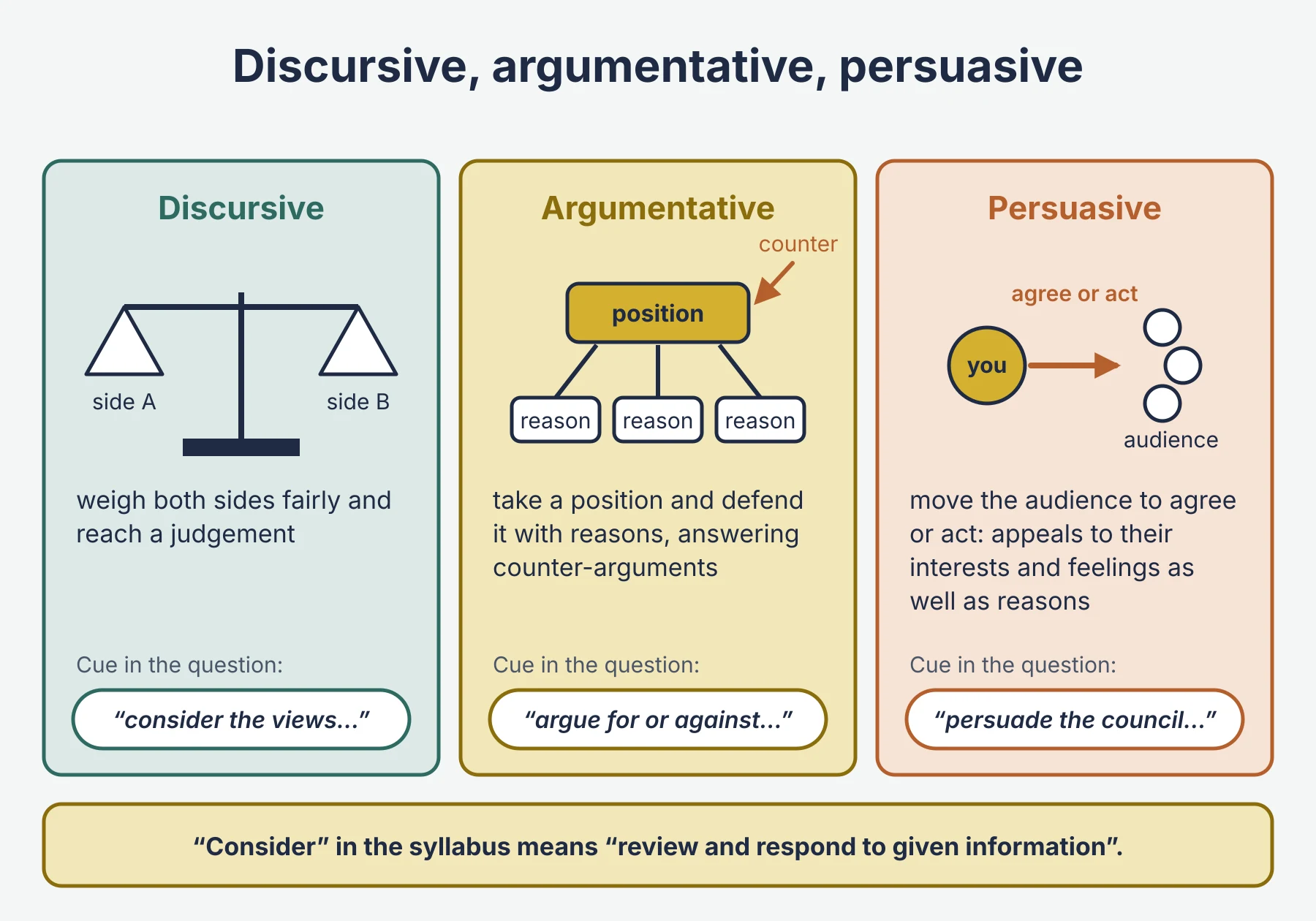
- Discursive: weigh both sides fairly and reach a judgement.
- Argumentative: take a position and defend it with reasons, answering counter-arguments.
- Persuasive: move the audience to agree or act, using appeals to their interests and feelings as well as reasons.
The question tells you which, sometimes by its wording (“persuade the council…”, “consider the views…”, “argue for or against…”). Consider in the syllabus means “review and respond to given information”.
Planning in ten minutes
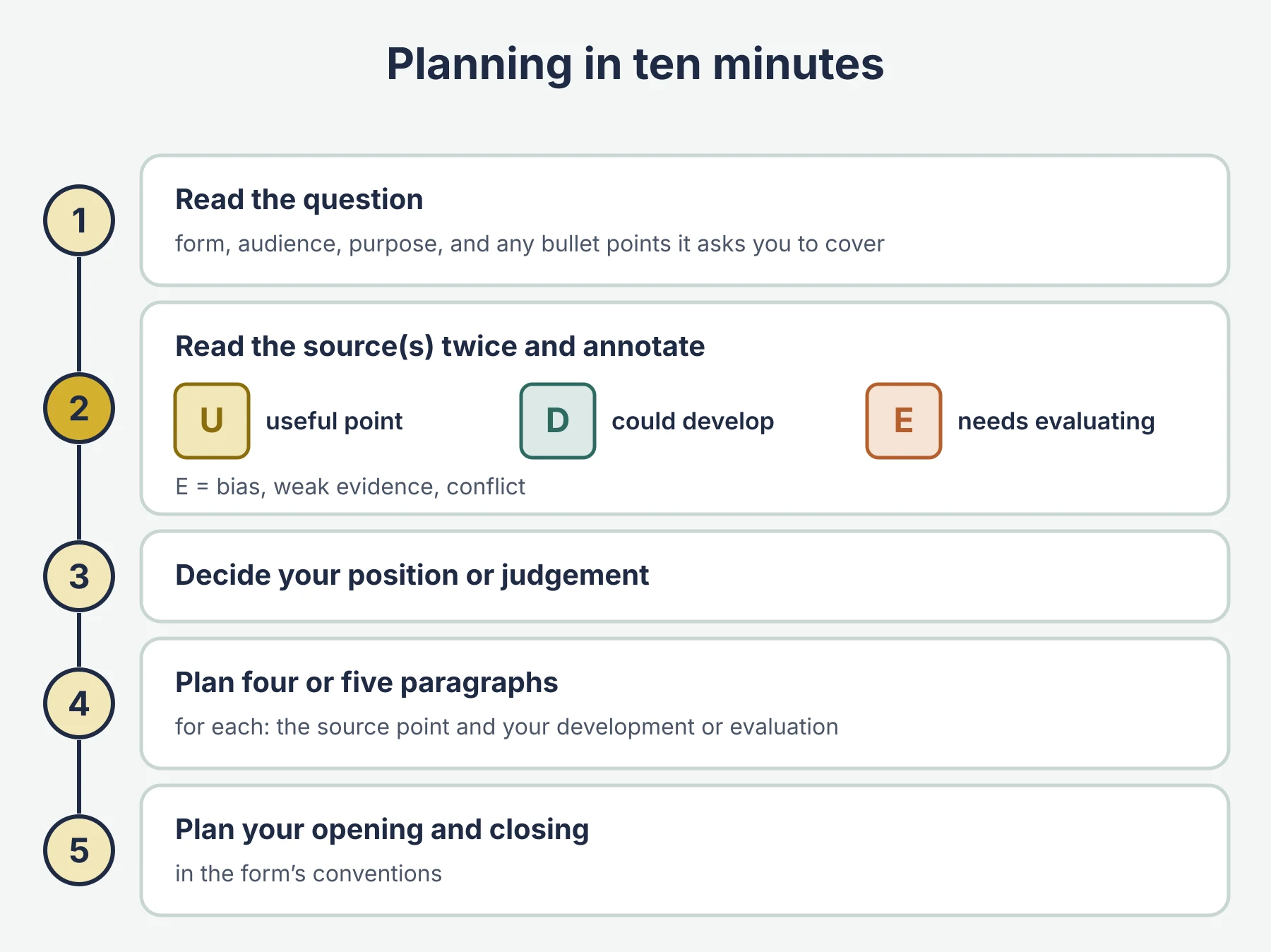
- Read the question: form, audience, purpose, and any bullet points it asks you to cover.
- Read the source(s) twice. Annotate: U (useful point), D (could develop), E (needs evaluating: bias, weak evidence, conflict).
- Decide your position or judgement.
- Plan four or five paragraphs; for each, note the source point and your development or evaluation.
- Plan your opening and closing in the form’s conventions.
Worked example
Sources (original, shortened):
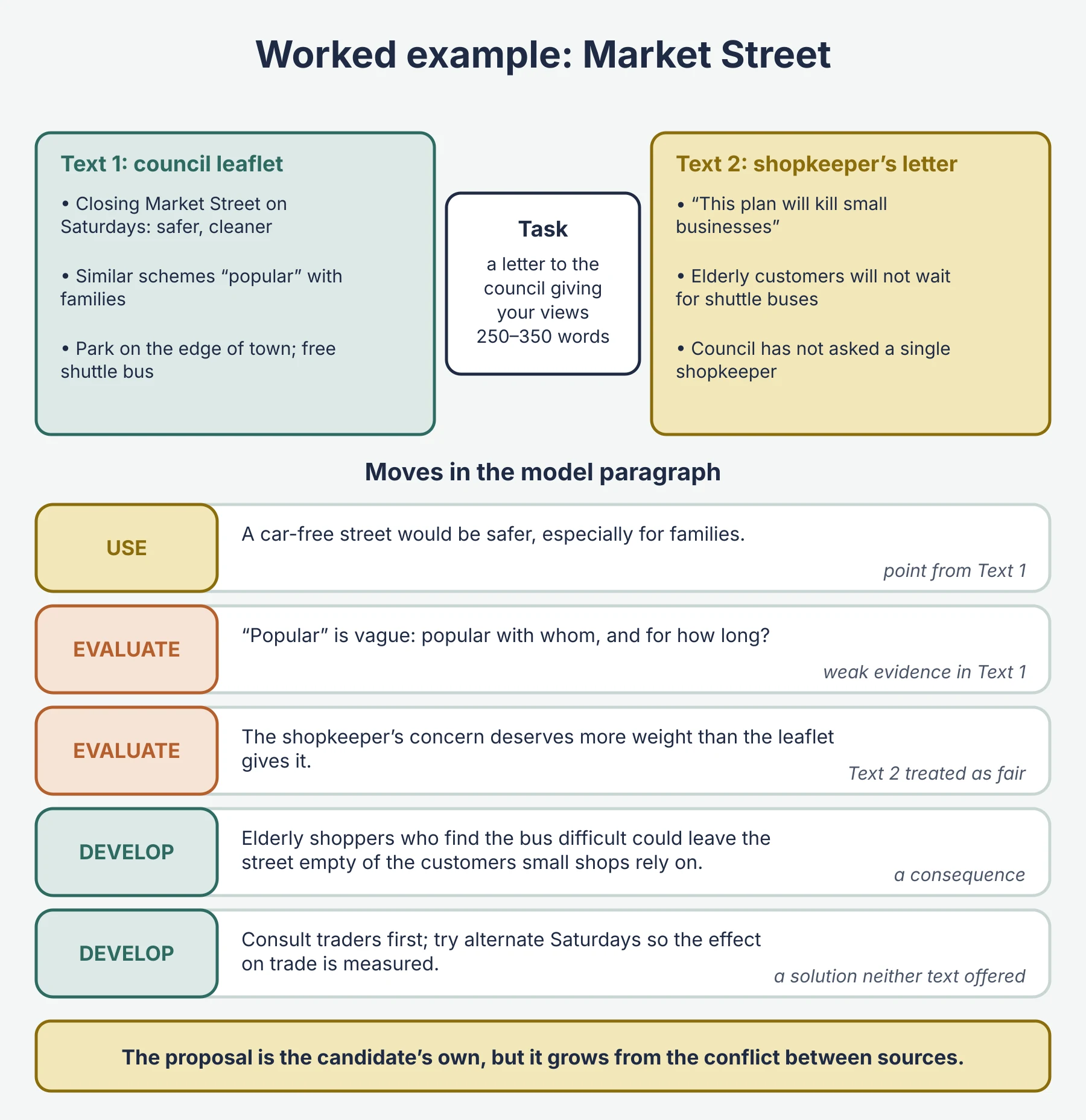
Text 1 (from a council leaflet): Closing Market Street to cars on Saturdays will make the town centre safer and cleaner. Similar schemes elsewhere have been popular with families. Shoppers will be able to park at the new site on the edge of town and take a free shuttle bus.
Text 2 (from a shopkeeper’s letter to the local paper): This plan will kill small businesses. My customers are elderly and will not wait for shuttle buses. Saturday is my busiest day. The council has not asked a single shopkeeper what we think.
Task: Write a letter to the council, giving your views on the plan. Write about 250–350 words.
Model paragraph (evaluating and developing):
The council’s leaflet is right that a car-free street would be safer, especially for the families who crowd Market Street on Saturdays. However, the claim that similar schemes have been “popular” is vague: popular with whom, and for how long? The shopkeeper’s concern deserves more weight than the leaflet gives it. If elderly shoppers find the shuttle bus difficult, the scheme could empty the street of exactly the customers small shops rely on. I would therefore urge the council to consult traders before any decision and to consider a trial on alternate Saturdays, so that its effect on trade can be measured rather than guessed.
Commentary: the paragraph uses points from both texts, evaluates them (vague evidence in Text 1; Text 2’s complaint about consultation treated as fair), and develops a solution neither source offered (a trial on alternate Saturdays). The register suits a letter to the council: polite, reasoned, direct. The closing proposal is the candidate’s own, but it grows directly from the conflict between the two sources, which is what makes it development rather than invention.
Openings and closings by form
| Form | Opening (original examples) | Closing |
|---|---|---|
| Speech | “Good morning, everyone. Raise your hand if you came to school by car today.” | “So next time you reach for the car keys, ask yourself: is there another way?” |
| Letter | “Dear Councillor Ahmed, I am writing about the proposal to close Market Street…” | “I look forward to hearing how the council will respond. Yours sincerely,…” |
| Report | “Purpose: this report considers the proposal and makes a recommendation.” | “Recommendation: a trial period of one term, followed by a review.” |
| Article | “Saturday mornings on Market Street could soon sound very different.” | a final line that returns to the opening image |
| “Dear Ms Lee, I am writing to ask for your support for…” | “Thank you for considering this. Best wishes,…” |
Common mistakes
- Retelling the sources in order, with no development or judgement.
- Ignoring one text when two are given.
- Copying long phrases: the sources’ words should be reworked into your own argument.
- Writing an essay when a letter, speech or report was asked for; missing form features.
- Register drift: a chatty phrase in a formal letter, or a stiff, impersonal tone in a speech to classmates.
- Leaving out a required bullet point in the question.
- Opinions with no source basis: personal views are welcome only when they grow from the material.
More resources on this topic
Related resources
-
Study guides
Cambridge O Level English Language (1123): Directed Writing – Writing an Article
How to write the article form in 1123 directed writing: headlines, hooks, writing for a publication's readers, viewpoint, source quotations and a model article.
English · Cambridge · O Level
Read guide -
Practice questions
Cambridge O Level English Language (1123): Directed Writing – Writing an Article – Practice Questions
Original article-writing practice for 1123 directed writing: headlines, hooks, register, model paragraphs and a full 25-mark newspaper article on two new texts.
English · Cambridge · O Level
Try questions -
Revision notes
Cambridge O Level English Language (1123): Directed Writing – Writing an Article – Revision Notes
Condensed notes on the article form for 1123 directed writing: headlines, hooks, register by publication, paragraph recipe, endings, traps and a self-test.
English · Cambridge · O Level
Revise topic
Get free revision emails (optional)
Occasional emails with practice questions, worked explanations and links to free resources for the qualification and subjects you choose. No spam, and you can unsubscribe from any email. The free tools on this site never need an email.