
Study Guides
Cambridge O Level English Language (1123): Descriptive Composition
Writing the 350-450-word descriptive composition in 1123 Paper 2 Section B: structure without plot, precise detail, atmosphere and a model passage.
- Subject
- English
- Level
- O LEVELS
- Topic
- Paper 2 – Writing
- Author
- Marlbridge Academic Team
- Updated
- Reviewed by
- Ammar Bilal (what this means)
Aligned to Cambridge O Level English (1123), 2024-2026. Official specification .
Syllabus page (what it covers and how it is assessed): Cambridge O Level English Language.
Found an error? Report a correction.
Need help with this topic? Request a free trial class for O Level English Language (1123).
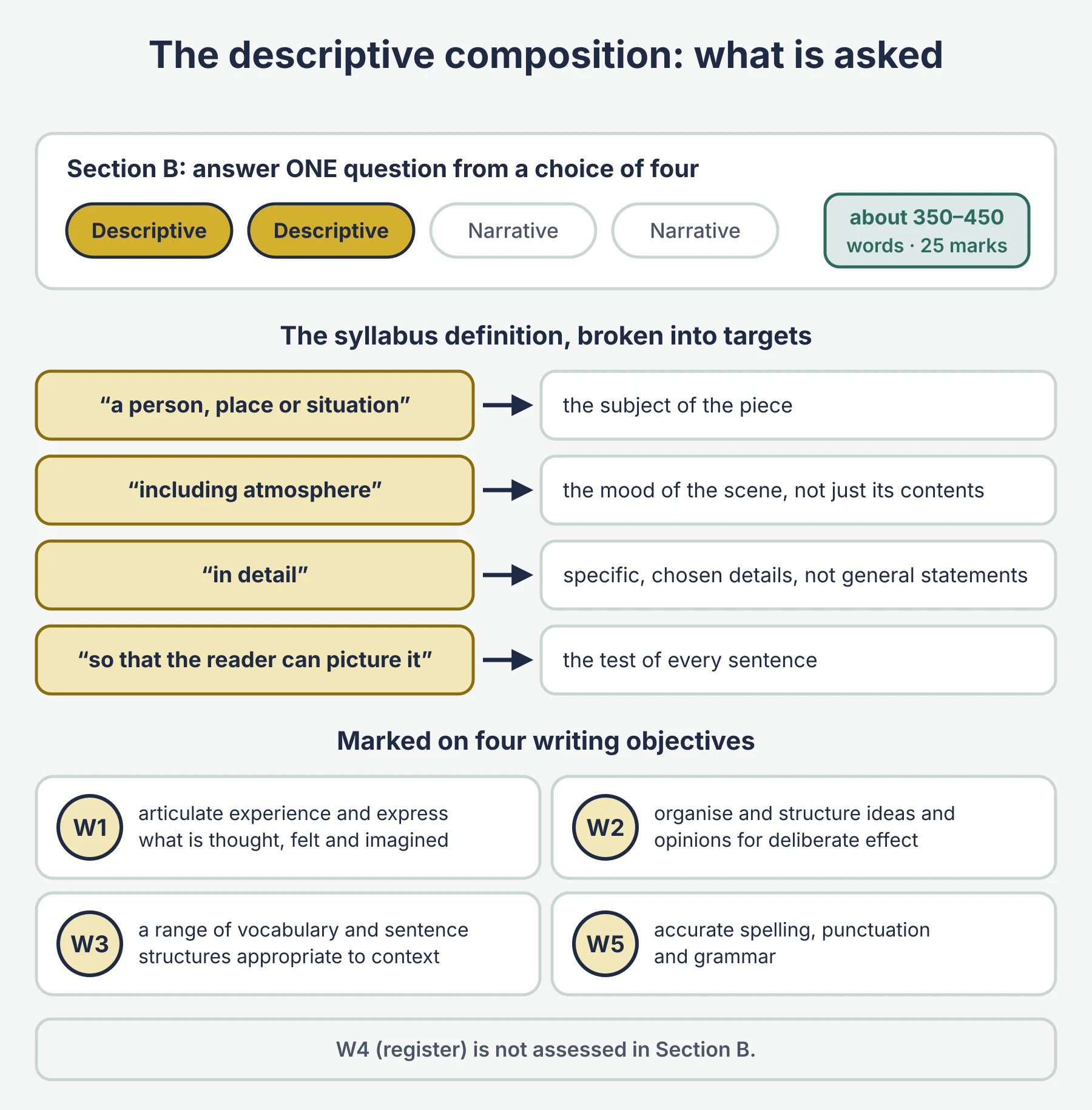
This guide covers the descriptive option in Section B, Composition, of Cambridge O Level English Language 1123 Paper 2 Writing. Candidates “answer one question from a choice of four: two descriptive and two narrative” and “write about 350–450 words”. The syllabus defines the type: “A descriptive piece of writing describes a person, place or situation (including atmosphere) in detail so that the reader can picture it.” The composition carries 25 marks, all for writing objectives W1, W2, W3 and W5. For the structure of the paper, see the Paper 2 Writing study guide. This page is about making a description work without a story to carry it.
What the definition asks of you
Break the syllabus definition into its parts and each becomes a target:
- “a person, place or situation”: the subject. Titles might name a busy place, a moment of waiting, a person you admire, a scene at a particular time of day.
- “including atmosphere”: the mood of the scene, not just its contents.
- “in detail”: specific, chosen details rather than general statements.
- “so that the reader can picture it”: the test of every sentence.
The objectives point the same way: W1 “articulate experience and express what is thought, felt and imagined”; W2 “organise and structure ideas and opinions for deliberate effect”; W3 “use a range of vocabulary and sentence structures appropriate to context”; W5 “make accurate use of spelling, punctuation and grammar”. Register (W4) is not assessed in Section B.
Description is not a story
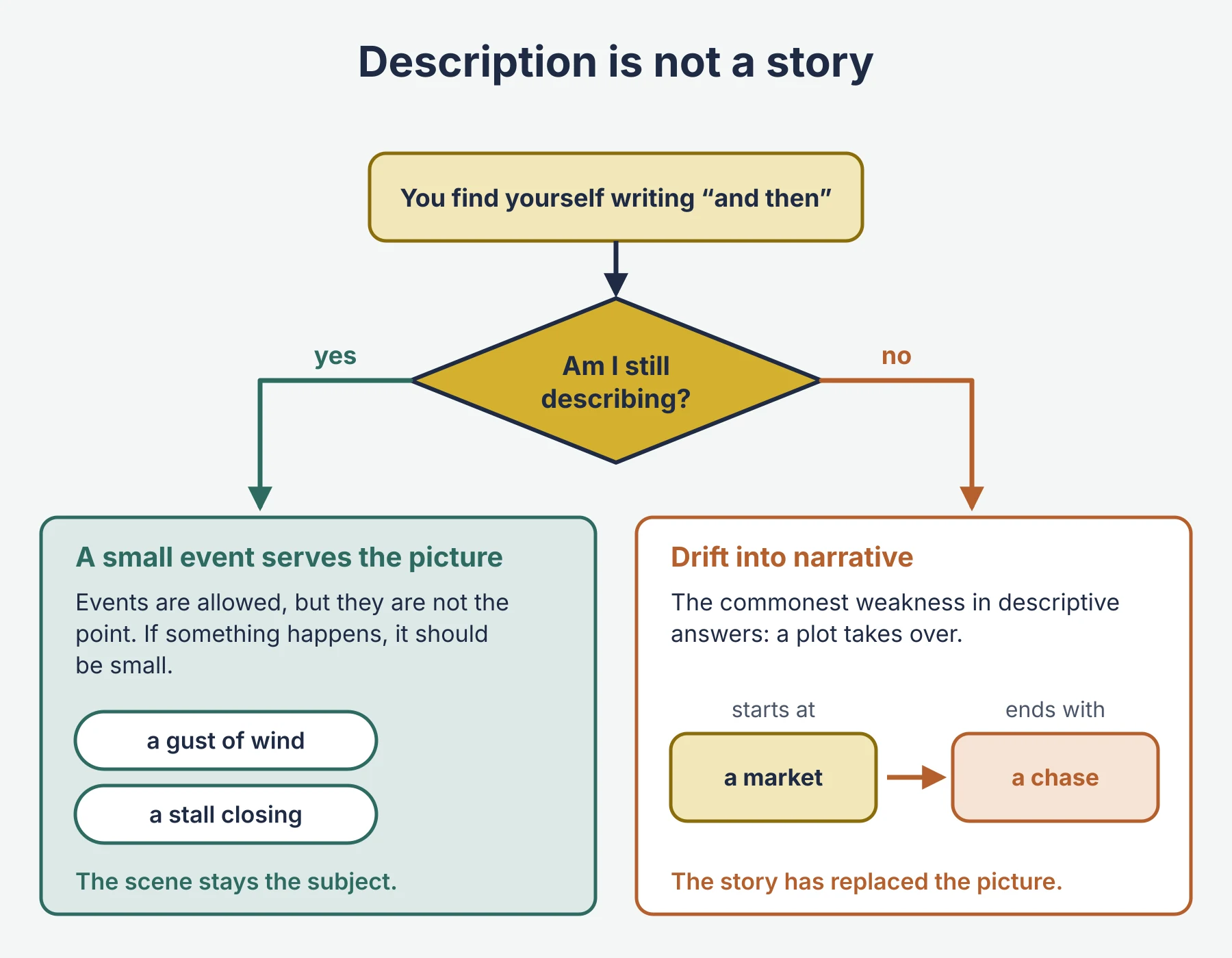
The commonest weakness in descriptive answers is drift into narrative: the piece starts at a market and ends with a chase. Events are allowed, but they are not the point. If something happens, it should be small and serve the picture (a gust of wind, a stall closing). If you find yourself writing “and then”, ask whether you are still describing.
Structures that work without plot
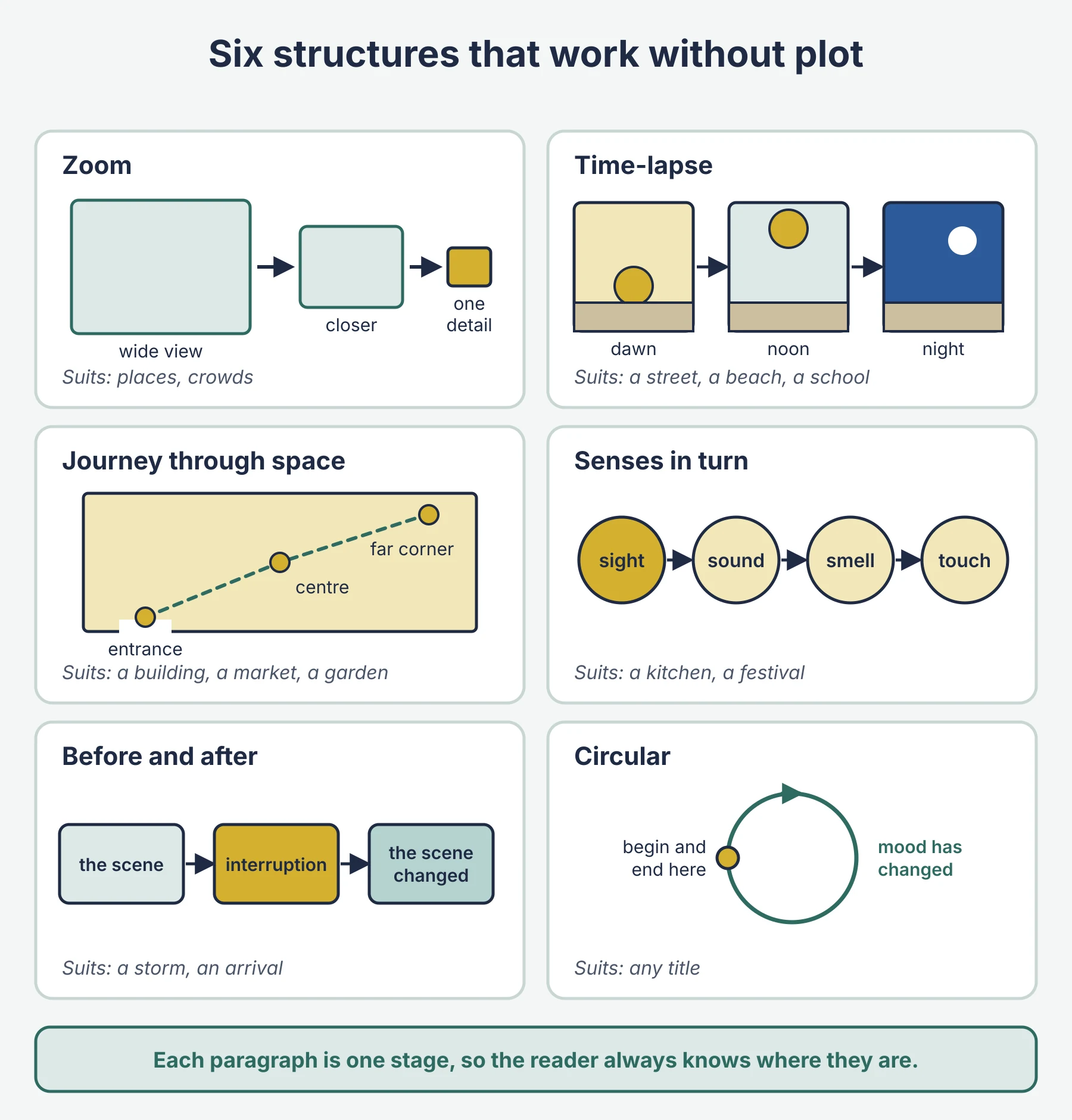
Description still needs deliberate structure for W2. Choose one before you write:
| Structure | How it moves | Suits |
|---|---|---|
| Zoom | wide view, then closer, then one tiny detail | places, crowds |
| Time-lapse | the same place at dawn, noon, night | a street, a beach, a school |
| Journey through space | entrance, centre, far corner | a building, a market, a garden |
| Senses in turn | sight, then sound, smell, touch | a kitchen, a festival |
| Before and after | the scene, an interruption, the scene changed | a storm, an arrival |
| Circular | end where you began, with the mood changed | any |
Each paragraph is a stage of the structure, so the reader always knows where they are.
Detail that does work
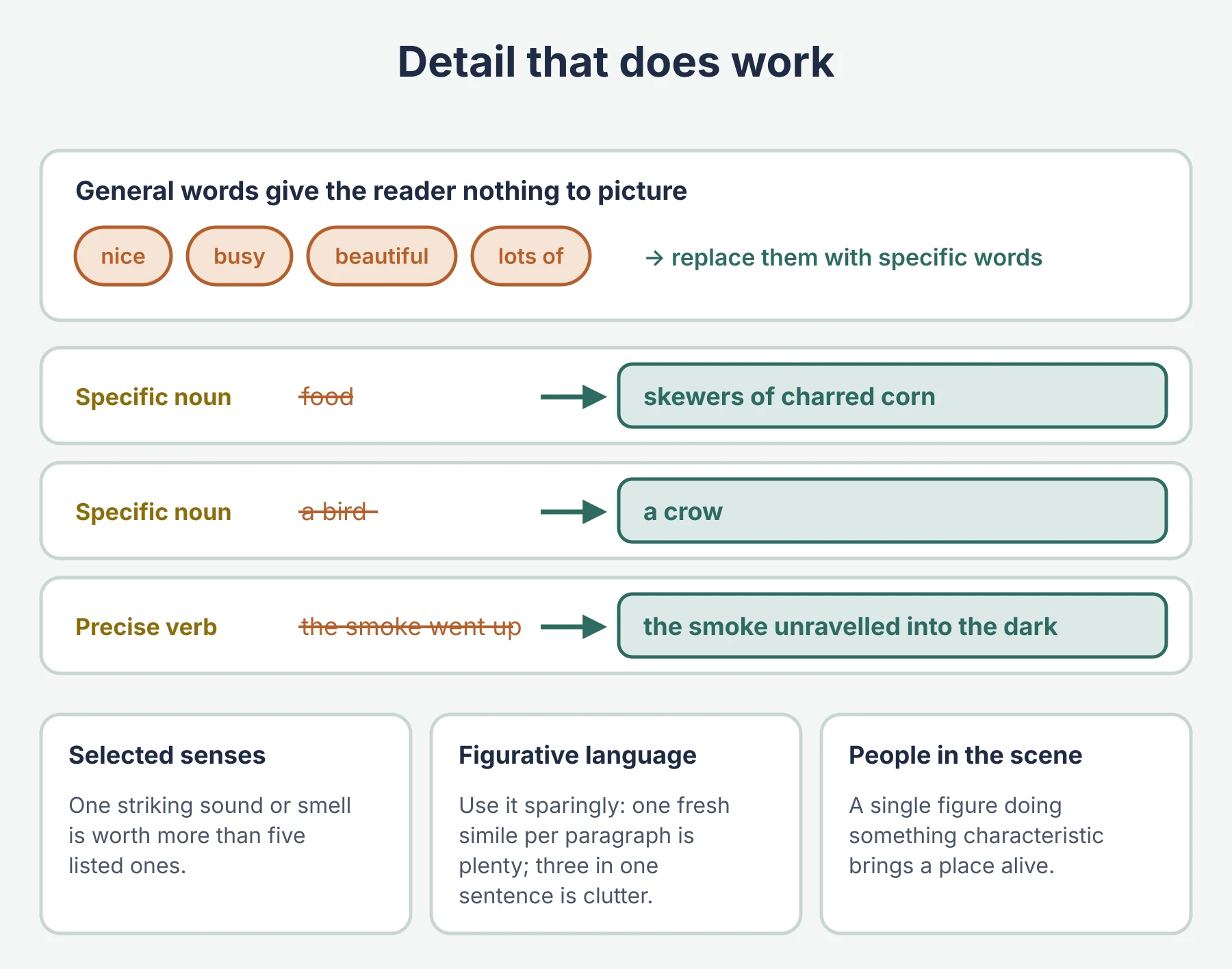
General words (nice, busy, beautiful, lots of) tell the reader nothing to picture. Replace them with:
- Specific nouns: not “food” but “skewers of charred corn”; not “a bird” but “a crow”.
- Precise verbs: not “the smoke went up” but “the smoke unravelled into the dark”.
- Selected senses: one striking sound or smell is worth more than five listed ones.
- Figurative language used sparingly: one fresh simile per paragraph is plenty; three in one sentence becomes clutter.
- People in the scene: a single figure doing something characteristic brings a place alive.
Building atmosphere
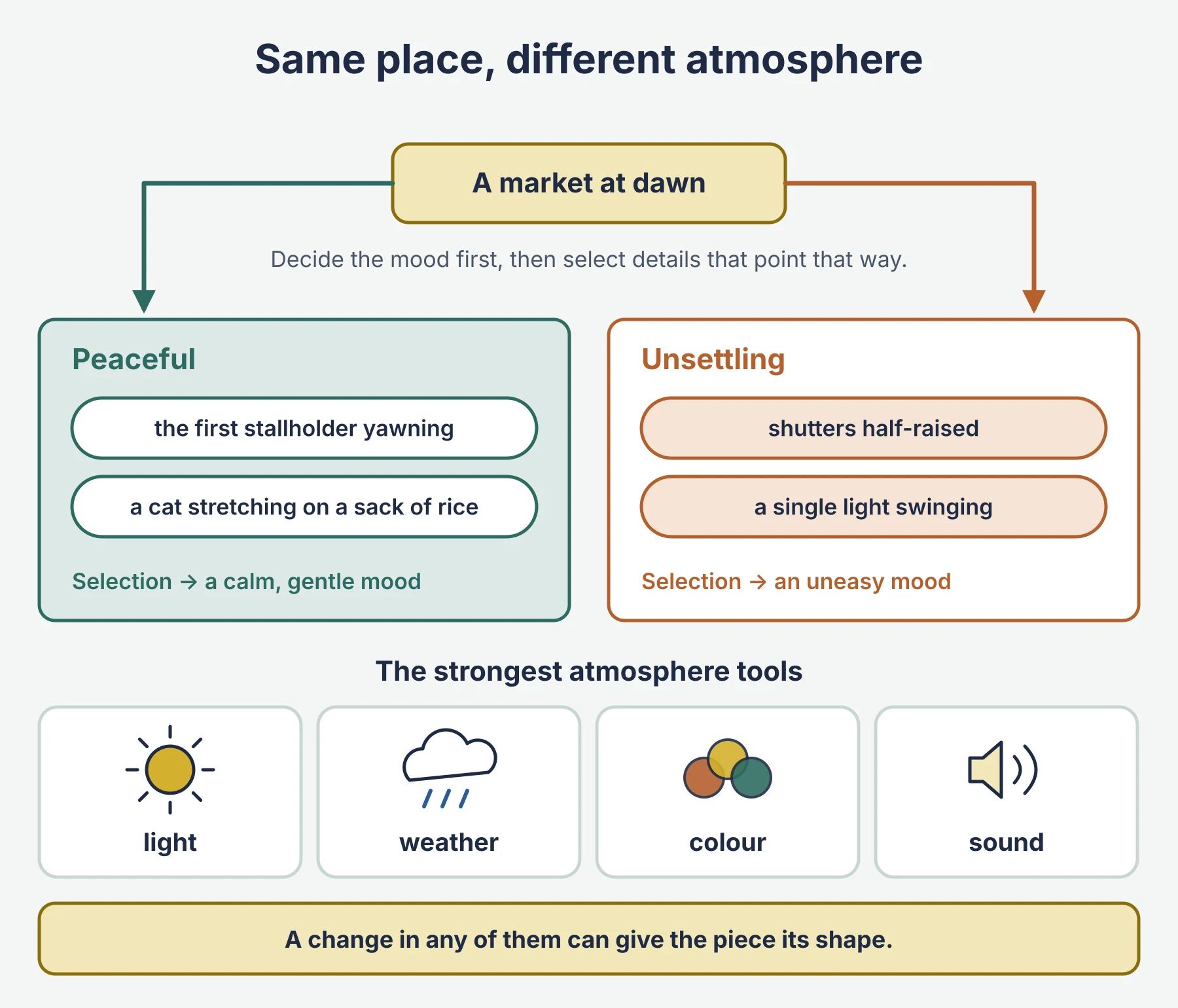
Atmosphere is the feeling the details add up to. Decide it before you write: tense, peaceful, melancholy, festive, eerie. Then choose details that point that way. A market at dawn can be peaceful (the first stallholder yawning, a cat stretching on a sack of rice) or unsettling (shutters half-raised, a single light swinging). The place is the same; the selection makes the mood.
Light, weather, colour and sound are the strongest atmosphere tools. A change in any of them can give the piece its shape.
Sentence control
W3 rewards “a range of … sentence structures appropriate to context”. In description:
- A long, accumulating sentence can convey abundance or movement.
- A short sentence after long ones creates a pause or a focus.
- Starting with something other than the subject varies rhythm: “Above the stalls, …”, “Slowly, …”, “Steaming in the cold air, …”.
- Present tense gives immediacy; past tense gives reflection. Choose one and hold it.
Model passage
Title (original): Describe a railway station late at night.
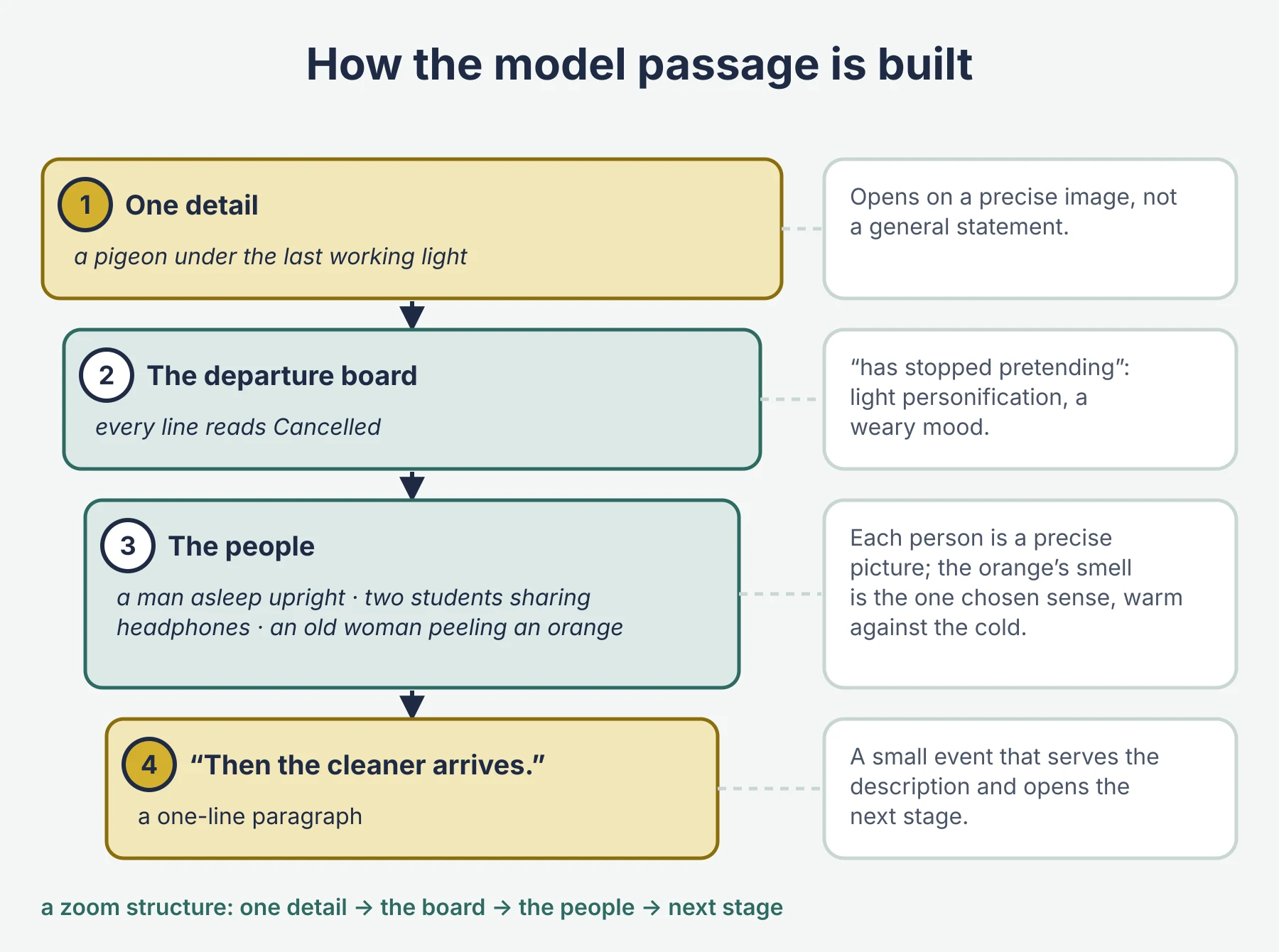
Under the last working light on platform four, a pigeon walks in slow circles, as if it too has missed its train. The departure board has stopped pretending: every line reads Cancelled, and the letters glow a tired orange against the dark. Somewhere a vending machine hums to itself.
Along the benches, the remaining travellers have arranged themselves into small islands of patience. A man in a crumpled suit sleeps sitting upright, his briefcase held against his chest like a pillow. Two students share one pair of headphones, nodding to a beat no one else can hear. An old woman peels an orange with great care, and its sharp, bright smell drifts across the platform, the only warm thing in the station.
Then the cleaner arrives.
Commentary: the passage moves from one detail (the pigeon) to the board, then to people, a zoom structure. Each person is a precise picture. The orange’s smell is the single, chosen sense that gives warmth against a cold atmosphere. Personification (“has stopped pretending”, “hums to itself”) is light and consistent with a weary mood. The one-line paragraph “Then the cleaner arrives.” is a small event that serves the description, opening the next stage without turning it into a story.
Choosing between the two descriptive titles
Pick the title for which you can see one particular place, person or moment clearly, with at least eight concrete details already in your head. A title that sounds impressive but leaves you with only general impressions (“a beautiful landscape”) will produce general writing. Places you know well, reshaped by a time of day or a change of weather, often give the richest material. Check, too, that you can find an atmosphere in the title; if nothing about the scene suggests a mood, the piece is likely to read as a list.
Common mistakes
- Drifting into narrative with a plot that takes over.
- Listing senses mechanically: “I could see… I could hear… I could smell…”
- Overwriting: adjective piled on adjective, simile on simile.
- No structure: details in random order, so W2 suffers.
- Tense switching between present and past.
- General words instead of specific ones.
- Ignoring the title’s angle: “late at night” matters as much as “railway station”.
Exam technique
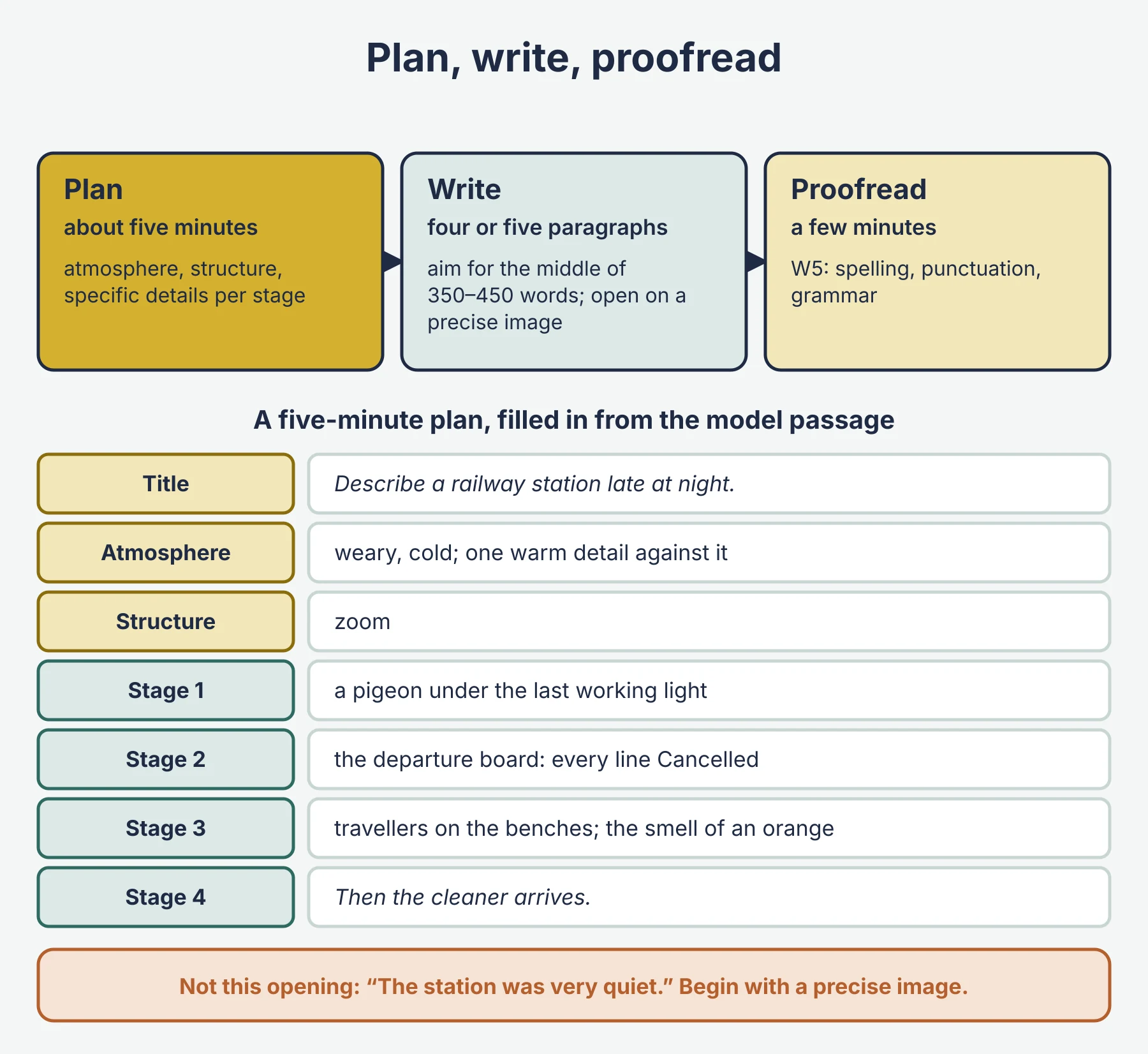
- Spend about five minutes planning: atmosphere, structure, a list of specific details per stage.
- Write four or five paragraphs; aim for the middle of the 350–450 range.
- Begin with a precise image, not a general statement (“The station was very quiet”).
- Keep a few minutes to proofread for W5: spelling, punctuation, grammar.
More resources on this topic
Related resources
-
Practice questions
Cambridge O Level English Language (1123): Descriptive Composition – Practice Questions
Original detail, structure and sentence drills plus a full 25-mark descriptive composition for 1123 Paper 2 Section B, with model answers and marking guidance.
English · Cambridge · O Level
Try questions -
Revision notes
Cambridge O Level English Language (1123): Descriptive Composition – Revision Notes
Condensed notes for the 1123 Paper 2 descriptive composition: the definition, objectives, six structures, detail and atmosphere tools, traps and a self-test.
English · Cambridge · O Level
Revise topic -
Study guides
Cambridge O Level English Language (1123): Directed Writing
How to use, develop and evaluate the source texts in 1123 Paper 2 Section A directed writing: the five forms, bias and evidence, planning and a model.
English · Cambridge · O Level
Read guide
Get free revision emails (optional)
Occasional emails with practice questions, worked explanations and links to free resources for the qualification and subjects you choose. No spam, and you can unsubscribe from any email. The free tools on this site never need an email.