
Study Guides
Cambridge O Level English Language (1123): Narrative Composition
Writing the 350-450-word narrative composition in 1123 Paper 2 Section B: shaping connected events, openings, tension, dialogue, endings and a model opening.
- Subject
- English
- Level
- O LEVELS
- Topic
- Paper 2 – Writing
- Author
- Marlbridge Academic Team
- Updated
- Reviewed by
- Ammar Bilal (what this means)
Aligned to Cambridge O Level English (1123), 2024-2026. Official specification .
Syllabus page (what it covers and how it is assessed): Cambridge O Level English Language.
Found an error? Report a correction.
Need help with this topic? Request a free trial class for O Level English Language (1123).
This guide covers the narrative option in Section B, Composition, of Cambridge O Level English Language 1123 Paper 2 Writing. Candidates choose one question “from a choice of four: two descriptive and two narrative” and “write about 350–450 words”. The syllabus definition is: “A narrative piece of writing tells a story containing a sequence of connected events which may be real or imaginary.” The composition carries 25 marks, for W1, W2, W3 and W5. For the paper’s structure, see the Paper 2 Writing study guide. This page is about shaping a story that fits the word range and earns the structure and language marks.
What “connected events” means
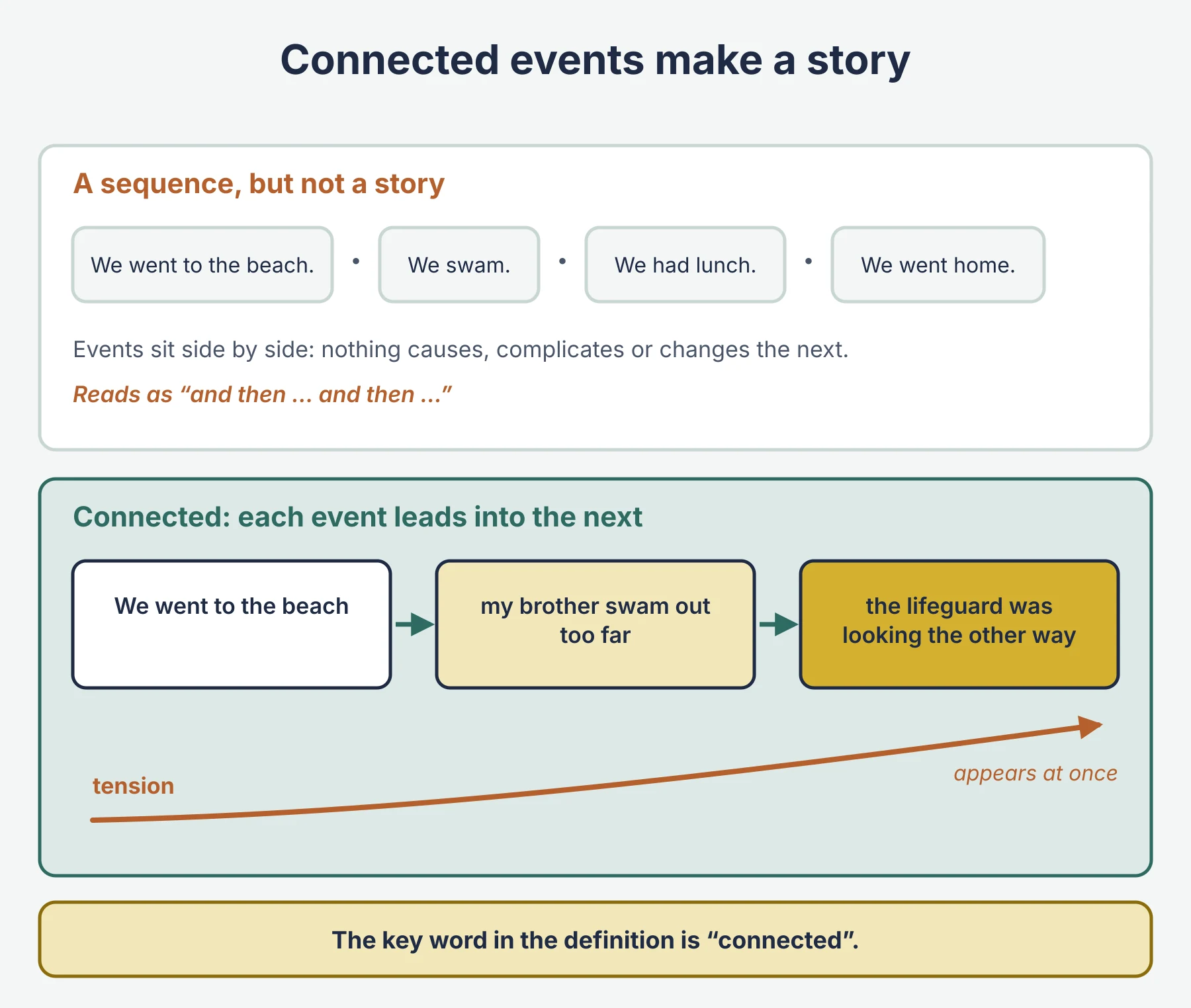
The definition’s key word is connected. A narrative is not a list of things that happened; each event should cause, complicate or change the next. “We went to the beach. We swam. We had lunch. We went home” is a sequence but not a story. “We went to the beach; my brother swam out too far; the lifeguard was looking the other way” is connected, and tension appears at once.
W2, “organise and structure ideas and opinions for deliberate effect”, is where a narrative’s shape is rewarded. W1, “articulate experience and express what is thought, felt and imagined”, rewards convincing characters and feelings. W3 rewards range in vocabulary and sentence structure; W5 accuracy.
Small is better
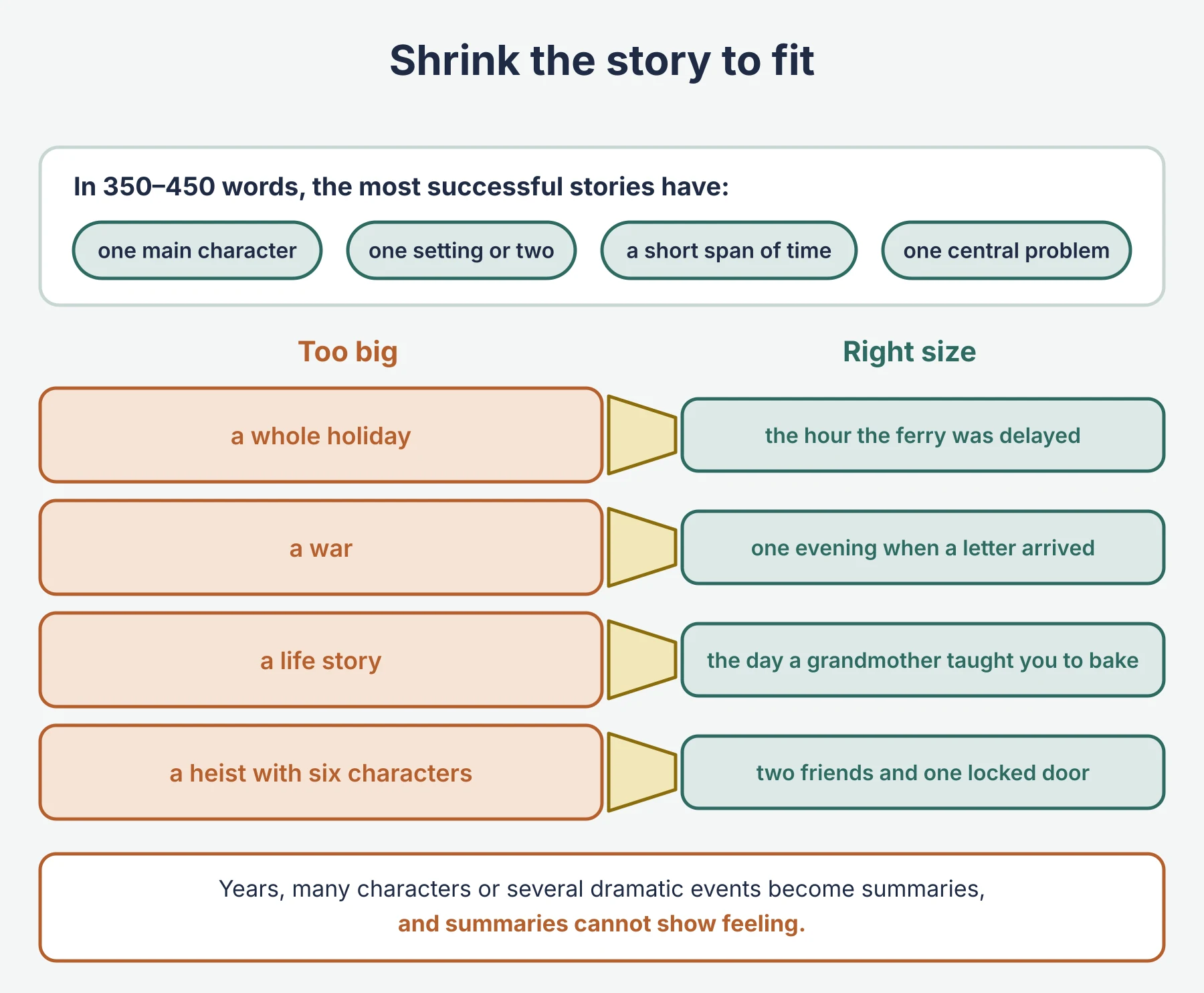
With 350–450 words, the most successful stories are small: one main character, one setting or two, a short span of time, one central problem. Stories that cover years, many characters or several dramatic events become summaries, and summaries cannot show feeling.
| Too big | Right size |
|---|---|
| a whole holiday | the hour the ferry was delayed |
| a war | one evening when a letter arrived |
| a life story | the day a grandmother taught you to bake |
| a heist with six characters | two friends and one locked door |
A simple shape
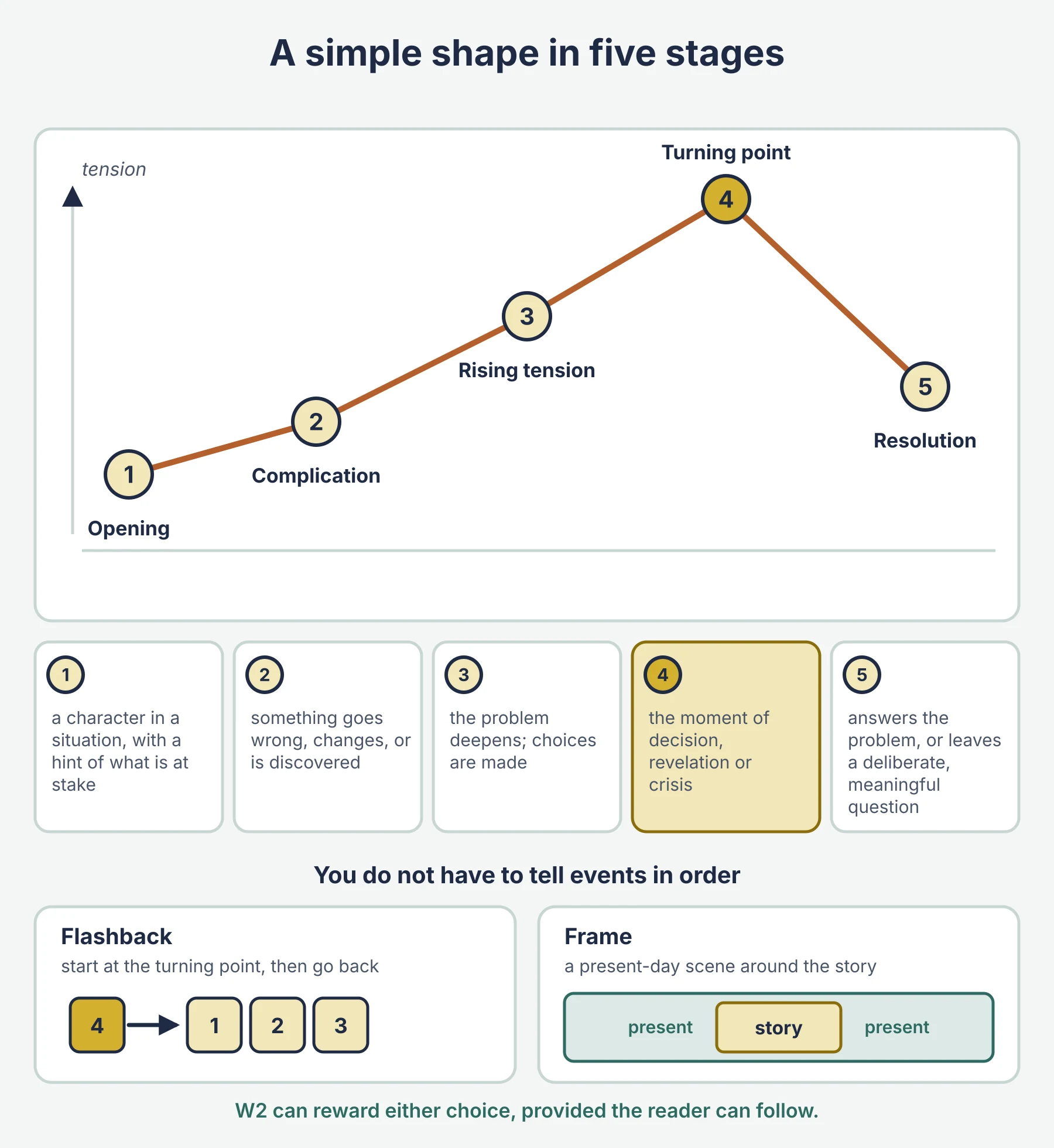
Plan four or five stages:
- Opening: a character in a situation, with a hint of what is at stake.
- Complication: something goes wrong, changes, or is discovered.
- Rising tension: the problem deepens; choices are made.
- Turning point: the moment of decision, revelation or crisis.
- Resolution: an ending that answers the problem, or leaves a deliberate, meaningful question.
You do not have to tell events in order. Starting at the turning point and going back (a flashback) or framing the story with a present-day scene are structural choices that W2 can reward, provided the reader can follow.
Openings that work
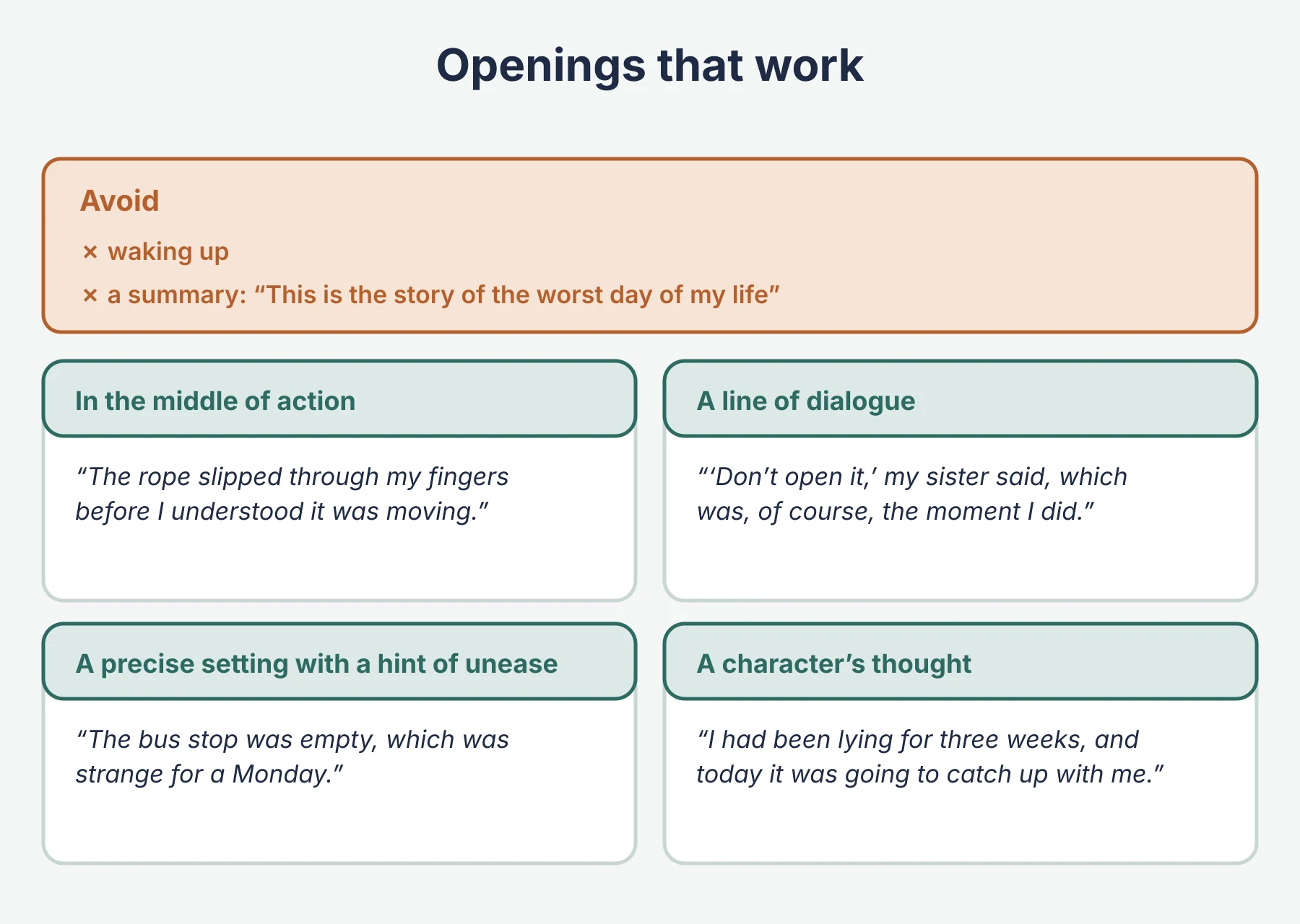
Avoid starting with waking up, or with a summary (“This is the story of the worst day of my life”). Try instead:
- In the middle of action: “The rope slipped through my fingers before I understood it was moving.”
- A line of dialogue: “‘Don’t open it,’ my sister said, which was, of course, the moment I did.”
- A precise setting with a hint of unease: “The bus stop was empty, which was strange for a Monday.”
- A character’s thought: “I had been lying for three weeks, and today it was going to catch up with me.”
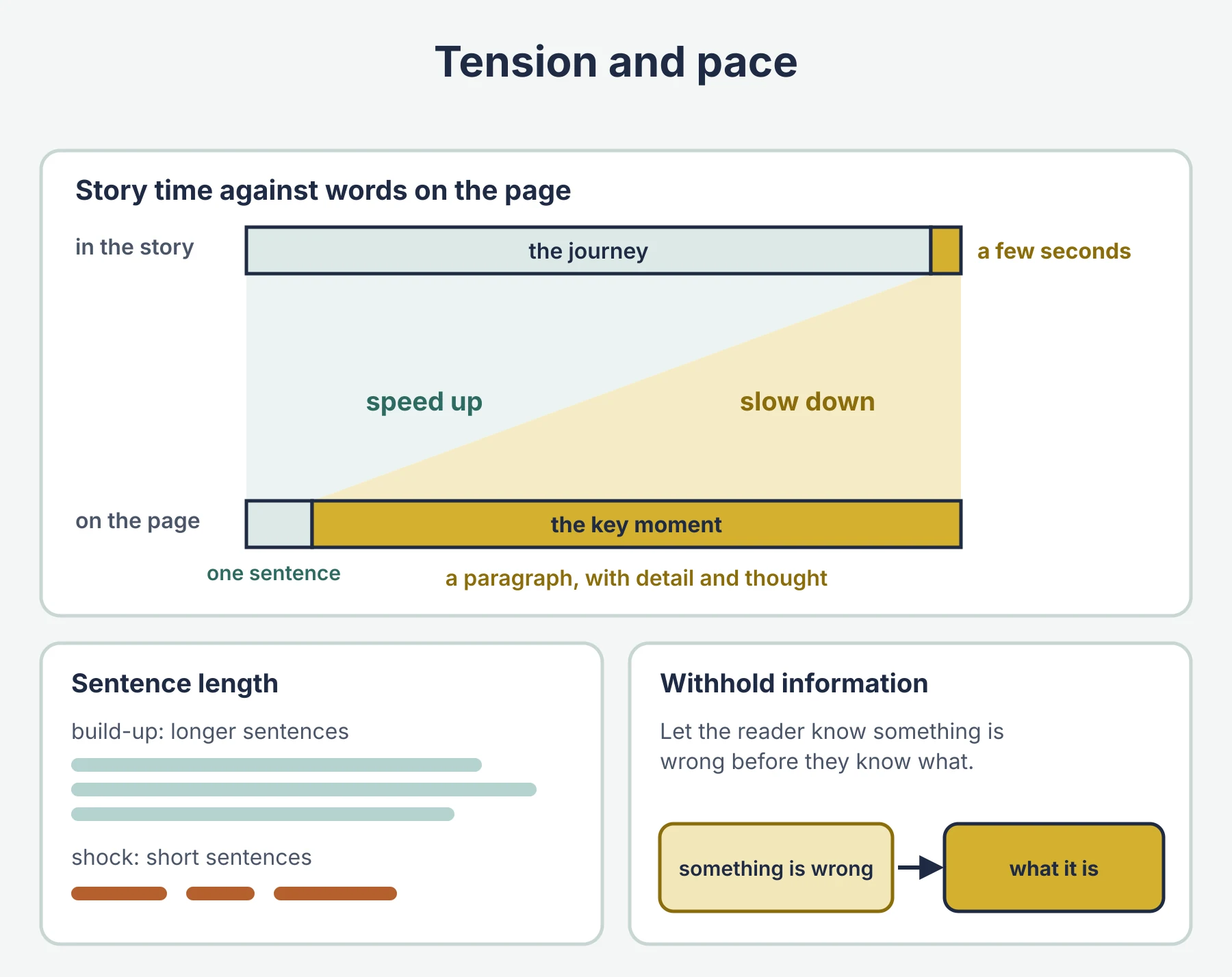
Tension and pace
- Slow down at the key moment: a few seconds can take a paragraph, with detail and thought.
- Speed up elsewhere: a journey can be one sentence.
- Short sentences at moments of shock; longer ones for build-up.
- Withhold information: let the reader know something is wrong before they know what.
Dialogue: a little, done well
Dialogue reveals character and moves events, but long conversations eat the word count. Use a few lines at important moments. Punctuate correctly, which is part of W5:
- New speaker, new line.
- Spoken words inside quotation marks, with the punctuation inside: “Wait,” she said.
- A capital letter to begin each speech.
Endings
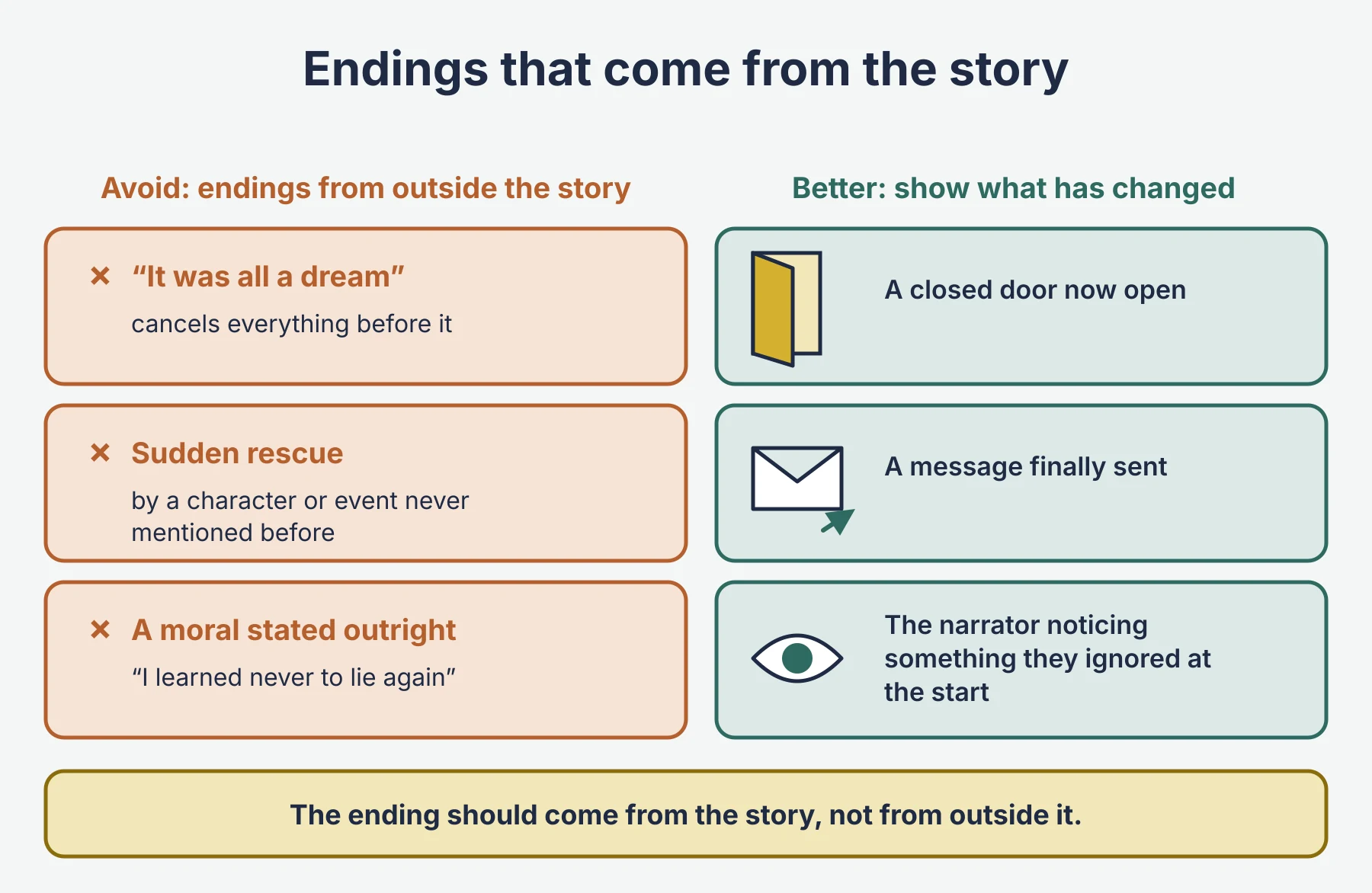
The ending should come from the story, not from outside it. Avoid:
- “It was all a dream”, which cancels everything before it.
- Sudden rescue by a character or event never mentioned before.
- A moral stated outright (“I learned never to lie again”).
Better: an action or image that shows what has changed. A closed door now open; a message finally sent; the narrator noticing something they ignored at the start.
Viewpoint and character
Choose a viewpoint before writing. First person (“I”) gives immediacy and lets you show the narrator’s thoughts directly, but the reader only knows what the narrator knows. Third person (“she”, “he”) allows a little more distance and lets you show a character from outside, which can be useful when the character hides their feelings. Whichever you choose, keep it consistent.
Give each character one defining detail rather than a full description: a habit, an object, a way of speaking. “My uncle, who folded every receipt into a tiny square” tells the reader more than three adjectives. Two or three characters are the most a story of this length can develop.
Model opening
Title (original): Write a story that begins with a phone call in the middle of the night.
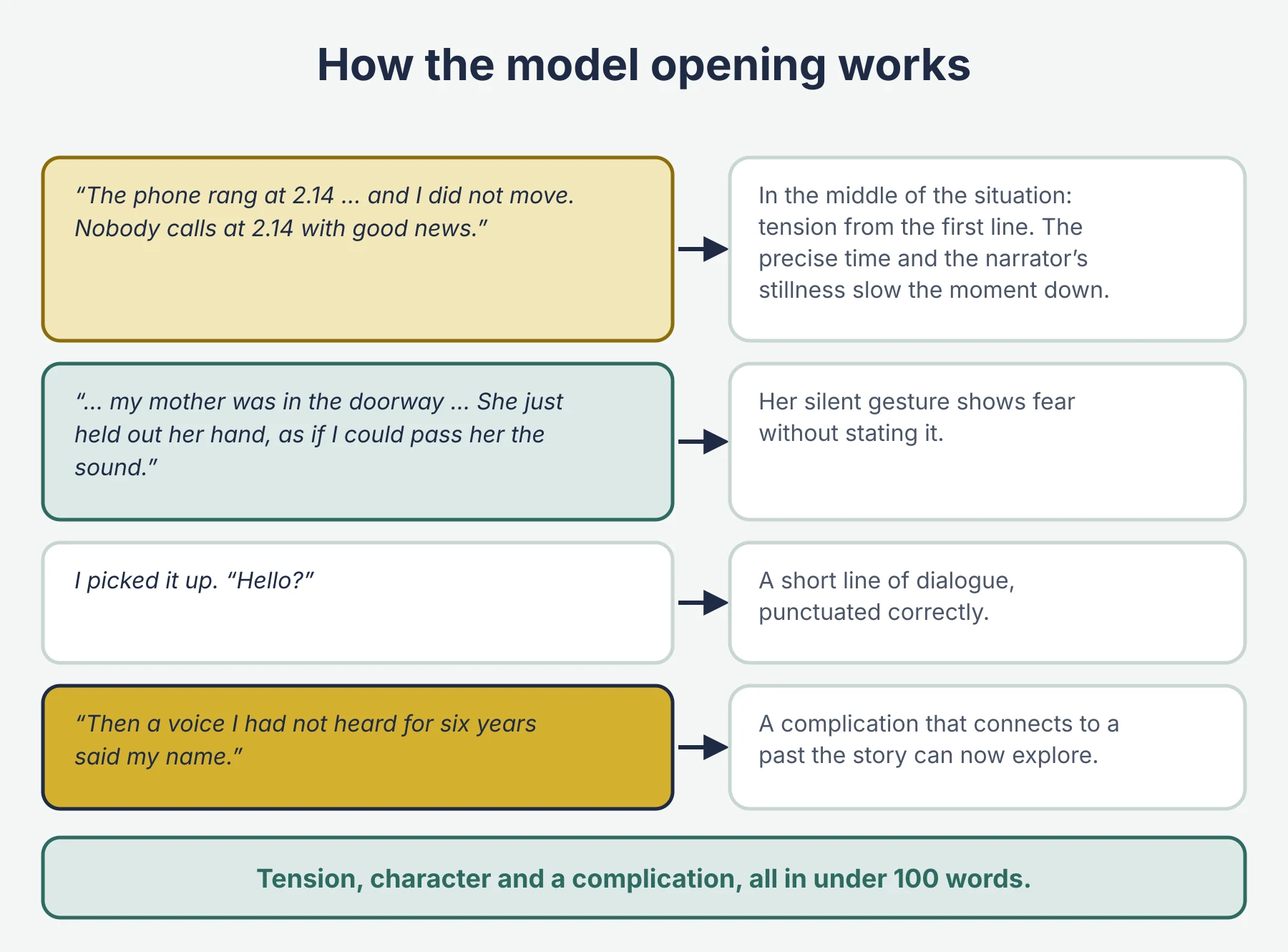
The phone rang at 2.14. I know because I watched the numbers on the clock while it rang, and I did not move. Nobody calls at 2.14 with good news.
By the fifth ring my mother was in the doorway, her face grey in the light from the landing. She didn’t say anything. She just held out her hand, as if I could pass her the sound.
I picked it up. “Hello?”
For a moment there was only breathing. Then a voice I had not heard for six years said my name.
Commentary: the opening is in the middle of the situation, with tension from the first line. The precise time and the narrator’s stillness slow the moment down. The mother’s silent gesture shows fear without stating it. A short line of dialogue is punctuated correctly. The last sentence is a complication that connects to a past the story can now explore, all in under 100 words.
Common mistakes
- Too much plot for the word range, so the story becomes a summary.
- Unconnected events: “and then… and then…”.
- Waking-up openings and dream endings.
- Pages of dialogue with little else.
- Tense switching between past and present.
- Characters with no feelings shown, only actions.
- Ignoring the title: if the title sets a situation, such as a phone call at night, the story must be built around it, not mention it in passing.
Exam technique
- Choose the title for which you can picture one clear situation, not the one that sounds most exciting.
- Plan the ending before you start writing.
- Aim for the middle of the 350–450 range; spend the words on the key moment.
- Keep the final two or three minutes of planning for the ending: a story that knows where it is going is easier to pace.
- Proofread for W5, especially dialogue punctuation and tense.
More resources on this topic
Related resources
-
Practice questions
Cambridge O Level English Language (1123): Narrative Composition – Practice Questions
Original plot, opening, dialogue and pacing drills plus a full 25-mark narrative composition for 1123 Paper 2 Section B, with model answers.
English · Cambridge · O Level
Try questions -
Revision notes
Cambridge O Level English Language (1123): Narrative Composition – Revision Notes
Condensed notes for the 1123 Paper 2 narrative composition: definition, objectives, sizing a story, a five-stage shape, openings, endings and a self-test.
English · Cambridge · O Level
Revise topic -
Study guides
Cambridge O Level English Language 1123: Paper 2 Writing Study Guide
Cambridge O Level English Language 1123 Paper 2 Writing in depth: directed writing and composition, their assessment objectives and how the marks are awarded.
English · Cambridge · O Level
Read guide
Get free revision emails (optional)
Occasional emails with practice questions, worked explanations and links to free resources for the qualification and subjects you choose. No spam, and you can unsubscribe from any email. The free tools on this site never need an email.