
Revision Notes
Cambridge O Level English Language (1123): Descriptive Composition – Revision Notes
Condensed notes for the 1123 Paper 2 descriptive composition: the definition, objectives, six structures, detail and atmosphere tools, traps and a self-test.
- Subject
- English
- Level
- O LEVELS
- Topic
- Paper 2 – Writing
- Author
- Marlbridge Academic Team
- Updated
- Reviewed by
- Ammar Bilal (what this means)
Aligned to Cambridge O Level English (1123), 2024-2026. Official specification .
Syllabus page (what it covers and how it is assessed): Cambridge O Level English Language.
Found an error? Report a correction.
Need help with this topic? Request a free trial class for O Level English Language (1123).
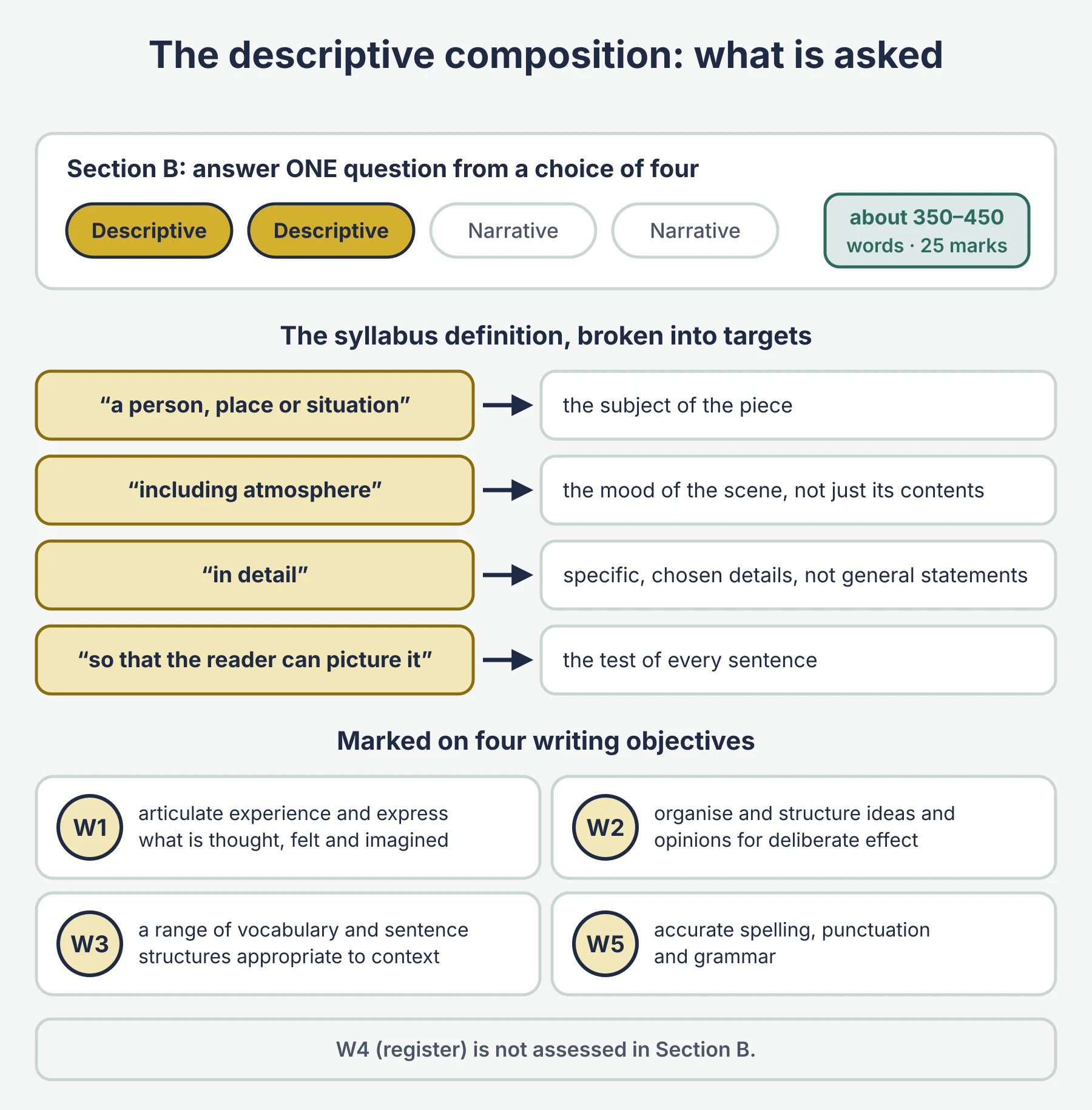
These notes cover the descriptive option in Section B of 1123 Paper 2: “A descriptive piece of writing describes a person, place or situation (including atmosphere) in detail so that the reader can picture it.” The paper overview is in the Paper 2 Writing study guide; the full method and a model passage are in the Descriptive composition study guide.
Task facts
| Fact | Detail |
|---|---|
| Choice | one from four titles: two descriptive, two narrative |
| Length | about 350–450 words |
| Marks | 25, all writing |
| Objectives | W1, W2, W3, W5 (W4 register not assessed in Section B) |
| Source text | none |
The definition as a checklist
- a person, place or situation
- atmosphere as well as contents
- in detail: specific, chosen details
- the reader can picture it
Objectives in the descriptive task
| Objective | Means |
|---|---|
| W1 articulate experience; express what is thought, felt and imagined | a vivid, convincing picture and mood |
| W2 organise and structure ideas for deliberate effect | a clear structure, paragraph by paragraph |
| W3 range of vocabulary and sentence structures | precise words, varied sentences |
| W5 accurate spelling, punctuation and grammar | proofread |
Six structures
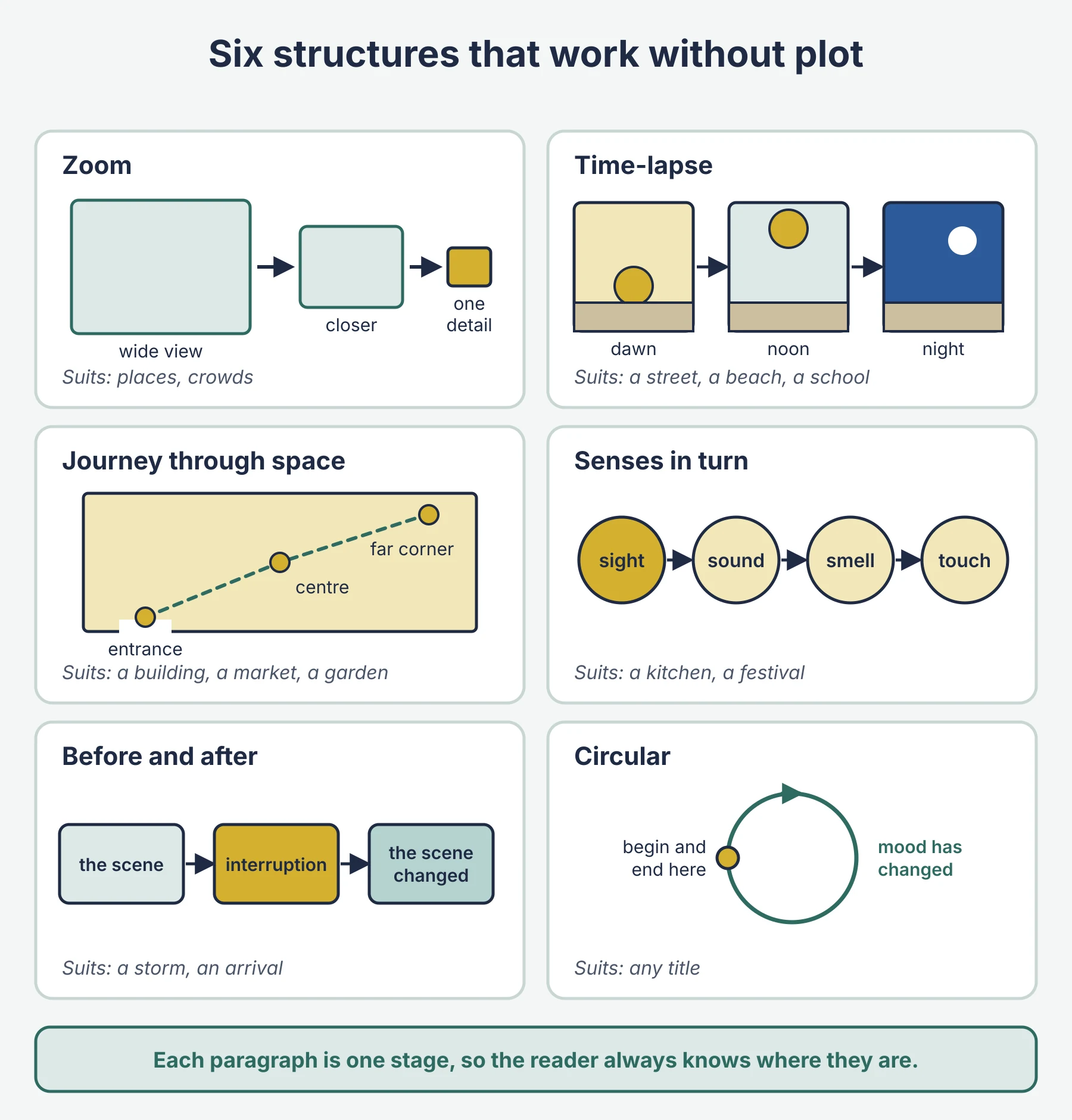
- Zoom: wide → close → tiny detail.
- Time-lapse: same place at different times.
- Journey through space: entrance → centre → far side.
- Senses in turn: one sense per paragraph (avoid sounding mechanical).
- Before and after: scene → interruption → changed scene.
- Circular: end where you started, mood shifted.
General to specific
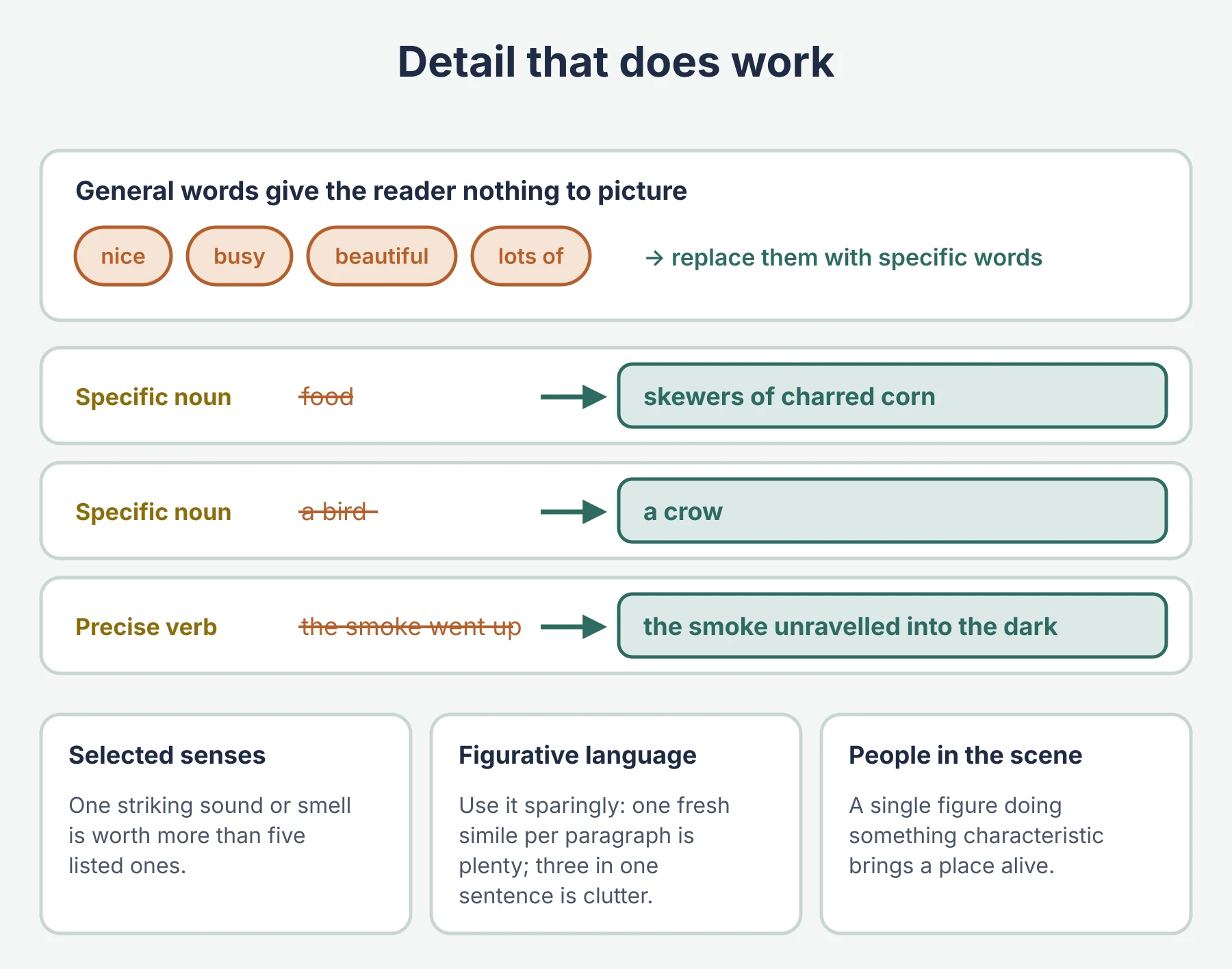
| General | Specific |
|---|---|
| food | skewers of charred corn |
| a bird | a crow on the railing |
| went up | unravelled, curled, drifted |
| noisy | the clatter of shutters, a radio crackling |
| beautiful sunset | the sky bruising from orange to violet |
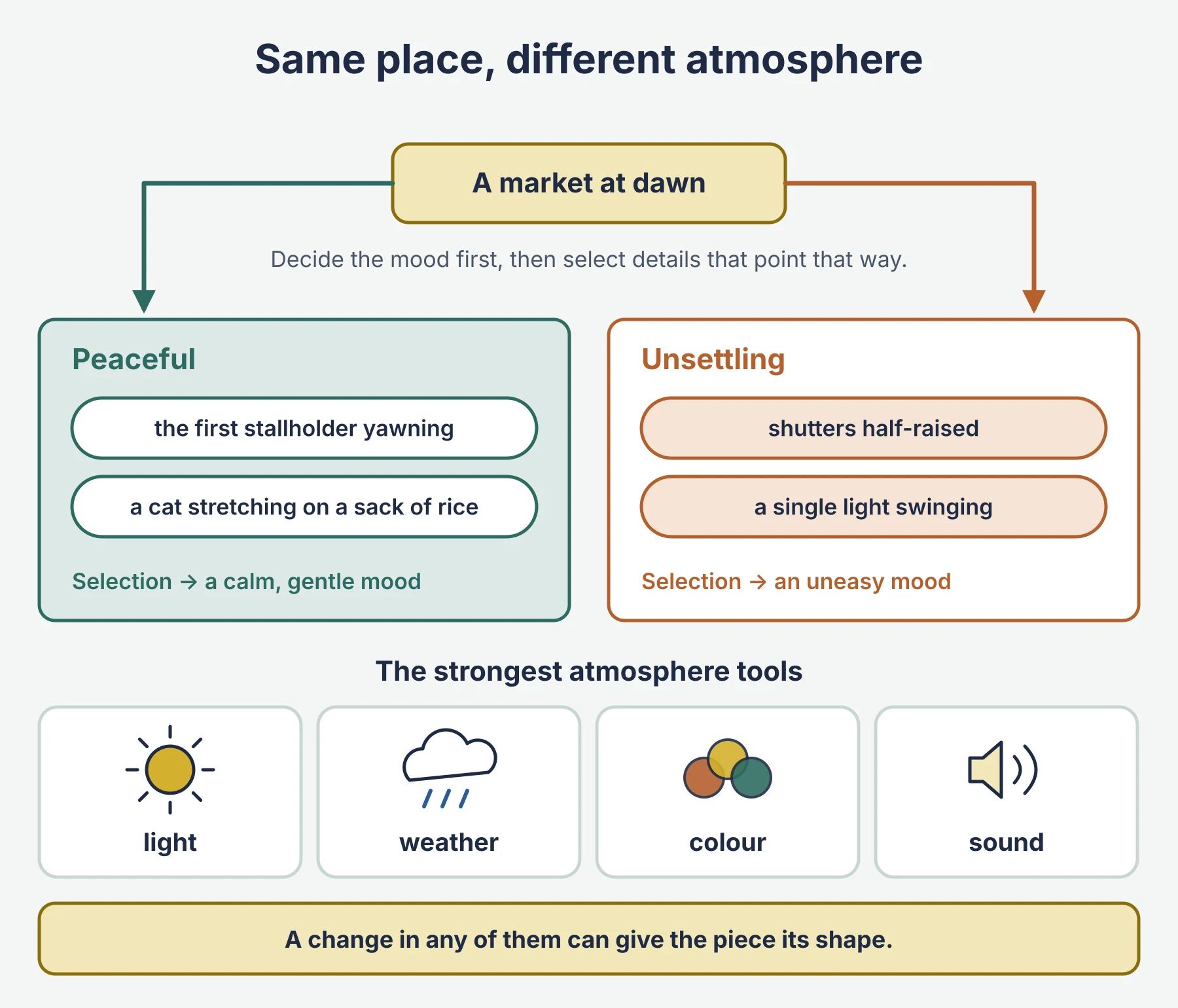
Atmosphere tools
- light (glare, dusk, a single bulb)
- weather (heat haze, drizzle, wind)
- colour (muted, vivid, one bright detail in grey)
- sound (silence broken, a constant hum)
- one human figure doing something characteristic
Decide the mood first; choose details that point to it. A change in light or sound halfway through can give the whole piece its turning point.
Sentence variety
- Long, accumulating sentence → abundance, movement.
- Short sentence → pause, focus.
- Fronted adverbials → rhythm (“Above the stalls, …”).
- One-line paragraph → a turn in the structure.
- Hold one tense: present (immediate) or past (reflective).
Figurative language: rules of thumb
- One fresh image per paragraph is plenty.
- Avoid clichés (“as white as snow”, “as busy as a bee”).
- Keep images consistent with the mood: a weary scene, weary personification.
Weak to strong
| Weak | Strong |
|---|---|
| The market was very busy and noisy. | Traders shouted prices over the clatter of handcarts, and the crowd moved like slow water between the stalls. |
| I could see the sea. I could hear the waves. | The sea folded itself against the rocks, again and again, with a sound like breath. |
| It was a scary, dark, cold, creepy house. | One shutter hung from a single hinge, knocking softly whenever the wind remembered it. |
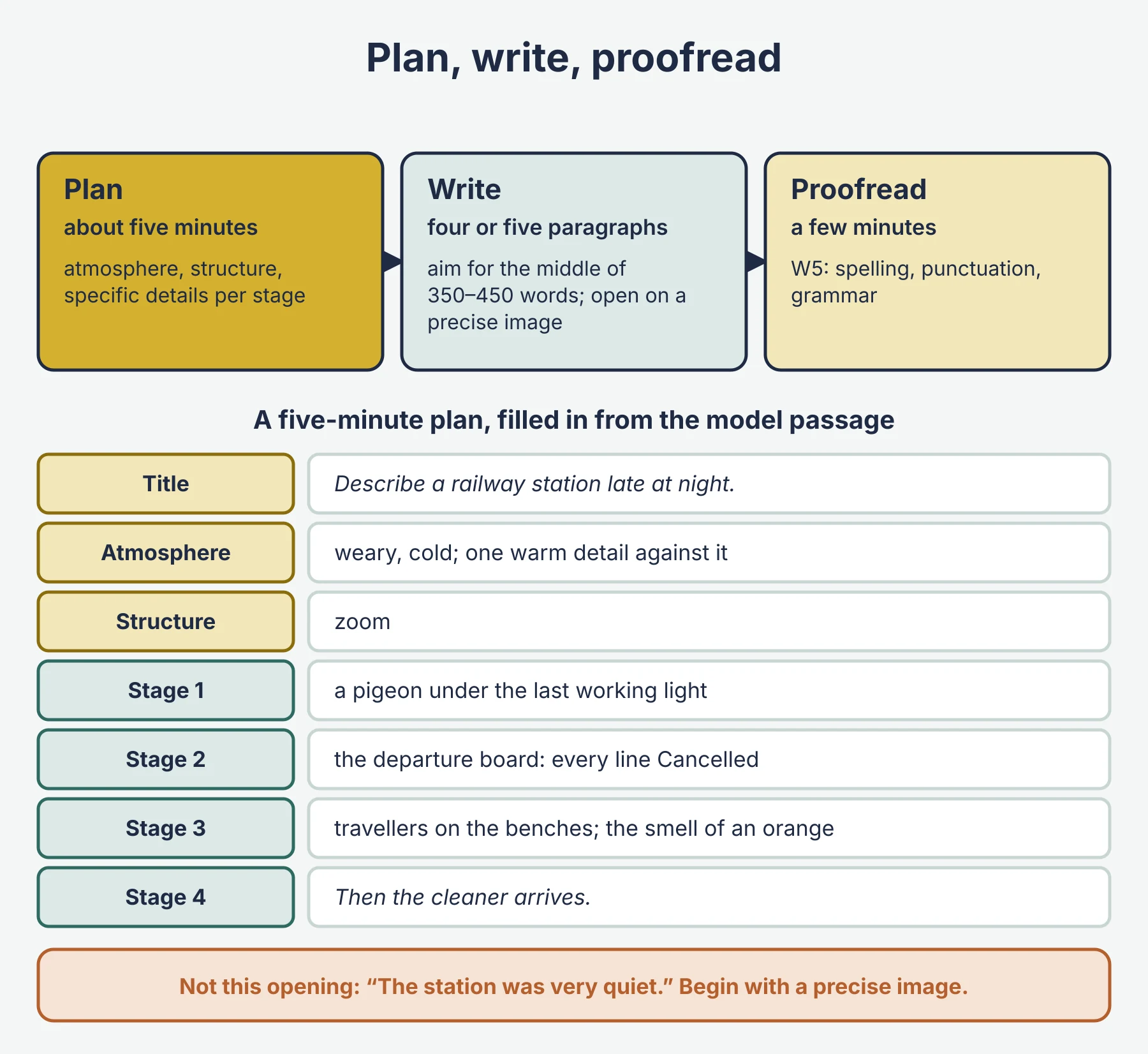
Five-minute plan template
| Paragraph | Focus | Two specific details |
|---|---|---|
| 1 | first image / wide view | … |
| 2 | closer / next space / next time | … |
| 3 | people or one figure | … |
| 4 | the turn: change in light, sound or mood | … |
| 5 (optional) | return or final image | … |
Write the atmosphere word at the top of the plan and check every detail against it.
Exam traps
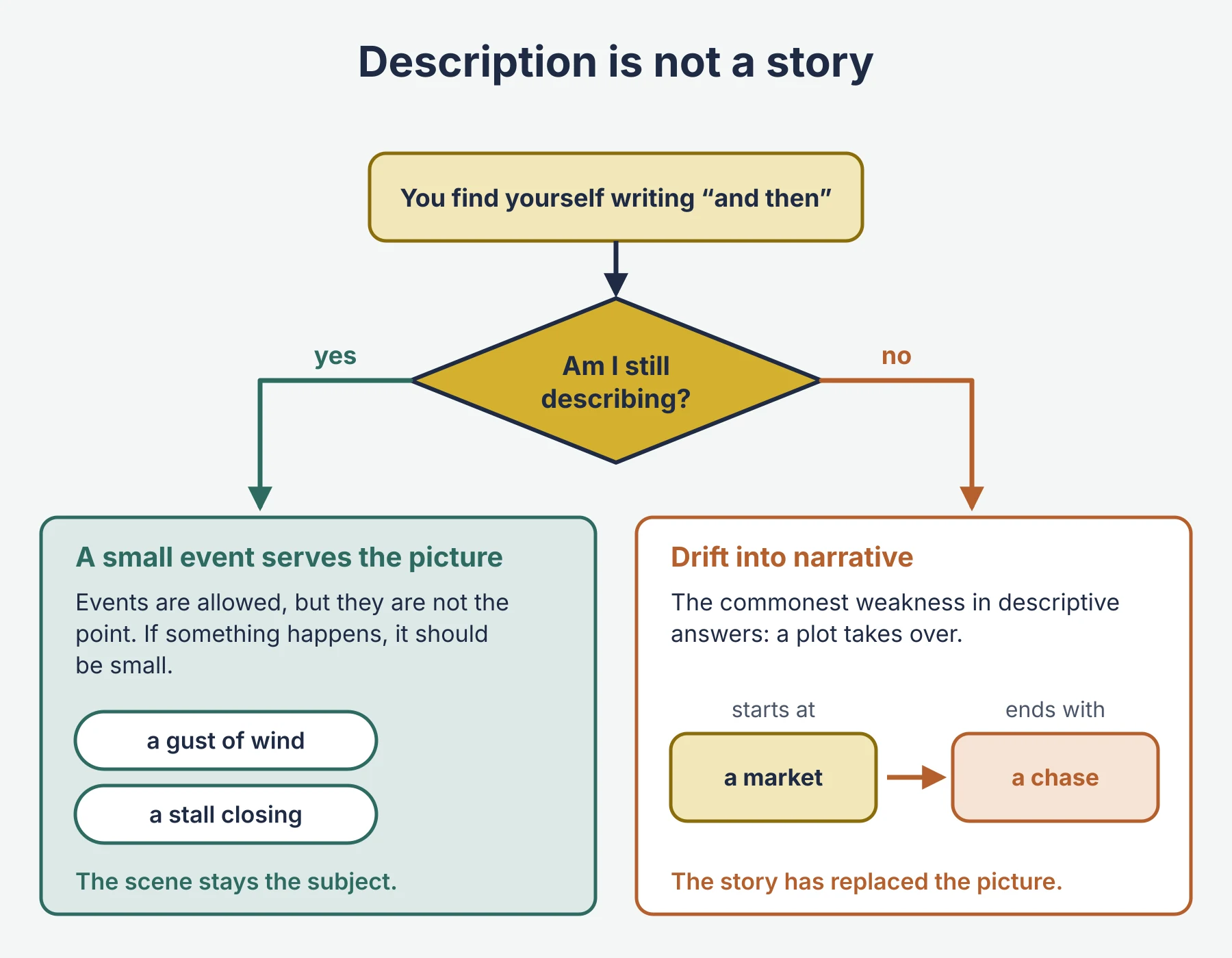
- Narrative takes over (“and then…”).
- “I could see… I could hear… I could smell…” lists.
- Overwriting: piles of adjectives and similes.
- Random order of details: no structure.
- Tense switching.
- General words (“nice”, “lots of”).
- Ignoring part of the title (“at night”, “after the storm”).
Self-test
- How many descriptive titles are offered, and how many compositions do you write?
- What is the word guide for the composition?
- Quote the syllabus definition of descriptive writing.
- Which writing objective is not assessed in Section B?
- Name three structures for a description.
- Make specific: “There was lots of food.”
- Why is “I could see… I could hear…” weak?
- What is atmosphere, and how do you create it?
- Give one effect of a short sentence after several long ones.
- Why should you avoid many similes in one sentence?
- A description of a beach ends with a shark attack. What is the risk?
- Which objective does proofreading protect?
Answers
- Two (of four titles); one composition.
- About 350–450 words.
- “A descriptive piece of writing describes a person, place or situation (including atmosphere) in detail so that the reader can picture it.”
- W4, register.
- Any three: zoom, time-lapse, journey through space, senses in turn, before and after, circular.
- For example: “Trays of steaming samosas and towers of oranges crowded every stall.”
- It becomes a mechanical list and repeats the same sentence pattern, weakening W2 and W3.
- The overall mood; created by choosing details (light, weather, colour, sound, figures) that all point towards it.
- It creates a pause or emphasis, drawing the reader’s attention to one detail.
- It clutters the writing and weakens each image; one precise image is more effective.
- The piece turns into a narrative, so it no longer does what the descriptive task asks.
- W5, accurate spelling, punctuation and grammar.
More resources on this topic
Related resources
-
Study guides
Cambridge O Level English Language (1123): Directed Writing
How to use, develop and evaluate the source texts in 1123 Paper 2 Section A directed writing: the five forms, bias and evidence, planning and a model.
English · Cambridge · O Level
Read guide -
Study guides
Cambridge O Level English Language (1123): Directed Writing – Writing an Article
How to write the article form in 1123 directed writing: headlines, hooks, writing for a publication's readers, viewpoint, source quotations and a model article.
English · Cambridge · O Level
Read guide -
Practice questions
Cambridge O Level English Language (1123): Directed Writing – Writing an Article – Practice Questions
Original article-writing practice for 1123 directed writing: headlines, hooks, register, model paragraphs and a full 25-mark newspaper article on two new texts.
English · Cambridge · O Level
Try questions
Get free revision emails (optional)
Occasional emails with practice questions, worked explanations and links to free resources for the qualification and subjects you choose. No spam, and you can unsubscribe from any email. The free tools on this site never need an email.