
Revision Notes
Cambridge O Level English Language (1123): Narrative Composition – Revision Notes
Condensed notes for the 1123 Paper 2 narrative composition: definition, objectives, sizing a story, a five-stage shape, openings, endings and a self-test.
- Subject
- English
- Level
- O LEVELS
- Topic
- Paper 2 – Writing
- Author
- Marlbridge Academic Team
- Updated
- Reviewed by
- Ammar Bilal (what this means)
Aligned to Cambridge O Level English (1123), 2024-2026. Official specification .
Syllabus page (what it covers and how it is assessed): Cambridge O Level English Language.
Found an error? Report a correction.
Need help with this topic? Request a free trial class for O Level English Language (1123).
These notes cover the narrative option in Section B of 1123 Paper 2: “A narrative piece of writing tells a story containing a sequence of connected events which may be real or imaginary.” The paper overview is in the Paper 2 Writing study guide; the full method and a model opening are in the Narrative composition study guide.
Task facts
| Fact | Detail |
|---|---|
| Choice | one from four: two descriptive, two narrative |
| Length | about 350–450 words |
| Marks | 25, all writing |
| Objectives | W1, W2, W3, W5 |
| Real or imaginary? | either |
Objectives in the narrative task
| Objective | Means |
|---|---|
| W1 articulate experience; express what is thought, felt and imagined | convincing characters and feelings |
| W2 organise and structure for deliberate effect | a clear shape, controlled pace, a fitting ending |
| W3 range of vocabulary and sentence structures | precise verbs, varied sentences |
| W5 accurate spelling, punctuation and grammar | including dialogue punctuation |
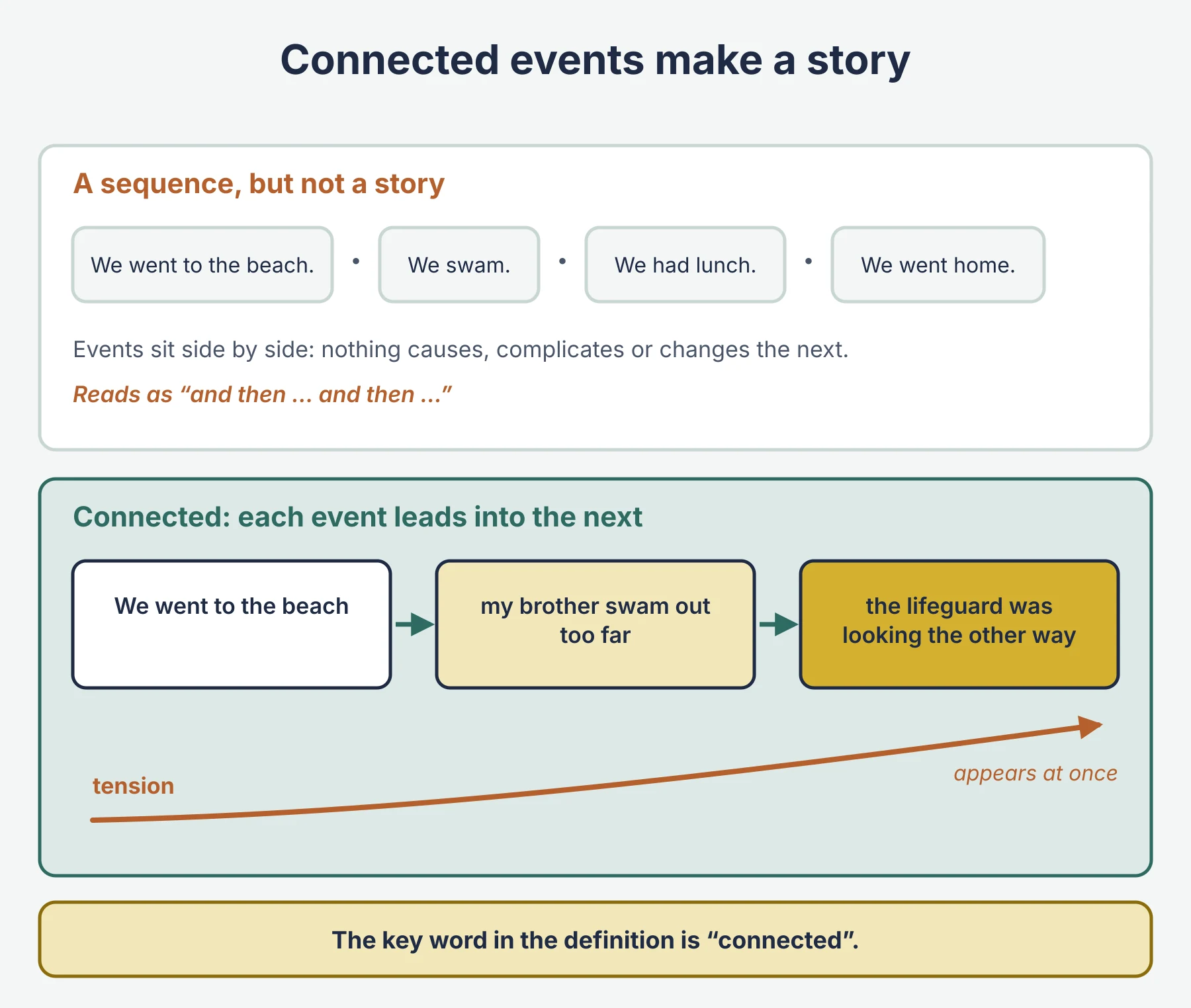
Connected, not listed
Each event should cause, complicate or change the next. “And then” chains are lists.
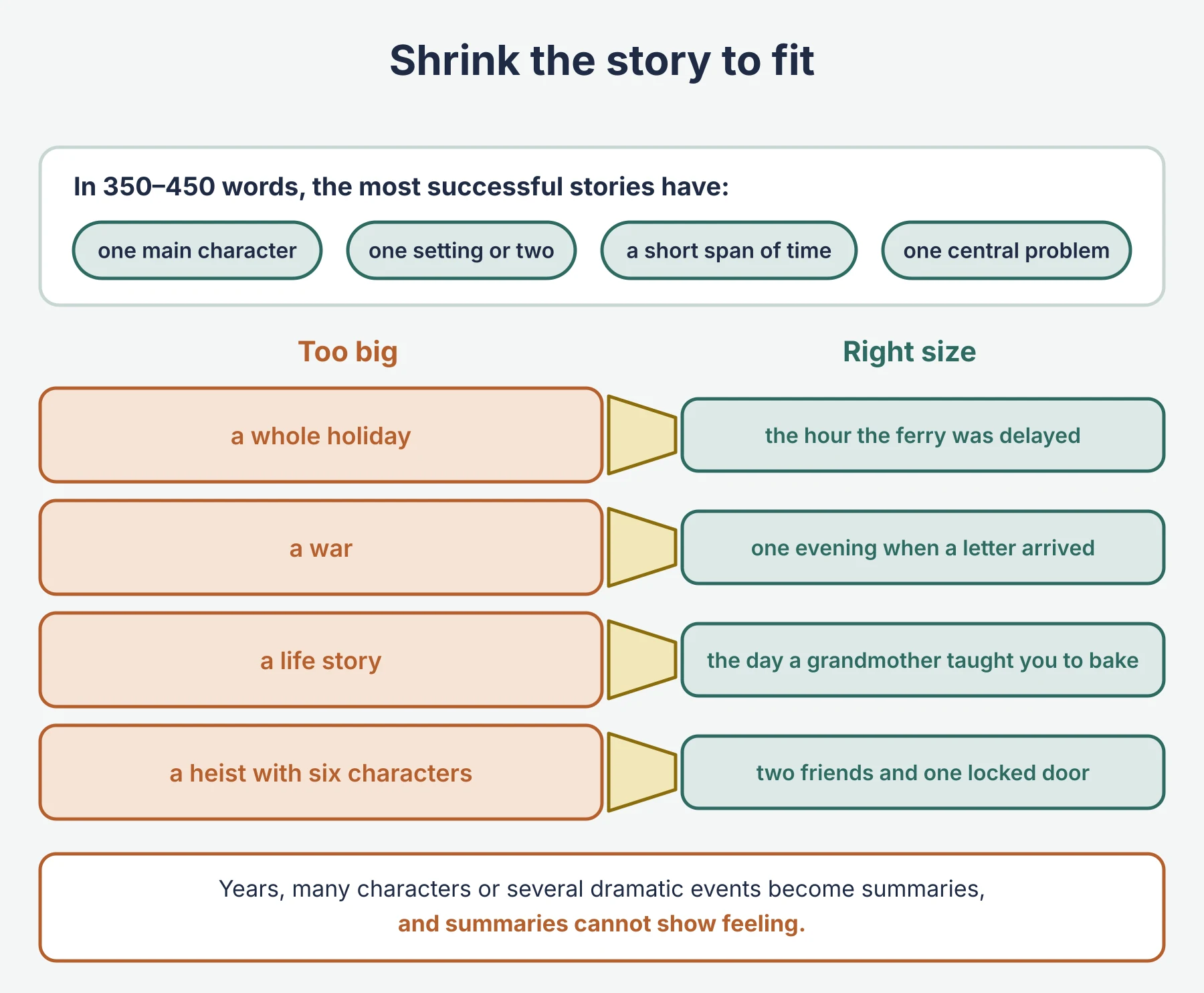
Sizing the story
One main character · one or two settings · a short span of time · one central problem.
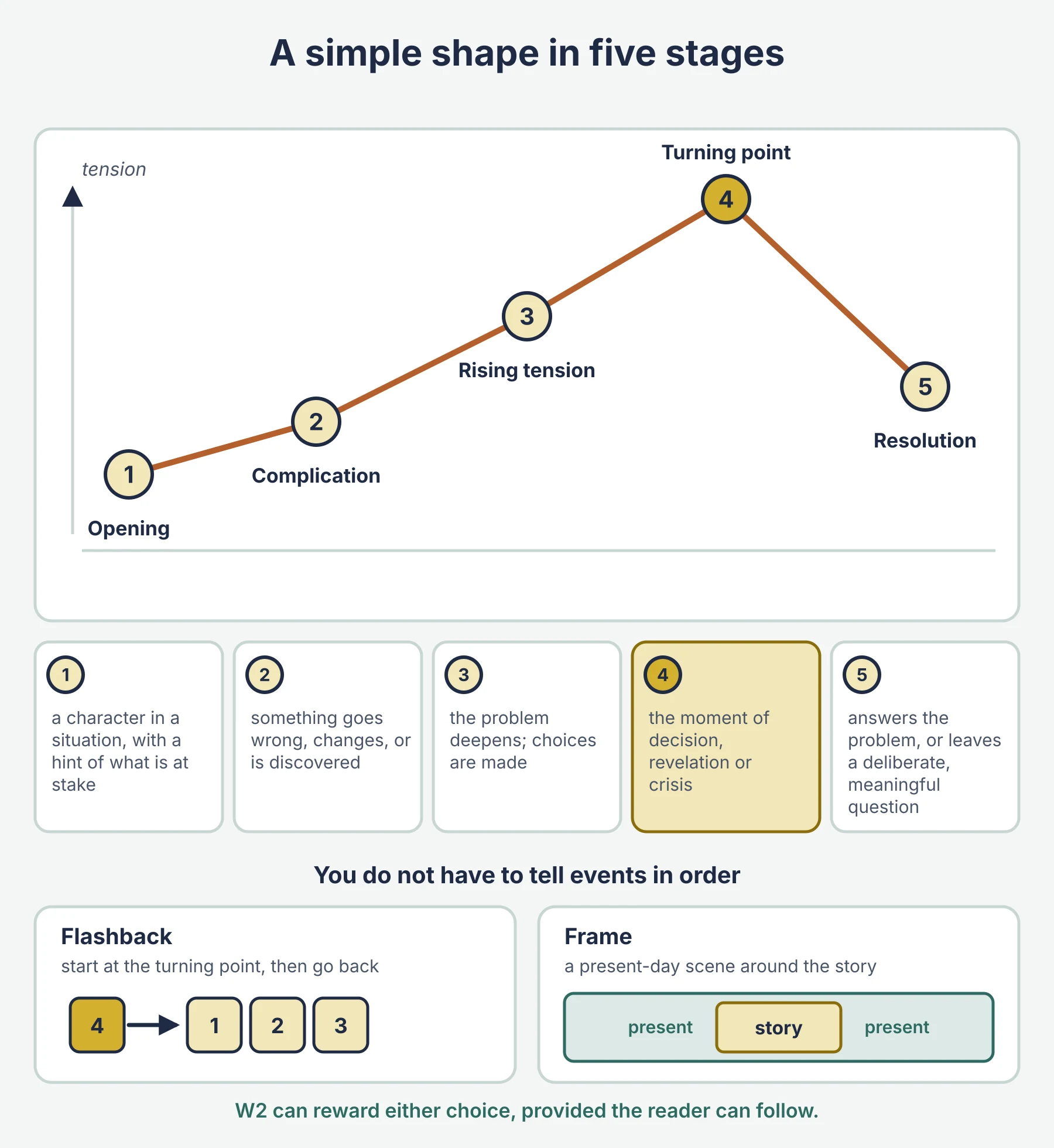
Five-stage shape
- Opening: character, situation, stakes.
- Complication.
- Rising tension.
- Turning point.
- Resolution (or a deliberate open question).
Optional structures: flashback; a present-day frame; starting at the turning point.
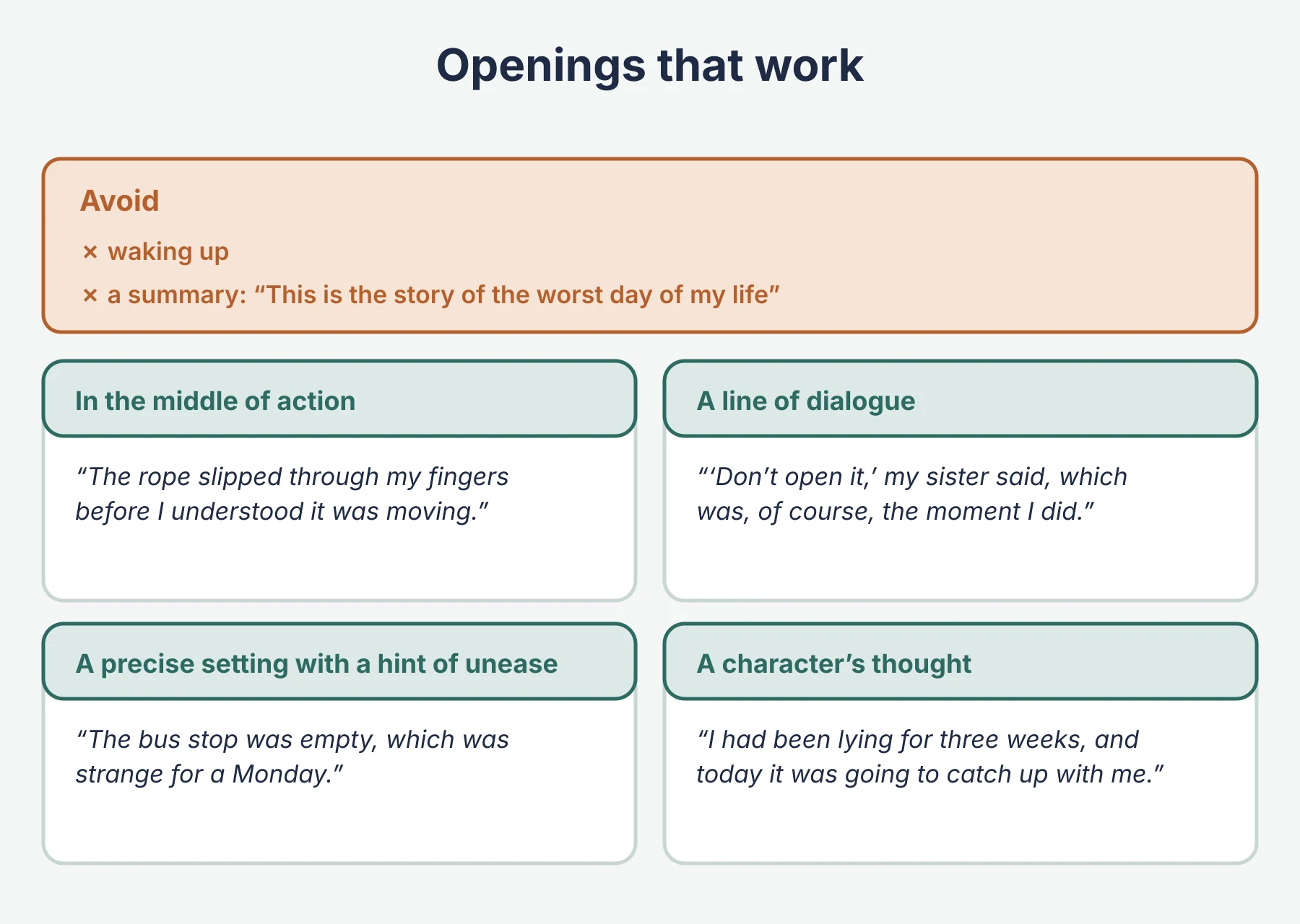
Opening types
| Type | Example (original) |
|---|---|
| in the action | “The rope slipped through my fingers before I understood it was moving.” |
| dialogue | “‘Don’t open it,’ my sister said.” |
| uneasy setting | “The bus stop was empty, which was strange for a Monday.” |
| a thought | “I had been lying for three weeks.” |
Avoid: waking up; “This is the story of…”.
Pace tools
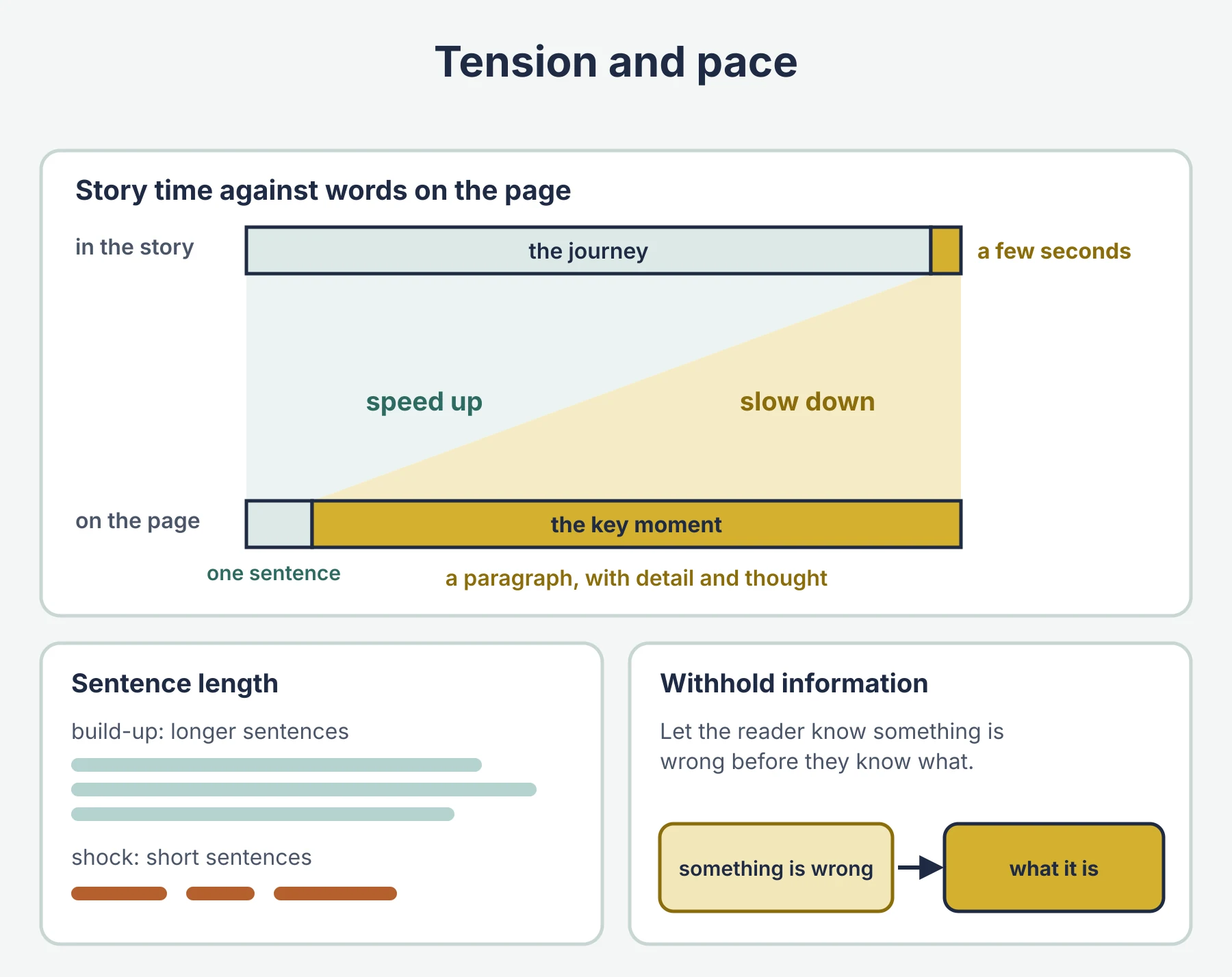
- Slow the key moment: detail, thought, short sentences.
- Speed the rest: a journey in one line.
- Withhold: let the reader sense the problem before naming it.
Show, don’t tell
| Tell | Show |
|---|---|
| She was nervous. | She folded the ticket into smaller and smaller squares. |
| He was angry. | He put the cup down so hard that tea spilled over the table. |
| It was frightening. | Nobody spoke; even the dog had stopped barking. |
Dialogue rules
- A few lines at key moments only.
- New speaker, new line.
- Punctuation inside the quotation marks: “Wait,” she said.
- Capital letter at the start of speech.
Endings
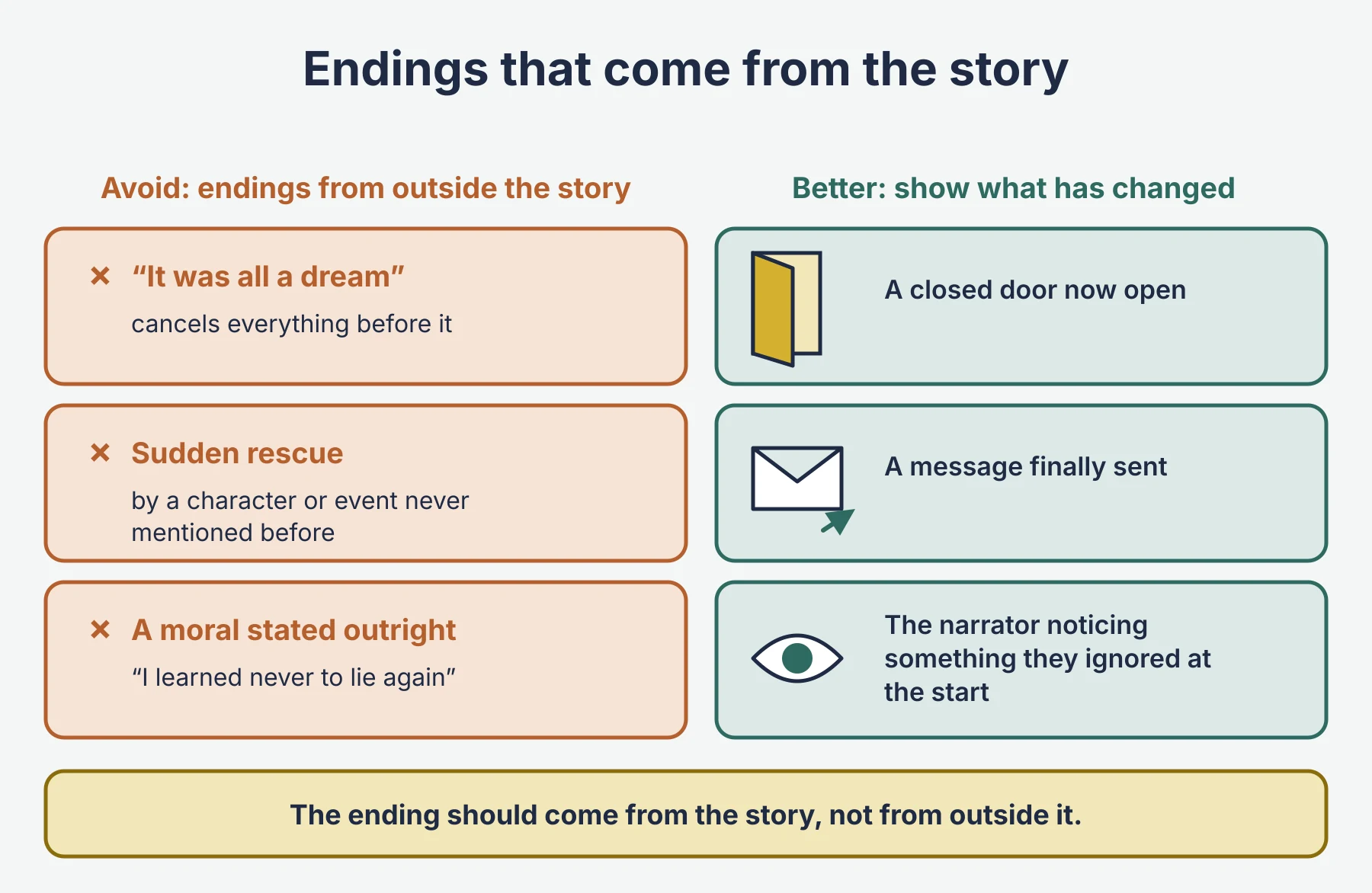
Avoid: a dream; a sudden rescue from nowhere; a stated moral. Prefer: an action or image showing change; a callback to the opening.
Weak to strong lines
| Weak | Strong |
|---|---|
| One day something strange happened. | The dog had stopped barking at exactly midnight, and that was the first strange thing. |
| I was very sad when she left. | I kept her cup on the shelf for a week, unwashed, as if she might come back for it. |
| Then we went home and it was fine. | On the way home, neither of us mentioned it, but she held my hand the whole way. |
Viewpoint
- First person: immediate, inner thoughts; limited to what the narrator knows.
- Third person: some distance; can show a character from outside.
- Keep it consistent from start to finish.
Plan template
| Stage | Note |
|---|---|
| Opening | who, where, what is at stake |
| Complication | what goes wrong or changes |
| Rising tension | what makes it worse |
| Turning point | the decision or revelation |
| Resolution | the image or action that shows change |
Write the last line of the plan first.
Exam traps
- Too much plot for the words.
- “And then” lists.
- Waking-up opening, dream ending.
- Long dialogue.
- Tense switching.
- Feelings told, never shown.
- The title’s situation mentioned in passing.
Self-test
- Quote the syllabus definition of narrative writing.
- How many narrative titles are offered, and how long should the composition be?
- Which objective most directly rewards the shape of the story?
- Why are small stories more successful in this word range?
- Name the five stages of the simple shape.
- Give two weak openings to avoid.
- Turn “He was scared” into a “show” sentence.
- Punctuate: wait she said I can hear something
- Why is “It was all a dream” a weak ending?
- What is a flashback, and when can it help?
- How should you use the time you save by speeding up minor events?
- Can the story be real?
Answers
- “A narrative piece of writing tells a story containing a sequence of connected events which may be real or imaginary.”
- Two (of four titles); about 350–450 words.
- W2, organise and structure ideas for deliberate effect.
- A short span with one problem leaves room to show feeling and detail; large plots turn into summaries.
- Opening, complication, rising tension, turning point, resolution.
- Two of: waking up; “This is the story of…”; a summary of the whole story.
- For example: “His hands would not stop shaking as he reached for the handle.”
- “Wait,” she said. “I can hear something.”
- It cancels the events and tension the story has built, so the structure fails.
- Going back in time from the present of the story; it can help when starting at the turning point creates tension, provided the reader can follow.
- Spend the words on the key moment, slowing it down with detail and thought.
- Yes: the events “may be real or imaginary”.
More resources on this topic
Related resources
-
Study guides
Cambridge O Level English Language 1123: Paper 2 Writing Study Guide
Cambridge O Level English Language 1123 Paper 2 Writing in depth: directed writing and composition, their assessment objectives and how the marks are awarded.
English · Cambridge · O Level
Read guide -
Practice questions
Cambridge O Level English Language: Paper 2 Writing — Practice Questions
Original practice on Cambridge O Level English Language 1123 Paper 2: the format, writing objectives W1 to W5 and the directed writing marks.
English · Cambridge · O Level
Try questions -
Revision notes
Cambridge O Level English Language: Paper 2 Writing — Revision Notes
Condensed notes on Cambridge O Level English Language 1123 Paper 2: directed writing and composition, mark allocation and the writing objectives W1 to W5.
English · Cambridge · O Level
Revise topic
Get free revision emails (optional)
Occasional emails with practice questions, worked explanations and links to free resources for the qualification and subjects you choose. No spam, and you can unsubscribe from any email. The free tools on this site never need an email.