
Study Guides
Cambridge O Level Islamiyat (2058): The History and Importance of the Hadith
Study guide to compiling and testing the Hadith, the Sunni and Shi'a collections and their legal role, for Cambridge O Level Islamiyat 2058 Paper 2 Question 2.
- Subject
- Islamiyat
- Level
- O LEVELS
- Topic
- Paper 2
- Author
- Marlbridge Academic Team
- Updated
- Reviewed by
- Azam Siddique (what this means)
Aligned to Cambridge O Level Islamiyat (2058), 2026-2027. Official specification .
Syllabus page (what it covers and how it is assessed): Cambridge O Level Islamiyat.
Syllabus points this page covers
2058
- 2.2 The History and Importance of the Hadith
Found an error? Report a correction.
Need help with this topic? Request a free trial class for O Level Islamiyat (2058).
The History and Importance of the Hadith is Paper 2 Question 2 in Cambridge O Level Islamiyat 2058, and every candidate must answer it. It is an essay question worth 14 marks, normally a knowledge part (a) worth 10 and an understanding part (b) worth 4. The syllabus covers how the Hadith were collected, how scholars tested them, the main collections and compilers, and why the Hadith matter in Islamic law and life.
What the syllabus lists
- the history of the compilation of the Hadith;
- the earliest collections;
- the main musnad and musannaf collections;
- the main compilers and their activities;
- the methods of testing reliability through the chain of transmitters (isnad) and the text (matn);
- the main features of the six Sunni collections and the four Shi’a collections;
- the major themes of the Hadith, in the set passages and similar ones;
- their use in legal thinking with the Qur’an, ijma’ and qiyas;
- their significance in thought and action in Islam.
Key words first
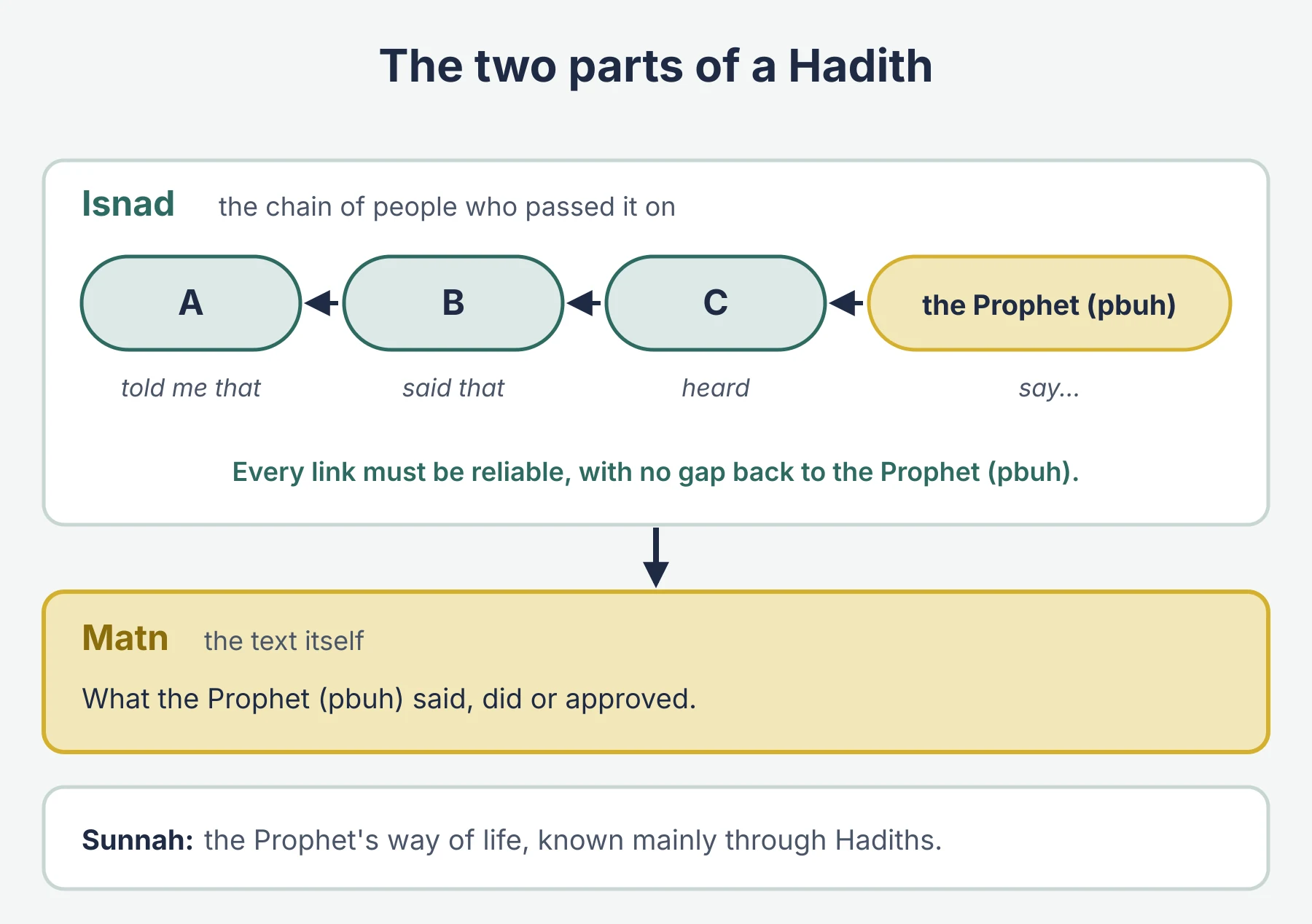
A Hadith is a report of what the Prophet (pbuh) said, did, or silently approved. The Sunna is his practice as a whole, which the Hadith record. Every Hadith has two parts: the isnad, the chain of people who passed it on (“A told me that B told him that he heard the Prophet (pbuh) say…”), and the matn, the text itself.
Stage 1: the Prophet’s (pbuh) lifetime
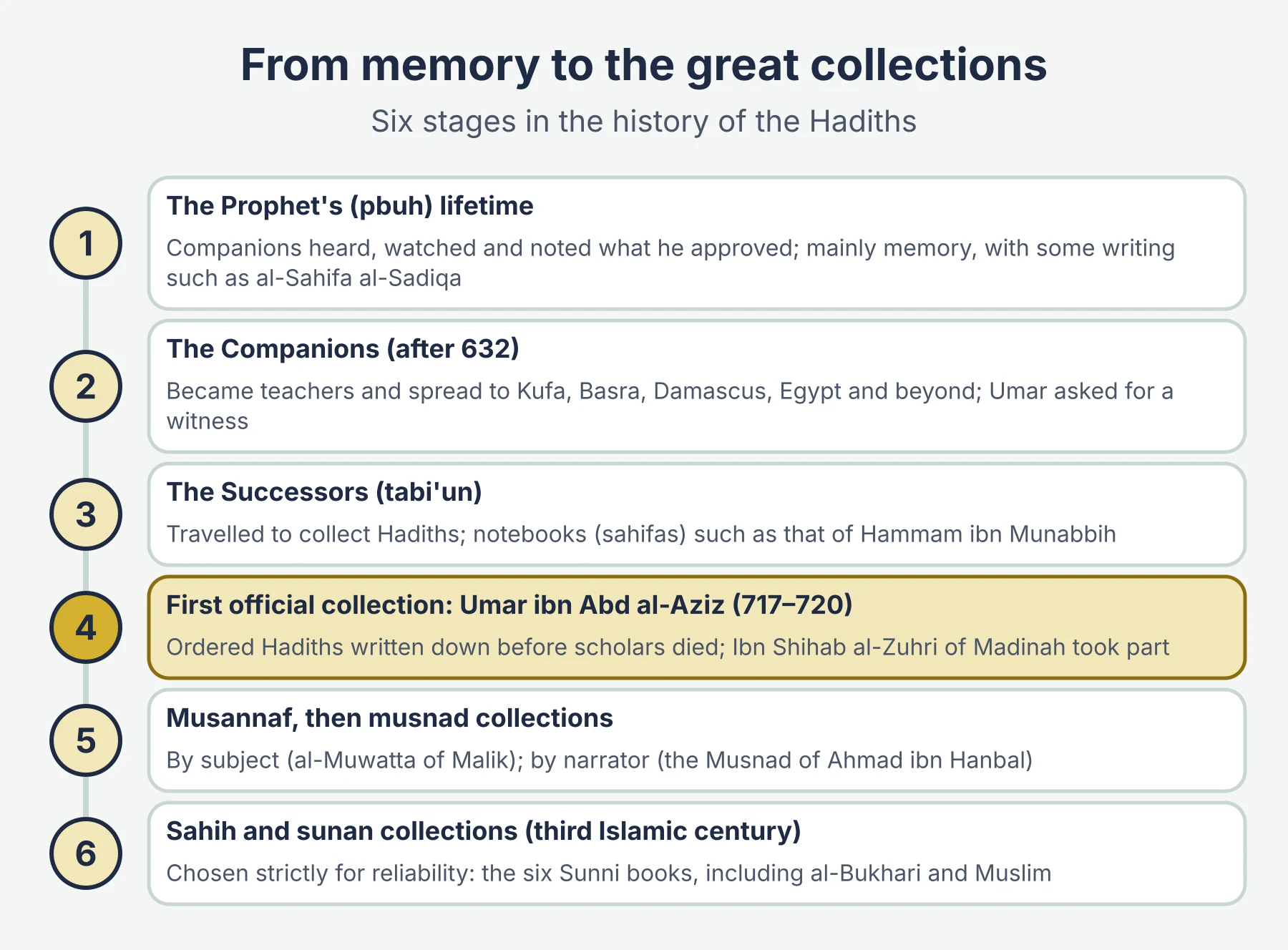
Companions learned Hadith in three ways: by hearing his words, by watching his actions (he told them, “Pray as you have seen me pray”), and by noting what he approved without objection. Memory was the main method in a society used to memorising poetry and genealogy. Some wrote: Abdullah ibn Amr ibn al-As kept a written collection he called al-Sahifa al-Sadiqa, “the truthful sheet”. At first writing was limited, reportedly so that Hadith would not be mixed with the Qur’an while it was still being revealed. Ali (RA) kept a sheet with rulings on matters such as blood money and the release of captives.
Stage 2: the Companions
After 632 the Companions became teachers. Abu Bakr (RA) and Umar (RA) were careful: Umar (RA) asked Abu Musa al-Ash’ari to bring a witness for a Hadith on seeking permission to enter, to show that reports about the Prophet (pbuh) must be handled with care. Companions spread to Kufa, Basra, Damascus, Egypt and beyond, taking their knowledge with them. Among those who narrated most were Abu Hurayra, Aisha (RA), Abdullah ibn Umar (RA), Anas ibn Malik and Abdullah ibn Abbas.
Stage 3: the Successors and the first official collection
The next generation, the tabi’un, travelled from city to city to collect Hadith from surviving Companions. Written notebooks (sahifas) circulated, such as that of Hammam ibn Munabbih, a student of Abu Hurayra. The Umayyad caliph Umar ibn Abd al-Aziz (717–720) feared that knowledge would be lost as the scholars died, and ordered governors and scholars to write Hadith down; Ibn Shihab al-Zuhri of Madina was among those who carried this out.
Stage 4: musannaf collections
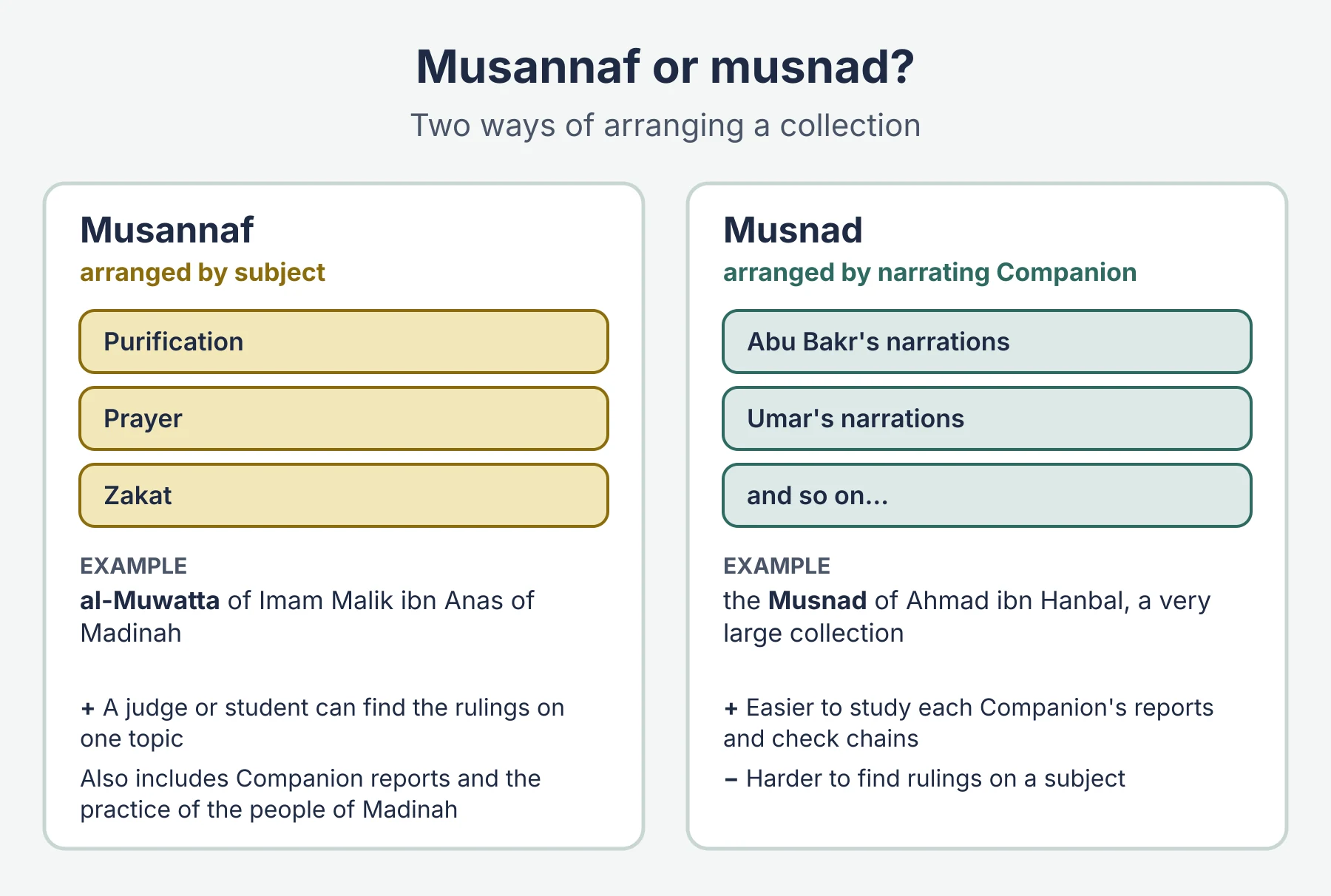
A musannaf collection arranges Hadith by subject, such as purification, prayer, zakat and trade, so that a judge or student can find the rulings on one topic. The best-known early example is al-Muwatta of Imam Malik ibn Anas of Madina. It includes Hadith of the Prophet (pbuh) together with reports of the Companions and the practice of the people of Madina, reflecting Malik’s view that Madina preserved the Sunna in living practice.
Stage 5: musnad collections
A musnad collection arranges Hadith by the Companion who narrated them: all of Abu Bakr’s (RA) narrations together, then Umar’s (RA), and so on. It made it easier to study each Companion’s reports and check chains, but harder to find rulings on a subject. The most famous is the Musnad of Ahmad ibn Hanbal, a very large collection.
Stage 6: the sahih and sunan collections
In the third Islamic century scholars produced collections chosen strictly for reliability and arranged by subject.
The six Sunni collections (al-Kutub al-Sitta):
| Collection | Compiler | Main features |
|---|---|---|
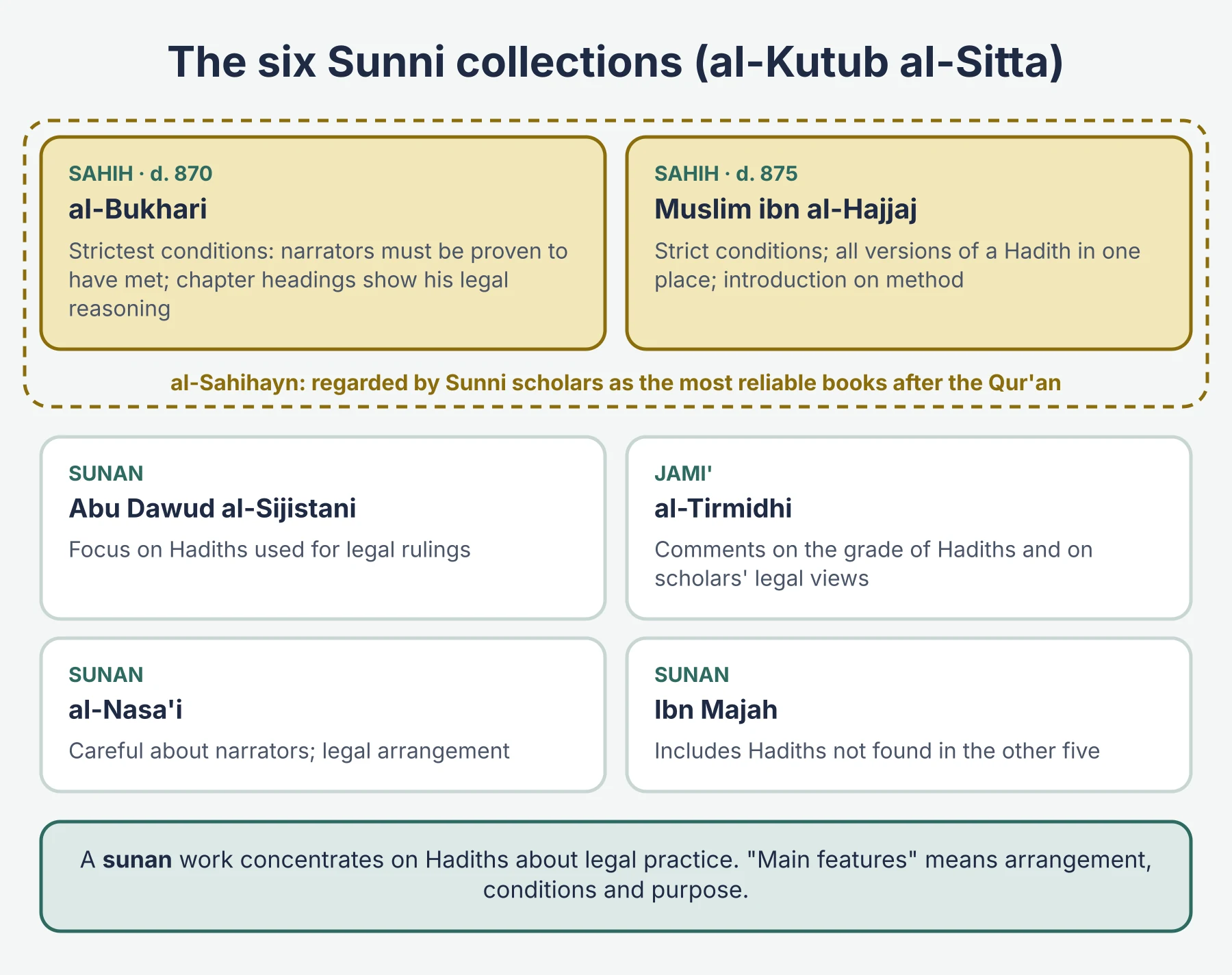
| Sahih al-Bukhari | Muhammad ibn Isma’il al-Bukhari (d. 870) | Strictest conditions; narrators must be proven to have met; chapter headings show his legal reasoning |
| Sahih Muslim | Muslim ibn al-Hajjaj (d. 875) | Strict conditions; all versions of a Hadith gathered in one place; introduction on method |
| Sunan Abu Dawud | Abu Dawud al-Sijistani | Focus on Hadith used for legal rulings |
| Jami’ al-Tirmidhi | al-Tirmidhi | Comments on the grade of Hadith and on scholars’ legal views |
| Sunan al-Nasa’i | al-Nasa’i | Careful about narrators; legal arrangement |
| Sunan Ibn Majah | Ibn Majah | Includes Hadith not found in the other five |
A sunan work concentrates on Hadith about legal practice. Sunni scholars regard al-Bukhari and Muslim, together called al-Sahihayn, as the most reliable books after the Qur’an.
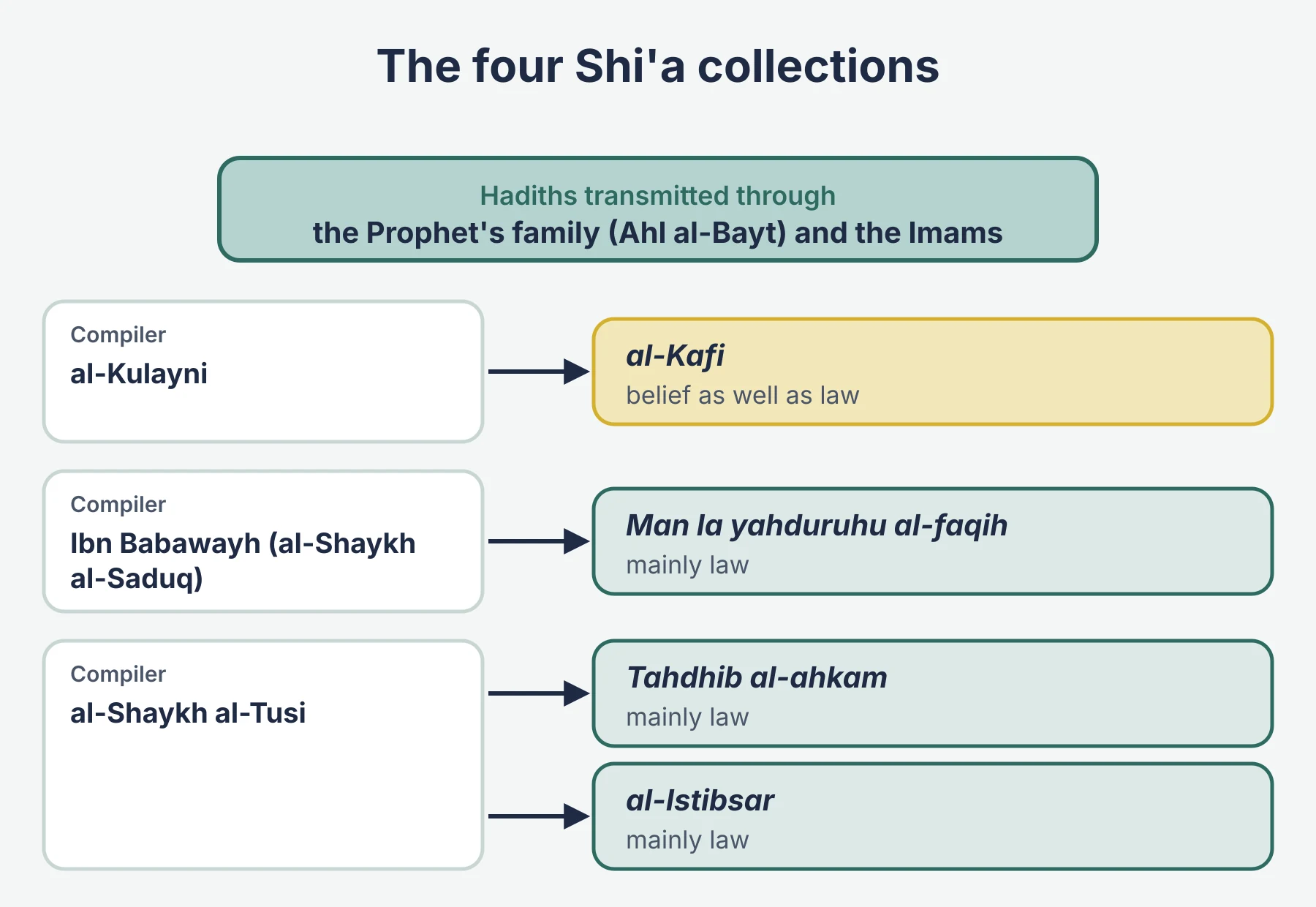
The four Shi’a collections (al-Kutub al-Arba’a): al-Kafi by al-Kulayni, covering belief and law; Man la yahduruhu al-faqih by Ibn Babawayh (al-Shaykh al-Saduq), a legal guide for those with no scholar at hand; and Tahdhib al-ahkam and al-Istibsar by al-Tusi, both on law, the second dealing with reports that seem to conflict. Shi’a scholars accept Hadith especially through the Prophet’s family and the Imams, whose words also carry authority.
How scholars tested Hadith
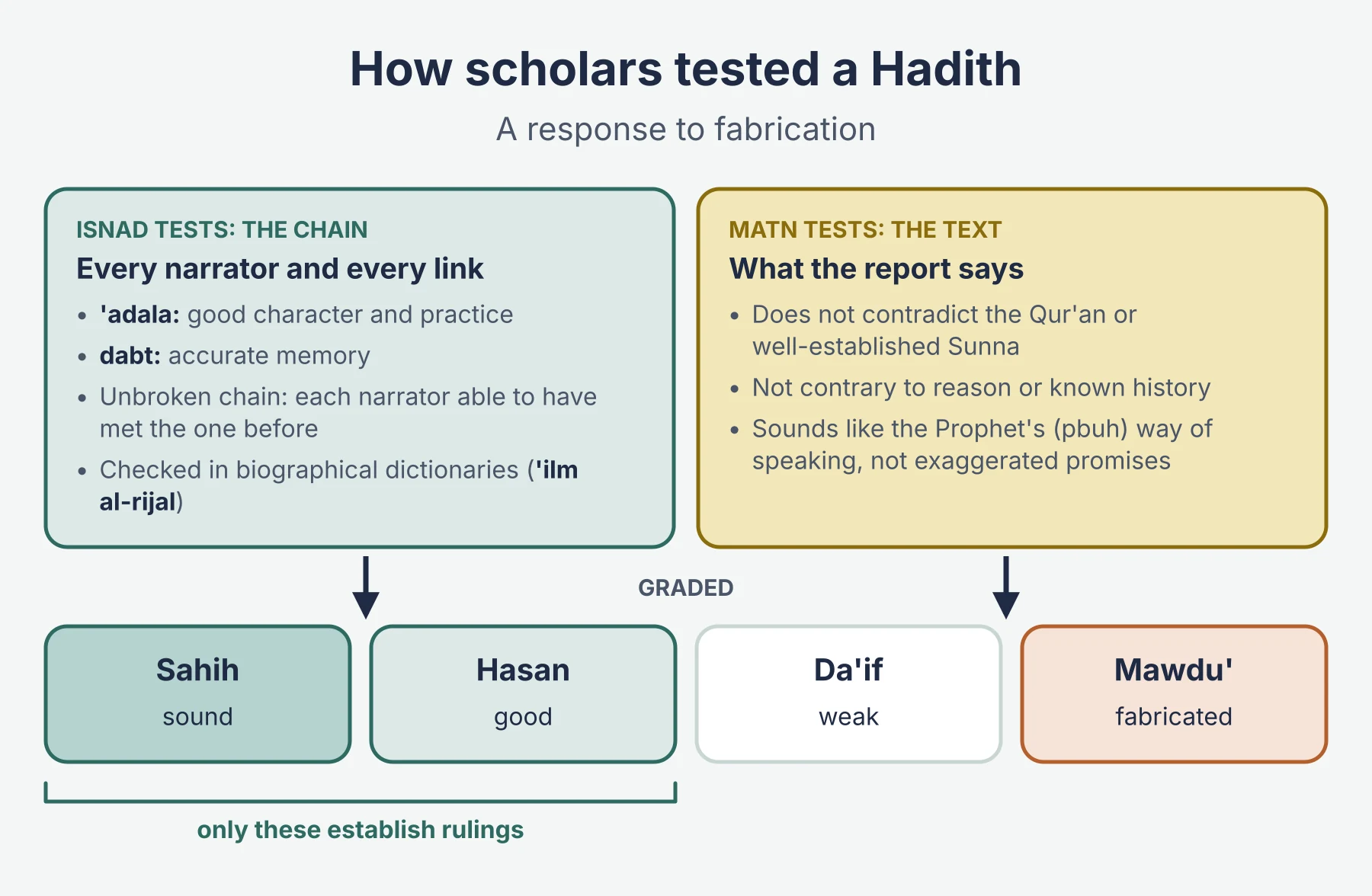
Fabrication became a real problem as political and sectarian disputes grew and some storytellers invented reports to move audiences. Scholars responded with two sets of tests.
Isnad tests. Every narrator had to be of good character and practice (’adala) and accurate in memory (dabt); the chain had to be unbroken, each narrator able to have met the one before. To check this, scholars compiled biographical dictionaries of narrators (’ilm al-rijal) recording their teachers, students, dates and reliability.
Matn tests. The text must not contradict the Qur’an or well-established Sunna, must not be contrary to reason or known history, and must sound like the Prophet’s (pbuh) way of speaking rather than exaggerated promises of huge rewards for small acts.
Result: Hadith were graded sahih (sound), hasan (good), da’if (weak) or mawdu’ (fabricated). Only sahih and hasan Hadith are used to establish rulings.
Hadith in legal thinking
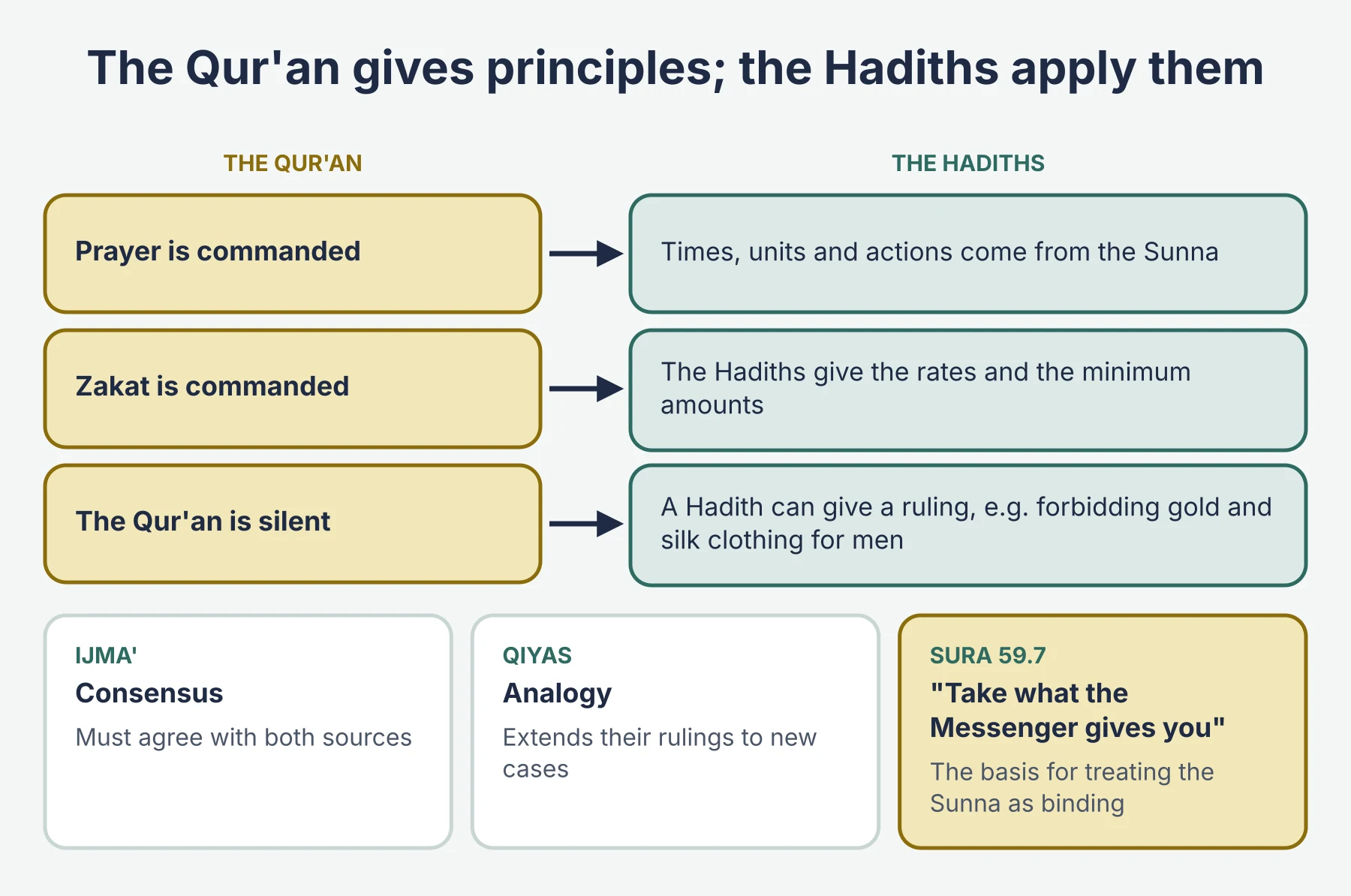
The Qur’an gives principles; the Hadith explain and apply them. The Qur’an commands prayer, but the times, units and actions come from the Sunna. The Qur’an commands zakat; the Hadith give the rates and the minimum amounts. Where the Qur’an is silent, a Hadith can give a ruling, such as forbidding gold and silk clothing for men. Ijma’ must agree with both sources, and qiyas extends their rulings to new cases. Sura 59.7 tells believers to “take what the Messenger gives you”, which is the basis for treating the Sunna as binding.
Significance in thought and action
- Practice: without the Hadith Muslims could not perform prayer, hajj or zakat as commanded.
- Character: they show the Prophet’s (pbuh) manners, family life and dealings with others, the “beautiful pattern” of Sura 33.21.
- Explanation: they explain the meaning of Qur’an verses, often with the reason for revelation.
- New questions: scholars apply Hadith principles to issues such as business, medicine and technology.
Worked example
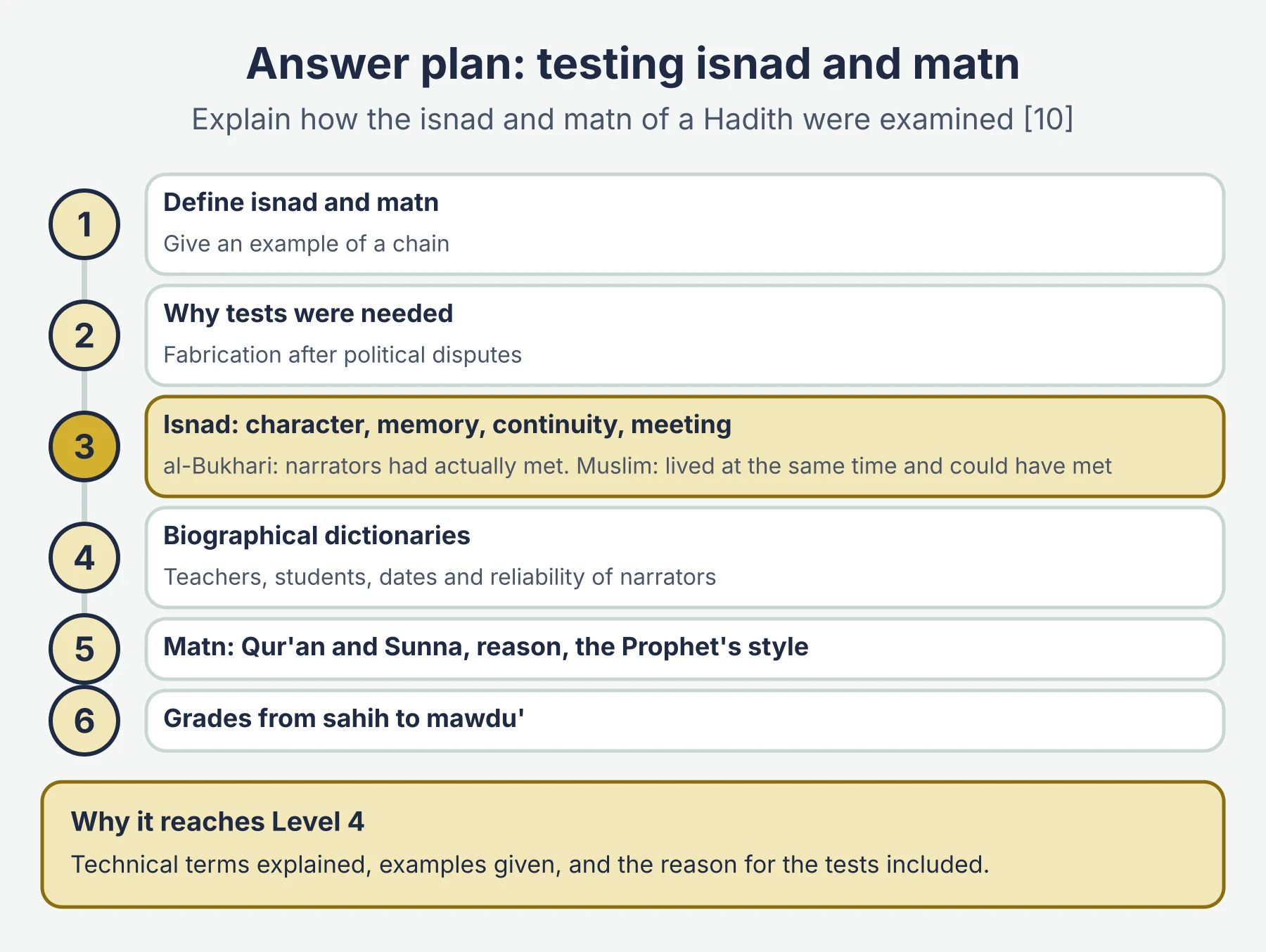
Question: Explain how the isnad and matn of a Hadith were examined to test its reliability. [10]
Model answer outline: define isnad and matn with an example of a chain → explain why tests were needed (fabrication after political disputes) → isnad: character, memory, continuity, meeting; give al-Bukhari’s requirement that narrators had actually met, and Muslim’s acceptance of narrators who lived at the same time and could have met → biographical dictionaries → matn: agreement with the Qur’an and Sunna, reason, the Prophet’s (pbuh) style → grades from sahih to mawdu’.
Why it reaches Level 4: technical terms explained, examples given, and the reason for the tests included.
Common mistakes
- Confusing musnad and musannaf. Musnad = by narrator; musannaf = by subject.
- Listing the six books with no features. “Main features” means arrangement, conditions and purpose.
- Ignoring the Shi’a books. They are named in the syllabus.
- Treating Hadith and Sunna as unrelated. The Hadith are the reports through which the Sunna is known.
Exam technique
- Describe / Write about (part a): follow the stages in order, naming compilers and works.
- Explain why / How important (part b): give two reasons with examples, for example how a Hadith details a Qur’anic command.
- Keep Question 1 to its 8 marks so you have time for this 14-mark essay.
Related pages
- History and Importance of the Hadith revision notes
- History and Importance of the Hadith practice questions
- Paper 2 study guide
Source: Cambridge International, Cambridge O Level Islamiyat 2058 syllabus for examination in 2026 and 2027, Paper 2 Topic 2.
Related resources
-
Practice questions
Cambridge O Level Islamiyat (2058): The History and Importance of the Hadith — Practice Questions
Eleven original questions on Hadith compilation, isnad and matn, musnad and musannaf works and Shi'a collections, for Cambridge O Level Islamiyat 2058 Paper 2.
Islamiyat · Cambridge · O Level
Try questions -
Practice questions
Cambridge O Level Islamiyat (2058): Major Teachings in the Hadith of the Prophet — Practice Questions
Twelve original questions on the 20 set Hadith for Cambridge O Level Islamiyat 2058 Paper 2 Question 1, with teachings, modern applications and marked answers.
Islamiyat · Cambridge · O Level
Try questions -
Study guides
Cambridge O Level Islamiyat (2058): The Period of Rule of the Rightly Guided Caliphs and Their Importance as Leaders
Study guide to the rules of Abu Bakr, Umar, Uthman and Ali, their difficulties and their lessons for government, for Cambridge O Level Islamiyat 2058 Paper 2.
Islamiyat · Cambridge · O Level
Read guide
Get free revision emails (optional)
Occasional emails with practice questions, worked explanations and links to free resources for the qualification and subjects you choose. No spam, and you can unsubscribe from any email. The free tools on this site never need an email.