
Study Guides
Cambridge O Level Sociology (2251): Research methods – How do sociologists investigate society?
Cambridge O Level Sociology 2251 key question 1.3: research design, operationalisation, five sampling techniques, methods, question types and ethics.
- Subject
- Sociology
- Level
- O LEVELS
- Topic
- Paper 1 – Research Methods, Identity and Inequality
- Author
- Marlbridge Academic Team
- Updated
- Reviewed by
- Naqiya Yousaf (what this means)
Aligned to Cambridge O Level Sociology (2251), 2025-2027. Official specification .
Syllabus page (what it covers and how it is assessed): Cambridge O Level Sociology.
Syllabus points this page covers
2251
- 1.3 Research methods – How do sociologists investigate society?
Found an error? Report a correction.
Need help with this topic? Request a free trial class for O Level Sociology (2251).
Key question 1.3 of Cambridge O Level Sociology (2251) asks How do sociologists investigate society? It is the practical heart of the Research methods topic, and the syllabus states that candidates “will be required to make and justify a plan of research on a specified topic”. That plan is Paper 1 Question 1(e): you explain the primary methods, sampling and secondary evidence you would use and give reasons, but you are not expected to evaluate your own plan. Every other part of Question 1 can also draw on this content, so it repays careful revision.
What the syllabus covers
| Section | Content |
|---|---|
| 1.3.1 Stages in research design | Selection of topic; aims; hypothesis; target population; methods; operationalisation; pilot studies |
| 1.3.2 Sampling | Sampling frames; random, systematic, stratified, snowball and quota sampling; strengths and limitations of each |
| 1.3.3 Primary research methods | Surveys; questionnaires; interviews (structured, semi-structured, unstructured, group); observations (participant, non-participant, covert, overt); strengths and limitations |
| 1.3.4 Types of question | Open; closed; multiple choice; scaled |
| 1.3.5 Theoretical and practical issues | Researcher perspective (positivist/interpretivist); access to sample; response rate; funding/cost; time |
| 1.3.6 Ethical issues | Informed consent; privacy/confidentiality; deception; prevention of harm; legality |
Stages in research design
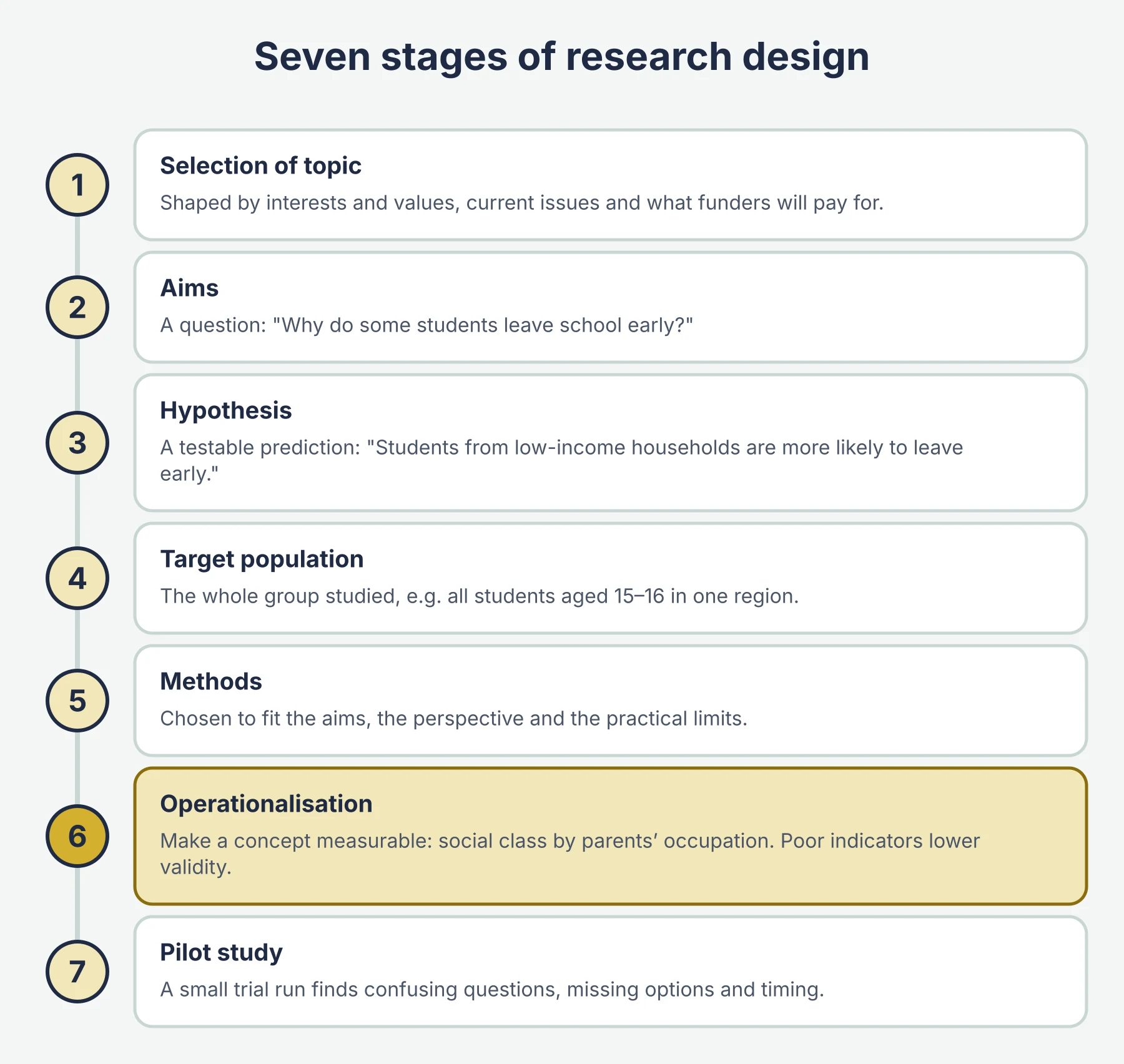
Research is a sequence of decisions, and each stage limits the next.
- Selection of topic: influenced by the researcher’s interests and values, current social issues, and what funders will pay for.
- Aims: what the research intends to find out, written as a question (“Why do some students leave school early?”).
- Hypothesis: a testable prediction about a relationship between variables (“Students from low-income households are more likely to leave school early”). Positivists usually begin with one; interpretivists often prefer open aims so they do not impose expectations.
- Target population: the whole group the research is about, such as all students aged 15–16 in one region.
- Methods: chosen to fit the aims, the perspective and the practical limits.
- Operationalisation: turning an abstract concept into something that can be measured. “Social class” might be operationalised by parents’ occupation; “religious commitment” by frequency of worship and prayer. Poor operationalisation lowers validity, because the indicator may not capture the concept.
- Pilot study: a small trial run with a few people similar to the sample. It reveals confusing questions, missing answer options and how long the method takes, saving time and money before the main study.
Sampling
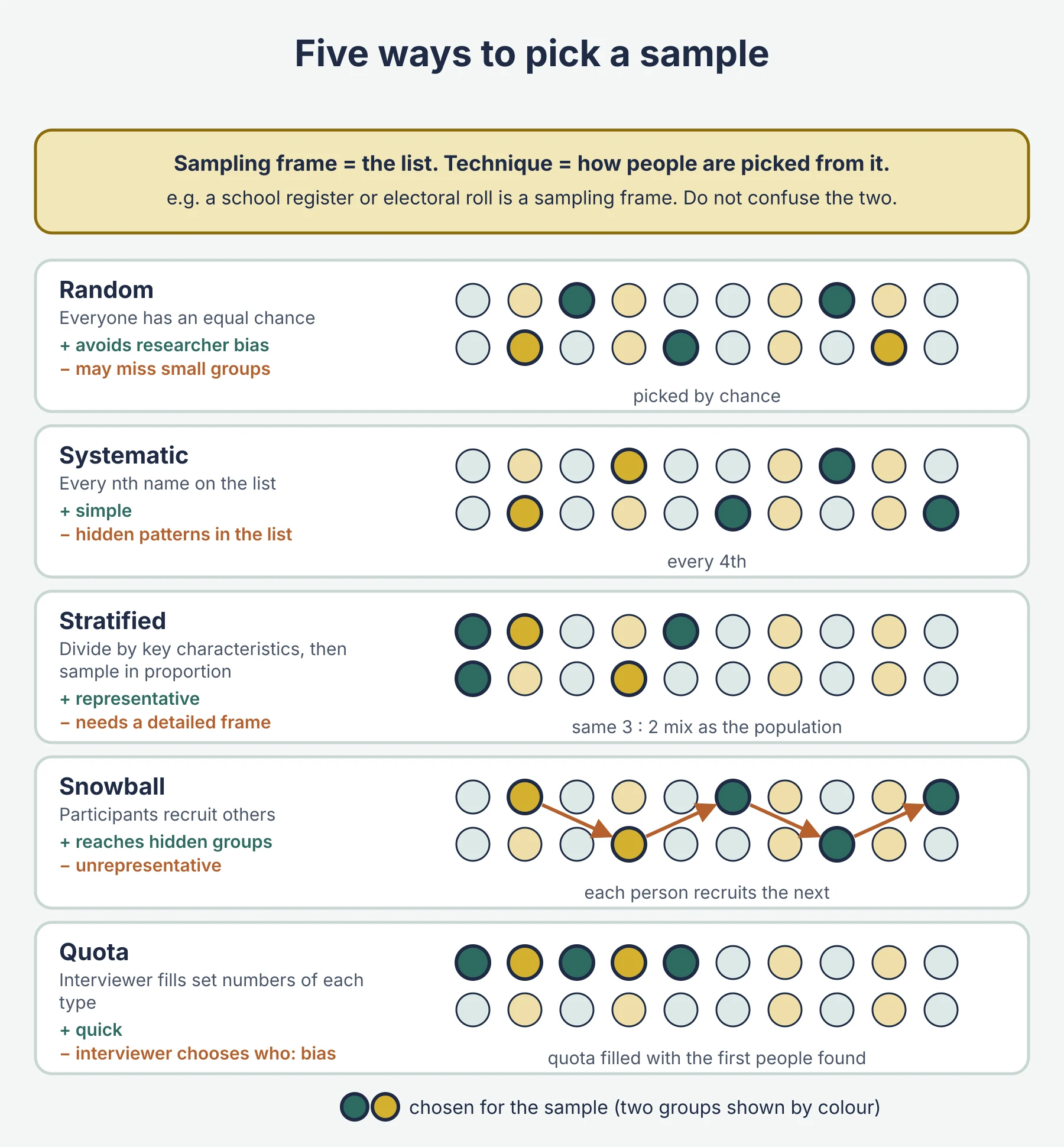
A sampling frame is a list of the target population from which a sample is drawn, such as a school register or an electoral roll. Without a complete, up-to-date frame, no method can give every member a known chance of selection.
| Technique | How it works | Strength | Limitation |
|---|---|---|---|
| Random | Every member of the frame has an equal chance of selection, for example by computer draw | Avoids researcher bias in choosing people | Can produce an unbalanced sample by chance, especially if small |
| Systematic | Every nth name from the frame, for example every 10th pupil on a register | Quick and simple | Biased if the list has a pattern, such as names ordered by class group |
| Stratified | Population divided into groups (strata), such as by gender or age, and a proportionate random sample taken from each | Ensures key groups are represented in correct proportions | Requires a frame with information about each person’s group |
| Snowball | Participants recruit others they know | Reaches hidden or hard-to-reach groups with no frame | Not representative; people recruit others like themselves |
| Quota | Interviewer fills set numbers in each category, such as 20 men and 20 women over 60, choosing whoever is available | Quick and cheap; no frame needed | Not random: interviewers may pick approachable people, introducing bias |
Primary methods
Surveys and questionnaires. A survey collects the same information from many people, often by questionnaire: a written list of questions completed by the respondent, on paper or online. They suit positivists because they are standardised, reliable and can cover large samples. Their weaknesses are low response rates for postal and online versions, no chance to clarify misunderstood questions, and answers that may be socially desirable rather than true.
Interviews.
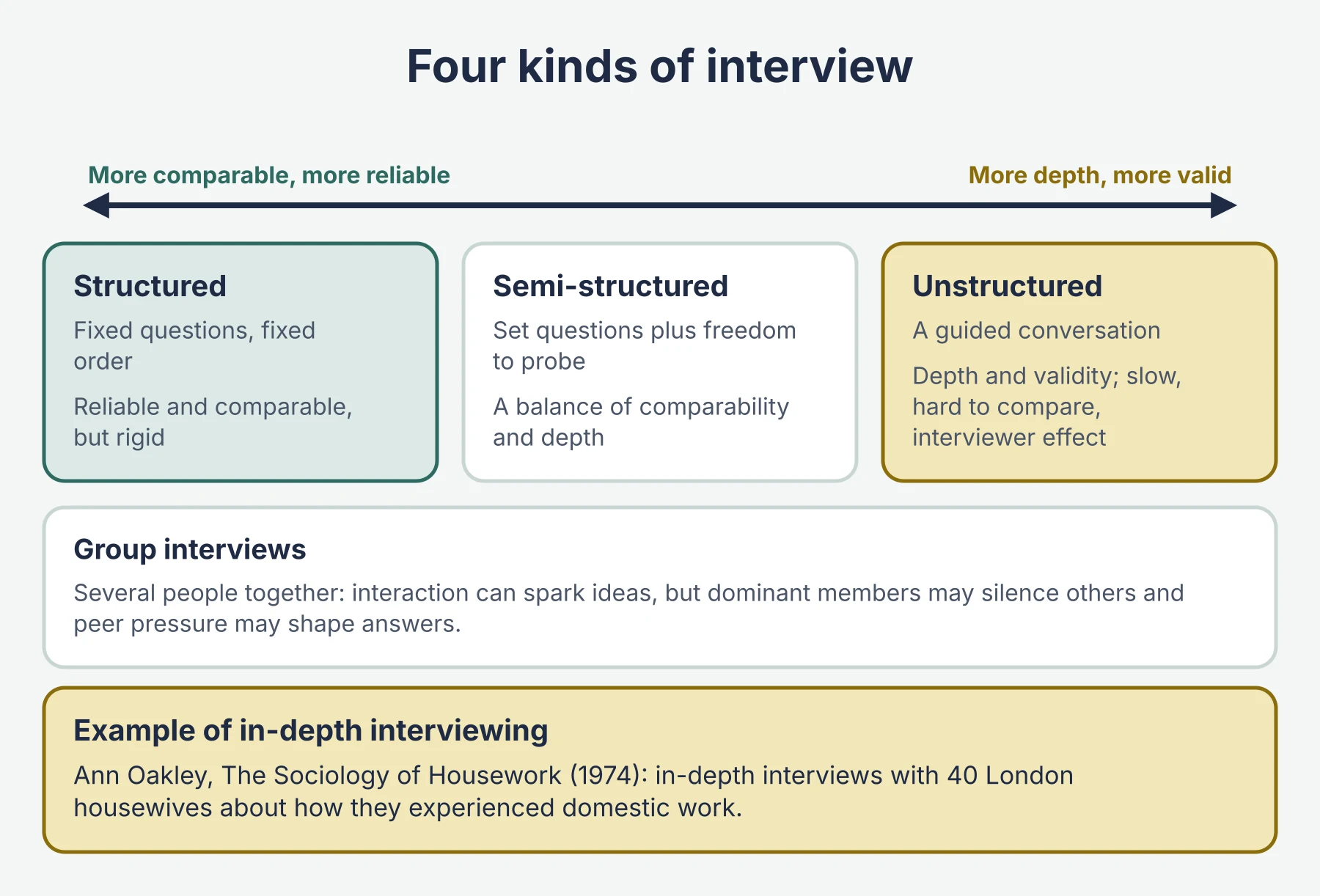
- Structured: fixed questions in a fixed order, read out by the interviewer; reliable and comparable, but rigid.
- Semi-structured: set questions with freedom to probe further; a balance of comparability and depth.
- Unstructured: a guided conversation; depth and validity, but time-consuming, hard to compare, and vulnerable to the interviewer effect. Ann Oakley’s The Sociology of Housework (1974) used in-depth interviews with 40 London housewives to explore how they experienced domestic work.
- Group: several people interviewed together; interaction can spark ideas, but dominant members may silence others and peer pressure may shape answers.
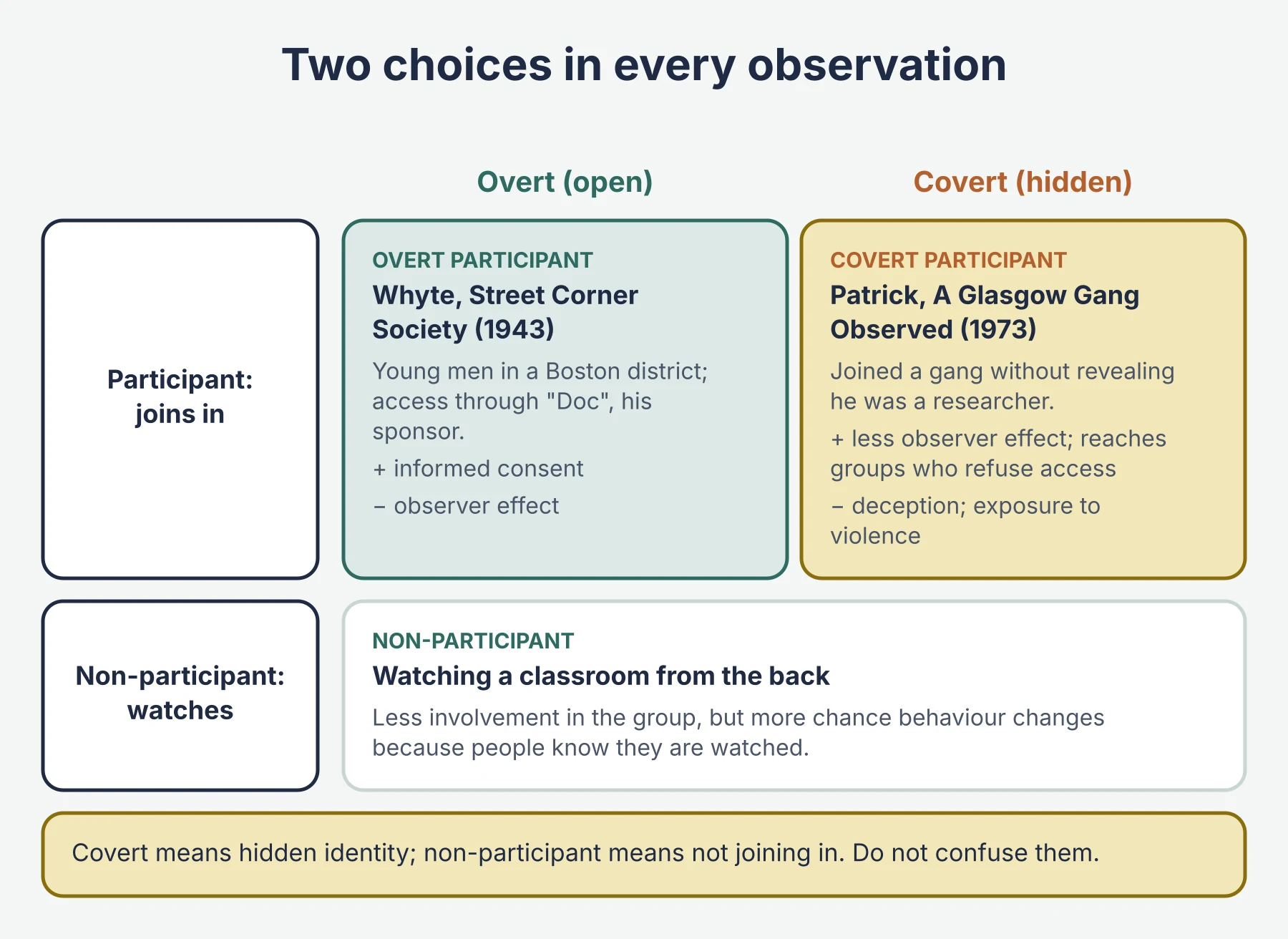
Observation. Two choices combine: participant or non-participant (joining in or watching), and overt or covert (open or hidden).
- Overt participant: William Foote Whyte’s Street Corner Society (1943) studied young men in an Italian-American district of Boston, gaining access through a local man, “Doc”, who acted as his sponsor. Openness allows informed consent but risks the observer effect.
- Covert participant: James Patrick’s A Glasgow Gang Observed (1973) was based on joining a gang without revealing he was a researcher. Covert observation reduces the observer effect and can reach groups that would refuse access, but it involves deception and, here, exposure to violence.
- Non-participant: watching a classroom from the back; less involvement in the group but more chance that behaviour changes because people know they are watched.
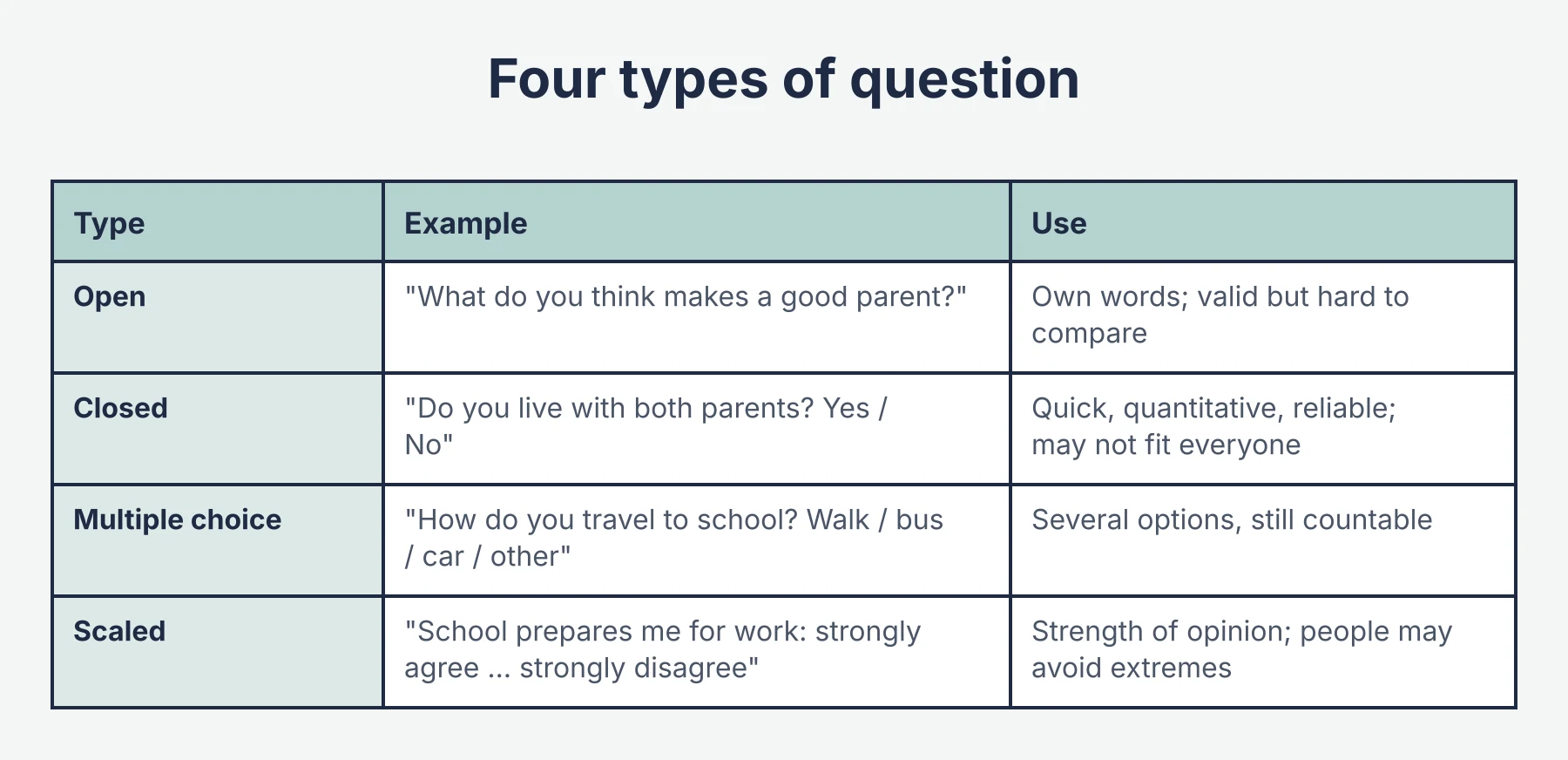
Types of question
| Type | Example | Use |
|---|---|---|
| Open | “What do you think makes a good parent?” | Qualitative answers in the respondent’s own words; valid but hard to compare |
| Closed | “Do you live with both parents? Yes / No” | Quick quantitative answers; reliable but may not fit everyone |
| Multiple choice | “How do you travel to school? Walk / bus / car / other” | Allows several options while staying countable |
| Scaled | “School prepares me for work: strongly agree … strongly disagree” | Measures strength of opinion; respondents may avoid extremes |
Theoretical, practical and ethical issues
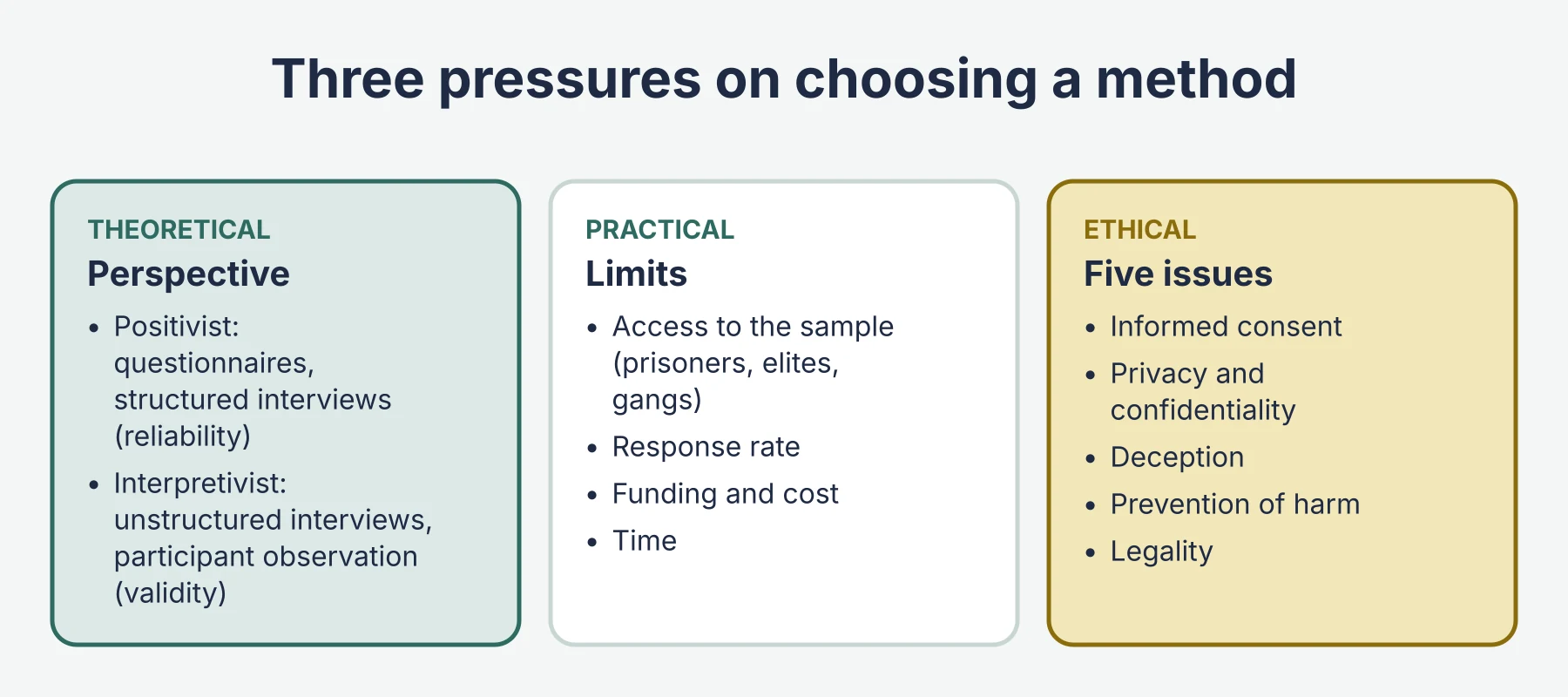
Method choice balances three pressures.
- Theoretical: a positivist will favour questionnaires and structured interviews for reliability; an interpretivist will favour unstructured interviews and participant observation for validity.
- Practical: access to the sample (prisoners, elites and gangs are hard to reach); expected response rate; funding and cost; and time available.
- Ethical: informed consent (participants agree knowing what the research involves); privacy and confidentiality (identities and data protected); deception (avoided unless strongly justified); prevention of harm (physical, emotional or social); legality (the researcher must not break the law).
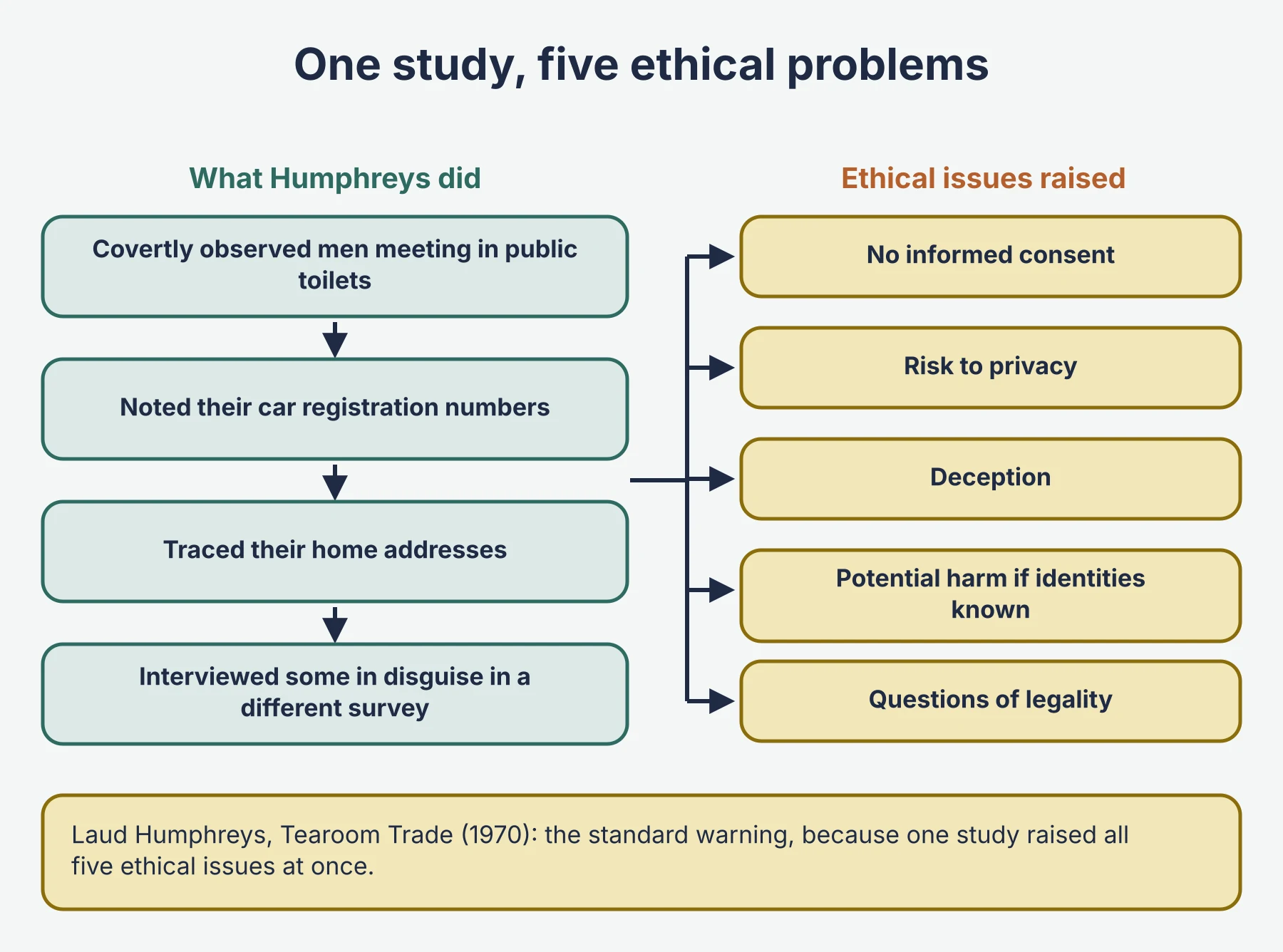
Laud Humphreys’s Tearoom Trade (1970) is the standard ethical warning. He covertly observed men meeting for sex in public toilets, noted their car registration numbers, traced their home addresses and later interviewed some of them in disguise as part of a different survey. The study raised all five issues at once: no consent, risk to privacy, deception, potential harm if identities became known, and questions of legality.
Worked example: a research plan for part (e)
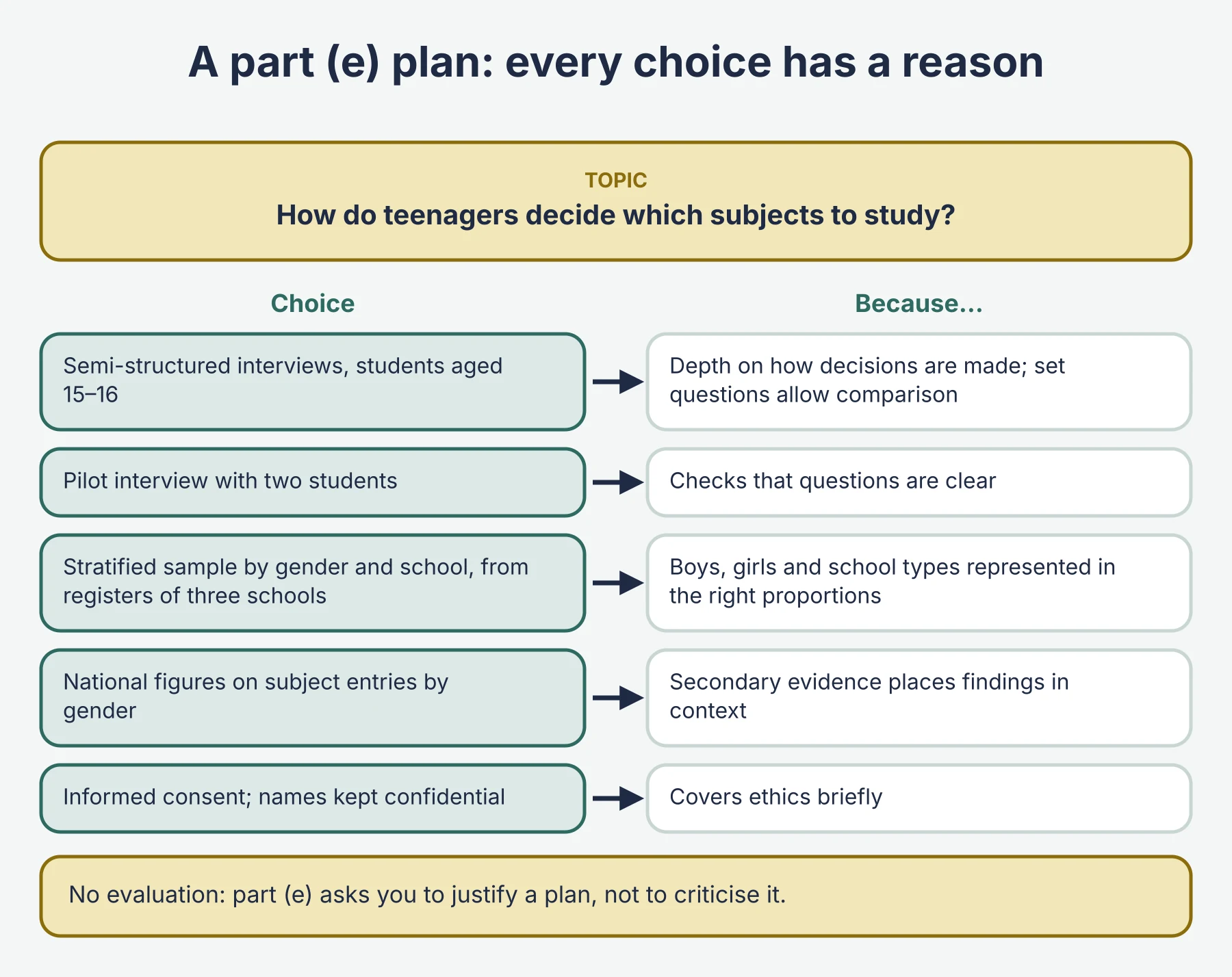
You have been asked to investigate how teenagers decide which subjects to study. Explain the primary research methods, sampling and secondary evidence you would use, and give reasons for your choices. (practice question)
I would use semi-structured interviews with students aged 15–16, because the aim is to understand how decisions are made and who influences them, which requires depth, while set questions allow comparison between students. A pilot interview with two students would check that questions are clear. I would use school registers from three schools as a sampling frame and take a stratified sample by gender and school, so that boys and girls and different types of school are represented in the right proportions. As secondary evidence I would use published national figures on subject entries by gender to place my findings in context. I would obtain informed consent from students and parents and keep all names confidential.
Why it works: each choice is named and justified against the aim; method, sampling and secondary evidence are all present; ethics is covered briefly; there is no evaluation, which part (e) does not require.
Common mistakes
- Using “random” to mean “whoever I meet”; that is opportunity sampling, not random sampling.
- Forgetting the sampling frame when describing random, systematic or stratified sampling.
- Describing a method in part (e) without a reason linked to the topic.
- Confusing covert (hidden identity) with non-participant (not joining in).
- Treating ethics as one idea; the syllabus names five separate issues.
Exam technique
- Describe a sampling technique: say how it works and what makes it more or less representative.
- Explain a strength or limitation: state it and link it to a concept, such as validity or response rate.
- Justify in part (e): every choice needs “because”, tied to the topic in the question.
Keep revising
Condense this page with the key question 1.3 revision notes and practise with the key question 1.3 practice questions. Secondary evidence for your plans is covered in the guide to key question 1.2.
Related resources
-
Practice questions
Cambridge O Level Sociology (2251): Research methods – How do sociologists investigate society? – Practice Questions
Original Cambridge O Level Sociology 2251 practice on key question 1.3: sampling, interviews, observation, question types, ethics and research plans.
Sociology · Cambridge · O Level
Try questions -
Revision notes
Cambridge O Level Sociology (2251): Research methods – How do sociologists investigate society? – Revision Notes
Revision notes for Cambridge O Level Sociology 2251 key question 1.3: research stages, sampling, interviews, observation, question types and ethics.
Sociology · Cambridge · O Level
Revise topic -
Study guides
Cambridge O Level Sociology (2251): Identity: self and society – How do we learn our identity?
Cambridge O Level Sociology 2251 key question 2.1 in depth: social construction, nature and nurture, agencies and processes of socialisation, and theories.
Sociology · Cambridge · O Level
Read guide
Related articles
Get free revision emails (optional)
Occasional emails with practice questions, worked explanations and links to free resources for the qualification and subjects you choose. No spam, and you can unsubscribe from any email. The free tools on this site never need an email.