
Revision Notes
Cambridge O Level Sociology (2251): Research methods – How do sociologists investigate society? – Revision Notes
Revision notes for Cambridge O Level Sociology 2251 key question 1.3: research stages, sampling, interviews, observation, question types and ethics.
- Subject
- Sociology
- Level
- O LEVELS
- Topic
- Paper 1 – Research Methods, Identity and Inequality
- Author
- Marlbridge Academic Team
- Updated
- Reviewed by
- Naqiya Yousaf (what this means)
Aligned to Cambridge O Level Sociology (2251), 2025-2027. Official specification .
Syllabus page (what it covers and how it is assessed): Cambridge O Level Sociology.
Syllabus points this page covers
2251
- 1.3 Research methods – How do sociologists investigate society?
Found an error? Report a correction.
Need help with this topic? Request a free trial class for O Level Sociology (2251).
These notes condense key question 1.3 of Cambridge O Level Sociology (2251), How do sociologists investigate society? Research moves through set stages from topic to pilot study; a sample is drawn from a sampling frame using one of five techniques; primary data comes from surveys, questionnaires, interviews and observation; and every choice is shaped by theoretical, practical and ethical issues. This content supplies most of the marks in the research plan at the end of Paper 1 Question 1.
Fuller explanations: key question 1.3 study guide.
Syllabus coverage
2251 syllabus 2025–2027, 1.3: 1.3.1 stages in research design; 1.3.2 sampling; 1.3.3 quantitative and qualitative primary methods; 1.3.4 types of question; 1.3.5 theoretical and practical issues; 1.3.6 ethical issues.
Key terms
| Term | Definition |
|---|---|
| Aim | What the research sets out to find out |
| Hypothesis | A prediction, stated so it can be tested, that two variables are linked |
| Target population | Everyone the findings are meant to apply to |
| Operationalisation | Turning a concept into measurable indicators |
| Pilot study | Small trial run to test and improve a method |
| Sampling frame | A list of the target population from which a sample is drawn |
| Representative sample | A sample with the same characteristics as the population |
| Response rate | Percentage of those approached who take part |
| Gatekeeper | Person who controls or sponsors access to a group |
| Covert / overt | Researcher’s identity hidden / known |
| Informed consent | Agreement to take part, knowing what the research involves |
| Confidentiality | Keeping participants’ identities and data private |
| Interviewer effect | Answers shaped by the interviewer’s characteristics or behaviour |
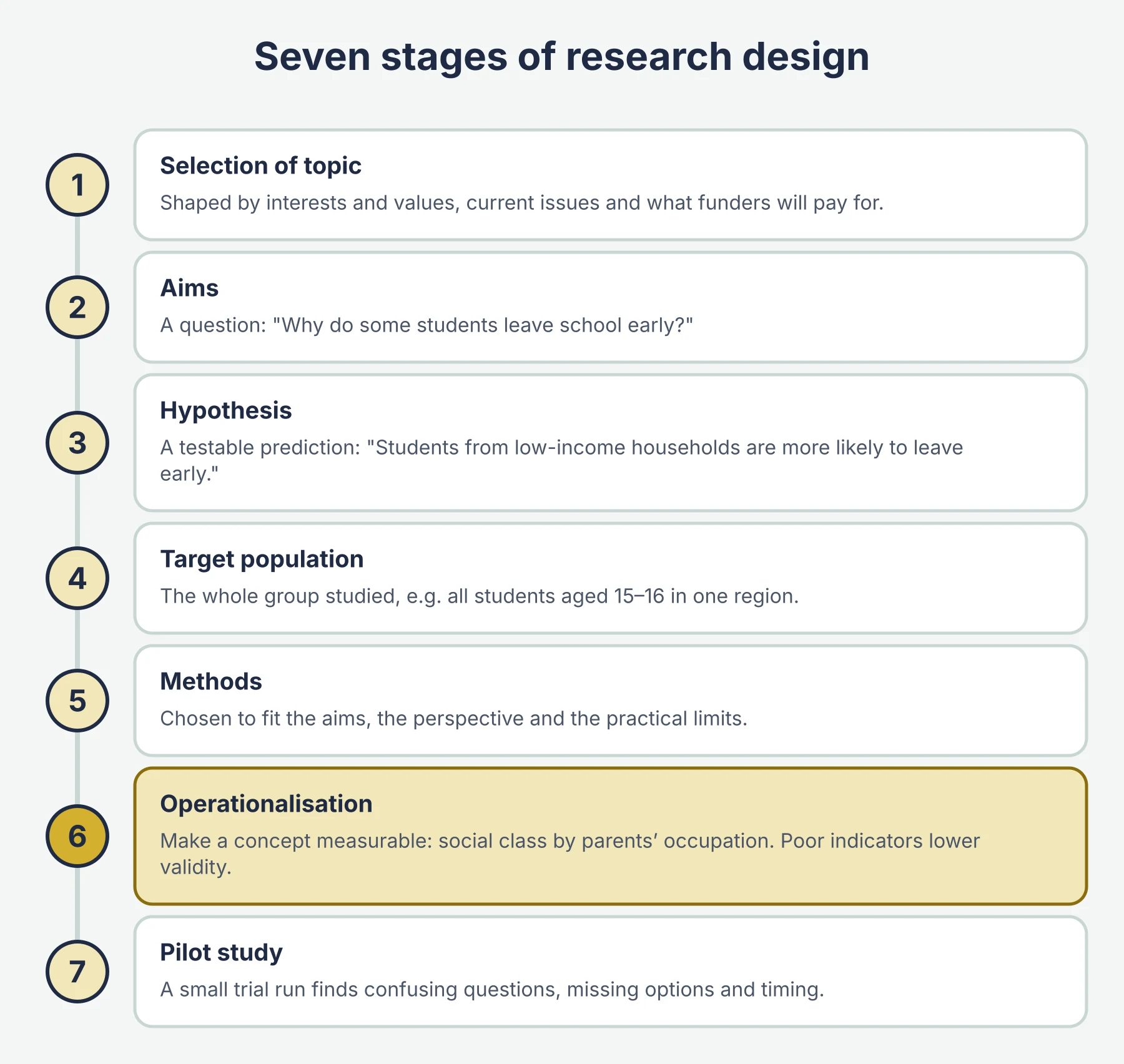
Research design in seven words
Topic → aims → hypothesis → population → methods → operationalisation → pilot.
- Hypotheses suit positivists; interpretivists often use open aims instead.
- Operationalisation example: “poverty” measured by household income below a set level, or by lack of items most people regard as necessities. Different indicators give different results.
- Pilot studies check wording, timing, answer options and practical problems.
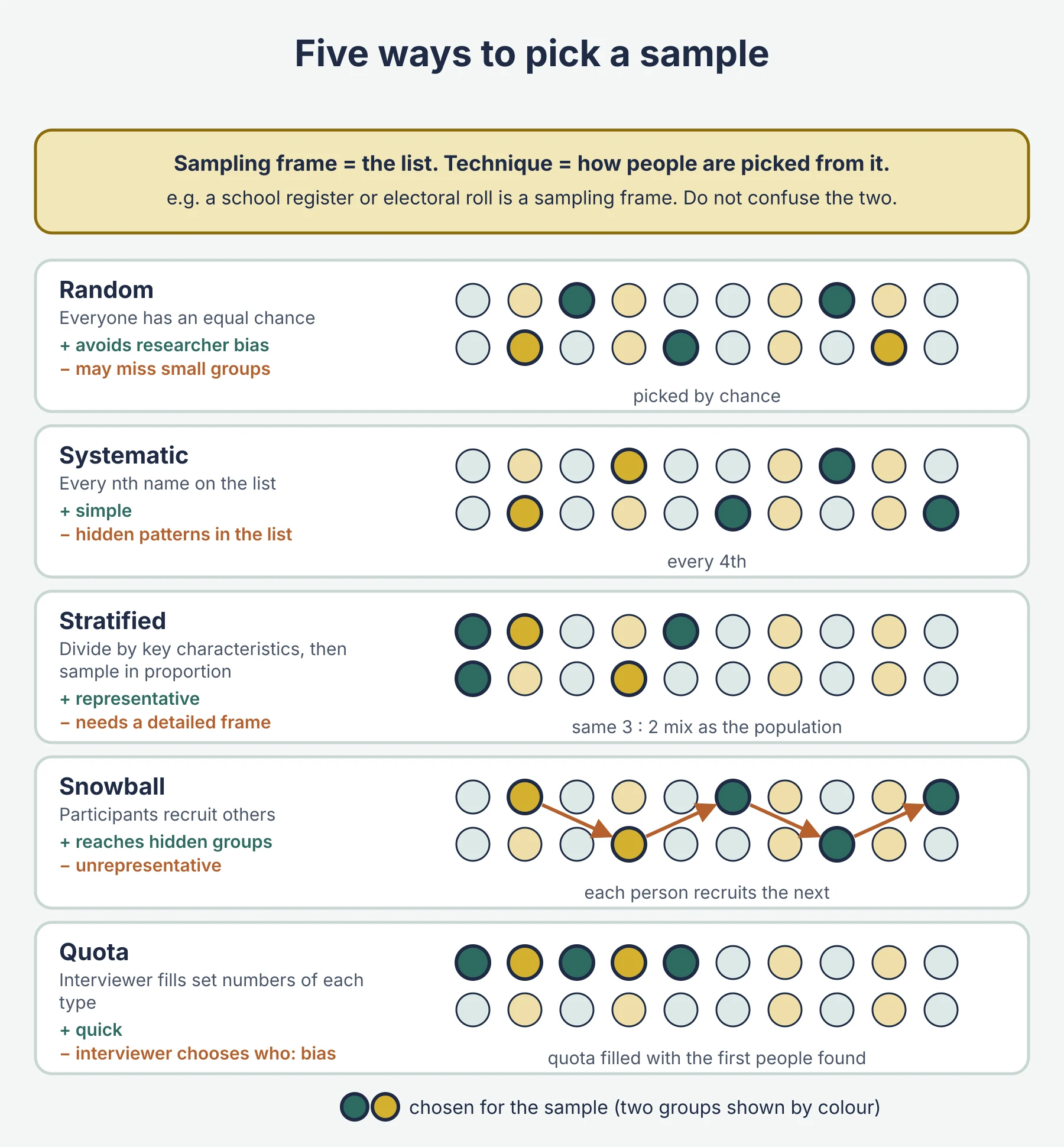
Five sampling techniques
| Technique | Key feature | Best for | Main problem |
|---|---|---|---|
| Random | Equal chance for all in the frame | Avoiding researcher bias | Small samples can be unbalanced |
| Systematic | Every nth name | Speed with a long list | Hidden patterns in the list |
| Stratified | Proportionate sample from each subgroup | Ensuring representation | Needs detailed frame |
| Snowball | Participants recruit others | Hidden groups with no frame | Unrepresentative |
| Quota | Interviewer fills category targets | Speed, no frame needed | Not random; interviewer choice |
Methods: strengths and limitations
| Method | Strengths | Limitations |
|---|---|---|
| Questionnaire / survey | Large samples; standardised and reliable; quick to analyse | Low response rates; no clarification; socially desirable answers |
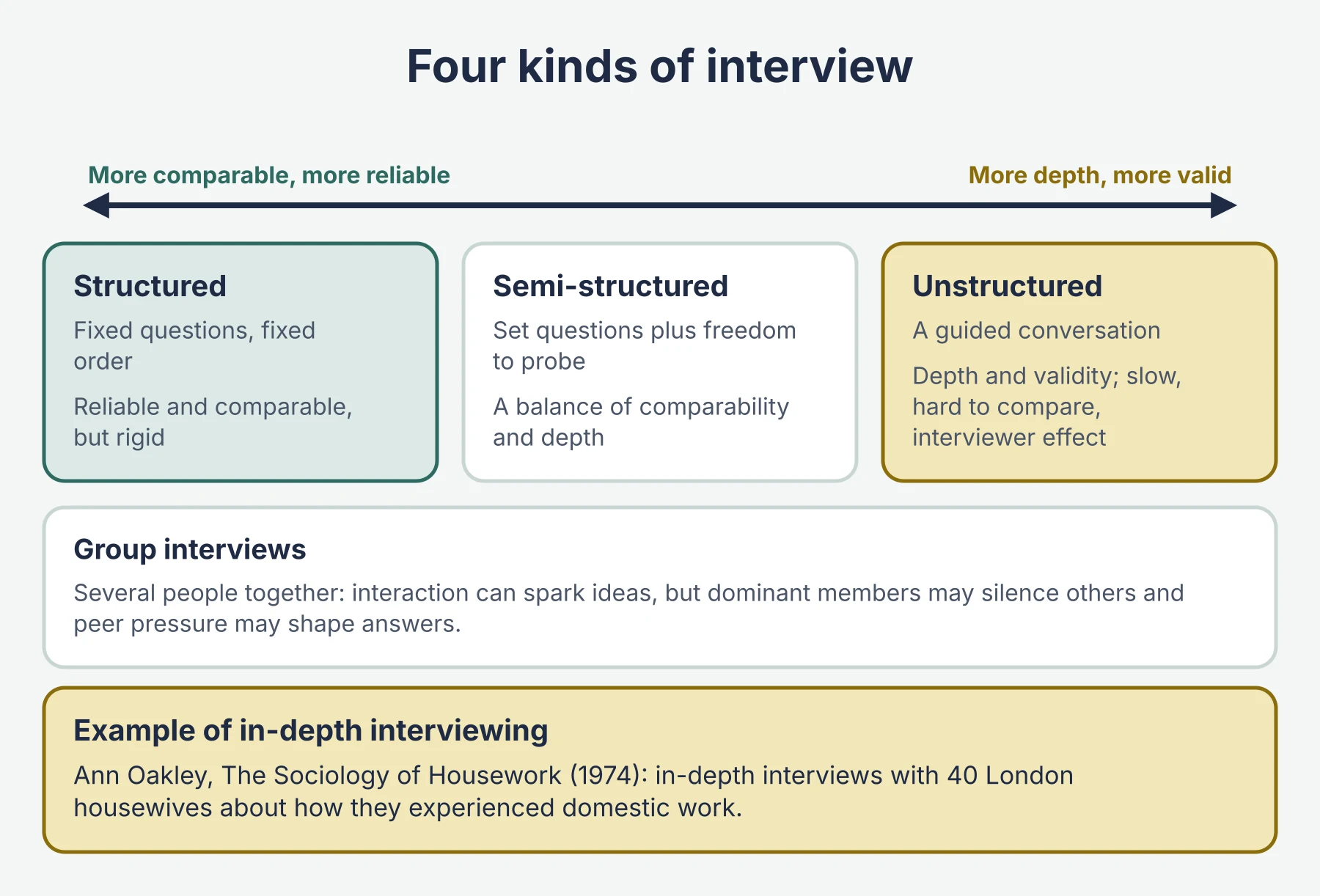
| Structured interview | Reliable; higher response than postal questionnaires; can clarify | Rigid; interviewer effect still possible |
| Semi-structured interview | Comparable core plus depth through probing | Slower; harder to analyse than structured |
| Unstructured interview | Depth, rapport and validity; respondent’s own words | Time-consuming; small samples; hard to repeat |
| Group interview | Interaction produces ideas; efficient | Dominant voices; peer pressure |
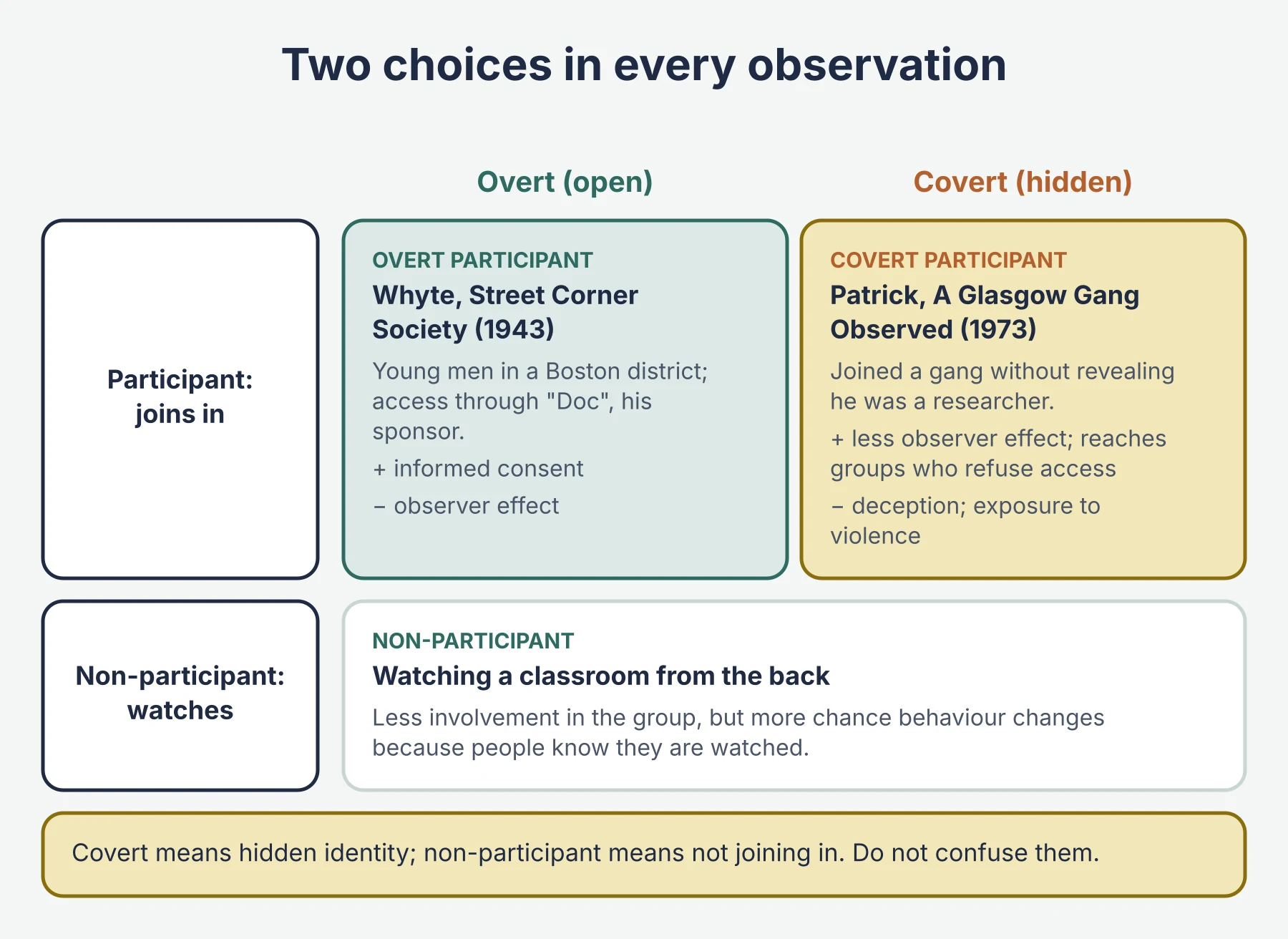
| Participant observation | Verstehen; sees behaviour in natural setting | Time-consuming; risk of “going native”; hard to record |
| Non-participant observation | Researcher stays detached | Observer effect; misses meanings |
| Covert | Avoids observer effect; access to closed groups | Deception; no consent; risk to researcher |
| Overt | Ethical; can ask questions openly | Behaviour may change while observed |
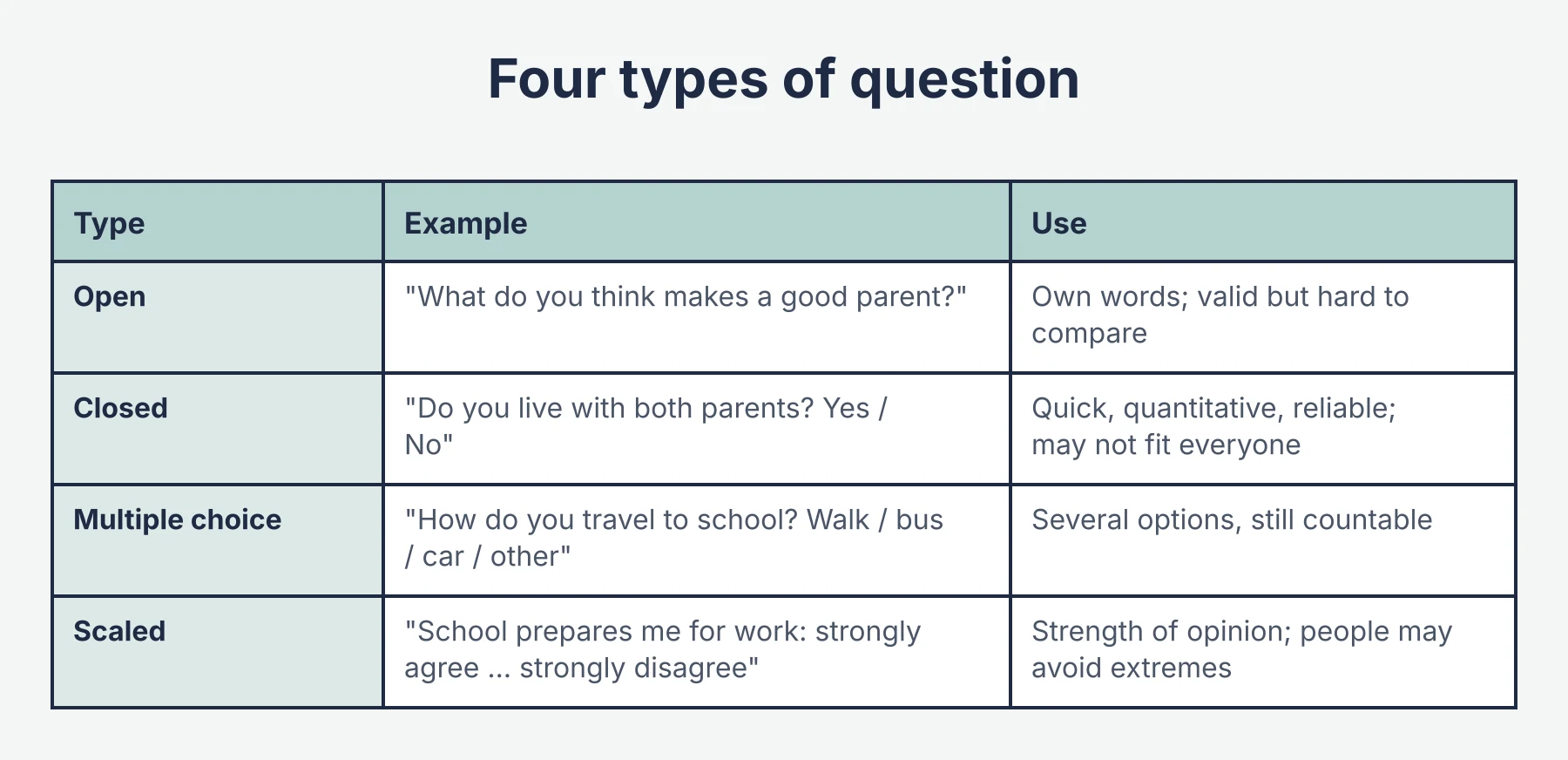
Question types
- Open: own words; qualitative; valid; hard to code.
- Closed: fixed choices such as yes/no; quantitative; reliable; may force an answer.
- Multiple choice: several fixed options; countable; options may not fit everyone.
- Scaled: strength of view on a scale; measures attitudes; people may choose the middle.
Issues affecting research
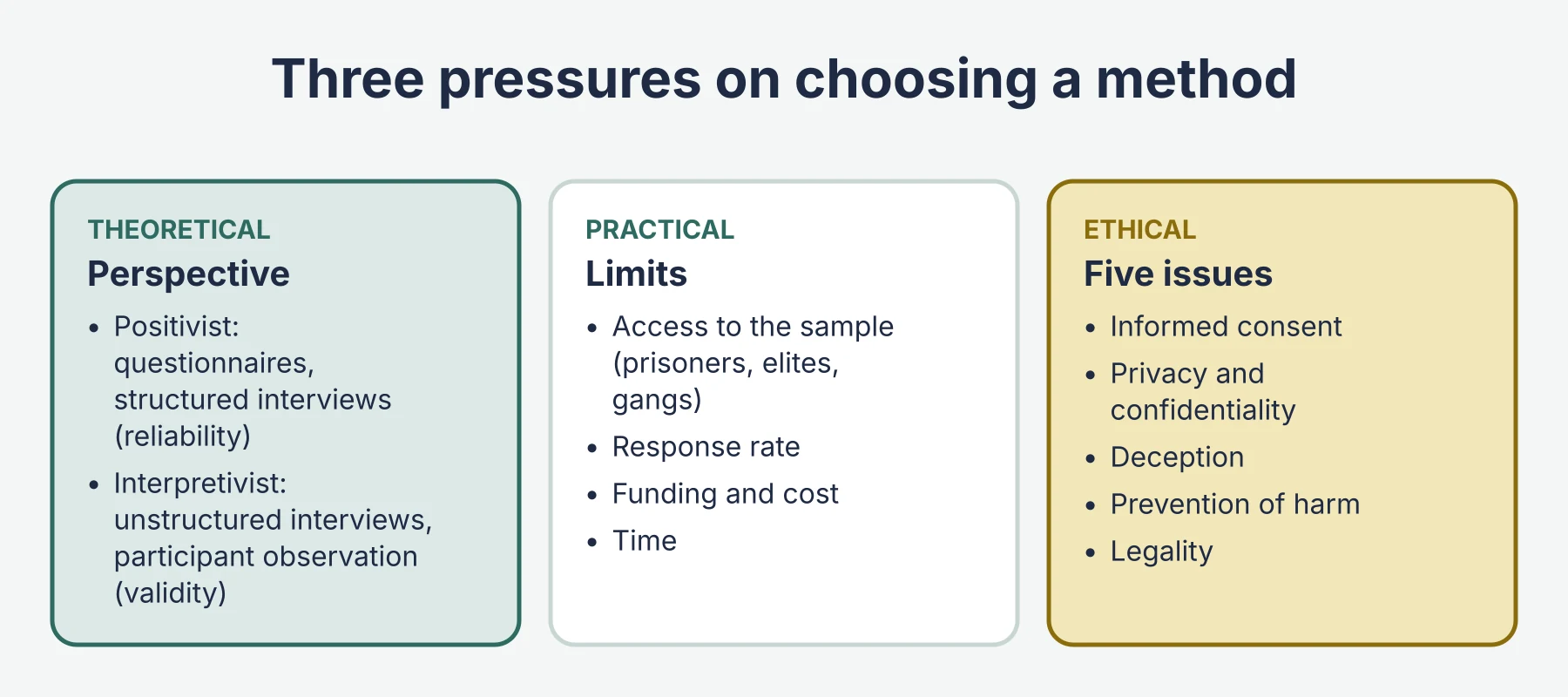
- Theoretical: positivist or interpretivist perspective decides the kind of data sought.
- Practical: access, response rate, funding/cost, time.
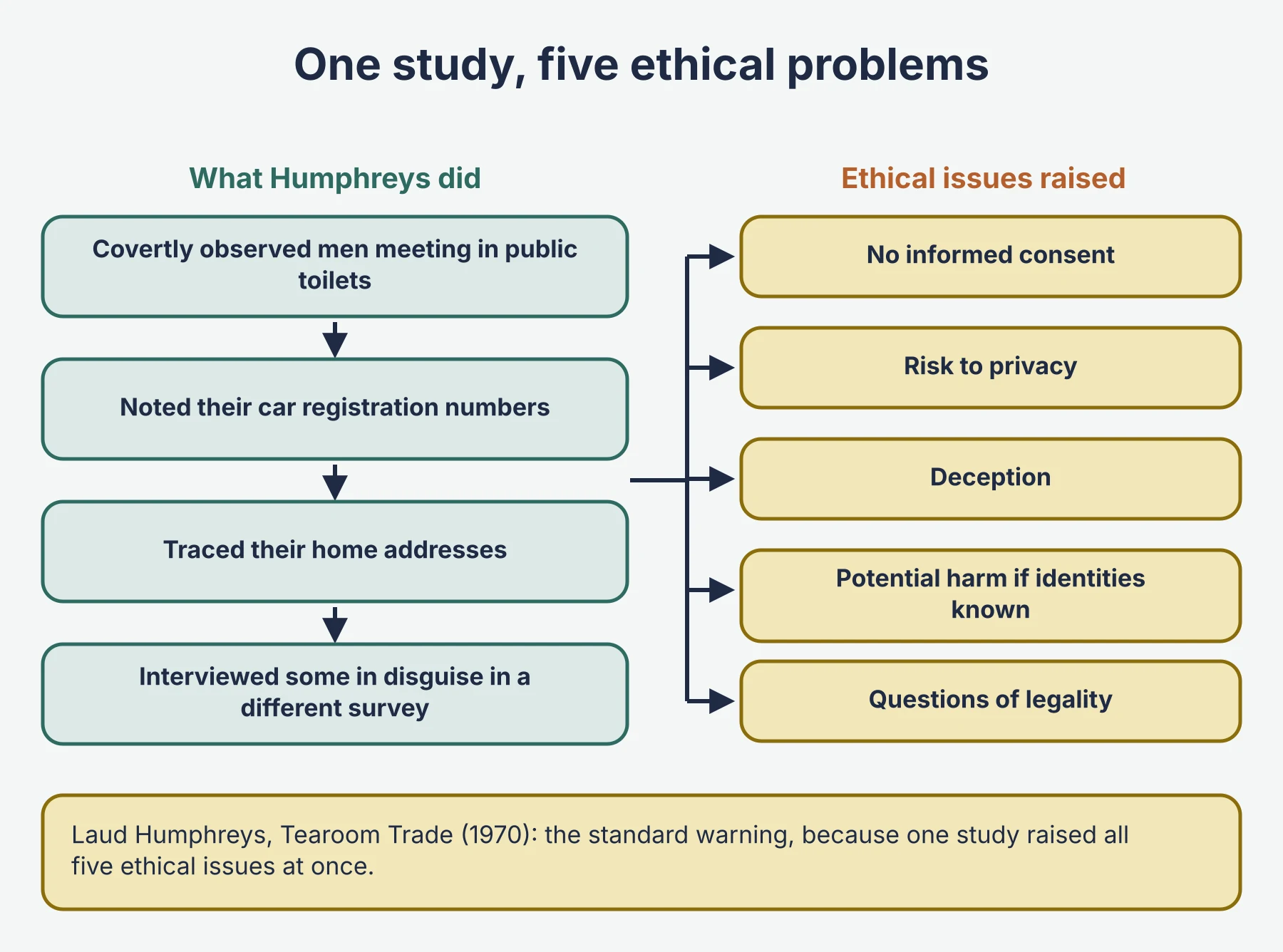
- Ethical: informed consent, privacy/confidentiality, deception, prevention of harm, legality.
- Studies to name: Whyte (1943), access through a sponsor; Patrick (1973), covert gang research and danger; Humphreys (1970), deception and privacy; Oakley (1974), in-depth interviews.
Exam traps
- Opportunity sampling (whoever is available) is not random sampling.
- A sampling frame is a list, not a sample.
- Quota sampling looks like stratified sampling but is not random.
- In part (e), justify every choice; do not evaluate your plan.
- Ethics answers should name the specific issue and apply it to the research.
- “Interviews” alone is vague; say which type.
Self-test
- What is operationalisation?
- Give one reason for carrying out a pilot study.
- What is a sampling frame?
- How does stratified sampling differ from quota sampling?
- When would snowball sampling be most useful?
- Give one strength and one limitation of unstructured interviews.
- What is the difference between covert and non-participant observation?
- Give one problem with group interviews.
- Write an example of a scaled question.
- Name the five ethical issues in the syllabus.
- Give one practical issue that affects research.
- Why are postal and online questionnaires often unrepresentative?
Answers
- Turning an abstract concept into something measurable, such as using occupation to measure class.
- To find confusing questions or practical problems before the main study.
- A list of the target population from which the sample is drawn.
- Stratified sampling selects randomly within each group; quota sampling lets the interviewer choose people until each quota is filled.
- For hidden or hard-to-reach groups with no sampling frame, such as drug users.
- Strength: depth and validity. Limitation: hard to compare or repeat; small samples.
- Covert means the group does not know they are being studied; non-participant means the researcher watches without joining in. Covert observation can be participant or non-participant.
- Dominant members may influence or silence others.
- “Homework helps me learn: strongly agree / agree / neutral / disagree / strongly disagree.”
- Informed consent, privacy/confidentiality, deception, prevention of harm, legality.
- Access, response rate, funding/cost or time.
- Response rates are low, and those who reply may differ from those who do not, for example by interest in the topic.
Frequently asked questions
How many methods should a part (e) plan use? One well-justified primary method is enough; a second can be added if it clearly serves the aim. Include sampling and secondary evidence too.
Can I choose covert observation in a plan? You can, but you must give a reason and recognise the ethical issue of consent briefly.
Related pages: key question 1.3 practice questions | key question 1.2 revision notes
Related resources
-
Study guides
Cambridge O Level Sociology (2251): Identity: self and society – How do we learn our identity?
Cambridge O Level Sociology 2251 key question 2.1 in depth: social construction, nature and nurture, agencies and processes of socialisation, and theories.
Sociology · Cambridge · O Level
Read guide -
Practice questions
Cambridge O Level Sociology (2251): Identity: self and society – How do we learn our identity? – Practice Questions
Original Cambridge O Level Sociology 2251 practice on key question 2.1: customs, roles, agencies of socialisation and three theories, with full answers.
Sociology · Cambridge · O Level
Try questions -
Revision notes
Cambridge O Level Sociology (2251): Identity: self and society – How do we learn our identity? – Revision Notes
Revision notes for Cambridge O Level Sociology 2251 key question 2.1: culture, nature and nurture, agencies and processes of socialisation, and three theories.
Sociology · Cambridge · O Level
Revise topic
Related articles
Get free revision emails (optional)
Occasional emails with practice questions, worked explanations and links to free resources for the qualification and subjects you choose. No spam, and you can unsubscribe from any email. The free tools on this site never need an email.