
Revision Notes
Cambridge O Level Sociology (2251): Identity: self and society – How do we learn our identity? – Revision Notes
Revision notes for Cambridge O Level Sociology 2251 key question 2.1: culture, nature and nurture, agencies and processes of socialisation, and three theories.
- Subject
- Sociology
- Level
- O LEVELS
- Topic
- Paper 1 – Research Methods, Identity and Inequality
- Author
- Marlbridge Academic Team
- Updated
- Reviewed by
- Naqiya Yousaf (what this means)
Aligned to Cambridge O Level Sociology (2251), 2025-2027. Official specification .
Syllabus page (what it covers and how it is assessed): Cambridge O Level Sociology.
Syllabus points this page covers
2251
- 2.1 Identity: self and society – How do we learn our identity?
Found an error? Report a correction.
Need help with this topic? Request a free trial class for O Level Sociology (2251).
These notes condense key question 2.1 of Cambridge O Level Sociology (2251), How do we learn our identity? Identity is socially constructed: we learn culture, norms and values through primary and secondary socialisation. Each agency uses particular processes and varies in effectiveness, and functionalists, Marxists and feminists disagree about what socialisation achieves and whose interests it serves.
Fuller explanations: key question 2.1 study guide.
Syllabus coverage
2251 syllabus 2025–2027, 2.1: 2.1.1 society as a social construction (culture, norms, values, customs, roles, status, stereotypes) and their influence on behaviour and identity; 2.1.2 nature and nurture, relativity of culture, socialisation; 2.1.3 primary and secondary socialisation, the six agencies and their effectiveness; 2.1.4 processes; 2.1.5 consensus and conflict, functionalist, Marxist and feminist ideas.
Key terms
| Term | Definition |
|---|---|
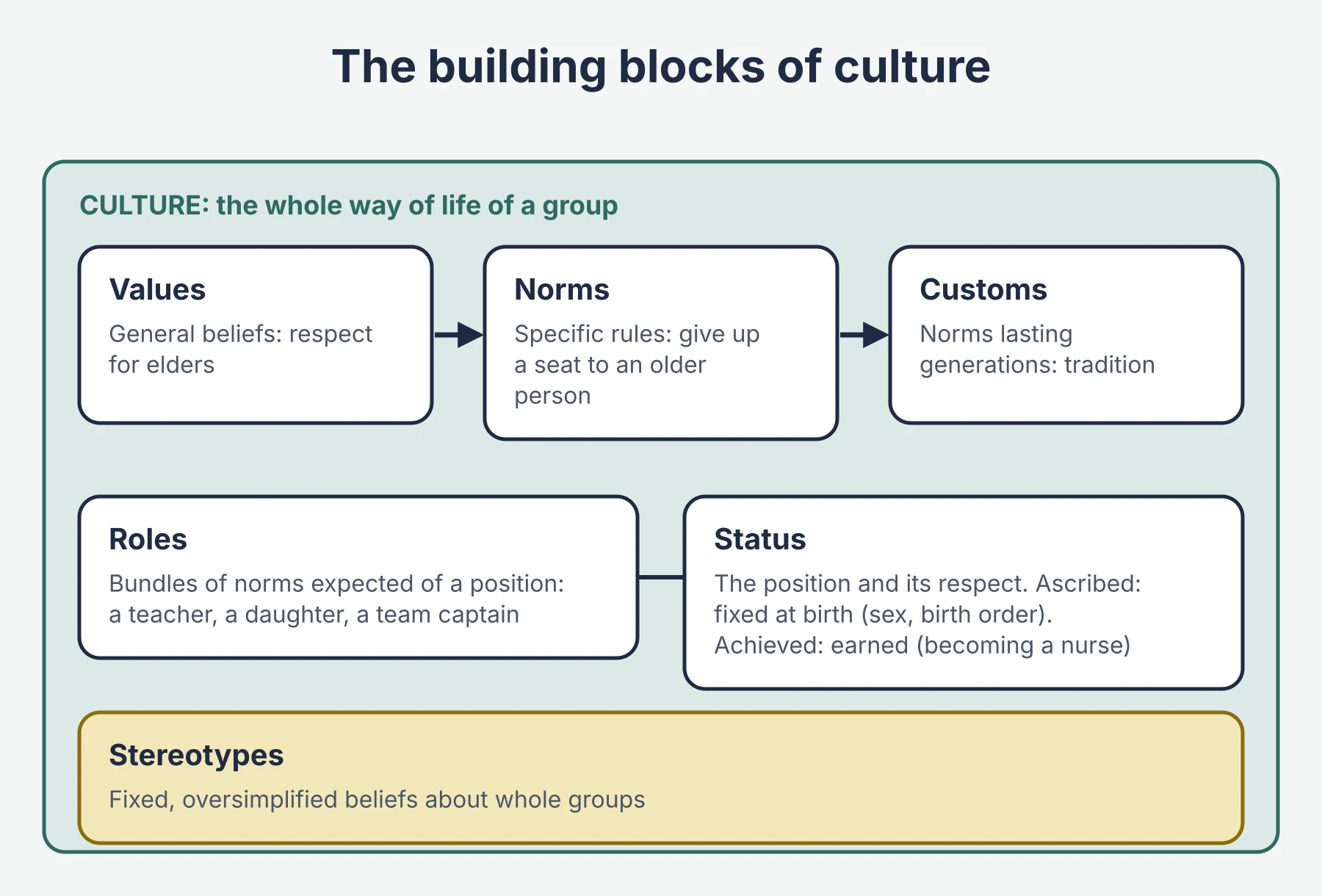
| Culture | The whole shared way of life of a group |
| Values | General beliefs about what is good or important |
| Norms | Specific rules of behaviour based on values |
| Customs | Long-established traditional norms |
| Role | Behaviour expected of someone in a particular position |
| Ascribed status | Position fixed at birth, e.g. sex or birth order |
| Achieved status | Position earned through effort or ability, e.g. doctor |
| Stereotype | Fixed, oversimplified belief about a group |
| Socialisation | Lifelong process of learning the culture of a society |
| Relativity of culture | Norms and values vary between societies and over time |
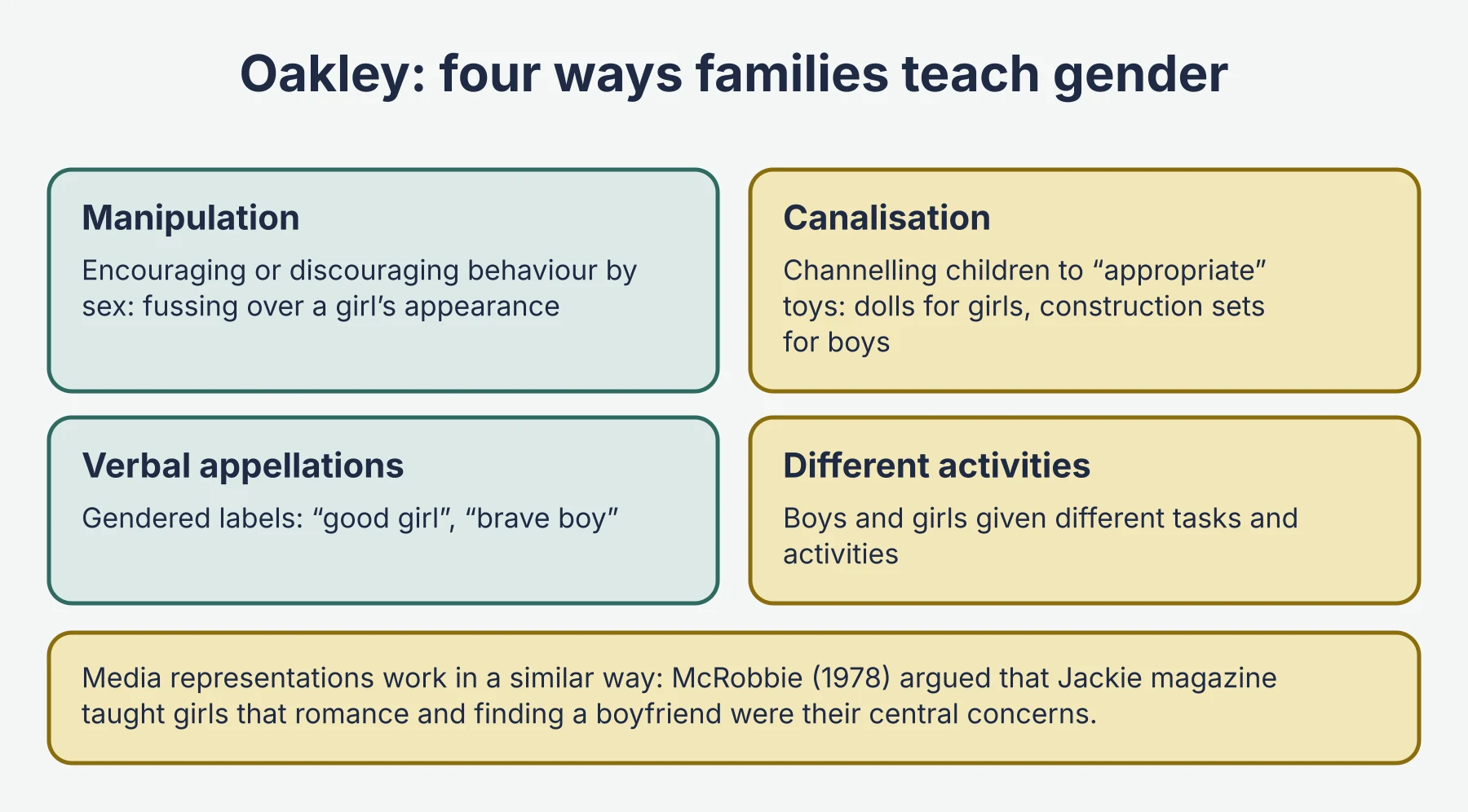
| Canalisation | Channelling children towards gender-“appropriate” toys and activities (Oakley) |
| Manipulation | Encouraging or discouraging behaviour according to sex (Oakley) |
| Hidden curriculum | Values taught informally through school rules and routines |
| Value consensus | Agreement on shared values across society |
| Ideology | Set of ideas that justifies a group’s position or power |
The chain from values to identity
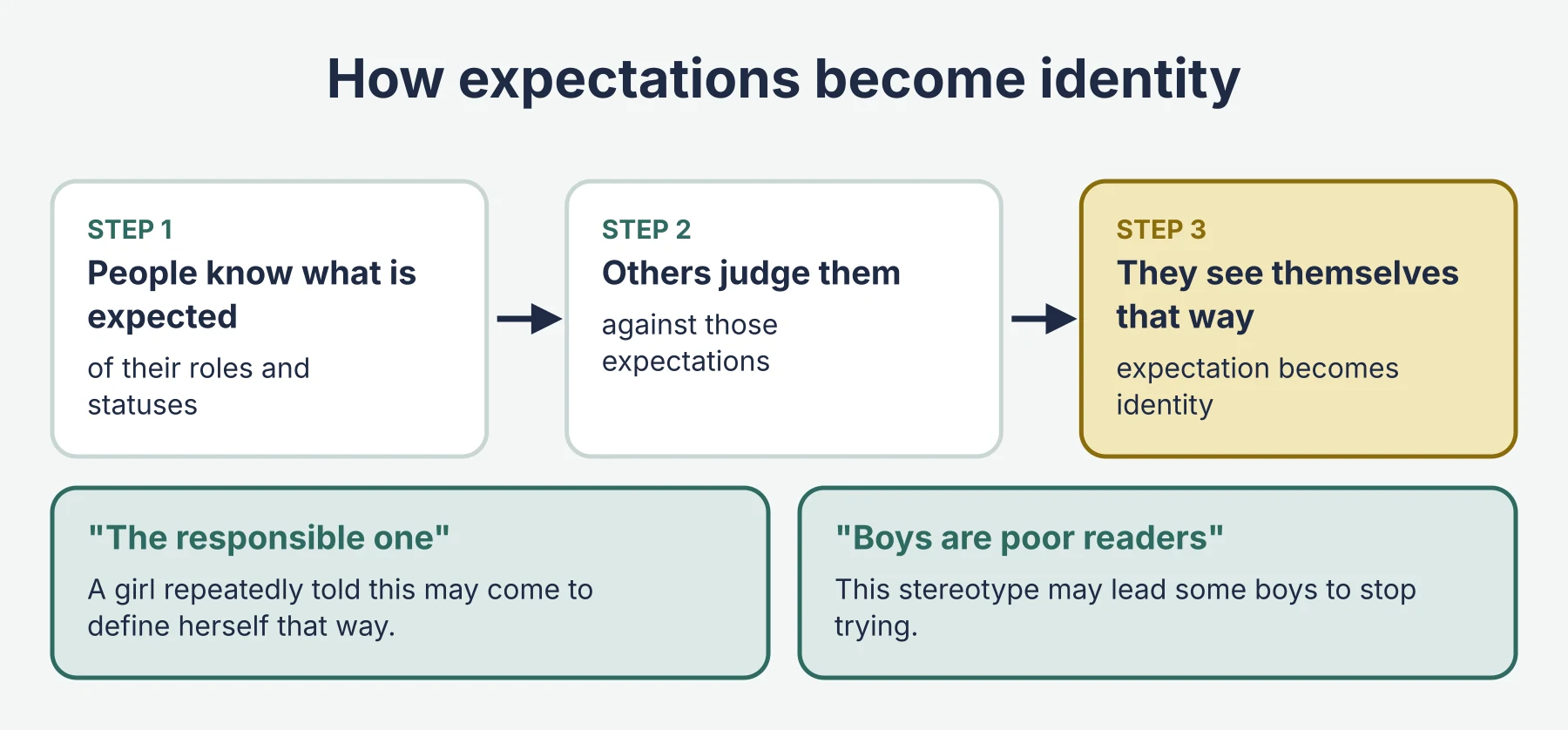
Values → norms → customs → roles → status → identity. Stereotypes attach expectations to groups. People are judged against these expectations, rewarded or punished, and come to see themselves in those terms.
Nature versus nurture
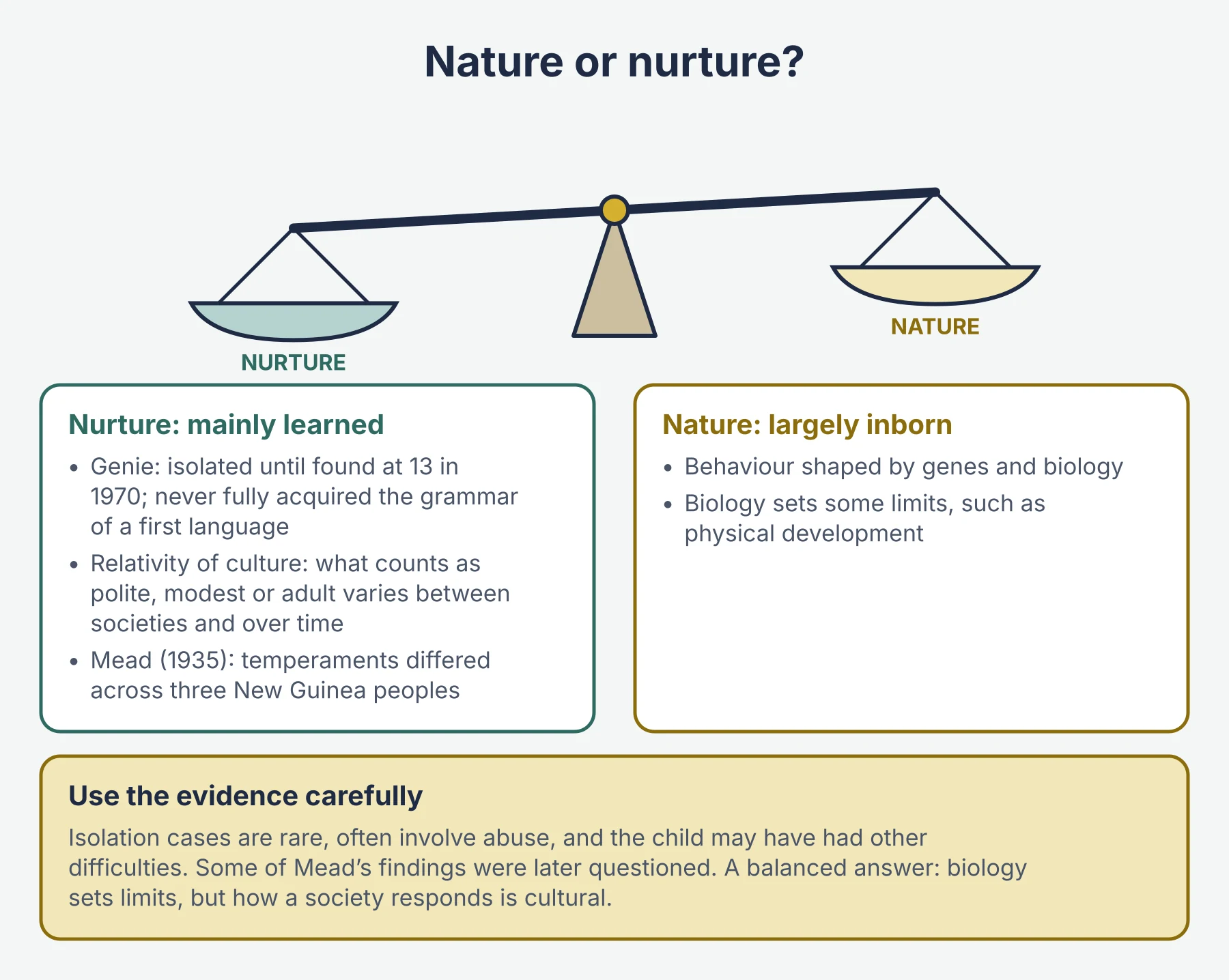
- Nature: behaviour is inborn and biological.
- Nurture: behaviour is learned; the sociological emphasis.
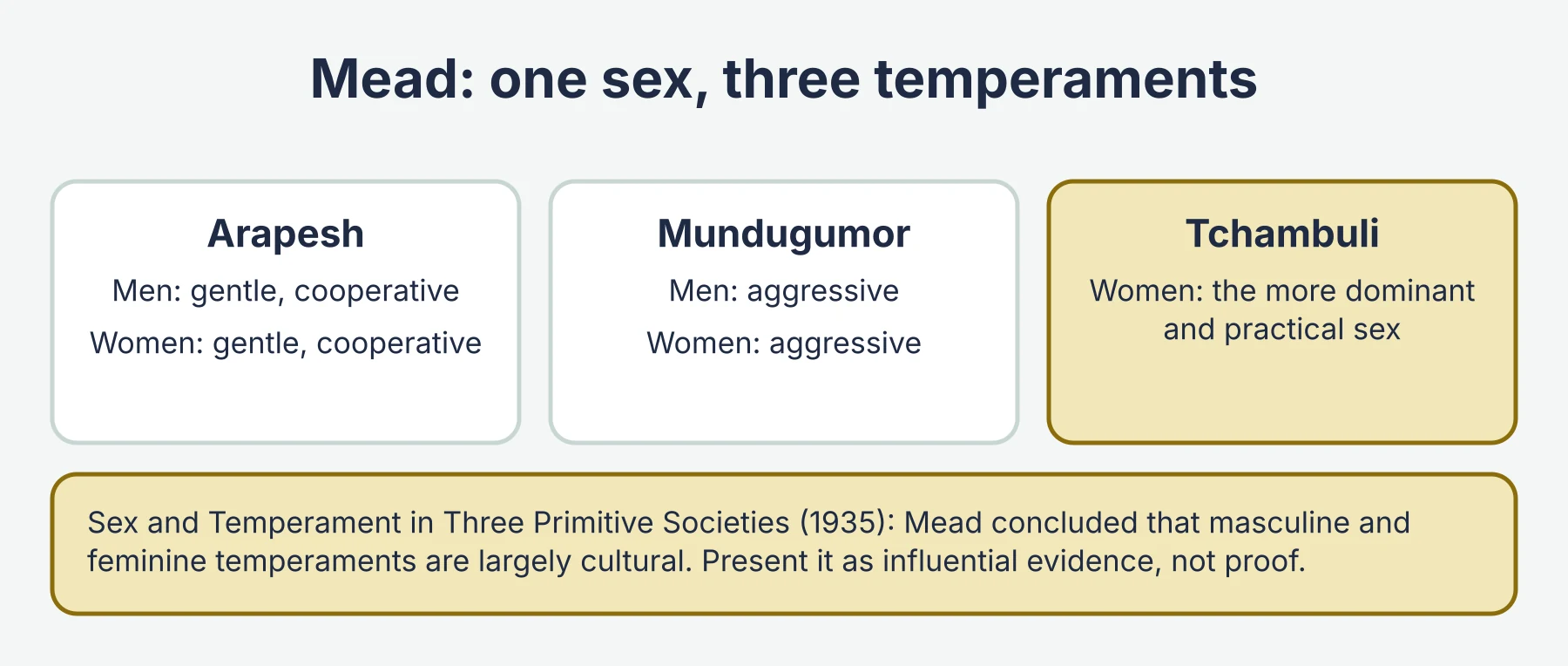
- Evidence for nurture: “Genie” (discovered in Los Angeles, 1970, aged 13) never fully acquired language after extreme isolation; Mead (1935) found different gender temperaments among the Arapesh, Mundugumor and Tchambuli in New Guinea.
- Caution: isolation cases are rare and may involve other causes; Mead’s findings were later questioned.
Agencies, processes and effectiveness
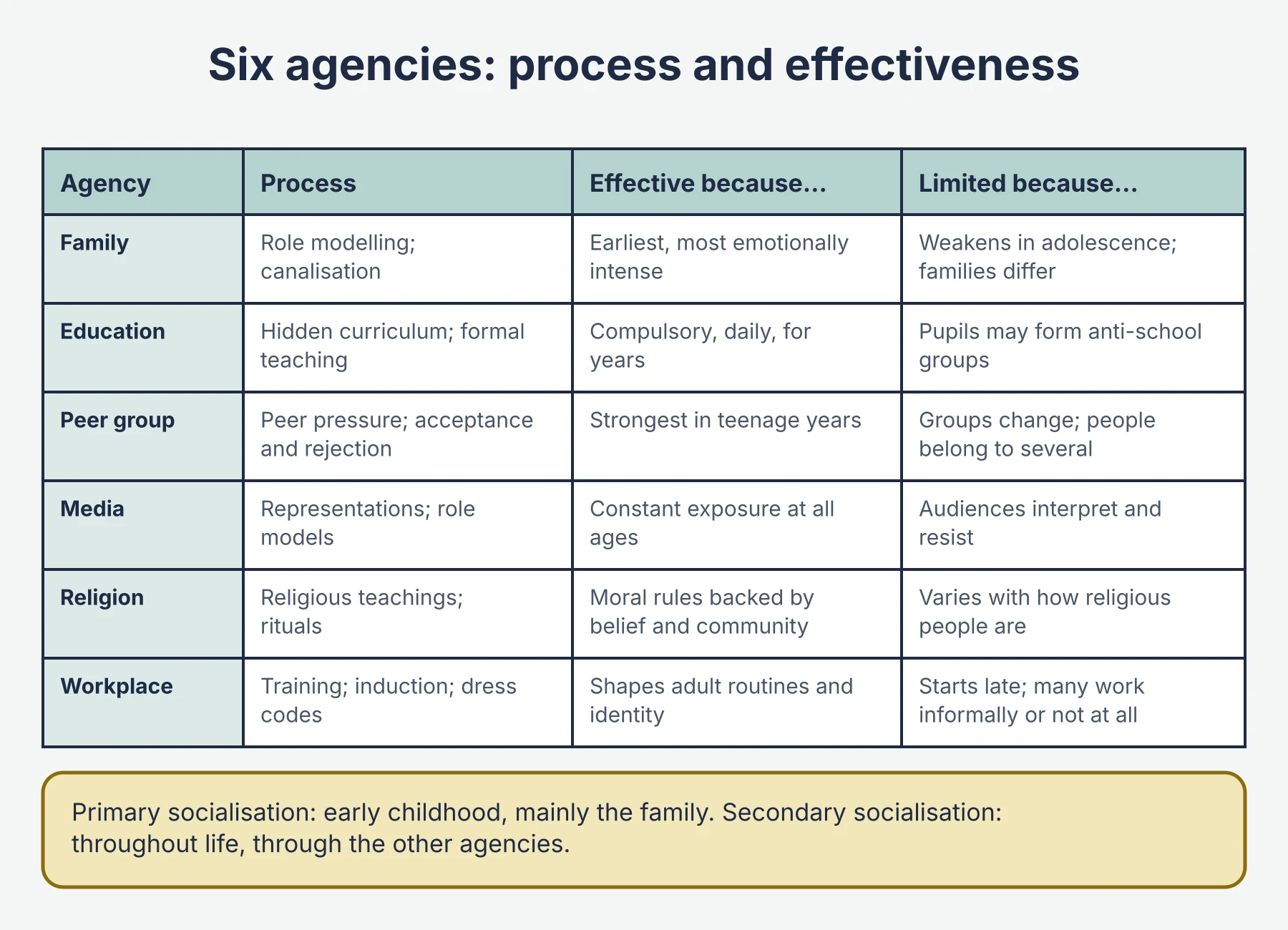
| Agency | Type | Main process | Effectiveness in one line |
|---|---|---|---|
| Family | Primary | Role modelling; canalisation; manipulation | Most powerful in early childhood |
| Education | Secondary | Hidden curriculum | Long, compulsory exposure; some pupils resist |
| Peer group | Secondary | Peer pressure | Strongest in adolescence |
| Media | Secondary | Media representations | Constant, but audiences interpret actively |
| Religion | Secondary | Religious teachings; ritual | Strong where faith is central to community |
| Workplace | Secondary | Workplace training; induction | Shapes adult identity; starts late |
Three theories
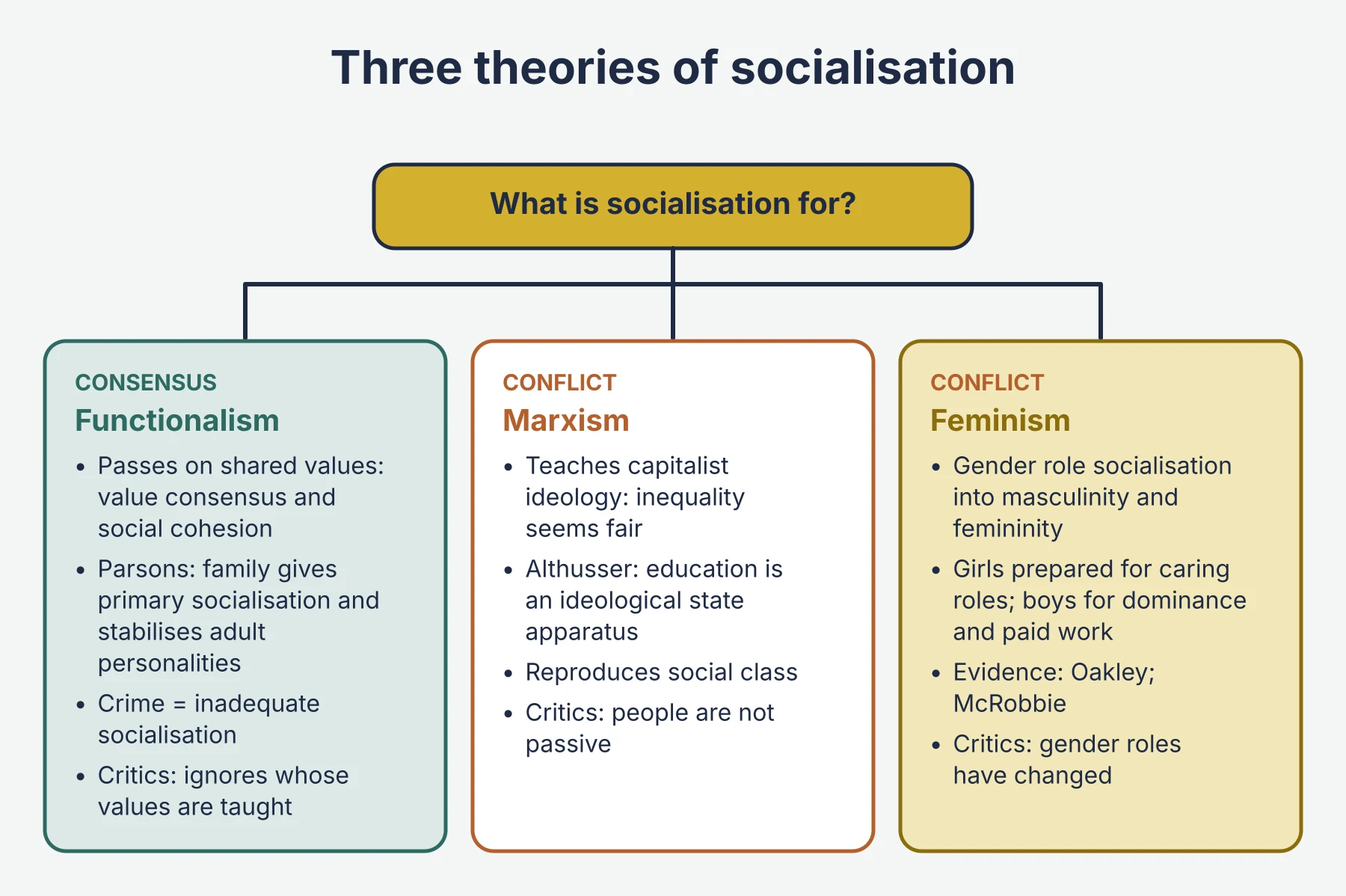
| Functionalism | Marxism | Feminism | |
|---|---|---|---|
| View | Consensus | Conflict | Conflict |
| Socialisation does what? | Passes on shared values; creates social cohesion | Spreads capitalist ideology; reproduces class | Teaches masculinity and femininity; reproduces patriarchy |
| Key idea | Inadequate socialisation explains deviance; Parsons on family functions | Althusser: education as an ideological state apparatus | Oakley’s canalisation and manipulation; McRobbie on Jackie (1978) |
| Main criticism | Ignores conflict and whose values are taught | People are not passive; ignores gender | Roles have changed; underestimates resistance |
Exam traps
- Family is the agency of primary socialisation; do not list it as secondary.
- Name the process as well as the agency.
- Ascribed is not the same as “unfair”; achieved is not the same as “high status”.
- Norms are specific; values are general.
- “Effectiveness” means judging how far an agency succeeds, not describing it.
- Do not treat Mead or isolated children as conclusive proof.
Worked example: a 6-mark “explain three” answer (practice)
Explain three ways education socialises young people.
- Hidden curriculum: rules on punctuality, uniform and obedience teach norms for adult work (2).
- Formal curriculum: subjects such as history and literature pass on a society’s shared culture and values (2).
- Rewards and sanctions: prizes and detentions teach which behaviour is approved, encouraging conformity (2).
Self-test
- Define norms and give an example.
- What is the difference between ascribed and achieved status?
- What does the relativity of culture show?
- Give one piece of evidence for the nurture side of the debate.
- Give one limitation of using isolated children as evidence.
- What is canalisation?
- Name the main process used by the peer group.
- Why may the family become less effective in adolescence?
- What do functionalists mean by inadequate socialisation?
- How do Marxists say socialisation reproduces social class?
- What did McRobbie argue about the magazine Jackie?
- Give one criticism of the feminist view of socialisation.
Answers
- Specific rules of behaviour, e.g. queuing in a shop.
- Ascribed status is fixed at birth; achieved status is earned through one’s own actions.
- That behaviour is learned, because norms and values vary between societies and over time.
- Genie’s limited language after isolation, or Mead’s study of gender in New Guinea.
- Cases are rare and extreme, and other factors such as abuse or disability may explain behaviour.
- Channelling children towards toys and activities seen as suitable for their sex.
- Peer pressure, through acceptance or rejection by friends.
- Teenagers spend more time with peers and media and may reject parents’ values.
- Failure of agencies to pass on shared norms, which can lead to deviance.
- Children are prepared for jobs similar to their parents’, and taught to accept their class position as fair.
- That it taught girls that romance and finding a boyfriend were their main concerns.
- Gender roles have changed, and girls and women actively resist traditional messages.
Frequently asked questions
Which agency is most important? The family is usually most important in early childhood, but in evaluation answers argue that importance changes over the life course.
Can I use local examples? Yes. Customs, religious teachings and family practices from your own society are good evidence if explained accurately.
Related pages: key question 2.1 practice questions | key question 2.2 study guide
Related resources
-
Study guides
Cambridge O Level Sociology (2251): Identity: self and society – How does society control us?
Cambridge O Level Sociology 2251 key question 2.2 in depth: formal and informal control, sanctions, three theories, surveillance and subcultures.
Sociology · Cambridge · O Level
Read guide -
Practice questions
Cambridge O Level Sociology (2251): Identity: self and society – How does society control us? – Practice Questions
Original Cambridge O Level Sociology 2251 practice on key question 2.2: sanctions, formal and informal agencies, theories of control and protest, with answers.
Sociology · Cambridge · O Level
Try questions -
Revision notes
Cambridge O Level Sociology (2251): Identity: self and society – How does society control us? – Revision Notes
Revision notes for Cambridge O Level Sociology 2251 key question 2.2: sanctions, formal and informal agencies, three theories, surveillance and subcultures.
Sociology · Cambridge · O Level
Revise topic
Related articles
Get free revision emails (optional)
Occasional emails with practice questions, worked explanations and links to free resources for the qualification and subjects you choose. No spam, and you can unsubscribe from any email. The free tools on this site never need an email.