
Study Guides
Cambridge O Level Sociology (2251): Identity: self and society – How does society control us?
Cambridge O Level Sociology 2251 key question 2.2 in depth: formal and informal control, sanctions, three theories, surveillance and subcultures.
- Subject
- Sociology
- Level
- O LEVELS
- Topic
- Paper 1 – Research Methods, Identity and Inequality
- Author
- Marlbridge Academic Team
- Updated
- Reviewed by
- Naqiya Yousaf (what this means)
Aligned to Cambridge O Level Sociology (2251), 2025-2027. Official specification .
Syllabus page (what it covers and how it is assessed): Cambridge O Level Sociology.
Syllabus points this page covers
2251
- 2.2 Identity: self and society – How does society control us?
Found an error? Report a correction.
Need help with this topic? Request a free trial class for O Level Sociology (2251).
Key question 2.2 of Cambridge O Level Sociology (2251) asks How does society control us? Most people obey most rules most of the time, and sociologists want to know why. The answer combines internal control (we have learned to want to conform) with external pressure from formal agencies such as the police and informal agencies such as the family. The syllabus also asks you to judge how effective each agency is, to compare consensus and conflict theories, and to explain why some people resist control through protest groups and subcultures. This is Paper 1 Question 2 content.
What the syllabus covers
- 2.2.1 Formal and informal social control; positive and negative sanctions; their effectiveness in producing social conformity.
- 2.2.2 Consensus and conflict views: functionalism, Marxism, feminism.
- 2.2.3 The effectiveness of formal agencies: government, police, courts, penal system, armed forces.
- 2.2.4 Methods used by formal agencies, e.g. law-making, coercion, digital surveillance, arrest, sentencing, imprisonment.
- 2.2.5 The effectiveness of informal agencies: family, education, peer group, media, religion, workplace.
- 2.2.6 Methods used by informal agencies: positive and negative sanctions, e.g. ostracism, parental rewards, social media “likes”, religious rewards/sanctions, school punishments, dismissal from a job.
- 2.2.7 Resistance through protest groups and subcultures: why people join; deviant and non-conformist behaviour; examples of protest groups and online, youth and religious subcultures.
Formal and informal control
Social control is every way in which a society encourages conformity to its norms and values.
- Formal control is exercised by official agencies of the state, using written rules (laws and regulations) and official penalties.
- Informal control is exercised by the people around us through everyday approval and disapproval, based on unwritten norms.
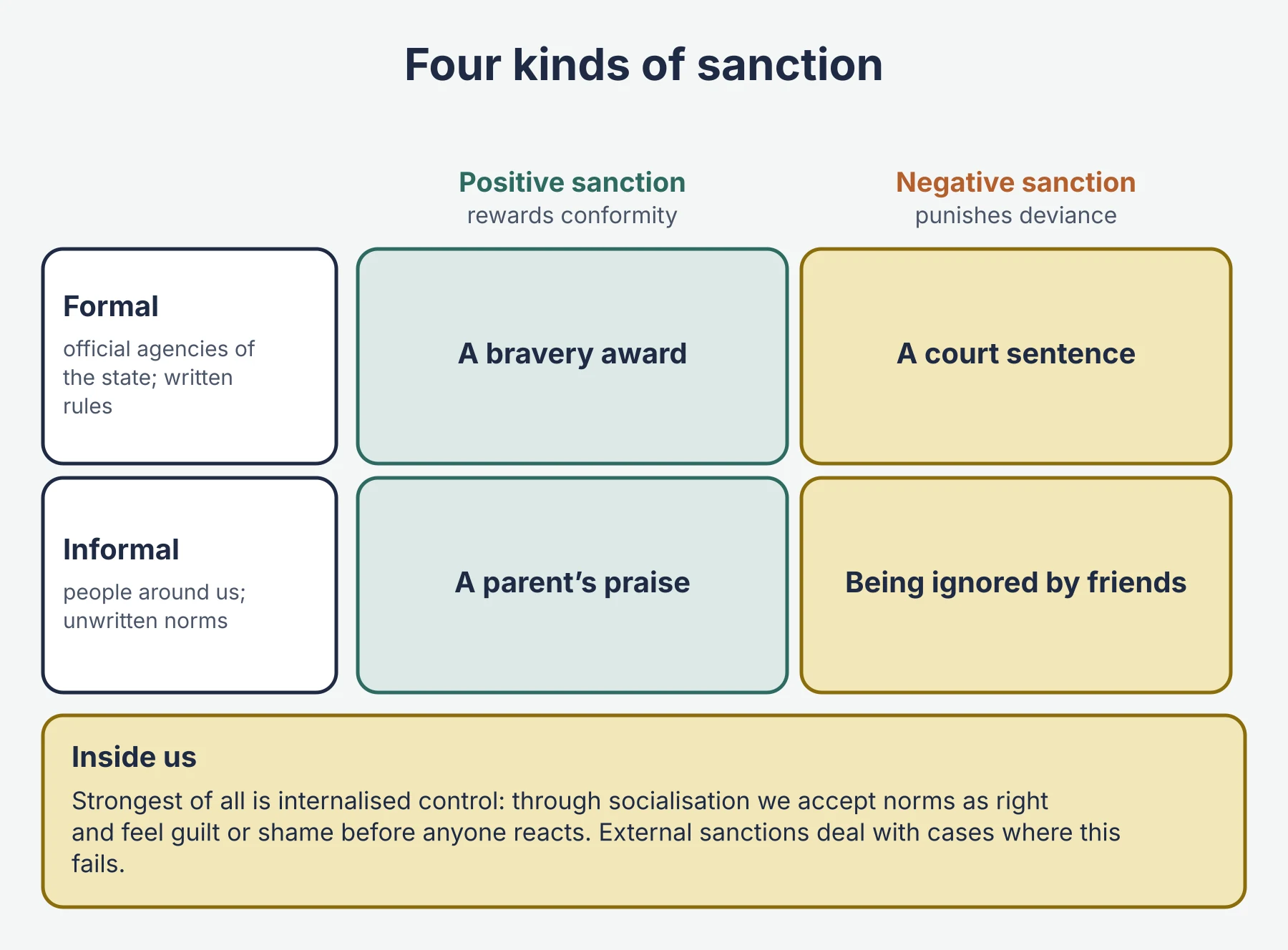
Both rely on sanctions. A positive sanction rewards conformity (a promotion, praise, a medal); a negative sanction punishes deviance (a fine, a detention, ostracism). Sanctions can be formal or informal, so there are four combinations: a court sentence is a formal negative sanction, a bravery award is a formal positive sanction, a parent’s praise is an informal positive sanction and being ignored by friends is an informal negative sanction.
The strongest control of all is internalised: through socialisation we come to accept norms as right, so we feel guilt or shame before anyone else reacts. External sanctions mainly deal with the cases where internal control fails.
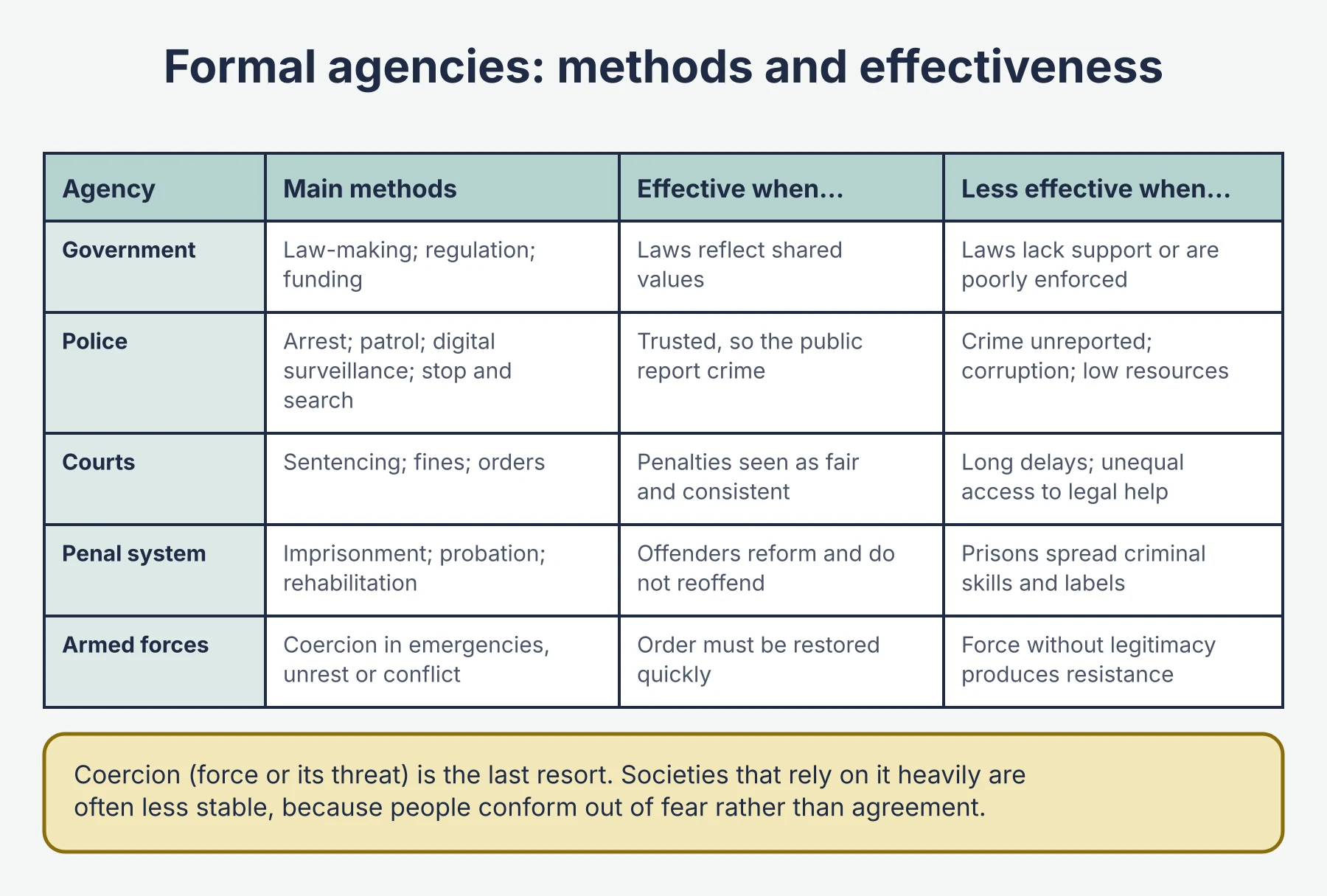
Formal agencies and their methods
| Agency | Main methods | Effective when… | Less effective when… |
|---|---|---|---|
| Government | Law-making; regulation; funding of other agencies | Laws reflect widely shared values | Laws lack public support or are poorly enforced |
| Police | Arrest; patrol; digital surveillance; stop and search | Trusted by the public, who then report crime | Crime goes unreported; corruption or low resources |
| Courts | Sentencing; fines; orders | Penalties are seen as fair and consistent | Long delays; unequal access to legal help |
| Penal system | Imprisonment; probation; rehabilitation | Offenders are reformed and do not reoffend | Prisons spread criminal skills and labels |
| Armed forces | Coercion in emergencies, civil unrest or conflict | Order must be restored quickly | Force without legitimacy produces resistance |
Coercion means force or the threat of force. It is the last resort of formal control, and societies that rely on it heavily are often less stable, because people conform out of fear rather than agreement.
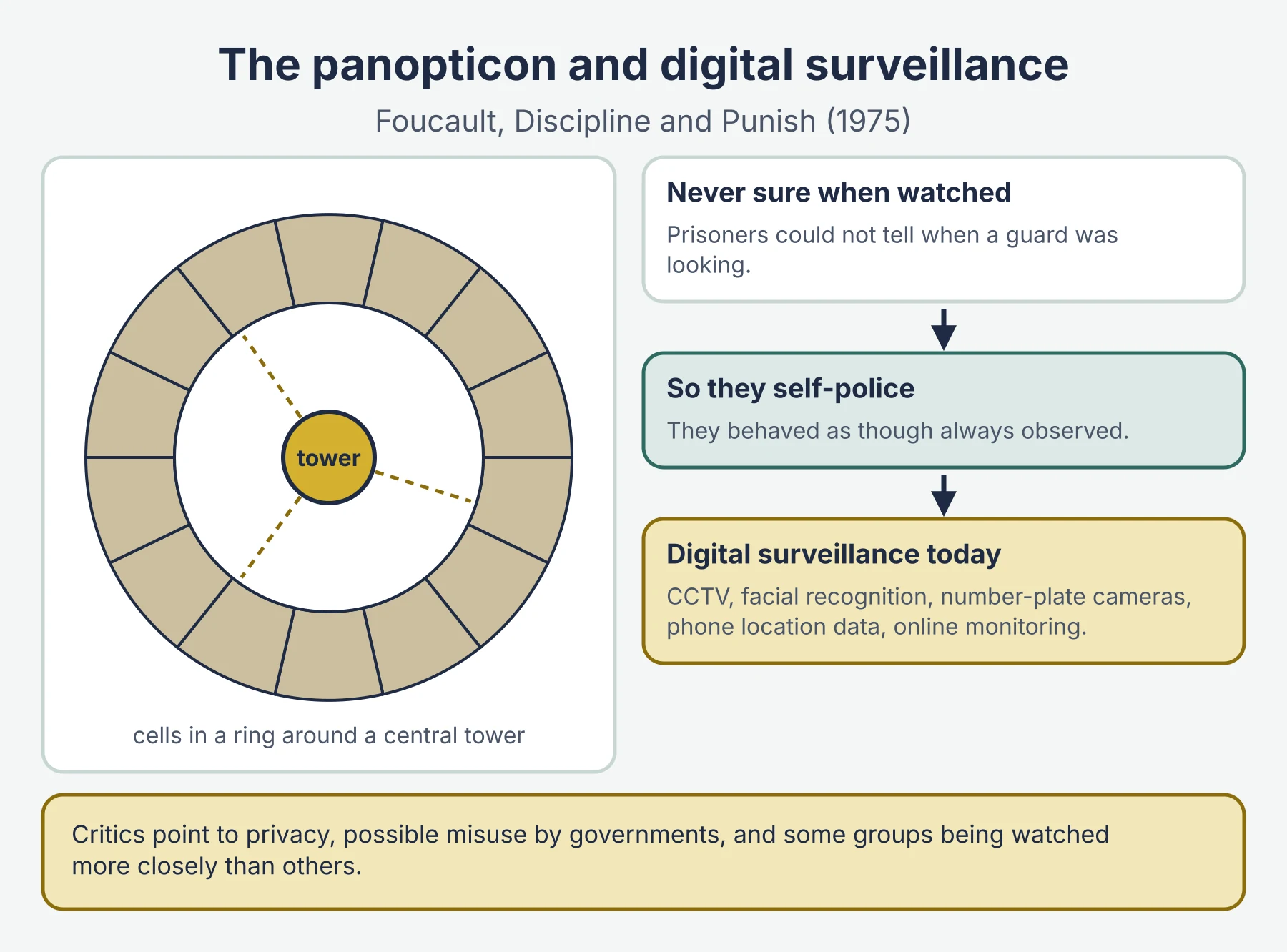
Digital surveillance extends formal control: CCTV, facial recognition, number-plate cameras, phone location data and monitoring of online activity. In Discipline and Punish (1975), Michel Foucault drew on the panopticon, a design for a prison with a central watchtower: because prisoners could never tell when a guard was looking, they behaved as though they were always observed. Surveillance works in the same way: knowing you might be watched changes behaviour. Critics point to privacy, the risk of misuse by governments and the fact that some groups are watched more closely than others.
Informal agencies and their methods
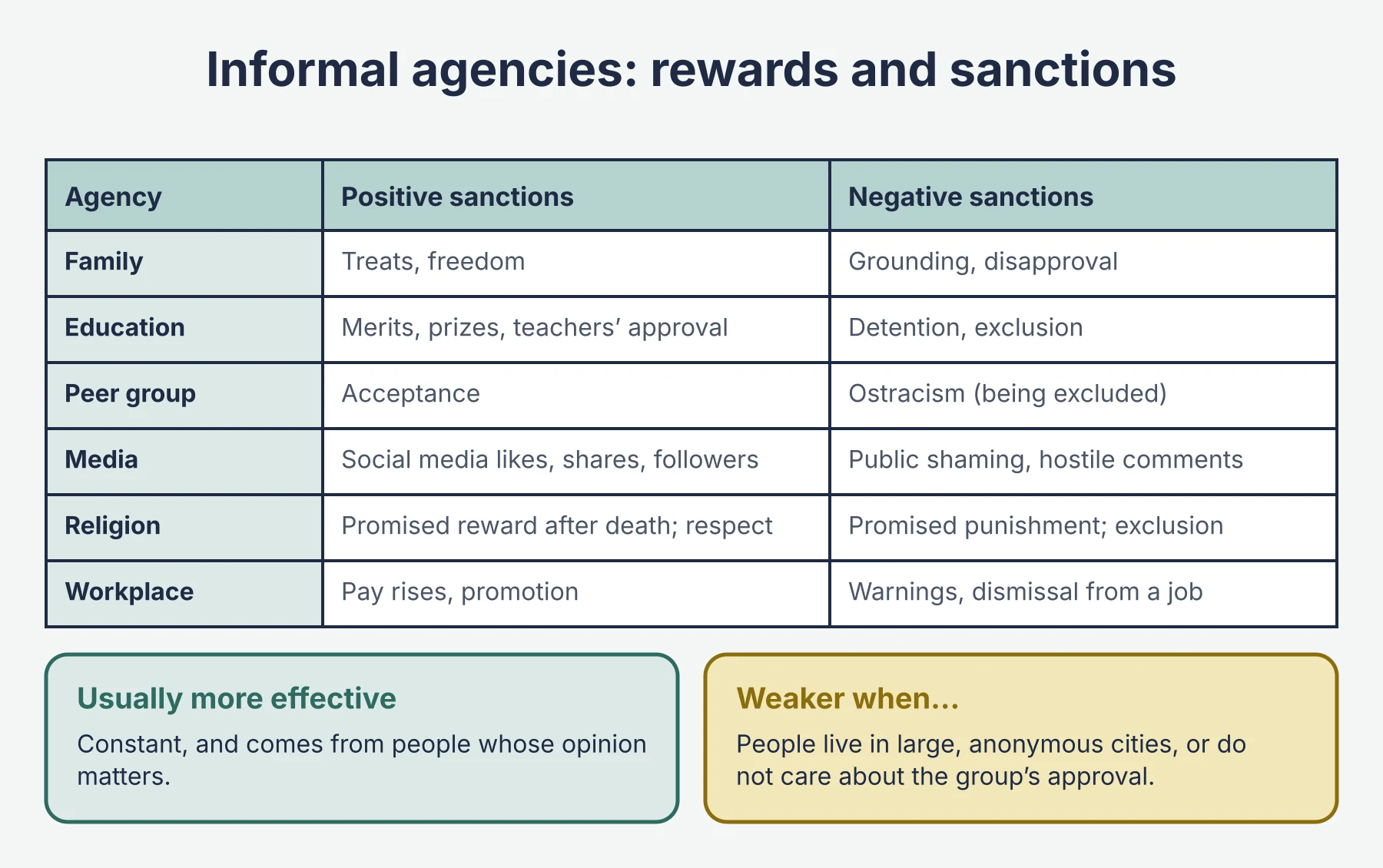
The syllabus names six informal agencies; their power comes from relationships people value.
- Family: parental rewards (treats, freedom) and sanctions (grounding, disapproval); strongest when children are young.
- Education: merits, prizes and school punishments such as detention or exclusion; teachers’ approval also matters.
- Peer group: acceptance or ostracism (being excluded); powerful in adolescence, but peer norms may encourage deviance rather than conformity.
- Media: social media “likes”, shares and followers reward approved behaviour; public shaming and hostile comments punish breaches of norms.
- Religion: religious rewards and sanctions, including the promise of reward or punishment after death, respect within the community, or exclusion from it.
- Workplace: pay rises and promotion; warnings and dismissal from a job.
Informal control is usually more effective in everyday life because it is constant and comes from people whose opinion matters. It is weaker in large, anonymous cities, where people do not know their neighbours, and among people who do not care about the group’s approval.
The theoretical debate
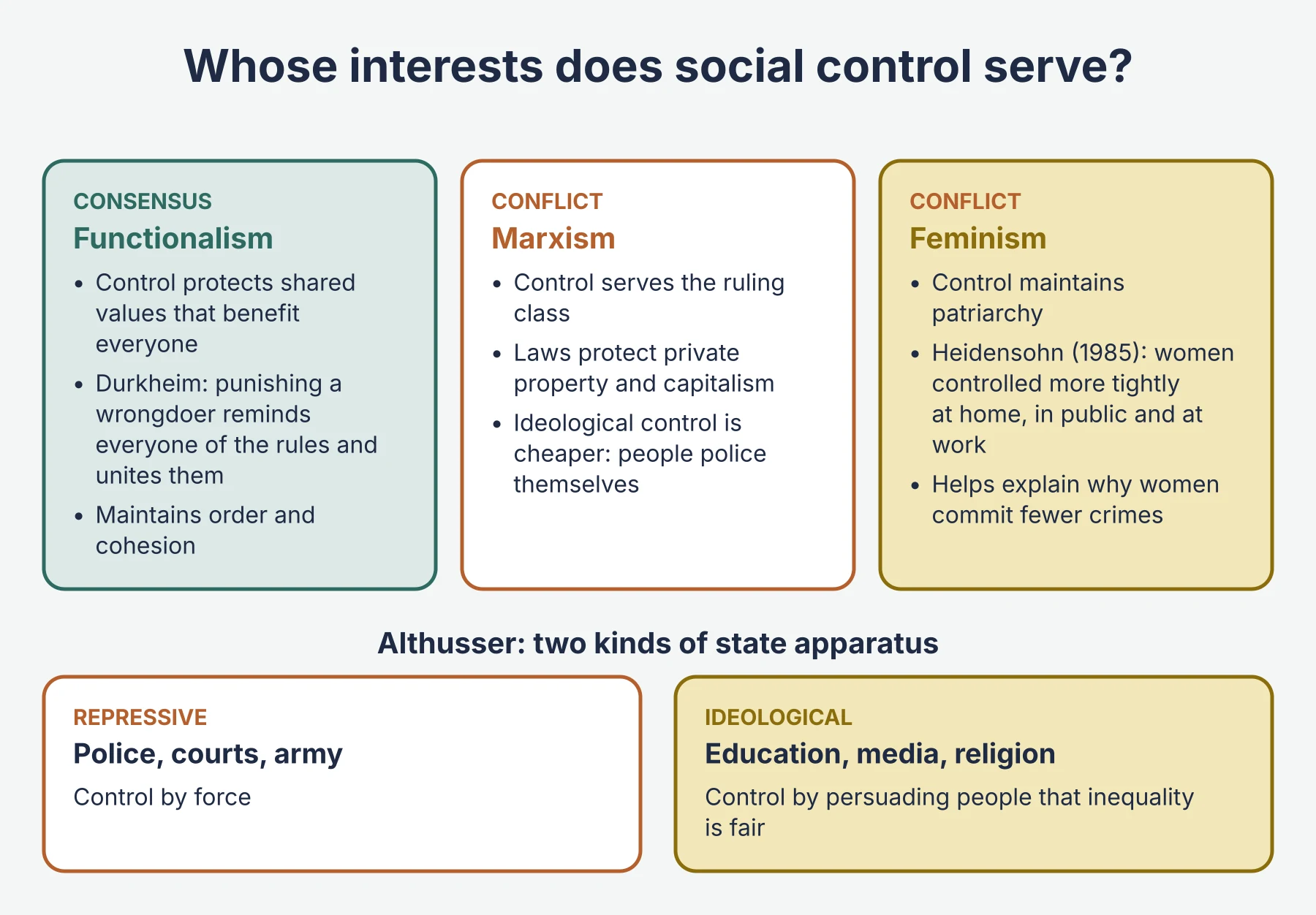
Functionalism (consensus). Social control protects shared values that benefit everyone. Émile Durkheim argued that punishing deviance reinforces the boundaries of acceptable behaviour: when a wrongdoer is punished, everyone else is reminded of the rules and united in disapproval. Agencies of control therefore help maintain social order and cohesion.
Marxism (conflict). Social control serves the ruling class. Laws protect private property and the capitalist system; the police, courts and armed forces enforce them. Althusser distinguished repressive state apparatuses (police, courts, army), which control by force, from ideological state apparatuses (education, media, religion), which control by persuading people that inequality is fair. Ideological control is cheaper and more effective, because people police themselves.
Feminism (conflict). Social control maintains patriarchy. Frances Heidensohn’s Women and Crime (1985) argued that women are controlled more tightly than men: at home through domestic responsibilities, in public through fear of male violence and concern for reputation, and at work by male supervisors. This helps explain why women commit fewer crimes, and shows informal control falling unequally on women.
Resistance: protest groups and subcultures
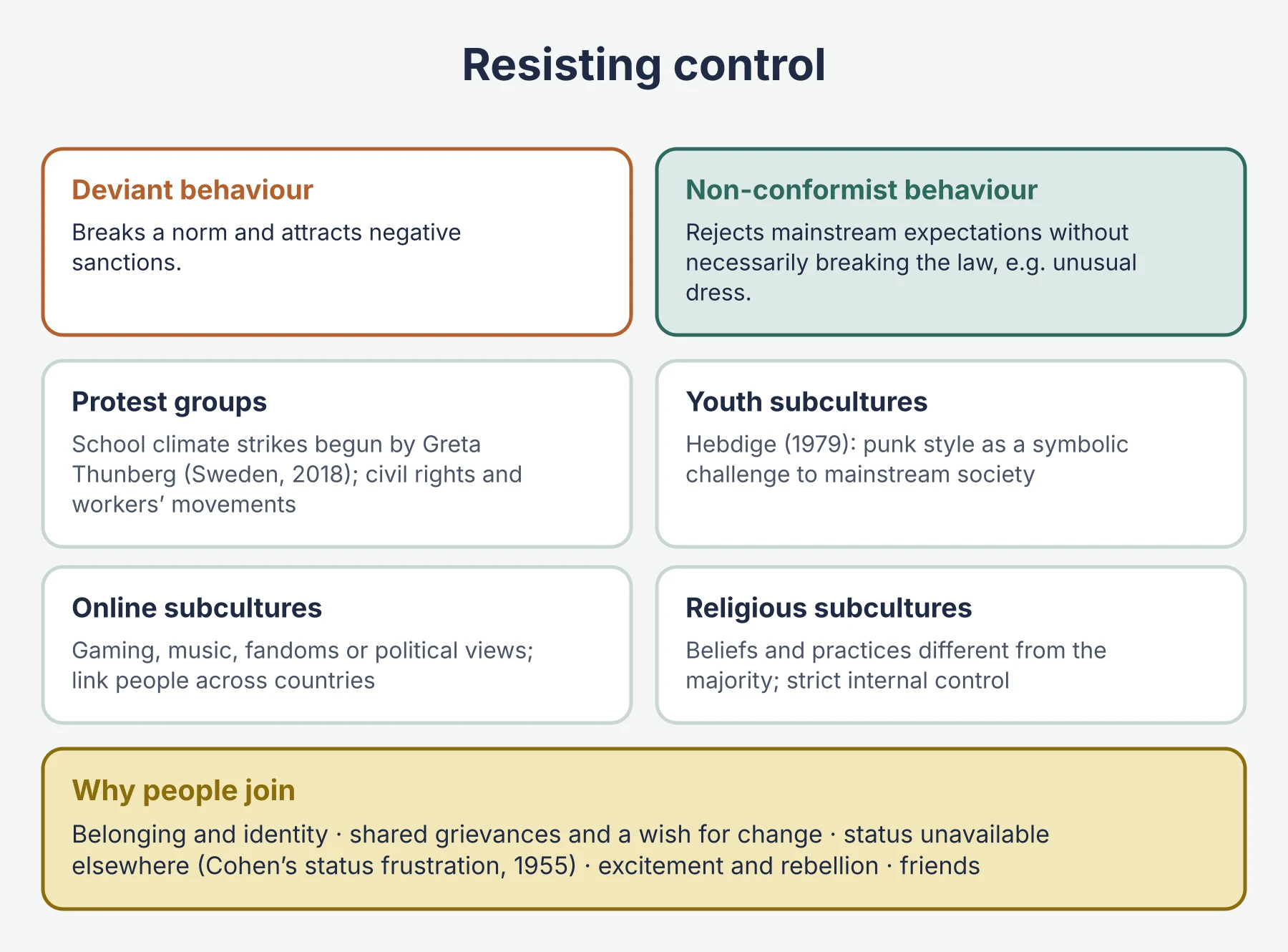
Not everyone conforms. Deviant behaviour breaks a norm and attracts negative sanctions; non-conformist behaviour rejects mainstream expectations without necessarily breaking the law, such as unusual dress or lifestyle.
- Protest groups campaign for change: environmental groups such as the school climate strikes begun by Greta Thunberg in Sweden in 2018, or civil rights and workers’ movements. Most act legally through marches and petitions; some use civil disobedience.
- Youth subcultures have distinctive styles and values: Dick Hebdige’s Subculture: The Meaning of Style (1979) interpreted punk style as a symbolic challenge to mainstream society.
- Online subcultures form around gaming, music, fandoms or political views, and can link people across countries.
- Religious subcultures follow beliefs and practices different from the majority, often with strict internal control.
Why people join: a sense of belonging and identity; shared grievances and a wish for change; status unavailable elsewhere (Albert Cohen’s idea of status frustration among working-class boys, 1955); excitement and rebellion; and the influence of friends. Note the irony: subcultures resist mainstream control but usually impose strong informal control of their own.
Worked example: an evaluation plan (practice)
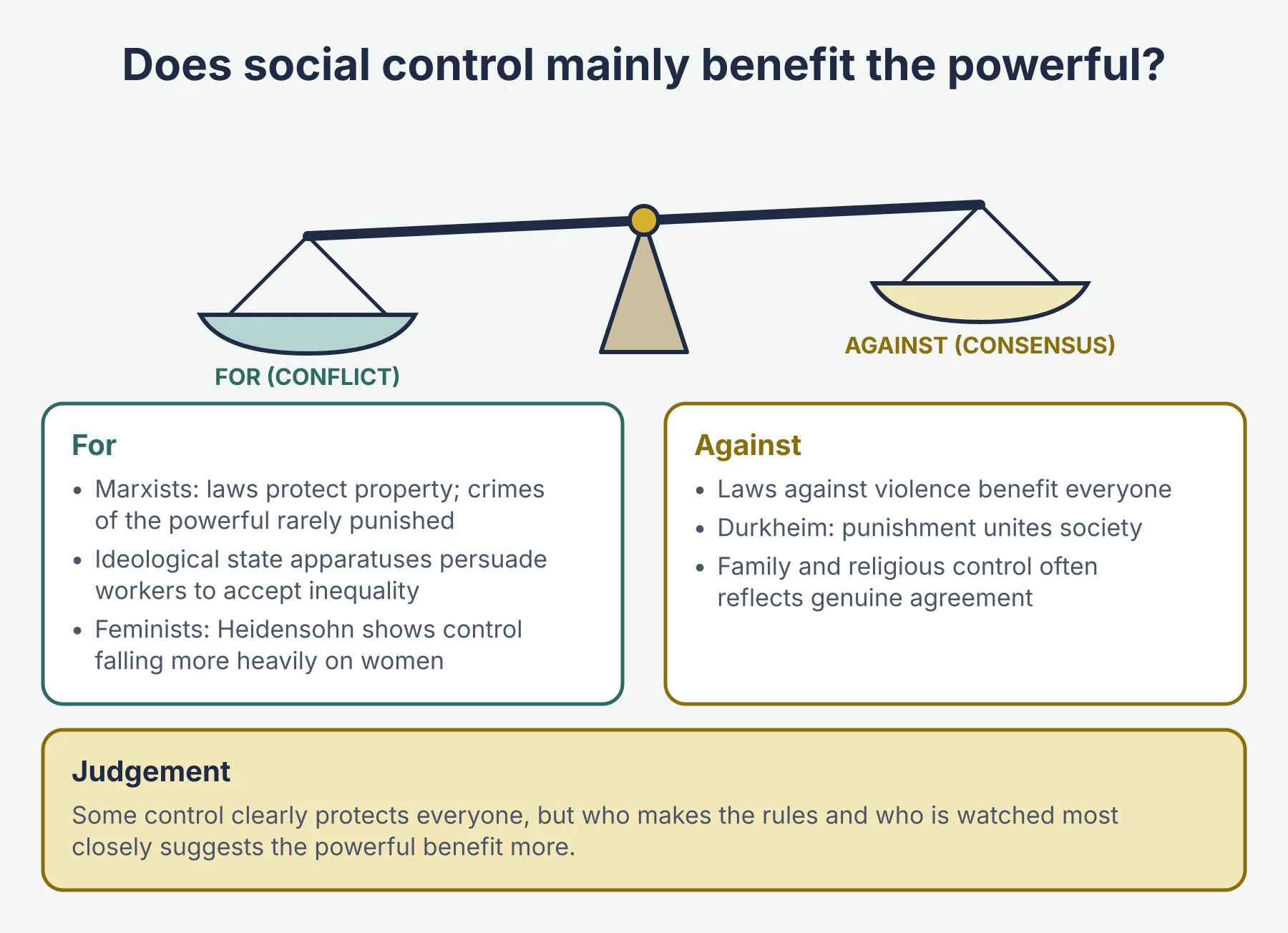
Evaluate the view that social control mainly benefits the powerful.
- For (conflict): Marxists argue laws protect property and the capitalist class, while crimes of the powerful are rarely punished; ideological state apparatuses persuade the working class to accept inequality; feminists such as Heidensohn show control falling more heavily on women.
- Against (consensus): functionalists argue control protects shared values, such as laws against violence that benefit everyone; Durkheim saw punishment as uniting society; informal control in families and religious communities often reflects genuine agreement.
- Judgement: some control clearly protects everyone, but who makes the rules and who is watched most closely suggests that the powerful benefit more.
Common mistakes
- Treating “formal” as “serious”: a school detention is informal social control in this syllabus, as school is an informal agency.
- Giving sanctions without saying whether they are positive or negative.
- Describing agencies without judging their effectiveness.
- Assuming subcultures are always criminal; many are non-conformist rather than deviant.
Exam technique
- Explain three (parts c and d): agency, method, example, then why it produces conformity.
- Discuss (part e): for “why people join subcultures”, give several reasons with named evidence.
- Evaluate (part f): set consensus against conflict views and conclude.
Keep revising
Condense this page with the key question 2.2 revision notes, then try the key question 2.2 practice questions. How socialisation creates internal control is covered in the guide to key question 2.1.
Related resources
-
Practice questions
Cambridge O Level Sociology (2251): Identity: self and society – How does society control us? – Practice Questions
Original Cambridge O Level Sociology 2251 practice on key question 2.2: sanctions, formal and informal agencies, theories of control and protest, with answers.
Sociology · Cambridge · O Level
Try questions -
Revision notes
Cambridge O Level Sociology (2251): Identity: self and society – How does society control us? – Revision Notes
Revision notes for Cambridge O Level Sociology 2251 key question 2.2: sanctions, formal and informal agencies, three theories, surveillance and subcultures.
Sociology · Cambridge · O Level
Revise topic -
Study guides
Cambridge O Level Sociology (2251): Identity: self and society – What influences our social identity?
Cambridge O Level Sociology 2251 key question 2.3 in depth: age, gender, ethnicity and class, the digital self, globalisation and postmodern views of identity.
Sociology · Cambridge · O Level
Read guide
Related articles
Get free revision emails (optional)
Occasional emails with practice questions, worked explanations and links to free resources for the qualification and subjects you choose. No spam, and you can unsubscribe from any email. The free tools on this site never need an email.