
Study Guides
Cambridge O Level Sociology (2251): Identity: self and society – What influences our social identity?
Cambridge O Level Sociology 2251 key question 2.3 in depth: age, gender, ethnicity and class, the digital self, globalisation and postmodern views of identity.
- Subject
- Sociology
- Level
- O LEVELS
- Topic
- Paper 1 – Research Methods, Identity and Inequality
- Author
- Marlbridge Academic Team
- Updated
- Reviewed by
- Naqiya Yousaf (what this means)
Aligned to Cambridge O Level Sociology (2251), 2025-2027. Official specification .
Syllabus page (what it covers and how it is assessed): Cambridge O Level Sociology.
Syllabus points this page covers
2251
- 2.3 Identity: self and society – What influences our social identity?
Found an error? Report a correction.
Need help with this topic? Request a free trial class for O Level Sociology (2251).
Key question 2.3 of Cambridge O Level Sociology (2251) asks What influences our social identity? Social identity is the sense of who we are that comes from the groups we belong to and how others see us. The syllabus asks you to explain four key aspects of identity and their impact in different societies, then three newer influences: online life, globalisation and the postmodern claim that identity is now chosen. Questions often set traditional sources of identity against the newer ones, so you need to be able to argue both ways. This is Paper 1 Question 2 content.
For an overview of 2.1 and 2.3 together, see the O Level guide to how we learn our identity. This guide goes deeper into the evidence and the debates.
What the syllabus covers
- 2.3.1 Social identity: key aspects (age, gender, ethnicity, social class) and the impact of each on individuals and social groups in different societies.
- 2.3.2 The digital self and online identities: positive and negative impacts of social networks, social media and virtual communities on identity.
- 2.3.3 Globalisation: (a) its influence on individual and social/cultural identities, for example cultural defence, hybrid identities and the homogenisation of identities; (b) positive and negative impacts on identity of cultural diversity, multiculturalism and global culture.
- 2.3.4 Postmodernist views of identity as chosen rather than given: digital identities; identities linked to consumption patterns and lifestyle in a “pick and mix” society.
Four key aspects of identity
Age
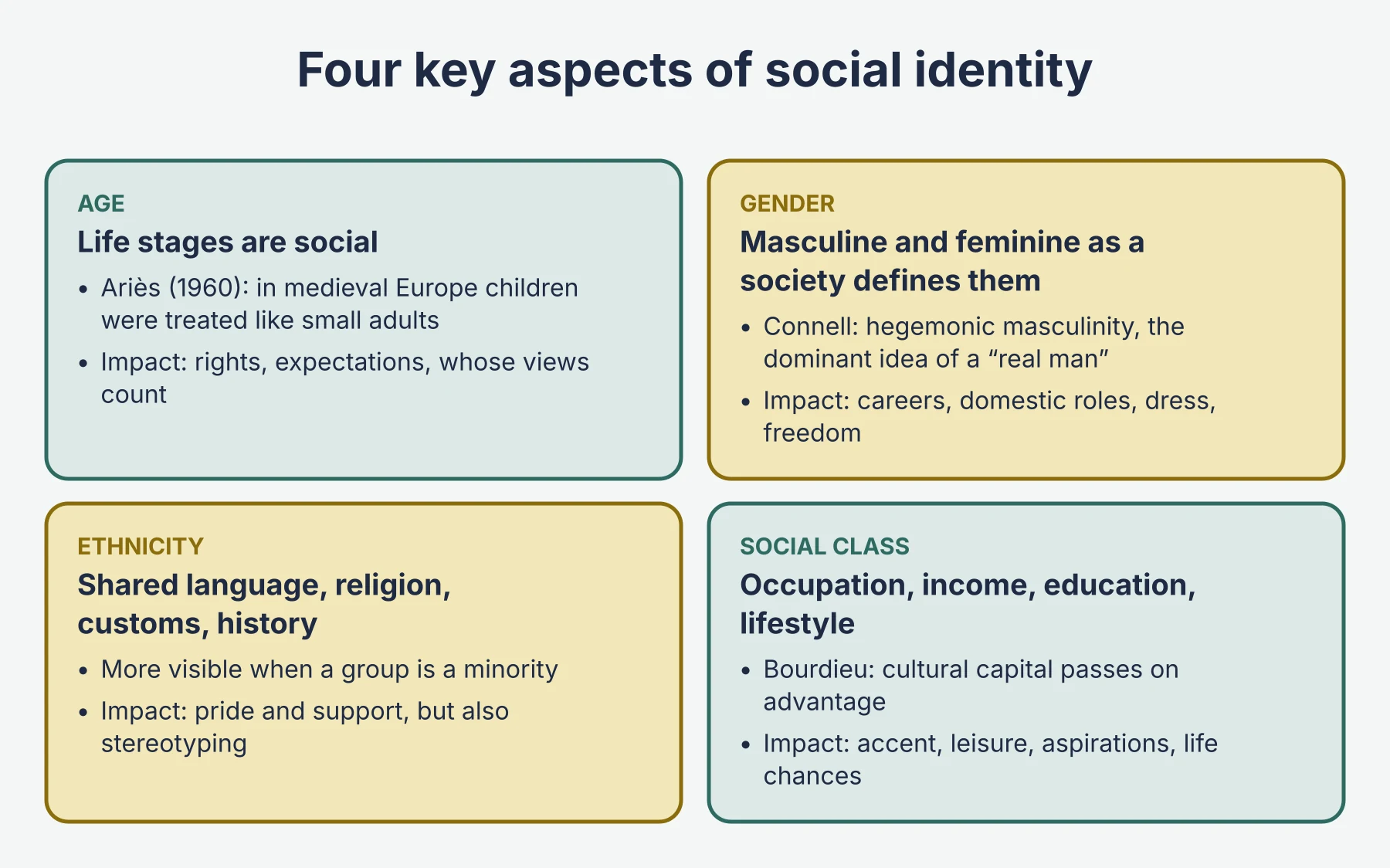
Age seems biological, but the meaning of each life stage is social. Philippe Ariès’s Centuries of Childhood (first published in French in 1960) argued that in medieval Europe children were treated much like small adults from an early age, and that childhood as a separate, protected stage developed gradually. Today the age at which someone is treated as an adult varies: in some societies it is marked by leaving education, in others by marriage, earning or a religious ceremony. Old age also carries different identities: in some societies elders hold authority and respect, while in others older people may be stereotyped as dependent or out of date.
Impact: age shapes rights (voting, marriage, work), expectations, and how seriously a person’s views are taken.
Gender
Gender identity is the sense of being masculine or feminine as defined by a society. R. W. Connell used the term hegemonic masculinity for the dominant idea of what a “real man” is in a society, often linked to toughness, earning power and heterosexuality, against which other masculinities and all femininities are judged. Gender identities are changing as more women enter higher education and paid work and as some men take a greater share of childcare, but traditional expectations remain strong in many families and communities.
Impact: gender affects career choices, domestic roles, dress, freedom of movement and exposure to violence or discrimination.
Ethnicity
Ethnicity is a shared cultural identity based on factors such as language, religion, customs, history and sometimes a sense of common origin. Ethnic identity tends to become more visible when a group is a minority: migrants and their children may emphasise language, religion or food to keep a sense of belonging, especially if they face discrimination.
Impact: ethnicity can give pride, community support and belonging, but it can also lead to stereotyping, exclusion and unequal treatment.
Social class
Class identity comes from occupation, income, education and lifestyle. Traditionally, working-class identity in industrial areas was linked to manual work, trade unions and close-knit communities. Pierre Bourdieu argued that classes differ in cultural capital, the tastes, knowledge and manners valued by the education system, which helps the middle class pass on advantages and a sense of confidence.
Impact: class shapes accent, leisure, aspirations and life chances. Some sociologists argue class identity has weakened as traditional industries have declined; others argue class still shapes identity even when people do not use class labels.
The digital self
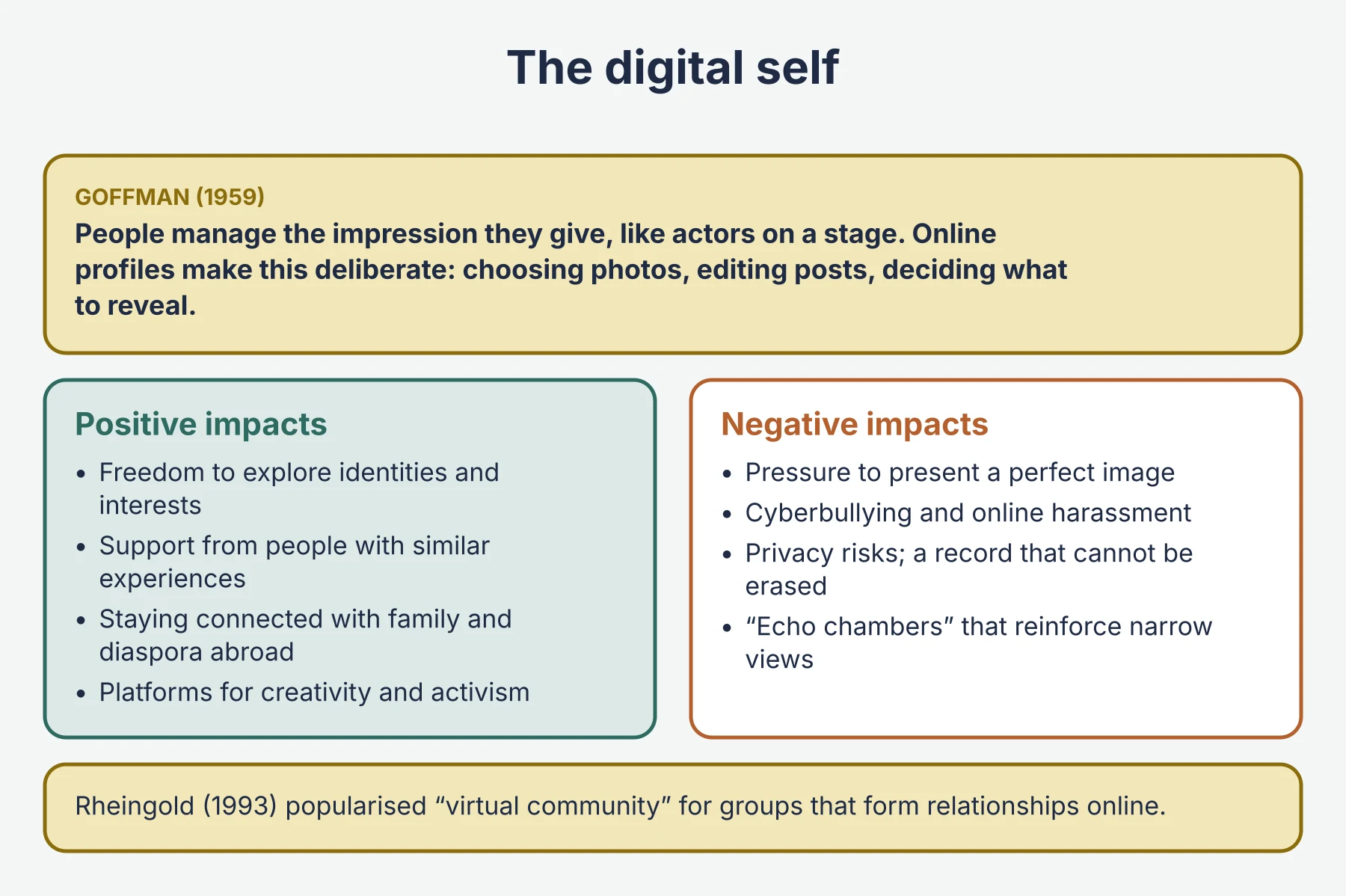
Erving Goffman’s The Presentation of Self in Everyday Life (1959) argued that people manage the impression they give to others, like actors on a stage. Online profiles make this impression management deliberate: people choose photographs, edit posts and decide what to reveal. Howard Rheingold popularised the term virtual community in 1993 for groups that form relationships online.
| Positive impacts | Negative impacts |
|---|---|
| Freedom to explore identities and interests | Pressure to present a perfect image, harming self-esteem |
| Support from people with similar experiences, such as rare illnesses or minority identities | Cyberbullying and online harassment |
| Staying connected with family and diaspora communities abroad | Privacy risks; a digital record that cannot be erased |
| Platforms for creativity and activism | “Echo chambers” that reinforce narrow views |
Globalisation and identity
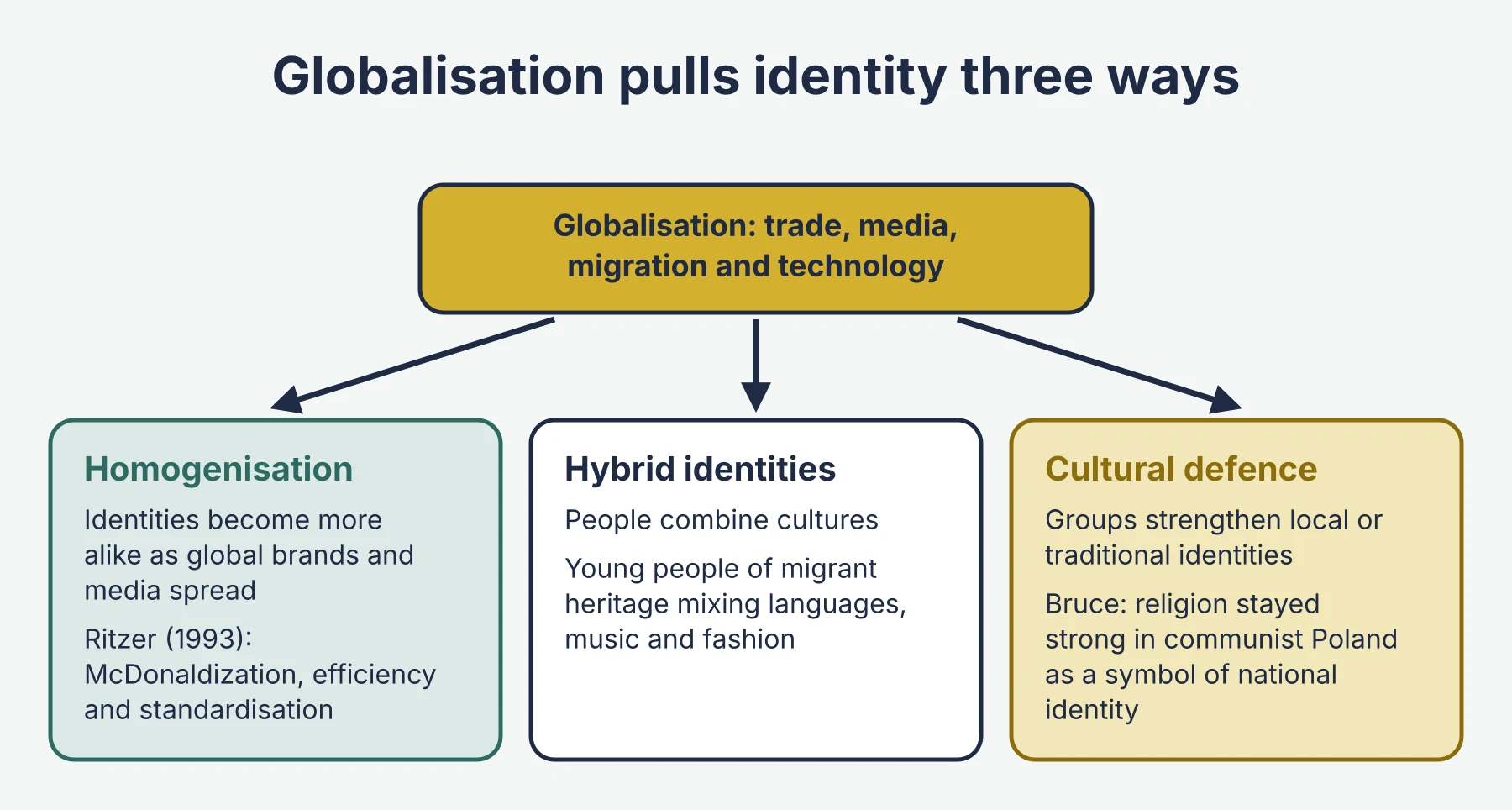
Globalisation is the growing interconnection of societies through trade, media, migration and technology. Its effects on identity pull in three directions.
- Homogenisation: identities become more alike as global brands, media and consumer habits spread. George Ritzer’s term McDonaldization (1993) described the spread of the fast-food model of efficiency and standardisation into many areas of life.
- Hybrid identities: people combine elements of different cultures, such as young people of migrant heritage mixing languages, music and fashion from their family’s culture and the society they live in.
- Cultural defence: groups strengthen local or traditional identities in response to outside influence. Steve Bruce used this idea to explain why religion stayed strong in Poland under communist rule, where the Catholic Church became a symbol of national identity.
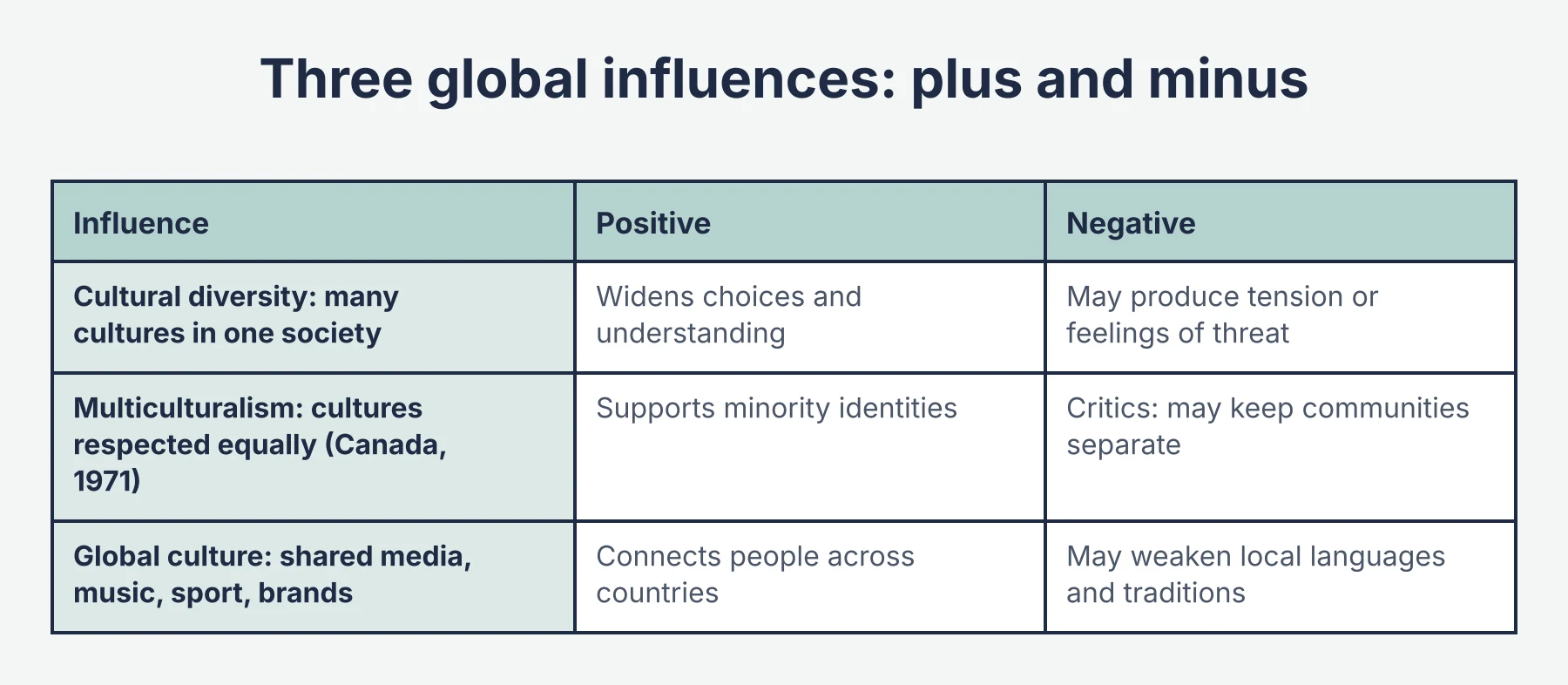
The syllabus also asks for positive and negative impacts of:
- Cultural diversity (many cultures living in one society): widens choices and understanding, but may produce tension or feelings of threat.
- Multiculturalism (a policy or belief that different cultures should be respected equally; Canada adopted an official multiculturalism policy in 1971): supports minority identities, but critics argue it can keep communities separate.
- Global culture (shared media, music, sport and brands): connects people across countries, but may weaken local languages and traditions.
Postmodernism: identity as chosen
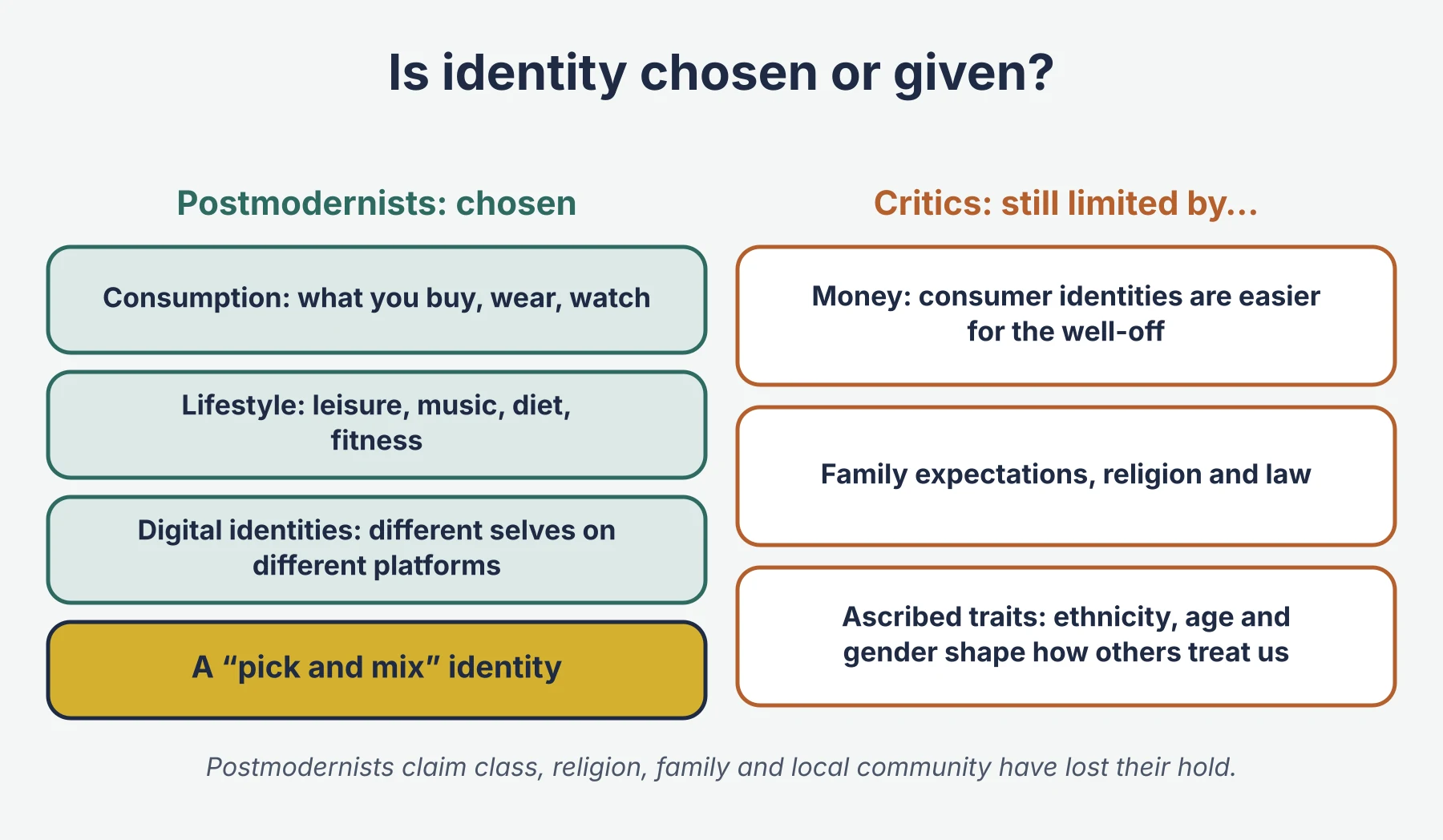
Postmodernists argue that traditional sources of identity, such as class, religion, family and local community, have lost their hold. In a “pick and mix” society, people build identities from a range of options, especially through consumption (what they buy, wear and watch) and lifestyle (leisure, music, diet, fitness). Digital identities add more choice: one person can present different selves on different platforms.
Evaluation: choice requires money, so consumer identities are easier for the well-off; family expectations, religion and law still limit many people’s choices; and ascribed characteristics such as ethnicity, age and gender continue to shape how others treat us, whatever identity we choose.
Worked example: an evaluation plan (practice)
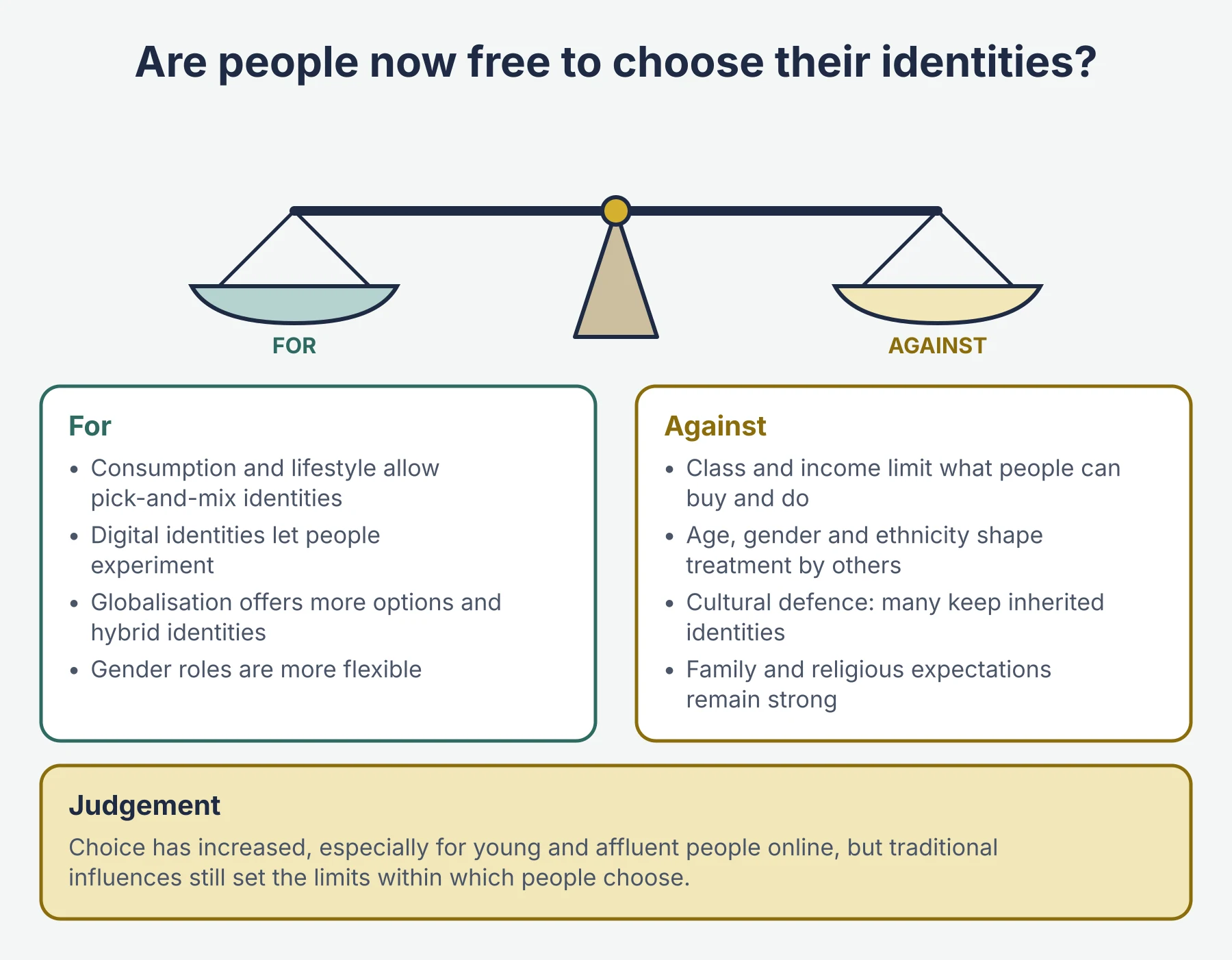
Evaluate the view that people are now free to choose their own identities.
- For: postmodernists argue that consumption and lifestyle allow “pick and mix” identities; digital identities let people experiment; globalisation offers more cultural options and hybrid identities; gender roles are more flexible than in the past.
- Against: class and income limit what people can buy and do; ascribed status such as age, gender and ethnicity still shapes treatment by others; cultural defence shows many people hold on to inherited identities; family and religious expectations remain strong in many societies.
- Judgement: choice has increased, especially for young and affluent people online, but traditional influences still set the limits within which people choose.
Common mistakes
- Treating age, gender and ethnicity as purely biological rather than socially constructed.
- Describing the digital self only negatively; the syllabus asks for positive and negative impacts.
- Confusing hybrid identities (mixing cultures) with homogenisation (cultures becoming alike).
- Accepting the postmodern view without evaluation.
- Ignoring “different societies”: use comparisons, such as how adulthood is marked in different cultures.
Exam technique
- Explain three (parts c and d): name the influence, explain its mechanism, give an example.
- Discuss (part e): explore one influence in depth, such as globalisation, with named ideas.
- Evaluate (part f): weigh traditional influences against newer ones and conclude.
Keep revising
Condense this page with the key question 2.3 revision notes, then try the key question 2.3 practice questions. How identity is learned is covered in the guide to key question 2.1.
Related resources
-
Practice questions
Cambridge O Level Sociology (2251): Identity: self and society – What influences our social identity? – Practice Questions
Original Cambridge O Level Sociology 2251 practice on key question 2.3: ethnicity, global culture, social media and postmodern identity, with answers.
Sociology · Cambridge · O Level
Try questions -
Revision notes
Cambridge O Level Sociology (2251): Identity: self and society – What influences our social identity? – Revision Notes
Revision notes for Cambridge O Level Sociology 2251 key question 2.3: age, gender, ethnicity, class, the digital self, globalisation and postmodern identity.
Sociology · Cambridge · O Level
Revise topic -
Practice questions
Cambridge O Level Sociology (2251): Social stratification and inequality – What is social stratification? – Practice Questions
Original Cambridge O Level Sociology 2251 practice on key question 3.1: caste, mobility, meritocracy, life chances, ethnicity and labelling, with answers.
Sociology · Cambridge · O Level
Try questions
Related articles
Get free revision emails (optional)
Occasional emails with practice questions, worked explanations and links to free resources for the qualification and subjects you choose. No spam, and you can unsubscribe from any email. The free tools on this site never need an email.