
Study Guides
Cambridge O Level Sociology (2251): Identity: self and society – How do we learn our identity?
Cambridge O Level Sociology 2251 key question 2.1 in depth: social construction, nature and nurture, agencies and processes of socialisation, and theories.
- Subject
- Sociology
- Level
- O LEVELS
- Topic
- Paper 1 – Research Methods, Identity and Inequality
- Author
- Marlbridge Academic Team
- Updated
- Reviewed by
- Naqiya Yousaf (what this means)
Aligned to Cambridge O Level Sociology (2251), 2025-2027. Official specification .
Syllabus page (what it covers and how it is assessed): Cambridge O Level Sociology.
Syllabus points this page covers
2251
- 2.1 Identity: self and society – How do we learn our identity?
Found an error? Report a correction.
Need help with this topic? Request a free trial class for O Level Sociology (2251).
Key question 2.1 of Cambridge O Level Sociology (2251) asks How do we learn our identity? For sociologists, who we are is acquired rather than inherited: identity comes from being socialised into a culture. In Paper 1 this content is tested in Question 2, which you can choose instead of Question 3. Strong answers do three things: they use the syllabus concepts precisely, they explain how each agency socialises (the process, not just the name), and they judge how effective agencies are and which theory explains socialisation best.
The O Level guide to how we learn our identity gives an overview of 2.1 and 2.3 together. This guide goes further into the evidence, the processes and the theoretical debate.
What the syllabus covers
- 2.1.1 (a) Society as a product of social construction: culture, norms, values, customs, roles, status (achieved/ascribed), stereotypes; (b) how these concepts influence individual behaviour and social identity.
- 2.1.2 The social construction of our identity: the nature–nurture debate, the relativity of culture, socialisation, norms and values.
- 2.1.3 Primary and secondary socialisation: the key agencies (family, education, peer group, media, religion, workplace) and the effectiveness of each.
- 2.1.4 Processes used by agencies, for example canalisation, hidden curriculum, media representations, peer pressure, religious teachings, role modelling and workplace training.
- 2.1.5 The debate between perspectives: consensus and conflict; functionalist ideas (inadequate socialisation, social cohesion/value consensus); Marxist ideas (socialisation into capitalist ideology, reproduction of social class); feminist ideas (gender role socialisation into masculinity/femininity).
How the building blocks fit together
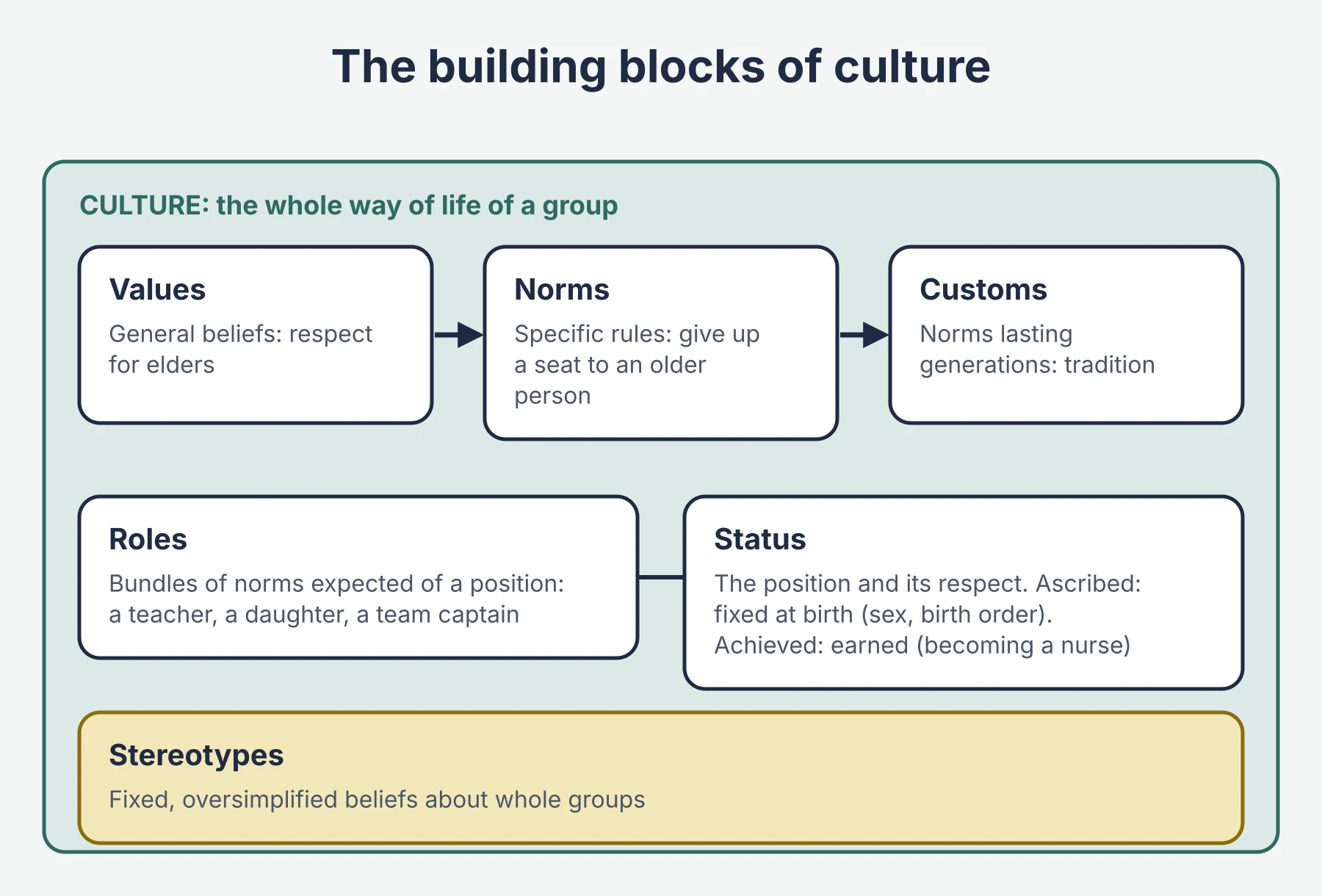
The 2.1.1 concepts form a chain. Values are general beliefs about what is good or important, such as respect for elders. Norms turn values into specific rules for behaviour, such as giving up a seat to an older person. Customs are norms that have lasted for generations and become tradition. Roles bundle norms together into the behaviour expected of a position: a teacher, a daughter, a team captain. Status is the social position itself and the respect attached to it, either ascribed (fixed at birth, such as sex or birth order) or achieved (earned, such as becoming a nurse). Stereotypes are fixed and oversimplified beliefs about whole groups. Together these make up culture, the whole way of life of a group.
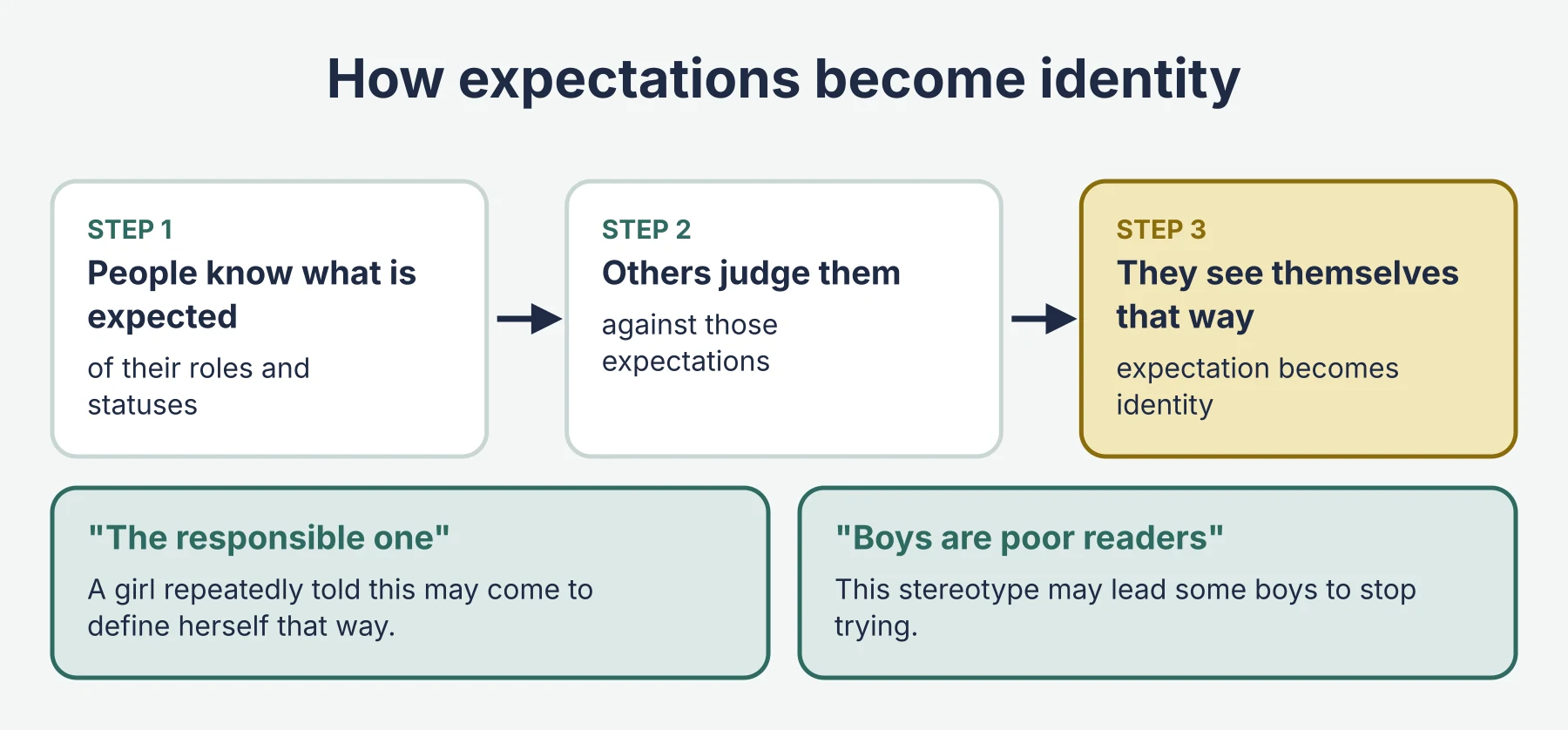
The exam asks how these concepts influence behaviour and identity (2.1.1b). The mechanism is expectation: people know what is expected of their roles and statuses, are judged against those expectations by others, and come to see themselves in those terms. A girl repeatedly told that she is “the responsible one” may come to define herself that way; a stereotype that boys are poor readers may lead some boys to stop trying.
Nature or nurture?
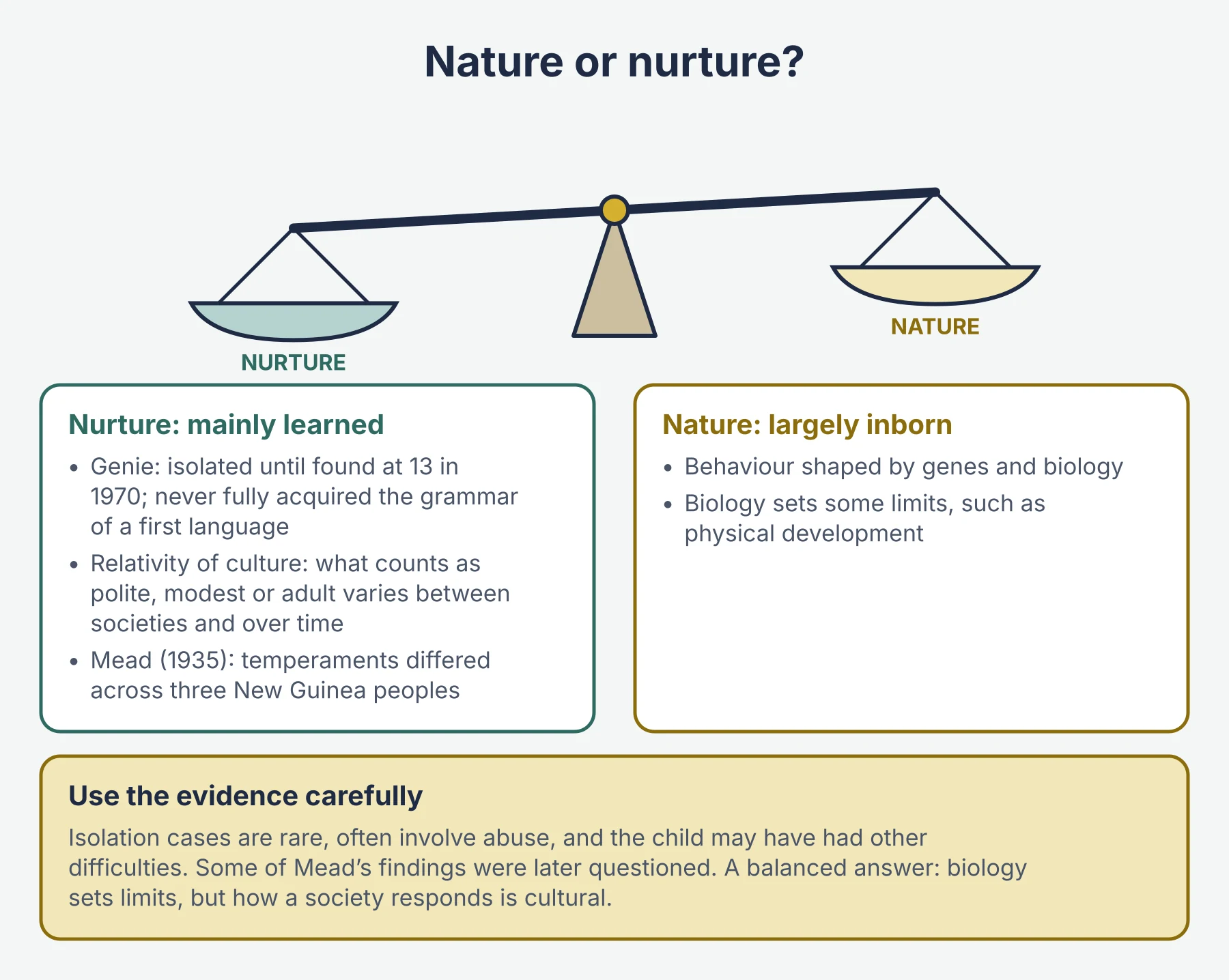
The nature side argues that behaviour is largely inborn, shaped by genes and biology. The nurture side argues that it is mainly learned through socialisation. Sociologists emphasise nurture, using two kinds of evidence.
Cases of extreme isolation. The girl known as “Genie” had been shut away from almost all human contact by her father until the authorities in Los Angeles found her, aged 13, in 1970; at that point she could barely speak. Despite years of later teaching she never fully acquired the grammar of a first language. Such cases suggest that language and social behaviour depend on contact with others at the right stage of life. They must be used carefully: they are rare, often involve abuse, and the child may have had other difficulties from birth.
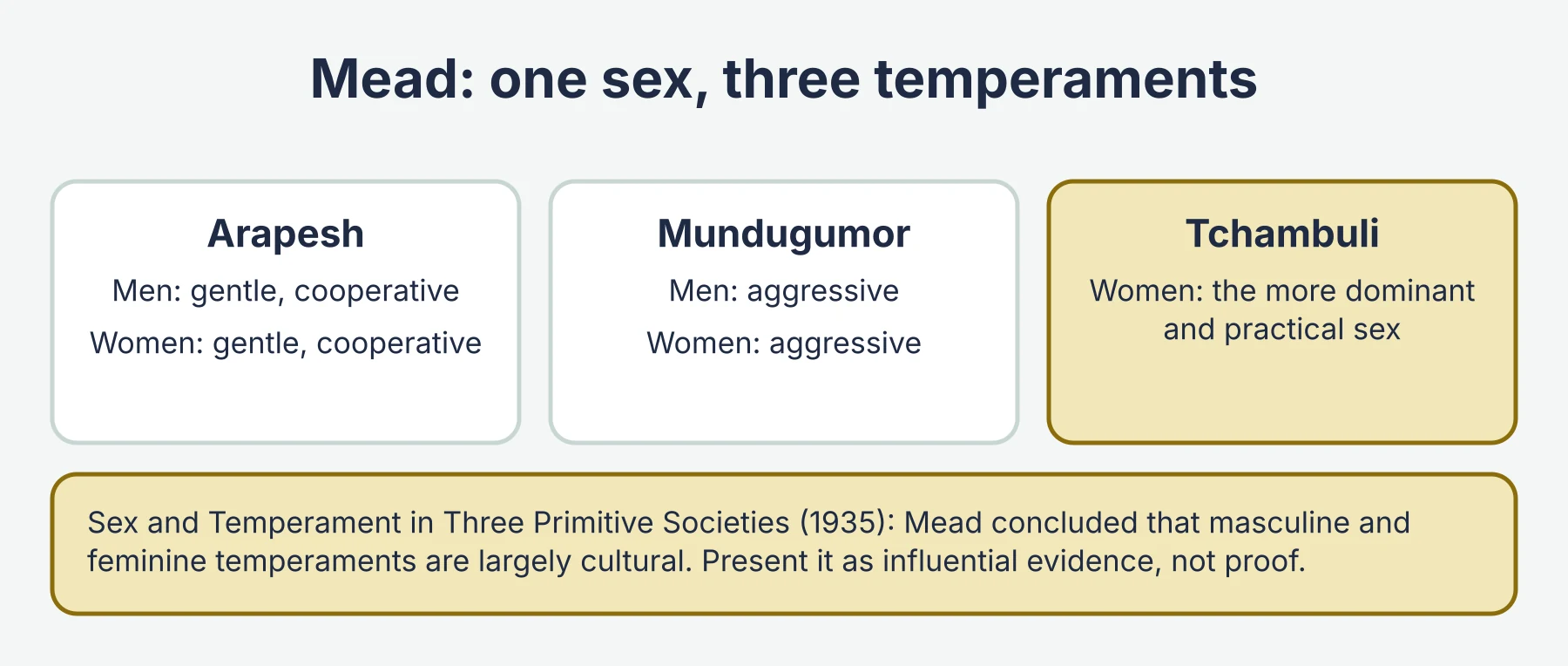
The relativity of culture. If behaviour were fixed by biology, it would be similar everywhere. In fact what counts as polite, modest, attractive or adult varies between societies and over time. In Sex and Temperament in Three Primitive Societies (1935), the anthropologist Margaret Mead compared three New Guinea peoples: among the Arapesh both men and women were expected to be gentle and cooperative, among the Mundugumor both were expected to be aggressive, and among the Tchambuli women were the more dominant and practical sex. Mead concluded that masculine and feminine temperaments are largely cultural. Later researchers questioned some of her findings, so present the study as influential evidence rather than proof.
A balanced answer accepts that biology sets some limits (for example, physical development), but that how a society interprets and responds to those differences is cultural.
Agencies and processes: how socialisation actually works
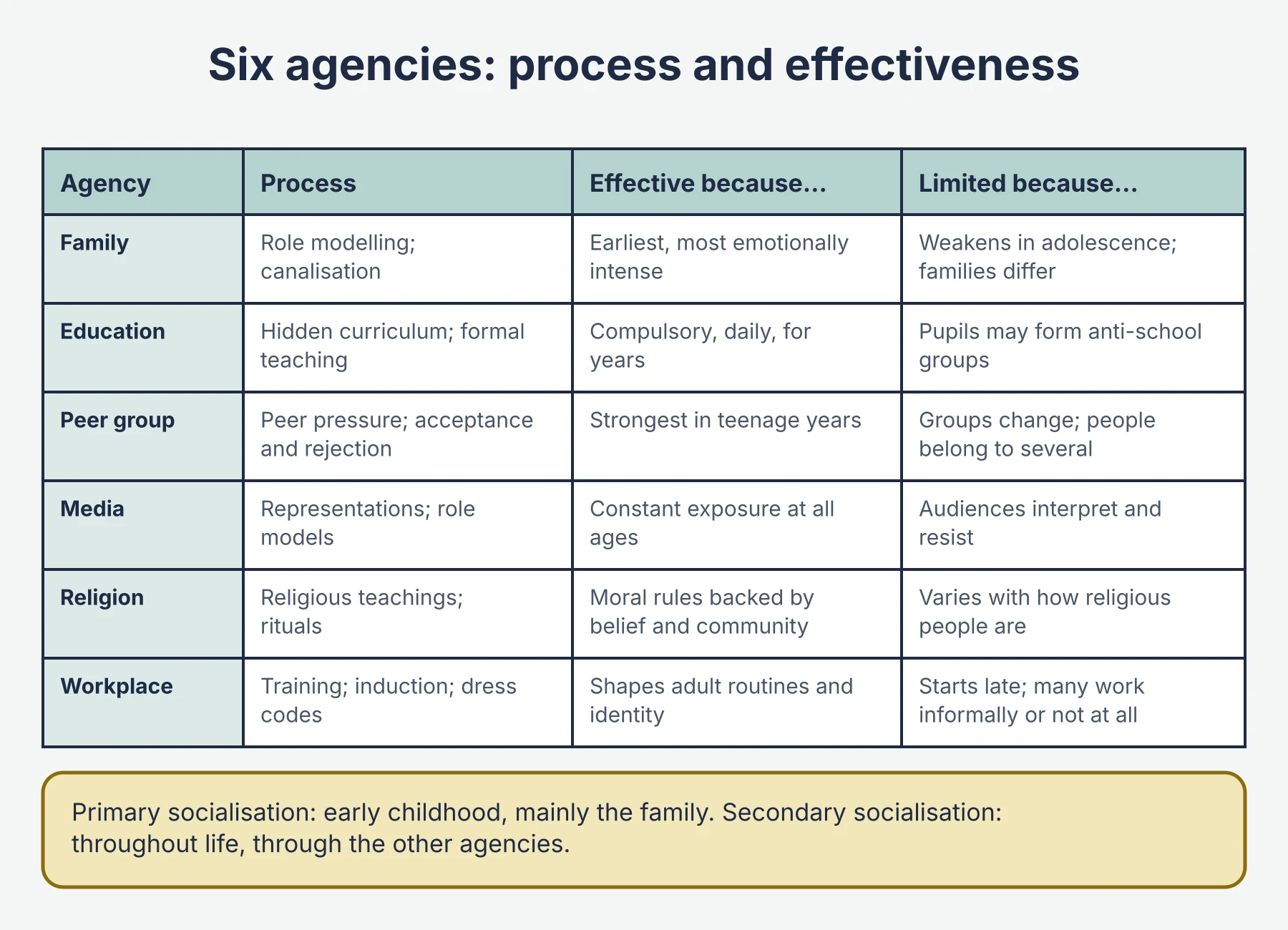
Primary socialisation takes place in early childhood, mainly in the family, and teaches language, basic norms and an early sense of self. Secondary socialisation continues throughout life through other agencies. The syllabus asks for both the process each agency uses and its effectiveness.
| Agency | Process | Why it is effective | Why its effect is limited |
|---|---|---|---|
| Family | Role modelling; canalisation | Earliest and most emotionally intense influence | Influence weakens in adolescence; families differ widely |
| Education | Hidden curriculum; formal teaching | Compulsory, daily, for many years | Pupils may reject school values, forming anti-school groups |
| Peer group | Peer pressure; acceptance and rejection | Strongest in teenage years, when status among friends matters most | Groups change; individuals belong to several peer groups at once |
| Media | Media representations; role models | Constant exposure across all ages | Audiences interpret and resist messages |
| Religion | Religious teachings; rituals | Gives moral rules backed by belief and community | Influence varies with how religious a society or family is |
| Workplace | Workplace training; induction; dress codes | Shapes adult routines and occupational identity | Starts late; many people work informally or not at all |
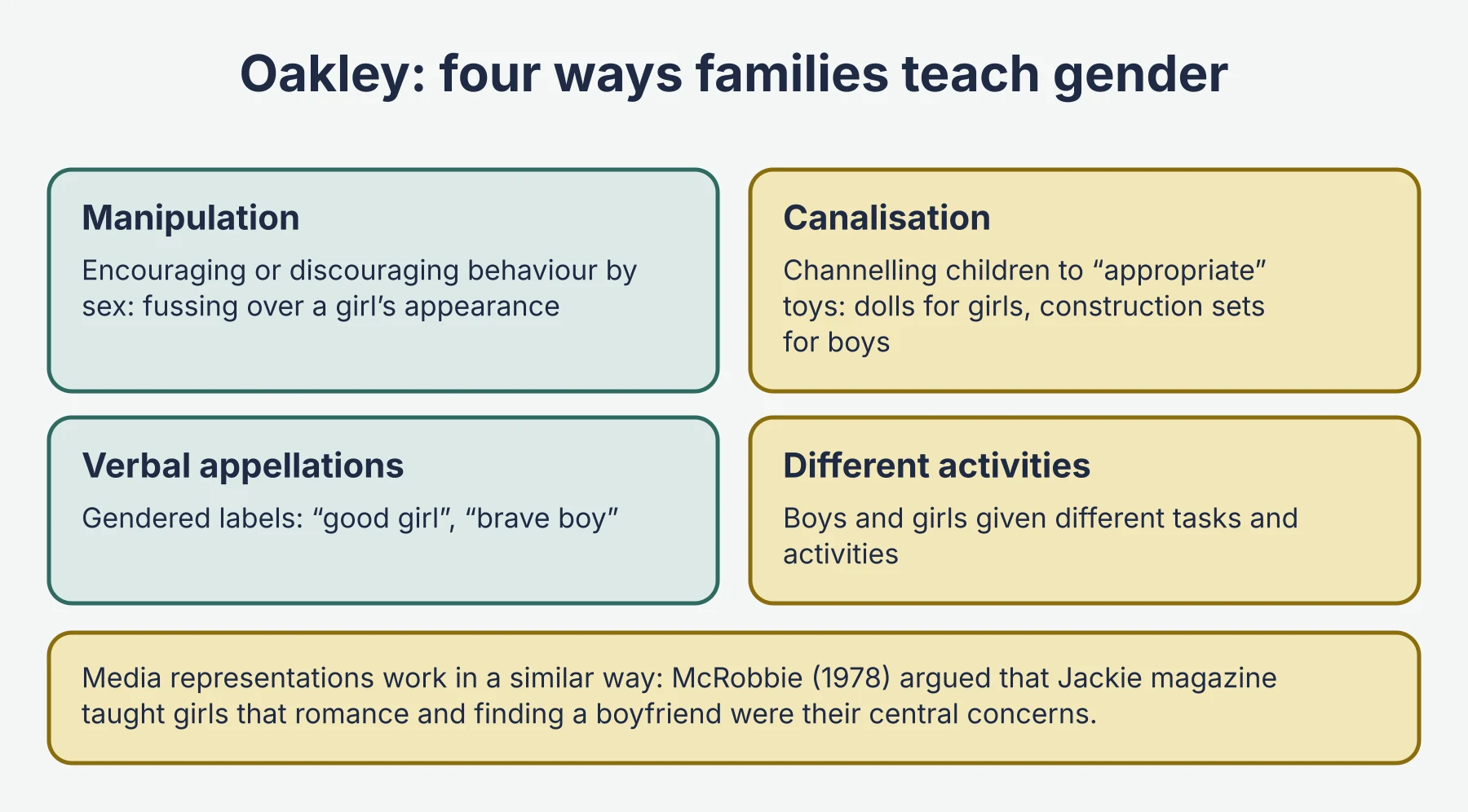
Ann Oakley described how families shape gender identity through manipulation (encouraging or discouraging behaviour according to sex, for example fussing over a girl’s appearance) and canalisation (channelling children towards “appropriate” toys and activities, such as dolls for girls and construction sets for boys). She also identified verbal appellations (“good girl”, “brave boy”) and different activities given to boys and girls. These are useful named processes for the family’s role in gender socialisation.
Angela McRobbie’s study of the teenage magazine Jackie (1978) is an example of media representations: she argued that the magazine taught girls that romance and finding a boyfriend were their central concerns.
The theoretical debate
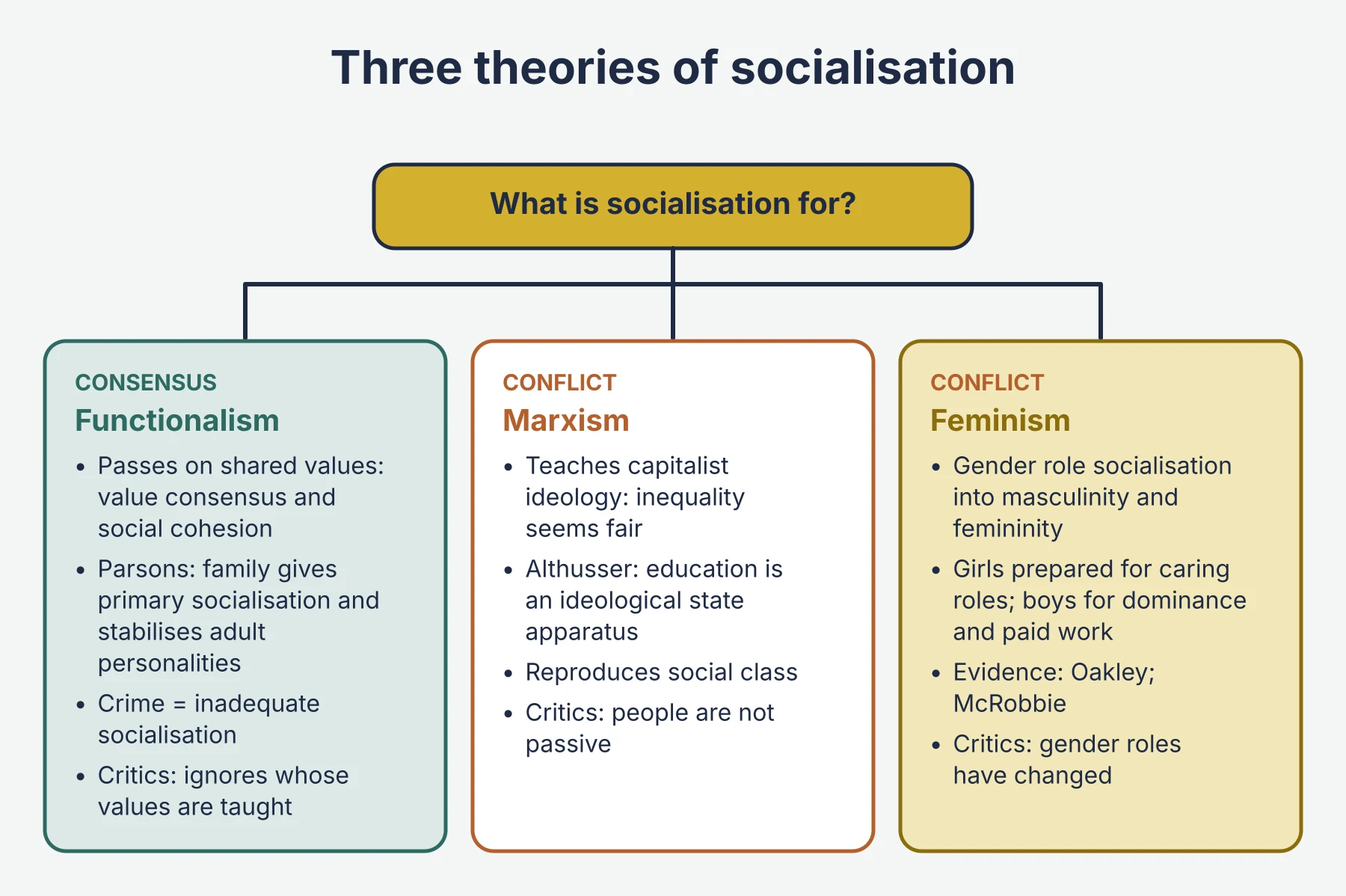
Consensus: functionalism. Functionalists see socialisation as the way society passes on shared values from one generation to the next, creating value consensus and social cohesion. Talcott Parsons argued that the family’s basic functions are the primary socialisation of children and the stabilisation of adult personalities. Problems such as crime are explained by inadequate socialisation: when families or schools fail to teach shared norms, individuals do not conform. Criticism: this assumes everyone shares the same values and ignores whose values are taught.
Conflict: Marxism. Marxists argue that agencies socialise people into capitalist ideology: beliefs that make inequality seem natural and fair, such as the idea that success depends only on effort. Louis Althusser called education an “ideological state apparatus” because it spreads ruling class ideas. Socialisation also reproduces social class: working-class children are prepared for working-class jobs, middle-class children for middle-class ones. Criticism: people are not passive; many recognise and challenge inequality.
Conflict: feminism. Feminists argue that gender role socialisation teaches masculinity and femininity as if they were natural, preparing girls for caring and domestic roles and boys for dominance and paid work. Oakley’s processes and McRobbie’s study of Jackie provide evidence. Criticism: gender roles have changed considerably, and feminists may underestimate girls’ and women’s ability to reject these messages.
Worked example: a “discuss” answer (practice)
Discuss how the family socialises children into gender roles.
The family is the main agency of primary socialisation, so it shapes gender identity before other agencies have any influence. Oakley identified canalisation: parents channel children towards gendered toys and activities, for example buying a girl a toy kitchen and a boy a football, so that children learn which interests are “normal” for their sex. Through manipulation, parents praise or discourage behaviour according to sex, such as comforting a crying girl but telling a boy to be brave. Role modelling matters too: if a mother does most of the cooking and a father controls the money, children may copy these patterns. Feminists see this as the start of patriarchal inequality. However, many families now challenge traditional roles, and children are also influenced by school, peers and media, so the family is one influence among several.
Why it works: it names processes, gives a concrete example of each, links to a theory, and ends with an evaluative point.
Common mistakes
- Listing agencies without the process each one uses.
- Naming the family as an agency of secondary socialisation.
- Using cases of isolated children as proof without noting their limitations.
- Describing a theory without saying what it argues socialisation is for.
- Confusing norms (specific rules) with values (general beliefs).
Exam technique
- Define (parts a and b): one precise sentence, ideally with an example.
- Explain (parts c and d): three developed points, each with a process and an example.
- Discuss (part e): explain in depth with evidence; a brief counter-point helps.
- Evaluate (part f): weigh two or more perspectives or agencies and reach a judgement.
Keep revising
Condense this page with the key question 2.1 revision notes, then try the key question 2.1 practice questions.
Related resources
-
Practice questions
Cambridge O Level Sociology (2251): Identity: self and society – How do we learn our identity? – Practice Questions
Original Cambridge O Level Sociology 2251 practice on key question 2.1: customs, roles, agencies of socialisation and three theories, with full answers.
Sociology · Cambridge · O Level
Try questions -
Revision notes
Cambridge O Level Sociology (2251): Identity: self and society – How do we learn our identity? – Revision Notes
Revision notes for Cambridge O Level Sociology 2251 key question 2.1: culture, nature and nurture, agencies and processes of socialisation, and three theories.
Sociology · Cambridge · O Level
Revise topic -
Study guides
Cambridge O Level Sociology (2251): Identity: self and society – How does society control us?
Cambridge O Level Sociology 2251 key question 2.2 in depth: formal and informal control, sanctions, three theories, surveillance and subcultures.
Sociology · Cambridge · O Level
Read guide
Related articles
Get free revision emails (optional)
Occasional emails with practice questions, worked explanations and links to free resources for the qualification and subjects you choose. No spam, and you can unsubscribe from any email. The free tools on this site never need an email.