
Revision Notes
Cambridge O Level Sociology (2251): Identity: self and society – How does society control us? – Revision Notes
Revision notes for Cambridge O Level Sociology 2251 key question 2.2: sanctions, formal and informal agencies, three theories, surveillance and subcultures.
- Subject
- Sociology
- Level
- O LEVELS
- Topic
- Paper 1 – Research Methods, Identity and Inequality
- Author
- Marlbridge Academic Team
- Updated
- Reviewed by
- Naqiya Yousaf (what this means)
Aligned to Cambridge O Level Sociology (2251), 2025-2027. Official specification .
Syllabus page (what it covers and how it is assessed): Cambridge O Level Sociology.
Syllabus points this page covers
2251
- 2.2 Identity: self and society – How does society control us?
Found an error? Report a correction.
Need help with this topic? Request a free trial class for O Level Sociology (2251).
These notes condense key question 2.2 of Cambridge O Level Sociology (2251), How does society control us? Most conformity comes from norms people have internalised, reinforced by rewards and punishments from state agencies and from the people around them. For functionalists this protects values everyone shares; for Marxists it protects the ruling class, and for feminists it protects men’s power. Some people resist through protest groups and subcultures.
Fuller explanations: key question 2.2 study guide.
Syllabus coverage
2251 syllabus 2025–2027, 2.2: 2.2.1 formal and informal control, sanctions and effectiveness; 2.2.2 functionalism, Marxism, feminism; 2.2.3 formal agencies; 2.2.4 their methods; 2.2.5 informal agencies; 2.2.6 their methods; 2.2.7 resistance through protest groups and subcultures.
Key terms
| Term | Definition |
|---|---|
| Social control | Ways a society encourages conformity to norms and values |
| Conformity | Behaving in line with norms and rules |
| Formal control | Control by official state agencies using written rules |
| Informal control | Control through everyday approval and disapproval |
| Positive sanction | Reward for conforming |
| Negative sanction | Punishment for deviance |
| Internalisation | Accepting norms as one’s own, so control comes from within |
| Coercion | Force or the threat of force |
| Digital surveillance | Monitoring through technology such as CCTV and online data |
| Panopticon | Foucault’s image of constant possible observation leading to self-control |
| Ostracism | Excluding someone from a group |
| Non-conformity | Rejecting mainstream expectations without necessarily breaking laws |
| Protest group | Group campaigning for social or political change |
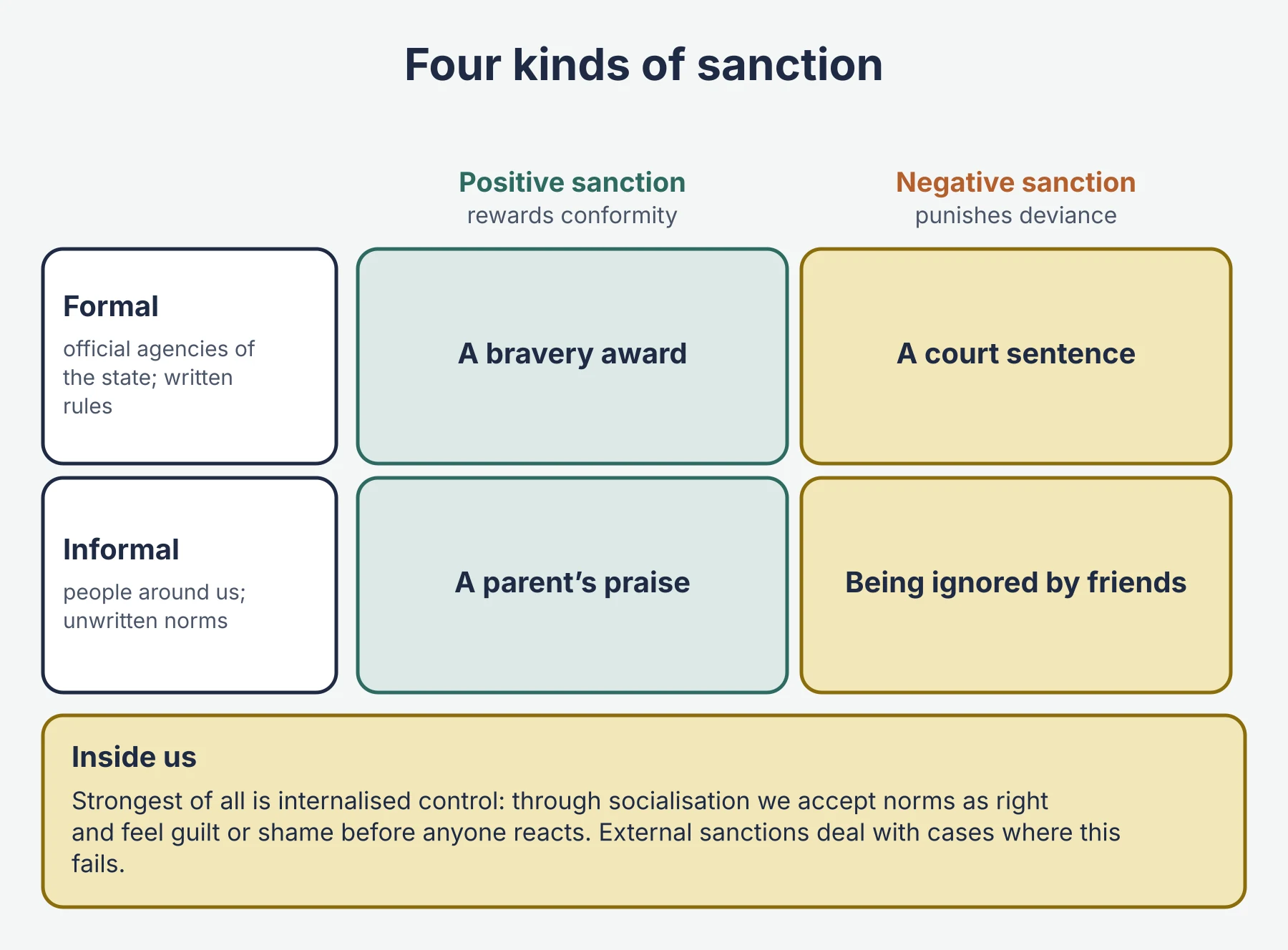
Sanctions grid
| Positive | Negative | |
|---|---|---|
| Formal | Award, medal, official honour | Fine, arrest, prison sentence |
| Informal | Praise, parental rewards, social media “likes”, promotion | Ostracism, school punishment, gossip, dismissal from a job |
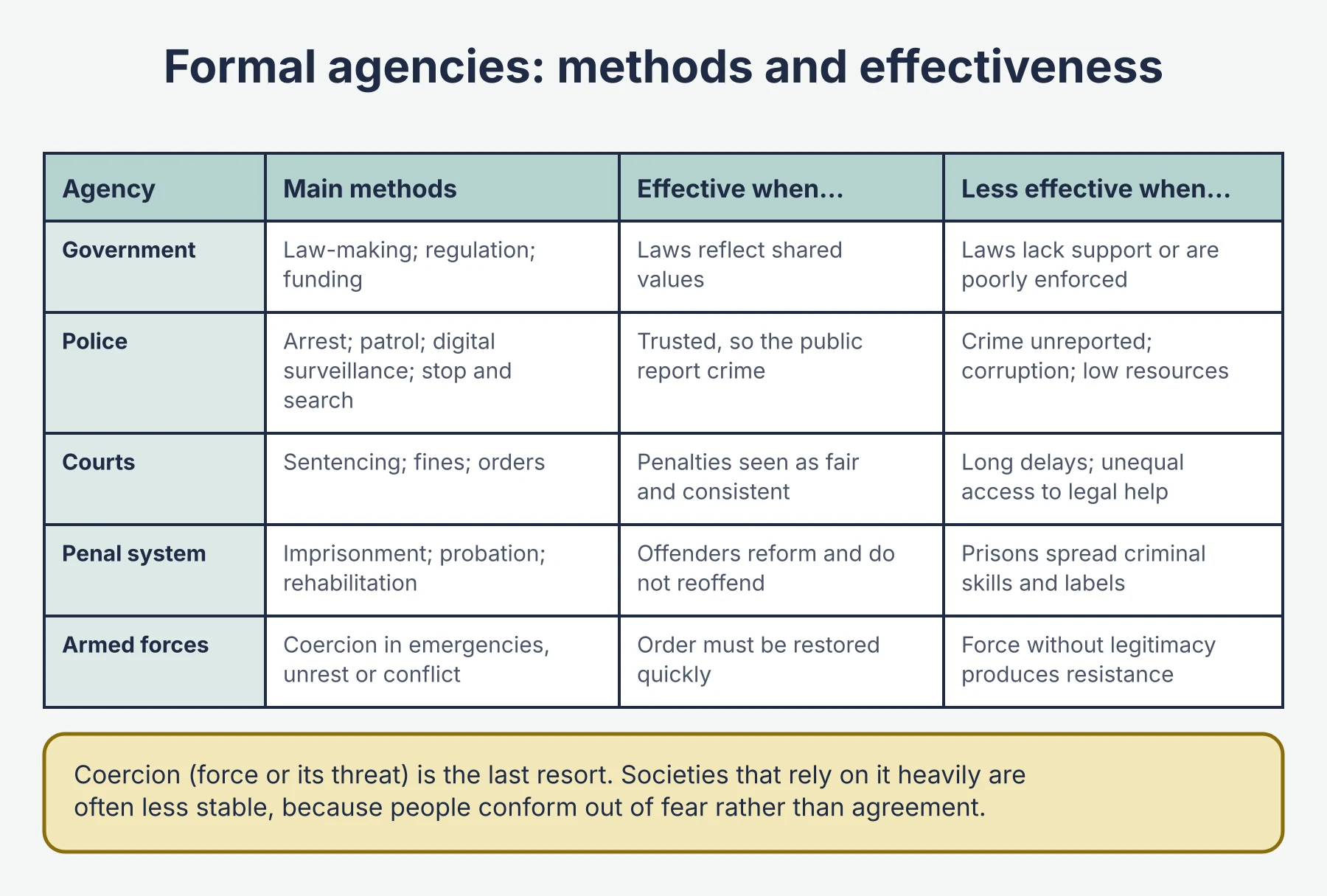
Formal agencies: methods and limits
| Agency | Method | Limit |
|---|---|---|
| Government | Law-making | Unpopular laws ignored |
| Police | Arrest; patrol; digital surveillance | Unreported crime; low trust |
| Courts | Sentencing | Delays; unequal legal help |
| Penal system | Imprisonment; probation | Reoffending; labelling |
| Armed forces | Coercion | Force without legitimacy breeds resistance |
Effectiveness rule: formal control works best when agencies are seen as legitimate and backed by informal control.
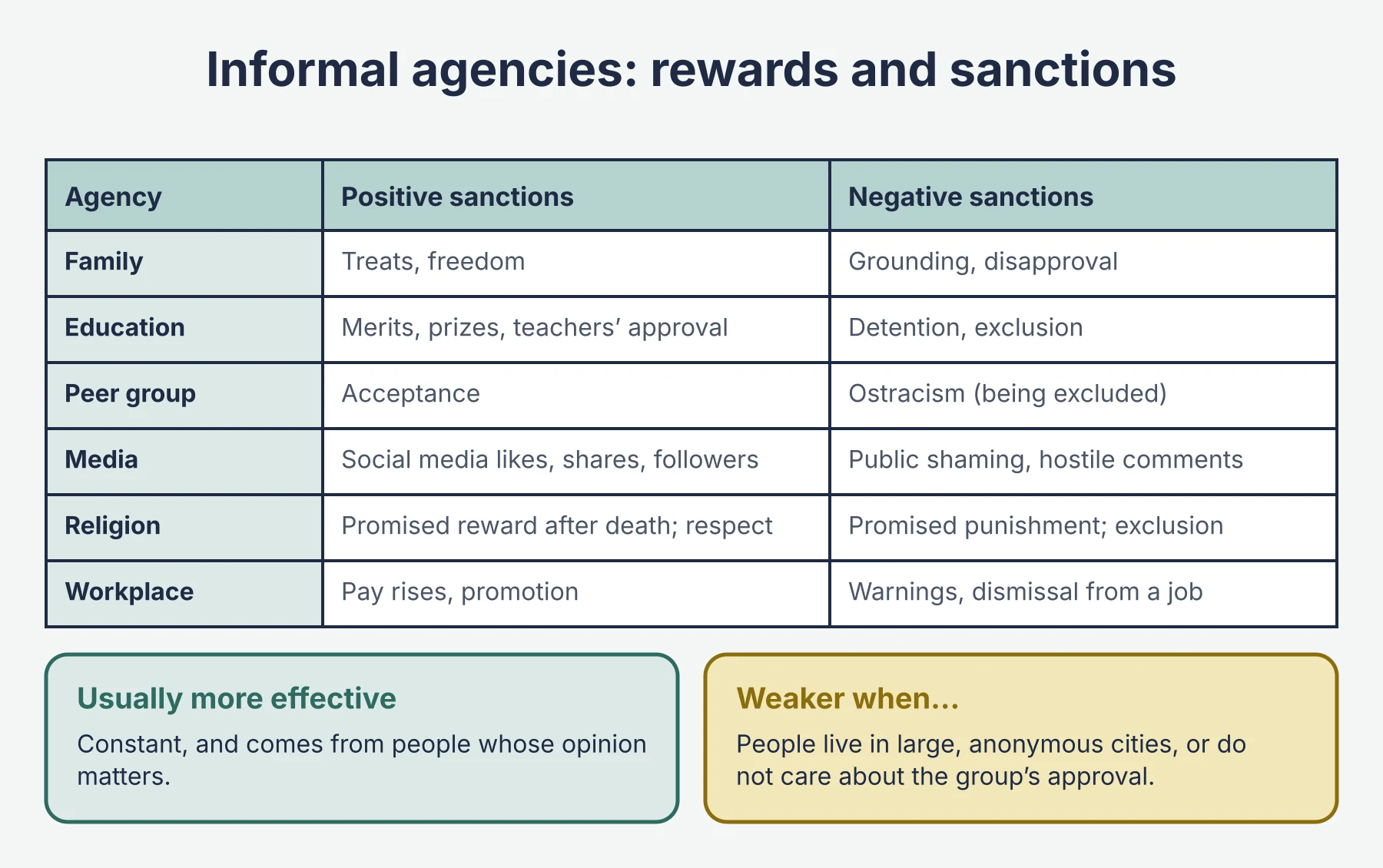
Informal agencies: methods and limits
- Family: rewards and grounding; weakens in adolescence.
- Education: merits, detentions, exclusion; some pupils reject school values.
- Peer group: acceptance or ostracism; may push towards deviance.
- Media: likes and public shaming; messages can be ignored.
- Religion: religious rewards and sanctions; depends on belief.
- Workplace: promotion or dismissal; only for those in work.
Theories
| Theory | View of control | Named idea |
|---|---|---|
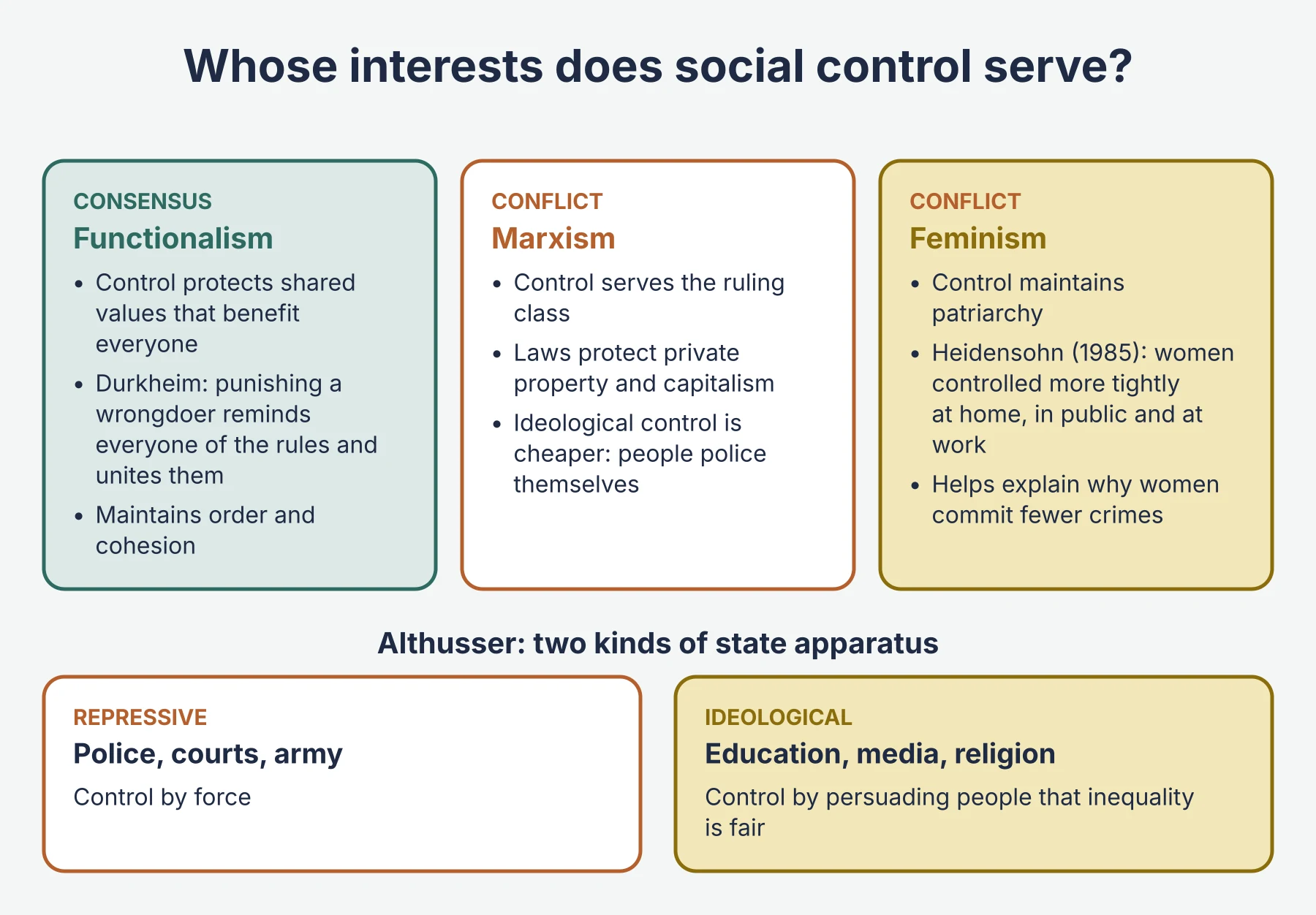
| Functionalism | Protects shared values; maintains order | Durkheim: punishment reinforces boundaries and unites society |
| Marxism | Protects ruling-class power and property | Althusser: repressive and ideological state apparatuses |
| Feminism | Protects patriarchy | Heidensohn (1985): women controlled at home, in public and at work |
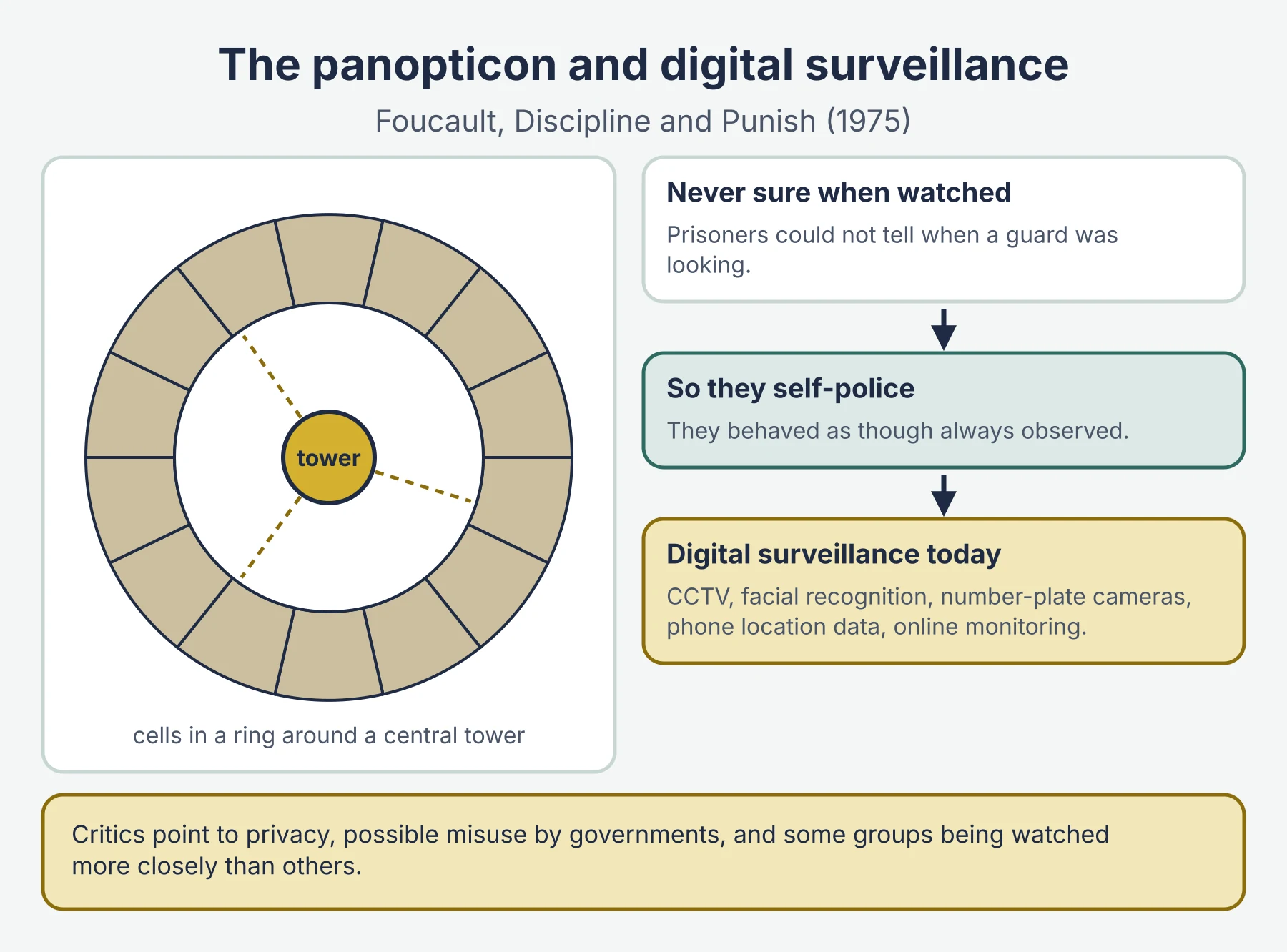
Surveillance: Foucault (1975), the panopticon; knowing you may be watched leads to self-discipline.
Resistance
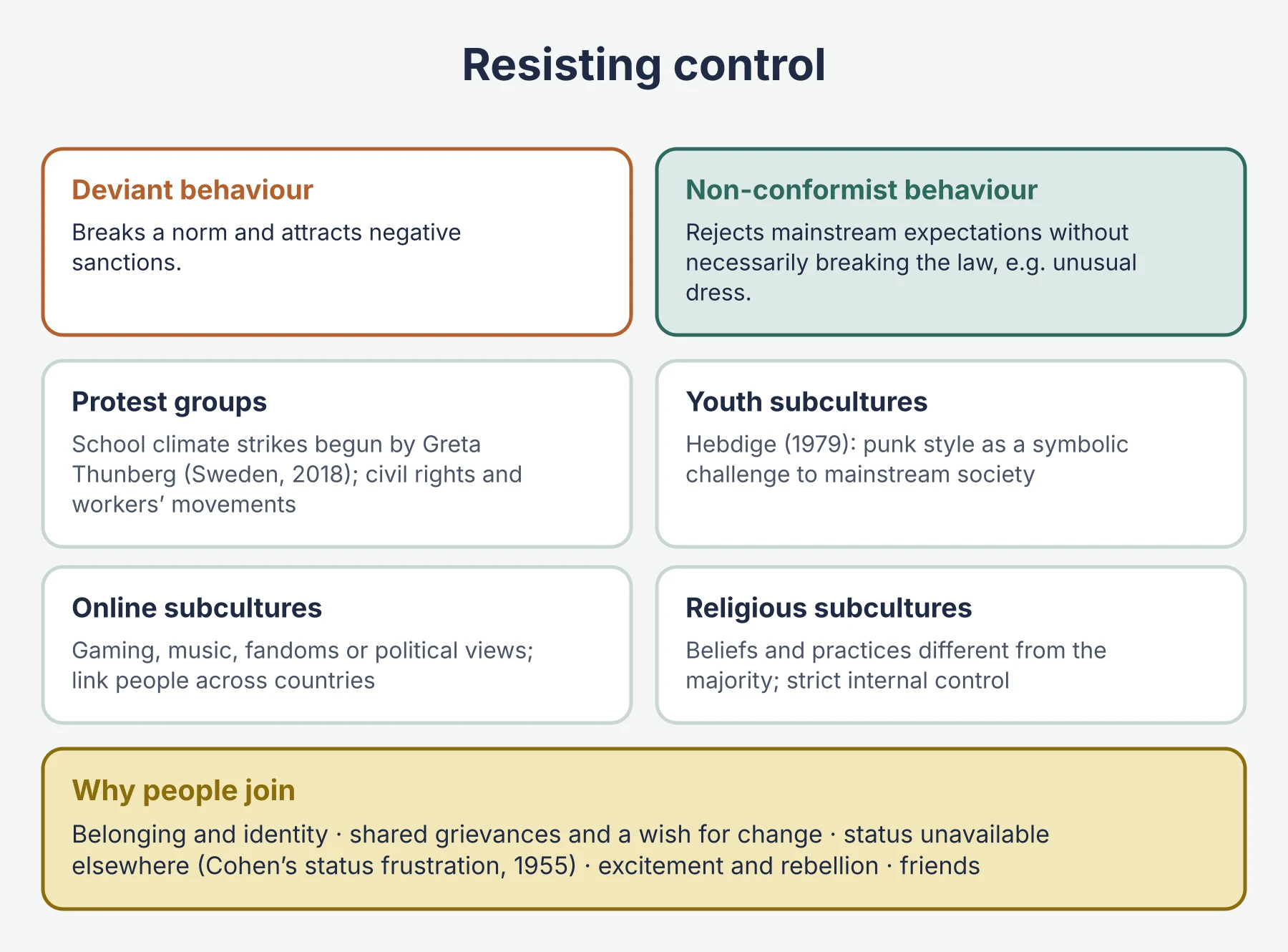
- Deviant (breaks norms, sanctioned) versus non-conformist (rejects expectations).
- Examples: protest groups (climate school strikes from 2018); youth subcultures (punk, analysed by Hebdige, 1979); online subcultures (gaming, fandoms); religious subcultures.
- Why join: belonging; identity; shared grievance; status (A. Cohen, 1955); excitement; peer influence.
- Irony: subcultures impose their own informal control.
Exam traps
- School punishments are listed under informal agencies in this syllabus.
- Always say whether a sanction is positive or negative.
- “Effectiveness” requires a judgement, not a description.
- Protest is not automatically deviant; most protest groups act legally.
- Do not confuse Althusser’s repressive apparatuses (force) with ideological ones (ideas).
Worked example: an 8-mark “discuss” plan (practice)
Discuss the effectiveness of digital surveillance as a method of social control.
- Effective: CCTV and phone data help identify offenders; visible cameras deter; online monitoring detects some cyber crime.
- Panopticon effect: people self-discipline because they might be watched (Foucault).
- Limits: offenders move elsewhere or hide identities; huge volumes of data are hard to use.
- Concerns: privacy; misuse by governments; some groups watched more than others (conflict view).
- Judgement: effective for detection and some deterrence, but raises questions of power.
Self-test
- Define social control.
- Give one example of a formal positive sanction.
- Give one example of an informal negative sanction used by the peer group.
- What is coercion?
- Name the five formal agencies in the syllabus.
- Why is informal control often more effective than formal control?
- What does the panopticon show about surveillance?
- How does Durkheim say punishment benefits society?
- What is the difference between repressive and ideological state apparatuses?
- Give two ways Heidensohn says women are controlled.
- What is the difference between deviant and non-conformist behaviour?
- Give three reasons why people join subcultures.
Answers
- All the ways a society encourages people to conform to its norms and values.
- A medal, honour or official award.
- Ostracism, teasing or gossip.
- Force or the threat of force.
- Government, police, courts, penal system, armed forces.
- It is constant and comes from people whose approval matters.
- People who might be watched at any time come to control themselves.
- It reminds everyone of the rules and unites them against wrongdoing.
- Repressive apparatuses control by force (police, army); ideological ones by ideas (education, media, religion).
- Through domestic responsibilities at home, fear of violence and concern for reputation in public, and male supervision at work.
- Deviant behaviour breaks norms and is sanctioned; non-conformist behaviour rejects mainstream expectations, often without breaking laws.
- Belonging, identity, shared grievances, status, excitement, peer influence.
Frequently asked questions
Can one agency be both formal and informal? The syllabus places each agency in one group, but an agency’s methods can vary: a school uses both written rules and informal approval.
Do I need examples from my own country? Local examples of protest groups or subcultures are credited if they are explained accurately.
Related pages: key question 2.2 practice questions | key question 2.3 revision notes
Related resources
-
Study guides
Cambridge O Level Sociology (2251): Identity: self and society – What influences our social identity?
Cambridge O Level Sociology 2251 key question 2.3 in depth: age, gender, ethnicity and class, the digital self, globalisation and postmodern views of identity.
Sociology · Cambridge · O Level
Read guide -
Practice questions
Cambridge O Level Sociology (2251): Identity: self and society – What influences our social identity? – Practice Questions
Original Cambridge O Level Sociology 2251 practice on key question 2.3: ethnicity, global culture, social media and postmodern identity, with answers.
Sociology · Cambridge · O Level
Try questions -
Revision notes
Cambridge O Level Sociology (2251): Identity: self and society – What influences our social identity? – Revision Notes
Revision notes for Cambridge O Level Sociology 2251 key question 2.3: age, gender, ethnicity, class, the digital self, globalisation and postmodern identity.
Sociology · Cambridge · O Level
Revise topic
Related articles
Get free revision emails (optional)
Occasional emails with practice questions, worked explanations and links to free resources for the qualification and subjects you choose. No spam, and you can unsubscribe from any email. The free tools on this site never need an email.