
Revision Notes
Cambridge O Level Sociology (2251): Identity: self and society – What influences our social identity? – Revision Notes
Revision notes for Cambridge O Level Sociology 2251 key question 2.3: age, gender, ethnicity, class, the digital self, globalisation and postmodern identity.
- Subject
- Sociology
- Level
- O LEVELS
- Topic
- Paper 1 – Research Methods, Identity and Inequality
- Author
- Marlbridge Academic Team
- Updated
- Reviewed by
- Naqiya Yousaf (what this means)
Aligned to Cambridge O Level Sociology (2251), 2025-2027. Official specification .
Syllabus page (what it covers and how it is assessed): Cambridge O Level Sociology.
Syllabus points this page covers
2251
- 2.3 Identity: self and society – What influences our social identity?
Found an error? Report a correction.
Need help with this topic? Request a free trial class for O Level Sociology (2251).
These notes condense key question 2.3 of Cambridge O Level Sociology (2251), What influences our social identity? Four traditional aspects (age, gender, ethnicity and social class) shape identity differently in different societies. Newer influences are online life, globalisation, and the postmodern claim that identity is now chosen through consumption and lifestyle. Most questions ask you to weigh the old against the new.
Fuller explanations: key question 2.3 study guide.
Syllabus coverage
2251 syllabus 2025–2027, 2.3: 2.3.1 age, gender, ethnicity, social class and their impact in different societies; 2.3.2 the digital self and online identities; 2.3.3 globalisation (cultural defence, hybrid identities, homogenisation; cultural diversity, multiculturalism, global culture); 2.3.4 postmodernist views of identity as chosen (digital identities; consumption and lifestyle in a “pick and mix” society).
Key terms
| Term | Definition |
|---|---|
| Social identity | Sense of self based on group membership and how others see us |
| Ethnicity | Shared culture based on language, religion, customs and history |
| Hegemonic masculinity | The dominant ideal of manhood in a society (Connell) |
| Cultural capital | Tastes, knowledge and manners valued by schools (Bourdieu) |
| Digital self | The identity a person presents online |
| Virtual community | Group whose relationships are formed and kept online (Rheingold, 1993) |
| Impression management | Controlling how others see us (Goffman, 1959) |
| Globalisation | Growing interconnection of societies through trade, media, migration and technology |
| Homogenisation | Identities and cultures becoming more alike |
| Hybrid identity | Identity combining elements of more than one culture |
| Cultural defence | Strengthening a traditional identity in response to outside pressure |
| Multiculturalism | Policy or belief that different cultures deserve equal respect |
| Global culture | Media, brands, music and styles shared across countries |
| “Pick and mix” identity | Postmodern idea of building identity from many options |
The four aspects at a glance
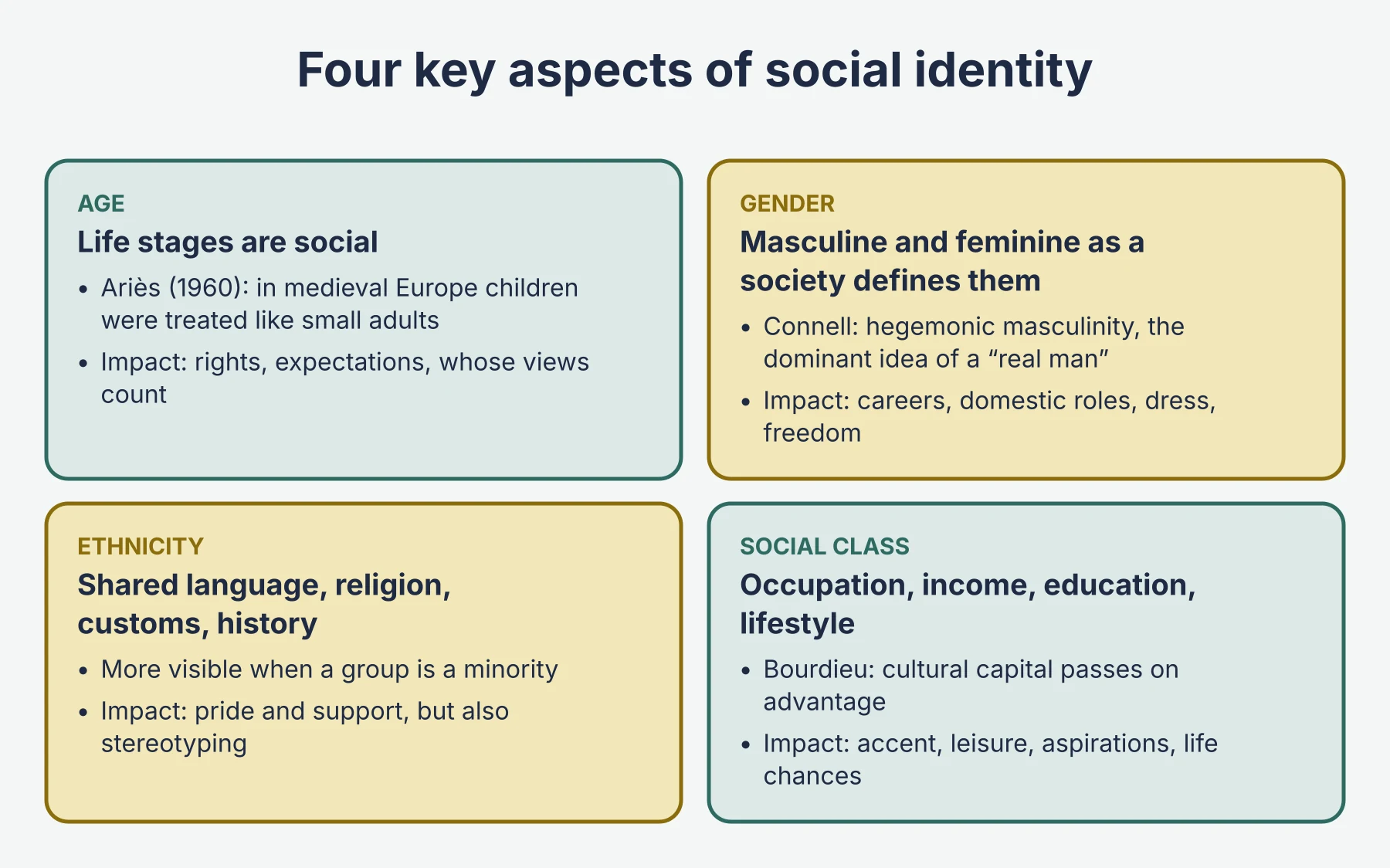
| Aspect | Socially constructed because… | Evidence or example | Impact |
|---|---|---|---|
| Age | Meaning of life stages varies | Ariès: childhood developed gradually as a separate stage | Rights, roles, respect |
| Gender | Masculinity and femininity are learned | Connell: hegemonic masculinity | Careers, domestic roles, freedom |
| Ethnicity | Shared culture is learned and maintained | Minority and migrant communities emphasising language and religion | Belonging; or stereotyping and exclusion |
| Class | Lifestyle and tastes differ by class | Bourdieu: cultural capital | Accent, aspirations, life chances |
Debate on class: some argue class identity has weakened with the decline of traditional industries; others argue it still shapes identity even when people avoid class labels.
The digital self
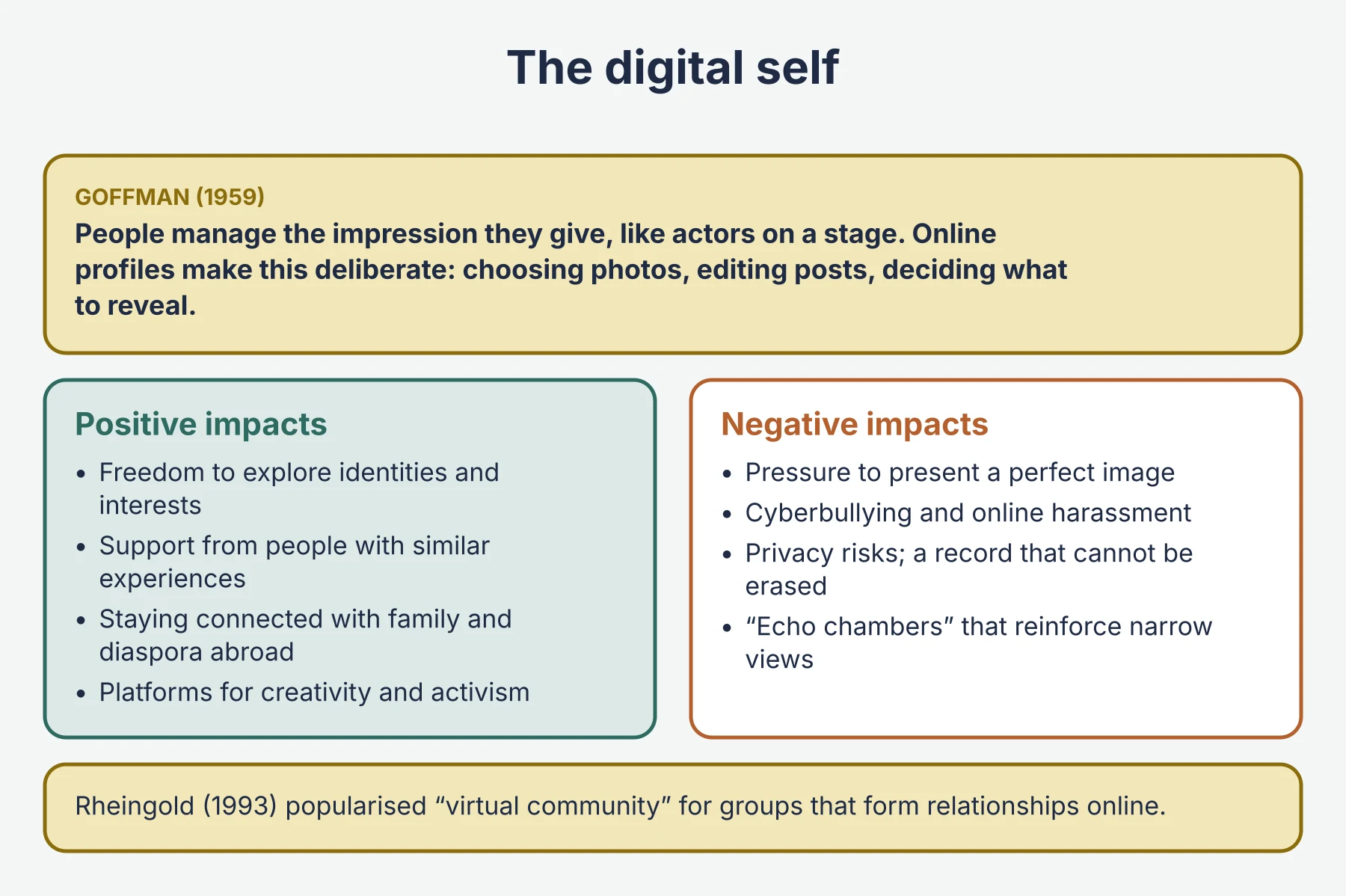
- Positives: explore identities; support networks; contact with diaspora; creativity and activism.
- Negatives: pressure to look perfect; cyberbullying; privacy risks; echo chambers.
- Theory link: Goffman’s impression management becomes deliberate online.
Globalisation: three effects
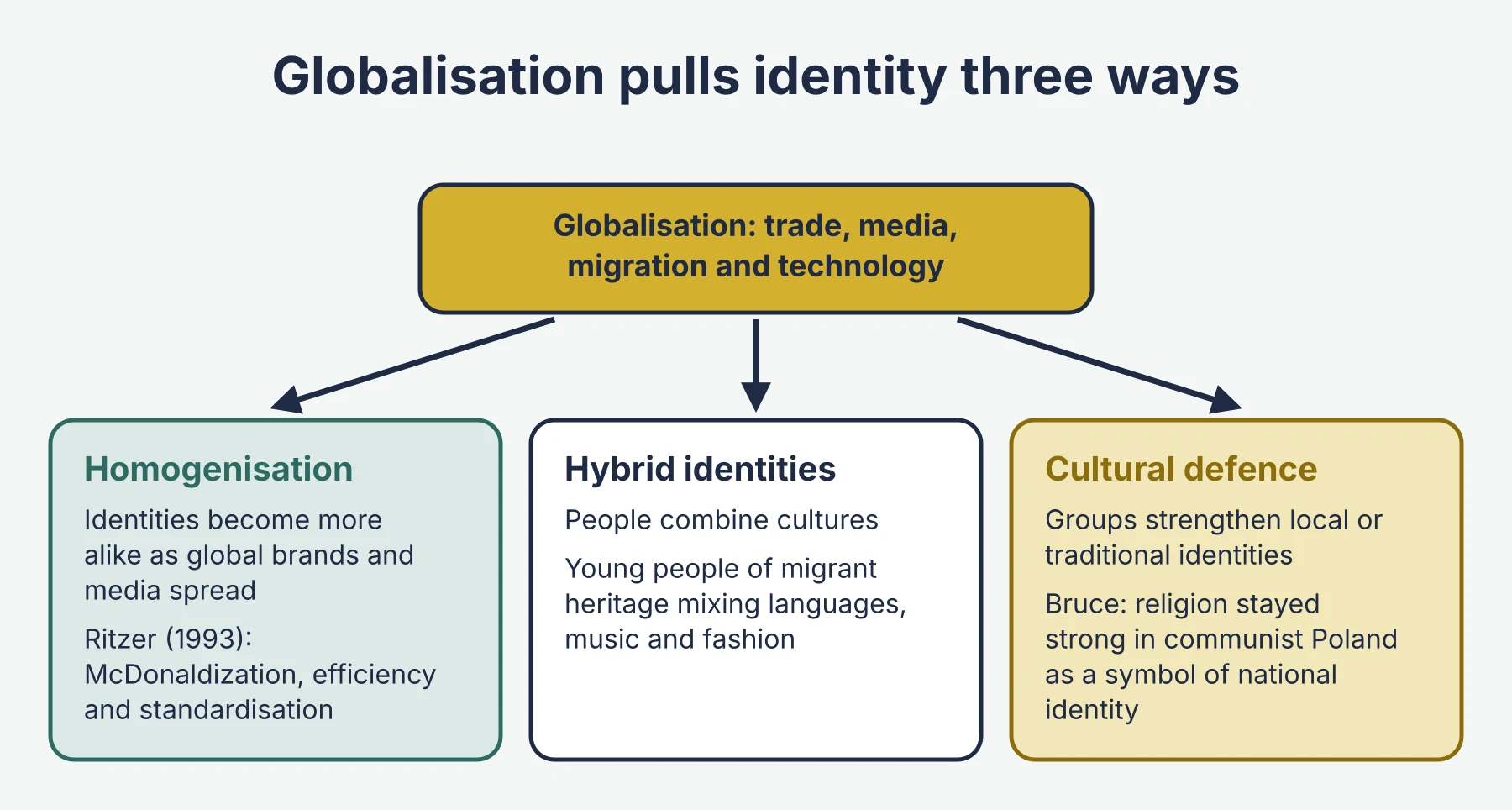
- Homogenisation — global brands and media make identities alike (Ritzer’s McDonaldization, 1993).
- Hybridity — new mixed identities among people of migrant heritage.
- Cultural defence — traditional identities strengthened (Bruce: Catholicism and Polish national identity under communism).
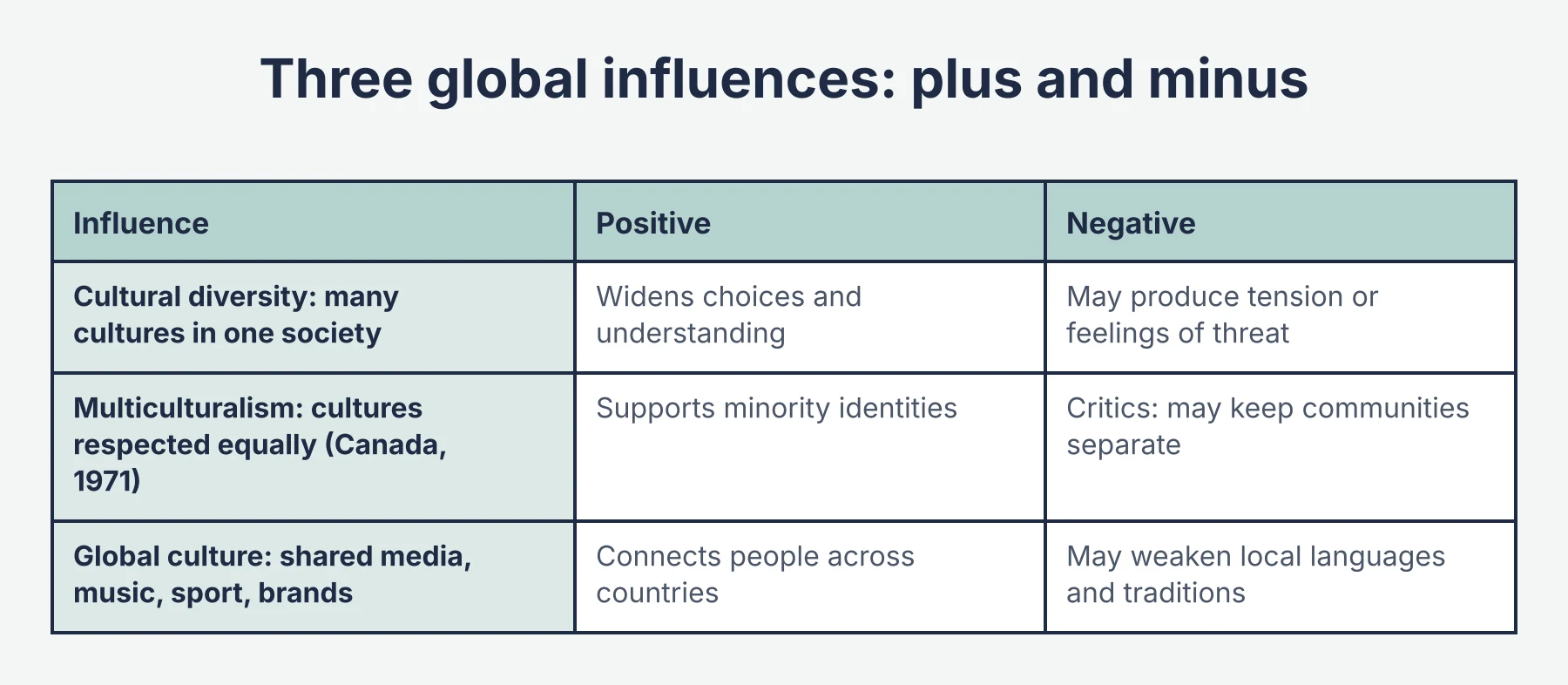
| Positive | Negative | |
|---|---|---|
| Cultural diversity | More choice and understanding | Tension, feelings of threat |
| Multiculturalism | Minority identities respected (Canada’s policy from 1971) | May keep communities separate |
| Global culture | Connects people worldwide | Weakens local languages and traditions |
Postmodernism
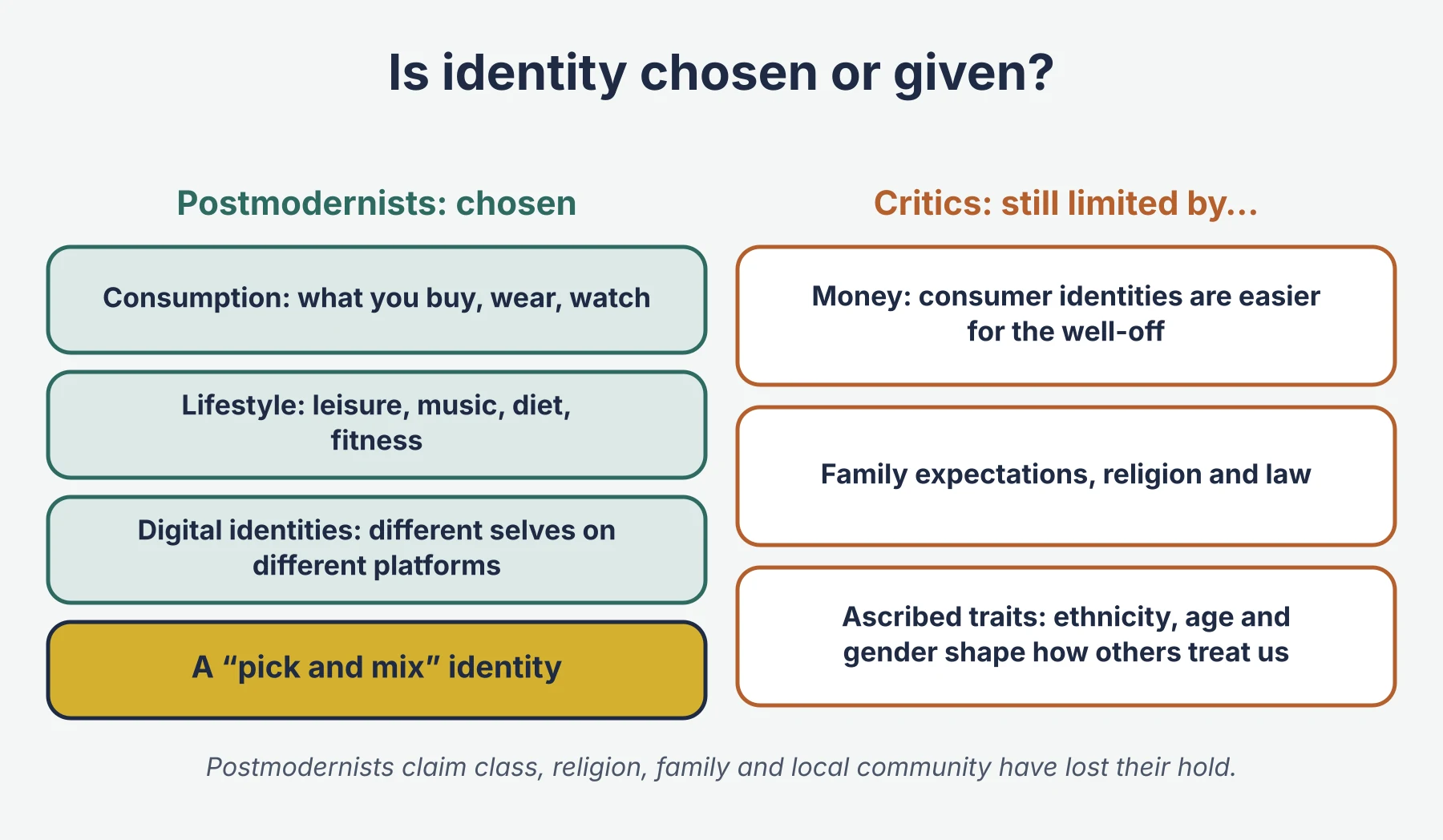
- Traditional sources of identity have weakened.
- Identity is built through consumption, lifestyle and digital identities.
- Criticisms: choice depends on money; ascribed characteristics still matter; family and religion still constrain; cultural defence shows inherited identities persist.
Exam traps
- Homogenisation (becoming alike) is not hybridity (mixing).
- Always give both positive and negative impacts when the syllabus says so.
- Age, gender and ethnicity are not just biology; explain the social meaning.
- “Different societies” in the syllabus invites comparison; use it.
- Postmodernism must be evaluated, not just described.
Worked example: a 6-mark “explain three” answer (practice)
Explain three ways social class may influence a person’s identity.
- Lifestyle and tastes: class shapes leisure, food and dress; Bourdieu linked these tastes to cultural capital, which gives middle-class children confidence in school (2).
- Occupation: work is a major source of identity; manual and professional jobs carry different status and values (2).
- Aspirations: class affects expectations about education and careers, shaping how young people see their future selves (2).
Self-test
- Define social identity.
- What did Ariès argue about childhood?
- What is hegemonic masculinity?
- Why may ethnic identity become stronger among migrants?
- What is cultural capital?
- Give one positive and one negative impact of social media on identity.
- How does Goffman’s idea of impression management apply online?
- What is the difference between homogenisation and hybrid identities?
- Give an example of cultural defence.
- Give one criticism of multiculturalism.
- What do postmodernists mean by a “pick and mix” society?
- Give two criticisms of the postmodern view of identity.
Answers
- The sense of who we are based on the groups we belong to and how others see us.
- That childhood as a separate, protected stage developed gradually; medieval children were treated much like small adults.
- The dominant ideal of manhood in a society, against which other identities are judged.
- As a minority, they may emphasise language, religion and customs to keep belonging, especially if they face discrimination.
- Tastes, knowledge and manners valued by schools, which benefit middle-class children.
- Positive: support networks or contact with family abroad. Negative: cyberbullying or pressure to look perfect.
- People choose photos, edit posts and present a managed image to their audience.
- Homogenisation means identities becoming alike; hybrid identities mix different cultures.
- Catholicism as a symbol of Polish national identity under communism (Bruce).
- It may keep communities separate rather than building shared identity.
- People choose identities from many options, especially through consumption and lifestyle.
- Choice depends on money; ascribed characteristics and family or religious expectations still shape identity.
Frequently asked questions
Is globalisation good or bad for identity? Both. Strong answers show that it can homogenise, create hybrids and provoke cultural defence at the same time.
Which aspect of identity matters most? It depends on the society and the person; argue this using comparisons.
Related pages: key question 2.3 practice questions | key question 2.2 revision notes
Related resources
-
Practice questions
Cambridge O Level Sociology (2251): Social stratification and inequality – What is social stratification? – Practice Questions
Original Cambridge O Level Sociology 2251 practice on key question 3.1: caste, mobility, meritocracy, life chances, ethnicity and labelling, with answers.
Sociology · Cambridge · O Level
Try questions -
Revision notes
Cambridge O Level Sociology (2251): Social stratification and inequality – What is social stratification? – Revision Notes
Revision notes for Cambridge O Level Sociology 2251 key question 3.1: open and closed societies, caste, mobility, life chances, labelling and Marxism.
Sociology · Cambridge · O Level
Revise topic -
Study guides
Cambridge O Level Sociology (2251): Social stratification and inequality – What attempts have been made to reduce social inequalities?
Cambridge O Level Sociology 2251 key question 3.2 in depth: tax, benefits, equality laws, welfare states, NGOs and New Right, Marxist and feminist views.
Sociology · Cambridge · O Level
Read guide
Related articles
Get free revision emails (optional)
Occasional emails with practice questions, worked explanations and links to free resources for the qualification and subjects you choose. No spam, and you can unsubscribe from any email. The free tools on this site never need an email.