
Study Guides
Cambridge O Level Sociology (2251): Social stratification and inequality – What attempts have been made to reduce social inequalities?
Cambridge O Level Sociology 2251 key question 3.2 in depth: tax, benefits, equality laws, welfare states, NGOs and New Right, Marxist and feminist views.
- Subject
- Sociology
- Level
- O LEVELS
- Topic
- Paper 1 – Research Methods, Identity and Inequality
- Author
- Marlbridge Academic Team
- Updated
- Reviewed by
- Naqiya Yousaf (what this means)
Aligned to Cambridge O Level Sociology (2251), 2025-2027. Official specification .
Syllabus page (what it covers and how it is assessed): Cambridge O Level Sociology.
Syllabus points this page covers
2251
- 3.2 Social stratification and inequality – What attempts have been made to reduce social inequalities?
Found an error? Report a correction.
Need help with this topic? Request a free trial class for O Level Sociology (2251).
Key question 3.2 of Cambridge O Level Sociology (2251) asks What attempts have been made to reduce social inequalities? The syllabus names three kinds of attempt (legislation, welfare states and the work of non-governmental organisations) and then asks how successful sociologists think they have been. Description earns only part of the credit: Paper 1 Question 3 rewards answers that explain how a measure is supposed to improve life chances and then weigh the criticisms from the New Right, Marxists, feminists and critics of NGOs.
The O Level guide to tackling inequality and globalisation gives an overview of 3.2 and 3.3 together. This guide explains the mechanisms in more detail, with a wider range of examples.
What the syllabus covers
- 3.2.1 Legislation, for example progressive taxation, redistribution of wealth through benefits, a minimum wage, equal opportunities laws and other government measures.
- 3.2.2 Welfare states and their impact on life chances: free and/or universal education, unemployment benefits, pensions, low-cost housing, free healthcare, universal basic income.
- 3.2.3 The global work of NGOs: reducing poverty, providing medical assistance, promoting business, improving education.
- 3.2.4 Sociological views of success: New Right criticisms of the welfare state and the underclass; the culture of poverty and the dependency culture; Marxist criticisms of the welfare state; criticisms of NGOs; feminist criticisms of equality legislation.
Legislation: how each measure is meant to work
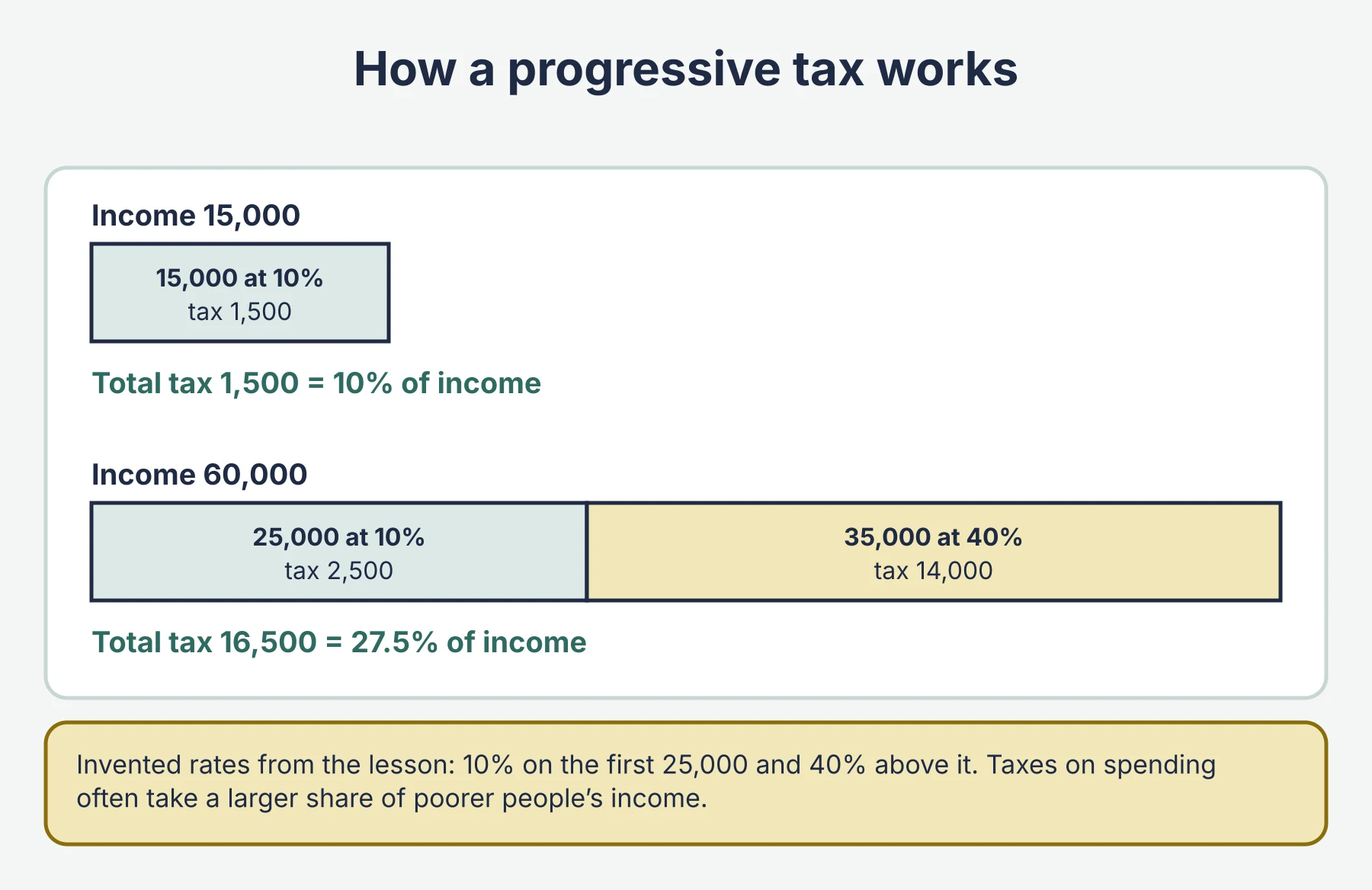
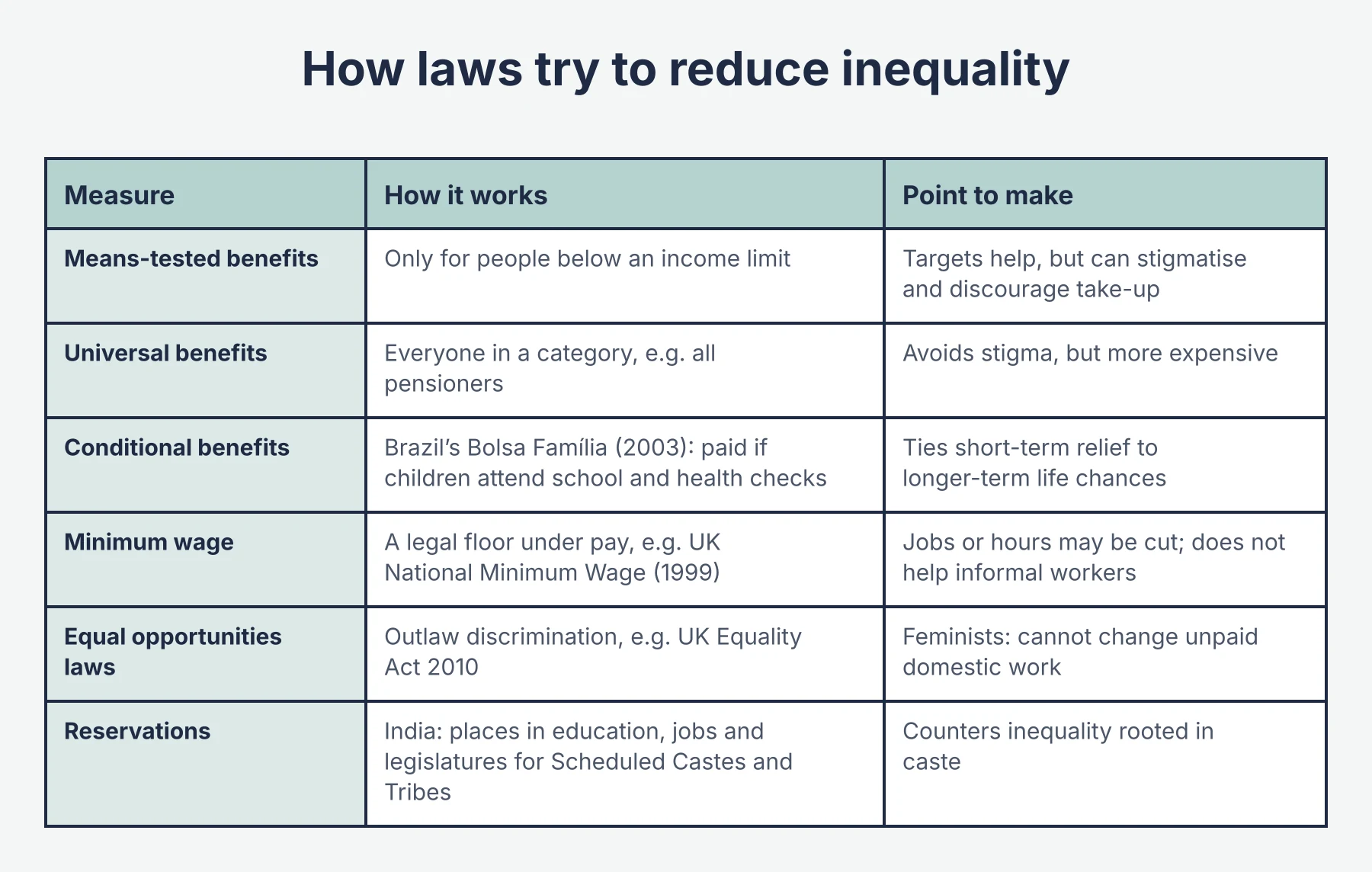
Progressive taxation takes a higher percentage of higher incomes. An invented illustration: suppose the first 25,000 of income is taxed at 10% and everything above it at 40%. Someone earning 15,000 pays 1,500, which is 10% of their income. Someone earning 60,000 pays 2,500 on the first 25,000 and 14,000 on the remaining 35,000, a total of 16,500, which is 27.5% of their income. The revenue can fund services used by everyone, so the gap in living standards narrows. Taxes on spending, by contrast, often take a larger share of poorer people’s income, because they spend more of what they earn.
Redistribution through benefits transfers resources to those in need. Means-tested benefits go only to people below an income limit, which targets help but can stigmatise claimants and discourage take-up. Universal benefits go to everyone in a category, such as all pensioners, which avoids stigma but is more expensive. Some schemes are conditional: under Brazil’s Bolsa Família, begun in 2003, low-income families received payments only if their children went to school and kept up health check-ups, tying short-term relief to longer-term life chances.
A minimum wage sets a legal floor under pay, such as the National Minimum Wage introduced in the United Kingdom in 1999. It raises the incomes of the lowest paid, many of whom are women, young people and migrants. Critics argue employers may cut jobs or hours, and it does not help the large number of people in informal work in many countries.
Equal opportunities laws outlaw discrimination. Britain’s Equality Act 2010 brought earlier laws together and protects characteristics including age, disability, race, religion or belief and sex.
Other government measures include reserved places or quotas for disadvantaged groups. India’s constitution provides for reservations in education, government jobs and legislatures for Scheduled Castes and Scheduled Tribes, an attempt to counter inequality rooted in caste.
Welfare states and life chances
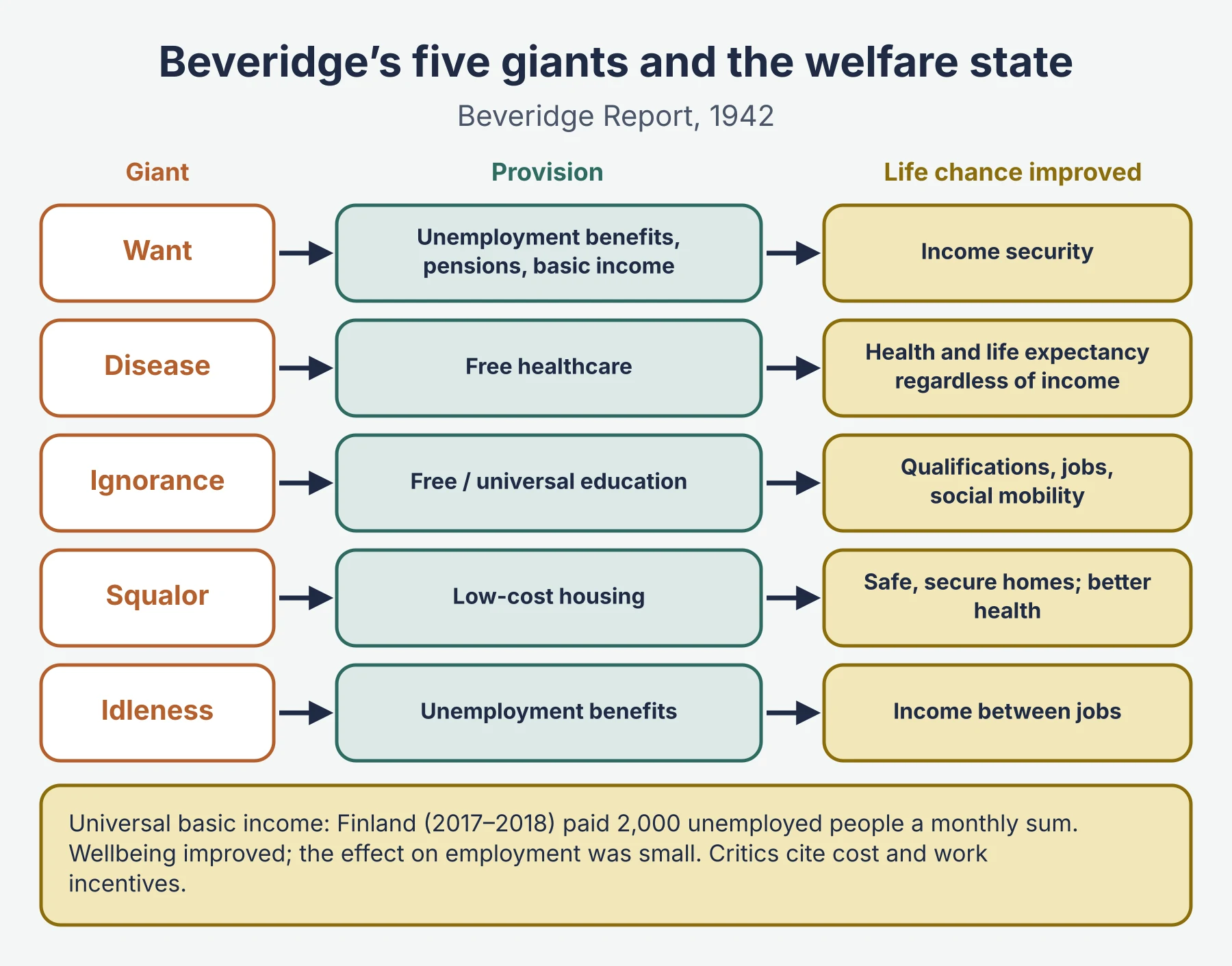
A welfare state is a system in which the government takes responsibility for citizens’ basic welfare. In Britain the Beveridge Report (1942) identified “five giants” to be defeated: Want, Disease, Ignorance, Squalor and Idleness. Each provision named in the syllabus targets one or more of these.
| Provision | Giant tackled | Life chance improved |
|---|---|---|
| Free/universal education | Ignorance | Qualifications, employment, social mobility |
| Unemployment benefits | Want, Idleness | Income security between jobs |
| Pensions | Want | Income and health in old age |
| Low-cost housing | Squalor | Safe, secure homes; better health |
| Free healthcare | Disease | Health and life expectancy regardless of income |
| Universal basic income | Want | A guaranteed floor of income for all |
Universal basic income (UBI) is an unconditional regular payment to every individual, whether or not they work. It is mostly trialled rather than fully adopted. Finland’s experiment in 2017–2018 paid 2,000 unemployed people a monthly sum without conditions; participants reported better wellbeing, while the effect on employment was small. Supporters say UBI removes stigma and the poverty trap; critics point to its cost and argue it may reduce the incentive to work.
NGOs: four kinds of work
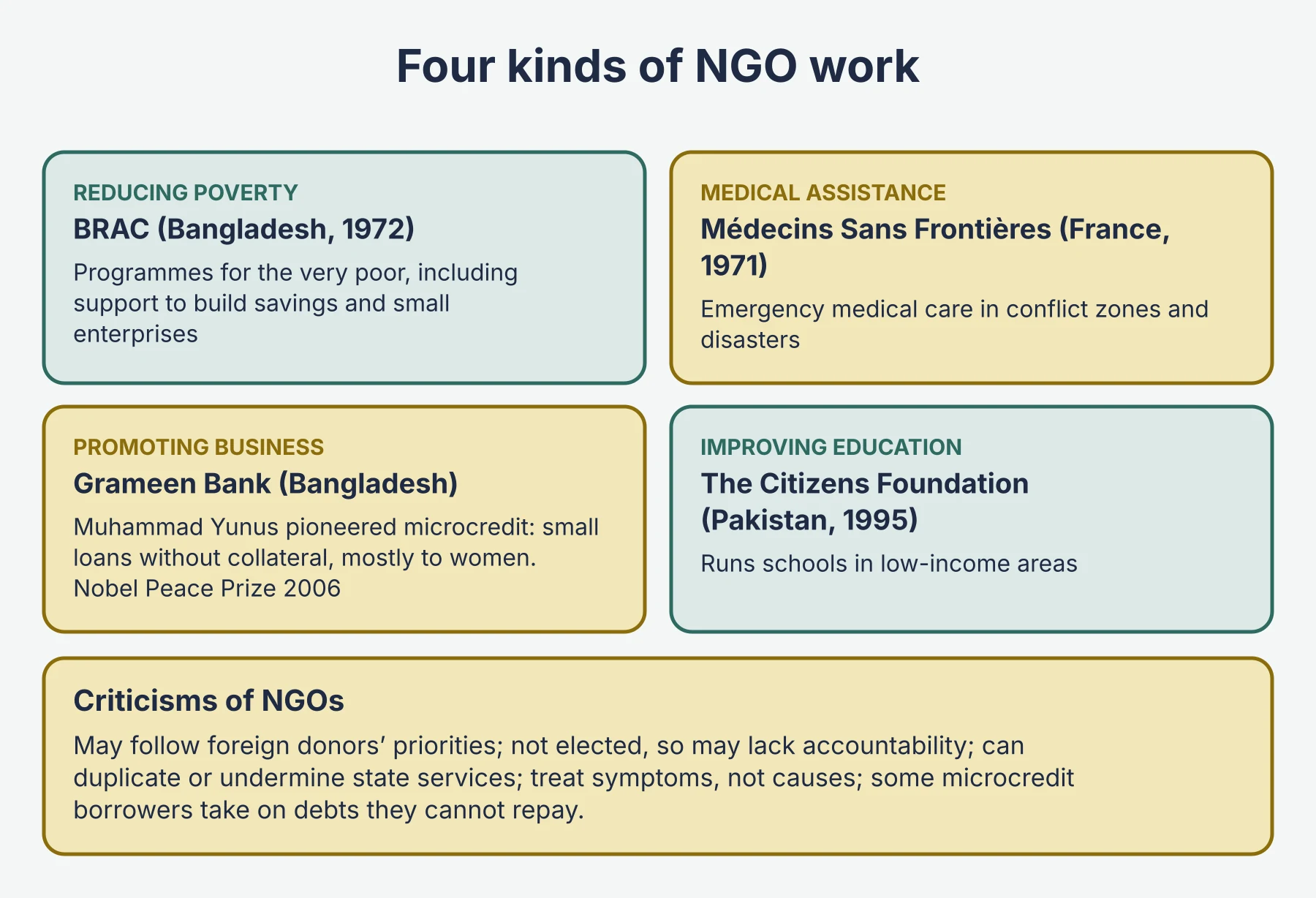
Non-governmental organisations are independent, non-profit bodies, from small local charities to large international organisations.
- Reducing poverty: BRAC, founded in Bangladesh in 1972, runs programmes for the very poor, including support for families to build savings and small enterprises.
- Providing medical assistance: Médecins Sans Frontières, founded in France in 1971, provides emergency medical care in conflict zones and disasters.
- Promoting business: the Grameen Bank, founded by Muhammad Yunus in Bangladesh, pioneered microcredit, small loans to poor people (mostly women) without collateral; Yunus and the bank shared the Nobel Peace Prize in 2006.
- Improving education: The Citizens Foundation in Pakistan, founded in 1995, runs schools in low-income areas.
How successful have these attempts been?
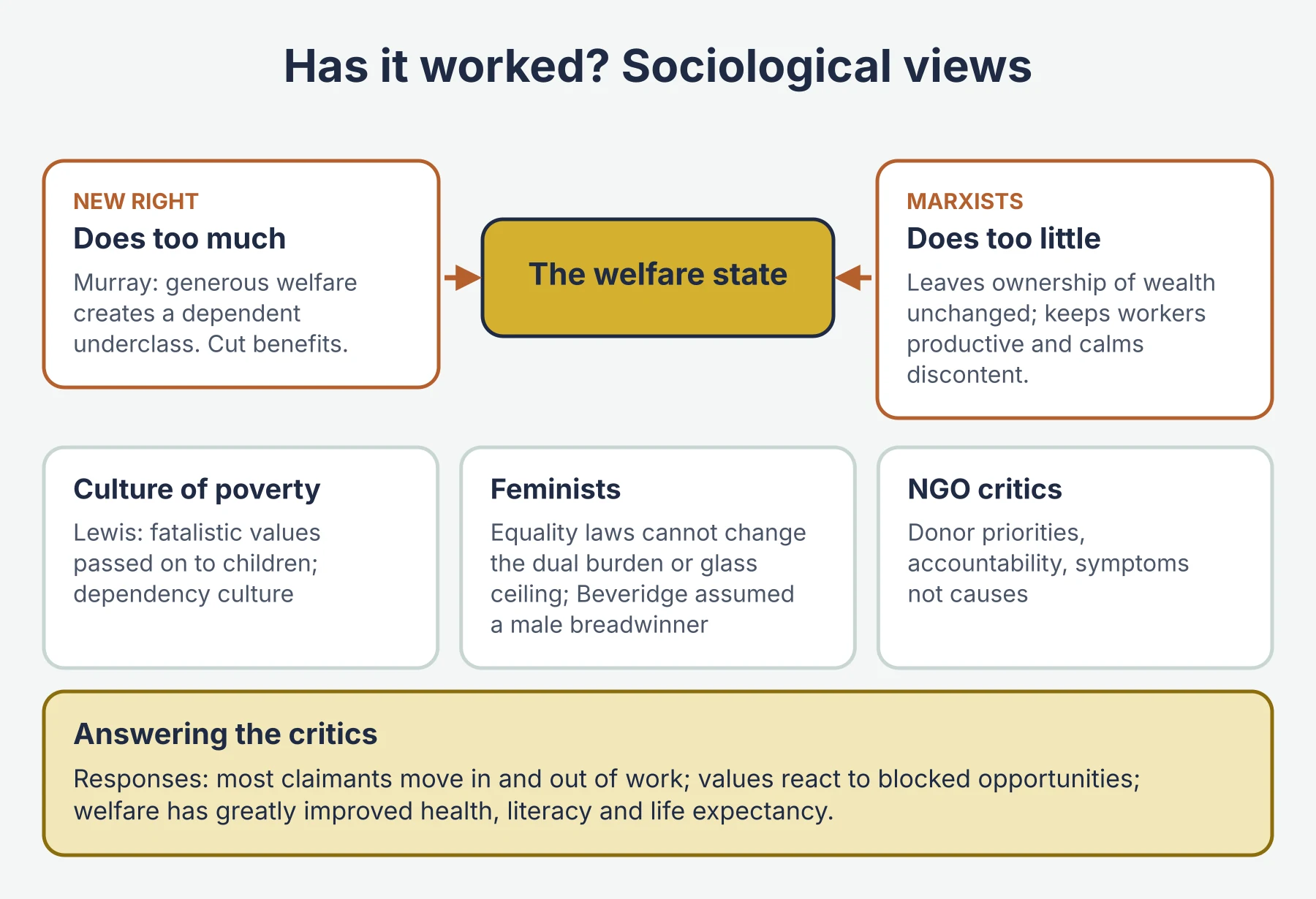
New Right. Charles Murray argued that generous welfare creates an underclass of people who depend on benefits, with weak family ties and little attachment to work. The solution is to cut benefits and encourage self-reliance. Response: most benefit claimants move in and out of work, and poverty is often caused by low pay, illness or unemployment rather than attitudes.
Culture of poverty and dependency culture. Oscar Lewis argued that people in long-term poverty develop fatalistic values that they pass on to their children, keeping them poor. The related idea of a dependency culture claims that welfare discourages people from helping themselves. Response: critics argue values are a reasonable reaction to blocked opportunities, so changing opportunities changes behaviour.
Marxists. The welfare state does not challenge the ownership of wealth. It keeps workers healthy and educated enough to be productive, and calms discontent that might lead to revolution. Benefits are set low, and the wealthy can avoid taxes, so inequality persists. Response: welfare has substantially improved health, literacy and life expectancy for working-class people.
Critics of NGOs. NGOs may depend on foreign donors and follow their priorities; they are not elected and may lack accountability to the people they serve; they can duplicate or undermine state services; and they treat symptoms rather than structural causes. Microcredit has also been criticised when borrowers take on debts they cannot repay.
Feminists. Equality laws have opened education and work to women, but they cannot change unpaid domestic labour, the “dual burden” of paid and unpaid work, or the glass ceiling. Feminists also argued that the Beveridge model assumed a male breadwinner and a dependent wife, building gender inequality into the welfare state.
Worked example: an annotated “explain three” answer (practice)
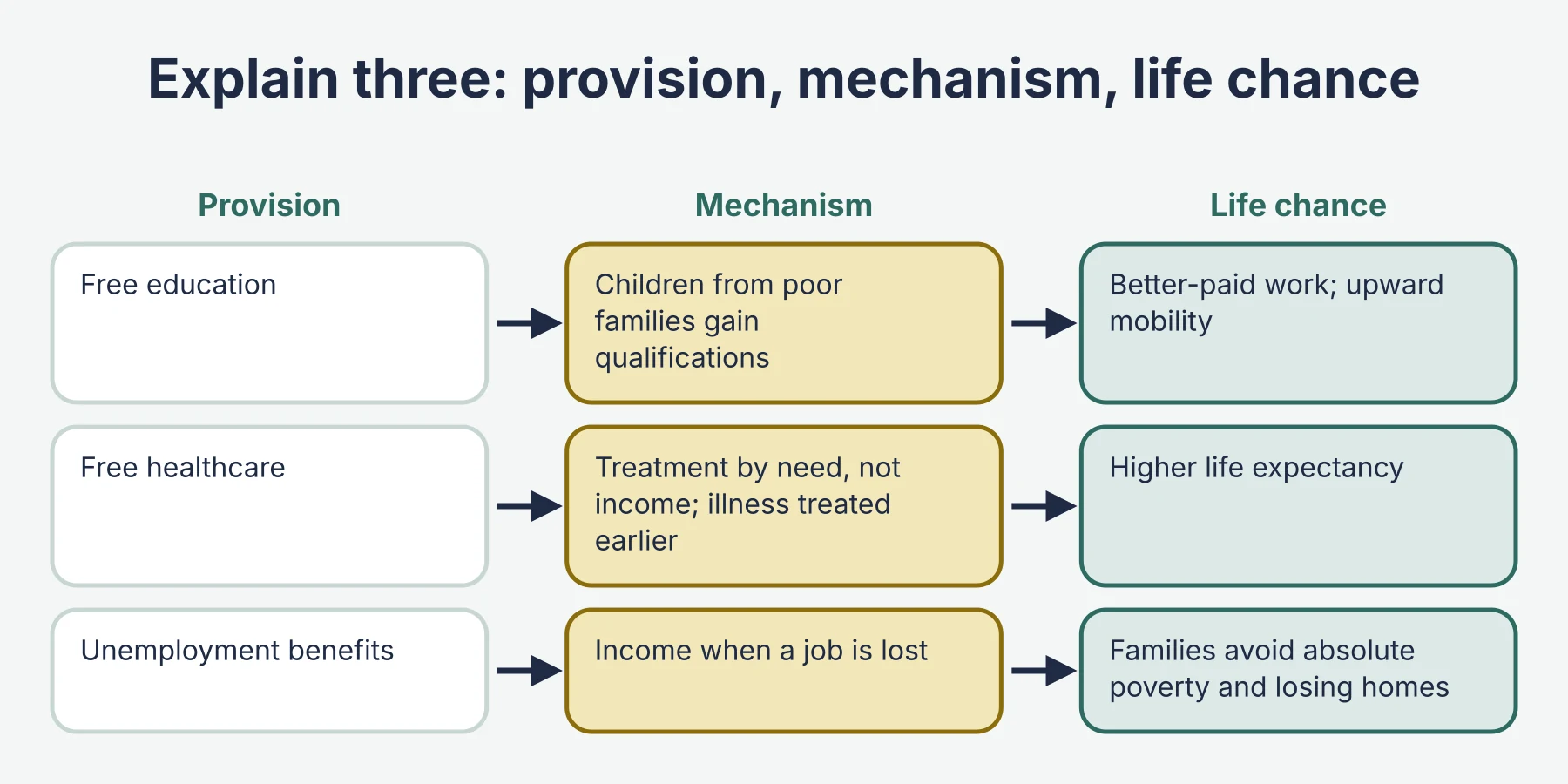
Explain three ways a welfare state may improve life chances.
First, free education allows children from poor families to gain qualifications, which opens routes to better-paid work and upward social mobility. Second, free healthcare means people receive treatment according to need rather than income, so illnesses are treated earlier and life expectancy rises. Third, unemployment benefits provide an income when people lose their jobs, which prevents families falling into absolute poverty and losing their homes.
Why it works: each point names a provision, explains the mechanism and links it to a specific life chance.
Common mistakes
- Listing measures without explaining the mechanism by which they reduce inequality.
- Confusing the New Right (welfare does too much) with Marxists (welfare does too little).
- Describing NGOs as part of the government.
- Ignoring 3.2.4 entirely: questions on success need criticisms.
- Assuming a law works because it exists; judge its effects.
Exam technique
- Explain (parts c and d): measure, mechanism, life chance.
- Discuss (part e): one view in depth, such as the New Right, with a response.
- Evaluate (part f): set the achievements of welfare or NGOs against the criticisms and conclude.
Keep revising
Condense this page with the key question 3.2 revision notes, then try the key question 3.2 practice questions. Inequality between societies follows in the guide to key question 3.3.
Related resources
-
Practice questions
Cambridge O Level Sociology (2251): Social stratification and inequality – What attempts have been made to reduce social inequalities? – Practice Questions
Original Cambridge O Level Sociology 2251 practice on key question 3.2: equality laws, basic income, pensions, NGOs and feminist critiques, with answers.
Sociology · Cambridge · O Level
Try questions -
Revision notes
Cambridge O Level Sociology (2251): Social stratification and inequality – What attempts have been made to reduce social inequalities? – Revision Notes
Revision notes for Cambridge O Level Sociology 2251 key question 3.2: tax, benefits, equality laws, welfare states, NGOs and critiques of their success.
Sociology · Cambridge · O Level
Revise topic -
Study guides
Cambridge O Level Sociology (2251): Social stratification and inequality – How has globalisation affected inequalities between societies?
Cambridge O Level Sociology 2251 key question 3.3 in depth: migration, transnational companies, climate, urbanisation and theories of global inequality.
Sociology · Cambridge · O Level
Read guide
Related articles
Get free revision emails (optional)
Occasional emails with practice questions, worked explanations and links to free resources for the qualification and subjects you choose. No spam, and you can unsubscribe from any email. The free tools on this site never need an email.