
Revision Notes
Cambridge O Level Sociology (2251): Social stratification and inequality – What attempts have been made to reduce social inequalities? – Revision Notes
Revision notes for Cambridge O Level Sociology 2251 key question 3.2: tax, benefits, equality laws, welfare states, NGOs and critiques of their success.
- Subject
- Sociology
- Level
- O LEVELS
- Topic
- Paper 1 – Research Methods, Identity and Inequality
- Author
- Marlbridge Academic Team
- Updated
- Reviewed by
- Naqiya Yousaf (what this means)
Aligned to Cambridge O Level Sociology (2251), 2025-2027. Official specification .
Syllabus page (what it covers and how it is assessed): Cambridge O Level Sociology.
Syllabus points this page covers
2251
- 3.2 Social stratification and inequality – What attempts have been made to reduce social inequalities?
Found an error? Report a correction.
Need help with this topic? Request a free trial class for O Level Sociology (2251).
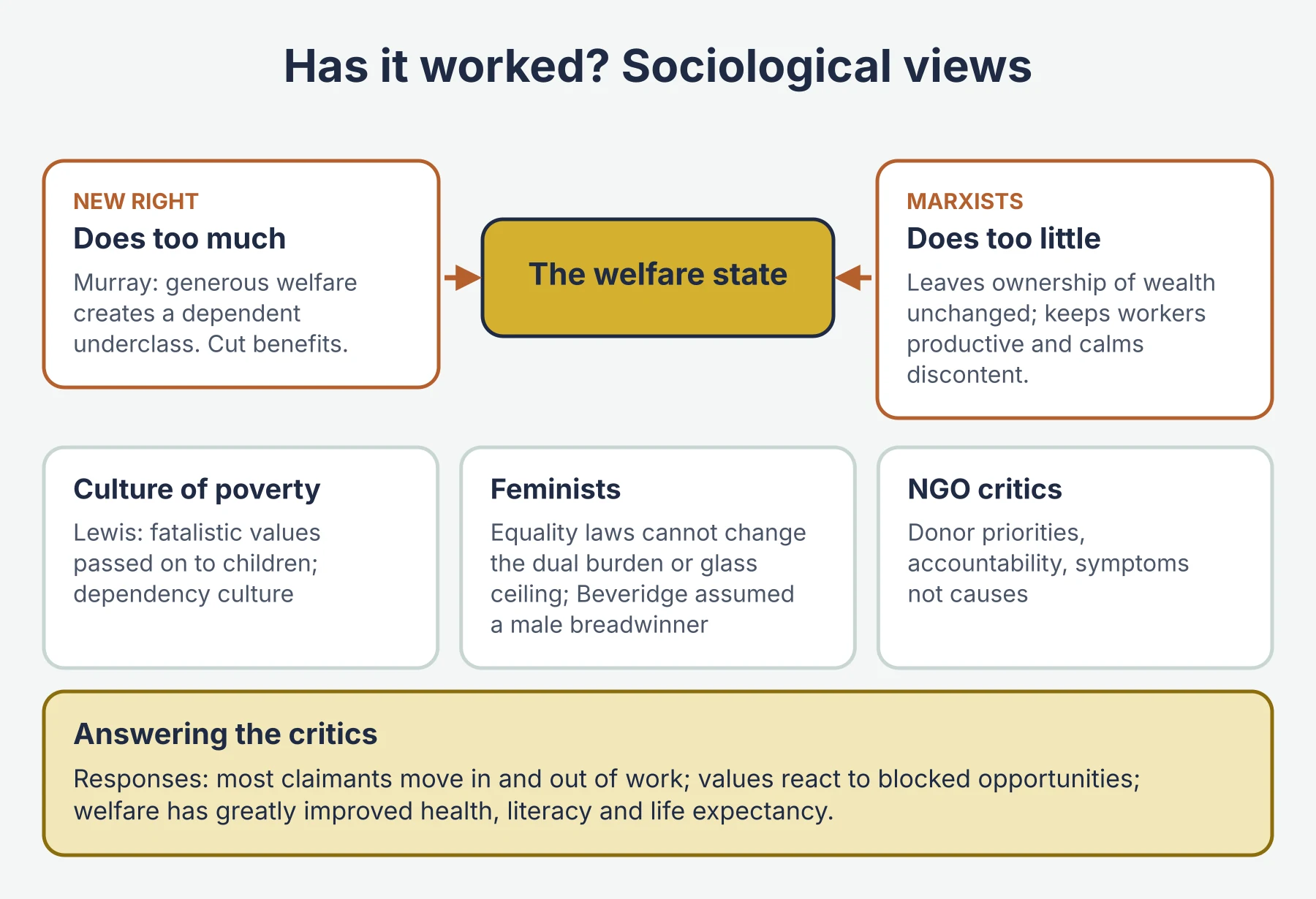
These notes condense key question 3.2 of Cambridge O Level Sociology (2251), What attempts have been made to reduce social inequalities? States act through laws and welfare provision, while NGOs tackle poverty, ill health, lack of enterprise and lack of schooling. Views of their success divide sharply: the New Right says welfare creates dependency, Marxists say it protects capitalism, feminists say equality laws leave patriarchy intact, and critics question whose interests NGOs serve.
Fuller explanations: key question 3.2 study guide.
Syllabus coverage
2251 syllabus 2025–2027, 3.2: 3.2.1 legislation; 3.2.2 welfare states and life chances; 3.2.3 NGOs; 3.2.4 sociological views of success.
Key terms
| Term | Definition |
|---|---|
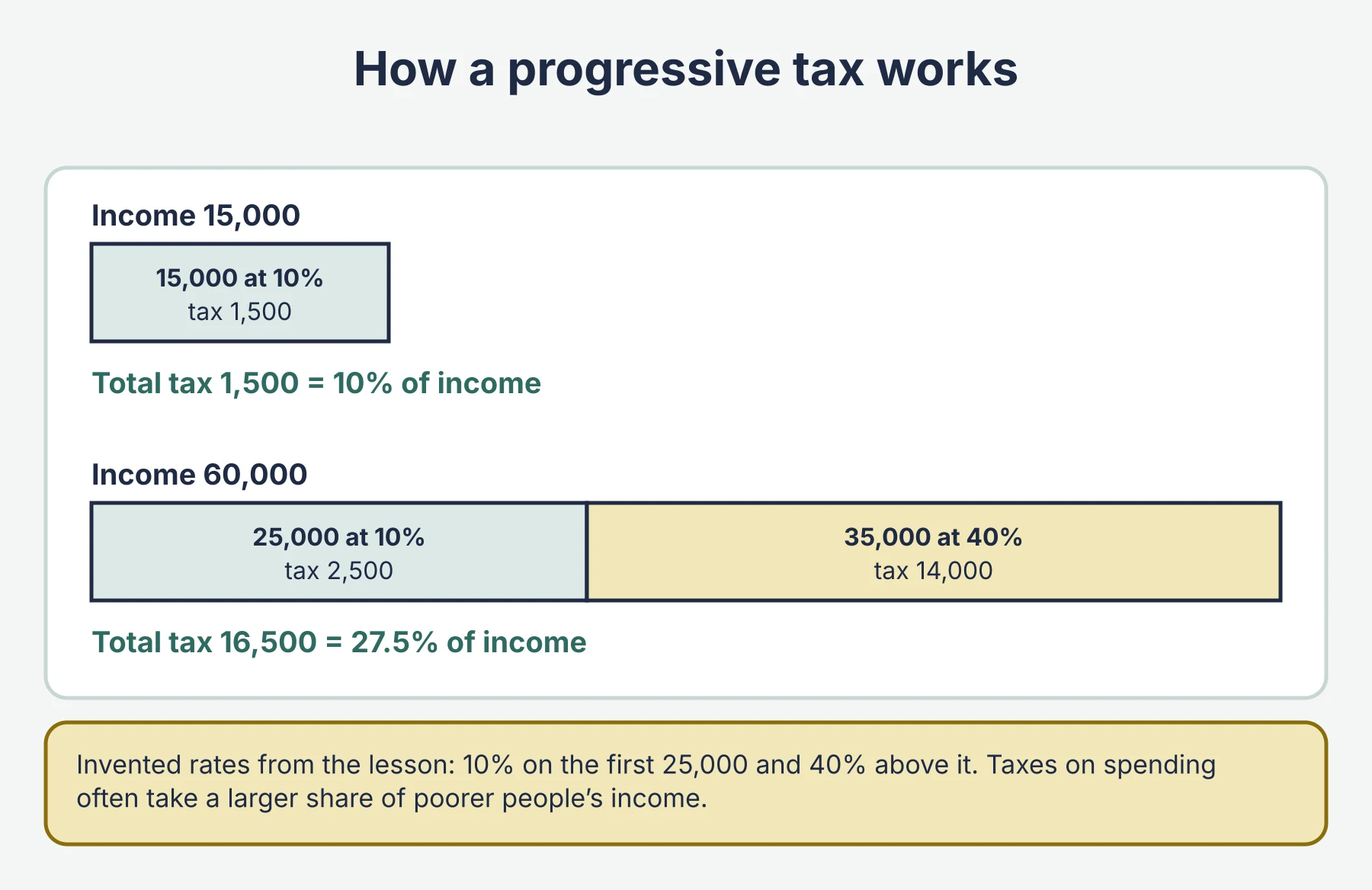
| Progressive taxation | Tax that takes a higher percentage of higher incomes |
| Redistribution | Transferring resources from richer to poorer groups |
| Means-tested benefit | Paid only to those below an income or savings limit |
| Universal benefit | Paid to everyone in a category regardless of income |
| Conditional cash transfer | Payment made on conditions such as school attendance |
| Minimum wage | Legal lowest rate of pay |
| Equal opportunities law | Law outlawing discrimination |
| Reservations / quotas | Places set aside for disadvantaged groups |
| Welfare state | Government responsibility for citizens’ basic welfare |
| Universal basic income | Unconditional regular payment to every individual |
| NGO | Independent, non-profit organisation |
| Microcredit | Small loans to poor people without collateral |
| Underclass | Group said to be detached from work and dependent on welfare |
| Dependency culture | Belief that welfare discourages self-reliance |
| Dual burden | Women’s combined load of paid and unpaid work |
3.2.1 Legislation
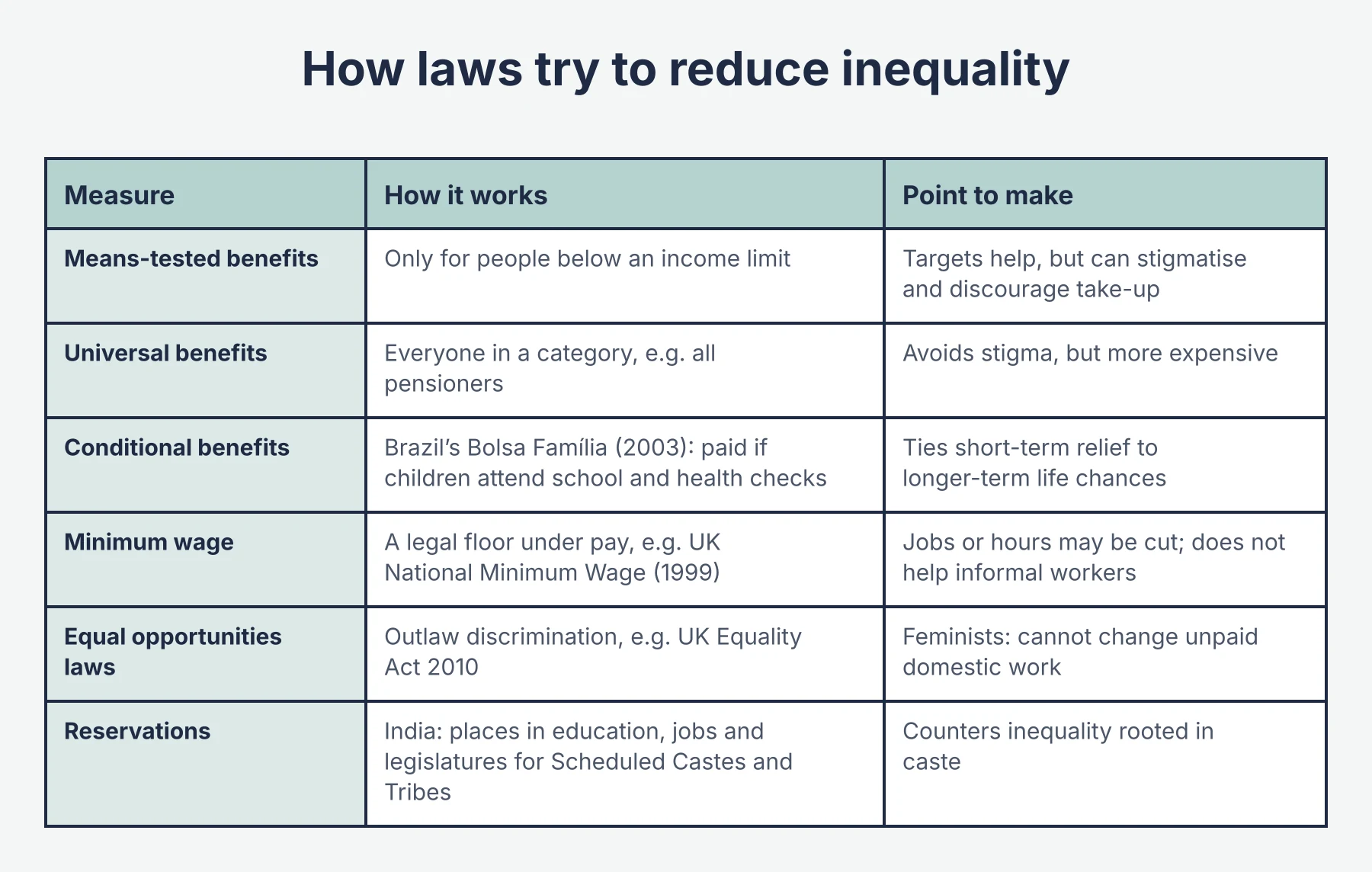
| Measure | Mechanism | Example | Weakness |
|---|---|---|---|
| Progressive tax | Takes more from those with more | Tax bands with higher rates | Avoidance by the wealthy |
| Benefits | Transfer to those in need | Bolsa Família, Brazil (2003), conditional on schooling and health checks | Stigma; low take-up of means-tested help |
| Minimum wage | Raises lowest pay | UK National Minimum Wage (1999) | Misses informal workers |
| Equality laws | Outlaw discrimination | UK Equality Act 2010 | Hard to enforce; attitudes persist |
| Other measures | Quotas and reservations | India: reservations for Scheduled Castes and Tribes | Accused of benefiting better-off members most |
3.2.2 Welfare states
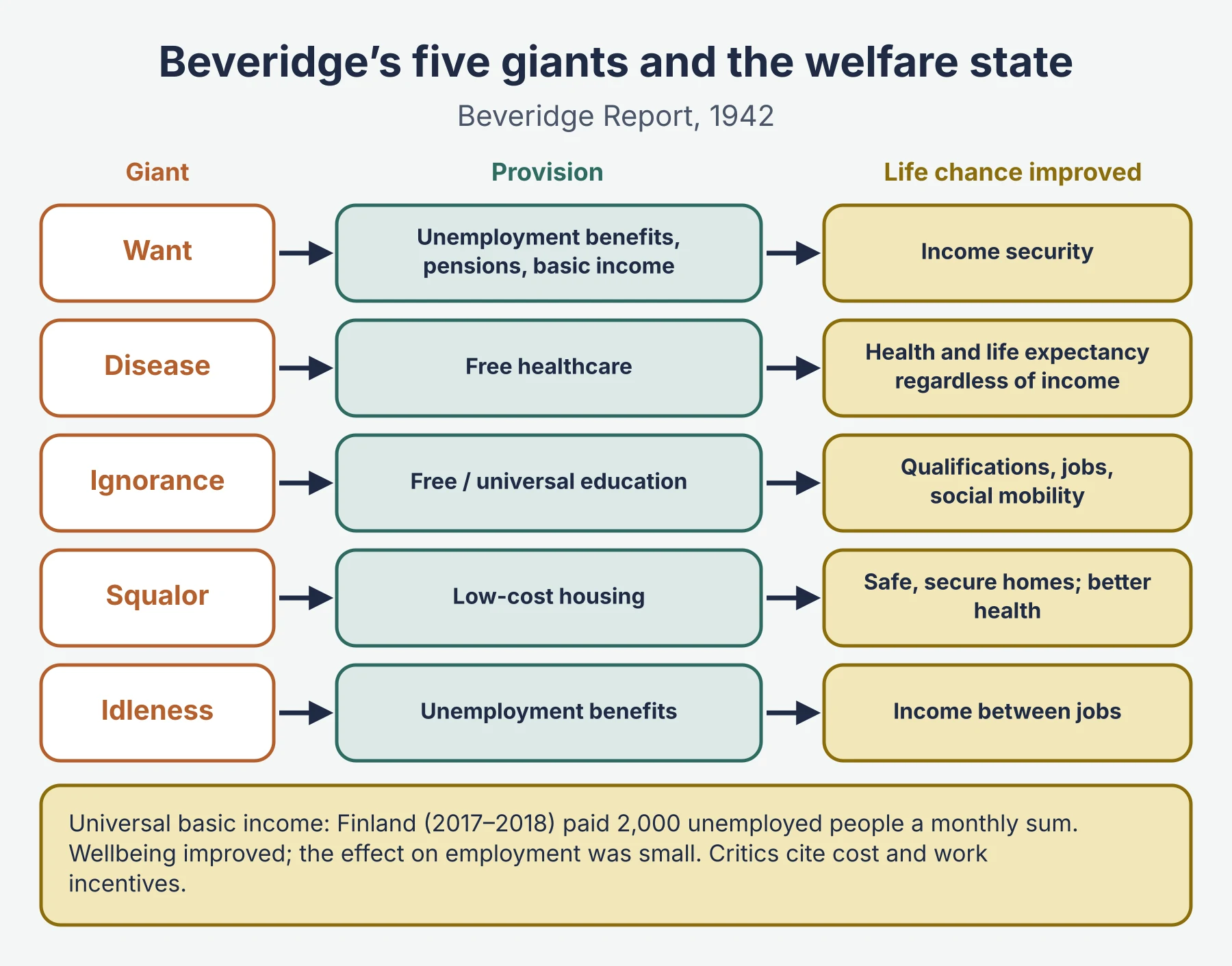
- Beveridge Report (1942): five giants — Want, Disease, Ignorance, Squalor, Idleness.
- Education tackles ignorance; healthcare tackles disease; housing tackles squalor; benefits and pensions tackle want; employment policy tackles idleness.
- UBI: Finland’s 2017–2018 trial paid 2,000 unemployed people unconditionally; wellbeing improved, employment effect small. Mostly trialled, not adopted.
3.2.3 NGOs
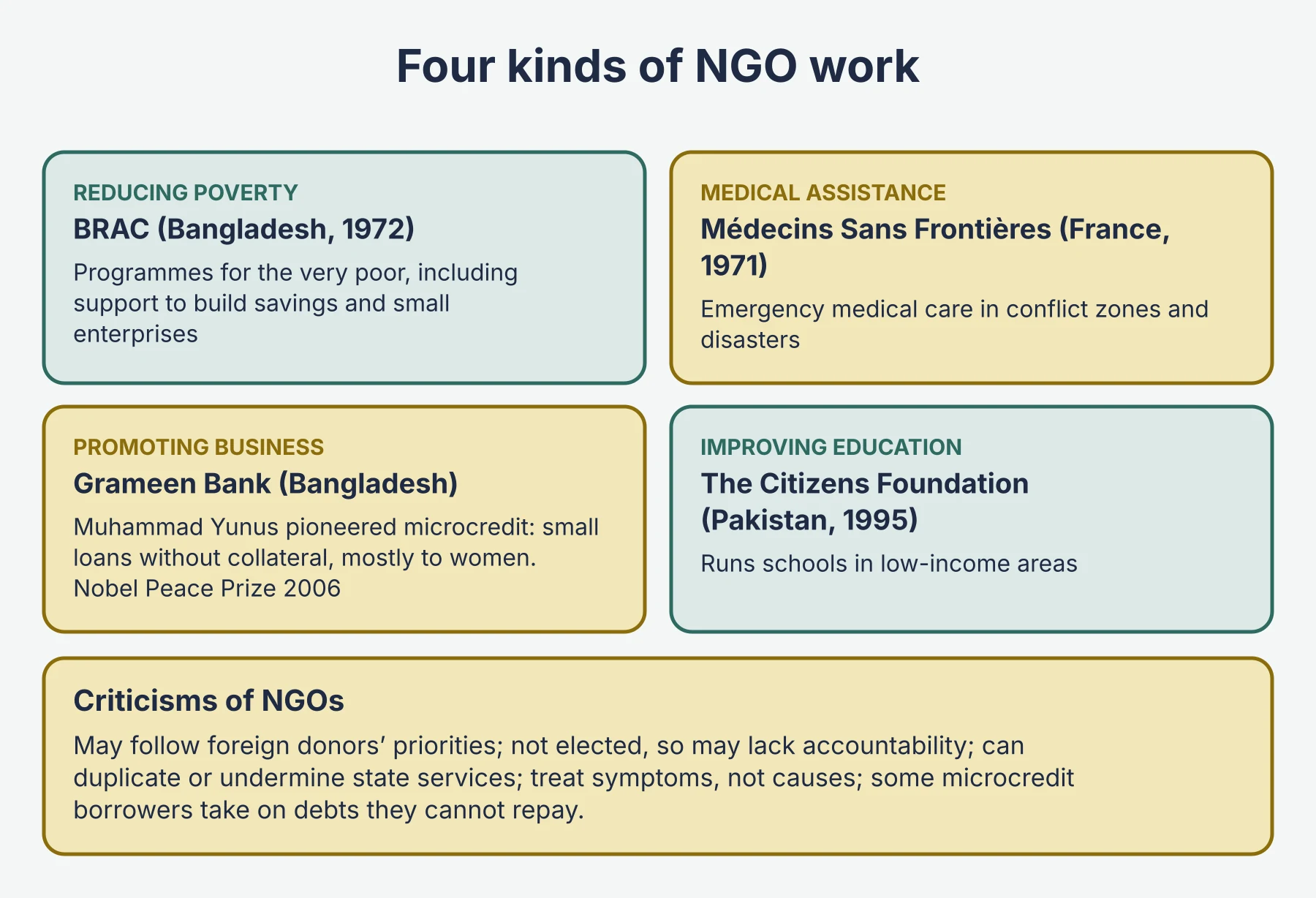
| Aim | Example |
|---|---|
| Reducing poverty | BRAC (Bangladesh, 1972) |
| Medical assistance | Médecins Sans Frontières (France, 1971) |
| Promoting business | Grameen Bank’s microcredit (Muhammad Yunus; Nobel Peace Prize 2006) |
| Improving education | The Citizens Foundation (Pakistan, 1995) |
3.2.4 Views of success
| View | Argument | Response |
|---|---|---|
| New Right | Welfare creates an underclass and dependency (Murray) | Poverty has structural causes; most claimants want work |
| Culture of poverty | Fatalistic values passed on (Lewis) | Values follow from blocked opportunities |
| Marxist | Welfare keeps workers productive and calms unrest; wealth untouched | Welfare has raised health and literacy |
| NGO critics | Donor-led, unaccountable, small-scale, treat symptoms; microcredit debt | Reach groups states neglect |
| Feminist | Laws ignore unpaid work, dual burden, glass ceiling; welfare built on male breadwinner model | Laws have widened women’s education and work |
Exam traps
- New Right says welfare does too much; Marxists say it does too little to change inequality.
- Progressive tax is about the percentage taken, not just the amount.
- NGOs are not government bodies.
- “Success” questions require criticisms, not just descriptions.
- Link every measure to a life chance.
Worked example: a 14-mark plan (practice)
Evaluate the view that NGOs are effective in reducing inequalities.
- For: reach remote and neglected groups; specialist expertise in health (MSF) and education (The Citizens Foundation); microcredit has helped some women start businesses (Grameen); flexible and quick in emergencies.
- Against: small scale compared with states; depend on donors and follow their priorities; not elected or accountable; may weaken state services; microcredit can trap borrowers in debt; treat symptoms not structural causes (Marxist view).
- Conclusion: effective for particular groups and emergencies, but cannot replace state action on the causes of inequality.
Self-test
- What makes a tax progressive?
- Give one advantage of universal benefits over means-tested ones.
- What were the conditions attached to Bolsa Família?
- Give one criticism of a minimum wage.
- Name Beveridge’s five giants.
- What is universal basic income?
- Give one finding of Finland’s UBI trial.
- Name an NGO that provides medical assistance.
- What is microcredit, and one criticism of it?
- What is the New Right view of the welfare state?
- How do Marxists criticise the welfare state?
- Give two feminist criticisms of equality legislation.
Answers
- It takes a higher percentage of higher incomes.
- No stigma, and higher take-up, because everyone in the category receives it.
- Children’s school attendance and health check-ups.
- It may lead employers to cut jobs or hours, and it does not reach informal workers.
- Want, Disease, Ignorance, Squalor, Idleness.
- An unconditional regular payment to every individual.
- Wellbeing improved; the effect on employment was small.
- Médecins Sans Frontières.
- Small loans to poor people without collateral; borrowers may take on debts they cannot repay.
- It is too generous and creates an underclass dependent on benefits.
- It leaves the ownership of wealth unchanged, keeps workers fit for work and calms unrest.
- It does not change unpaid domestic work or the dual burden; the glass ceiling remains.
Frequently asked questions
Can I use examples from my own country? Yes. National cash-transfer schemes, minimum wage laws or local NGOs are all relevant if you can explain them accurately.
How do I show balance in a “success” question? Pair each criticism with a response, then judge which side is stronger for the measure in the question.
Related pages: key question 3.2 practice questions | key question 3.3 revision notes
Related resources
-
Study guides
Cambridge O Level Sociology (2251): Social stratification and inequality – How has globalisation affected inequalities between societies?
Cambridge O Level Sociology 2251 key question 3.3 in depth: migration, transnational companies, climate, urbanisation and theories of global inequality.
Sociology · Cambridge · O Level
Read guide -
Practice questions
Cambridge O Level Sociology (2251): Social stratification and inequality – How has globalisation affected inequalities between societies? – Practice Questions
Original Cambridge O Level Sociology 2251 practice on key question 3.3: migration, remittances, TNCs, climate and theories of global inequality, with answers.
Sociology · Cambridge · O Level
Try questions -
Revision notes
Cambridge O Level Sociology (2251): Social stratification and inequality – How has globalisation affected inequalities between societies? – Revision Notes
Revision notes for Cambridge O Level Sociology 2251 key question 3.3: push and pull, remittances, TNCs, climate, pollution, urbanisation and global inequality.
Sociology · Cambridge · O Level
Revise topic
Related articles
Get free revision emails (optional)
Occasional emails with practice questions, worked explanations and links to free resources for the qualification and subjects you choose. No spam, and you can unsubscribe from any email. The free tools on this site never need an email.