
Revision Notes
Cambridge O Level Sociology (2251): Social stratification and inequality – How has globalisation affected inequalities between societies? – Revision Notes
Revision notes for Cambridge O Level Sociology 2251 key question 3.3: push and pull, remittances, TNCs, climate, pollution, urbanisation and global inequality.
- Subject
- Sociology
- Level
- O LEVELS
- Topic
- Paper 1 – Research Methods, Identity and Inequality
- Author
- Marlbridge Academic Team
- Updated
- Reviewed by
- Naqiya Yousaf (what this means)
Aligned to Cambridge O Level Sociology (2251), 2025-2027. Official specification .
Syllabus page (what it covers and how it is assessed): Cambridge O Level Sociology.
Syllabus points this page covers
2251
- 3.3 Social stratification and inequality – How has globalisation affected inequalities between societies?
Found an error? Report a correction.
Need help with this topic? Request a free trial class for O Level Sociology (2251).
These notes condense key question 3.3 of Cambridge O Level Sociology (2251), How has globalisation affected inequalities between societies? Migration moves people, money and skills between societies with mixed effects. Transnational companies, climate change, pollution and urbanisation tend to place the heaviest costs on poorer societies. Marxists, theorists of colonialism and feminists explain why the gaps between societies persist.
Fuller explanations: key question 3.3 study guide.
Syllabus coverage
2251 syllabus 2025–2027, 3.3: 3.3.1 migration (immigration/emigration, push and pull factors, cultural diversity, economic consequences, negative perceptions of migrants); 3.3.2 global ecological issues (transnational companies, climate change, pollution, urbanisation); 3.3.3 explanations (Marxist views of capitalist exploitation, colonialism, feminist ideas of patriarchy).
Key terms
| Term | Definition |
|---|---|
| Globalisation | Growing interconnection of societies through trade, communication, migration and culture |
| Immigration | Moving into a country to live |
| Emigration | Leaving one’s country to live elsewhere |
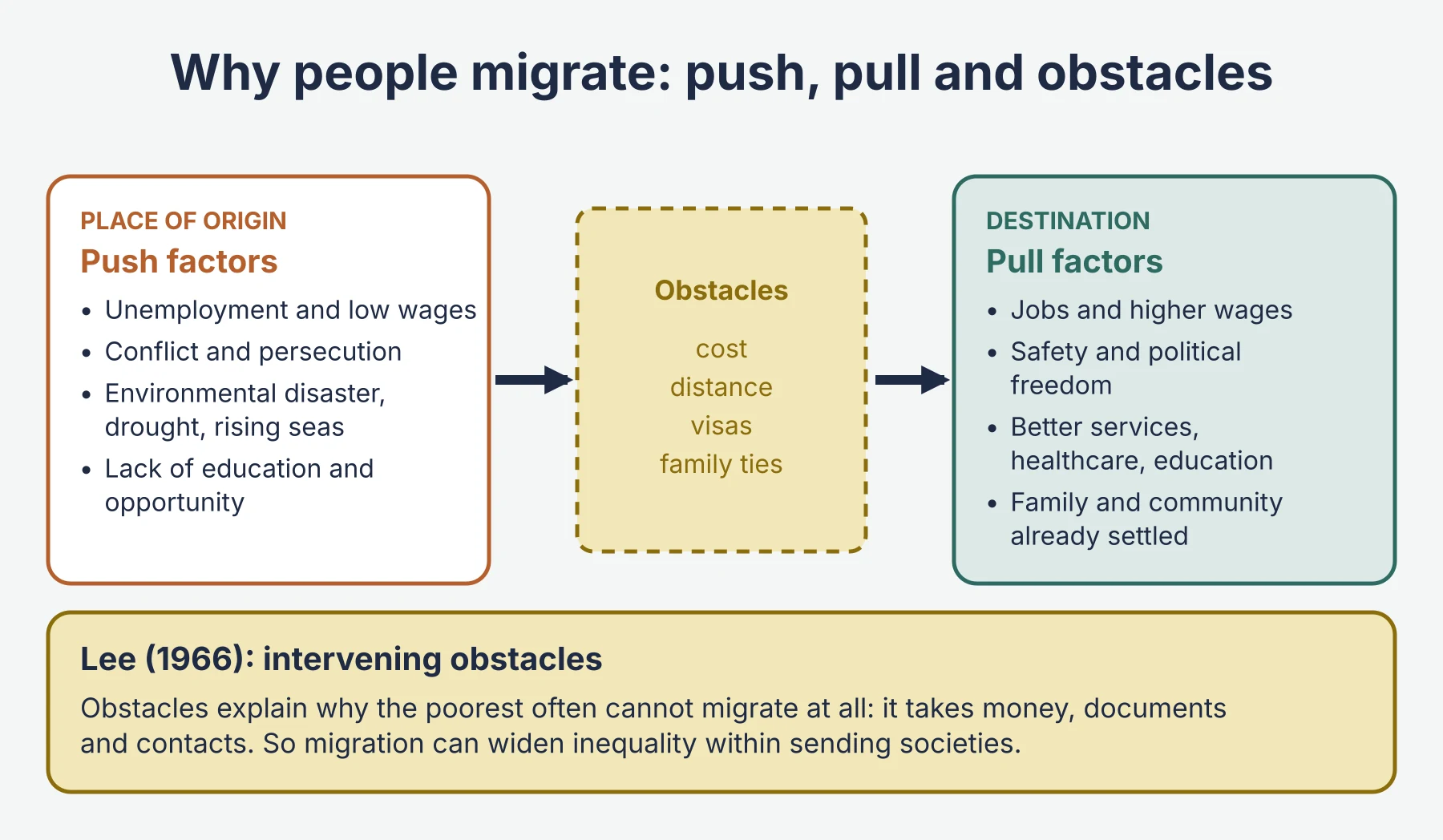
| Push factor | Condition that drives people away from a place |
| Pull factor | Condition that attracts people to a place |
| Intervening obstacle | Barrier to migration, such as cost or visas (Lee, 1966) |
| Remittances | Money migrants send to families at home |
| Brain drain | Emigration of skilled and educated workers |
| Scapegoating | Blaming a group, such as migrants, for wider problems |
| Transnational company (TNC) | Business operating in many countries |
| Climate justice | Idea that those least responsible for climate change suffer most |
| Urbanisation | Growth in the share of population living in towns and cities |
| Dependency theory | Rich nations developed by exploiting poor ones (Frank) |
| World-systems theory | World economy of core, semi-periphery and periphery (Wallerstein) |
| Global care chain | Women migrate to do care work, leaving their own care to others (Hochschild, 2000) |
3.3.1 Migration: effects on two societies
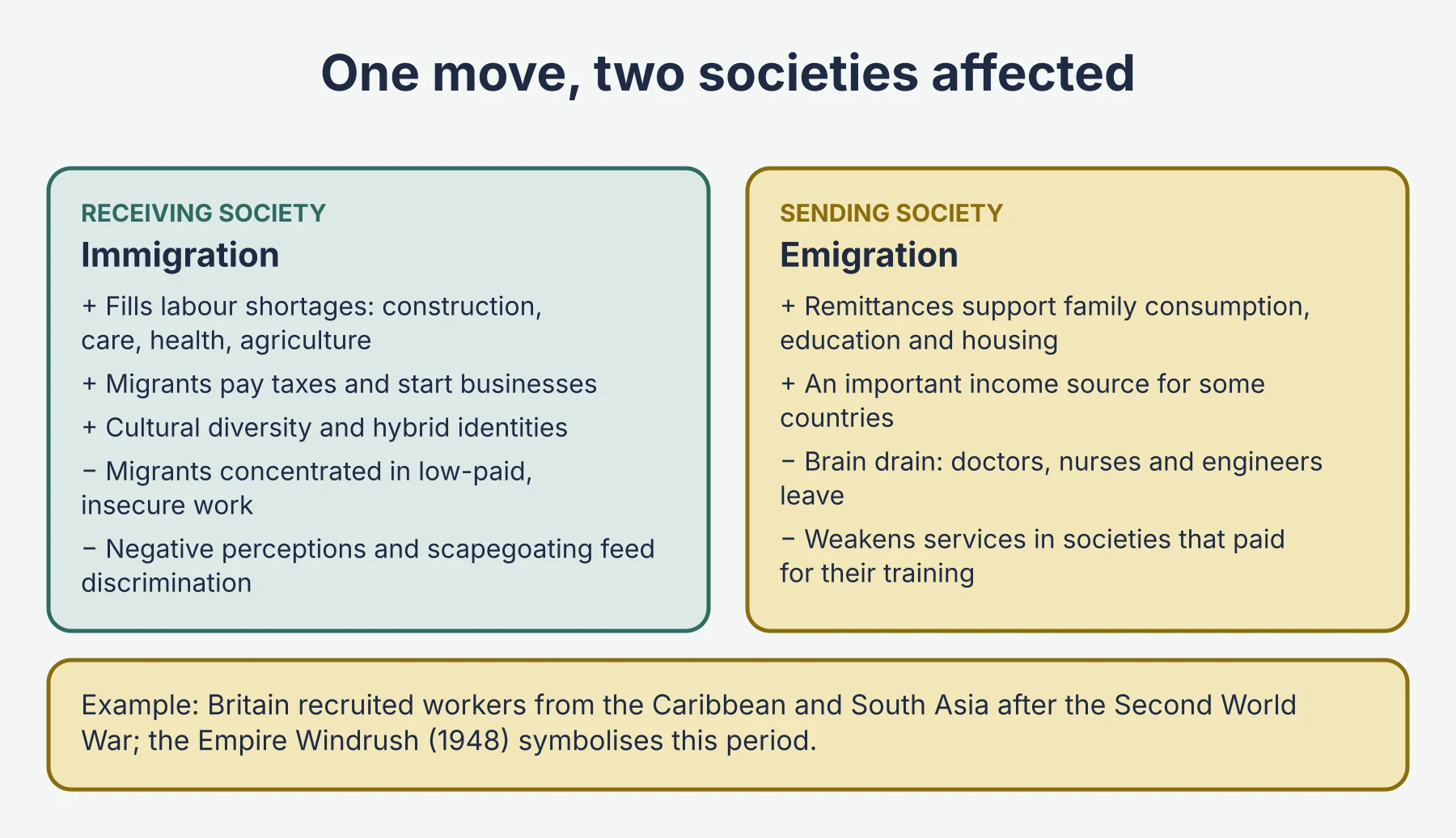
| Sending society | Receiving society | |
|---|---|---|
| Gains | Remittances; less unemployment; returning skills | Labour shortages filled; taxes; new businesses; cultural diversity |
| Losses | Brain drain; family separation; dependence on remittances | Possible tension; pressure on services in some areas |
| For migrants | — | Higher wages but often low-paid, insecure work; discrimination |
- Example: post-war recruitment of Caribbean and South Asian workers to Britain; Empire Windrush (1948) as a symbol.
- Negative perceptions: stereotyping, scapegoating in hard times, media amplification, discrimination in housing and jobs.
- Who migrates: the poorest often cannot afford to, so migration may widen inequality within sending societies.
3.3.2 Ecological issues
| Issue | How it affects inequality | Example |
|---|---|---|
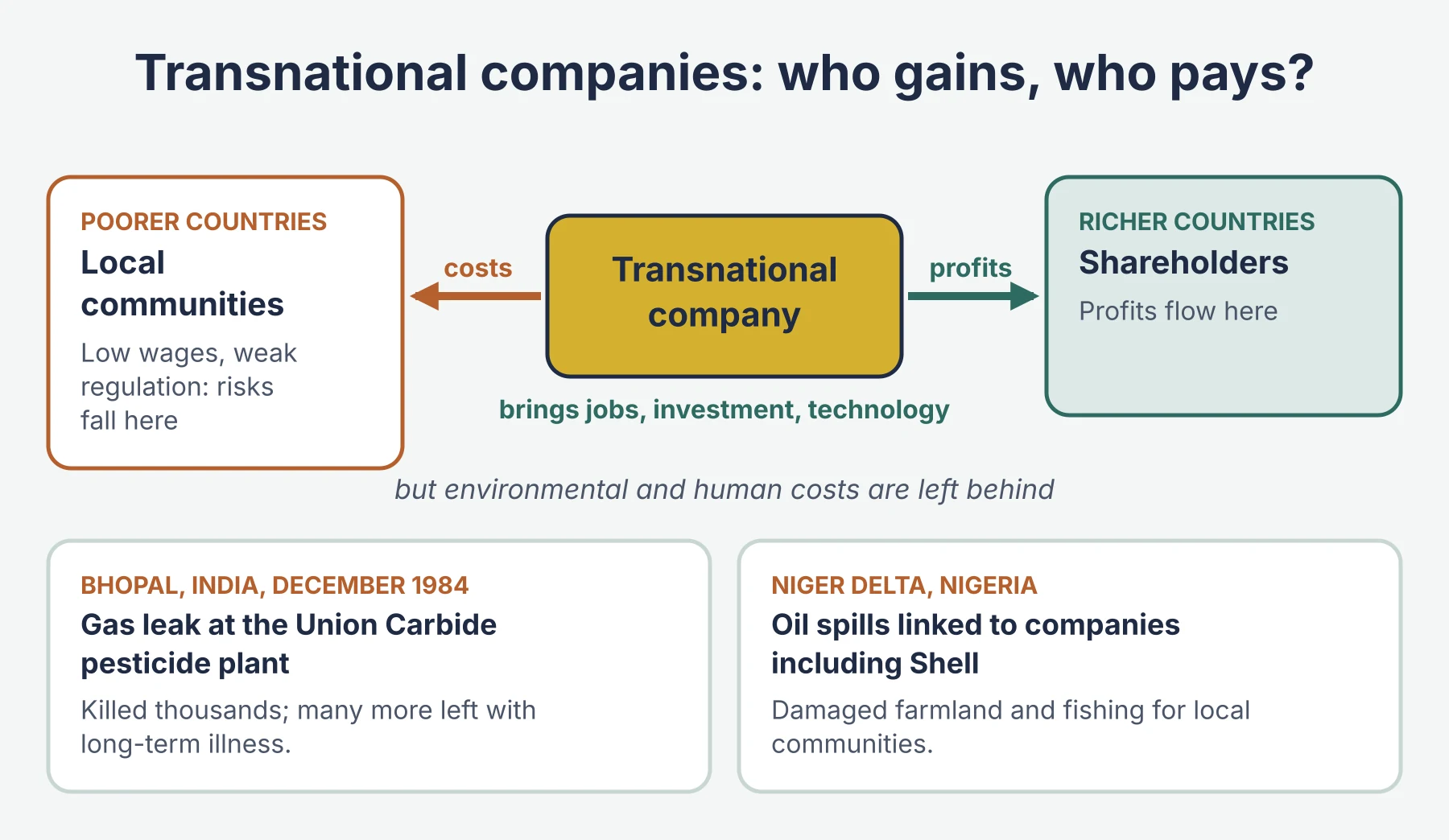
| TNCs | Profits flow out; risks stay with local communities | Bhopal gas leak, India (1984); oil pollution in the Niger Delta |
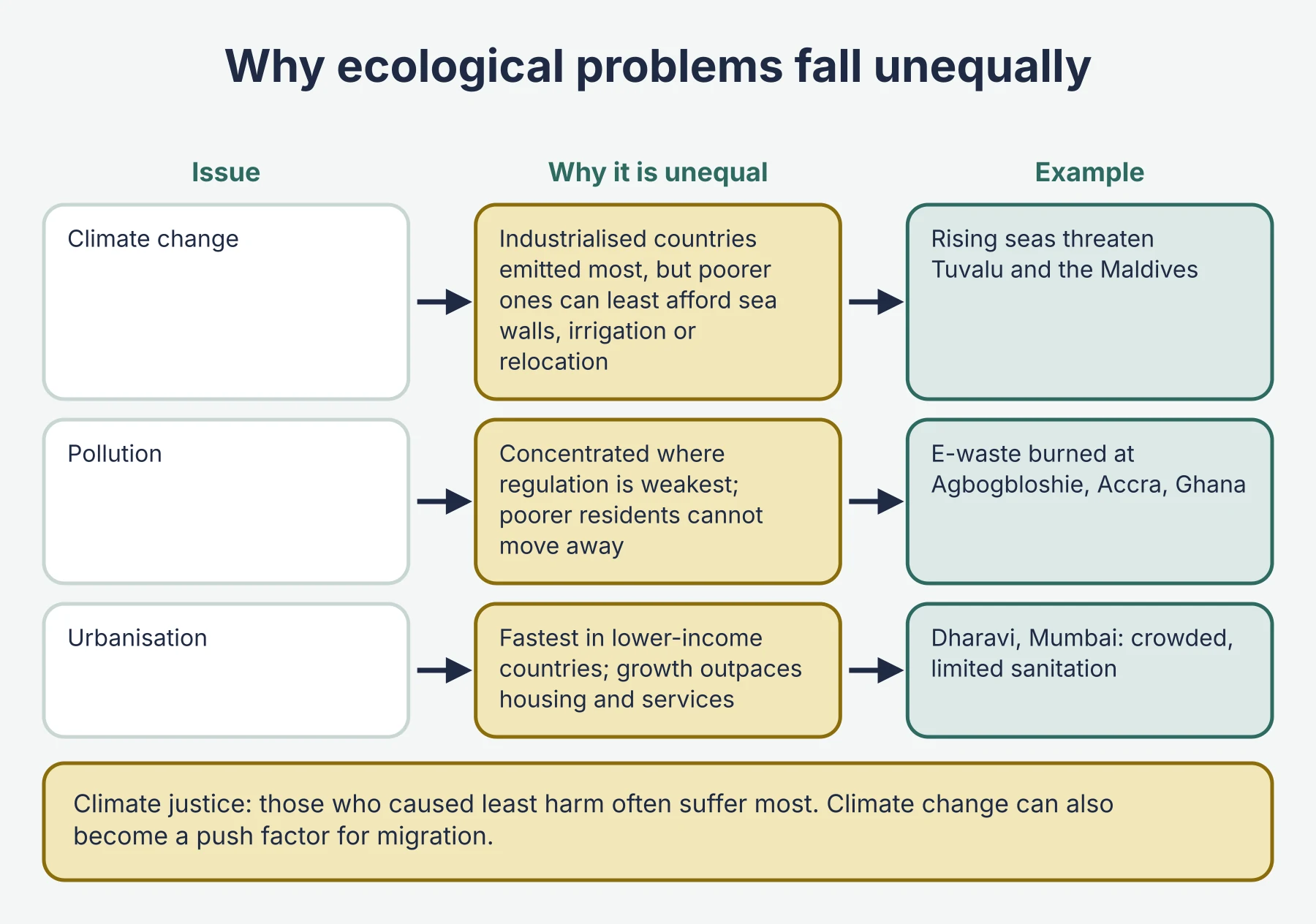
| Climate change | Poorer societies suffer most but emitted least | Rising seas threaten Tuvalu and the Maldives |
| Pollution | Concentrated where regulation is weakest | E-waste burning at Agbogbloshie, Accra |
| Urbanisation | Growth outpaces housing and services | Informal settlements such as Dharavi, Mumbai |
3.3.3 Explanations
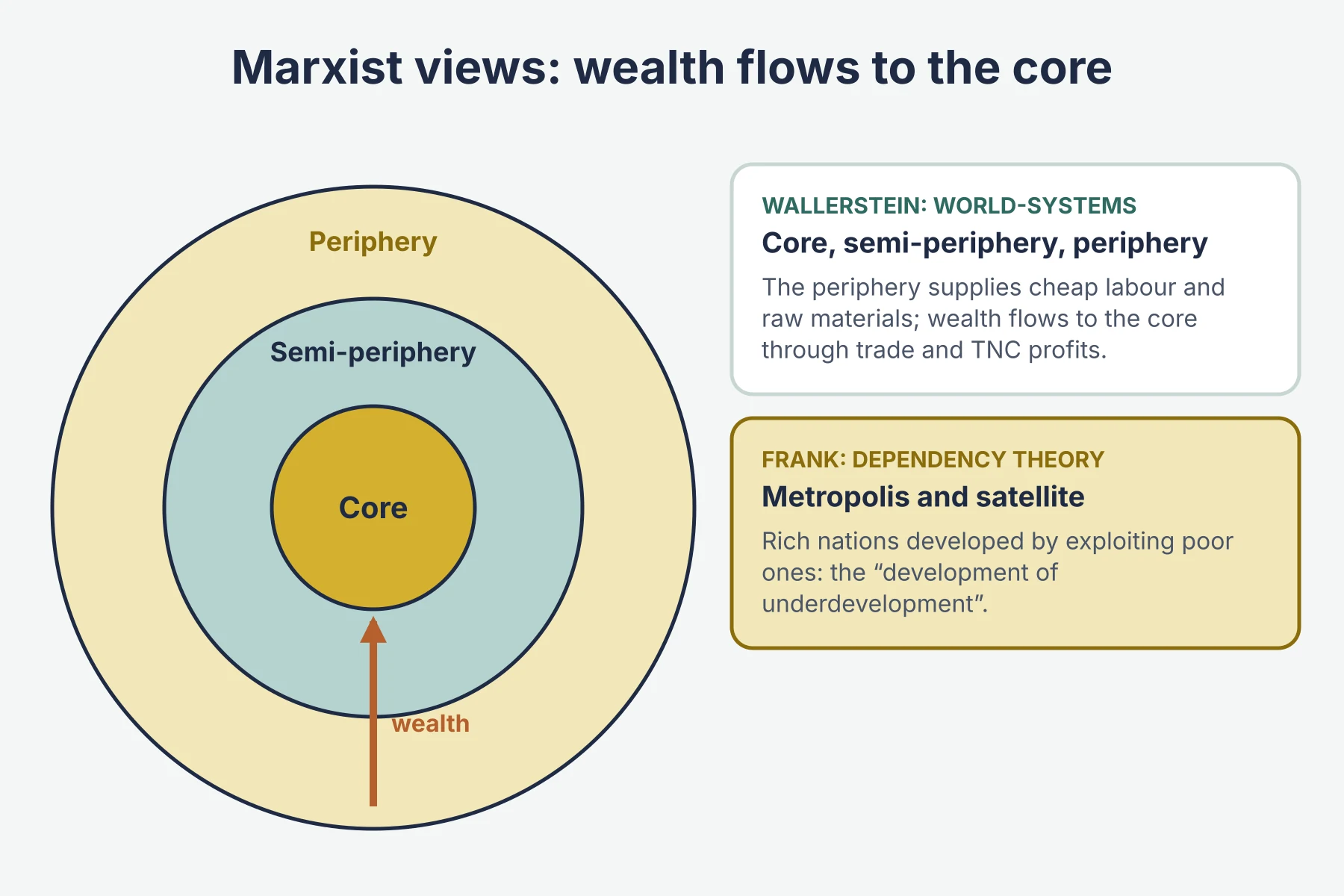
- Marxist: global capitalism transfers wealth from periphery to core. Frank: “development of underdevelopment”. Wallerstein: core, semi-periphery, periphery.
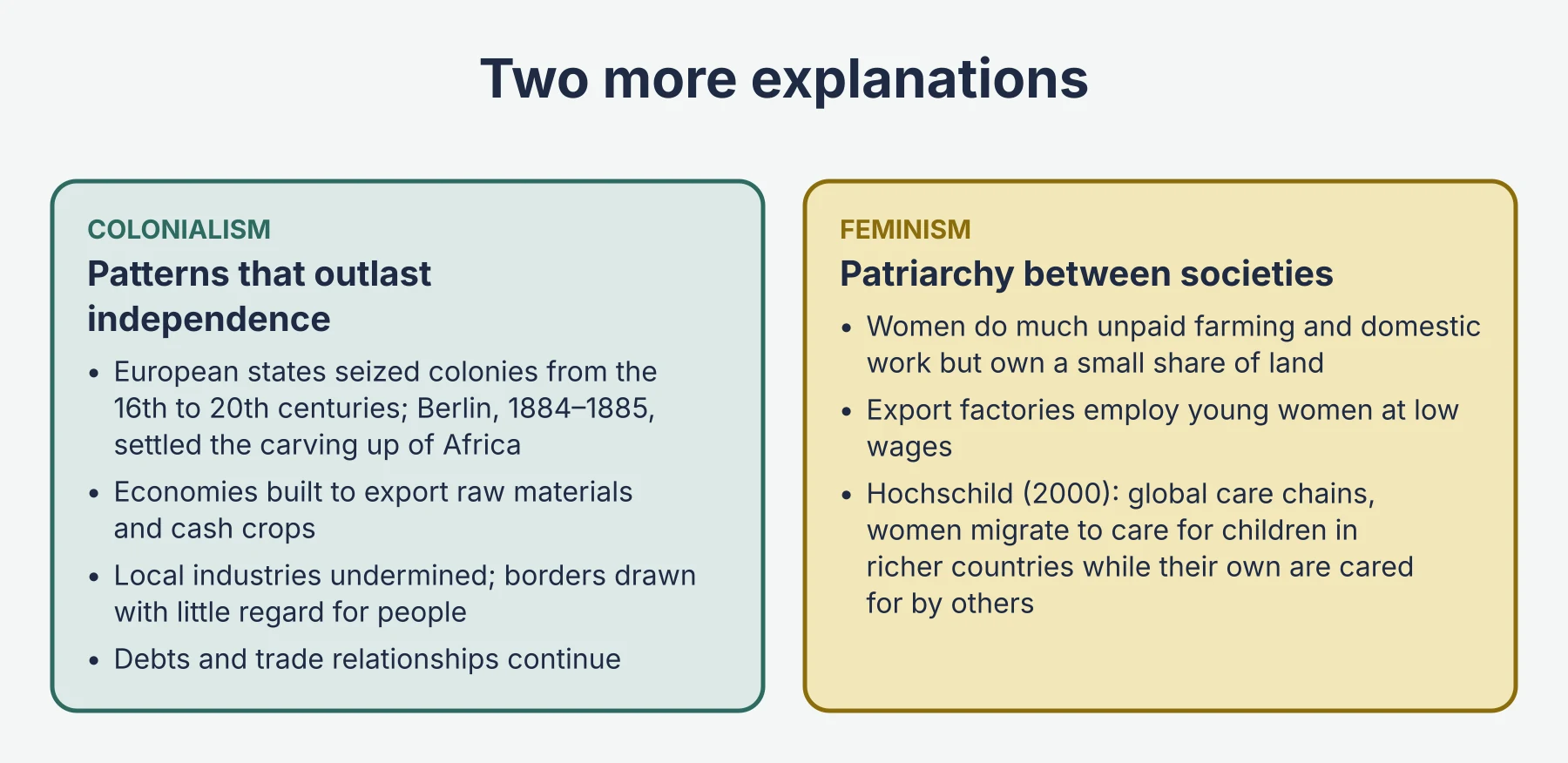
- Colonialism: economies built to export raw materials; local industry undermined; borders drawn by colonial powers (Berlin Conference, 1884–1885); effects continue after independence.
- Feminist: women do much unpaid work but own little land; export factories rely on low-paid young women; global care chains (Hochschild).
Exam traps
- 3.3 is about inequality between societies, not within one.
- Immigration = coming in; emigration = going out.
- Every migration affects two societies; discuss both.
- Climate answers must explain why effects are unequal.
- Do not treat TNCs as wholly harmful; give benefits too, then judge.
- Colonialism needs a mechanism, not just a name.
Worked example: an 8-mark “discuss” plan (practice)
Discuss the effects of migration on receiving societies.
- Economic gains: labour shortages filled in health, care and construction; taxes paid; new businesses.
- Cultural gains: greater diversity of food, music and ideas; hybrid identities.
- Pressures: competition for some low-paid jobs and housing in particular areas.
- Negative perceptions: stereotyping and scapegoating; discrimination reproduces inequality.
- Judgement: overall economic effects are often positive, but benefits and costs are unevenly felt, and perceptions shape outcomes.
Self-test
- Define globalisation.
- What is the difference between immigration and emigration?
- Give two push factors and two pull factors.
- What are intervening obstacles?
- Give one benefit and one cost of migration for sending societies.
- Why may migrants be scapegoated?
- Give one example of harm linked to a TNC.
- Why does climate change increase inequality between societies?
- What is urbanisation, and one problem it causes?
- What did Frank mean by the “development of underdevelopment”?
- Name Wallerstein’s three zones of the world economy.
- What is a global care chain?
Answers
- The growing interconnection of societies through trade, communication, migration and culture.
- Immigration is moving into a country; emigration is leaving one’s own country.
- Push: unemployment, conflict. Pull: higher wages, safety.
- Barriers such as cost, distance, visas or family ties that limit migration.
- Benefit: remittances. Cost: brain drain of skilled workers.
- They are blamed for problems such as unemployment or crime, especially in economic difficulty and when media amplify fears.
- The Bhopal gas leak at the Union Carbide plant in India (1984).
- Poorer societies suffer most from floods, drought and rising seas but have emitted least and have fewer resources to adapt.
- Growth of the urban share of population; informal settlements with poor sanitation.
- Rich nations developed by exploiting poor ones, actively making them poorer.
- Core, semi-periphery and periphery.
- Women from poorer countries migrate to care for families in richer ones, while their own children are cared for by others.
Frequently asked questions
How does 3.3 link to identity? Globalisation also affects identity (key question 2.3); in 3.3 focus on how it changes economic and environmental inequality between societies.
Can I use local examples? Yes. Local migration, a recent flood or a nearby industrial site are all relevant if you explain how they affect inequality.
Related pages: key question 3.3 practice questions | key question 3.2 revision notes
Related resources
-
Study guides
O Level Sociology: How We Learn Our Identity and What Shapes It (Cambridge 2251)
Cambridge O Level Sociology 2251 key questions 2.1 and 2.3: culture and norms, nature versus nurture, agencies of socialisation and influences on identity.
Sociology · Cambridge · O Level
Read guide -
Practice questions
O Level Sociology: Research Methods, Identity and Inequality — Practice Questions
Original exam-style practice questions with full worked answers on research methods, socialisation, culture and social inequality.
Sociology · Cambridge · O Level
Try questions -
Revision notes
O Level Sociology: Research Methods, Identity and Inequality — Revision Notes
Condensed recall notes on research methods, culture and socialisation, and social class, gender and ethnic inequality for Cambridge O Level Sociology 2251.
Sociology · Cambridge · O Level
Revise topic
Related articles
Get free revision emails (optional)
Occasional emails with practice questions, worked explanations and links to free resources for the qualification and subjects you choose. No spam, and you can unsubscribe from any email. The free tools on this site never need an email.