
Study Guides
Cambridge O Level Sociology (2251): Social stratification and inequality – How has globalisation affected inequalities between societies?
Cambridge O Level Sociology 2251 key question 3.3 in depth: migration, transnational companies, climate, urbanisation and theories of global inequality.
- Subject
- Sociology
- Level
- O LEVELS
- Topic
- Paper 1 – Research Methods, Identity and Inequality
- Author
- Marlbridge Academic Team
- Updated
- Reviewed by
- Naqiya Yousaf (what this means)
Aligned to Cambridge O Level Sociology (2251), 2025-2027. Official specification .
Syllabus page (what it covers and how it is assessed): Cambridge O Level Sociology.
Syllabus points this page covers
2251
- 3.3 Social stratification and inequality – How has globalisation affected inequalities between societies?
Found an error? Report a correction.
Need help with this topic? Request a free trial class for O Level Sociology (2251).
Key question 3.3 of Cambridge O Level Sociology (2251) asks How has globalisation affected inequalities between societies? Questions 3.1 and 3.2 look mainly at inequality within a society; 3.3 widens the lens to the gaps between richer and poorer societies. The syllabus names three areas: migration, global ecological issues and sociological explanations for global inequality. Strong Paper 1 Question 3 answers explain the mechanism that links each issue to inequality and show that effects are uneven, with winners and losers in every society.
The O Level guide to tackling inequality and globalisation gives an overview of 3.2 and 3.3 together. This guide develops 3.3 with further examples and the theoretical explanations in more depth.
What the syllabus covers
- 3.3.1 The impact of migration on societies: immigration/emigration; push and pull factors; increasing cultural diversity; economic consequences; negative perceptions of migrants.
- 3.3.2 The impact of global ecological issues on societies: the influence of transnational companies; climate change; pollution; urbanisation.
- 3.3.3 Sociological explanations for global inequalities: Marxist views of capitalist exploitation; colonialism; feminist ideas of patriarchy.
Globalisation is the growing interconnection of the world’s societies through trade, investment, communication, migration and culture. It is not new, but faster transport and digital technology have greatly increased its speed and reach.
Migration
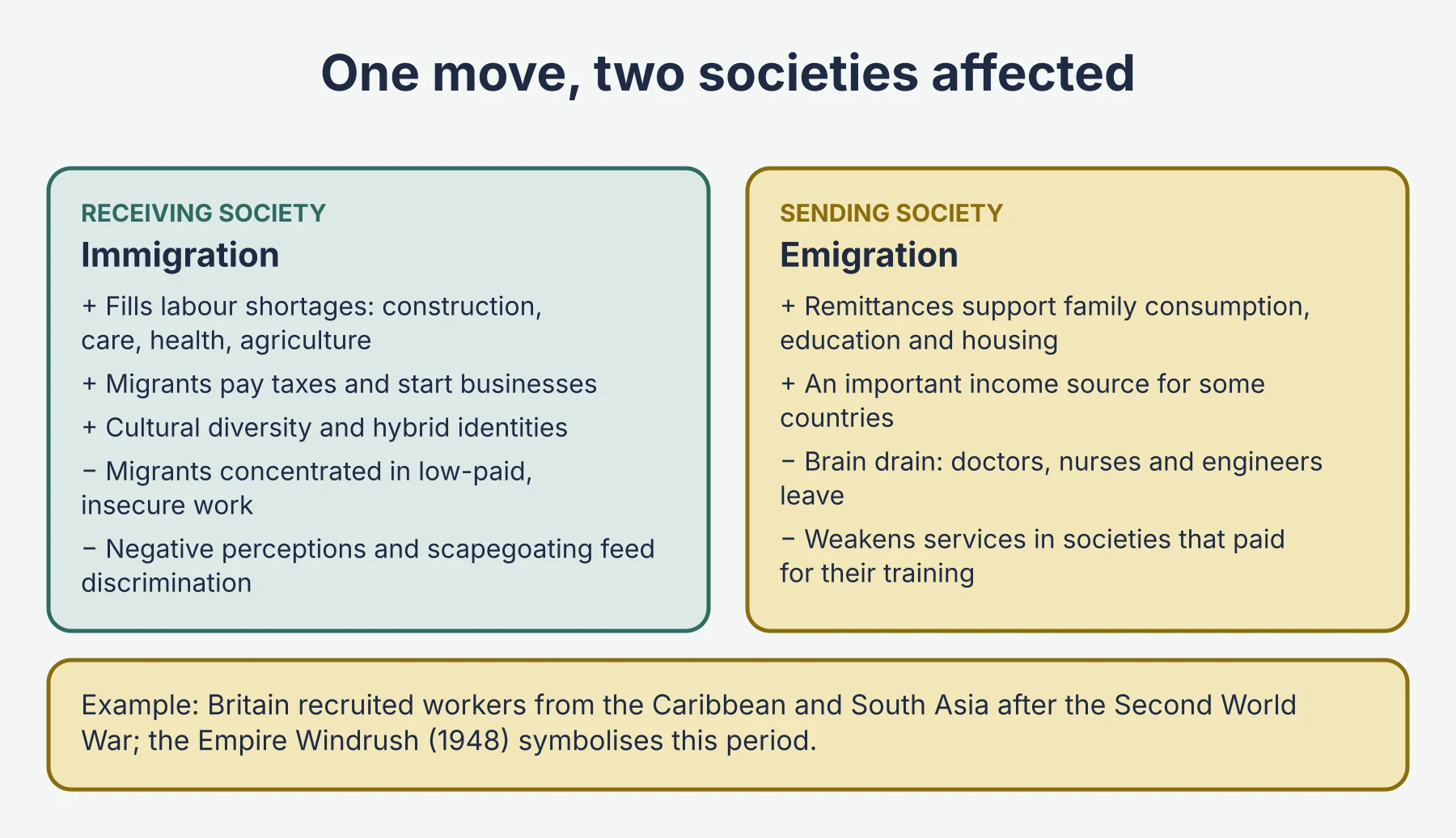
Immigration means arriving in a country to settle; emigration means departing from one’s own country to settle elsewhere. The same person is an emigrant from one society and an immigrant to another, so every movement affects two societies at once.
Push and pull factors
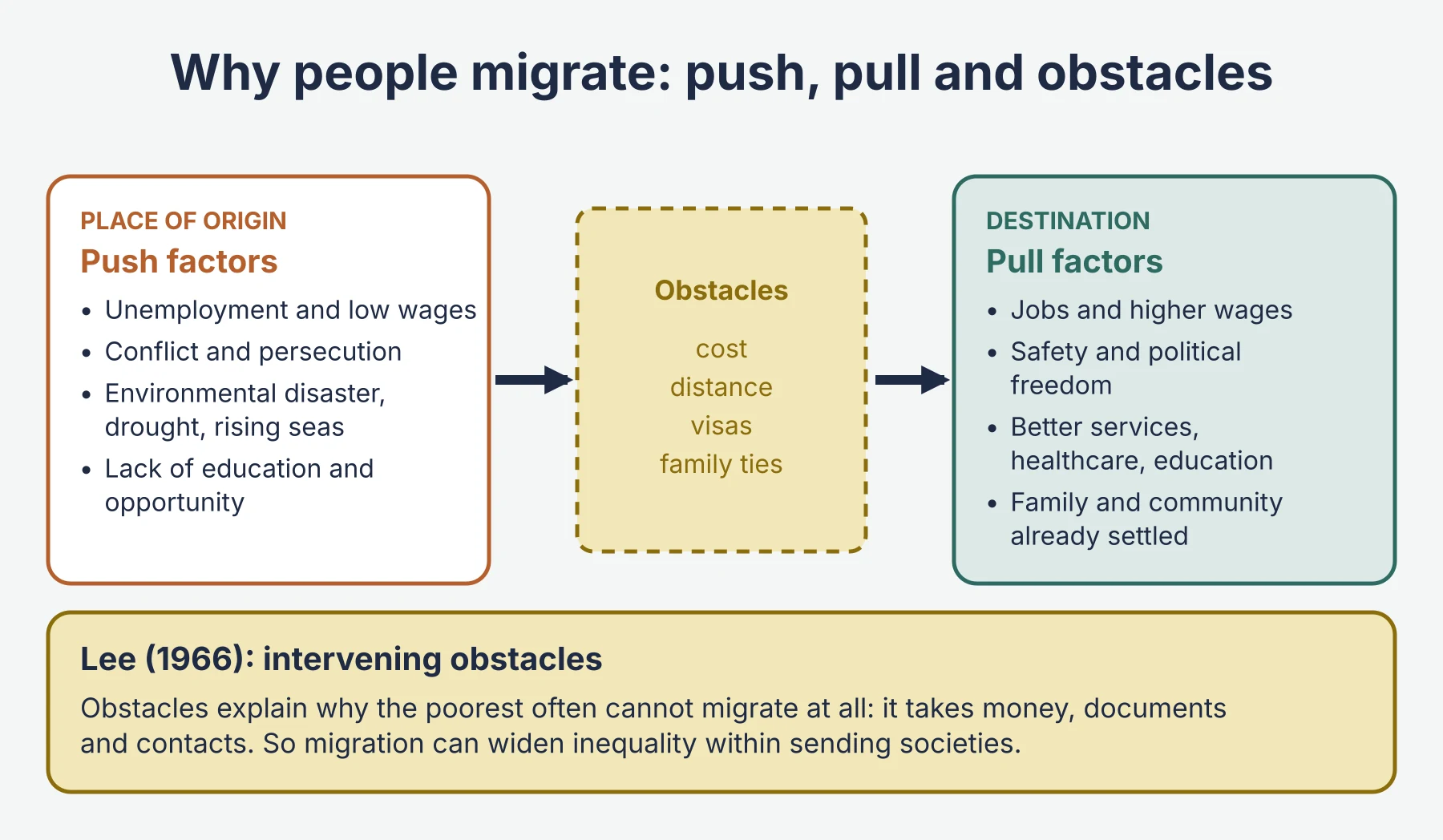
Everett Lee’s model (1966) explains migration as the result of push factors in the place of origin and pull factors in the destination, filtered by intervening obstacles such as cost, distance, visas and family ties.
| Push factors | Pull factors |
|---|---|
| Unemployment and low wages | Jobs and higher wages |
| Conflict and persecution | Safety and political freedom |
| Environmental disaster, drought, rising seas | Better services, healthcare and education |
| Lack of education and opportunity | Family and community already settled |
The obstacles explain why the poorest people often cannot migrate at all: international migration requires money, documents and contacts. This is one reason migration can widen inequality within sending societies, as better-off families gain access to foreign earnings.
Economic consequences
For receiving societies: migrants fill labour shortages in sectors such as construction, care, health and agriculture. After the Second World War, Britain recruited workers from the Caribbean and South Asia to fill such shortages; the arrival of the ship Empire Windrush in 1948 has become a symbol of this period. Migrants pay taxes and start businesses, but may be concentrated in low-paid and insecure work.
For sending societies: remittances (money sent home) support family consumption, education and housing, and are an important source of income for some countries. Against this, the emigration of doctors, nurses and engineers, the brain drain, weakens services in societies that paid for their training.
Cultural diversity and negative perceptions
Migration increases cultural diversity in receiving societies: new languages, religions, food, music and hybrid identities. It can also produce negative perceptions: migrants may be stereotyped as taking jobs, lowering wages or increasing crime, and become scapegoats during economic difficulty. Media coverage can amplify these fears. Negative perceptions feed discrimination in housing and work, reproducing inequality inside the receiving society as well.
Global ecological issues
Transnational companies
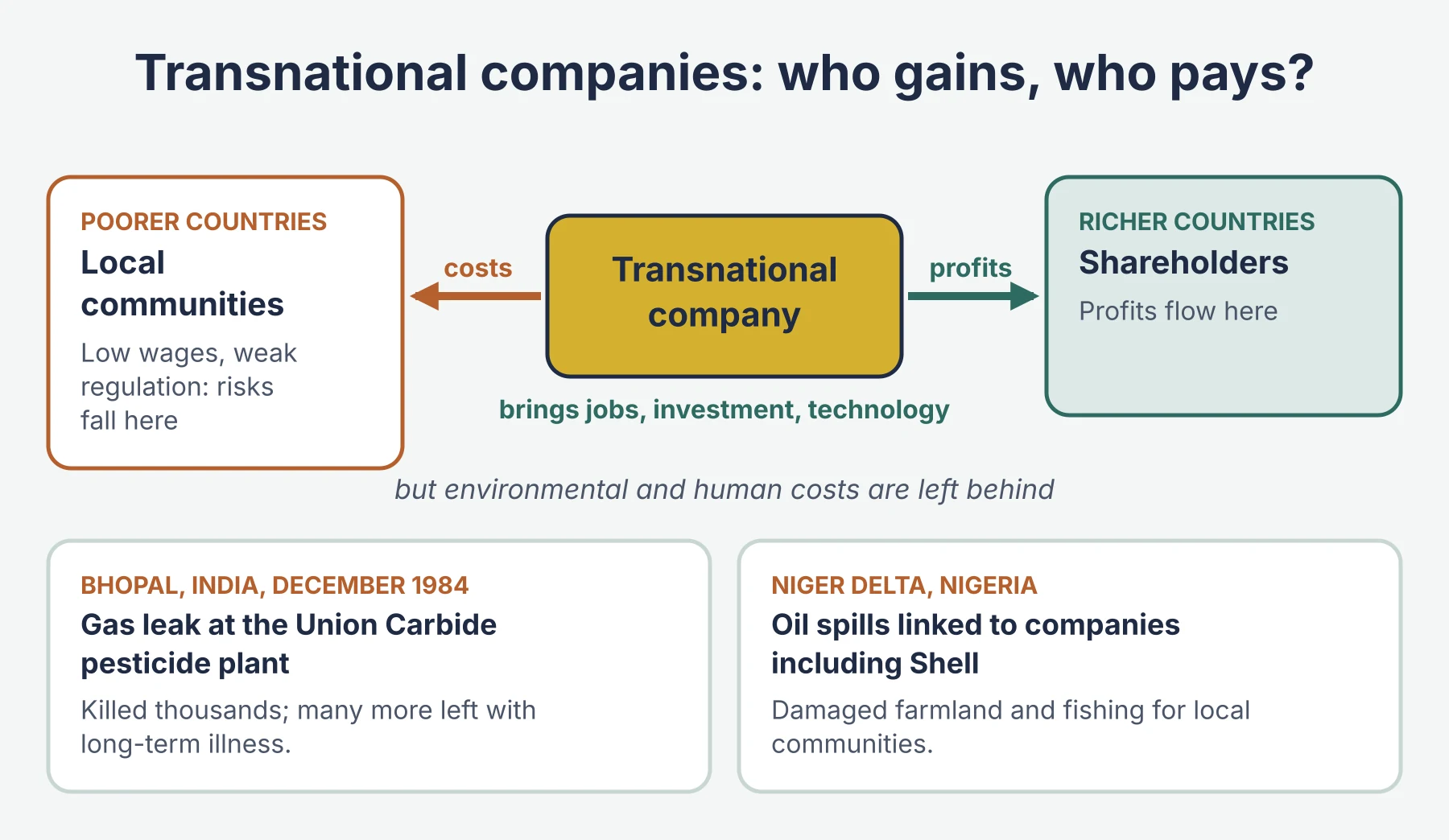
Transnational companies (TNCs) operate in many countries, and some have revenues larger than the economies of small states. They bring jobs, investment and technology, but critics argue they move production to places with low wages and weak regulation, leaving environmental and human costs behind.
- In December 1984, a gas leak at the Union Carbide pesticide plant in Bhopal, India, killed thousands of people and left many more with long-term illness.
- Oil spills in the Niger Delta, Nigeria, linked to companies including Shell, have damaged farmland and fishing for local communities.
The pattern is that profits flow to shareholders, often in richer countries, while risks fall on communities with the least power to resist.
Climate change
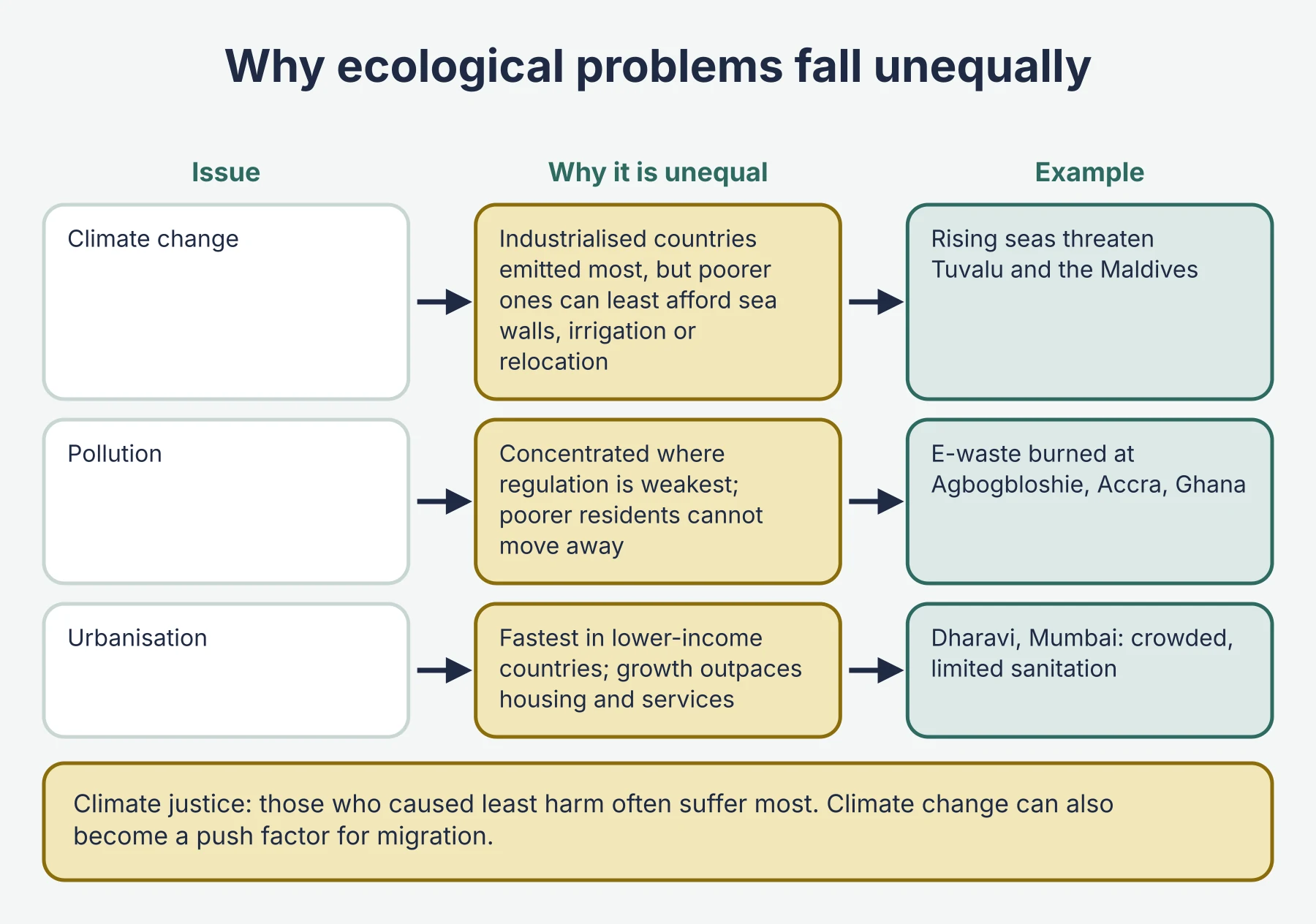
The countries that have emitted the most greenhouse gases over time are mainly industrialised ones, yet the worst effects often fall on poorer societies, which can least afford sea walls, irrigation or relocation. Rising seas threaten the existence of Tuvalu and the Maldives, both barely above sea level; farming communities face drought, floods and failed harvests. This is sometimes described as a question of climate justice. Climate change can also act as a push factor for migration.
Pollution
Pollution is concentrated where regulation is weakest. Electronic waste from richer countries has been shipped to places such as the Agbogbloshie site in Accra, Ghana, where workers, including children, burn cables to recover metals, exposing themselves to toxic smoke. Air pollution in fast-growing industrial cities affects health and life expectancy, especially for poorer residents who cannot move away.
Urbanisation
Urbanisation is the growth in the proportion of a population living in towns and cities. It is fastest in lower-income countries, driven by rural poverty and the pull of urban jobs. Cities offer opportunities, but rapid growth often outpaces housing and services, producing large informal settlements such as Dharavi in Mumbai, with crowded housing and limited sanitation.
Explaining global inequality
Marxist views of capitalist exploitation
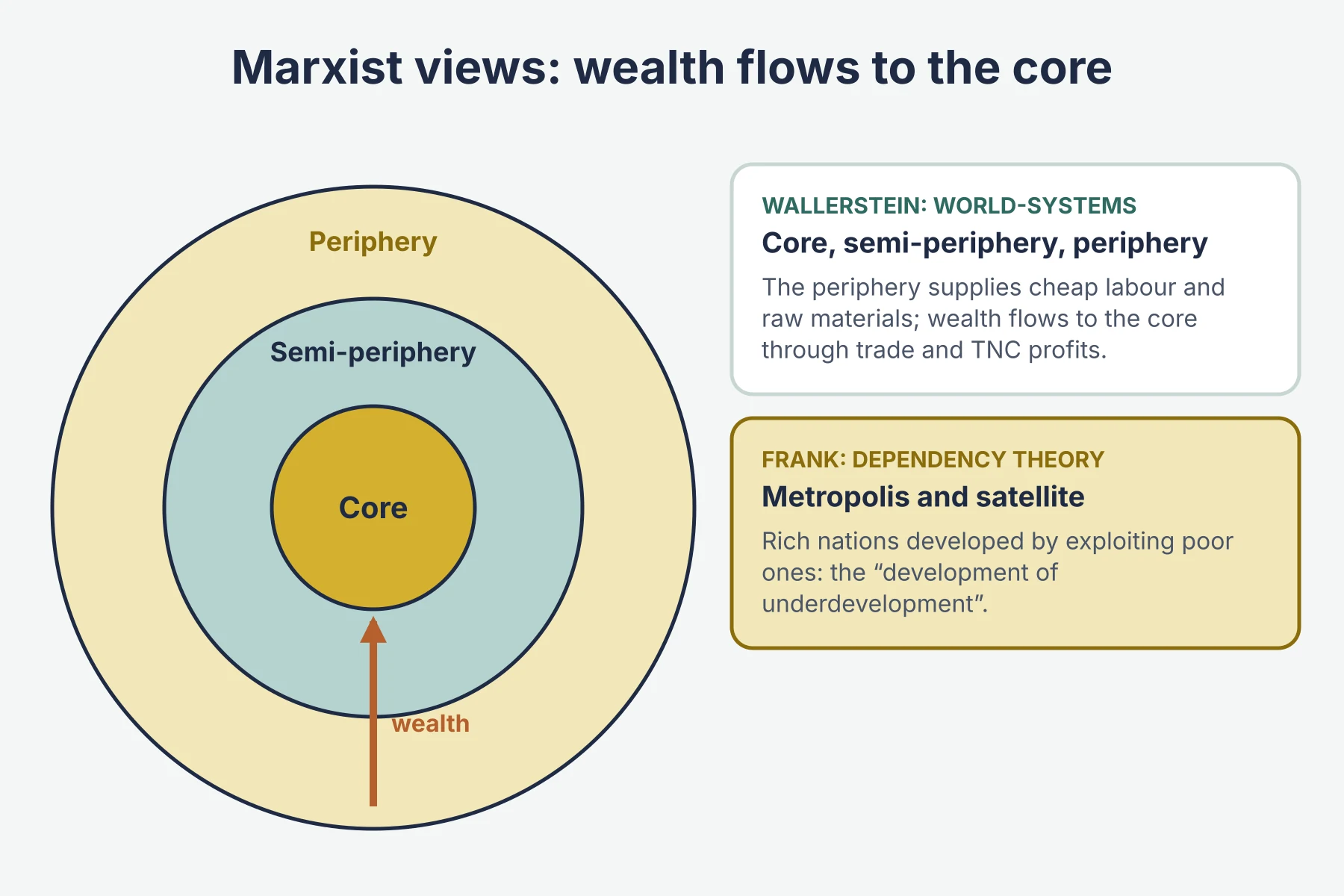
For Marxists, the gap between rich and poor nations is what capitalism produces once it spreads across the whole world. Andre Gunder Frank’s dependency theory argued that rich “metropolis” nations developed by exploiting poor “satellite” nations, a process he called the “development of underdevelopment”. Immanuel Wallerstein’s world-systems theory divided the world economy into a core of wealthy states, a periphery supplying cheap labour and raw materials, and a semi-periphery in between. Wealth flows towards the core through trade and the profits of TNCs.
Colonialism
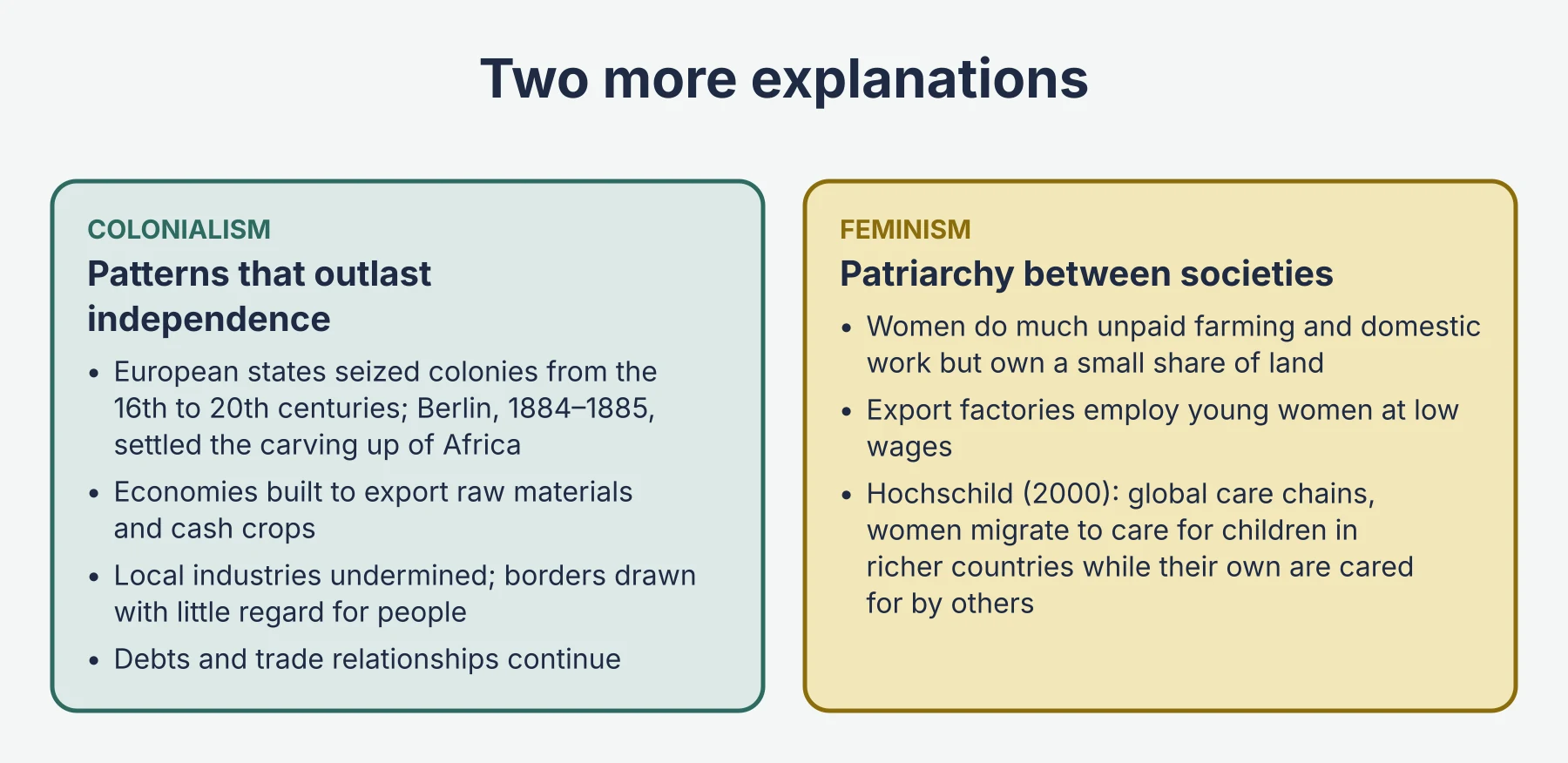
From the sixteenth century to the twentieth, European states seized large parts of the world as colonies, and in 1884–1885 their representatives met in Berlin to settle the terms on which Africa would be carved up between them. Colonial economies were organised to export raw materials and cash crops to the colonising country, local industries were often undermined, and borders were drawn with little regard for the people living within them. Sociologists argue that these patterns, along with debts and trade relationships formed in that period, continue to shape inequality after independence.
Feminist ideas of patriarchy
Feminists add gender to the picture: in their view, inequality between societies is also inequality between men and women. Women do much of the world’s unpaid farming and domestic work, yet own a small share of land and property. Global factories in export industries such as clothing and electronics often employ young women at low wages because they are seen as cheap and compliant. Arlie Hochschild (2000) described global care chains: women from poorer countries migrate to care for children in richer ones, while their own children are cared for by relatives or lower-paid workers at home.
Worked example: an evaluation plan (practice)
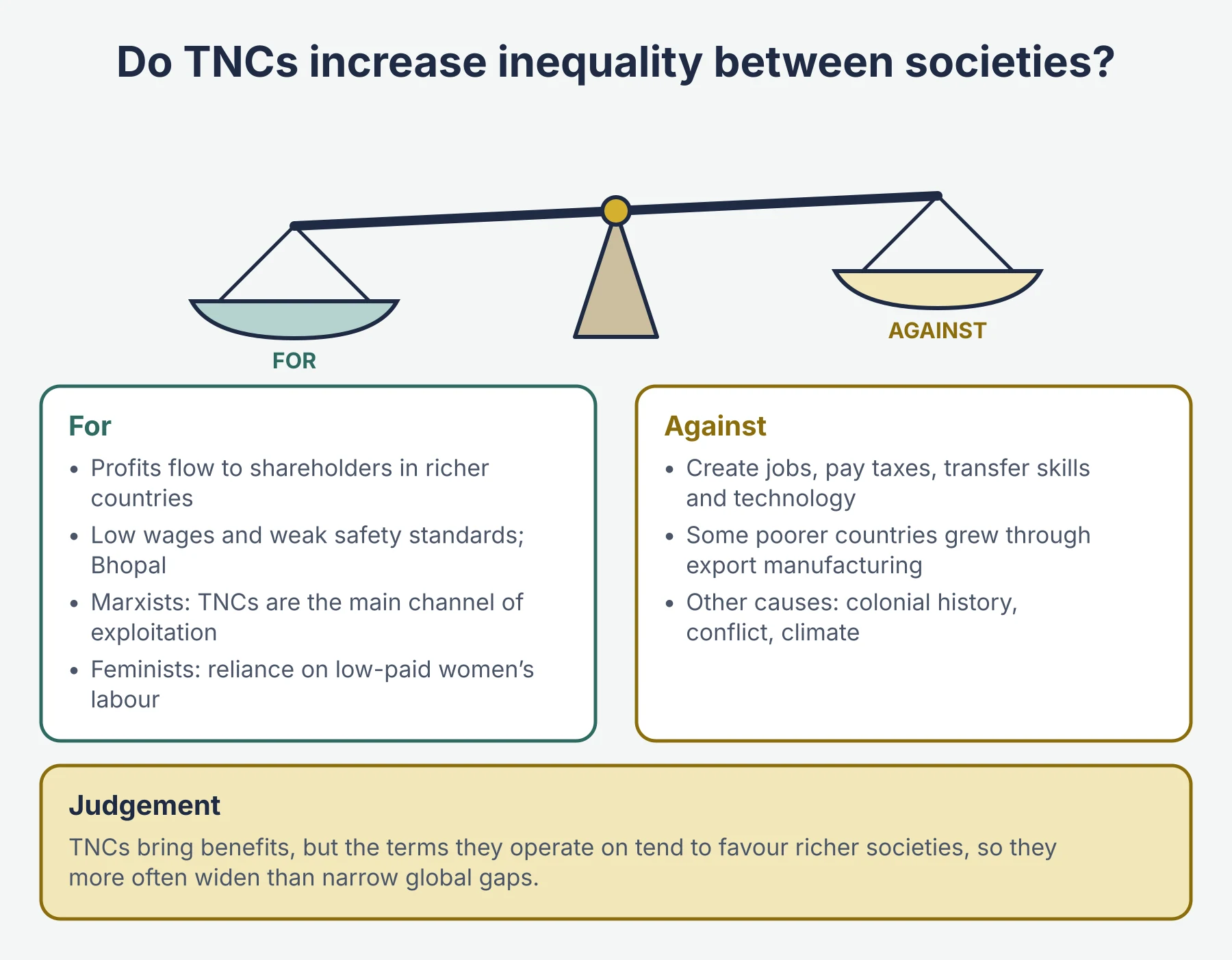
Evaluate the view that transnational companies increase inequalities between societies.
- For: profits flow to shareholders in richer countries; low wages and weak safety standards in poorer ones; environmental disasters such as Bhopal; Marxist and dependency theorists see TNCs as the main channel of exploitation; feminists note reliance on low-paid women’s labour.
- Against: TNCs create jobs, pay taxes and transfer skills and technology; some poorer countries have grown rapidly through export manufacturing; inequality also has other causes, such as colonial history, conflict and climate.
- Judgement: TNCs bring benefits, but the terms on which they operate tend to favour richer societies, so they more often widen than narrow global gaps.
Common mistakes
- Writing about inequality within a society when the question asks between societies.
- Confusing immigration and emigration.
- Treating migration as wholly good or wholly bad; show both effects for both societies.
- Describing climate change without explaining why it falls unequally.
- Naming colonialism without explaining its lasting mechanisms.
Exam technique
- Explain three (parts c and d): issue, mechanism, effect on inequality, example.
- Discuss (part e): one explanation or issue in depth, with evidence.
- Evaluate (part f): weigh benefits of globalisation against its costs and conclude.
Keep revising
Condense this page with the key question 3.3 revision notes, then try the key question 3.3 practice questions. Attempts to reduce inequality within societies are covered in the guide to key question 3.2.
Related resources
-
Practice questions
Cambridge O Level Sociology (2251): Social stratification and inequality – How has globalisation affected inequalities between societies? – Practice Questions
Original Cambridge O Level Sociology 2251 practice on key question 3.3: migration, remittances, TNCs, climate and theories of global inequality, with answers.
Sociology · Cambridge · O Level
Try questions -
Revision notes
Cambridge O Level Sociology (2251): Social stratification and inequality – How has globalisation affected inequalities between societies? – Revision Notes
Revision notes for Cambridge O Level Sociology 2251 key question 3.3: push and pull, remittances, TNCs, climate, pollution, urbanisation and global inequality.
Sociology · Cambridge · O Level
Revise topic -
Study guides
O Level Sociology: How We Learn Our Identity and What Shapes It (Cambridge 2251)
Cambridge O Level Sociology 2251 key questions 2.1 and 2.3: culture and norms, nature versus nurture, agencies of socialisation and influences on identity.
Sociology · Cambridge · O Level
Read guide
Related articles
Get free revision emails (optional)
Occasional emails with practice questions, worked explanations and links to free resources for the qualification and subjects you choose. No spam, and you can unsubscribe from any email. The free tools on this site never need an email.