
Revision Notes
Cambridge O Level Sociology (2251): Social stratification and inequality – What is social stratification? – Revision Notes
Revision notes for Cambridge O Level Sociology 2251 key question 3.1: open and closed societies, caste, mobility, life chances, labelling and Marxism.
- Subject
- Sociology
- Level
- O LEVELS
- Topic
- Paper 1 – Research Methods, Identity and Inequality
- Author
- Marlbridge Academic Team
- Updated
- Reviewed by
- Naqiya Yousaf (what this means)
Aligned to Cambridge O Level Sociology (2251), 2025-2027. Official specification .
Syllabus page (what it covers and how it is assessed): Cambridge O Level Sociology.
Syllabus points this page covers
2251
- 3.1 Social stratification and inequality – What is social stratification?
Found an error? Report a correction.
Need help with this topic? Request a free trial class for O Level Sociology (2251).
These notes condense key question 3.1 of Cambridge O Level Sociology (2251), What is social stratification? Stratification is the division of a society into unequal layers. Societies range from closed, where position is ascribed at birth, to open, where position can be achieved. Age, gender, ethnicity and social class shape life chances, these factors intersect, and labelling theory and Marxism offer explanations of why inequality persists.
Fuller explanations: O Level social stratification and inequality guide.
Syllabus coverage
2251 syllabus 2025–2027, 3.1: 3.1.1 stratification in open and closed societies (achieved and ascribed status, poverty and wealth, power, social mobility, meritocracy, modern slavery, the caste system); 3.1.2 life chances in education, employment, health, housing and life expectancy, affected by age, gender, ethnicity and social class; 3.1.3 intersectionality; 3.1.4 theories, including labelling theory (stereotypes, master status, self-fulfilling prophecy) and Marxism (exploitation of the proletariat, ideological control, poverty trap, reserve army of labour).
Key terms
| Term | Definition |
|---|---|
| Social stratification | Division of society into unequal layers or strata |
| Closed society | Position fixed at birth; little or no mobility |
| Open society | Position can be achieved; mobility is possible |
| Absolute poverty | Lacking the basic necessities for survival, such as food, water and shelter |
| Relative poverty | Lacking the standard of living considered normal in a particular society |
| Wealth | Assets owned, such as property, land, savings and shares |
| Power | Ability to get one’s way even against resistance (Weber) |
| Social mobility | Movement up or down the stratification system |
| Intergenerational mobility | Change in position compared with one’s parents |
| Intragenerational mobility | Change in position within one’s own lifetime |
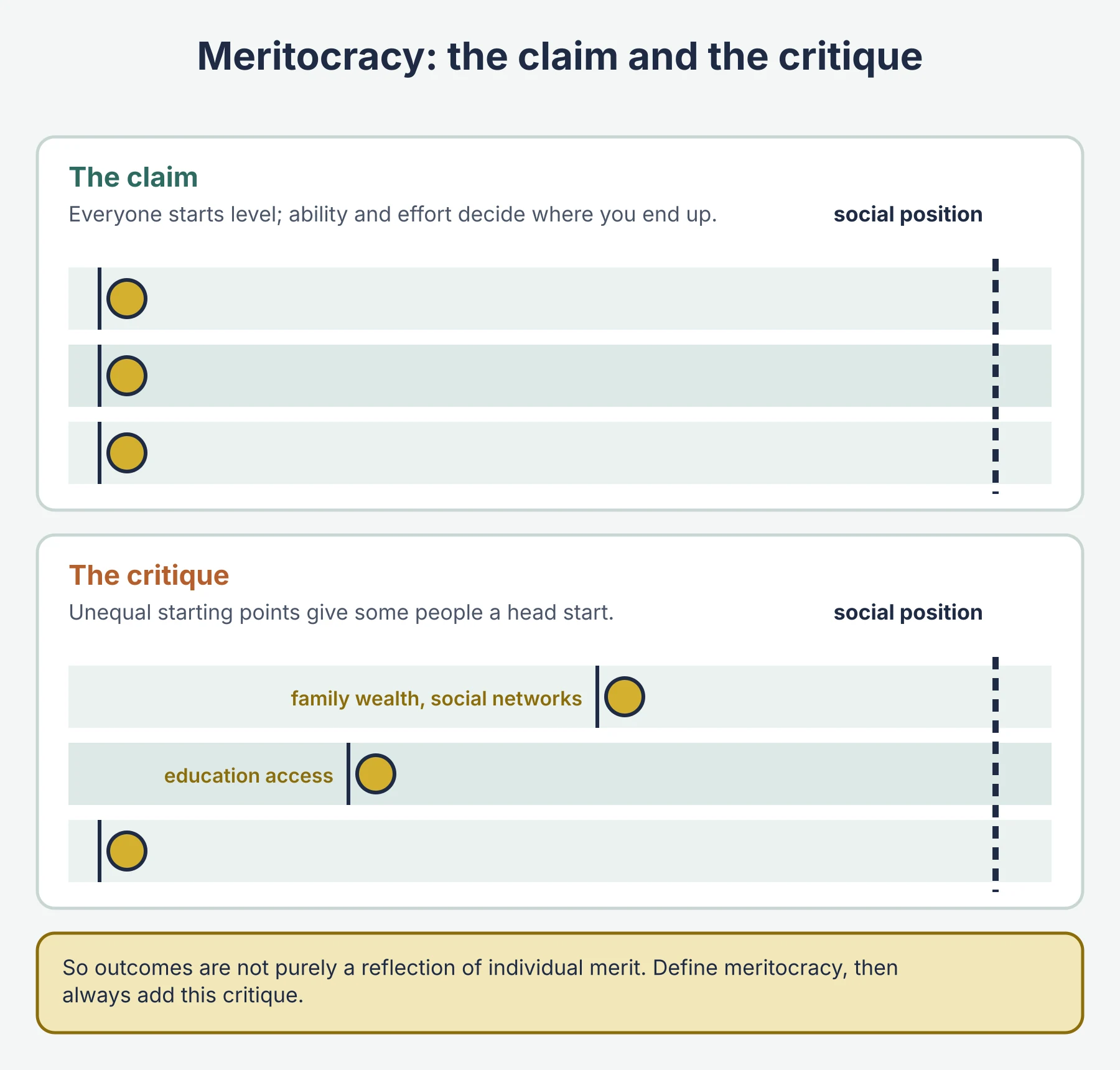
| Meritocracy | System in which position depends on ability and effort |
| Modern slavery | Control of people for exploitation through force, threat or deception |
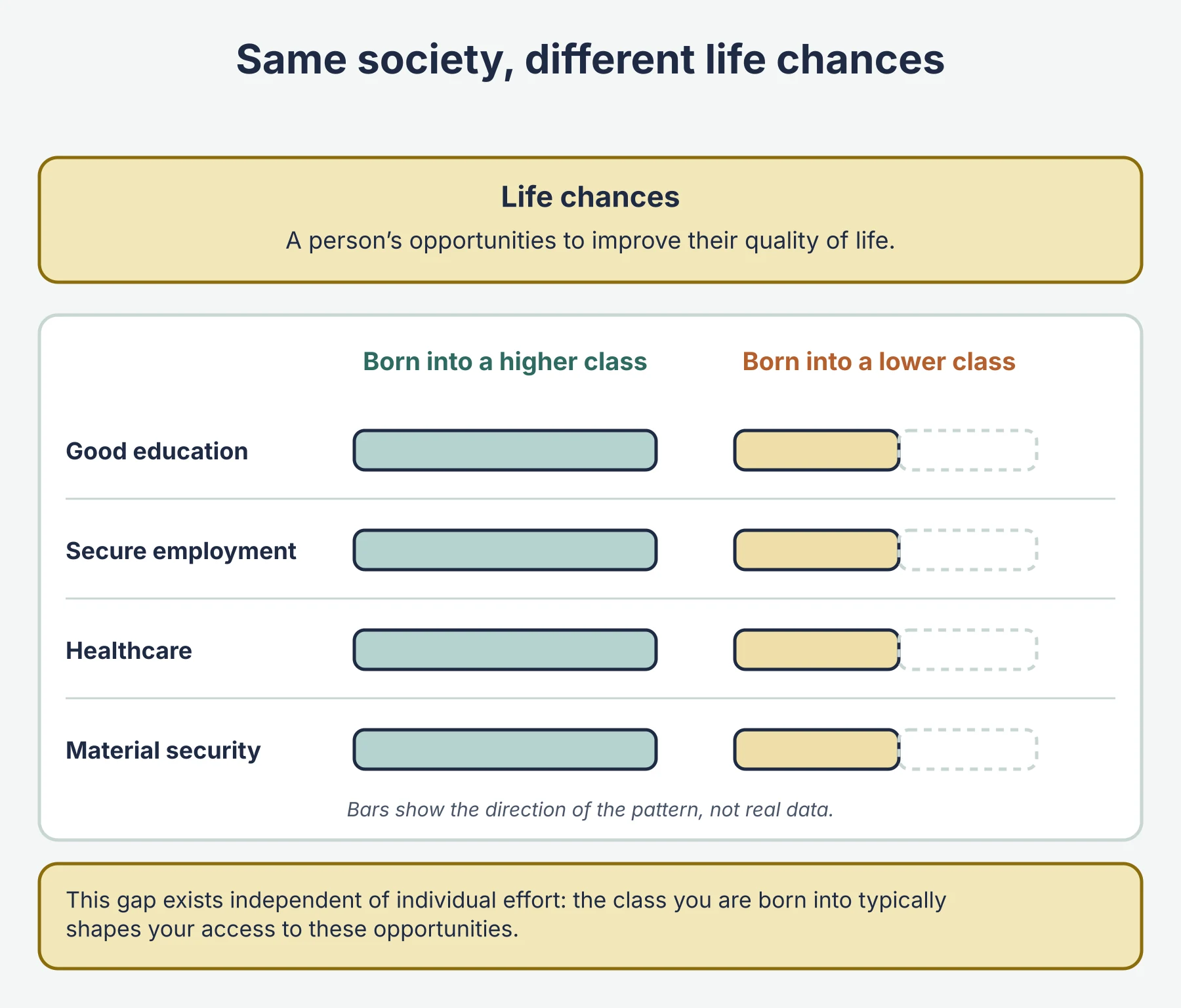
| Life chances | Opportunities to achieve a good quality of life |
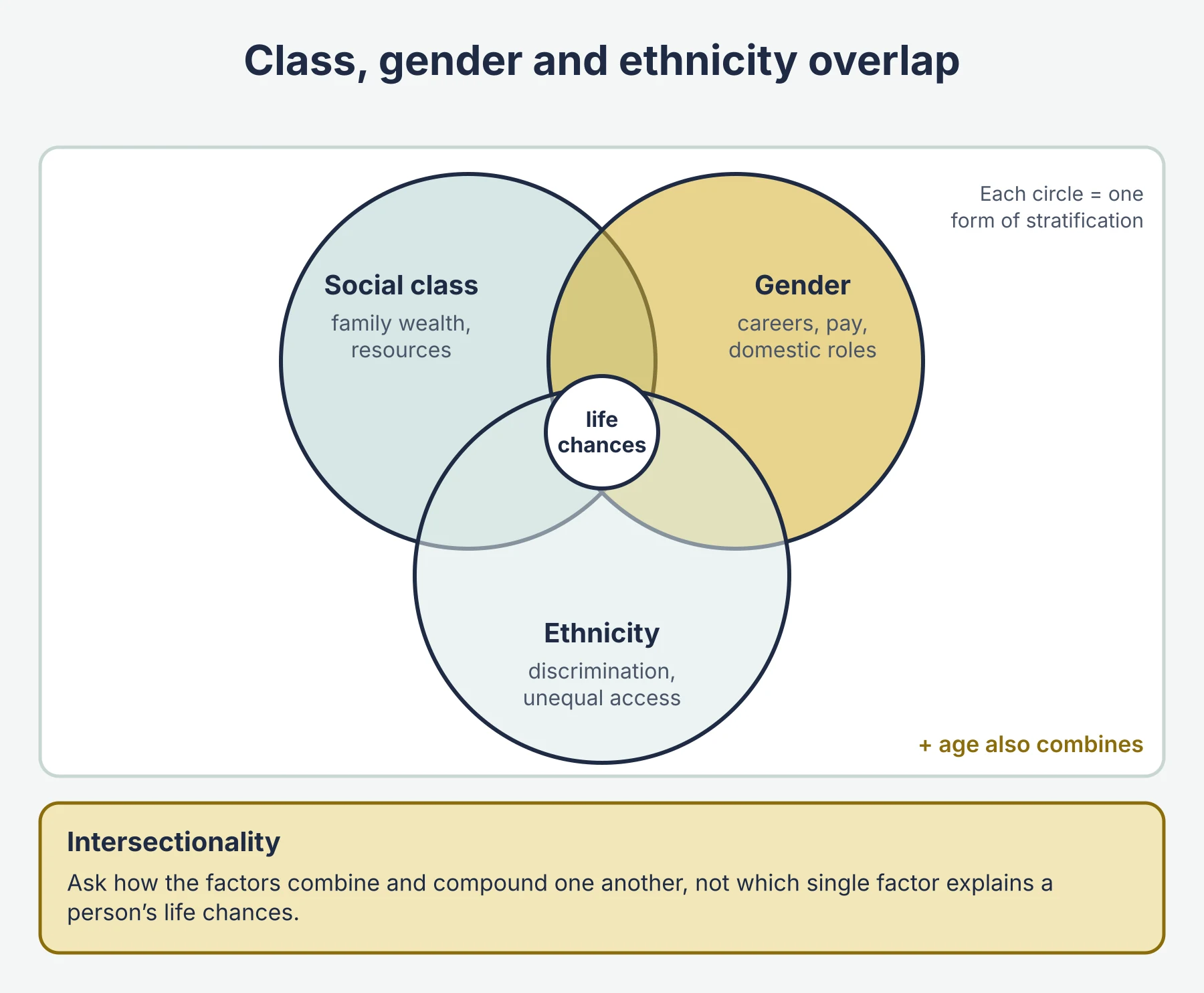
| Intersectionality | The combined effect of several inequalities on one person |
| Reserve army of labour | Pool of workers hired when needed and dismissed when not (Marxism) |
Open and closed societies
| Feature | Closed (e.g. traditional caste, slavery) | Open (e.g. modern class systems) |
|---|---|---|
| Basis of position | Ascribed | Mainly achieved |
| Mobility | Very little | Possible, up and down |
| Marriage | Within the group (endogamy) | Between groups allowed |
| Justification | Religion, tradition, law | Merit, qualifications |
The caste system (India): traditionally four varnas, Brahmins (priests and scholars), Kshatriyas (rulers and warriors), Vaishyas (traders) and Shudras (labourers), with Dalits treated as outside and below the system. Position was inherited, marriage was within the caste, and ideas of ritual purity and pollution limited contact. India’s 1950 constitution abolished “untouchability”, but caste-based disadvantage persists in some areas, a good example of law and tradition pulling in different directions.
Modern slavery: forced labour, debt bondage (working to repay a debt that never ends), human trafficking, domestic servitude and forced marriage. Kevin Bales’s Disposable People (1999) described “new slavery”, in which people are controlled cheaply for profit rather than legally owned. The United Kingdom passed a Modern Slavery Act in 2015.
Life chances
| Area | How class, gender, ethnicity and age can affect it |
|---|---|
| Education | Middle-class children have more resources and cultural capital; girls’ access varies between societies; some ethnic groups face stereotyping |
| Employment | Pay gaps by gender and ethnicity; age discrimination against older and very young workers; class affects access to professions |
| Health | Manual workers face more workplace hazards; poorer people have less access to care and healthy food |
| Housing | Low income means overcrowding, poor sanitation or insecure tenancy; discrimination in renting |
| Life expectancy | Generally lower for poorer groups; women generally live longer than men |
Intersectionality
Term coined by Kimberlé Crenshaw (1989). Inequalities combine rather than simply add up: a poor, elderly woman from an ethnic minority may face disadvantages that none of these factors alone would explain. Use it to criticise answers that treat class, gender, ethnicity and age separately.
Theories
Labelling theory
- Stereotypes about groups shape how teachers, employers or police treat them.
- A label can become a master status, overriding all other aspects of identity (“benefit claimant”, “slum dweller”).
- The self-fulfilling prophecy: people come to act out the label; Rosenthal and Jacobson’s Pygmalion in the Classroom (1968) suggested teacher expectations affected pupils’ progress.
- Criticism: deterministic; people can reject labels; ignores structural causes.
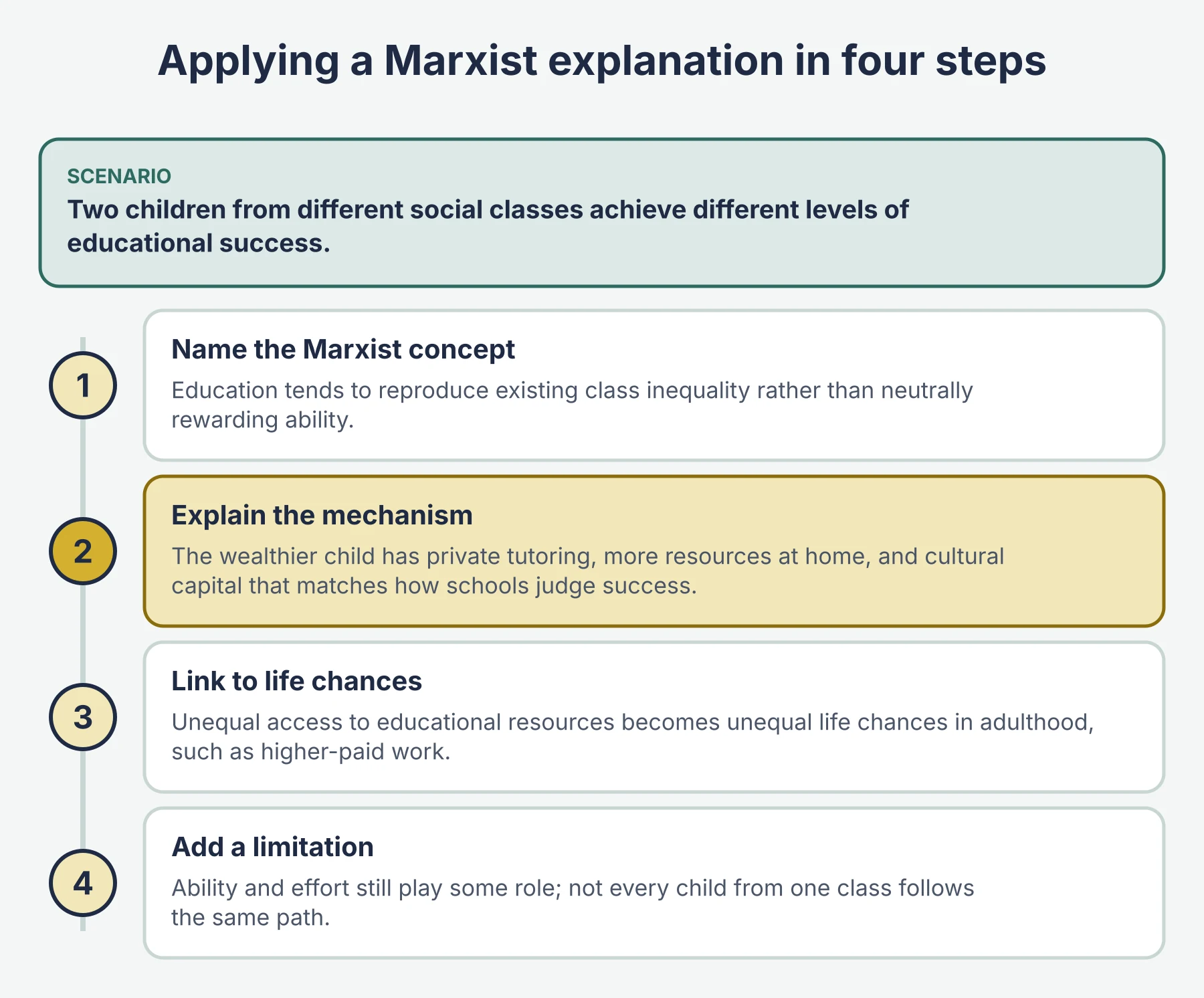
Marxism
- Exploitation of the proletariat: the bourgeoisie own the means of production and take the surplus value workers create.
- Ideological control: education, media and religion persuade workers that inequality is fair (false consciousness).
- Poverty trap: low pay and loss of benefits when earnings rise keep the poor in poverty.
- Reserve army of labour: the unemployed, casual workers and often women and migrants keep wages low because they can replace existing workers.
- Criticism: ignores gender and ethnicity as sources of inequality; mobility exists; class is not the only basis of power.
Exam traps
- Ascribed status is not always low status: royalty is ascribed.
- Wealth (assets) and income (earnings) are different.
- “Relative poverty” depends on the society; do not define it with a fixed amount.
- Name the mechanism of a theory, not just the label.
- Meritocracy must be defined and critiqued.
- Caste and slavery are examples of closed stratification.
Self-test
- What is the difference between an open and a closed society?
- Give one example of ascribed status that is high status.
- Define relative poverty.
- What is intergenerational mobility?
- Name the four varnas of the traditional caste system.
- Give two forms of modern slavery.
- Give one way social class affects health.
- Who coined the term intersectionality, and what does it mean?
- What is a master status?
- Explain the self-fulfilling prophecy.
- What is the reserve army of labour?
- Give one criticism of the Marxist view of inequality.
Answers
- A closed society fixes position at birth with little mobility; an open society allows position to be achieved.
- Royalty, or nobility inherited by birth.
- Lacking the standard of living considered normal in a particular society.
- Movement up or down compared with one’s parents’ position.
- Brahmins, Kshatriyas, Vaishyas and Shudras.
- Any two: forced labour, debt bondage, trafficking, domestic servitude, forced marriage.
- Manual work involves more hazards; poorer people have less access to healthcare or healthy food.
- Kimberlé Crenshaw; the combined effect of several inequalities, such as gender and ethnicity, on one person.
- A label that overrides all other aspects of a person’s identity.
- People act out the label given to them, so the prediction comes true.
- A pool of unemployed or casual workers who can be hired and dismissed as needed, keeping wages low.
- It neglects gender and ethnicity, or underestimates social mobility.
Related pages: key question 3.1 practice questions | key question 3.2 revision notes
Related resources
-
Study guides
Cambridge O Level Sociology (2251): Social stratification and inequality – What attempts have been made to reduce social inequalities?
Cambridge O Level Sociology 2251 key question 3.2 in depth: tax, benefits, equality laws, welfare states, NGOs and New Right, Marxist and feminist views.
Sociology · Cambridge · O Level
Read guide -
Practice questions
Cambridge O Level Sociology (2251): Social stratification and inequality – What attempts have been made to reduce social inequalities? – Practice Questions
Original Cambridge O Level Sociology 2251 practice on key question 3.2: equality laws, basic income, pensions, NGOs and feminist critiques, with answers.
Sociology · Cambridge · O Level
Try questions -
Revision notes
Cambridge O Level Sociology (2251): Social stratification and inequality – What attempts have been made to reduce social inequalities? – Revision Notes
Revision notes for Cambridge O Level Sociology 2251 key question 3.2: tax, benefits, equality laws, welfare states, NGOs and critiques of their success.
Sociology · Cambridge · O Level
Revise topic
Related articles
Get free revision emails (optional)
Occasional emails with practice questions, worked explanations and links to free resources for the qualification and subjects you choose. No spam, and you can unsubscribe from any email. The free tools on this site never need an email.