
Study Guides
Cambridge O Level Sociology (2251): Family – What are the different types of families?
Cambridge O Level Sociology 2251 key question 4.1 in depth: defining family, judging structures, diversity debates, alternatives and types of marriage.
- Subject
- Sociology
- Level
- O LEVELS
- Topic
- Paper 2 – Family, Education and Crime
- Author
- Marlbridge Academic Team
- Updated
- Reviewed by
- Naqiya Yousaf (what this means)
Aligned to Cambridge O Level Sociology (2251), 2025-2027. Official specification .
Syllabus page (what it covers and how it is assessed): Cambridge O Level Sociology.
Syllabus points this page covers
2251
- 4.1 Family – What are the different types of families?
Found an error? Report a correction.
Need help with this topic? Request a free trial class for O Level Sociology (2251).
Key question 4.1 of Cambridge O Level Sociology (2251) asks What are the different types of families? It opens the Family question on Paper 2, and its vocabulary returns in almost every part of that question: you cannot discuss the role of the family (4.2) or explain how family life is changing (4.3) without naming structures accurately. A list of family types is the starting point; this guide shows how to judge those types, how to use the diversity debate, and how to avoid the definitional slips that cost marks.
What the syllabus covers
| Section | Content named in the 2251 syllabus (2025–2027) |
|---|---|
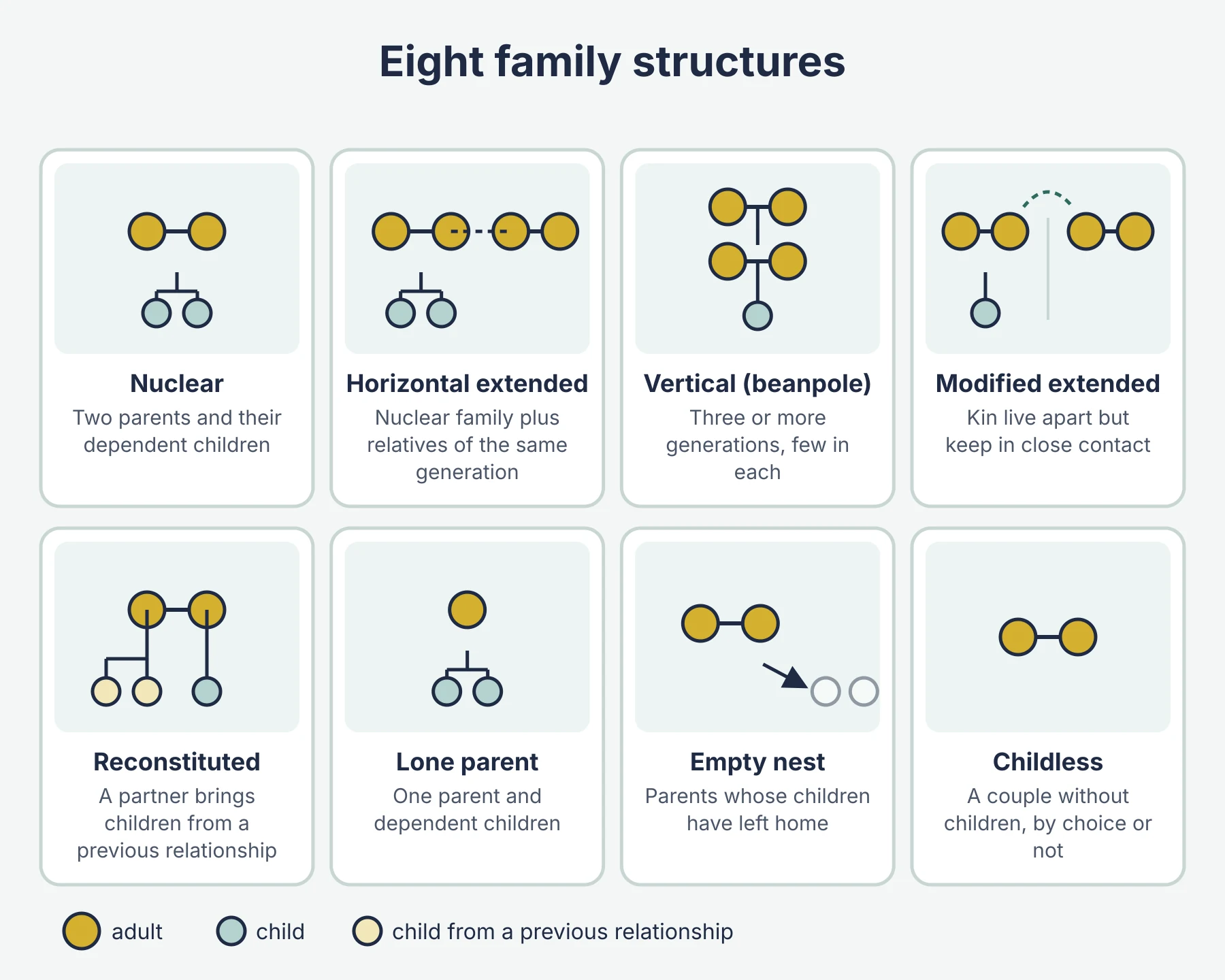
| 4.1.1 Different family structures | Nuclear; extended, e.g. modified, horizontal, vertical/beanpole; reconstituted; lone parent; empty nest; childless; strengths and limitations of different family structures |
| 4.1.2 Variations and diversity in the family | Cross-cultural; social class; ethnicity |
| 4.1.3 Sociological views on family diversity | New Right views on family diversity and dysfunctional families; postmodernist views on the positive aspects of family diversity; the extent of family diversity and the dominance of the nuclear family |
| 4.1.4 Alternatives to the family | Single person households; shared households; friends as family |
| 4.1.5 Variations in types of marriage | Arranged; empty shell; love; monogamy; serial monogamy |
The syllabus adds that other family and marriage types, such as polygamous and same-sex families, may be taught where appropriate to the local context. That content is not assessed, but you may use it to support an answer where relevant.
Family or household?
Before comparing structures, separate two terms that candidates often blur.
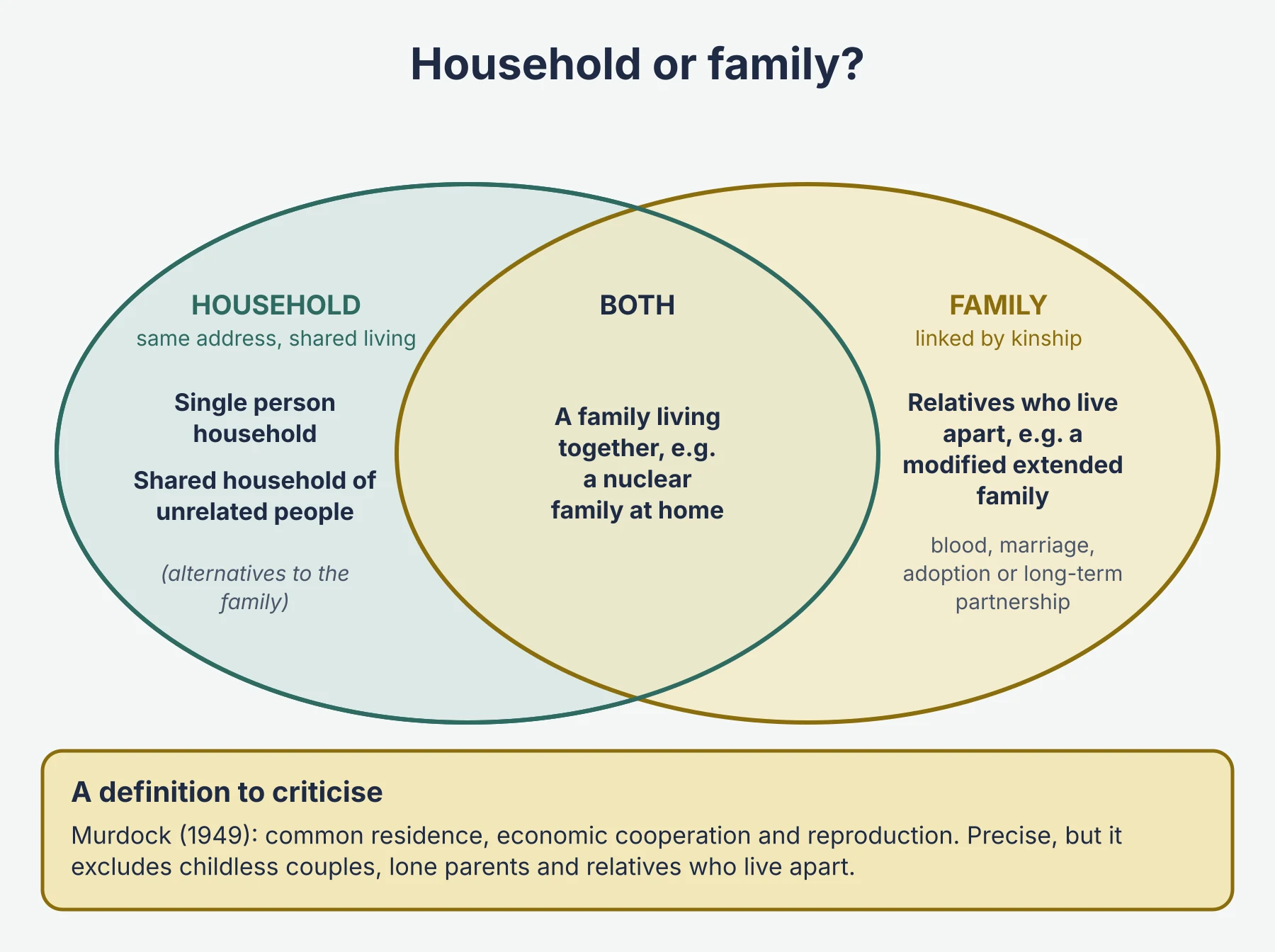
- A household is a person living alone, or a group of people living at the same address and sharing living arrangements. They need not be related.
- A family is a group linked by kinship: blood, marriage, adoption or, in some definitions, a long-term partnership. Its members need not live together.
George Murdock (1949) defined the family as a social group characterised by common residence, economic cooperation and reproduction, and claimed that the nuclear family is found in every society. His definition is useful because it is precise, but it is also easy to criticise: it excludes childless couples, lone parents and relatives who live apart, all of which appear in the 4.1.1 list. When a question asks you to define a family type, the household/family distinction is often what makes a definition precise. A single person household, for example, is a household but not a family, which is why the syllabus lists it under alternatives to the family.
Judging family structures: “strong for whom?”
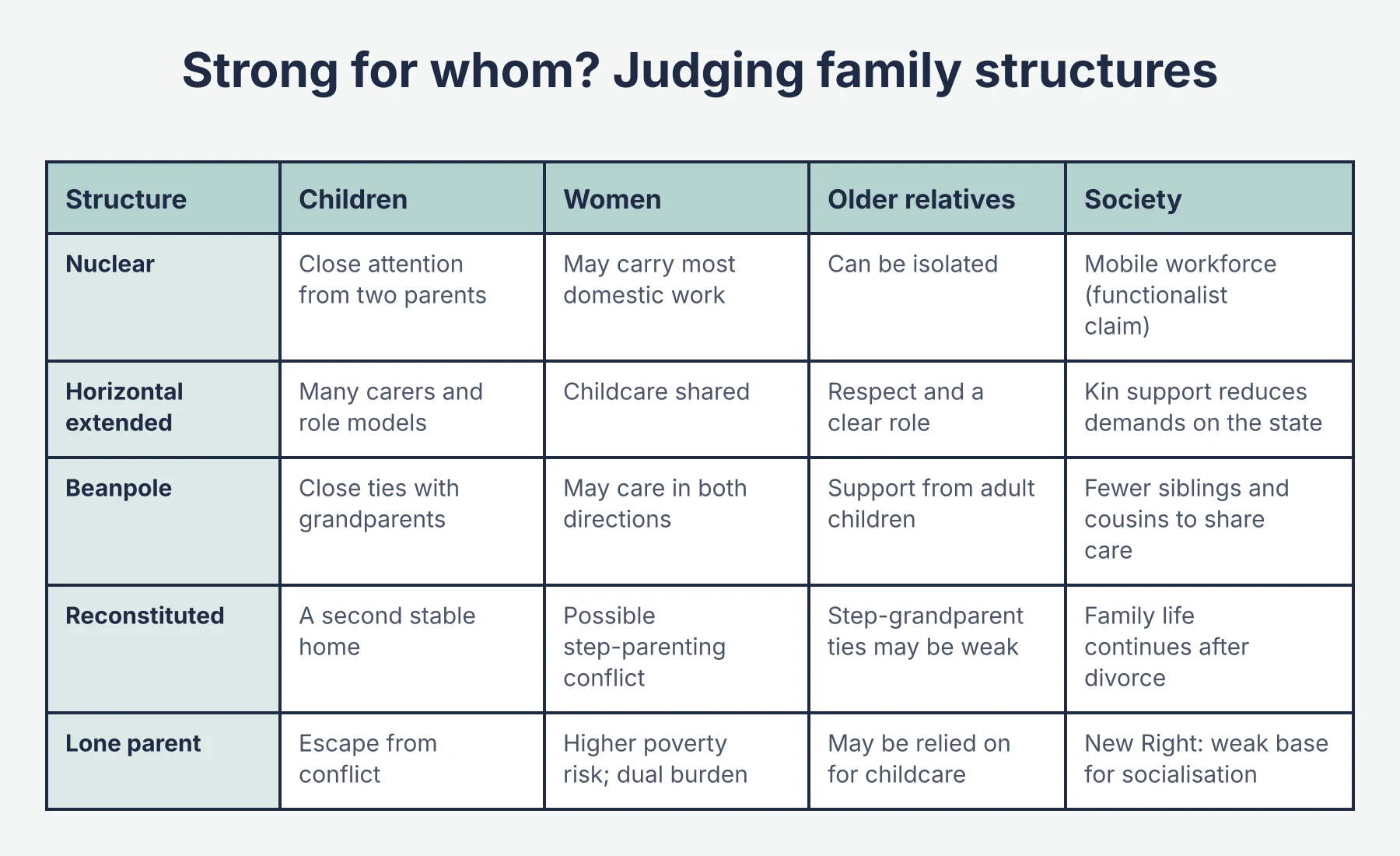
The syllabus asks for strengths and limitations of each structure. Many answers give one advantage and one disadvantage without saying who gains or loses. A stronger method is to judge each structure from the position of different members.
| Structure | Children | Women | Older relatives | Society |
|---|---|---|---|---|
| Nuclear | Close attention from two parents | May carry most domestic work | Can be isolated from the household | Mobile workforce (a functionalist claim) |
| Horizontal extended | Many carers and role models | Childcare shared among adults | Respect and a clear role | Kin support reduces demands on the state |
| Beanpole | Close ties with grandparents | Middle-generation women may care in both directions | Support from adult children | Fewer siblings and cousins to share care |
| Reconstituted | A second stable home after divorce | Possible conflict over step-parenting | Step-grandparent ties may be weak | Shows family life continuing after divorce |
| Lone parent | Escape from a conflict-filled home | Higher risk of poverty and the dual burden | May be relied on for childcare | New Right see a weak base for socialisation |
Using this grid, you can turn a simple point into a developed one: “The extended family can share childcare, which allows mothers to take paid work, but the same arrangement may limit privacy for the couple and give older relatives authority over parenting decisions.”
Variations and diversity (4.1.2)
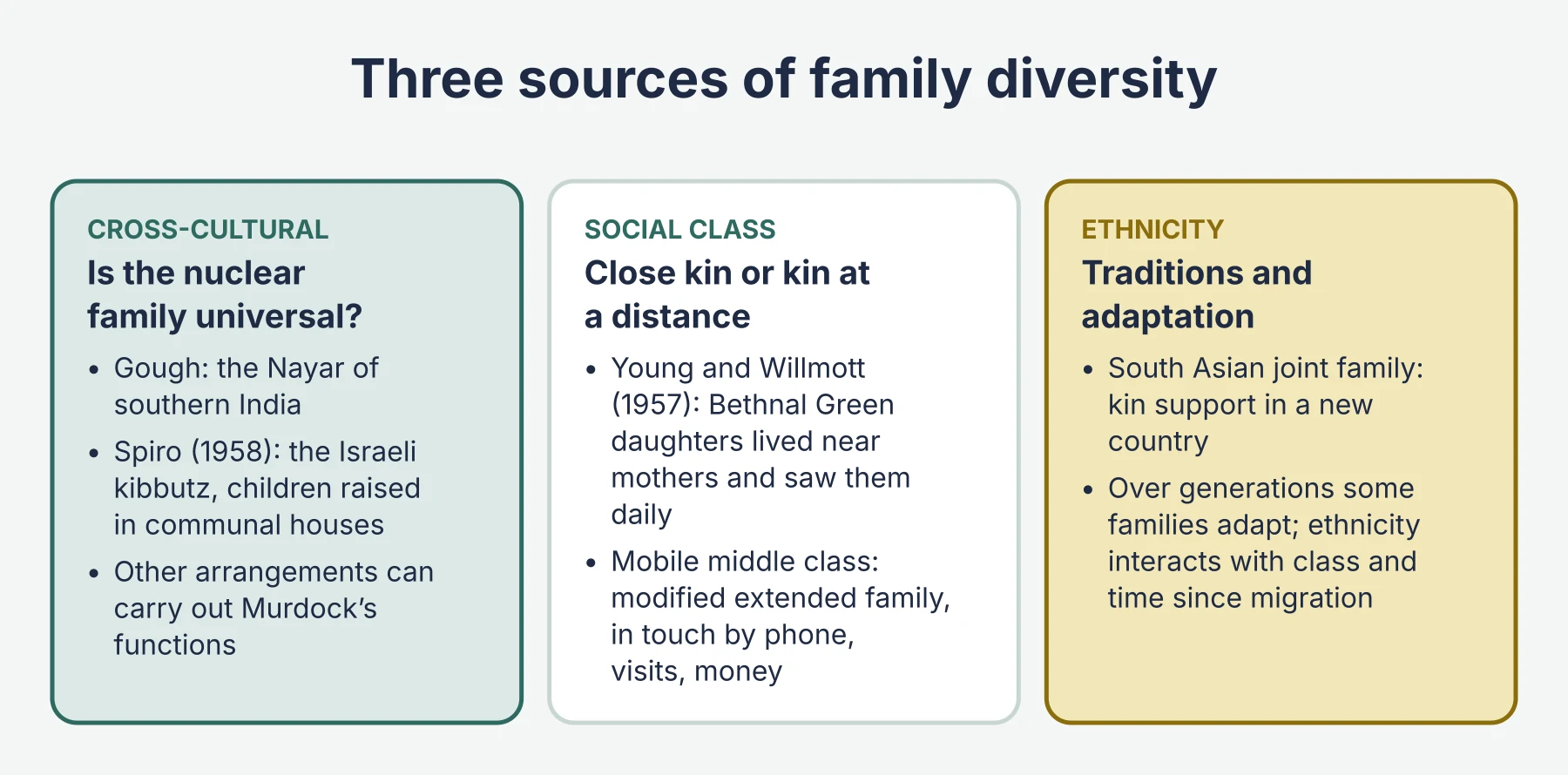
Cross-cultural. Murdock’s claim of a universal nuclear family has been challenged by studies of societies where children were raised without a co-resident father. Kathleen Gough’s work on the Nayar of southern India and Melford Spiro’s study of the Israeli kibbutz (Children of the Kibbutz, 1958), where children were raised in communal children’s houses, are the examples usually used. Both show that the functions Murdock gave to the nuclear family can be carried out by other arrangements.
Social class. Michael Young and Peter Willmott’s Family and Kinship in East London (1957) described working-class families in Bethnal Green where married daughters lived close to their mothers and saw them daily. Middle-class families are more often geographically mobile for careers, which makes the modified extended family more typical: relatives keep in touch by phone, visits and money rather than living nearby.
Ethnicity. Migrant families may keep extended-family traditions, such as the joint family in South Asian communities, because kin networks provide support in a new country. Over generations, some families adapt to the patterns of the society they live in, so ethnicity interacts with class and with time since migration.
The diversity debate (4.1.3)
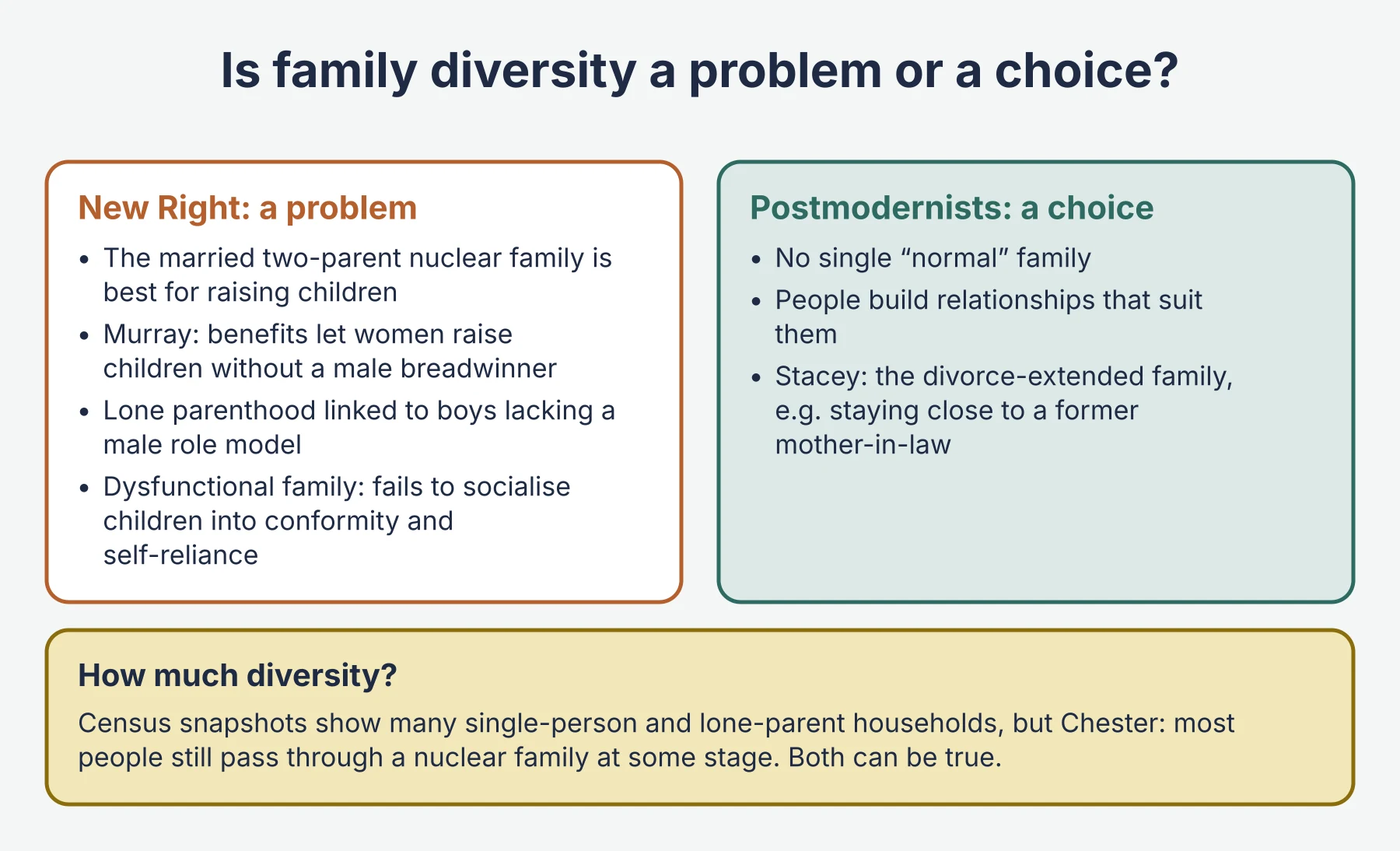
The New Right treat the married, two-parent nuclear family as the best structure for raising children. Charles Murray argued that welfare benefits made it possible for women to raise children without a male breadwinner, and linked lone parenthood to boys growing up without a male role model. In New Right terms, a dysfunctional family is one that fails to socialise children into conformity and self-reliance.
Postmodernists see diversity as a sign of choice. There is no single “normal” family, and people build relationships that suit them. Judith Stacey described a divorce-extended family, in which people stay connected through former marriages, for example a woman remaining close to her former mother-in-law.
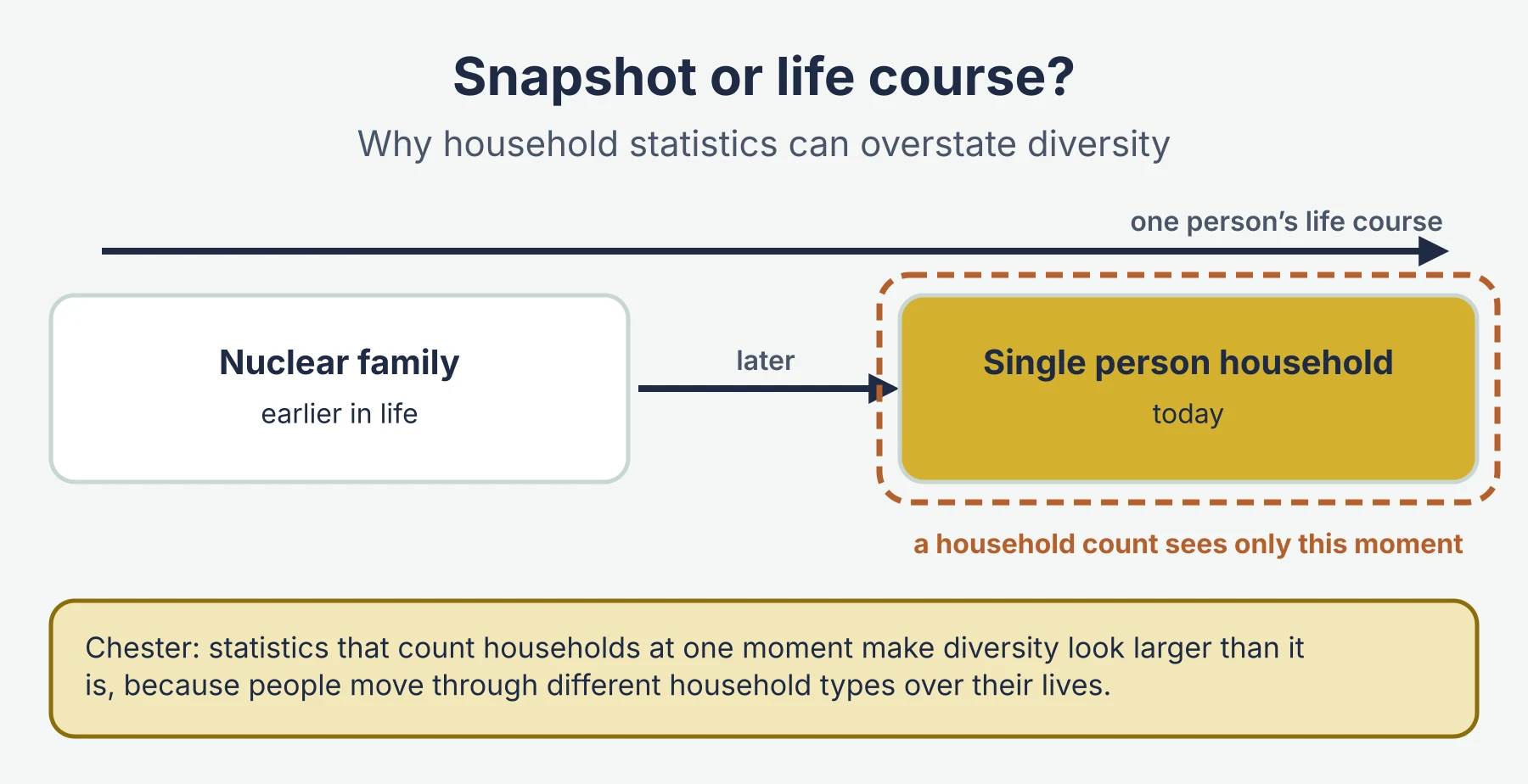
The third bullet, the extent of diversity and the dominance of the nuclear family, asks you to weigh these views. Census figures give a snapshot of households on one day, so they show many single-person and lone-parent households. Robert Chester’s point was that most people still pass through a nuclear family at some stage of their life. Diversity in a snapshot and the dominance of the nuclear family over a lifetime can both be true.
Alternatives to the family (4.1.4)
- Single person households have grown for different reasons in different groups: older widowed people living longer, young adults living alone while they establish careers, and people living alone after divorce.
- Shared households are groups of unrelated people, such as students or young workers sharing rent. They give companionship and lower costs without kinship obligations.
- Friends as family describes friendships that carry the emotional support and care once expected from relatives. Postmodernists see this as chosen intimacy; critics note friendships rarely carry the legal and lifelong obligations of kinship.
Types of marriage (4.1.5)
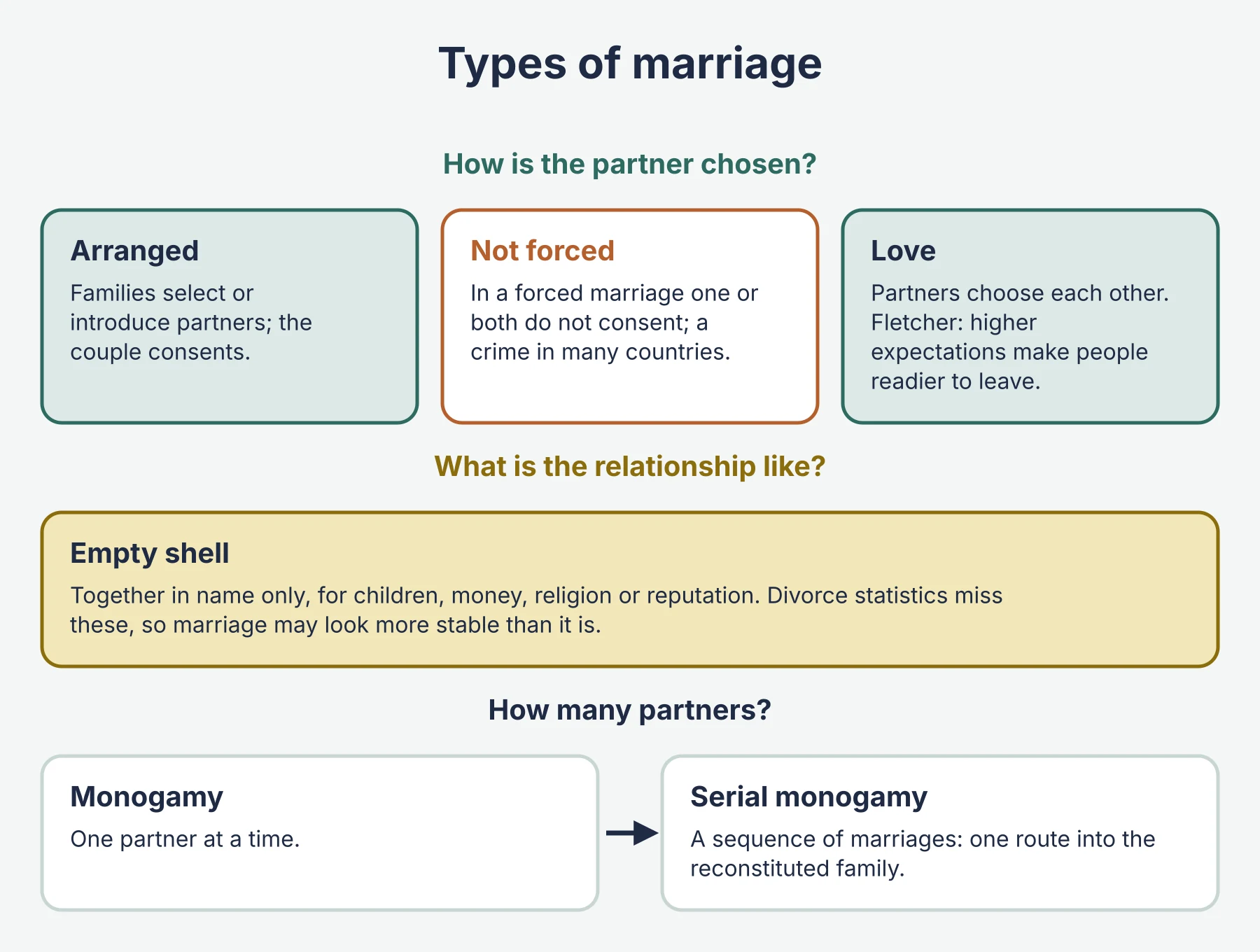
- Arranged marriage: families select or introduce partners, and the couple consents. It must not be confused with forced marriage, where one or both partners do not consent; this is a crime in many countries.
- Love marriage: partners choose each other on the basis of romantic attraction. Functionalist Ronald Fletcher argued that people now expect more from marriage, so they are more likely to leave a marriage that fails to meet those expectations.
- Empty shell marriage: the couple stay together in name only, for reasons such as children, finances, religion or reputation. Divorce statistics do not count these, so marriage may look more stable than it is.
- Monogamy is marriage to one partner at a time. Serial monogamy is a sequence of such marriages, which is one route into the reconstituted family.
Worked example: a definition and an explanation
Question: Define the term reconstituted family.
Model answer: A family in which at least one adult has a child or children from a previous relationship, formed when a lone parent marries or cohabits with a new partner.
Why it works: it names the defining feature (children from a previous relationship) and how the family forms. “A step-family” alone is a synonym, not a definition.
Question: Explain why the nuclear family may not be universal.
Annotated answer: “Murdock claimed the nuclear family exists in all societies [states the view]. However, in the kibbutz children lived in communal houses and were raised by trained carers, so key socialisation tasks were done outside the nuclear unit [evidence and mechanism]. In many societies today children are raised in lone-parent or extended households, so the nuclear family is one arrangement among several rather than a universal one [applies to the present].”
Common mistakes
- Treating household and family as the same thing.
- Calling every arranged marriage forced, or assuming that love marriages are always more stable.
- Mixing up beanpole (many generations, few members in each) with horizontal extended (more members of the same generation).
- Assuming lone-parent families are always headed by mothers, or that they are always poor.
- Describing the New Right and postmodernist views without saying which side each takes on whether diversity is good.
- Quoting census figures as proof the nuclear family has disappeared, without the life-course argument.
Exam technique for 2251 command words
- Define: one or two precise sentences with the defining feature, not an example alone.
- Give / Identify: a short, accurate answer, such as naming two alternatives to the family.
- Explain: give a point, the reason or mechanism behind it, and an example. “Explain three limitations” needs three separate, developed points.
- Discuss: write in depth and in a structured way, for instance setting out the postmodernist view, supporting it with Stacey, then considering criticisms.
- Evaluate / Assess: weigh both sides and finish with a judgement, for example on how dominant the nuclear family still is.
Keep revising
Related resources
-
Revision notes
Cambridge O Level Sociology (2251): Family – What are the different types of families? – Revision Notes
Revision notes for Cambridge O Level Sociology 2251 key question 4.1: family structures, diversity, alternatives and marriage types, with a self-test.
Sociology · Cambridge · O Level
Revise topic -
Study guides
Cambridge O Level Sociology (2251): Family – What is the role of the family for the individual and society?
Cambridge O Level Sociology 2251 key question 4.2 in depth: functionalist, Marxist and feminist views of the family, their limits and its dark side.
Sociology · Cambridge · O Level
Read guide -
Practice questions
Cambridge O Level Sociology (2251): Family – What is the role of the family for the individual and society? – Practice Questions
Original Cambridge O Level Sociology 2251 Family practice on functionalist, Marxist and feminist views of the family's role, with mark-scheme answers.
Sociology · Cambridge · O Level
Try questions
Related articles
Get free revision emails (optional)
Occasional emails with practice questions, worked explanations and links to free resources for the qualification and subjects you choose. No spam, and you can unsubscribe from any email. The free tools on this site never need an email.