
Study Guides
Cambridge O Level Sociology (2251): Family – What is the role of the family for the individual and society?
Cambridge O Level Sociology 2251 key question 4.2 in depth: functionalist, Marxist and feminist views of the family, their limits and its dark side.
- Subject
- Sociology
- Level
- O LEVELS
- Topic
- Paper 2 – Family, Education and Crime
- Author
- Marlbridge Academic Team
- Updated
- Reviewed by
- Naqiya Yousaf (what this means)
Aligned to Cambridge O Level Sociology (2251), 2025-2027. Official specification .
Syllabus page (what it covers and how it is assessed): Cambridge O Level Sociology.
Syllabus points this page covers
2251
- 4.2 Family – What is the role of the family for the individual and society?
Found an error? Report a correction.
Need help with this topic? Request a free trial class for O Level Sociology (2251).
Key question 4.2 of Cambridge O Level Sociology (2251) asks What is the role of the family for the individual and society? It is the theory core of the Family question. Three perspectives are named, each with its own list of concepts, and the syllabus then asks you to weigh them and to judge whether family life is positive or negative for its members. Longer answers on Paper 2 usually turn on this material, so this guide explains each view through its mechanism, then shows how to set the views against each other.
What the syllabus covers
| Section | Content named in the 2251 syllabus (2025–2027) |
|---|---|
| 4.2.1 Functionalist views | How the family benefits its members and society; functions of the family; the loss of functions debate; how family functions have changed over time; “warm bath” theory; importance of the nuclear family |
| 4.2.2 Marxist views | How the family benefits capitalism; exploitation of family members; reproduction of class inequalities; family as a unit of consumption; family and ideological control |
| 4.2.3 Feminist views | How the family benefits patriarchy and male power; the domestic division of labour; domestic violence and abuse; joint and segregated conjugal roles; dual burden / triple shift; decision-making; gendered socialisation |
| 4.2.4 | Strengths and limitations of functionalist, Marxist and feminist views of the role of the family |
| 4.2.5 | Debates about whether the experience of family life is positive or negative for family members |
Functionalism: the family meets society’s needs
Functionalists see society as a set of institutions that work together, like organs in a body. The question they ask is: what does the family do that society needs?
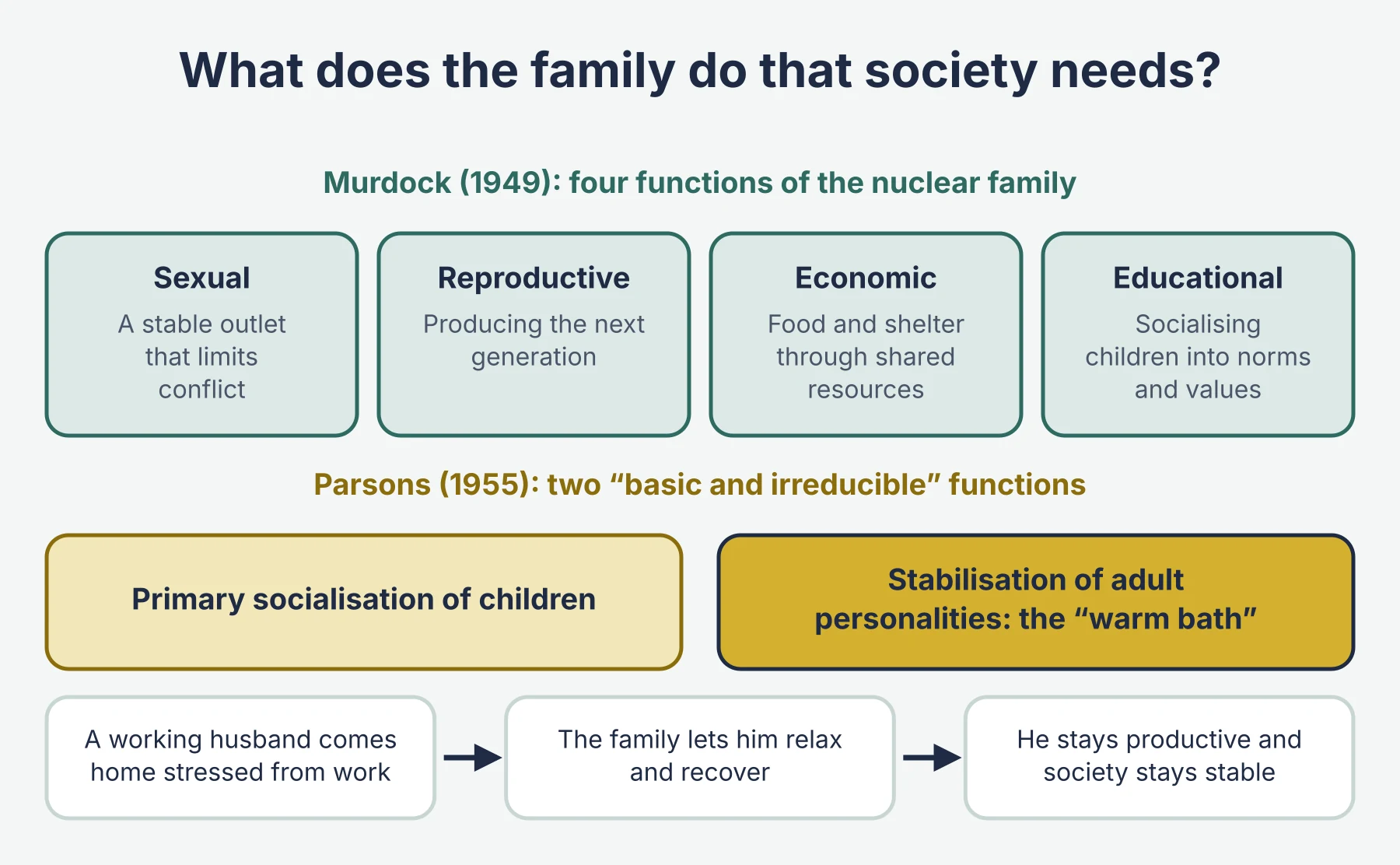
George Murdock (1949) studied a large number of societies and identified four functions of the nuclear family:
- Sexual: a stable outlet for sexual relationships, which limits conflict.
- Reproductive: producing the next generation.
- Economic: providing food and shelter through shared resources.
- Educational: socialising children into the norms and values of society.
Talcott Parsons (1955) argued that in modern industrial society the family keeps two “basic and irreducible” functions: the primary socialisation of children and the stabilisation of adult personalities. The second is often called the “warm bath” theory: the family is a place where an adult, usually pictured as a working husband, relaxes and recovers from the stress of work, which keeps him productive and keeps society stable.
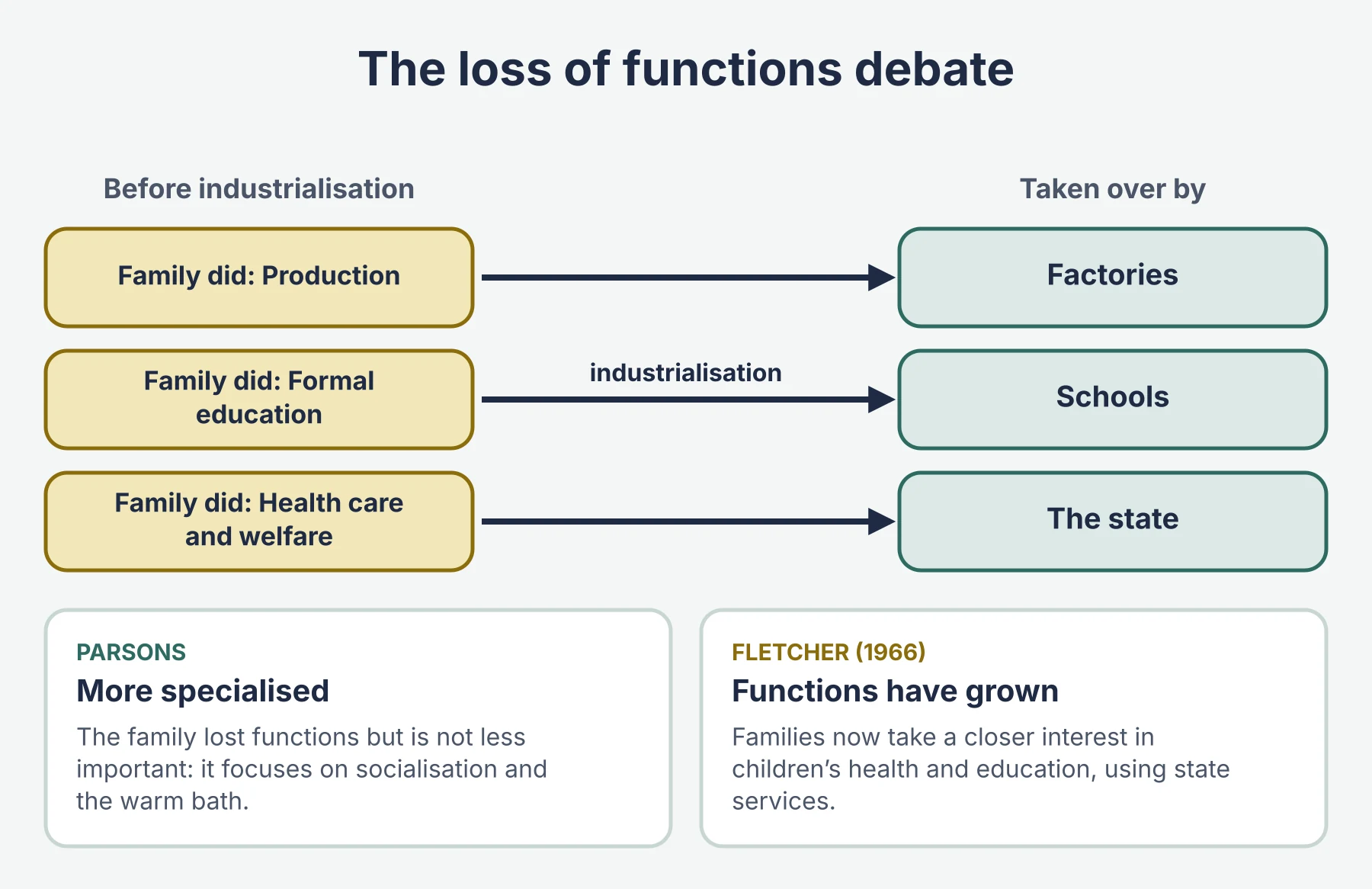
The loss of functions debate. Parsons argued that as society industrialised, specialised institutions took over jobs the family once did. Factories replaced the family as the unit of production; schools took over formal education; hospitals and the welfare state took on health care. The family lost functions but became more specialised in the two it kept. Ronald Fletcher (1966) disagreed: the family’s functions have not been lost but have grown in importance. Parents now supervise health and education more closely than before, and the state supports the family rather than replacing it.
Importance of the nuclear family. Parsons argued that the isolated nuclear family “fits” the needs of industrial society: it is small enough to move where jobs are, and status in it is not tied to an extended kin network.
Marxism: the family serves capitalism
Marxists see society as divided between the ruling class, who own the means of production, and the working class. Their question is: how does the family help capitalism continue?
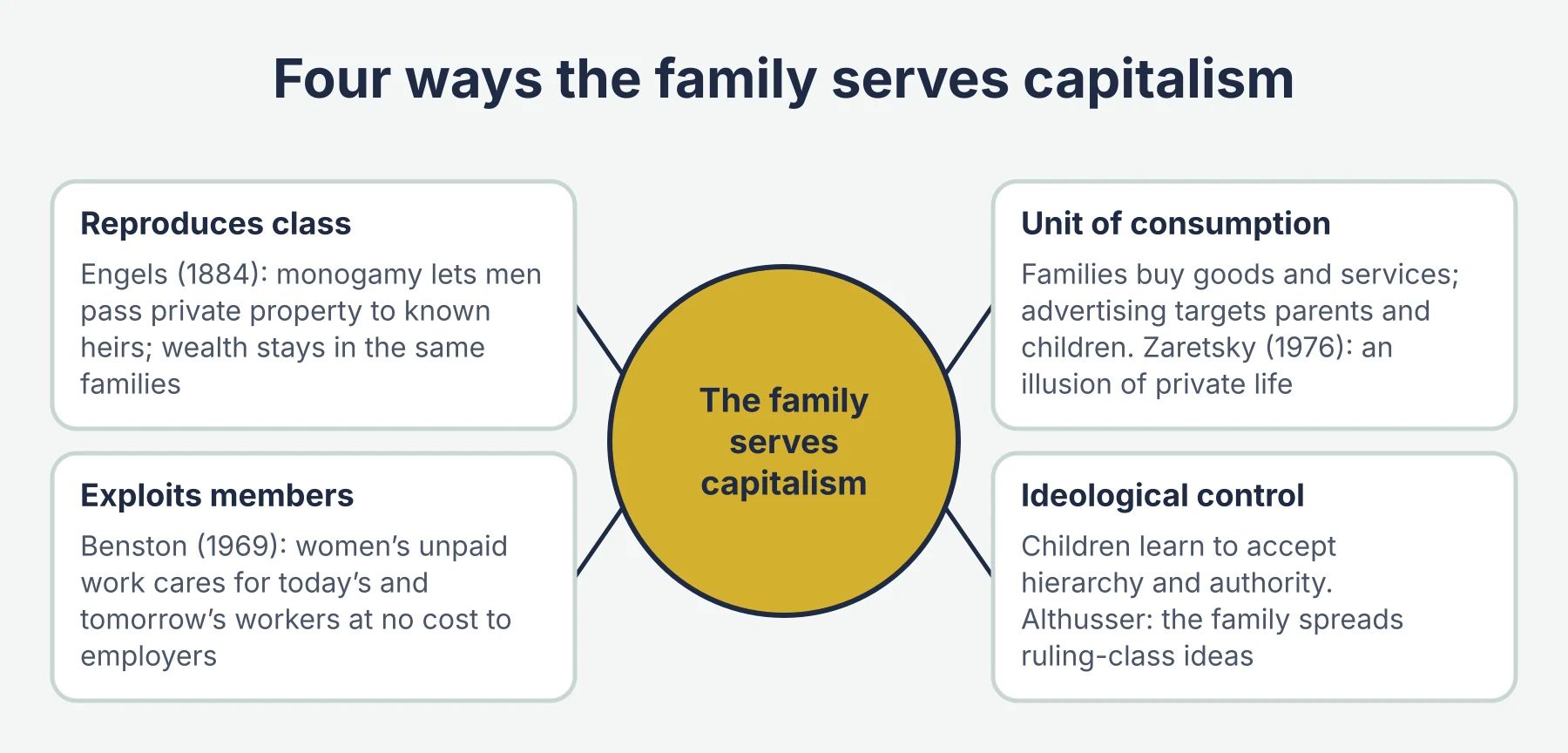
- How the family benefits capitalism and reproduces class inequality. Friedrich Engels (1884) argued that the monogamous family developed so that men could be sure who their heirs were and pass private property to them. Inheritance keeps wealth in the same families from one generation to the next, so class inequality is reproduced.
- Exploitation of family members. Unpaid domestic work by women feeds, clothes and cares for the current workforce and raises the next one at no cost to employers. Margaret Benston (1969), a Marxist feminist, argued this makes the family a free support system for capitalism.
- Family as a unit of consumption. Families buy goods and services, generating profit. Advertising targets parents and children, and families feel pressure to keep up with others through what they own. Eli Zaretsky (1976) argued that the family gives people an illusion of a private life separate from work, while in reality it props up the economy.
- Family and ideological control. Children learn in the family to accept hierarchy and authority, which prepares them to accept inequality at work. Louis Althusser listed the family among the institutions that spread ruling-class ideas.
Feminism: the family serves patriarchy
Feminists argue that the family benefits men more than women. Their question is: who does the work, who holds power, and who is harmed?
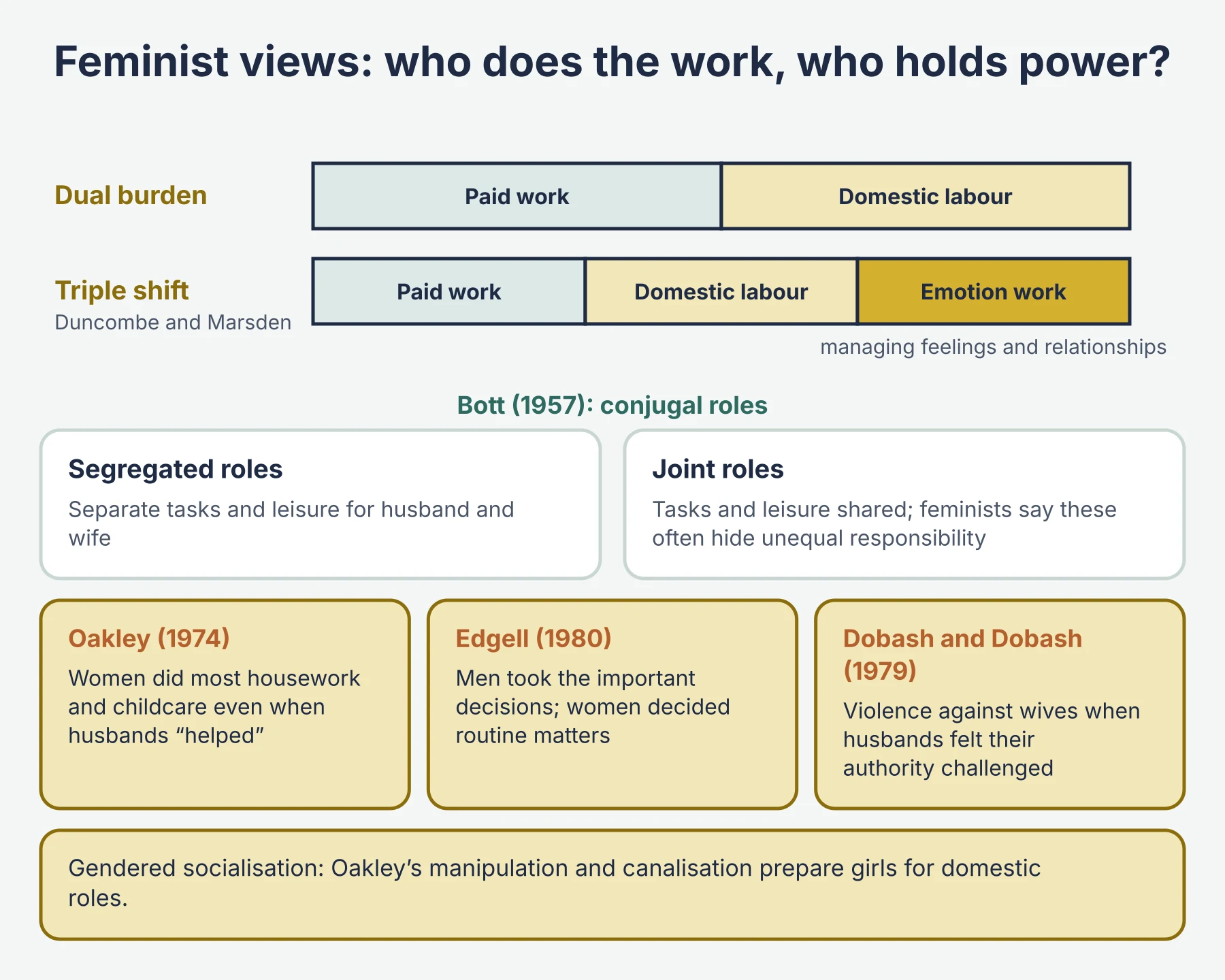
- Domestic division of labour. Ann Oakley’s The Sociology of Housework (1974) found that women took responsibility for most housework and childcare, even when husbands “helped”.
- Joint and segregated conjugal roles. Elizabeth Bott (1957) distinguished segregated roles (separate tasks and leisure for husband and wife) from joint roles (tasks and leisure shared). Feminists argue that apparently joint roles often hide unequal responsibility.
- Dual burden and triple shift. Women in paid work often carry a dual burden of a job plus domestic labour. Jean Duncombe and Dennis Marsden added a third shift, emotion work: managing the feelings and relationships of the family.
- Decision-making. Stephen Edgell (1980) found that in middle-class couples men took the decisions seen as important, such as moving house or major finances, while women decided routine matters.
- Domestic violence and abuse. R. Emerson Dobash and Russell Dobash (1979) found that violence against wives was often triggered when husbands felt their authority was challenged. Feminists see this as a product of patriarchy, not of a few “sick” individuals.
- Gendered socialisation. Oakley described manipulation (encouraging behaviour seen as gender-appropriate) and canalisation (directing children towards gendered toys and activities), which prepares girls for domestic roles.
Feminists differ among themselves: liberal feminists see gradual progress towards equality, while radical and Marxist feminists see the family as a core source of women’s oppression.
Weighing the three views (4.2.4)
| View | Strengths | Limitations |
|---|---|---|
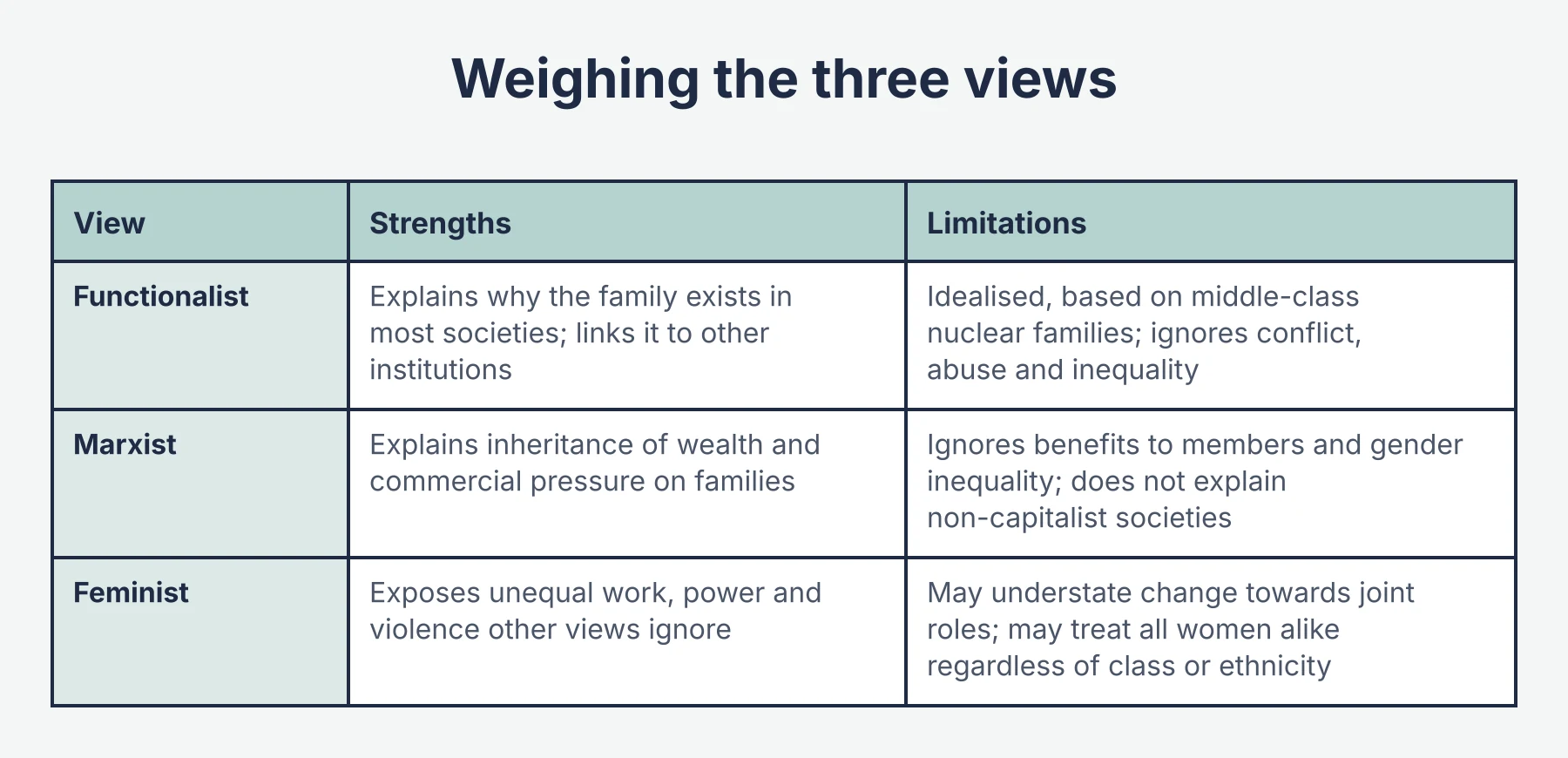
| Functionalist | Explains why the family exists in some form in most societies; links family to other institutions | Idealised and based on middle-class nuclear families; ignores conflict, abuse and inequality; assumes family members share interests |
| Marxist | Explains inheritance of wealth and the commercial pressure on families | Ignores benefits families give members; ignores gender inequality within the working class; does not explain families in non-capitalist societies |
| Feminist | Exposes unequal work, power and violence that other views ignore | May understate change towards joint roles and dual-earner equality; may treat all women as having the same experience regardless of class or ethnicity |
Positive or negative? (4.2.5)
This is a debate in its own right, so it needs evidence on both sides.
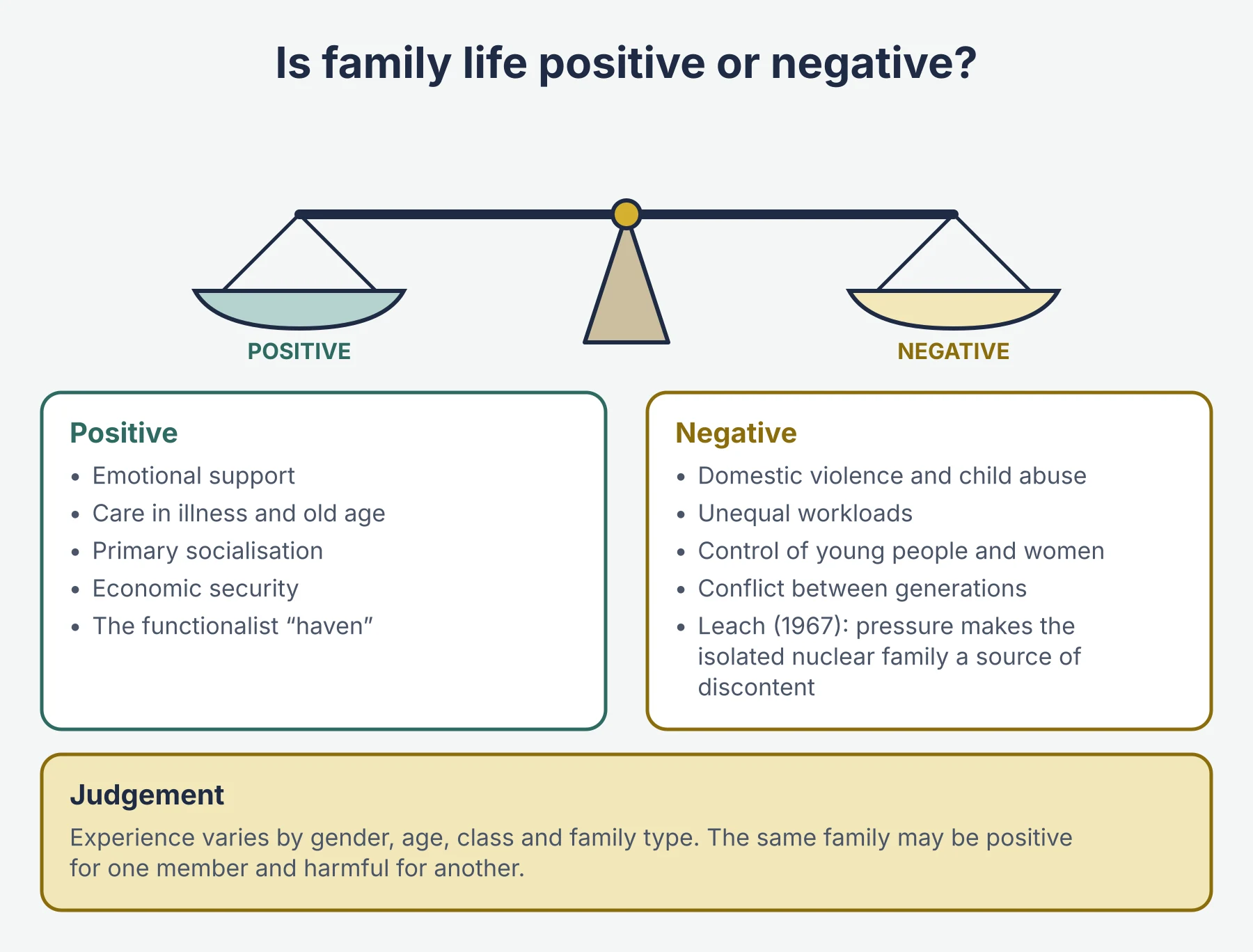
- Positive: emotional support; care in illness and old age; primary socialisation; economic security; the functionalist “haven” of family life.
- Negative: domestic violence and child abuse; unequal workloads; control of young people and women; conflict between generations. Edmund Leach (1967) argued that the isolated nuclear family is under such pressure that it becomes a source of discontent rather than a haven.
- Judgement: experience varies by gender, age, class and family type. The same family may be positive for one member and harmful for another, which is the strongest line for a conclusion.
Worked example: an annotated essay plan
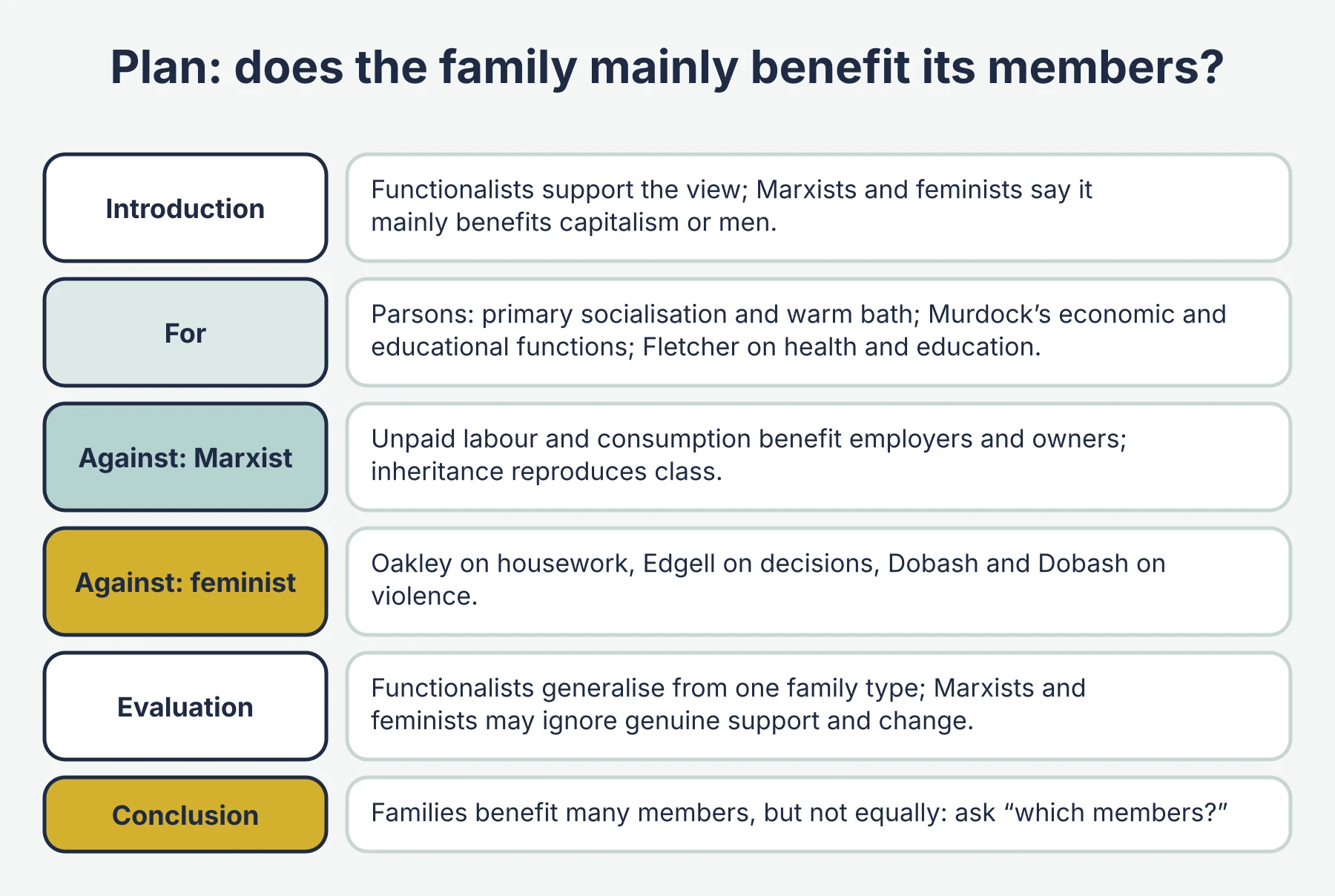
Question: Evaluate the view that the family mainly benefits its members.
- Introduction: functionalists support the view; Marxists and feminists say the family mainly benefits capitalism or men. Sets out the debate in two sentences.
- For: Parsons’s primary socialisation and warm bath theory; Murdock’s economic and educational functions; Fletcher on the family’s growing role in health and education. Each point explains how a member benefits.
- Against (Marxist): unpaid domestic labour and consumption benefit employers and owners; inheritance reproduces class. Shifts the beneficiary from members to capitalism.
- Against (feminist): Oakley on housework, Edgell on decision-making, Dobash and Dobash on violence. Shows some members benefit more than others.
- Evaluation: functionalists generalise from one family type; Marxists and feminists may ignore genuine support and change. Judges each view, not only the claim.
- Conclusion: families benefit many members, but not equally; the claim needs to ask “which members?” Answers the question directly.
Common mistakes
- Writing “functionalists think the family is good” without naming a function or a mechanism.
- Attributing the warm bath theory to the wrong perspective, or saying it stabilises children.
- Treating the loss of functions debate as one view rather than Parsons against Fletcher.
- Confusing dual burden (paid work plus domestic work) with the triple shift (adding emotion work).
- Writing a Marxist paragraph that only says “the family supports capitalism” without explaining consumption, inheritance or ideology.
- Ending an evaluation without a judgement.
Exam technique for 2251 command words
- Define concepts such as unit of consumption or segregated conjugal roles in one precise sentence.
- Explain each point with a mechanism: what happens, how it benefits a group, and who gains.
- Discuss a view by setting out its argument, supporting it with a named study, and giving at least one criticism.
- Evaluate by setting perspectives against each other and reaching a reasoned conclusion.
Keep revising
Related resources
-
Practice questions
Cambridge O Level Sociology (2251): Family – What is the role of the family for the individual and society? – Practice Questions
Original Cambridge O Level Sociology 2251 Family practice on functionalist, Marxist and feminist views of the family's role, with mark-scheme answers.
Sociology · Cambridge · O Level
Try questions -
Revision notes
Cambridge O Level Sociology (2251): Family – What is the role of the family for the individual and society? – Revision Notes
Revision notes for Cambridge O Level Sociology 2251 key question 4.2: functionalist, Marxist and feminist views of the family, with traps and a self-test.
Sociology · Cambridge · O Level
Revise topic -
Study guides
Cambridge O Level Sociology (2251): Family – How is family life changing?
Cambridge O Level Sociology 2251 key question 4.3 in depth: demographic change, industrialisation, divorce and cohabitation trends and changing family roles.
Sociology · Cambridge · O Level
Read guide
Related articles
Get free revision emails (optional)
Occasional emails with practice questions, worked explanations and links to free resources for the qualification and subjects you choose. No spam, and you can unsubscribe from any email. The free tools on this site never need an email.