
Revision Notes
Cambridge O Level Sociology (2251): Family – What is the role of the family for the individual and society? – Revision Notes
Revision notes for Cambridge O Level Sociology 2251 key question 4.2: functionalist, Marxist and feminist views of the family, with traps and a self-test.
- Subject
- Sociology
- Level
- O LEVELS
- Topic
- Paper 2 – Family, Education and Crime
- Author
- Marlbridge Academic Team
- Updated
- Reviewed by
- Naqiya Yousaf (what this means)
Aligned to Cambridge O Level Sociology (2251), 2025-2027. Official specification .
Syllabus page (what it covers and how it is assessed): Cambridge O Level Sociology.
Syllabus points this page covers
2251
- 4.2 Family – What is the role of the family for the individual and society?
Found an error? Report a correction.
Need help with this topic? Request a free trial class for O Level Sociology (2251).
These notes condense key question 4.2 of Cambridge O Level Sociology (2251), What is the role of the family for the individual and society? Three perspectives each answer the question “who benefits from the family?” differently: society as a whole (functionalism), capitalism and the ruling class (Marxism), or men (feminism). Learn one named study and one mechanism for every concept listed.
Syllabus coverage
- 4.2.1 Functionalist: benefits to members and society; functions; loss of functions debate; changing functions over time; “warm bath” theory; importance of the nuclear family.
- 4.2.2 Marxist: benefits to capitalism; exploitation; reproduction of class inequalities; unit of consumption; ideological control.
- 4.2.3 Feminist: benefits to patriarchy; domestic division of labour; domestic violence and abuse; joint and segregated conjugal roles; dual burden / triple shift; decision-making; gendered socialisation.
- 4.2.4 Strengths and limitations of all three views.
- 4.2.5 Whether family life is positive or negative for its members.
Key terms
| Term | Meaning |
|---|---|
| Function | The contribution an institution makes to keeping society running |
| Primary socialisation | Learning basic norms and values in early childhood, mainly in the family |
| Warm bath theory | Parsons: the family relieves adult stress so that workers return refreshed |
| Loss of functions | The view that specialised institutions took over family tasks after industrialisation |
| Functional fit | Parsons: the nuclear family suits the mobility needs of industrial society |
| Unit of consumption | The family as a buyer of goods and services that generate profit |
| Ideological control | Teaching ideas that make inequality seem normal or fair |
| Patriarchy | A system in which men hold power over women |
| Domestic division of labour | How housework and childcare are divided between partners |
| Segregated conjugal roles | Partners have separate tasks and leisure |
| Joint conjugal roles | Partners share tasks, decisions and leisure |
| Dual burden | Paid work plus most of the domestic work |
| Triple shift | Paid work, domestic work and emotion work |
| Emotion work | Managing family members’ feelings and relationships |
| Gendered socialisation | Learning behaviour seen as appropriate for one’s gender |
Functionalism in five lines
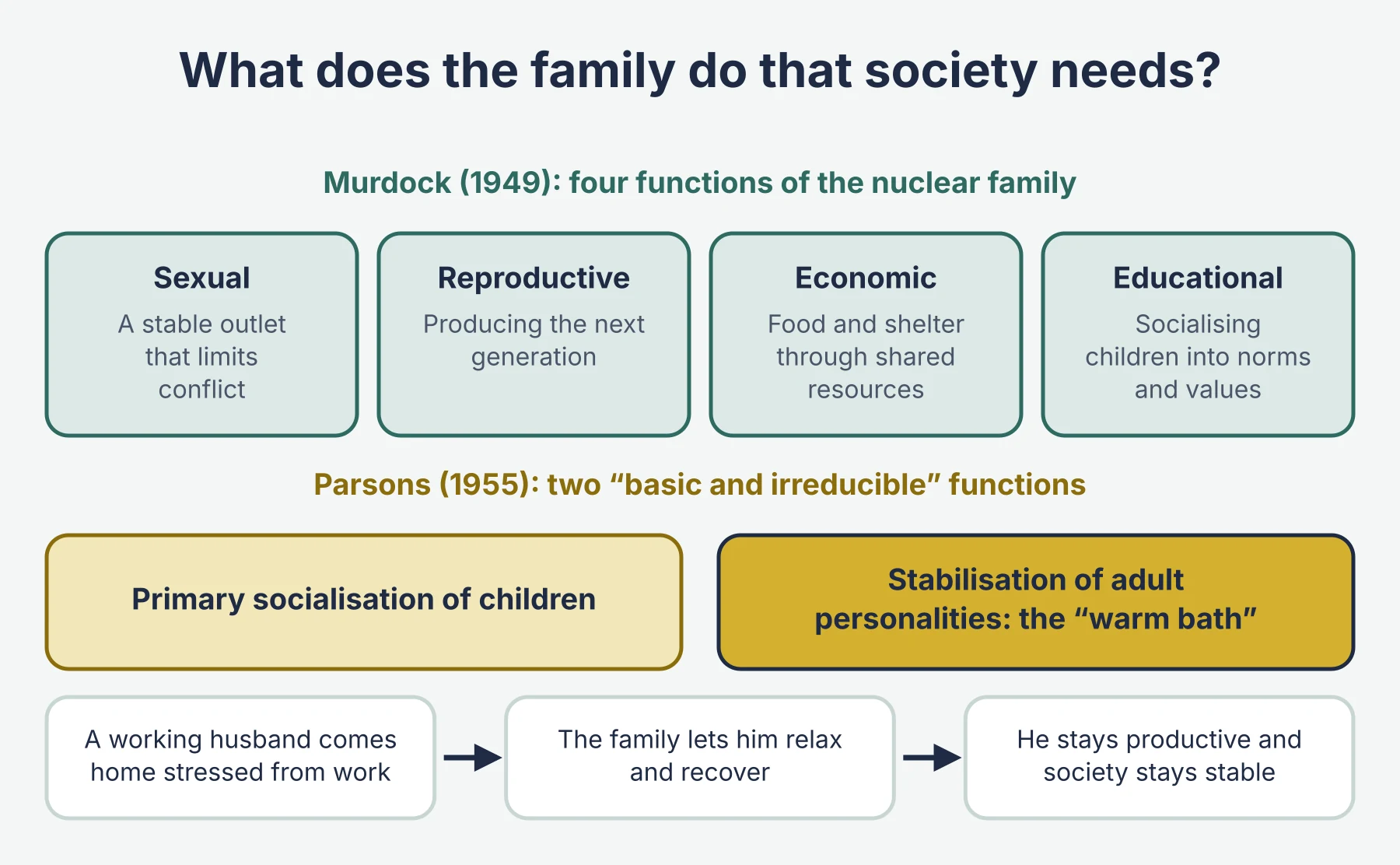
- Murdock (1949): four functions: sexual, reproductive, economic, educational.
- Parsons (1955): two irreducible functions: primary socialisation and stabilisation of adult personalities (the warm bath).
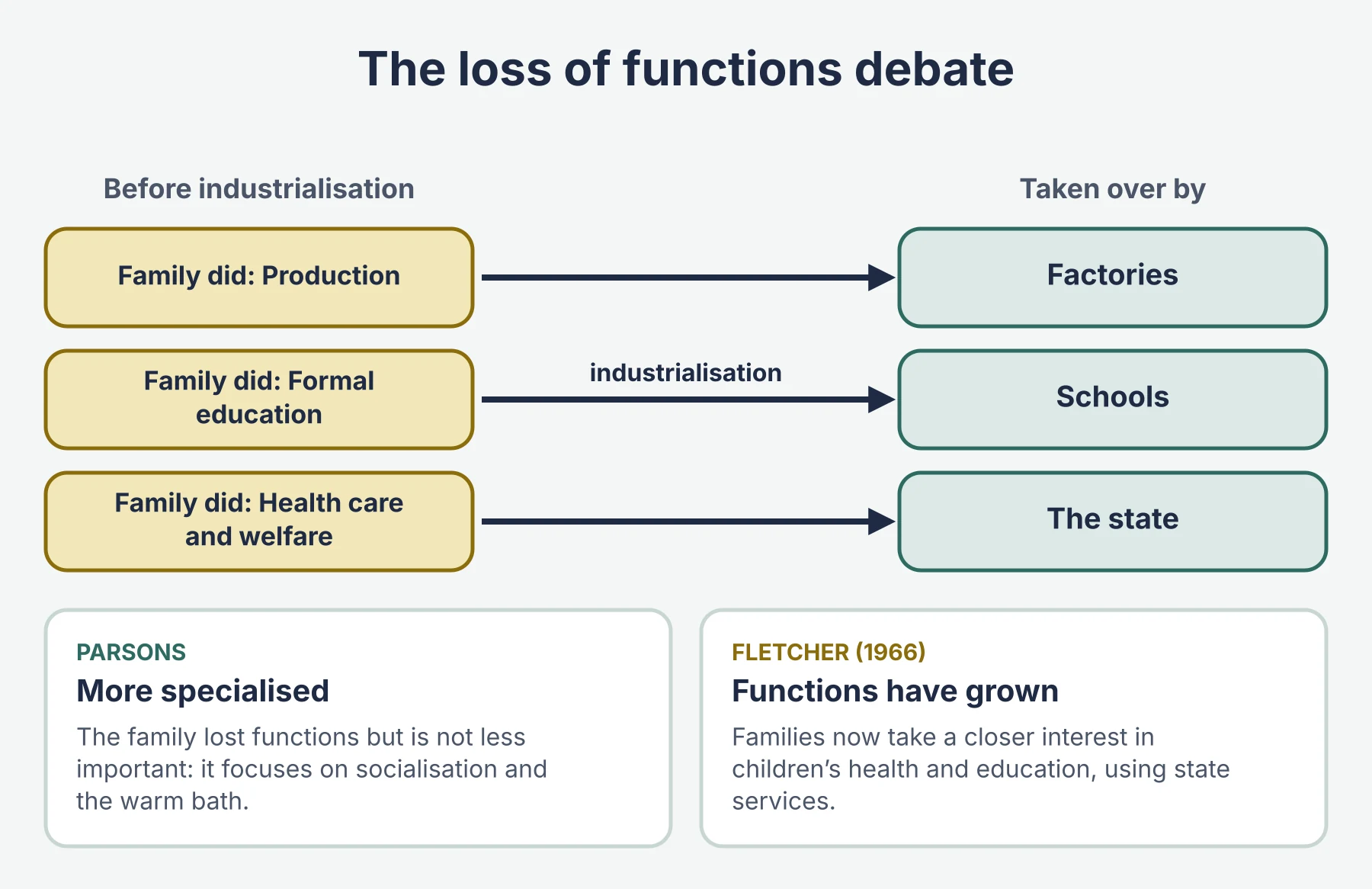
- Loss of functions: Parsons says production, education and health care moved to factories, schools and the state, leaving the family more specialised.
- Against: Fletcher (1966) says family functions have grown in importance, with the state supporting rather than replacing the family.
- Nuclear family: Parsons’s functional fit: small and mobile, suited to industrial work.
Marxism in five lines
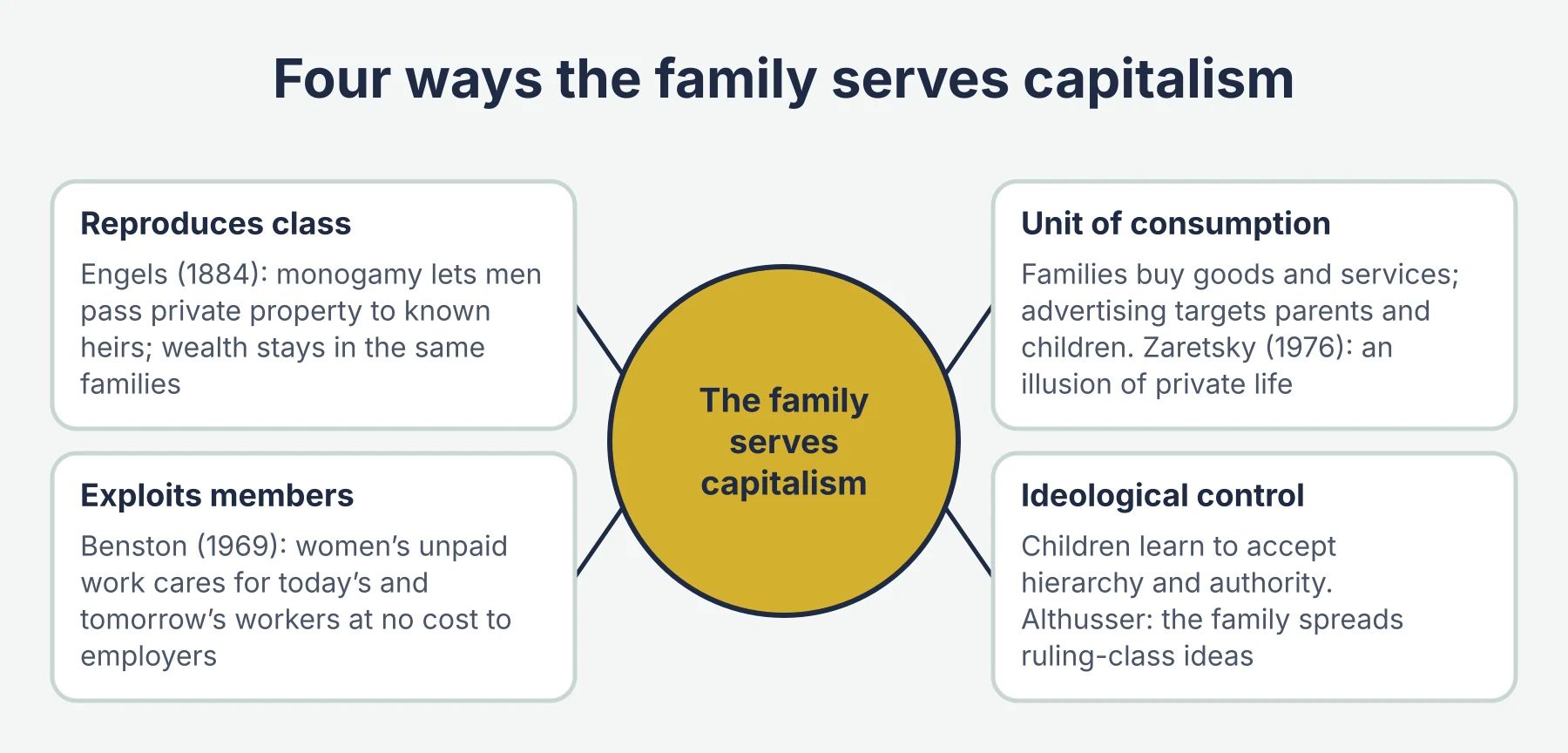
- Inheritance: Engels (1884): monogamy secures legitimate heirs for private property, so wealth and class stay in families.
- Exploitation: women’s unpaid domestic labour maintains today’s workers and raises tomorrow’s (Benston, 1969).
- Consumption: families spend wages on goods; advertising and peer pressure target parents and children.
- Illusion of private life: Zaretsky (1976): the family offers escape from work but props up the economy.
- Ideology: children learn obedience to authority, preparing them to accept hierarchy at work.
Feminism in six lines
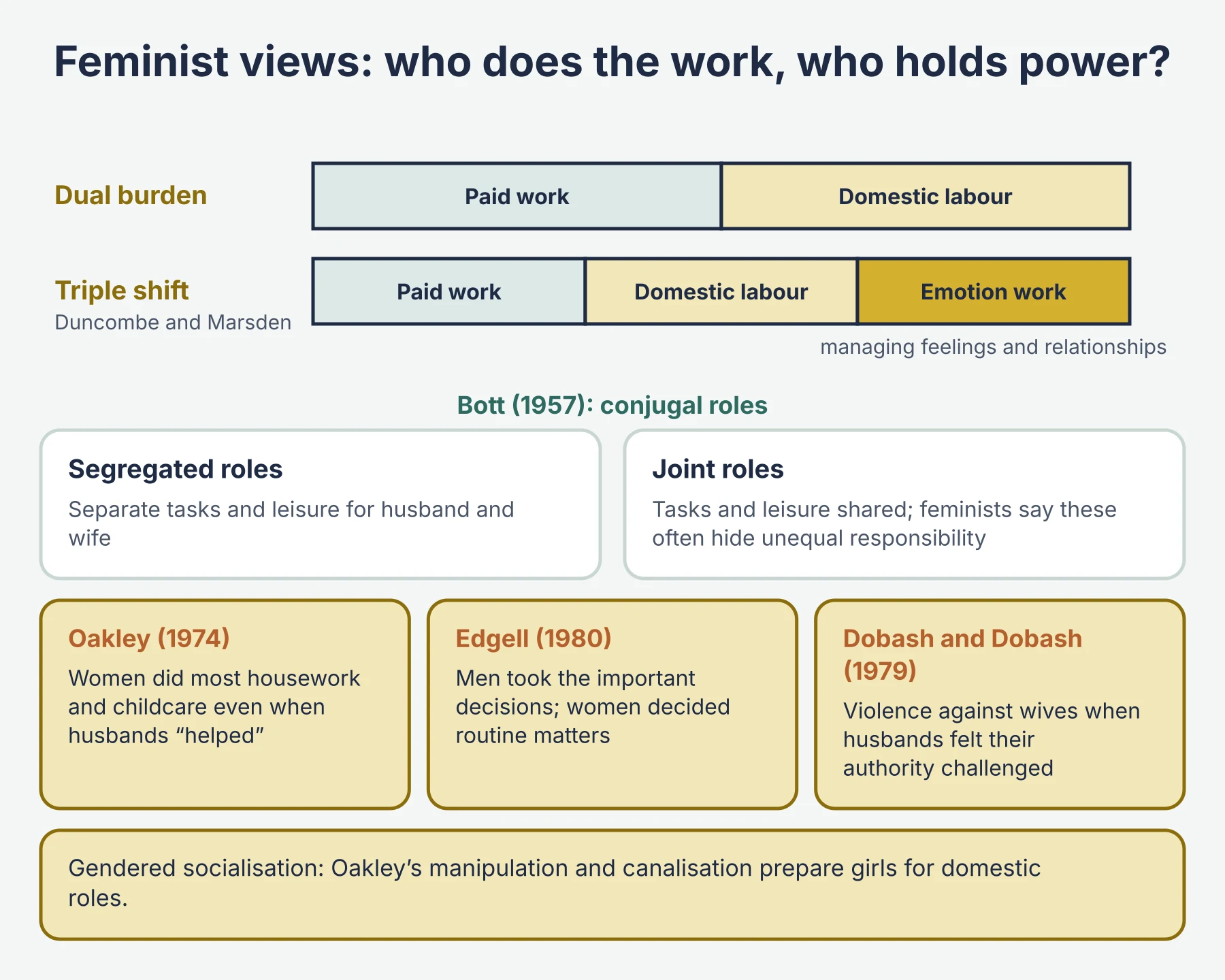
- Housework: Oakley (1974): women carry most housework and childcare.
- Conjugal roles: Bott (1957) distinguished joint from segregated roles; feminists say “joint” often hides unequal responsibility.
- Dual burden and triple shift: paid work, domestic work and emotion work (Duncombe and Marsden).
- Decisions: Edgell (1980): men take the important decisions, women the routine ones.
- Violence: Dobash and Dobash (1979): violence often follows a perceived challenge to the husband’s authority.
- Socialisation: Oakley’s manipulation and canalisation steer children into gender roles.
Strengths and limitations (4.2.4) in one sentence each
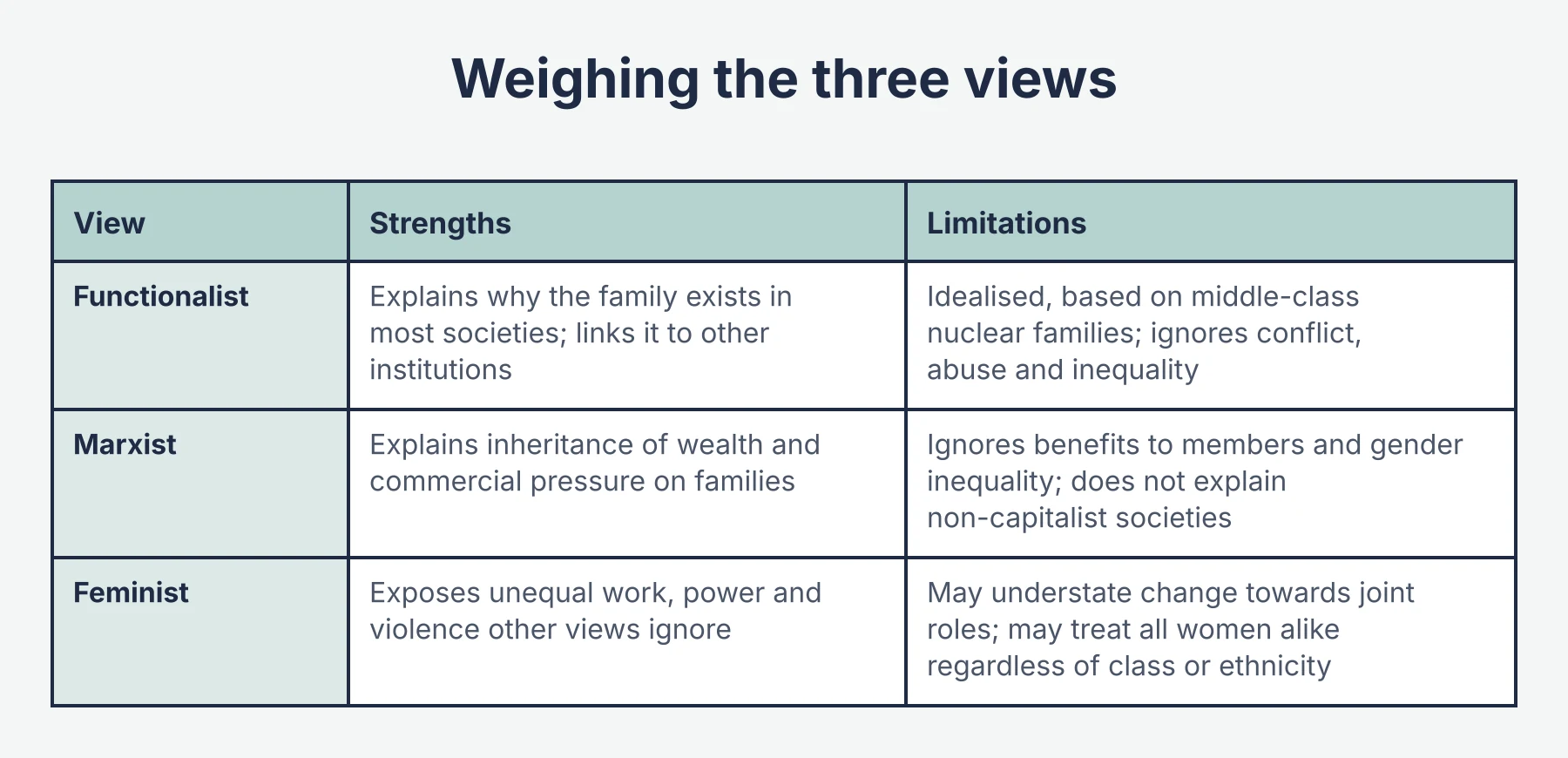
- Functionalism: explains why families exist almost everywhere, but paints a harmonious, middle-class picture that ignores abuse and inequality.
- Marxism: explains inheritance and consumer pressure, but ignores the real support families give and the gender inequality within classes.
- Feminism: exposes unequal work and power, but may understate change and treat all women’s experiences as the same.
Positive or negative? (4.2.5)
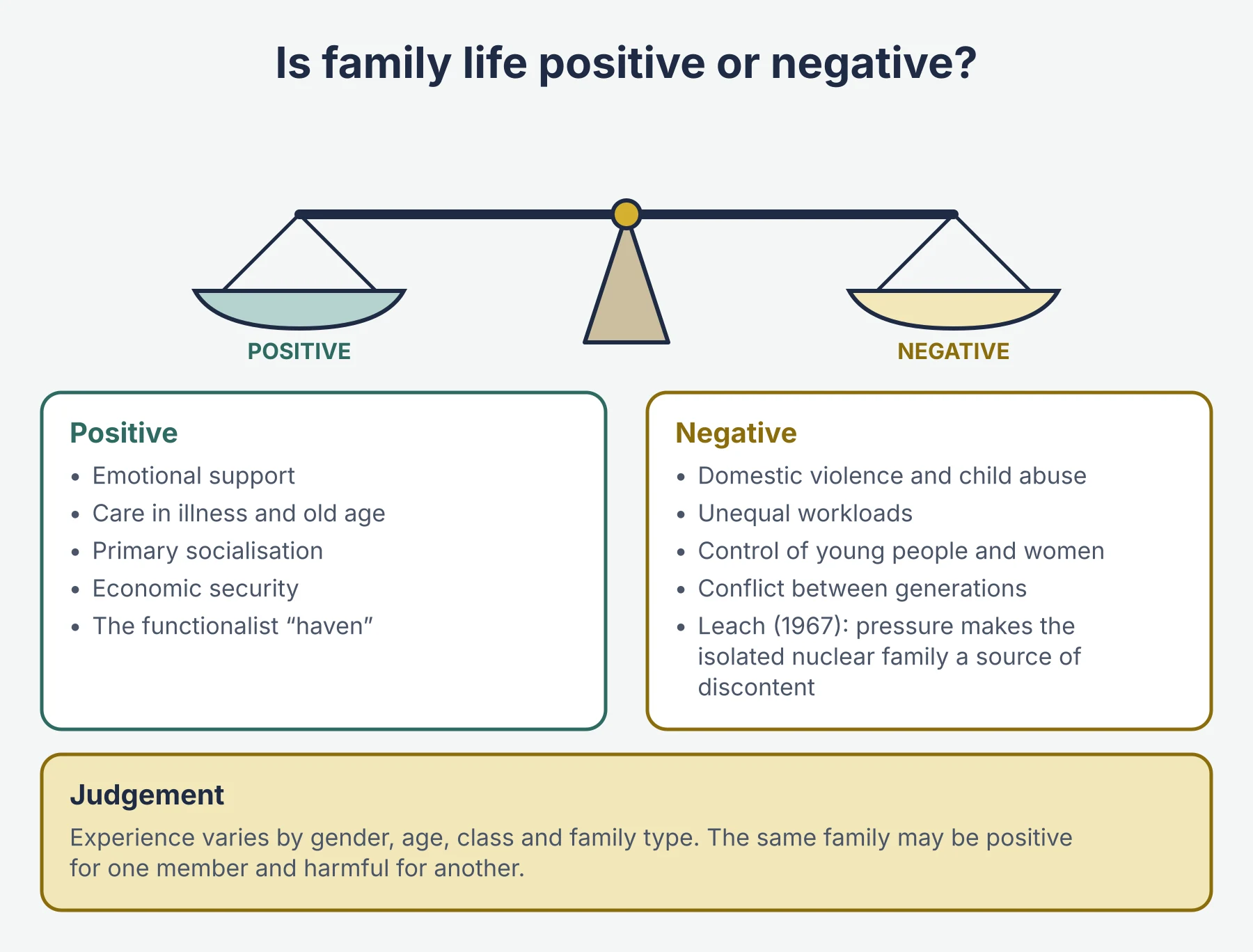
- Positive: love and support; care for the sick and elderly; socialisation; shared income.
- Negative: domestic violence and child abuse; unequal work; control of women and young people; Leach (1967) on the isolated family as a source of discontent.
- Best judgement: it depends which member you ask; gender, age and class shape experience.
Exam traps
- The warm bath stabilises adults, not children.
- The loss of functions debate needs both Parsons and Fletcher.
- Do not use “feminists think men are bad”: explain the mechanism, such as unequal decision-making.
- Marxist answers must say how capitalism benefits: consumption, unpaid labour, inheritance or ideology.
- Dual burden is two loads; triple shift is three. Keep them separate.
- In an evaluation, criticise a view with another view and with evidence of change.
Self-test
- Name Murdock’s four functions of the family.
- What are Parsons’s two irreducible functions?
- What is the warm bath theory?
- Who argued that family functions have grown, not shrunk?
- How, according to Engels, does the family reproduce class inequality?
- Explain the family as a unit of consumption.
- How does women’s unpaid domestic labour benefit capitalism?
- Distinguish joint from segregated conjugal roles.
- What is the triple shift?
- What did Edgell find about decision-making?
- What triggered violence in many cases studied by Dobash and Dobash?
- Give one limitation of the feminist view.
Answers
- Sexual, reproductive, economic and educational.
- Primary socialisation of children and stabilisation of adult personalities.
- The family relieves the stress of adult life, especially work, so that adults return refreshed and society stays stable.
- Ronald Fletcher (1966).
- Monogamy ensures legitimate heirs, so private property is inherited and wealth stays in the same families across generations.
- Families spend wages on goods and services, generating profit for capitalists, encouraged by advertising and peer pressure.
- It maintains current workers and raises the next generation of workers at no cost to employers.
- Segregated roles mean separate tasks and leisure; joint roles mean shared tasks, decisions and leisure.
- Paid work, domestic work and emotion work carried by women.
- Men made the decisions seen as most important, such as moving house and major finances; women made routine decisions.
- Husbands’ sense that their authority was being challenged.
- Any one: it may understate change towards more equal roles; it may treat all women as sharing the same experience regardless of class or ethnicity; it may overlook families women find supportive.
More resources on this topic
Related resources
-
Study guides
Cambridge O Level Sociology (2251): Family – How is family life changing?
Cambridge O Level Sociology 2251 key question 4.3 in depth: demographic change, industrialisation, divorce and cohabitation trends and changing family roles.
Sociology · Cambridge · O Level
Read guide -
Practice questions
Cambridge O Level Sociology (2251): Family – How is family life changing? – Practice Questions
Original Cambridge O Level Sociology 2251 Family practice on demographic change, divorce and cohabitation, and changing family roles, with full answers.
Sociology · Cambridge · O Level
Try questions -
Revision notes
Cambridge O Level Sociology (2251): Family – How is family life changing? – Revision Notes
Revision notes for Cambridge O Level Sociology 2251 key question 4.3: demographic change, divorce and cohabitation trends and changing roles, with a self-test.
Sociology · Cambridge · O Level
Revise topic
Related articles
Get free revision emails (optional)
Occasional emails with practice questions, worked explanations and links to free resources for the qualification and subjects you choose. No spam, and you can unsubscribe from any email. The free tools on this site never need an email.