
Study Guides
Cambridge O Level Sociology (2251): Family – How is family life changing?
Cambridge O Level Sociology 2251 key question 4.3 in depth: demographic change, industrialisation, divorce and cohabitation trends and changing family roles.
- Subject
- Sociology
- Level
- O LEVELS
- Topic
- Paper 2 – Family, Education and Crime
- Author
- Marlbridge Academic Team
- Updated
- Reviewed by
- Naqiya Yousaf (what this means)
Aligned to Cambridge O Level Sociology (2251), 2025-2027. Official specification .
Syllabus page (what it covers and how it is assessed): Cambridge O Level Sociology.
Syllabus points this page covers
2251
- 4.3 Family – How is family life changing?
Found an error? Report a correction.
Need help with this topic? Request a free trial class for O Level Sociology (2251).
Key question 4.3 of Cambridge O Level Sociology (2251) asks How is family life changing? It is the part of the Family topic most often tested through “explain why” questions, so the skill it rewards is linking a cause to an effect. This guide works through each of the five syllabus sections as chains of cause and consequence, and shows how to bring sociological perspectives into an answer about change.
What the syllabus covers
| Section | Content named in the 2251 syllabus (2025–2027) |
|---|---|
| 4.3.1 Demographic factors and their effects on family life | Family size; birth rates; life expectancy; ageing population; having children in later life |
| 4.3.2 | The impact of industrialisation and urbanisation on family structures and roles |
| 4.3.3 Explanations of changing patterns and trends in marriage, divorce and cohabitation | Legislation; societal attitudes and values; role of the internet; secularisation; cultural expectations; changes in the status and power of women / female empowerment |
| 4.3.4 Alternatives to marriage | Cohabitation; singlehood; lone parents; civil partnerships |
| 4.3.5 Changing family roles | Conjugal roles (more diverse family types; segregated to joint roles, e.g. symmetrical family, dual worker family; the pivot/sandwich generation); roles of children (economic burden/cost; child-centredness; boomerang children); roles of grandparents (childcare; economic support; wisdom and advice; dependent / a burden) |
Demographic change as cause and effect (4.3.1)
Demography is the study of population: births, deaths and migration. The birth rate is the number of live births per 1,000 people in the population per year. Life expectancy is the average number of years a person born in a given year can expect to live.
Write each factor as a chain:
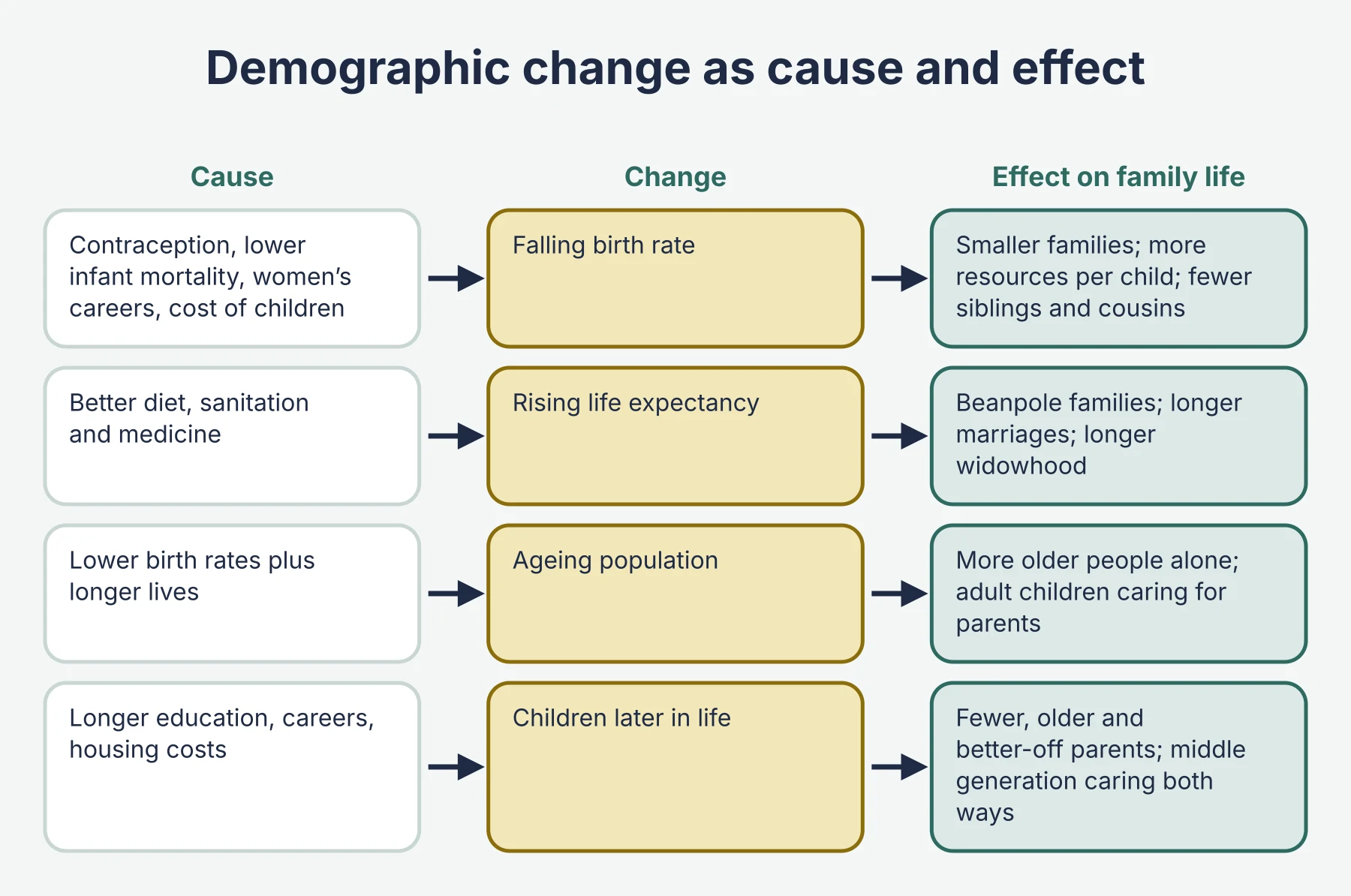
- Falling birth rates → smaller families. Causes include reliable contraception, falling infant mortality (parents no longer have extra children in case some die), women’s education and careers, and the rising cost of raising children. Effect: fewer siblings and cousins, more resources per child, and families that are “thin” across each generation.
- Rising life expectancy → more living generations. Better diet, sanitation and medicine mean grandparents and great-grandparents are more often alive. Effect: the beanpole family, longer marriages (which may raise the chance of divorce), and longer periods of widowhood.
- Ageing population → new care responsibilities. An ageing population has a rising share of older people, because of lower birth rates and longer lives. Effect: more older people living alone, more adult children caring for parents, and pressure on pensions and health services that shapes family decisions.
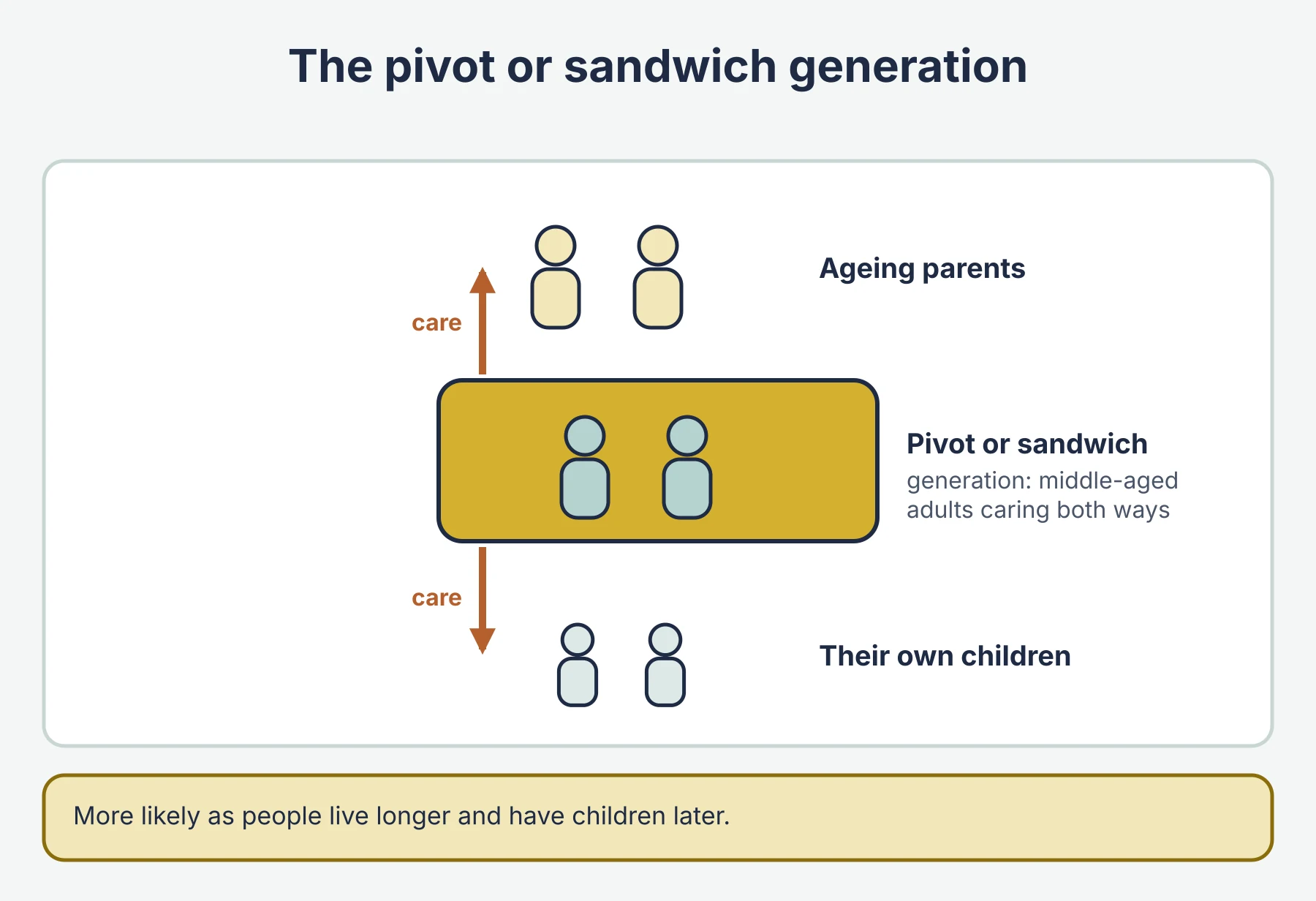
- Having children in later life → a wider gap between generations. Longer education, careers and housing costs delay parenthood. Effect: fewer children per couple, parents who are older and often better off, and a middle generation that may care for young children and frail parents at the same time.
Industrialisation and urbanisation (4.3.2)
Industrialisation is the shift from agricultural work to factory and service work; urbanisation is the movement of population from rural areas to towns and cities. The debate is about what these changes did to family structure and roles.
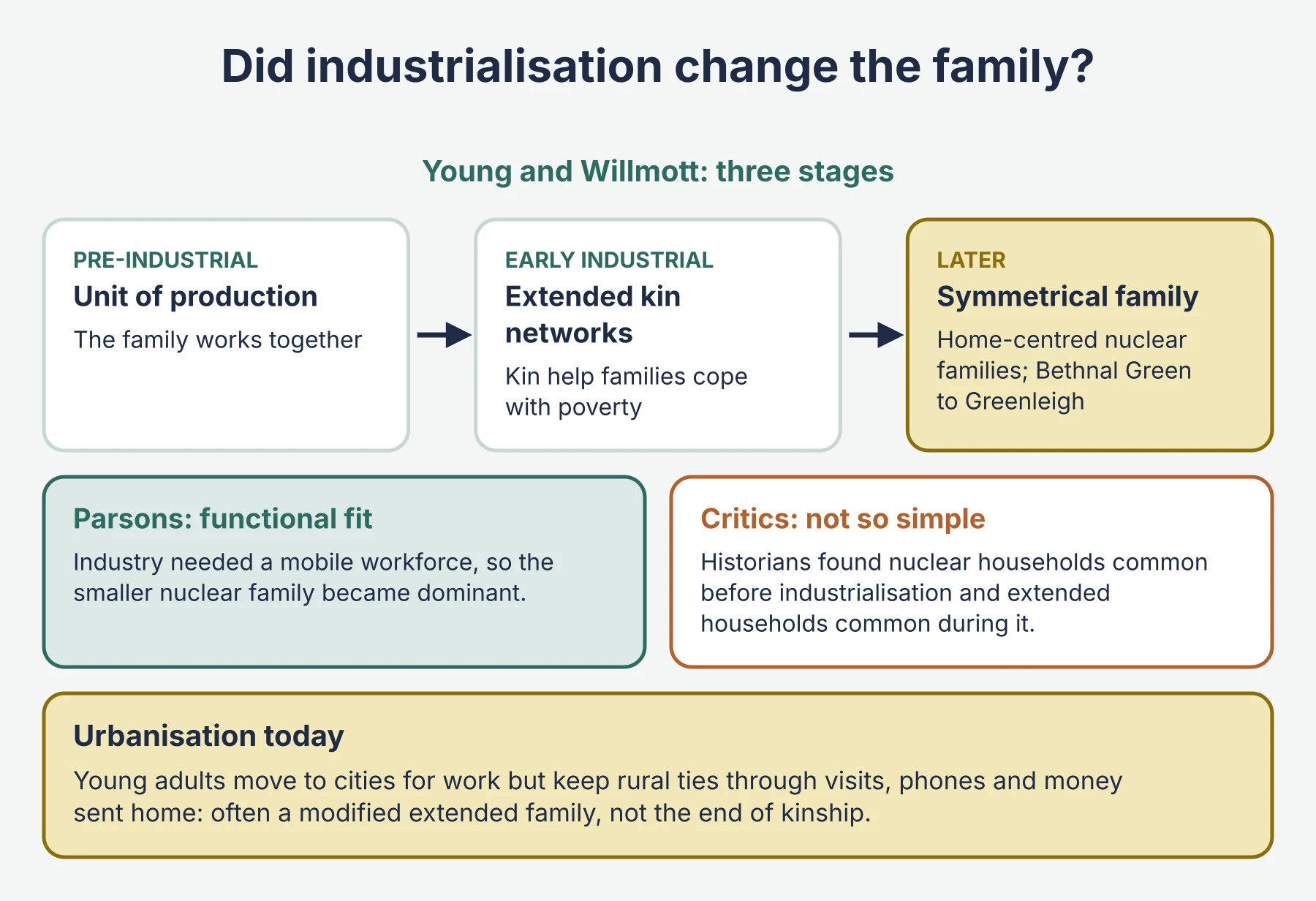
- Parsons (functional fit): the pre-industrial extended family worked together as a unit of production; industry needed a mobile workforce, so the smaller nuclear family became dominant.
- Young and Willmott described stages: the pre-industrial family as a unit of production; an early industrial stage in which extended kin networks helped families cope with poverty; and a later symmetrical stage of home-centred nuclear families. Their study of families moving from Bethnal Green to the new estate they called Greenleigh found that daily contact with extended kin fell and couples became more home-centred.
- Critics: historians found nuclear households common before industrialisation and extended households common during it, so the link is not simple.
- Urbanisation today: in many countries young adults move to cities for work, forming nuclear or single-person households while keeping ties to rural relatives through visits, phones and money sent home. The result is often a modified extended family rather than the end of kinship.
Why are marriage, divorce and cohabitation changing? (4.3.3)
Each named factor needs a mechanism, not just a label.
| Factor | Mechanism | Likely effect |
|---|---|---|
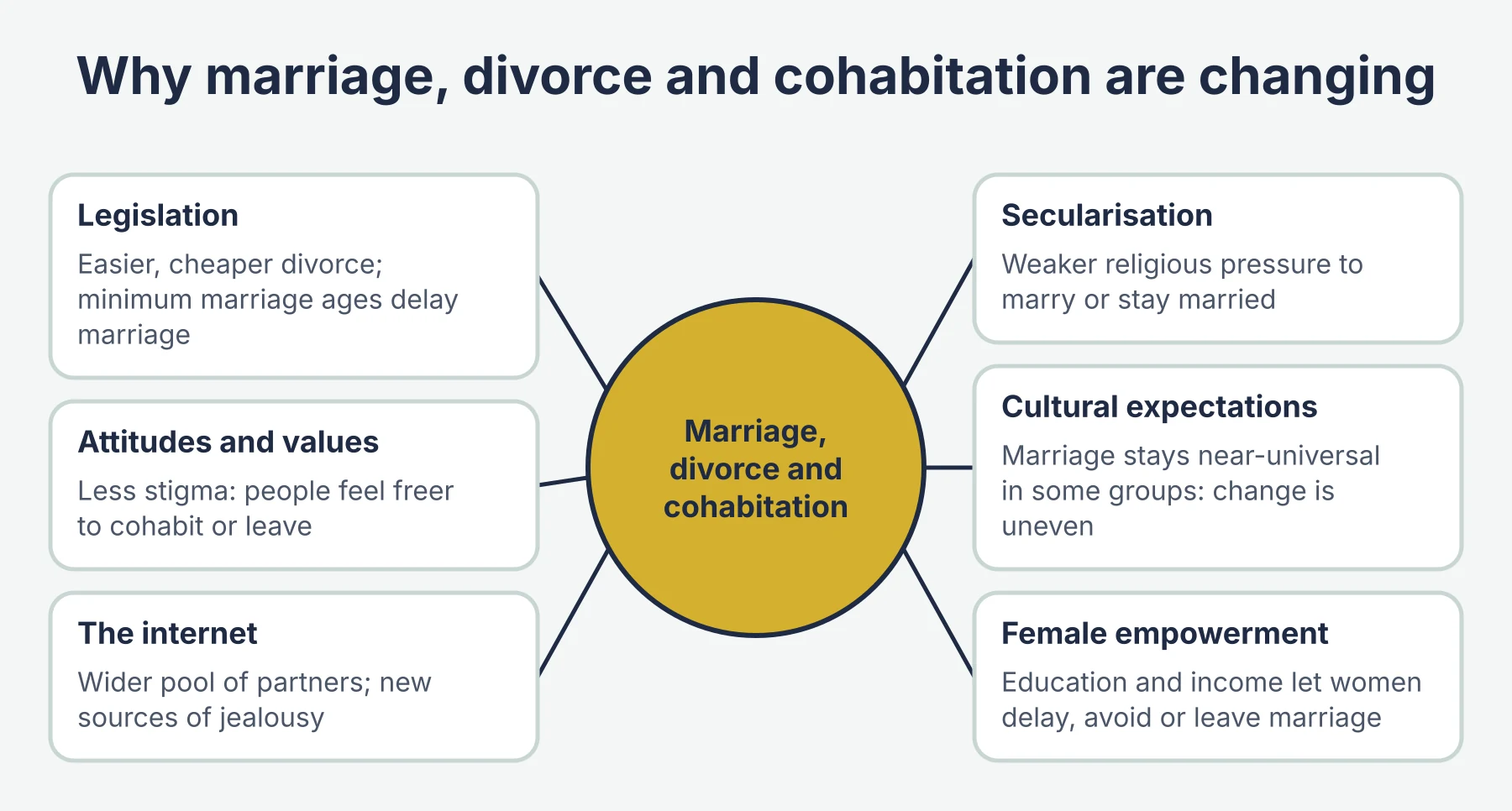
| Legislation | Laws change the cost, grounds or speed of divorce, and women’s rights to property and custody | Easier, cheaper divorce raises divorce rates; laws on minimum marriage age delay marriage |
| Societal attitudes and values | Less stigma attaches to divorce, cohabitation and children born outside marriage | People feel freer to cohabit or leave a marriage |
| Role of the internet | Dating sites and apps widen the pool of partners; social media can create new sources of jealousy | Partner choice becomes more individual; some argue it also makes relationships easier to end |
| Secularisation | Religion has less influence on people’s thinking and behaviour | Weaker pressure to marry, or to stay married, for religious reasons |
| Cultural expectations | Communities may expect marriage, early marriage or arranged marriage | Marriage stays near-universal in some groups; change is uneven between cultures |
| Female empowerment | Education, paid work and income give women independence | Women can delay marriage, choose not to marry, or leave unhappy marriages |
Perspectives on the trends:
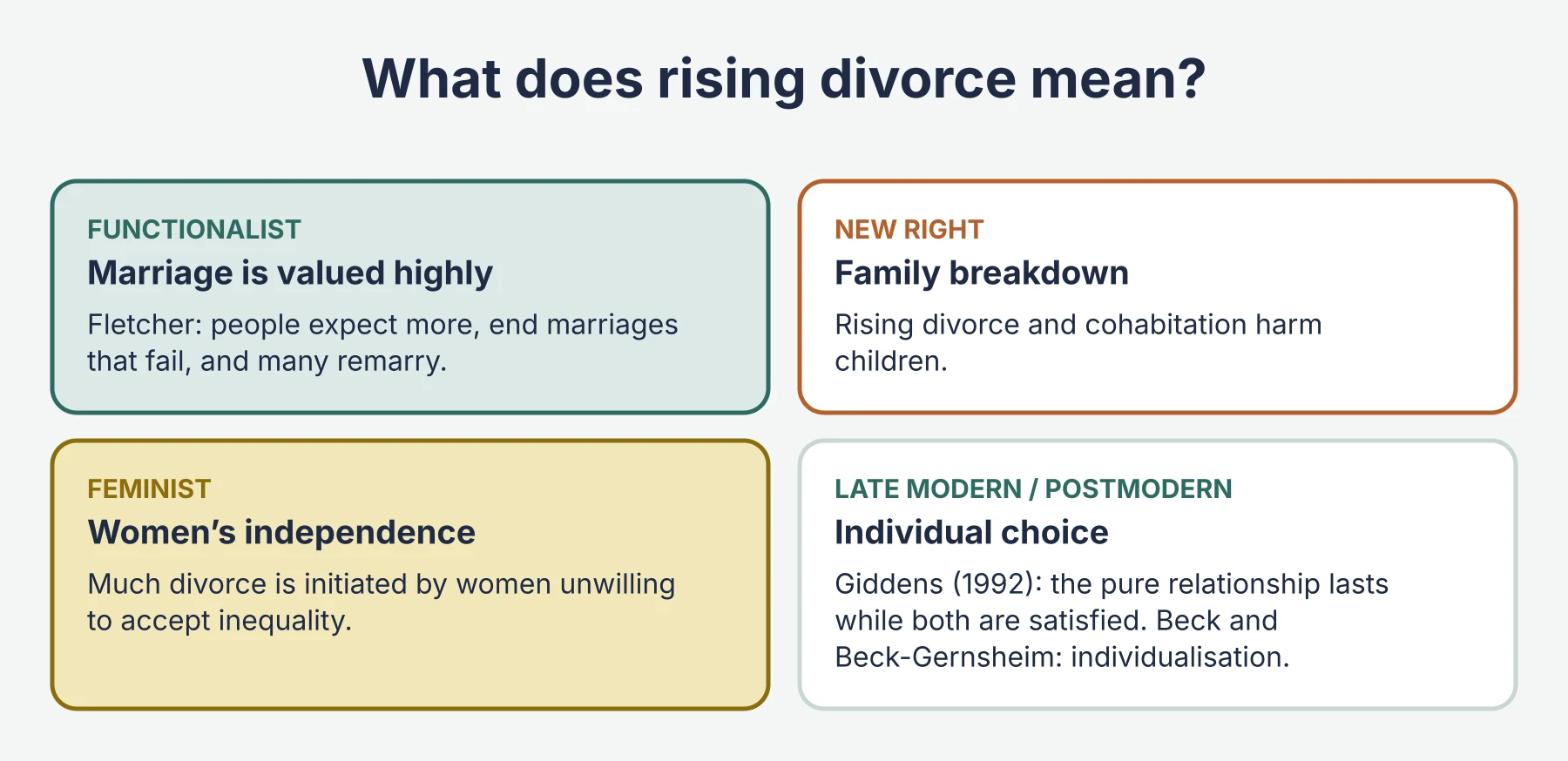
- Functionalist: Ronald Fletcher argued that a high divorce rate reflects the high value placed on marriage. People expect more, so they end marriages that fail, and many remarry.
- New Right: rising divorce and cohabitation are signs of family breakdown that harm children.
- Feminist: rising divorce, much of it initiated by women in countries such as the UK, reflects women’s greater independence and unwillingness to accept inequality.
- Late modern and postmodern writers: Anthony Giddens (1992) described the pure relationship, which lasts only as long as both partners are satisfied. Ulrich Beck and Elisabeth Beck-Gernsheim linked rising divorce to individualisation, as tradition gives way to personal choice.
Alternatives to marriage (4.3.4)
- Cohabitation: a couple living together without marrying. For some it is a trial before marriage; for others a long-term alternative.
- Singlehood: not living with a partner, which may be chosen or result from divorce, widowhood or the cost of housing.
- Lone parents: raising children outside a couple, through divorce, separation, bereavement or choice.
- Civil partnerships: legally registered unions, available in some countries, which give partners rights similar to those of marriage.
Changing family roles (4.3.5)
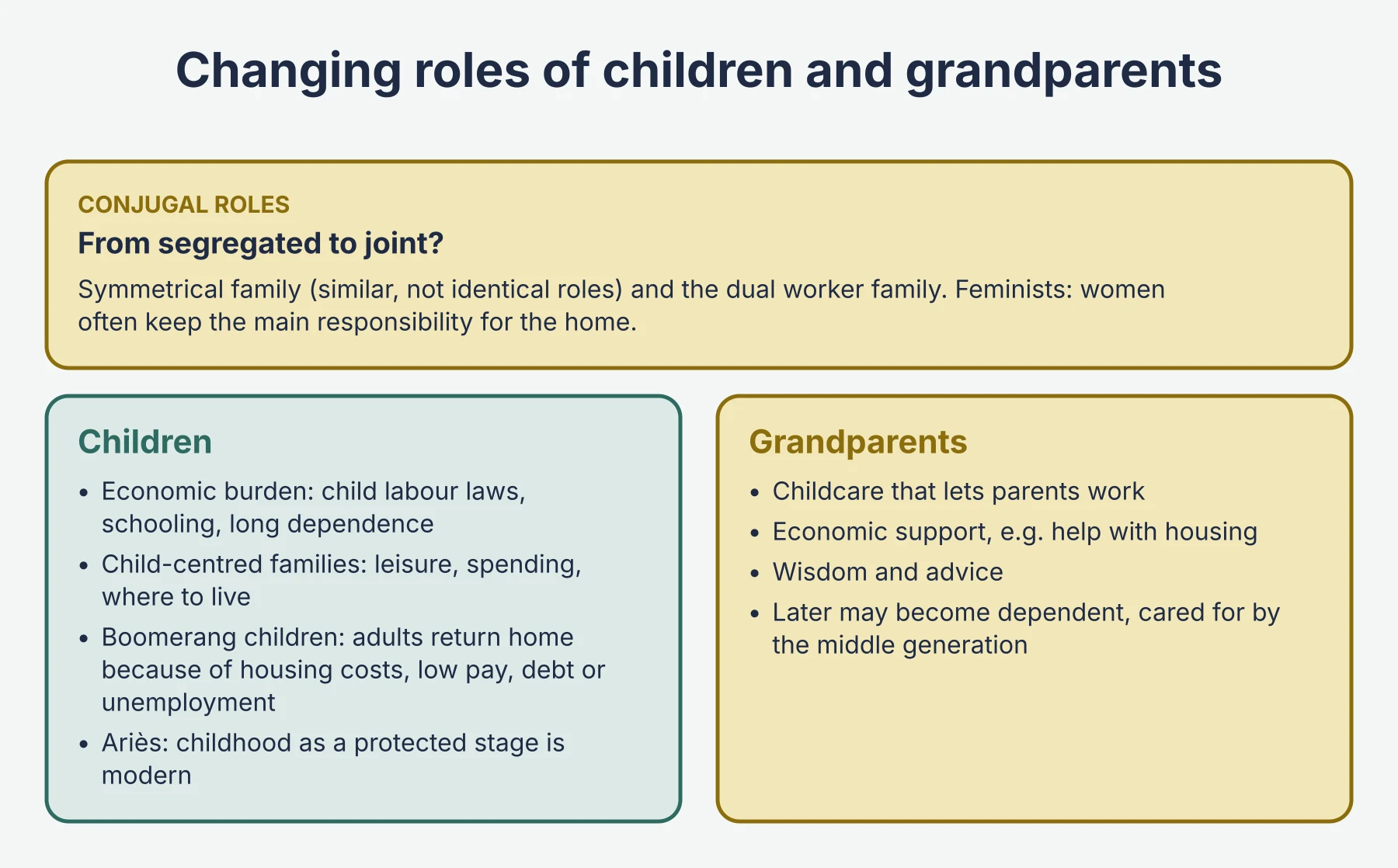
Conjugal roles. Young and Willmott’s symmetrical family described couples whose roles were similar though not identical. The dual worker family, with both partners in paid work, is now common in many societies. Feminists reply that women in dual worker families often keep the main responsibility for the home. More diverse family types mean conjugal roles also vary: in a lone-parent family there is no partner to share with. The pivot or sandwich generation cares for children and ageing parents at once.
Children. Philippe Ariès argued that childhood as a separate, protected stage is a modern idea; in medieval Europe children joined adult work and life early. Today:
- Children are an economic burden/cost rather than a source of income, because of child labour laws, compulsory schooling and long periods of dependence.
- Families are more child-centred: decisions about leisure, spending and where to live often revolve around children.
- Boomerang children return to the parental home as adults, often because of housing costs, low pay, debt or unemployment.
Grandparents. With longer life expectancy, grandparents provide childcare that lets parents work, economic support such as help with housing, and wisdom and advice. Later in life they may become dependent, needing care that falls mainly on the middle generation.
Worked example: an annotated “explain” answer
Question: Explain two reasons why divorce rates have risen in many societies.
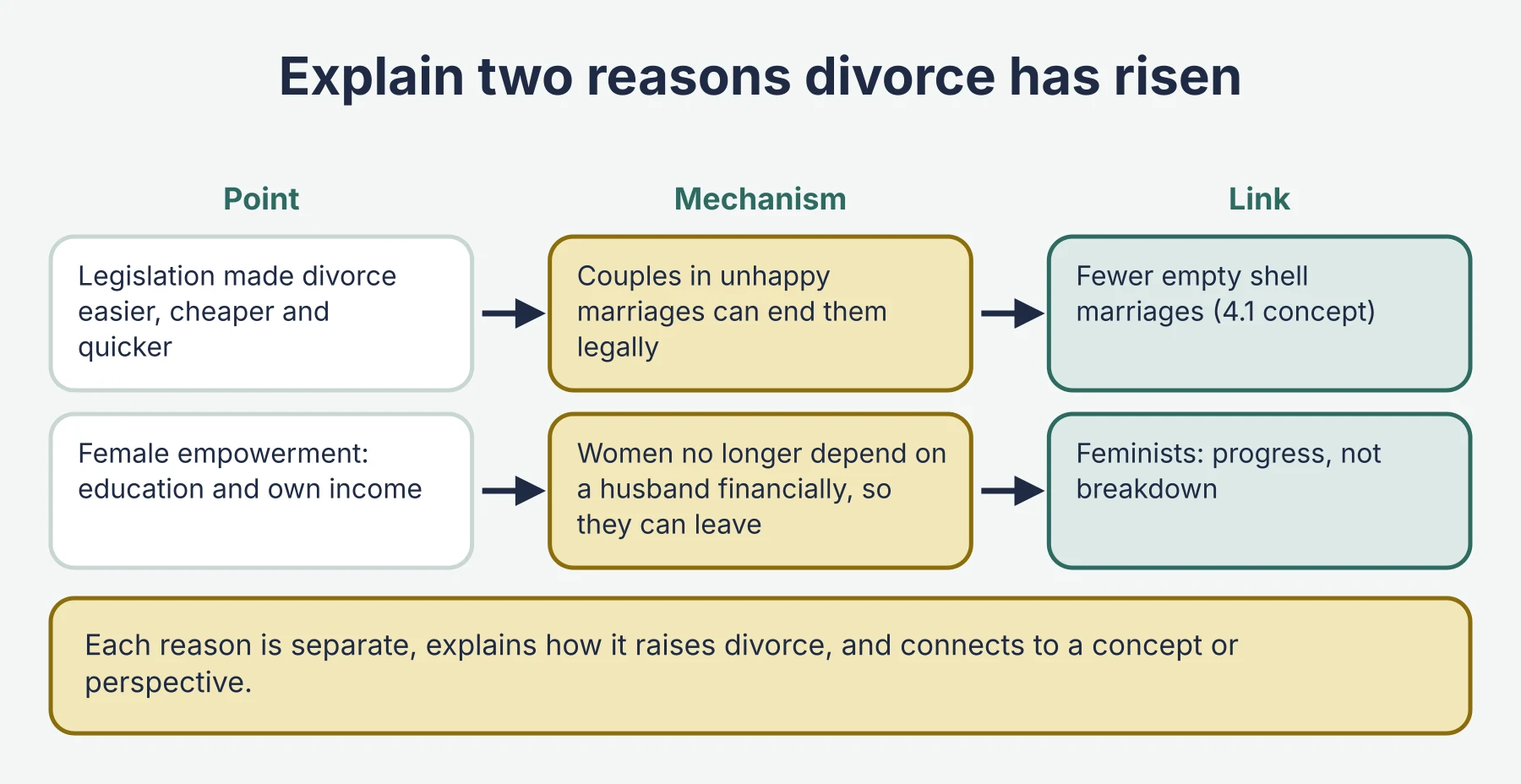
Answer: “First, legislation has made divorce easier in many countries, for example by reducing the grounds a person must prove or the time a divorce takes [point]. When divorce is cheaper and quicker, couples in unhappy marriages who might once have stayed in an empty shell marriage can end it legally [mechanism and link to 4.1 concept]. Second, female empowerment: as more women are educated and earn their own income, they no longer depend on a husband financially [point], so they are able to leave a marriage that is unequal or abusive, which feminists see as progress rather than breakdown [mechanism and perspective].”
Why it works: each reason is separate, explained with how it raises divorce, and connected to a concept or perspective.
Common mistakes
- Stating a demographic change without its effect on family life.
- Writing “the internet changed marriage” without saying how.
- Treating rising divorce as proof that marriage is unpopular, ignoring remarriage and Fletcher’s argument.
- Assuming all societies are changing in the same direction or at the same speed.
- Using “symmetrical” to mean “equal”: Young and Willmott meant similar contributions.
- Confusing boomerang children (adults returning home) with child-centredness.
Exam technique for 2251 command words
- Explain answers need the chain: change → mechanism → effect on family life.
- Discuss whether roles are becoming more equal by setting the symmetrical family against feminist evidence.
- Evaluate a claim such as “marriage is in decline” by weighing divorce and cohabitation trends against remarriage and cultural variation, then judging.
- Suggest questions reward realistic reasons applied to a situation, for example why a couple may delay having children.
Keep revising
Related resources
-
Practice questions
Cambridge O Level Sociology (2251): Family – How is family life changing? – Practice Questions
Original Cambridge O Level Sociology 2251 Family practice on demographic change, divorce and cohabitation, and changing family roles, with full answers.
Sociology · Cambridge · O Level
Try questions -
Revision notes
Cambridge O Level Sociology (2251): Family – How is family life changing? – Revision Notes
Revision notes for Cambridge O Level Sociology 2251 key question 4.3: demographic change, divorce and cohabitation trends and changing roles, with a self-test.
Sociology · Cambridge · O Level
Revise topic -
Practice questions
Cambridge O Level Sociology (2251): Education – What is education and schooling? – Practice Questions
Original Cambridge O Level Sociology 2251 Education practice on the official and hidden curriculum, school types and alternative approaches, with answers.
Sociology · Cambridge · O Level
Try questions
Related articles
Get free revision emails (optional)
Occasional emails with practice questions, worked explanations and links to free resources for the qualification and subjects you choose. No spam, and you can unsubscribe from any email. The free tools on this site never need an email.