
Revision Notes
Cambridge O Level Sociology (2251): Family – How is family life changing? – Revision Notes
Revision notes for Cambridge O Level Sociology 2251 key question 4.3: demographic change, divorce and cohabitation trends and changing roles, with a self-test.
- Subject
- Sociology
- Level
- O LEVELS
- Topic
- Paper 2 – Family, Education and Crime
- Author
- Marlbridge Academic Team
- Updated
- Reviewed by
- Naqiya Yousaf (what this means)
Aligned to Cambridge O Level Sociology (2251), 2025-2027. Official specification .
Syllabus page (what it covers and how it is assessed): Cambridge O Level Sociology.
Syllabus points this page covers
2251
- 4.3 Family – How is family life changing?
Found an error? Report a correction.
Need help with this topic? Request a free trial class for O Level Sociology (2251).
These notes condense key question 4.3 of Cambridge O Level Sociology (2251), How is family life changing? Almost every question here is about cause and effect, so learn each change as a short chain: what changed, why, and what it did to family structures or roles.
Syllabus coverage
- 4.3.1 Demographic factors: family size, birth rates, life expectancy, ageing population, having children in later life.
- 4.3.2 Industrialisation and urbanisation and their impact on family structures and roles.
- 4.3.3 Explanations of trends in marriage, divorce and cohabitation: legislation, attitudes and values, the internet, secularisation, cultural expectations, female empowerment.
- 4.3.4 Alternatives to marriage: cohabitation, singlehood, lone parents, civil partnerships.
- 4.3.5 Changing conjugal roles, roles of children and roles of grandparents.
Key terms
| Term | Meaning |
|---|---|
| Demography | The study of population: births, deaths and migration |
| Birth rate | Live births per 1,000 people in the population per year |
| Life expectancy | Average years a person born in a given year can expect to live |
| Ageing population | A rising share of older people in the population |
| Industrialisation | Shift from farming to factory and service work |
| Urbanisation | Movement of population from rural areas to towns and cities |
| Secularisation | Decline in the influence of religion on thinking, behaviour and institutions |
| Cohabitation | A couple living together without being married |
| Civil partnership | A legally registered union giving rights similar to marriage, in some countries |
| Symmetrical family | Young and Willmott: partners’ roles similar though not identical |
| Dual worker family | Both partners in paid work |
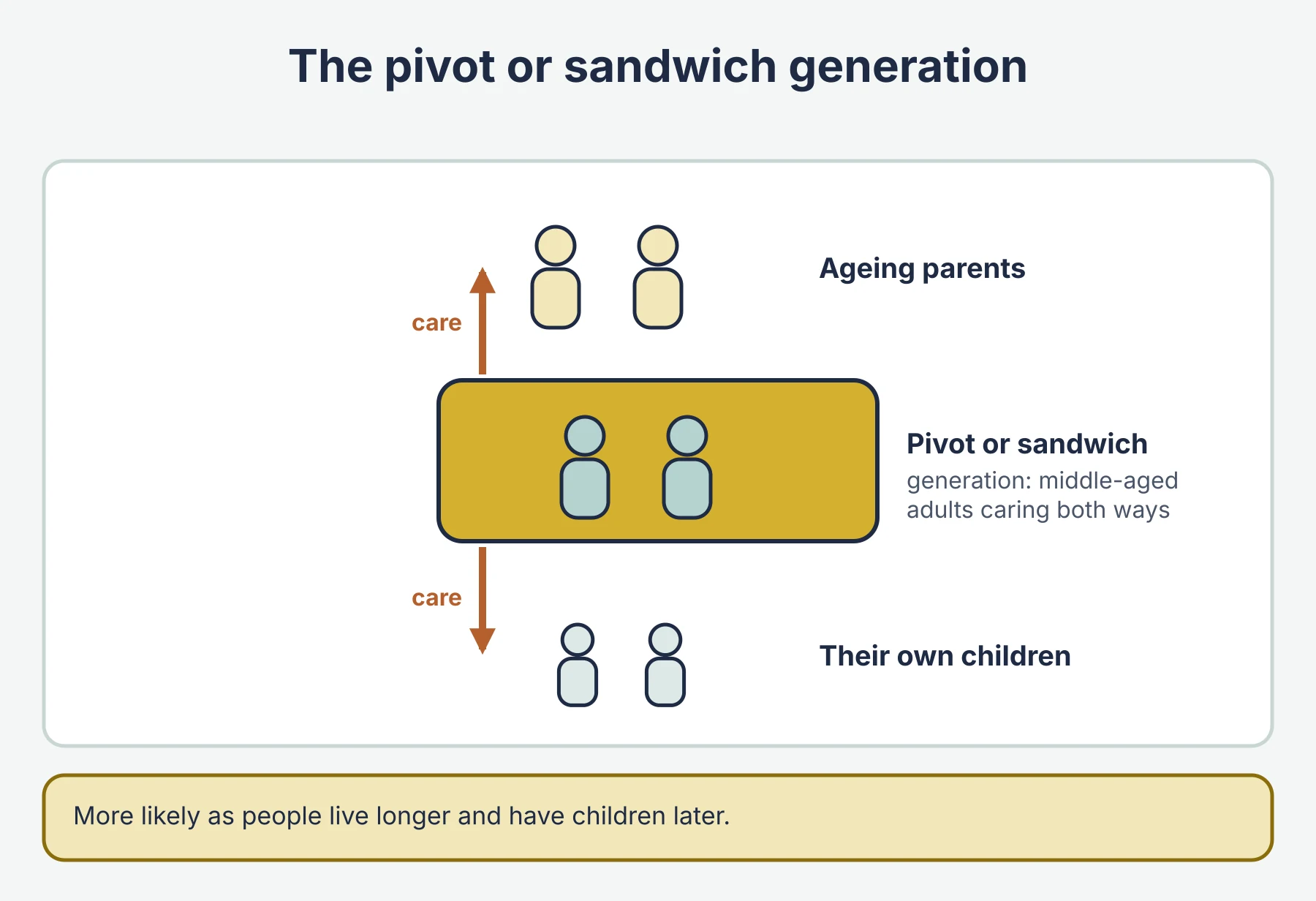
| Pivot / sandwich generation | Middle generation caring for children and ageing parents at once |
| Child-centredness | Family life organised around children’s needs and wishes |
| Boomerang children | Adult children who return to live in the parental home |
| Pure relationship | Giddens: a relationship that lasts only while both partners are satisfied |
Demographic chains (4.3.1)
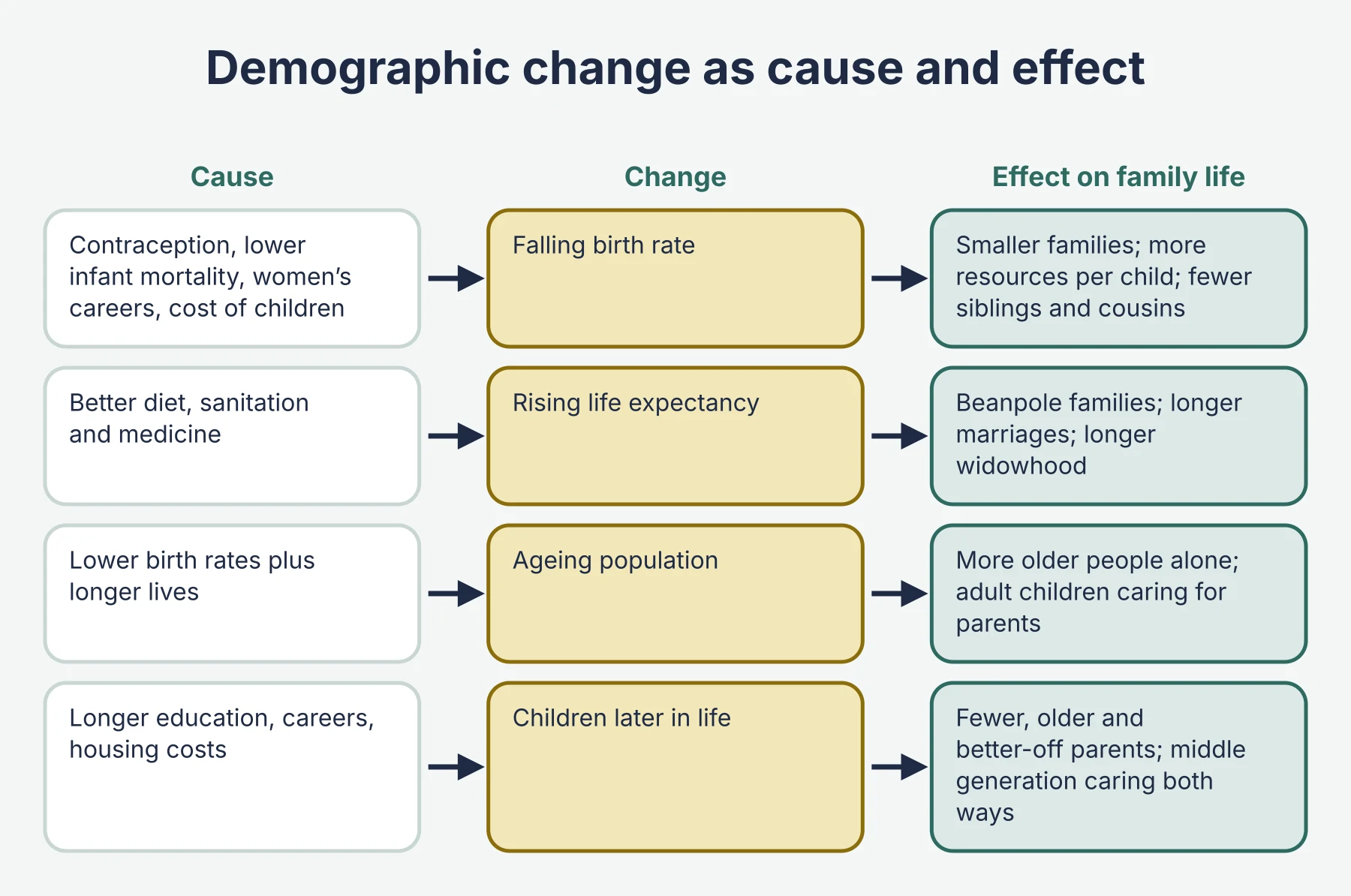
- Contraception + women’s careers + cost of children + lower infant mortality → lower birth rate → smaller families, more resources per child.
- Better diet, sanitation, medicine → longer life expectancy → beanpole families, longer marriages, longer widowhood.
- Low births + long lives → ageing population → more older single-person households, more family caring, pressure on pensions.
- Longer education, careers, housing costs → later parenthood → fewer children, wider gap between generations, squeezed middle generation.
Industrialisation and urbanisation (4.3.2)
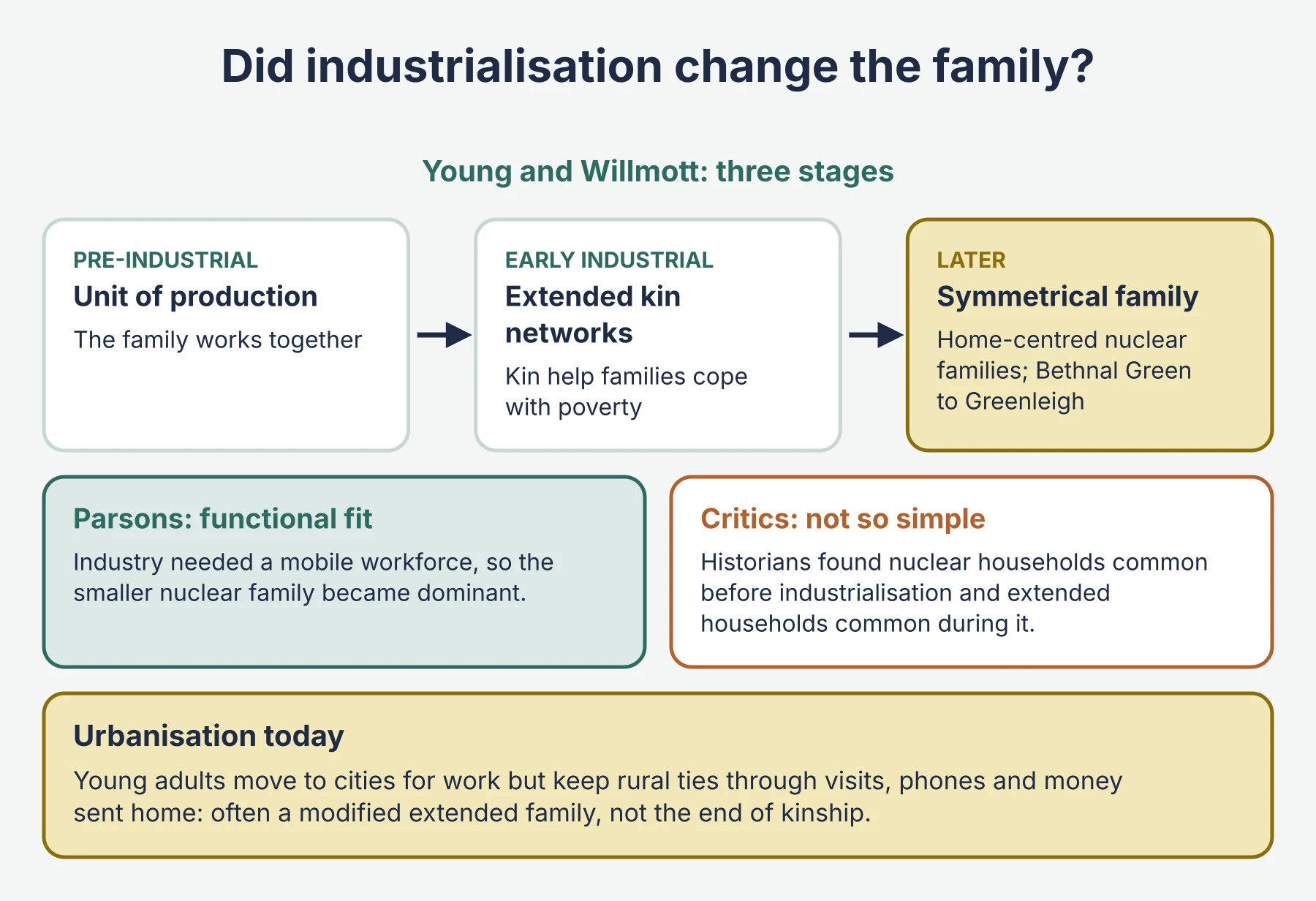
- Parsons: industry needs mobility, so the nuclear family “fits”.
- Young and Willmott: pre-industrial unit of production → early industrial extended kin support → home-centred symmetrical family; moving from Bethnal Green to Greenleigh weakened daily kin contact.
- Critics: nuclear households existed before industry; extended households helped families cope during it.
- Urbanisation today: migrants to cities form smaller households but keep rural kin ties, giving modified extended families.
Six explanations of trends (4.3.3)
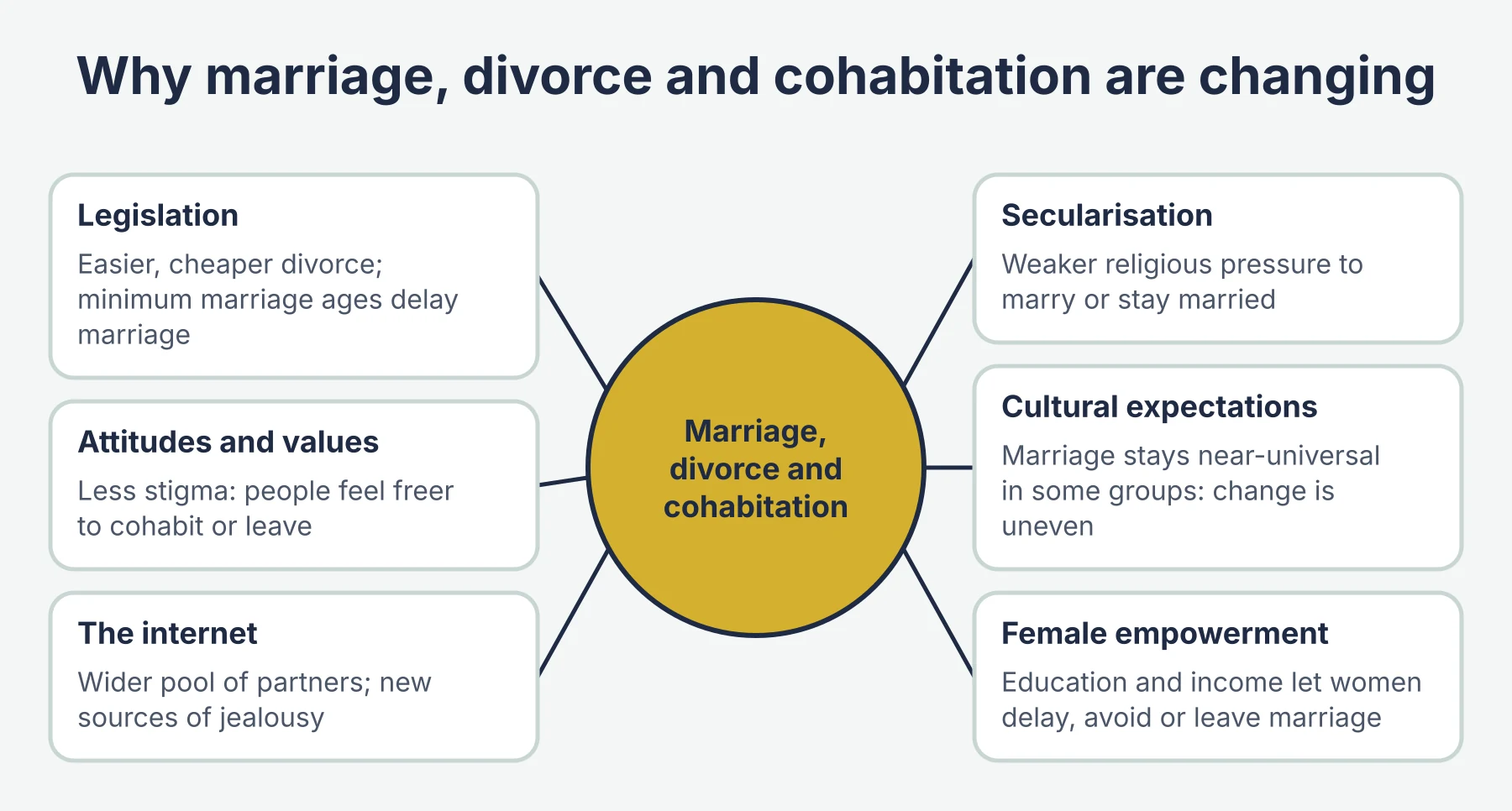
- Legislation: cheaper, quicker divorce; property and custody rights for women; minimum marriage ages.
- Attitudes and values: less stigma for divorce, cohabitation and births outside marriage.
- Internet: dating apps widen partner choice; online contact may also create new tensions.
- Secularisation: less religious pressure to marry or stay married.
- Cultural expectations: some communities keep strong expectations of marriage, so change is uneven.
- Female empowerment: education and earnings let women delay marriage or leave unhappy ones.
Perspectives on change
| Perspective | Reading of the trends |
|---|---|
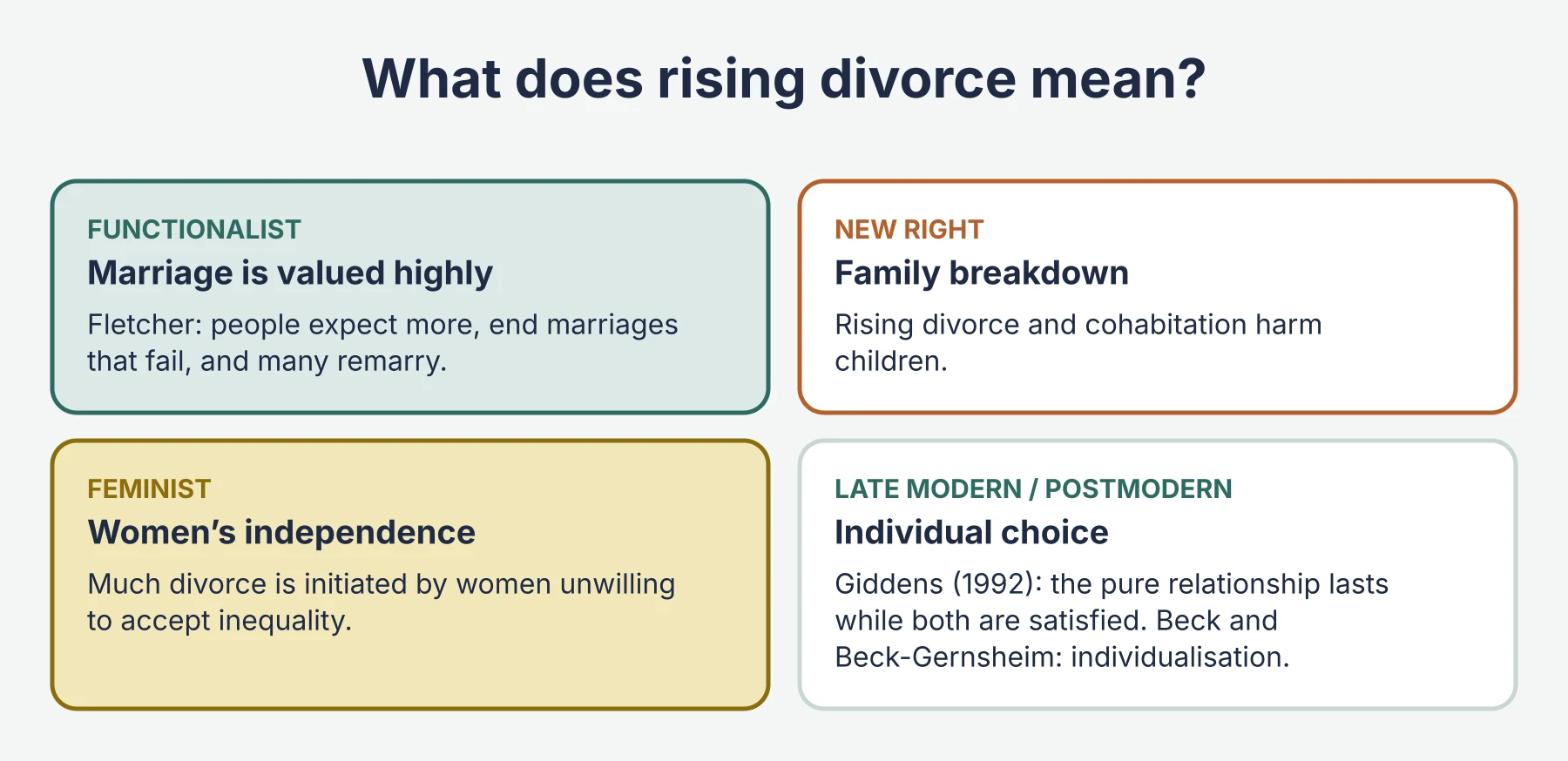
| Functionalist (Fletcher) | High divorce reflects high expectations of marriage; remarriage shows marriage is still valued |
| New Right | Divorce and cohabitation signal breakdown and harm children |
| Feminist | Divorce reflects women’s independence and refusal to accept inequality |
| Giddens; Beck and Beck-Gernsheim | Pure relationships and individualisation: choice replaces tradition |
Changing roles (4.3.5)
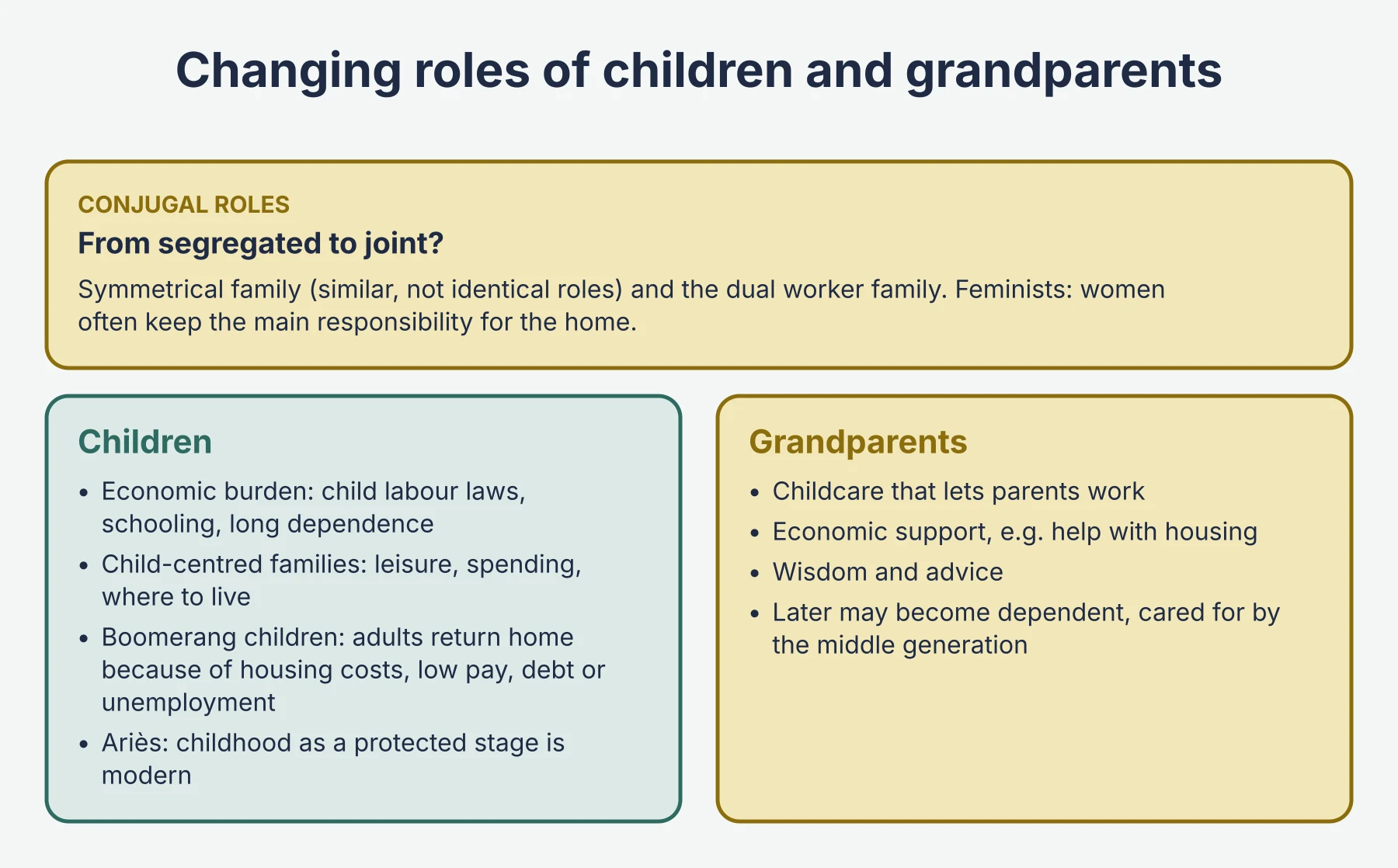
- Conjugal: segregated → more joint; dual worker families common; feminists say women keep main responsibility; diverse family types mean diverse role patterns.
- Children: from economic asset to economic cost (child labour laws, compulsory schooling); child-centred families; boomerang children because of housing costs, debt or unemployment. Ariès: childhood as a protected stage is a modern idea.
- Grandparents: childcare, economic support, wisdom and advice; later may become dependent, cared for by the pivot generation.
Exam traps
- Every demographic change needs an effect on family life, not just a cause.
- “Symmetrical” means similar, not identical or equal.
- Rising divorce does not prove people reject marriage: many remarry.
- Do not assume change is the same everywhere; cultural expectations slow or reverse trends.
- Boomerang children are adults returning home, not young children.
- The internet is a mechanism: say how it changes partner choice or relationship stability.
Self-test
- Define birth rate.
- Give two reasons why birth rates have fallen in many societies.
- How does rising life expectancy change family structure?
- What is the pivot or sandwich generation?
- How did the move to Greenleigh affect the families Young and Willmott studied?
- Explain how secularisation may affect divorce.
- How might legislation change marriage patterns?
- What does Fletcher argue about high divorce rates?
- What is a pure relationship?
- Give two reasons why boomerang children return home.
- Why are children now seen as an economic cost?
- Give two roles grandparents play in modern families.
Answers
- The number of live births per 1,000 people in the population per year.
- Any two: contraception; women’s education and careers; cost of raising children; lower infant mortality; later marriage.
- More generations are alive at once, producing beanpole families and longer grandparent roles.
- A middle generation caring for its own children and its ageing parents at the same time.
- Daily contact with extended kin fell and couples became more home-centred.
- With less religious influence, people feel less pressure to stay in an unhappy marriage, so divorce becomes more acceptable.
- Easier divorce laws raise divorce rates; minimum age laws delay marriage; rights for cohabiting couples or civil partners create alternatives.
- It shows people value marriage and expect more of it, so they end marriages that fail and often remarry.
- Giddens’s term for a relationship that lasts only as long as both partners are satisfied.
- Any two: high housing costs; low pay; student debt; unemployment; relationship breakdown.
- Child labour laws and compulsory schooling mean children no longer earn, and they stay dependent for longer.
- Any two: childcare; economic support; wisdom and advice.
More resources on this topic
Related resources
-
Practice questions
Cambridge O Level Sociology (2251): Education – What is education and schooling? – Practice Questions
Original Cambridge O Level Sociology 2251 Education practice on the official and hidden curriculum, school types and alternative approaches, with answers.
Sociology · Cambridge · O Level
Try questions -
Revision notes
Cambridge O Level Sociology (2251): Education – What is education and schooling? – Revision Notes
Revision notes for Cambridge O Level Sociology 2251 key question 5.1: formal and informal education, curricula, school types and alternatives, with a self-test.
Sociology · Cambridge · O Level
Revise topic -
Study guides
Cambridge O Level Sociology (2251): Education – What are the roles and functions of education?
Cambridge O Level Sociology 2251 key question 5.2 in depth: functionalist, Marxist and feminist views of education, with evidence, criticisms and a model plan.
Sociology · Cambridge · O Level
Read guide
Related articles
Get free revision emails (optional)
Occasional emails with practice questions, worked explanations and links to free resources for the qualification and subjects you choose. No spam, and you can unsubscribe from any email. The free tools on this site never need an email.