
Study Guides
Cambridge O Level Sociology (2251): Education – What are the roles and functions of education?
Cambridge O Level Sociology 2251 key question 5.2 in depth: functionalist, Marxist and feminist views of education, with evidence, criticisms and a model plan.
- Subject
- Sociology
- Level
- O LEVELS
- Topic
- Paper 2 – Family, Education and Crime
- Author
- Marlbridge Academic Team
- Updated
- Reviewed by
- Naqiya Yousaf (what this means)
Aligned to Cambridge O Level Sociology (2251), 2025-2027. Official specification .
Syllabus page (what it covers and how it is assessed): Cambridge O Level Sociology.
Syllabus points this page covers
2251
- 5.2 Education – What are the roles and functions of education?
Found an error? Report a correction.
Need help with this topic? Request a free trial class for O Level Sociology (2251).
Key question 5.2 of Cambridge O Level Sociology (2251) asks What are the roles and functions of education? It is the theory core of the Education question. The syllabus names three views and, for each, a list of concepts and a requirement to know its strengths and limitations. Questions may ask you to explain one view, discuss it, or weigh it against the others. This guide explains each concept as a mechanism, links it to named evidence, and shows how the views criticise each other.
What the syllabus covers
| Section | Content named in the 2251 syllabus (2025–2027) |
|---|---|
| 5.2.1 The functionalist view | The roles of education: socialisation, social control, economic, selective; meritocracy and social mobility; role allocation; value consensus; equal opportunities; standardised testing; setting by ability; vocationalism; strengths and limitations |
| 5.2.2 The Marxist view | Reproduction of class inequalities: socialisation and social control as capitalist ideological control; the hidden and official curriculum; middle-class culture in schools, e.g. cultural capital; the myth of meritocracy; material factors, e.g. access to digital technology; setting by ability; strengths and limitations |
| 5.2.3 The feminist view | Perpetuating gender inequalities: the patriarchal culture of education; male power; gender hierarchy; role models; access to education; gendered curriculum / subject choice; teacher expectations; peer groups and social control; strengths and limitations |
Notice that socialisation, social control, the curriculum and setting by ability appear under more than one view. The same school practice is read in different ways, which is what makes these views easy to set against each other.
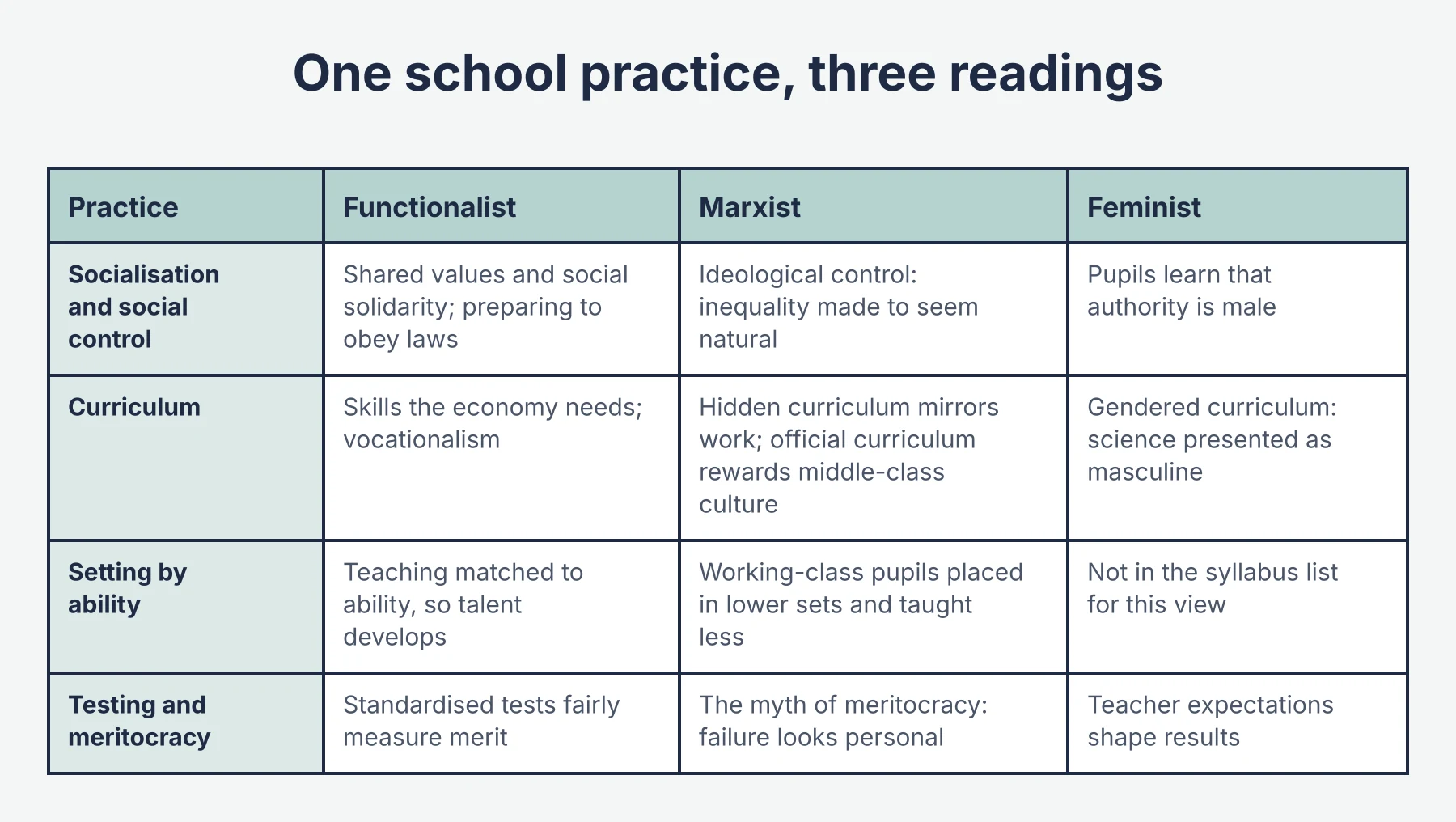
The functionalist view: education meets society’s needs
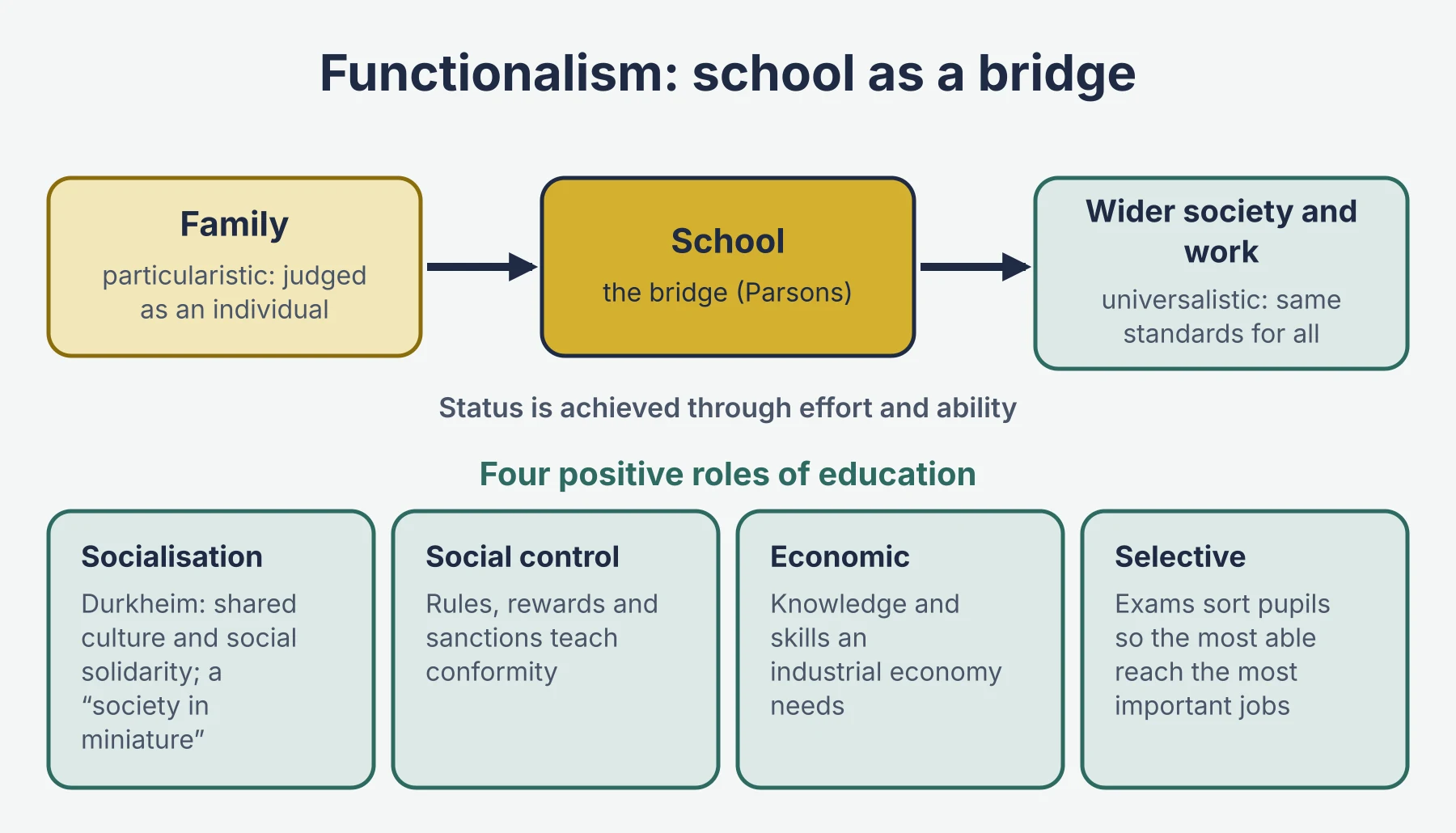
Functionalists ask what education contributes to a stable, efficient society. The syllabus names four roles:
- Socialisation: Émile Durkheim argued that schools transmit society’s shared norms and values, creating social solidarity. Teaching a nation’s history, for example, gives pupils a sense of belonging to something larger than their family. Durkheim described the school as “society in miniature”, where pupils learn to cooperate with people who are not relatives.
- Social control: rules, rewards and sanctions teach pupils to conform, preparing them to obey laws and workplace rules.
- Economic: schools teach the skills a modern economy needs, from literacy to specialist knowledge. Vocationalism, education and training directly linked to jobs, strengthens this role.
- Selective: schools sort pupils by ability through examinations.
Talcott Parsons saw the school as a bridge between the family and wider society. In the family a child is judged by particularistic standards, as a unique individual. At school and work, people are judged by universalistic standards, the same rules for everyone. Status at school is achieved, not ascribed, so education is a meritocracy: rewards follow ability and effort.
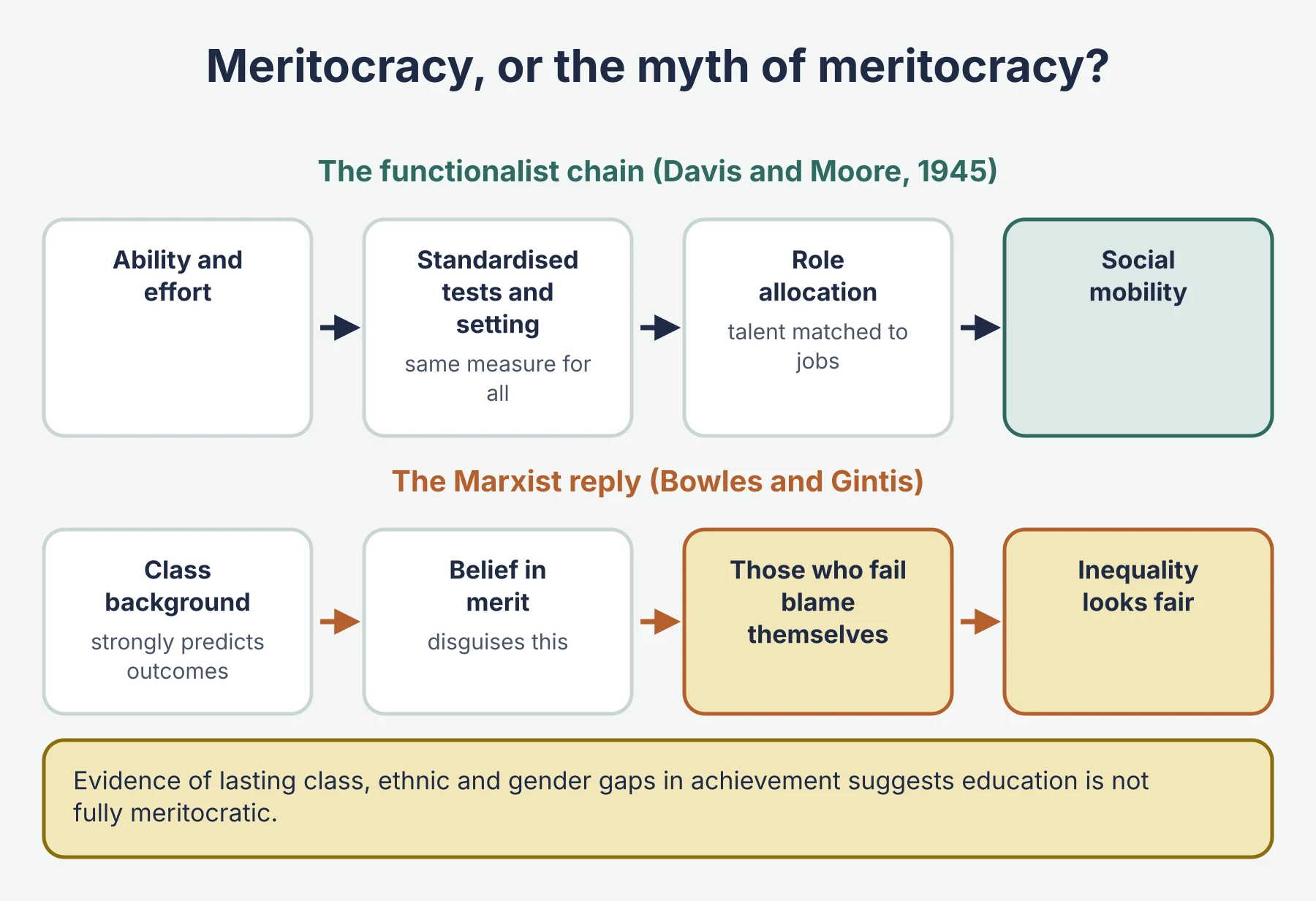
Kingsley Davis and Wilbert Moore (1945) linked this to role allocation: education sifts and sorts people so that the most able reach the most important jobs, which carry the highest rewards to motivate them.
The remaining concepts all support the meritocracy claim:
- Equal opportunities: free schooling and anti-discrimination policies give everyone a chance to compete.
- Standardised testing: the same examination for all is an objective, fair measure of merit.
- Setting by ability: grouping pupils by attainment lets teaching match ability, so talent is developed efficiently.
- Social mobility: because rewards follow merit, people from poorer backgrounds can rise.
- Value consensus: shared agreement on values, including the value of achievement, holds this system together.
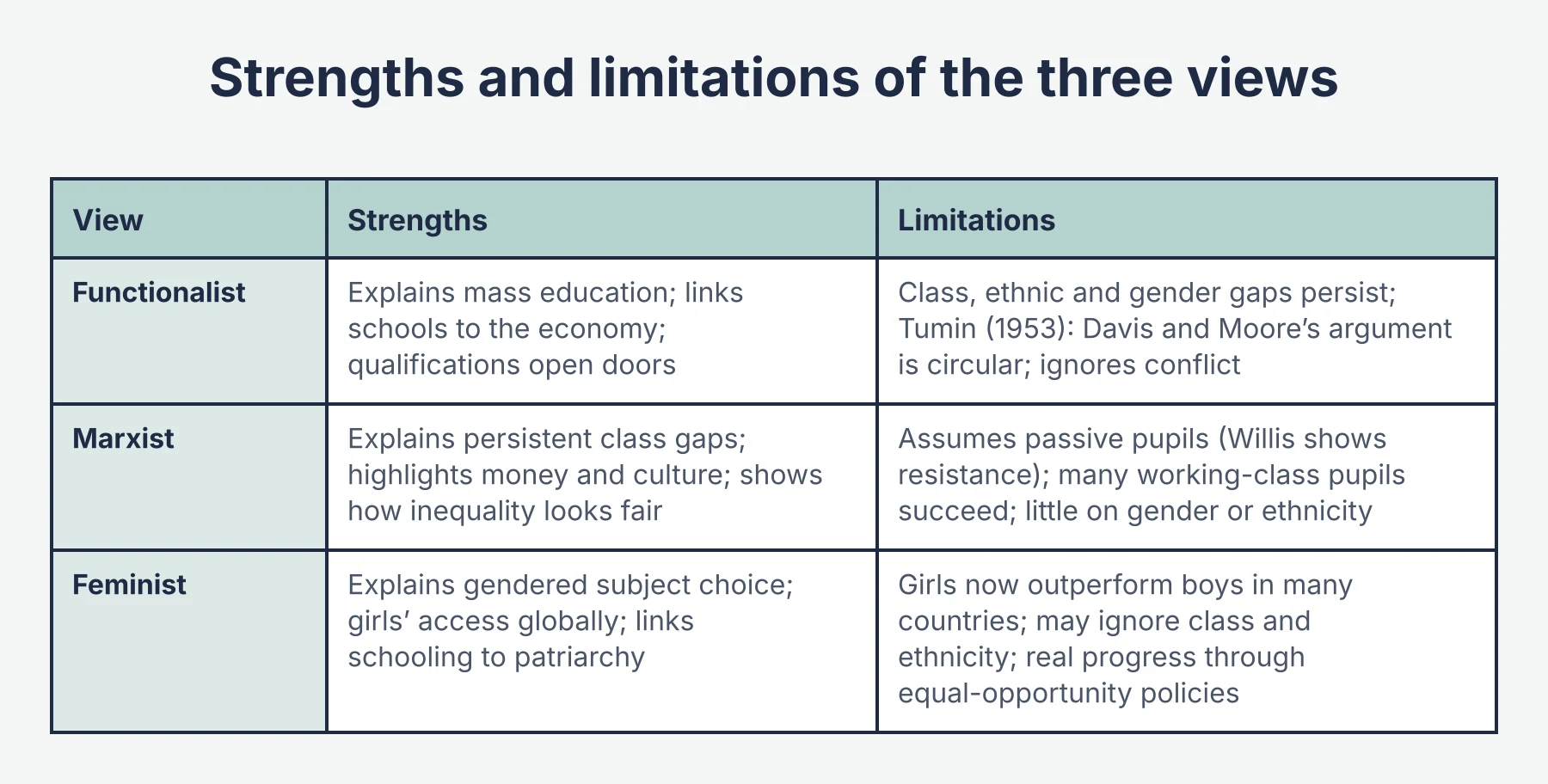
Strengths: explains why societies invest in mass education; links schools to the economy; qualifications do open doors for many individuals.
Limitations: class, ethnic and gender gaps in achievement persist, which challenges the claim that schooling is meritocratic; Melvin Tumin (1953) criticised Davis and Moore’s argument as circular, since it assumes that highly rewarded jobs must be the most important; the view assumes shared values and ignores conflict in schools.
The Marxist view: education reproduces class inequality
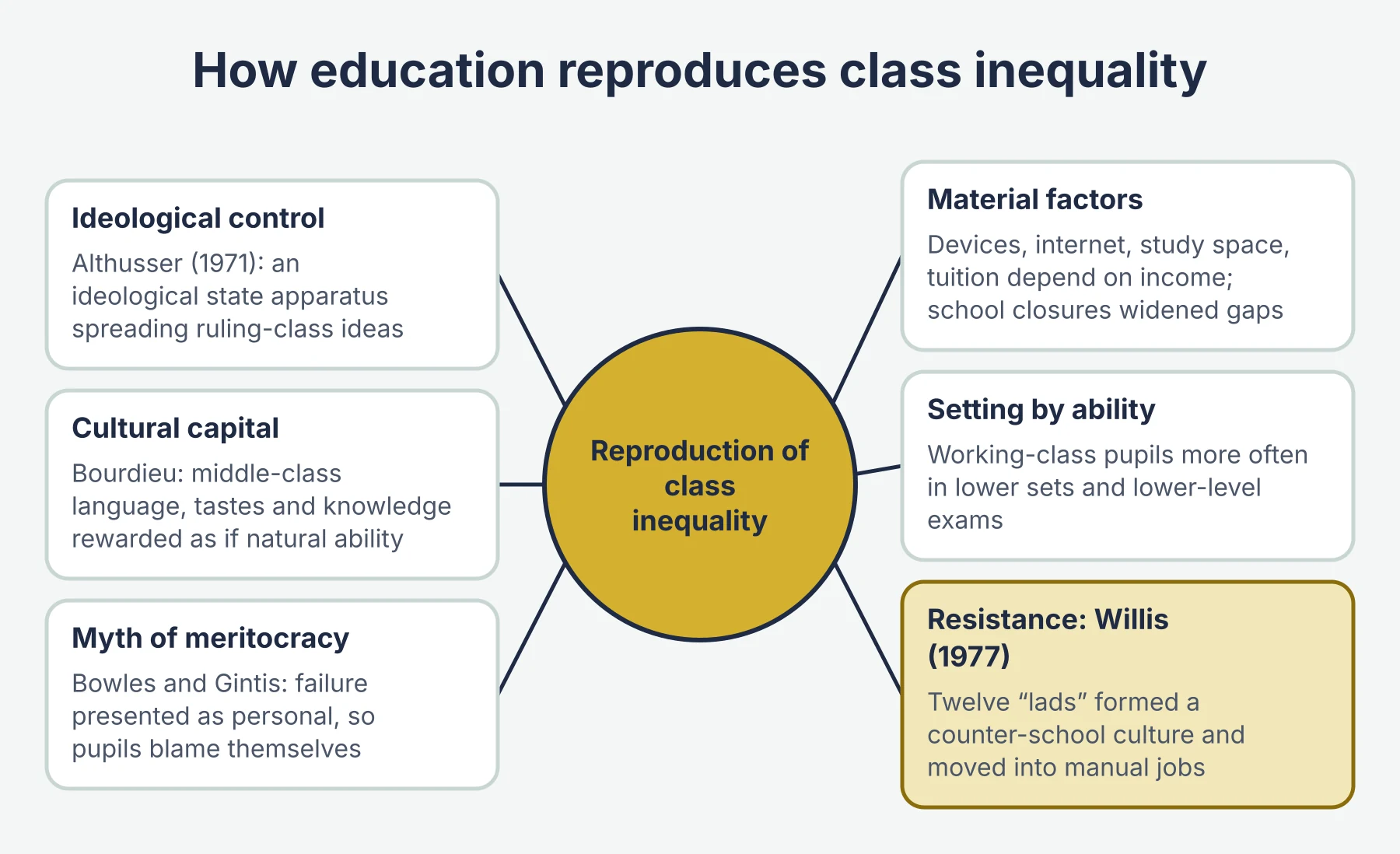
Marxists argue that education serves the interests of the ruling class. The syllabus frames the whole view around the reproduction of class inequalities: making sure that the children of the working class mostly end up in working-class jobs.
- Socialisation and social control as ideological control. Louis Althusser (1971) called education an ideological state apparatus: an institution that spreads ruling-class ideas so that inequality seems natural. What functionalists call socialisation, Marxists call ideology.
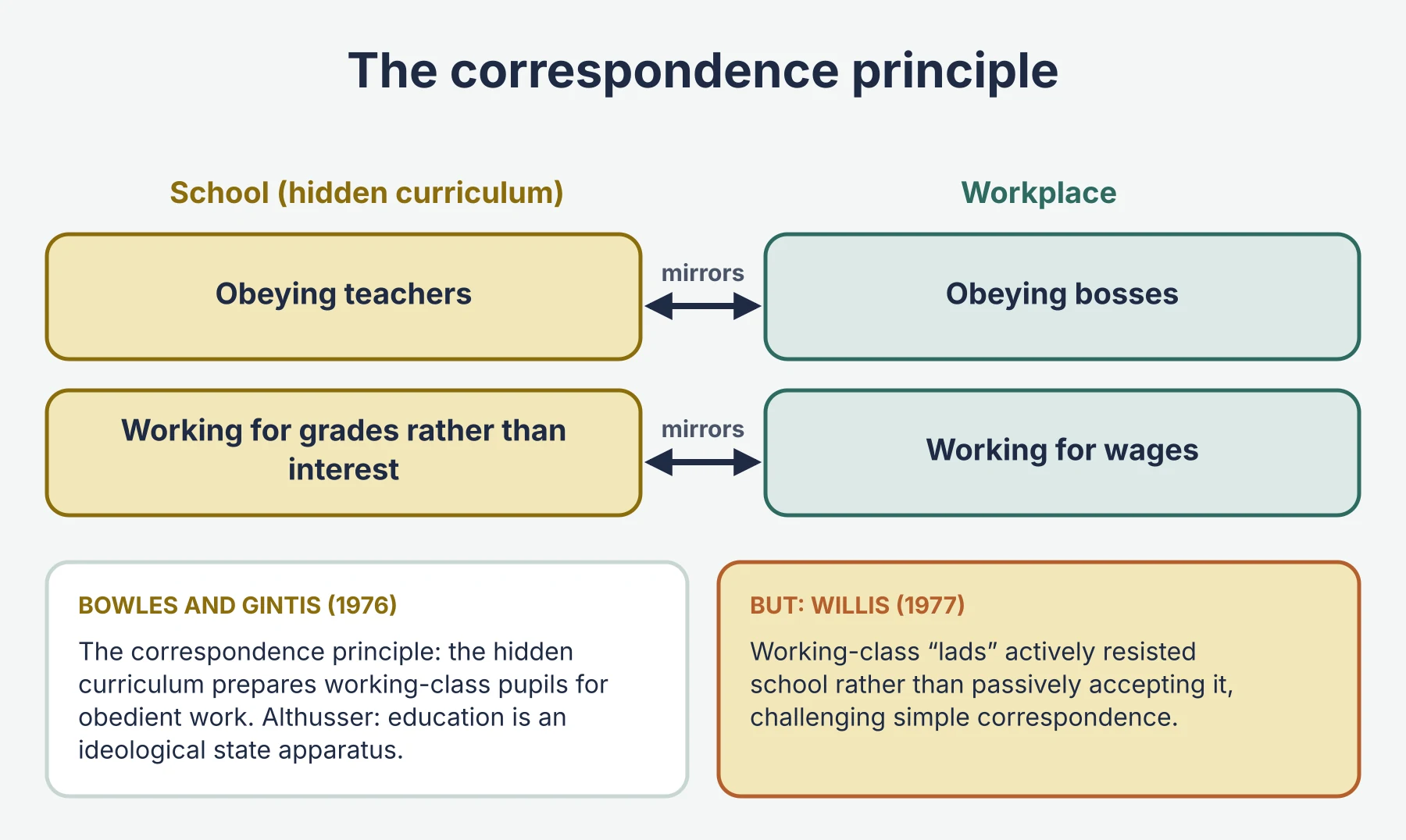
- The hidden and official curriculum. Samuel Bowles and Herbert Gintis (1976) proposed the correspondence principle: the way school is organised mirrors the workplace. Hierarchies of teachers and pupils mirror managers and workers; pupils work for grades as workers work for wages. The official curriculum, through what is tested and valued, rewards knowledge closer to middle-class culture.
- Middle-class culture and cultural capital. Pierre Bourdieu argued that middle-class children arrive with cultural capital: the language, tastes and knowledge that schools value. Schools reward this as if it were natural ability.
- The myth of meritocracy. Bowles and Gintis argued that meritocracy is an illusion. Failure is presented as personal, so working-class pupils blame themselves rather than the system.
- Material factors. Access to digital technology, quiet study space and private tuition depends on income. During school closures, pupils without devices or internet fell further behind.
- Setting by ability. Marxists argue that sets are not neutral: working-class pupils are more often placed in lower sets, entered for lower-level examinations and taught less.
Evidence of resistance: Paul Willis’s Learning to Labour (1977) studied twelve working-class “lads” who formed a counter-school culture. They saw through the myth of meritocracy, rejected school, and so moved into manual jobs. Willis shows class reproduced through pupils’ own choices.
Strengths: explains persistent class gaps; highlights the role of money and culture; shows how inequality can look fair.
Limitations: assumes pupils passively accept the hidden curriculum (Willis shows resistance); many working-class pupils succeed; schools also teach critical thinking; the view says little about gender or ethnicity.
The feminist view: education perpetuates gender inequality
Feminists argue that education has reproduced patriarchy, though they disagree about how much has changed.
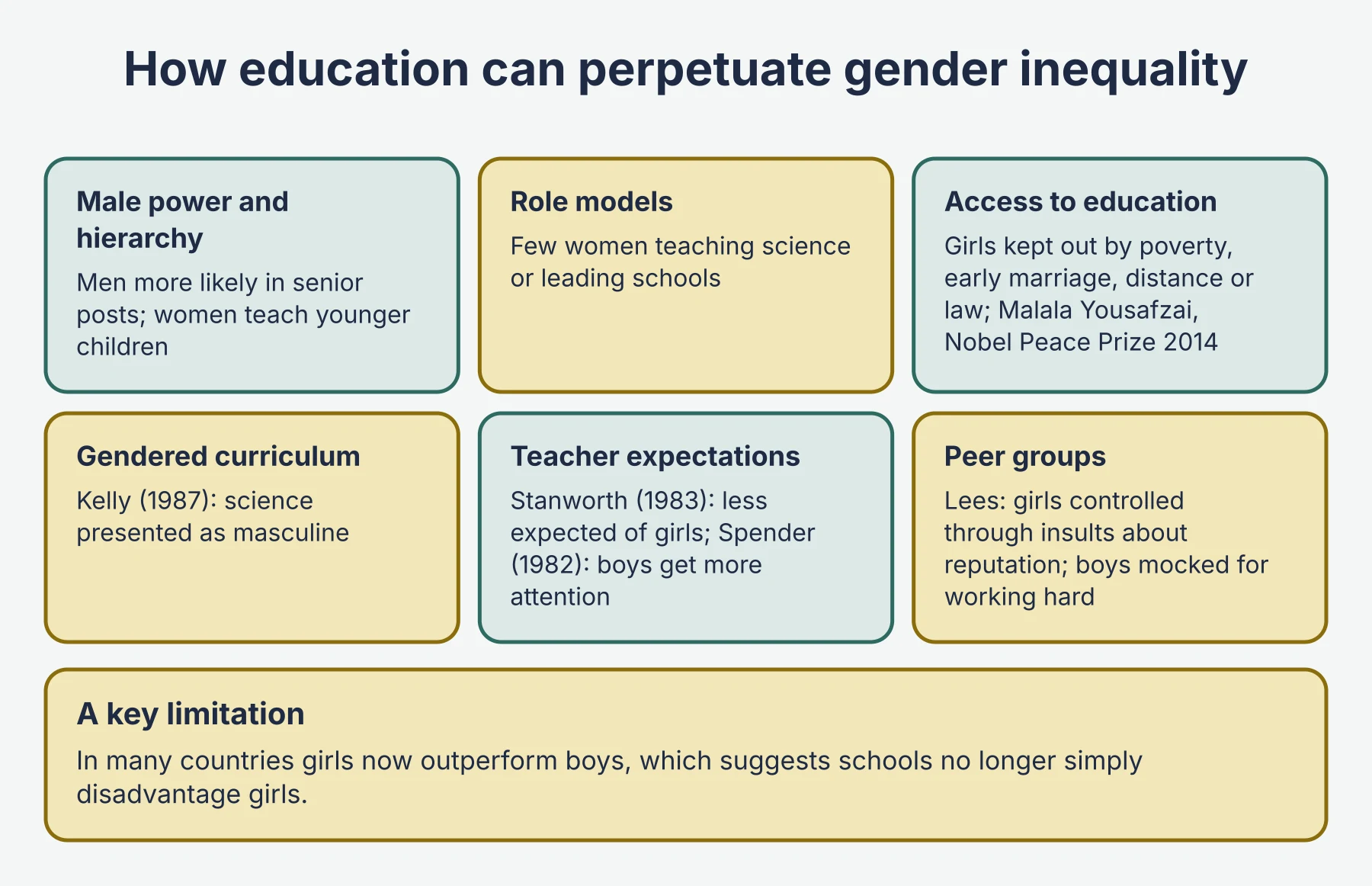
- Patriarchal culture, male power and gender hierarchy. In many education systems men are more likely to hold senior posts, while women teach younger children. Pupils learn that authority is male.
- Role models. Few women teaching science or leading schools gives girls fewer models of ambition in those fields.
- Access to education. In some societies girls are kept out of school, especially at secondary level, by poverty, early marriage, distance or law. Malala Yousafzai’s campaign for girls’ schooling in Pakistan, for which she shared the Nobel Peace Prize in 2014, made this issue globally visible.
- Gendered curriculum and subject choice. Alison Kelly (1987) argued that science is presented as a masculine subject, with examples and classroom behaviour that favour boys.
- Teacher expectations. Michelle Stanworth (1983) found that teachers expected less of girls, and Dale Spender (1982) argued that boys received more of teachers’ attention in mixed classrooms.
- Peer groups and social control. Peers police gender: girls may be mocked for ambition or judged by reputation, and boys for working hard. Sue Lees argued that girls’ behaviour was controlled through insults about their sexual reputation.
Strengths: explains gendered subject choice and career paths; draws attention to girls’ access to education globally; links schooling to wider patriarchy.
Limitations: in many countries girls now outperform boys, which suggests schools no longer simply disadvantage girls; the view may ignore class and ethnic differences among girls; liberal feminists would point to real progress through equal-opportunity policies.
Worked example: an annotated “discuss” plan
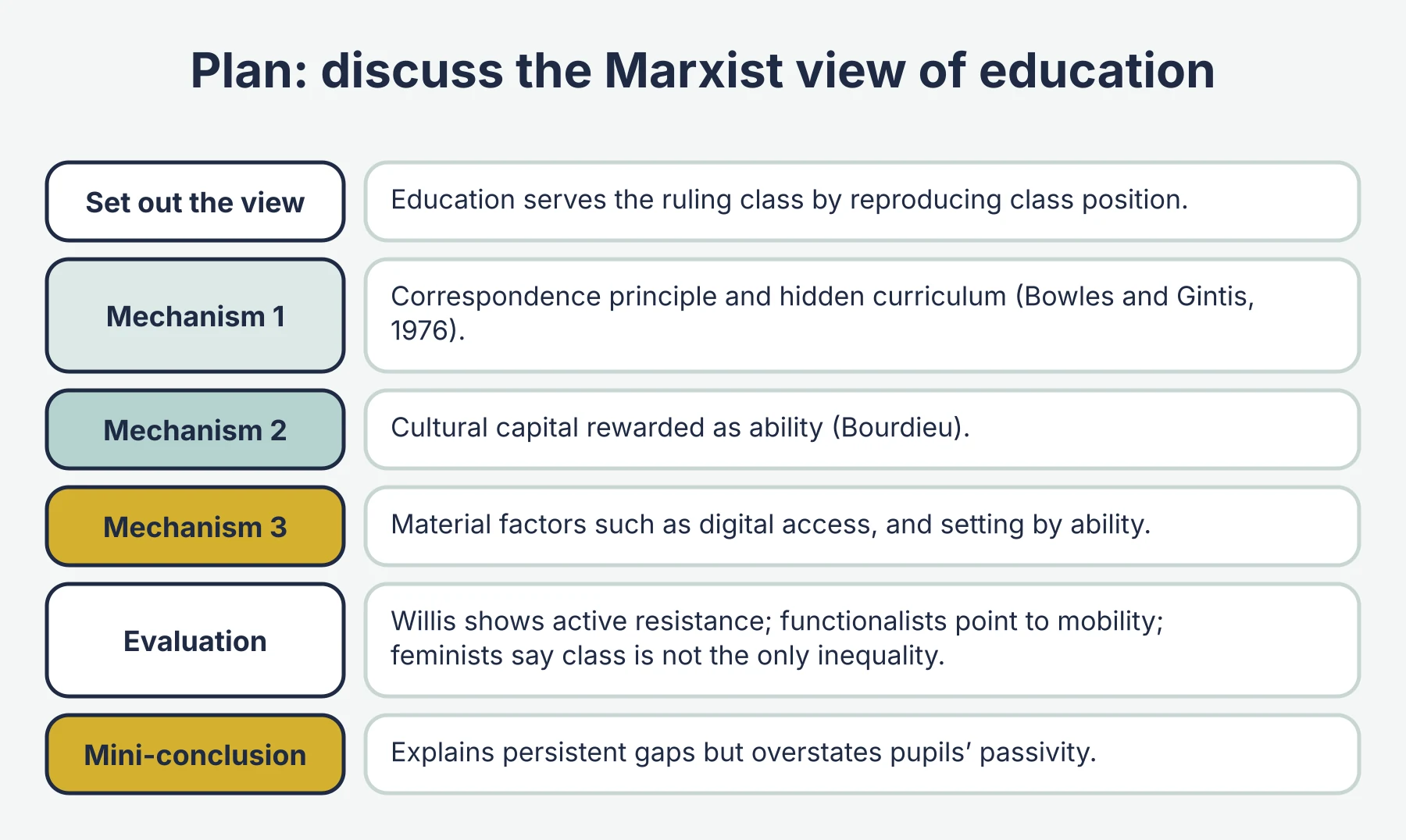
Question: Discuss the Marxist view that education reproduces class inequality.
- Set out the view: education serves the ruling class by reproducing class position [names the core idea].
- Mechanism 1: correspondence principle and hidden curriculum (Bowles and Gintis, 1976) [explains how].
- Mechanism 2: cultural capital rewarded as ability (Bourdieu) [second, distinct mechanism].
- Mechanism 3: material factors such as digital access, and setting by ability [applies to a modern example].
- Evaluation: Willis shows active resistance; functionalists point to mobility; feminists say class is not the only inequality [at least two criticisms].
- Mini-conclusion: the view explains persistent gaps but overstates pupils’ passivity [a judgement].
Common mistakes
- Using “functionalists say education is good” without naming a role or mechanism.
- Treating the hidden curriculum as purely Marxist: functionalists also discuss it.
- Saying meritocracy exists without stating whose view that is.
- Ignoring that girls now outperform boys in many countries when evaluating feminism.
- Listing Marxist concepts without explaining how each reproduces class.
Exam technique for 2251 command words
- Define a concept such as role allocation or myth of meritocracy in one precise sentence.
- Explain each point with a mechanism and, where possible, a named study.
- Discuss one view in depth, ending with evaluation.
- Evaluate the view in the question against the other two perspectives and reach a judgement.
Keep revising
Related resources
-
Practice questions
Cambridge O Level Sociology (2251): Education – What are the roles and functions of education? – Practice Questions
Original Cambridge O Level Sociology 2251 Education practice on functionalist, Marxist and feminist views of the roles of education, with full answers.
Sociology · Cambridge · O Level
Try questions -
Revision notes
Cambridge O Level Sociology (2251): Education – What are the roles and functions of education? – Revision Notes
Revision notes for Cambridge O Level Sociology 2251 key question 5.2: functionalist, Marxist and feminist views of education, with key studies and a self-test.
Sociology · Cambridge · O Level
Revise topic -
Study guides
Cambridge O Level Sociology (2251): Education – What factors help to explain differences in educational achievement and experience?
Cambridge O Level Sociology 2251 key question 5.3 in depth: class, ethnicity, gender and global differences in achievement, with key studies and evaluation.
Sociology · Cambridge · O Level
Read guide
Related articles
Get free revision emails (optional)
Occasional emails with practice questions, worked explanations and links to free resources for the qualification and subjects you choose. No spam, and you can unsubscribe from any email. The free tools on this site never need an email.