
Revision Notes
Cambridge O Level Sociology (2251): Education – What is education and schooling? – Revision Notes
Revision notes for Cambridge O Level Sociology 2251 key question 5.1: formal and informal education, curricula, school types and alternatives, with a self-test.
- Subject
- Sociology
- Level
- O LEVELS
- Topic
- Paper 2 – Family, Education and Crime
- Author
- Marlbridge Academic Team
- Updated
- Reviewed by
- Naqiya Yousaf (what this means)
Aligned to Cambridge O Level Sociology (2251), 2025-2027. Official specification .
Syllabus page (what it covers and how it is assessed): Cambridge O Level Sociology.
Syllabus points this page covers
2251
- 5.1 Education – What is education and schooling?
Found an error? Report a correction.
Need help with this topic? Request a free trial class for O Level Sociology (2251).
These notes condense key question 5.1 of Cambridge O Level Sociology (2251), What is education and schooling? The key question has three parts: formal and informal education (with the official and hidden curricula), different types of schools, and alternative approaches to education. The syllabus asks about the effectiveness and the strengths and limitations of each school type and approach, so every item below has a judgement attached.
Syllabus coverage
- 5.1.1 Differences between formal and informal education; the official curriculum (testing, syllabus content and subjects); the hidden curriculum (norms and values, punctuality, conformity, gender roles).
- 5.1.2 The effectiveness of different types of schools, e.g. state/public, private, selective/non-selective, single-sex, co-educational, faith, international; strengths and limitations of each.
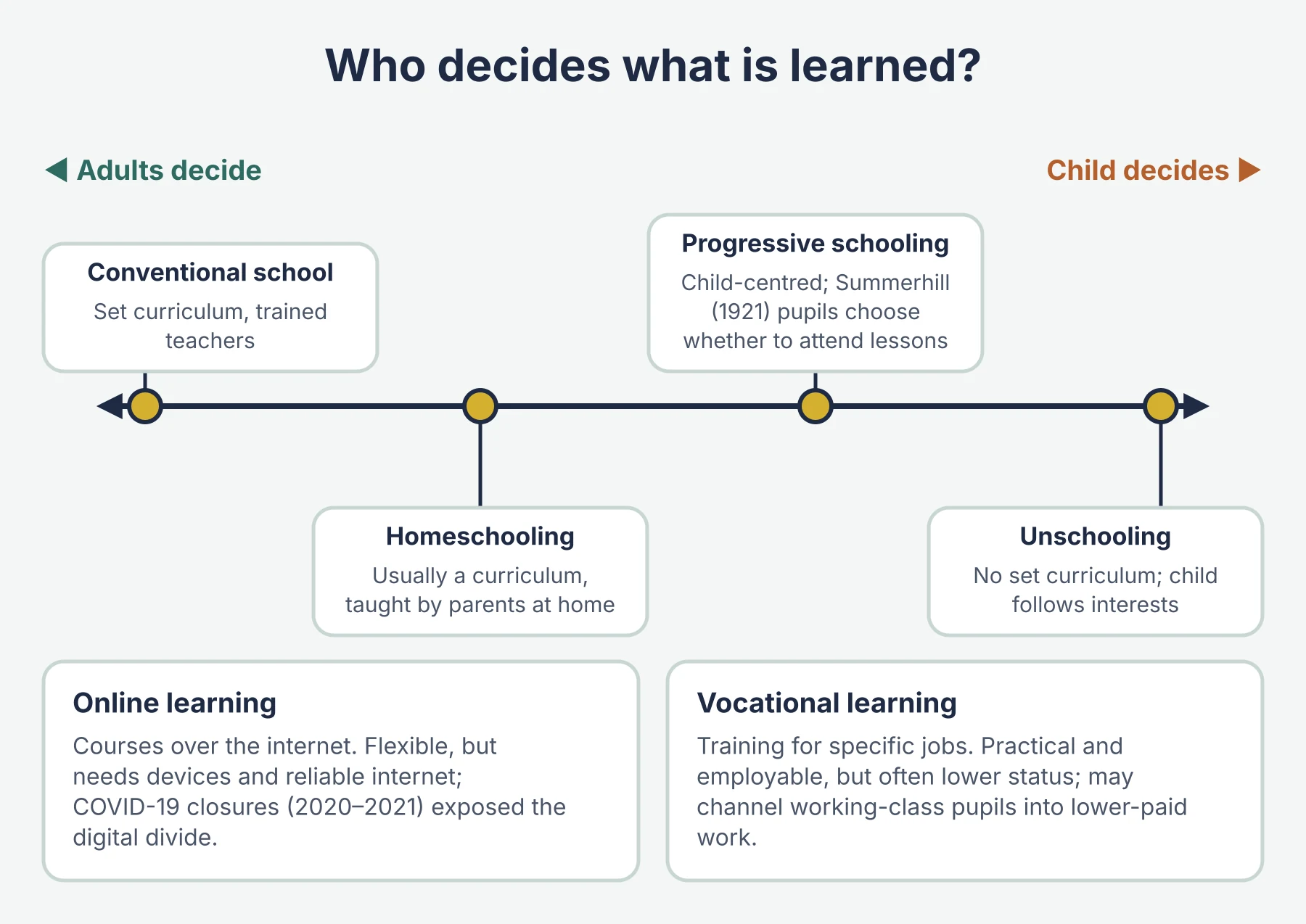
- 5.1.3 Online learning, homeschooling, unschooling, vocational learning, progressive schooling; strengths and limitations of each.
Key terms
| Term | Meaning |
|---|---|
| Education | The process of gaining knowledge, skills, norms and values, inside or outside institutions |
| Schooling | The formal part of education that takes place in schools |
| Formal education | Planned learning in institutions, with a set curriculum, trained teachers and assessment |
| Informal education | Unplanned learning from everyday life: family, peers, media, community, work |
| Official curriculum | What schools openly teach: subjects, syllabus content and testing |
| Hidden curriculum | Norms and values learned from the way school is organised rather than from lessons |
| Selective school | Admits pupils on the basis of ability or attainment, often by test |
| Non-selective school | Admits pupils regardless of ability |
| Faith school | A school with a religious character or ethos |
| Unschooling | Child-led learning through interests and daily life, without a set curriculum |
| Progressive schooling | Child-centred schooling that gives pupils freedom and a say in how they learn |
| Vocational learning | Education and training for particular jobs or trades |
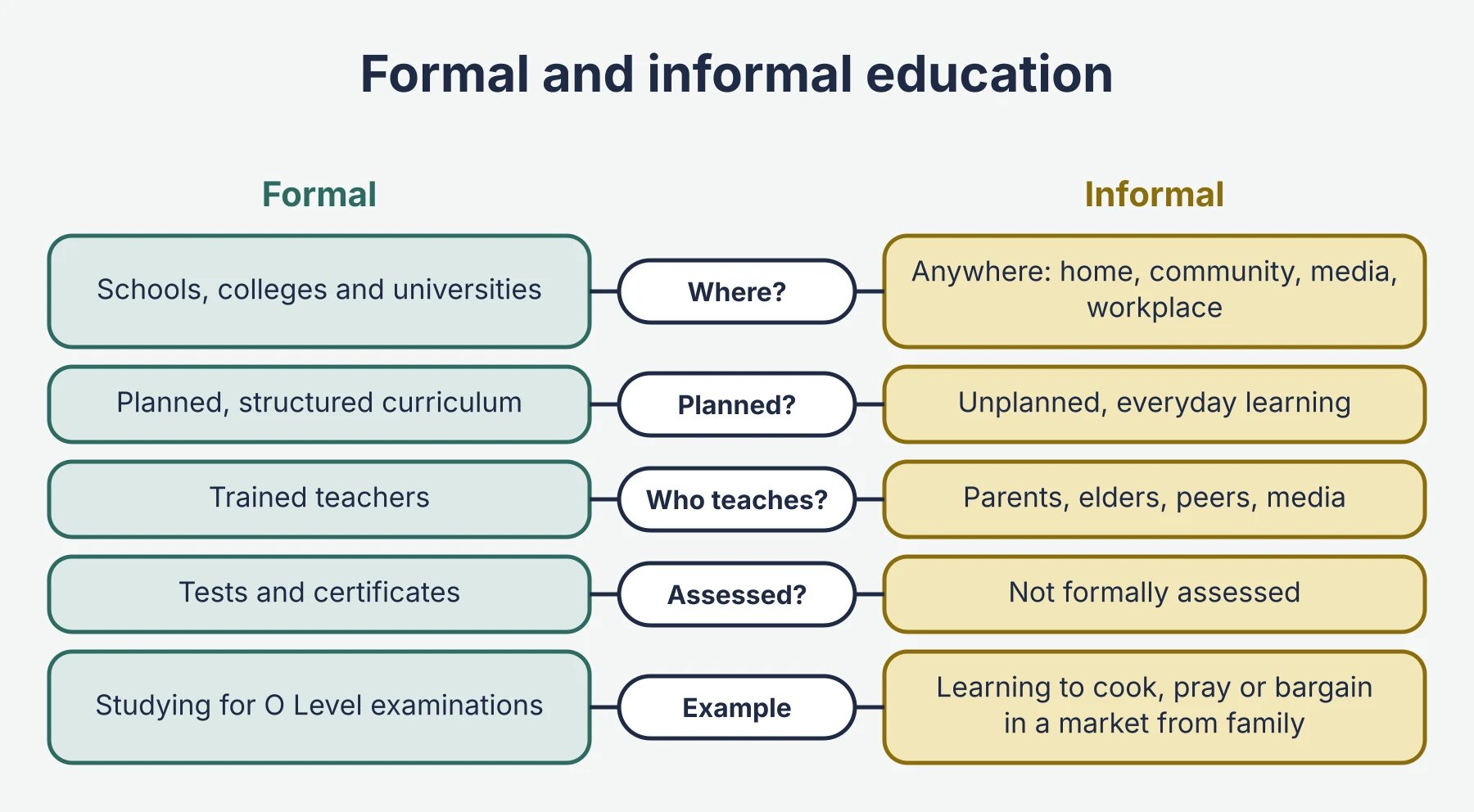
Formal vs informal: four tests
Ask four questions to classify any learning: Where? (institution or everyday life) Planned? (curriculum or not) Who teaches? (trained teachers or family, peers, media) Assessed? (examinations and certificates or not). Formal education passes all four; informal education usually passes none. Many situations are mixed: a parent following a homeschool curriculum is formal learning in an informal setting.
The official curriculum
- Subjects: which subjects are taught and which are compulsory shows what a society values.
- Syllabus content: what is included, and what is left out, within each subject.
- Testing: examinations measure and rank pupils, and decide who progresses.
Sociologists ask whose knowledge the official curriculum contains and who benefits when it is tested.
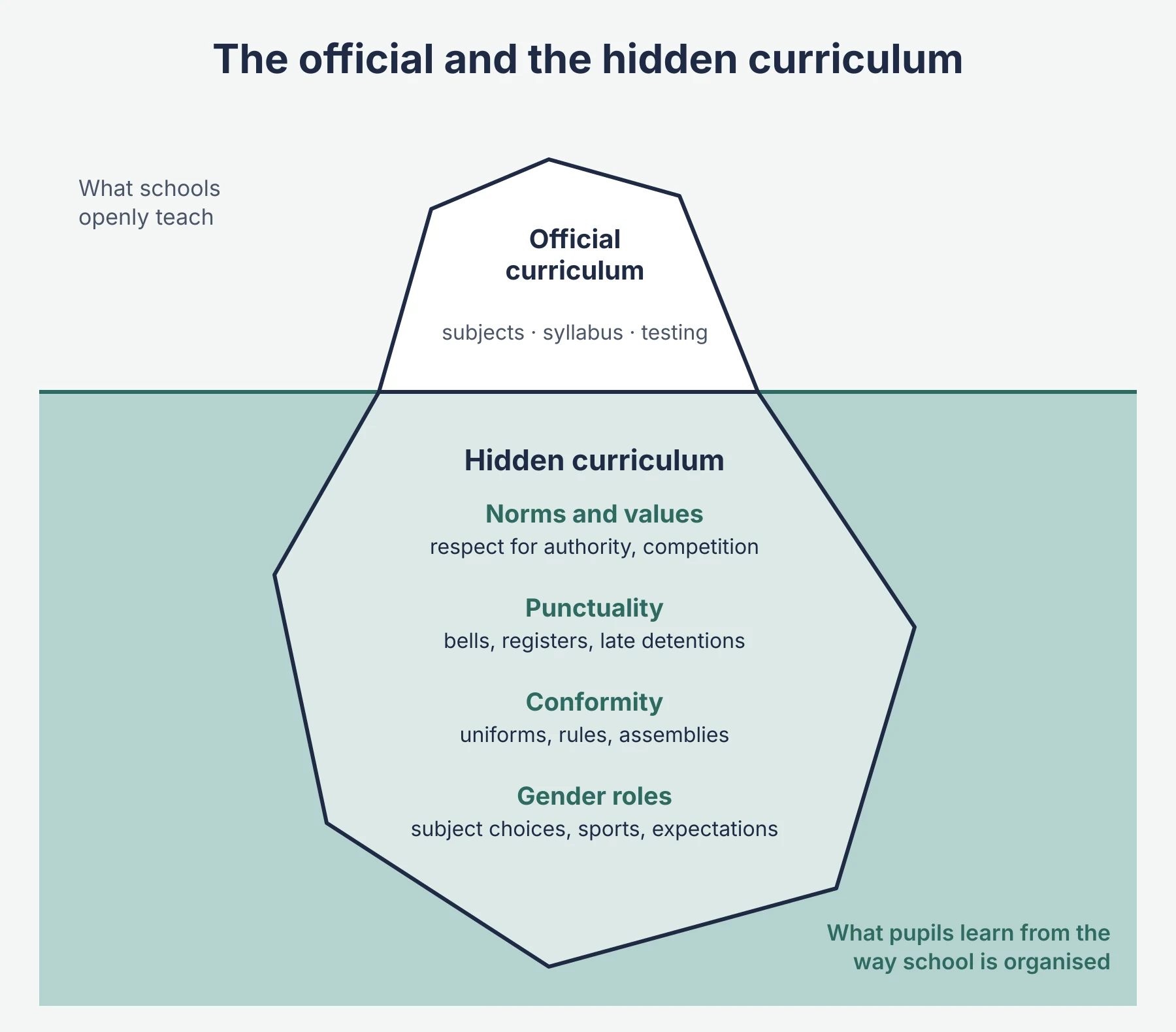
The hidden curriculum
The term is usually credited to Philip Jackson’s Life in Classrooms (1968).
- Norms and values: respect for authority, competition, individual achievement.
- Punctuality: bells, registers and penalties for lateness.
- Conformity: uniforms, rules, queues and assemblies.
- Gender roles: who is chosen for which tasks, sports and prefect roles, and teachers’ expectations of boys and girls.
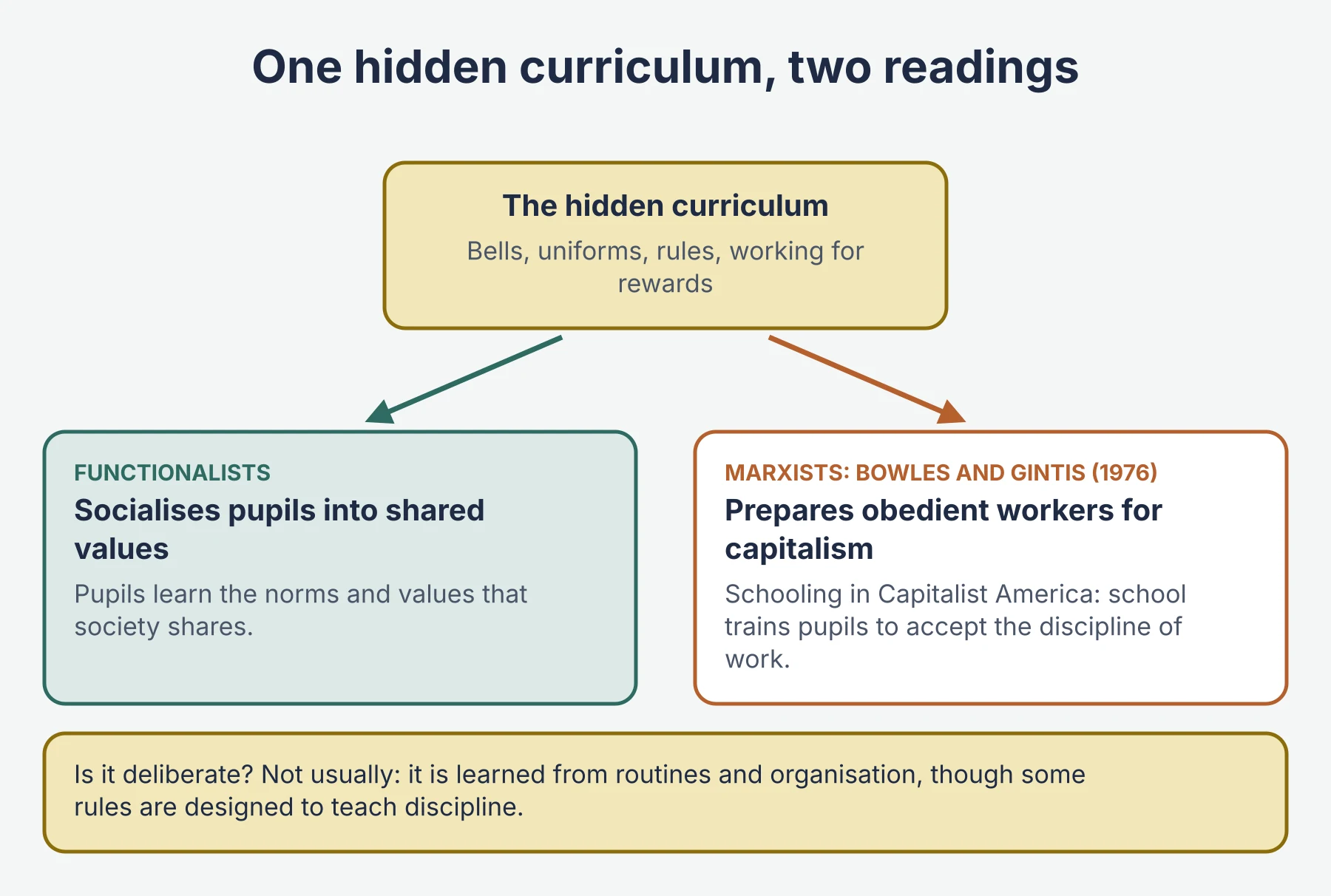
Two readings: functionalists see it as useful socialisation into shared values; Marxists (Bowles and Gintis, 1976) see it as training obedient workers for capitalism.
Judging school types (5.1.2)
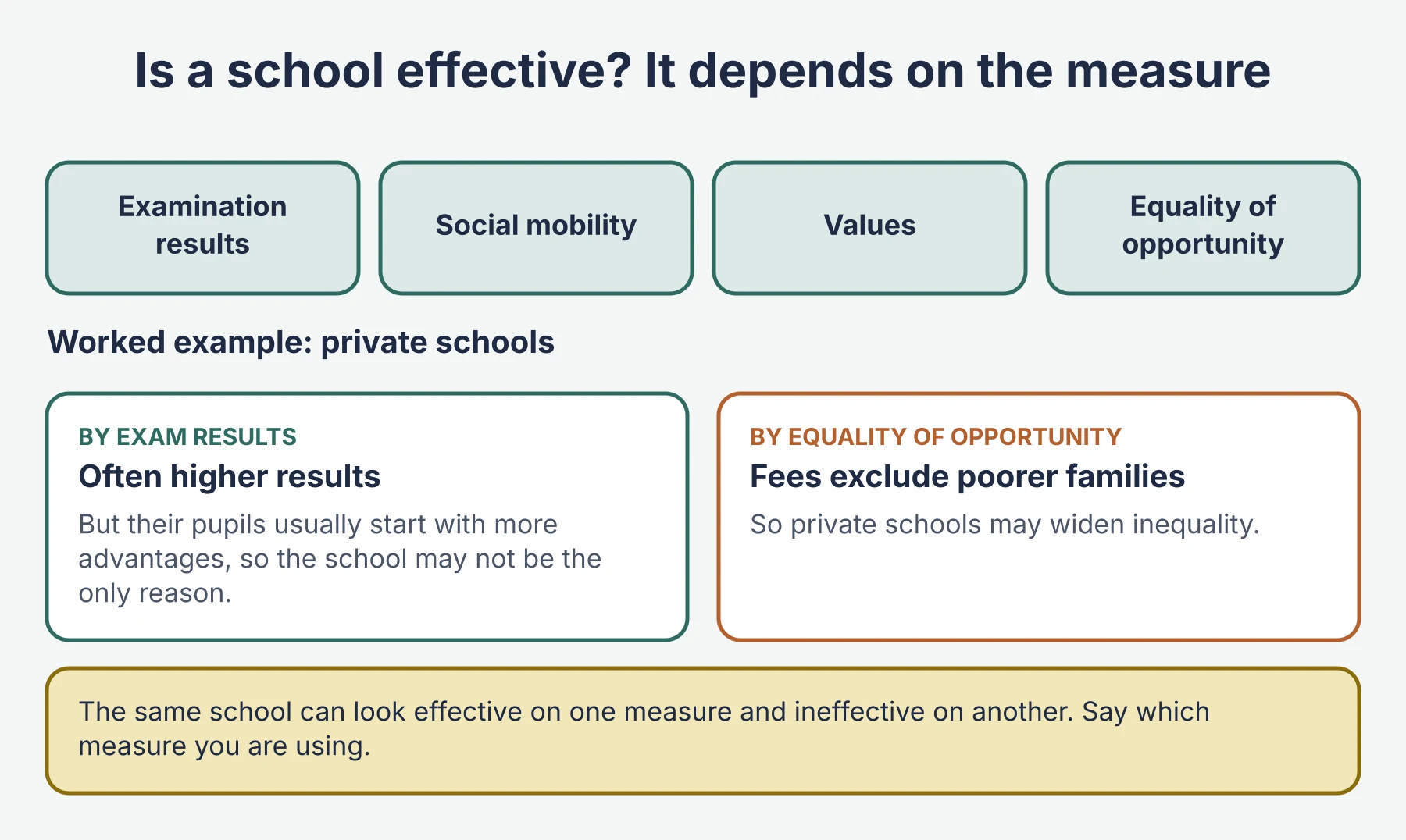
Effectiveness depends on the measure: examination results, equality of opportunity, social mixing, values, or preparation for work.
| Type | Effective at | Less effective at |
|---|---|---|
| State/public | Access for all; national standards | Resources and class sizes in many countries |
| Private | Results; facilities; small classes | Equality; social mixing |
| Selective | Stretching high attainers | Fairness to those rejected; social mixing |
| Non-selective | Equal opportunity; mixed intake | Stretching the most able, some argue |
| Single-sex | Some argue: wider subject choice for girls | Experience of mixed settings |
| Co-educational | Reflecting wider society | Boys may dominate attention |
| Faith | Shared values; community | Social and religious mixing |
| International | Global qualifications; languages | Cost; links to local culture |
Key evaluation point: a school with high results may have recruited advantaged pupils, so results alone do not prove the school is more effective.
Alternatives (5.1.3) in one line each
- Online learning: flexible and wide access, but depends on devices and connection; less social contact.
- Homeschooling: tailored and safe, but depends on parents’ time, knowledge and income.
- Unschooling: builds curiosity and independence, but risks gaps and makes qualifications harder; linked to John Holt and to Ivan Illich’s critique of schooling in Deschooling Society (1971).
- Vocational learning: practical skills and employability, but often lower status.
- Progressive schooling: motivation and democratic values, but uneven outcomes and may not suit every child; A.S. Neill’s Summerhill and Maria Montessori’s methods are well-known examples.
Exam traps
- The hidden curriculum is learned from organisation and routine, not from a hidden subject.
- Homeschooling and unschooling are not the same: one usually follows a curriculum, the other does not.
- “Effective” must be defined: effective at what, and for whom?
- Single-sex schooling is not only about girls; consider effects on boys too.
- Informal education is not the same as learning nothing useful; it teaches norms, skills and values.
- Do not judge a school type only by its examination results.
Self-test
- Distinguish education from schooling.
- Give two features of formal education.
- Name the three parts of the official curriculum listed in the syllabus.
- Who is usually credited with the term “hidden curriculum”?
- Give one example of the hidden curriculum teaching punctuality.
- How do Marxists interpret the hidden curriculum?
- Why might a private school’s high results not prove it is more effective?
- Give one strength and one limitation of faith schools.
- What is the difference between homeschooling and unschooling?
- Give one limitation of vocational learning.
- Name one example of progressive schooling.
- Which writer argued that society should be “deschooled”?
Answers
- Education is all learning of knowledge, skills and values; schooling is the formal part that happens in schools.
- Any two: takes place in institutions; planned curriculum; trained teachers; formal assessment.
- Testing, syllabus content and subjects.
- Philip Jackson (Life in Classrooms, 1968).
- Bells, registers or detentions for lateness.
- As training pupils to obey authority and accept hierarchy, preparing them for work under capitalism (Bowles and Gintis, 1976).
- Its pupils may already have advantages such as wealthier, more educated parents, so results may reflect intake rather than teaching.
- Strength: shared values and a strong community; limitation: may separate pupils by religion and reduce social mixing.
- Homeschooling usually follows a curriculum at home; unschooling lets the child decide what and how to learn.
- Any one: lower status than academic routes; may channel working-class pupils into lower-paid work.
- A.S. Neill’s Summerhill School, or Montessori schools.
- Ivan Illich (Deschooling Society, 1971).
More resources on this topic
Related resources
-
Study guides
Cambridge O Level Sociology (2251): Education – What are the roles and functions of education?
Cambridge O Level Sociology 2251 key question 5.2 in depth: functionalist, Marxist and feminist views of education, with evidence, criticisms and a model plan.
Sociology · Cambridge · O Level
Read guide -
Practice questions
Cambridge O Level Sociology (2251): Education – What are the roles and functions of education? – Practice Questions
Original Cambridge O Level Sociology 2251 Education practice on functionalist, Marxist and feminist views of the roles of education, with full answers.
Sociology · Cambridge · O Level
Try questions -
Revision notes
Cambridge O Level Sociology (2251): Education – What are the roles and functions of education? – Revision Notes
Revision notes for Cambridge O Level Sociology 2251 key question 5.2: functionalist, Marxist and feminist views of education, with key studies and a self-test.
Sociology · Cambridge · O Level
Revise topic
Related articles
Get free revision emails (optional)
Occasional emails with practice questions, worked explanations and links to free resources for the qualification and subjects you choose. No spam, and you can unsubscribe from any email. The free tools on this site never need an email.