
Revision Notes
Cambridge O Level Sociology (2251): Education – What are the roles and functions of education? – Revision Notes
Revision notes for Cambridge O Level Sociology 2251 key question 5.2: functionalist, Marxist and feminist views of education, with key studies and a self-test.
- Subject
- Sociology
- Level
- O LEVELS
- Topic
- Paper 2 – Family, Education and Crime
- Author
- Marlbridge Academic Team
- Updated
- Reviewed by
- Naqiya Yousaf (what this means)
Aligned to Cambridge O Level Sociology (2251), 2025-2027. Official specification .
Syllabus page (what it covers and how it is assessed): Cambridge O Level Sociology.
Syllabus points this page covers
2251
- 5.2 Education – What are the roles and functions of education?
Found an error? Report a correction.
Need help with this topic? Request a free trial class for O Level Sociology (2251).
These notes condense key question 5.2 of Cambridge O Level Sociology (2251), What are the roles and functions of education? Three views answer one question differently: does education serve society as a whole (functionalism), the ruling class (Marxism) or men (feminism)? The syllabus lists the concepts for each view and asks for strengths and limitations of all three.
Syllabus coverage
- 5.2.1 Functionalist: socialisation, social control, economic and selective roles; meritocracy and social mobility; role allocation; value consensus; equal opportunities; standardised testing; setting by ability; vocationalism.
- 5.2.2 Marxist: socialisation and social control as ideological control; hidden and official curriculum; middle-class culture and cultural capital; the myth of meritocracy; material factors such as digital access; setting by ability.
- 5.2.3 Feminist: patriarchal culture; male power; gender hierarchy; role models; access to education; gendered curriculum and subject choice; teacher expectations; peer groups and social control.
Key terms
| Term | Meaning |
|---|---|
| Social solidarity | A sense of belonging and shared identity that binds society together (Durkheim) |
| Universalistic standards | The same rules and criteria applied to everyone (Parsons) |
| Particularistic standards | Judging a person as a unique individual, as in the family |
| Meritocracy | A system in which rewards are based on ability and effort |
| Role allocation | Sorting people into the jobs that best suit their abilities |
| Value consensus | Broad agreement on shared norms and values |
| Vocationalism | Education aimed directly at preparing people for work |
| Ideological state apparatus | Althusser: an institution that spreads ruling-class ideas |
| Correspondence principle | Bowles and Gintis: school organisation mirrors the workplace |
| Cultural capital | Bourdieu: knowledge, language and tastes valued by schools, mostly from middle-class homes |
| Myth of meritocracy | The Marxist claim that meritocracy is an illusion that legitimates inequality |
| Counter-school culture | A pupil group that rejects school values (Willis, 1977) |
| Gender hierarchy | Ranking in which men hold more senior and powerful positions |
| Gendered subject choice | Patterned choice of subjects by gender |
Functionalism at a glance
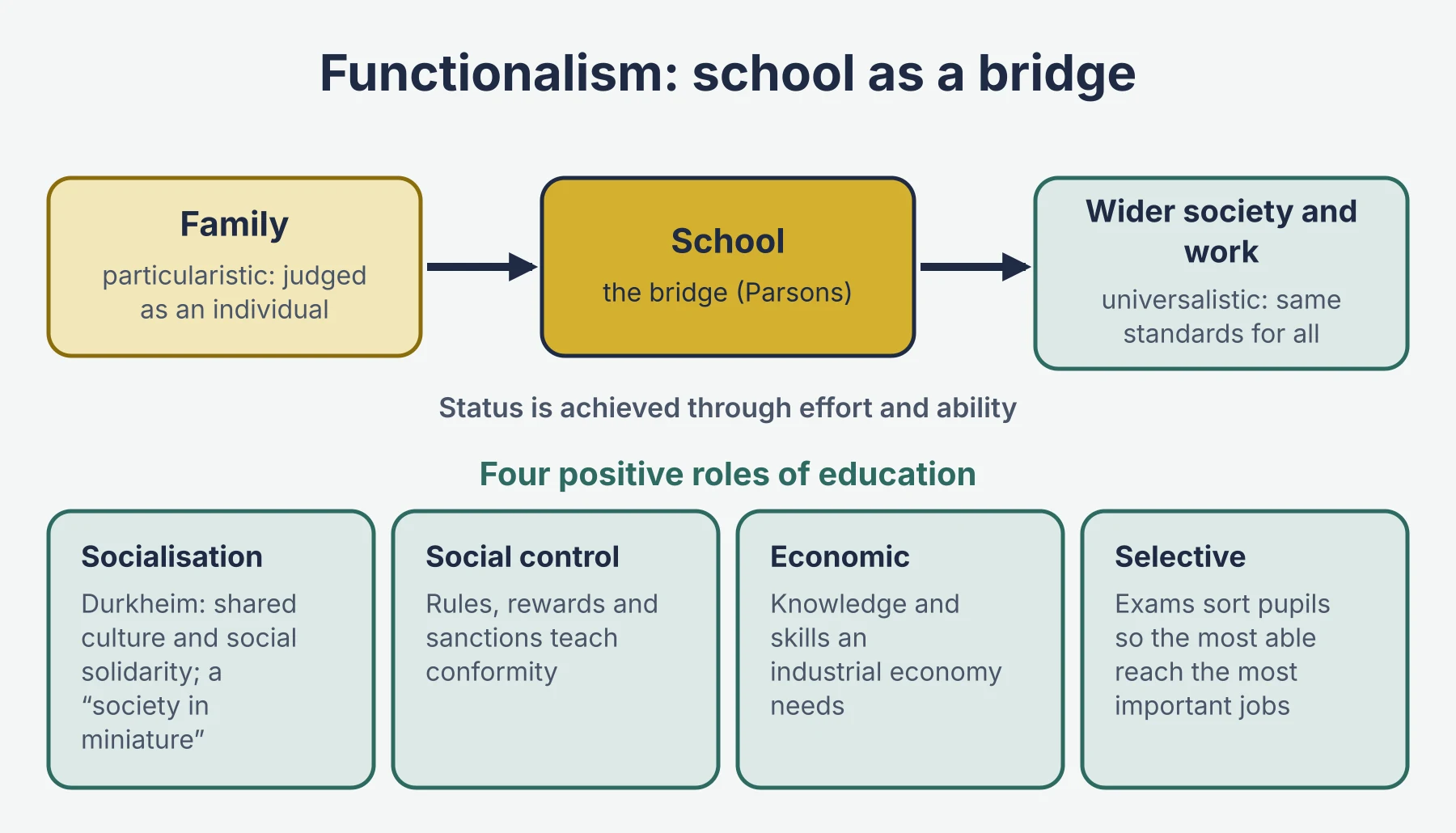
- Durkheim: socialisation creates social solidarity; school is “society in miniature”; teaches specialist skills.
- Parsons: school bridges family (particularistic, ascribed) and society (universalistic, achieved); meritocracy.
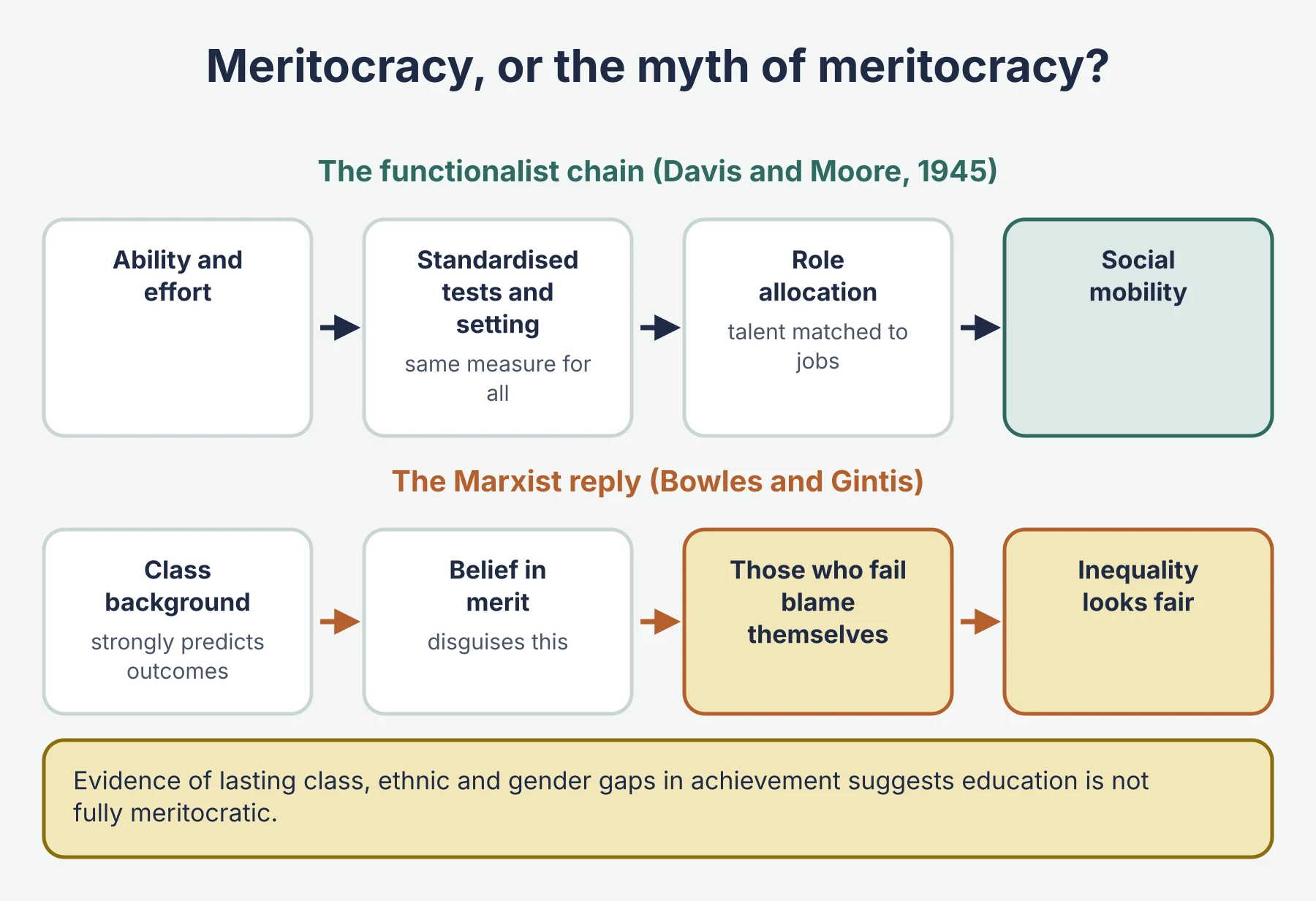
- Davis and Moore (1945): role allocation; most able to most important, best-rewarded jobs.
- Supporting practices: equal opportunities, standardised testing, setting by ability, vocationalism.
- Strengths: links education to the economy; qualifications do aid mobility for many.
- Limitations: persistent class, ethnic and gender gaps; Tumin (1953) called Davis and Moore circular; assumes consensus.
Marxism at a glance
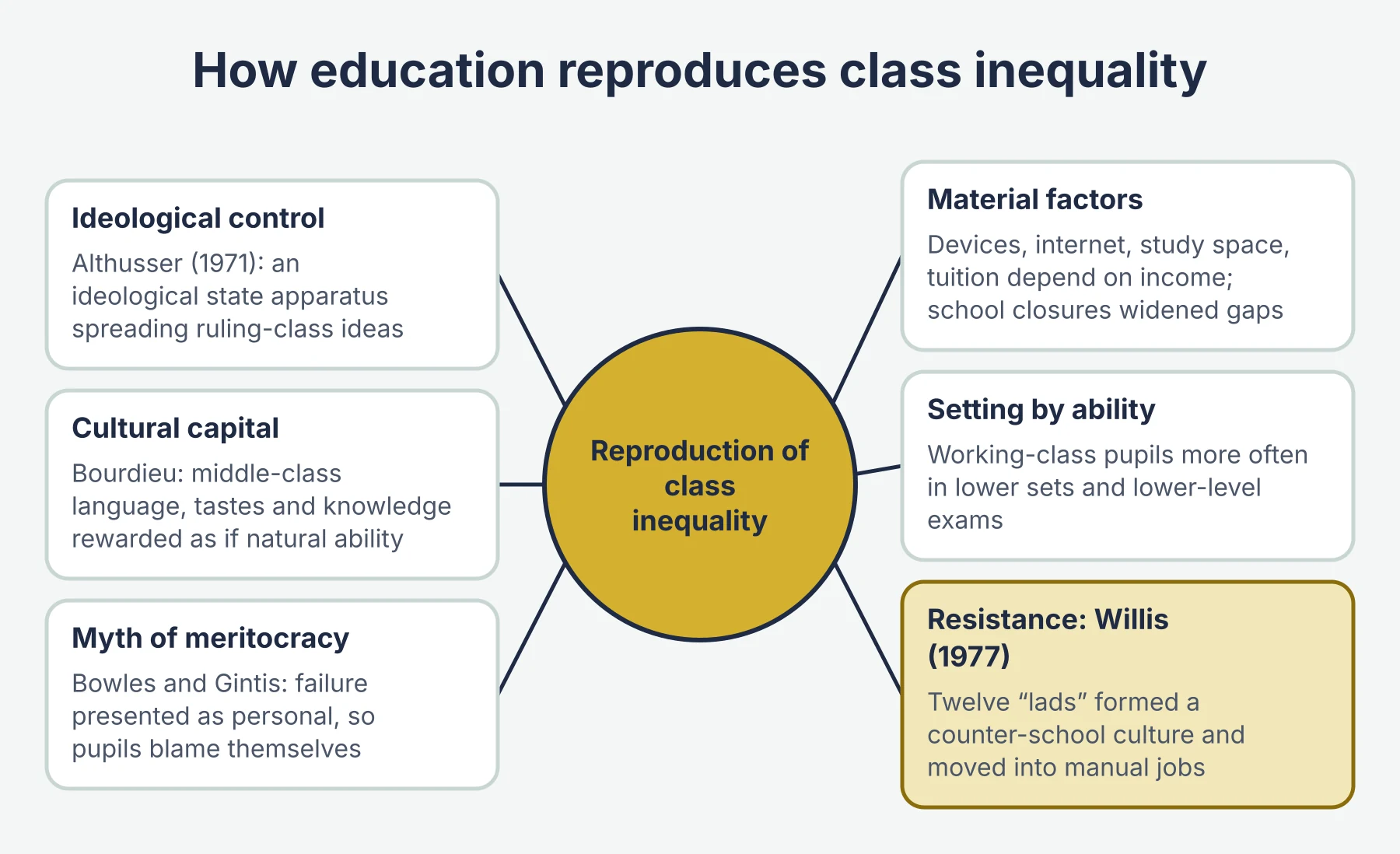
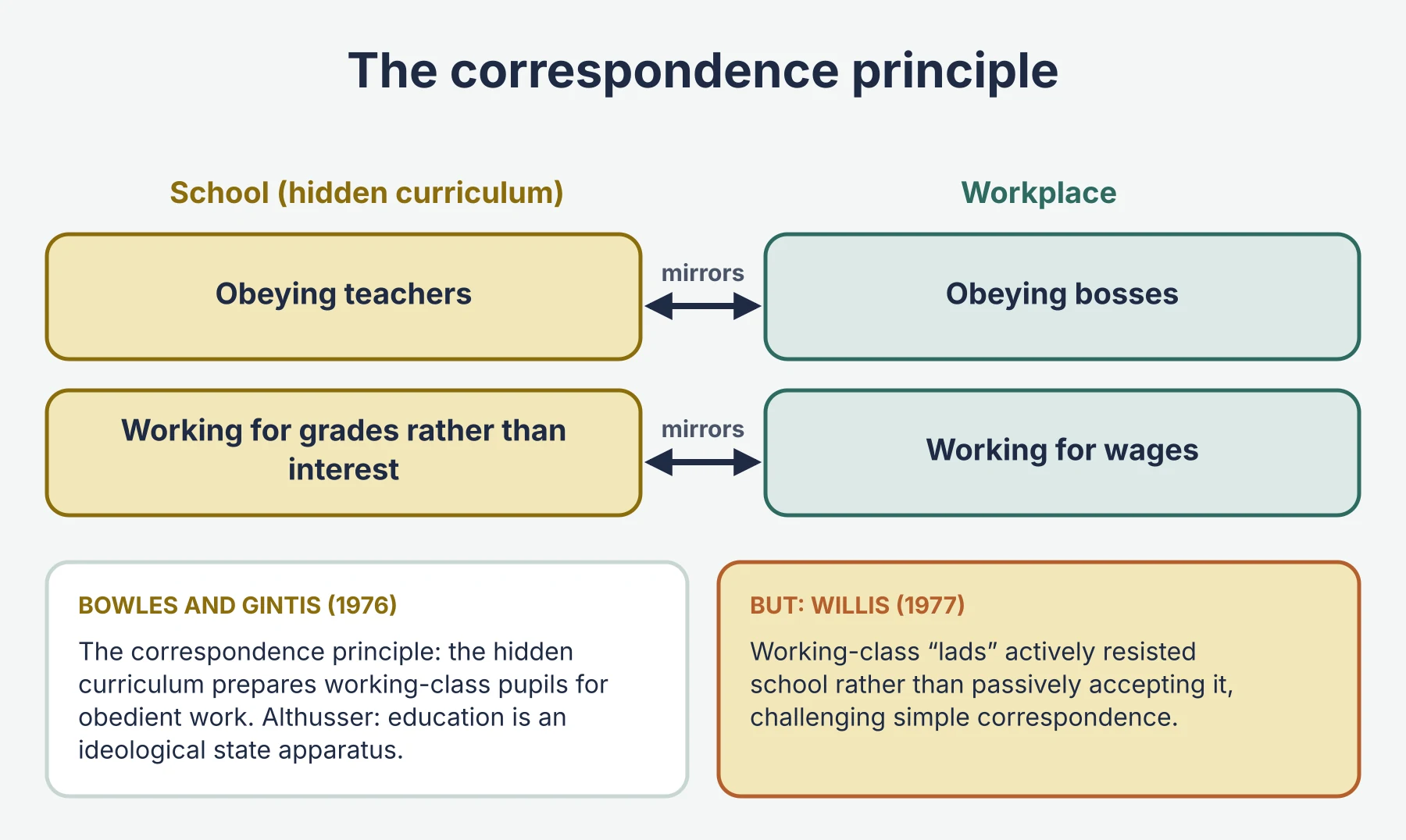
- Althusser (1971): education as an ideological state apparatus.
- Bowles and Gintis (1976): correspondence principle; hidden curriculum trains obedient workers; myth of meritocracy.
- Bourdieu: cultural capital rewarded as ability.
- Material factors: devices, internet, study space, tuition.
- Setting: working-class pupils more often placed in lower sets.
- Willis (1977): twelve working-class “lads” rejected school and moved into manual work.
- Strengths: explains persistent class gaps and why inequality can look fair.
- Limitations: pupils are not passive (Willis); many working-class pupils succeed; ignores gender and ethnicity.
Feminism at a glance
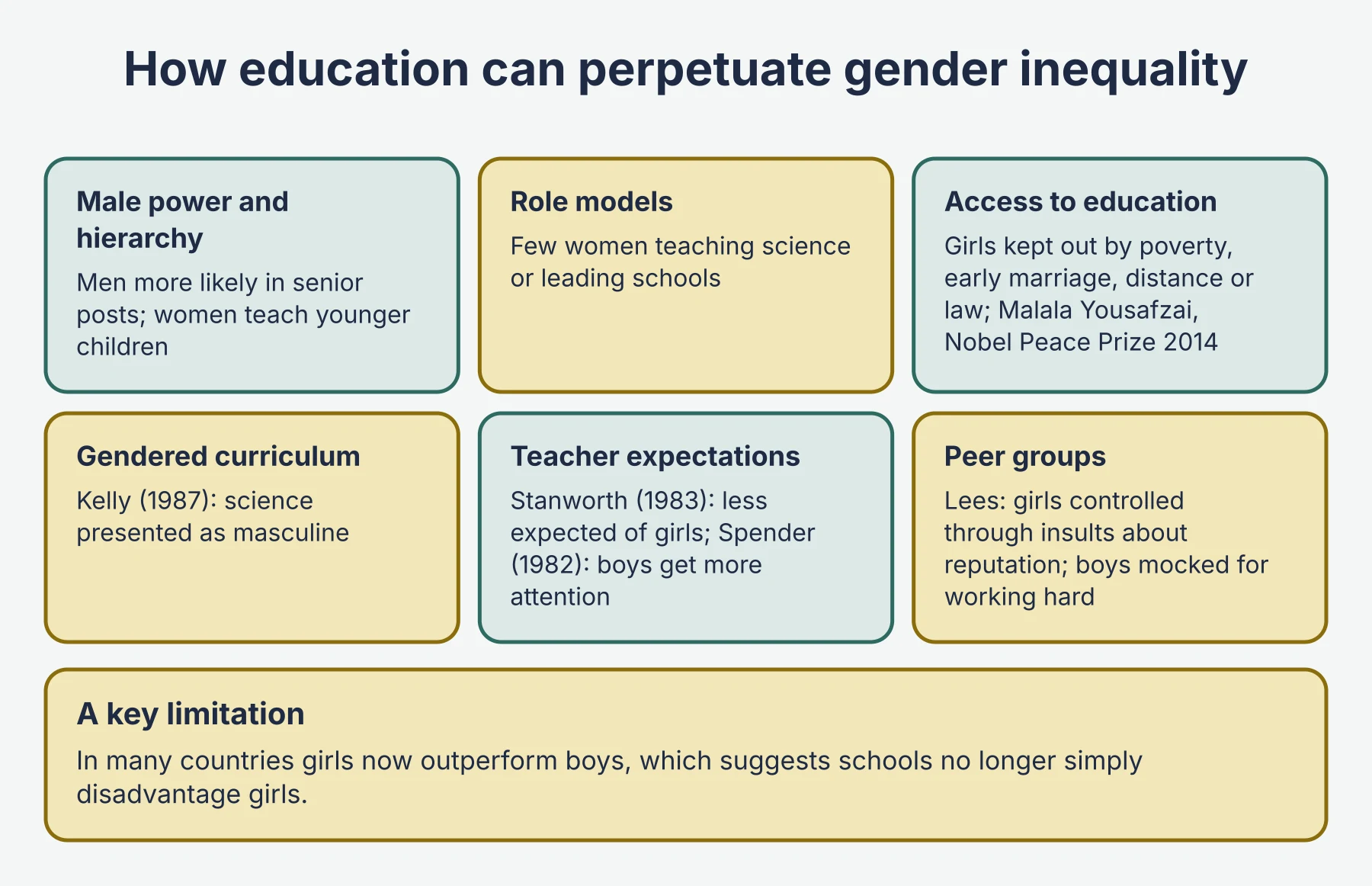
- Patriarchal culture and male power: senior posts often held by men.
- Role models: few women in science teaching or school leadership.
- Access: girls excluded from schooling in some societies by poverty, early marriage, distance or law; Malala Yousafzai’s campaign.
- Curriculum: Kelly (1987): science presented as masculine.
- Teacher expectations: Stanworth (1983): teachers expected less of girls; Spender (1982): boys got more attention.
- Peer control: Lees: girls policed through insults about reputation.
- Strengths: explains gendered subject and career choices; global access issues.
- Limitations: girls outperform boys in many countries; ignores class and ethnic differences among girls; real progress through equal-opportunity policies.
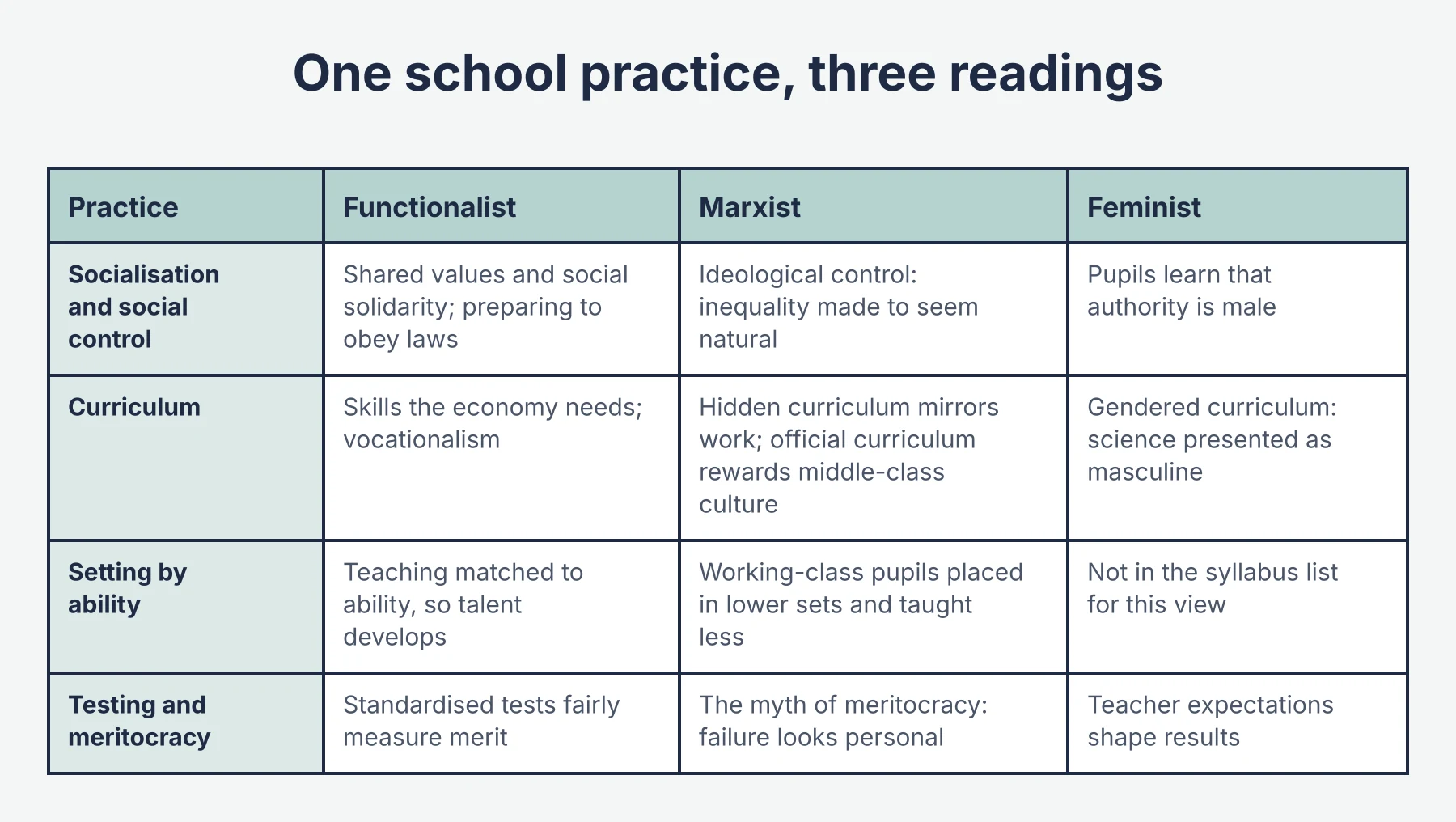
One practice, three readings
| School practice | Functionalist | Marxist | Feminist |
|---|---|---|---|
| Hidden curriculum | Teaches shared values | Teaches obedience for capitalism | Teaches gender roles |
| Examinations | Fair measure of merit | Reward cultural capital | Shape gendered subject routes |
| Setting by ability | Efficient matching | Places working-class pupils low | Can reflect gendered expectations |
Exam traps
- Role allocation (Davis and Moore) is not the same as social control.
- “Meritocracy” is functionalist; “myth of meritocracy” is Marxist. Do not mix them.
- The correspondence principle is about school organisation, not lesson content.
- Cultural capital is not money: material factors are a separate point.
- A feminist evaluation must deal with girls’ rising achievement.
- Explain the mechanism; naming a study alone is description.
Self-test
- Name the four roles of education listed under the functionalist view.
- What did Durkheim mean by “society in miniature”?
- Distinguish particularistic from universalistic standards.
- What is role allocation and who proposed it?
- Why did Tumin criticise Davis and Moore?
- What is the correspondence principle?
- Define cultural capital.
- What did Willis’s lads do, and what happened to them?
- Give one material factor that affects achievement.
- What did Kelly argue about science?
- Give two ways peer groups may control gender behaviour.
- Give one limitation of the feminist view of education.
Answers
- Socialisation, social control, economic and selective.
- School is where pupils learn to cooperate with non-relatives under shared rules, as in wider society.
- Particularistic standards judge someone as an individual, as in the family; universalistic standards apply the same rules to everyone, as at school and work.
- Sorting people into the jobs that suit their abilities; Davis and Moore (1945).
- Their argument is circular: it assumes the best-rewarded jobs must be the most important.
- Bowles and Gintis’s idea that school organisation mirrors the workplace, preparing pupils for work under capitalism.
- The knowledge, language and tastes valued by schools, mostly passed on in middle-class homes (Bourdieu).
- They formed a counter-school culture, rejected school and moved into manual jobs.
- Any one: digital devices and internet; quiet study space; private tuition; money for trips and books.
- That science is presented as a masculine subject, discouraging girls.
- Any two: mocking girls for ambition; judging girls by reputation; teasing boys who work hard; pressure to choose “gender-appropriate” subjects.
- Any one: girls outperform boys in many countries; ignores class and ethnic differences; underplays progress.
More resources on this topic
Related resources
-
Study guides
Cambridge O Level Sociology (2251): Education – What factors help to explain differences in educational achievement and experience?
Cambridge O Level Sociology 2251 key question 5.3 in depth: class, ethnicity, gender and global differences in achievement, with key studies and evaluation.
Sociology · Cambridge · O Level
Read guide -
Practice questions
Cambridge O Level Sociology (2251): Education – What factors help to explain differences in educational achievement and experience? – Practice Questions
Original Cambridge O Level Sociology 2251 Education practice on class, ethnicity, gender and global differences in achievement, with mark-scheme answers.
Sociology · Cambridge · O Level
Try questions -
Revision notes
Cambridge O Level Sociology (2251): Education – What factors help to explain differences in educational achievement and experience? – Revision Notes
Revision notes for Cambridge O Level Sociology 2251 key question 5.3: class, ethnicity, gender and global differences in achievement, with a self-test.
Sociology · Cambridge · O Level
Revise topic
Related articles
Get free revision emails (optional)
Occasional emails with practice questions, worked explanations and links to free resources for the qualification and subjects you choose. No spam, and you can unsubscribe from any email. The free tools on this site never need an email.