
Study Guides
Cambridge O Level Sociology (2251): Education – What factors help to explain differences in educational achievement and experience?
Cambridge O Level Sociology 2251 key question 5.3 in depth: class, ethnicity, gender and global differences in achievement, with key studies and evaluation.
- Subject
- Sociology
- Level
- O LEVELS
- Topic
- Paper 2 – Family, Education and Crime
- Author
- Marlbridge Academic Team
- Updated
- Reviewed by
- Naqiya Yousaf (what this means)
Aligned to Cambridge O Level Sociology (2251), 2025-2027. Official specification .
Syllabus page (what it covers and how it is assessed): Cambridge O Level Sociology.
Syllabus points this page covers
2251
- 5.3 Education – What factors help to explain differences in educational achievement and experience?
Found an error? Report a correction.
Need help with this topic? Request a free trial class for O Level Sociology (2251).
Key question 5.3 of Cambridge O Level Sociology (2251) asks What factors help to explain differences in educational achievement and experience? It is the largest key question in the Education topic: four patterns, a separate list of explanations for class, ethnicity and gender, a list of reasons for global differences, and a requirement to judge them all. The skill that earns credit is sorting each explanation by where it operates (home, school or society) and how it affects achievement.
What the syllabus covers
| Section | Content named in the 2251 syllabus (2025–2027) |
|---|---|
| 5.3.1 Patterns | Social class; ethnicity; gender; global differences |
| 5.3.2 Social class | Material factors, e.g. access to digital technology; cultural and social factors; cultural capital; home/community factors; linguistic factors; compensatory education; in-school factors, e.g. pro- and anti-school sub-cultures; selective and private education; labelling theory; Marxist explanations |
| 5.3.3 Ethnicity | Institutional racism; ethnocentric curriculum; role models; linguistic factors; cultural, material and social factors; home/community factors; in-school factors, e.g. pro- and anti-school sub-cultures, ethnic sub-cultures; labelling theory |
| 5.3.4 Gender | Differential gendered socialisation and social control; teacher expectations; cultural and social factors; access to education; in-school factors, e.g. gendered sub-cultures; labelling theory; feminist explanations, e.g. patriarchy |
| 5.3.5 Global differences | Availability of schools; poverty/wealth; access to education for girls; class sizes; norms, values and cultural differences; access to the internet / digital resources |
| 5.3.6 | Strengths and limitations of the explanations for class, ethnicity, gender and global differences |
The key question says achievement and experience. Experience means what school is like for a pupil: being labelled, feeling included in the curriculum, being bullied, being placed in a low set. Use both words in your answers.
The patterns (5.3.1)
In many societies, broad patterns recur: pupils from middle-class backgrounds on average achieve more than working-class pupils; some ethnic groups achieve above and some below the average; girls now outperform boys in many countries at school-leaving level, although boys and men still dominate some subjects and careers; and achievement varies greatly between richer and poorer countries. Patterns differ between societies, so treat them as tendencies, not rules, and do not quote figures you cannot support.
Explanations based on social class (5.3.2)
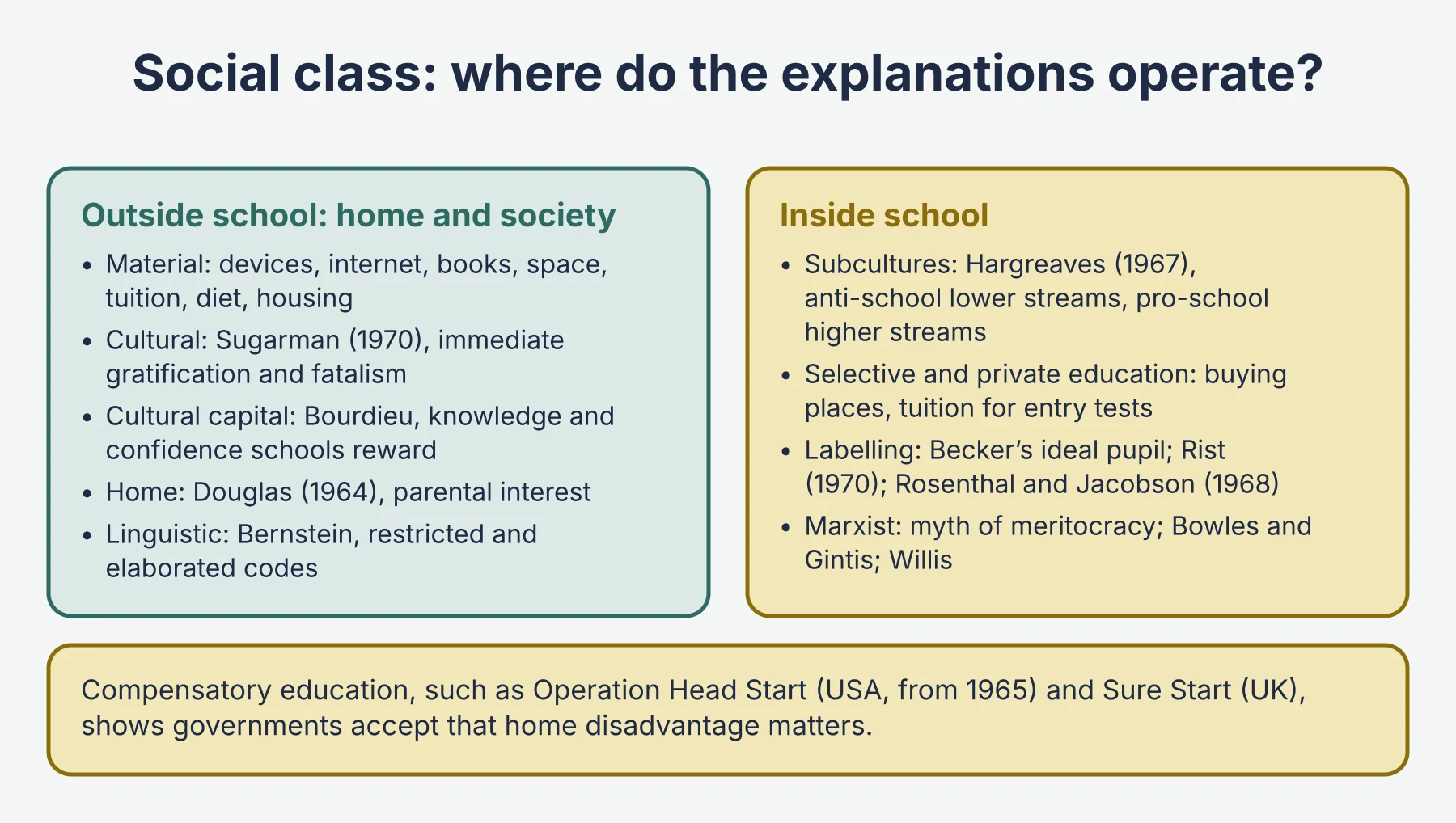
Outside school (home and society):
- Material factors: lack of money for devices, internet, books, quiet space, trips and tuition; poor diet and housing affect health and attendance.
- Cultural and social factors: Barry Sugarman (1970) argued that working-class subculture valued immediate gratification over deferred rewards and held a fatalistic outlook, discouraging long study. Critics say these are realistic responses to poverty, not a separate culture.
- Cultural capital: Pierre Bourdieu argued that middle-class children inherit knowledge, tastes and confidence that schools reward.
- Home/community factors: J.W.B. Douglas’s The Home and the School (1964) linked achievement to the level of parental interest in a child’s education, which he found higher in middle-class families. Critics point out that working-class parents may care just as much but have less time.
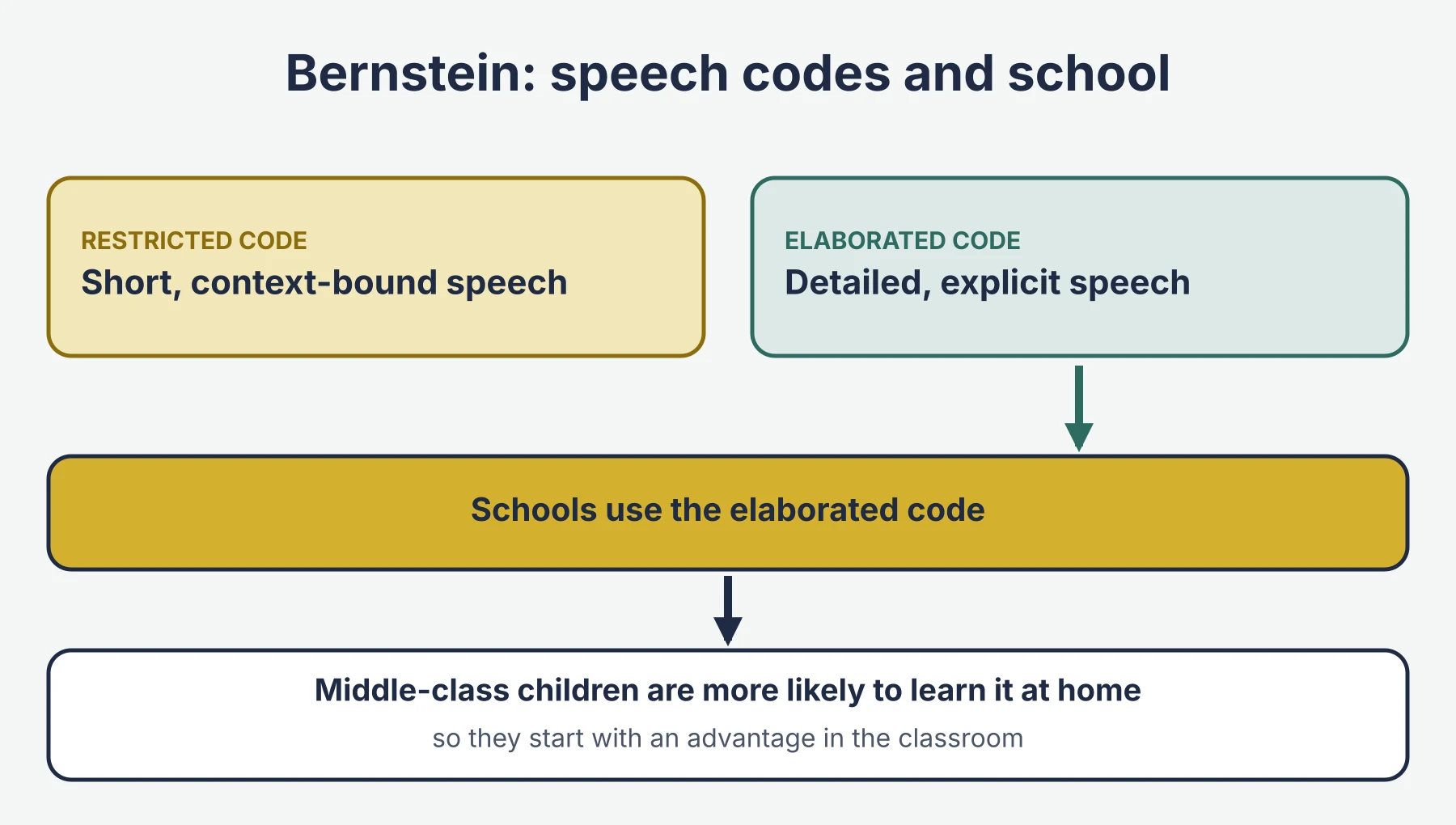
- Linguistic factors: Basil Bernstein distinguished the restricted code (short, context-bound speech) from the elaborated code (detailed, explicit speech). Schools use the elaborated code, which middle-class children learn at home.
- Compensatory education: programmes that give extra resources to disadvantaged children, such as Operation Head Start in the USA (from 1965) and Sure Start in the UK. They show that governments accept home disadvantage matters.
Inside school:
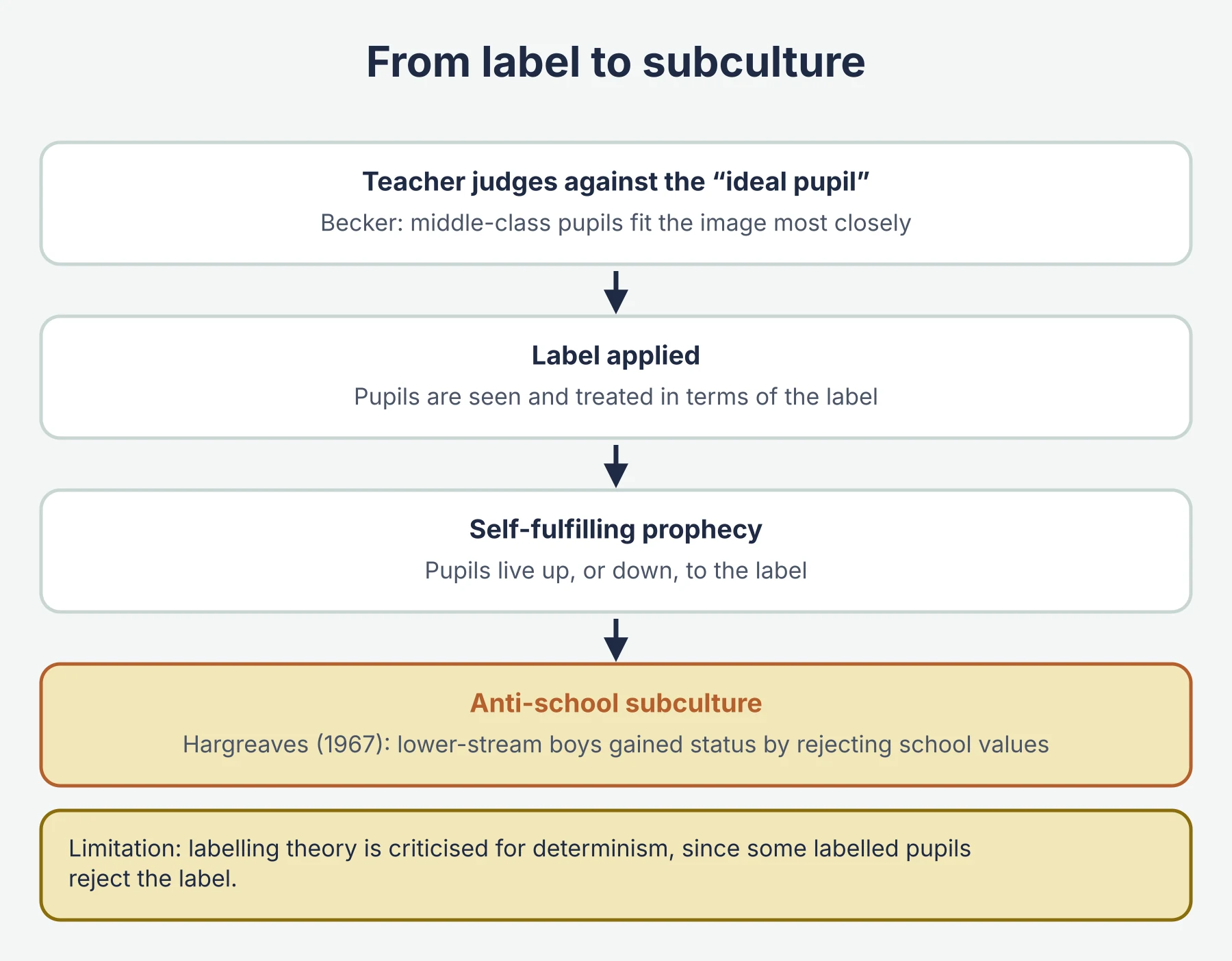
- In-school factors: David Hargreaves (1967) found that boys in lower streams, labelled as failures, formed an anti-school subculture that gave them status by breaking rules. Pupils in higher streams more often formed pro-school subcultures.
- Selective and private education: wealthier families can buy places in private schools or move near high-performing schools; entry tests may favour children with tuition.
- Labelling theory: Howard Becker found that teachers judged pupils against an image of the ideal pupil, which middle-class pupils fitted best. Ray Rist (1970) observed a kindergarten teacher seating children by her early judgement of their ability, which matched their social class. Robert Rosenthal and Lenore Jacobson (Pygmalion in the Classroom, 1968) found that pupils teachers were told would “spurt” ahead often did, suggesting a self-fulfilling prophecy.
- Marxist explanations: the myth of meritocracy and the reproduction of class (Bowles and Gintis; Willis), which tie the in-school and out-of-school factors to capitalism.
Explanations based on ethnicity (5.3.3)
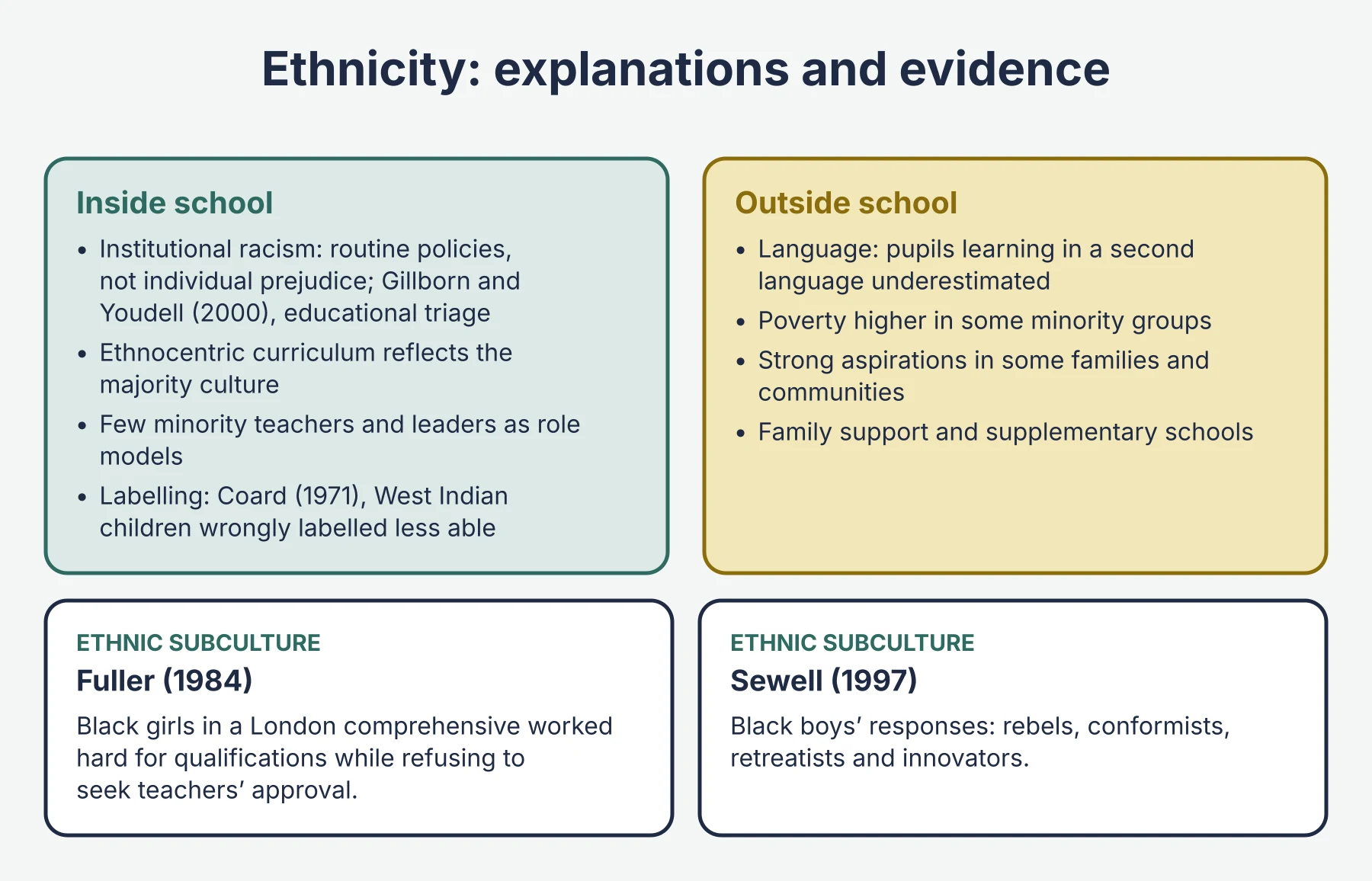
- Institutional racism: discrimination built into the routine policies of an organisation rather than individual prejudice. The term was given wide public attention by the Macpherson Report (1999) into the police investigation of Stephen Lawrence’s murder. In education, David Gillborn and Deborah Youdell (2000) argued that schools focused effort on pupils seen as likely to pass, a form of educational triage, and that some minority pupils were less often placed in that group.
- Ethnocentric curriculum: a curriculum that reflects the culture and history of the majority group, which can leave minority pupils feeling excluded.
- Role models: few teachers or school leaders from minority groups.
- Linguistic factors: pupils learning in a second language may be underestimated or placed in lower sets.
- Cultural, material and social factors: higher rates of poverty in some minority groups; strong educational aspirations in some families and communities.
- Home/community factors: family support, supplementary schools and community expectations can raise achievement.
- In-school factors and ethnic subcultures: Mary Fuller (1984) studied Black girls in a London comprehensive who worked hard for qualifications while refusing to seek teachers’ approval. Tony Sewell (1997) described different responses among Black boys, including rebels, conformists, retreatists and innovators.
- Labelling theory: Bernard Coard (1971) argued that the British school system wrongly labelled many West Indian children as less able. Labels may lead to lower sets and lower expectations.
Explanations based on gender (5.3.4)
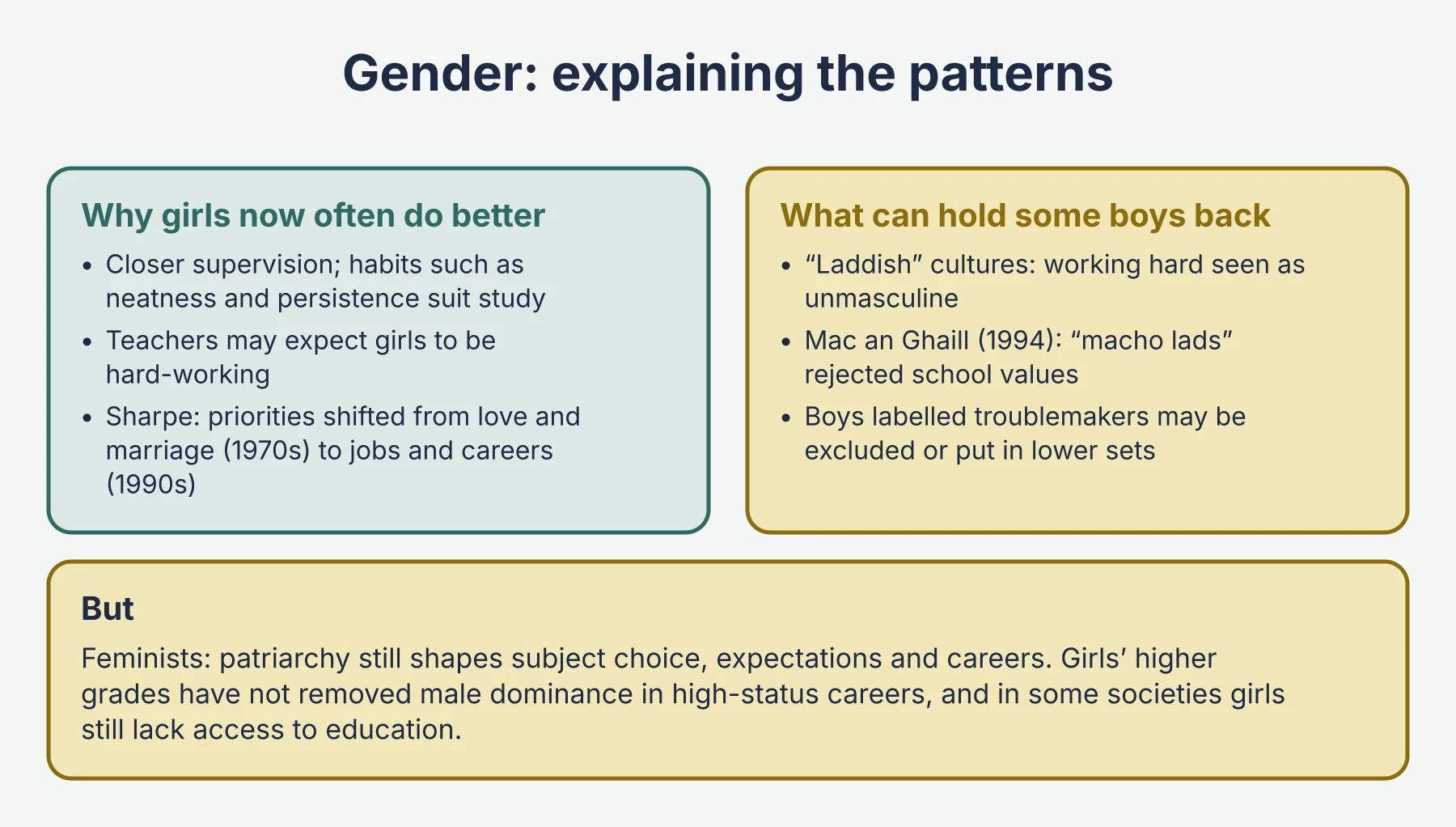
- Differential gendered socialisation and social control: girls are often more closely supervised, and some argue they learn habits such as neatness and persistence that suit coursework and study.
- Teacher expectations: teachers may expect girls to be hard-working and boys to be disruptive, or expect boys to be stronger in science.
- Cultural and social factors: Sue Sharpe’s study of girls’ priorities found a shift between the 1970s and the 1990s from love and marriage towards jobs and careers, linked to changing opportunities for women.
- Access to education: in some societies girls have less access because of poverty, early marriage, safety on the way to school or law.
- In-school factors and gendered subcultures: “laddish” cultures in which working hard is seen as unmasculine may lower some boys’ achievement; Máirtín Mac an Ghaill (1994) described “macho lads” who rejected school values.
- Labelling theory: boys labelled as troublemakers may be excluded or placed in lower sets.
- Feminist explanations: patriarchy shapes subject choice, expectations and careers; feminists note that girls’ higher grades have not removed male dominance in high-status careers.
Global differences (5.3.5)
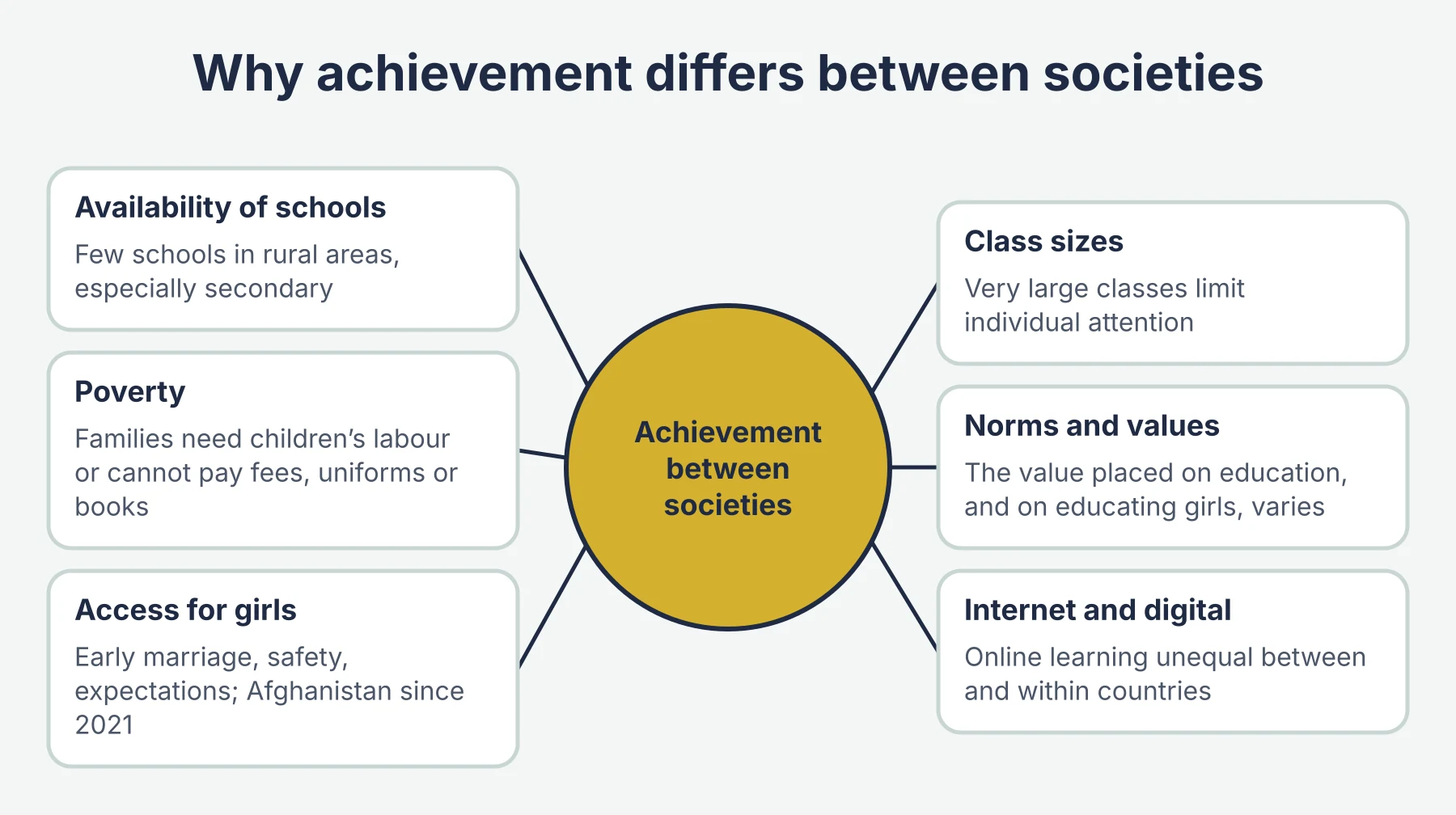
- Availability of schools: rural areas may have few schools, especially secondary schools.
- Poverty/wealth: families may need children’s labour or cannot afford fees, uniforms or books.
- Access to education for girls: early marriage, safety and cultural expectations; restrictions on girls’ secondary schooling in Afghanistan since 2021 are a current example.
- Class sizes: very large classes limit individual attention.
- Norms, values and cultural differences: the value placed on education, and on educating girls, varies.
- Internet and digital resources: access to online learning and information is unequal between and within countries.
Weighing the explanations (5.3.6)
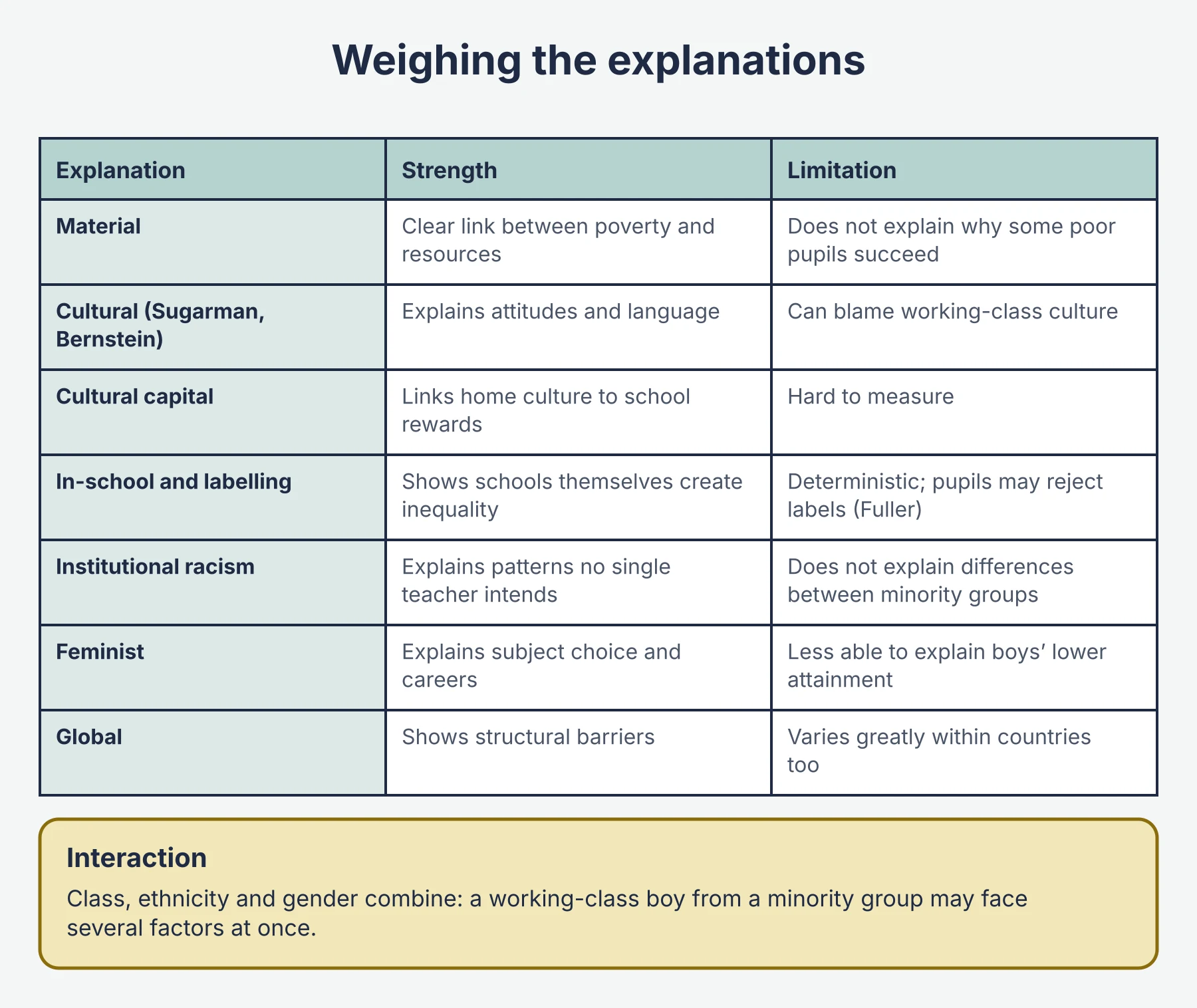
| Explanation type | Strength | Limitation |
|---|---|---|
| Material | Clear link between poverty and resources | Does not explain why some poor pupils succeed |
| Cultural (Sugarman, Bernstein) | Explains attitudes and language | Can blame working-class culture rather than schools or poverty |
| Cultural capital | Links home culture to school rewards | Hard to measure |
| In-school and labelling | Shows schools themselves create inequality | Can be deterministic; pupils may reject labels (Fuller) |
| Institutional racism | Explains patterns no single teacher intends | Does not explain differences between minority groups |
| Feminist | Explains subject choice and careers | Less able to explain boys’ lower attainment |
| Global | Shows structural barriers | Varies greatly within countries as well as between them |
Interaction: class, ethnicity and gender combine. A working-class boy from a minority group may face several factors at once, so the strongest answers show how explanations overlap.
Worked example: an annotated “explain” answer
Question: Explain two in-school factors that may affect the achievement of working-class pupils.
“One factor is labelling. Teachers may judge working-class pupils as less able because they do not fit the image of the ideal pupil (Becker) [point and evidence]. The pupil may then be placed in a lower set and receive less challenging work, so the label becomes a self-fulfilling prophecy [mechanism]. A second factor is anti-school subcultures. Pupils placed in lower streams may gain status by rejecting school rules instead (Hargreaves, 1967) [point and evidence], which lowers their effort and results further [effect].”
Common mistakes
- Treating material and cultural factors as the same; cultural capital is not money.
- Explaining ethnicity patterns as if all minority groups achieve the same.
- Using “girls are cleverer” rather than a sociological explanation.
- Forgetting experience: exclusion, labelling and curriculum content matter even where grades are similar.
- Describing global differences without explaining why each factor affects achievement.
Exam technique for 2251 command words
- Explain answers need factor → mechanism → effect on achievement.
- Discuss a factor such as labelling by setting out evidence and its limits.
- Evaluate a claim like “home factors matter more than school factors” by weighing both sides and judging.
Keep revising
Related resources
-
Practice questions
Cambridge O Level Sociology (2251): Education – What factors help to explain differences in educational achievement and experience? – Practice Questions
Original Cambridge O Level Sociology 2251 Education practice on class, ethnicity, gender and global differences in achievement, with mark-scheme answers.
Sociology · Cambridge · O Level
Try questions -
Revision notes
Cambridge O Level Sociology (2251): Education – What factors help to explain differences in educational achievement and experience? – Revision Notes
Revision notes for Cambridge O Level Sociology 2251 key question 5.3: class, ethnicity, gender and global differences in achievement, with a self-test.
Sociology · Cambridge · O Level
Revise topic -
Study guides
Cambridge O Level Sociology (2251): Crime, deviance and social control – What are crime, deviance and social control?
Cambridge O Level Sociology 2251 key question 6.1 in depth: crime and deviance, relativity, formal and informal control, types of crime and measuring crime.
Sociology · Cambridge · O Level
Read guide
Related articles
Get free revision emails (optional)
Occasional emails with practice questions, worked explanations and links to free resources for the qualification and subjects you choose. No spam, and you can unsubscribe from any email. The free tools on this site never need an email.