
Study Guides
Cambridge O Level Sociology (2251): Crime, deviance and social control – What are crime, deviance and social control?
Cambridge O Level Sociology 2251 key question 6.1 in depth: crime and deviance, relativity, formal and informal control, types of crime and measuring crime.
- Subject
- Sociology
- Level
- O LEVELS
- Topic
- Paper 2 – Family, Education and Crime
- Author
- Marlbridge Academic Team
- Updated
- Reviewed by
- Naqiya Yousaf (what this means)
Aligned to Cambridge O Level Sociology (2251), 2025-2027. Official specification .
Syllabus page (what it covers and how it is assessed): Cambridge O Level Sociology.
Syllabus points this page covers
2251
- 6.1 Crime, deviance and social control – What are crime, deviance and social control?
Found an error? Report a correction.
Need help with this topic? Request a free trial class for O Level Sociology (2251).
Key question 6.1 of Cambridge O Level Sociology (2251) asks What are crime, deviance and social control? It supplies the vocabulary for the whole Crime question: you cannot explain patterns (6.2) or judge punishments (6.3) without precise definitions, a clear idea of how social control works, and an understanding of why crime figures need careful handling. This guide covers all six syllabus sections, with examples you can adapt to any society.
What the syllabus covers
| Section | Content named in the 2251 syllabus (2025–2027) |
|---|---|
| 6.1.1 The difference between crime and deviance | Definitions of crime and deviance; the relativity of crime and deviance: they vary within and between societies, cultures, situations and across time |
| 6.1.2 Formal social control | The police; courts; armed forces; government; penal system; how formal agencies control individuals and prevent crime and deviance |
| 6.1.3 Informal social control | Family; education; workplace; peer group; traditional and digital media; religion; how informal agencies control individuals and prevent crime and deviance |
| 6.1.4 | The effectiveness of agencies and methods of social control in achieving conformity and preventing crime and deviance |
| 6.1.5 Different types and examples of crimes | Violent; property; white-collar/corporate; expressive; instrumental; gang; green; global, e.g. organised; cyber; hate; domestic |
| 6.1.6 Measuring crime | Official statistics; self-report studies; victim surveys (local and national); strengths and limitations of each; the problem of unreported and unrecorded crime |
Crime and deviance (6.1.1)
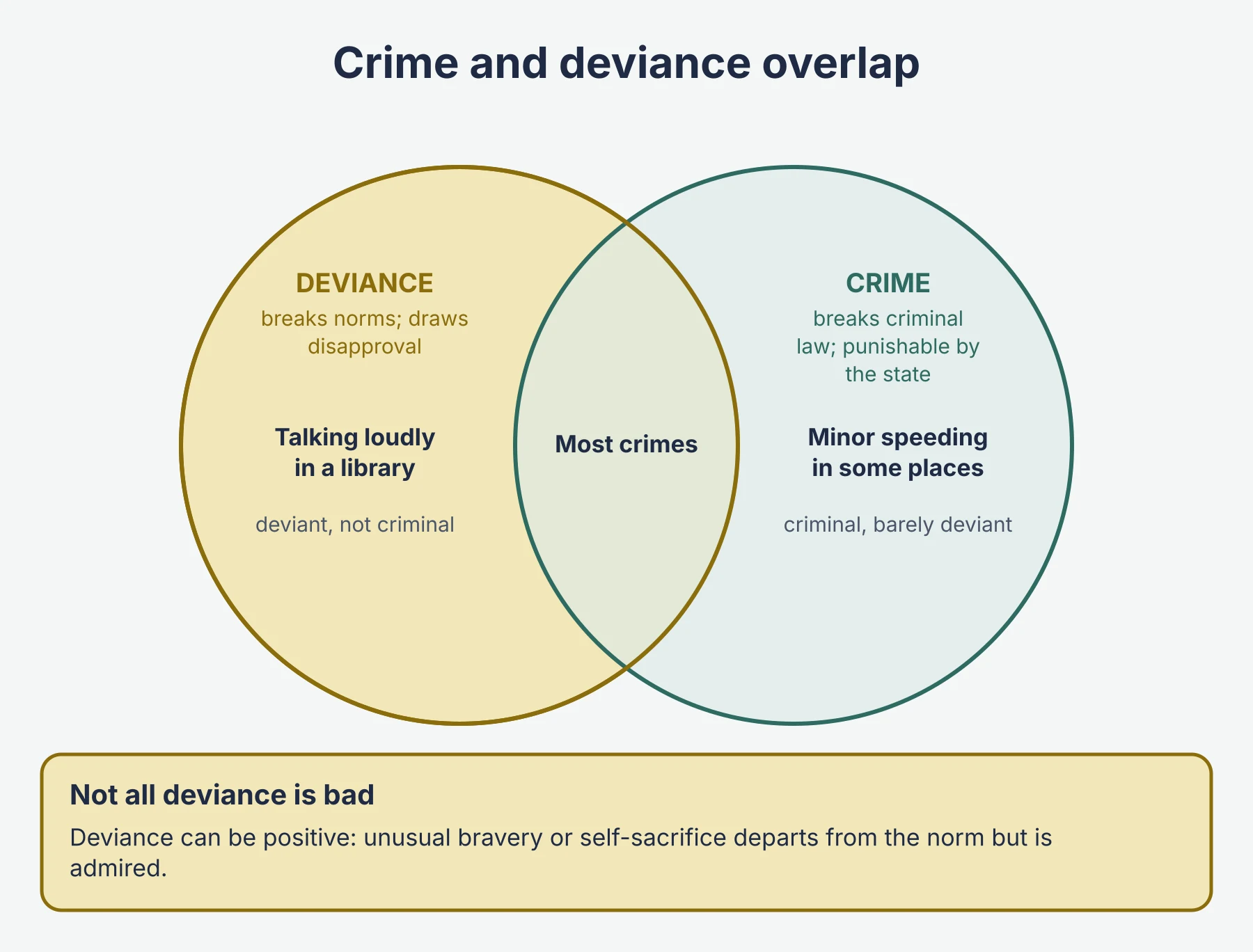
- Crime is behaviour that breaks the criminal law and can be punished by the state.
- Deviance is behaviour that goes against the norms of a society or group and is likely to draw disapproval.
The two overlap but are not the same. Most crimes are deviant, but some deviance is not criminal (talking loudly in a library, ignoring a dress code at a wedding), and some crime is so common that it is barely seen as deviant (minor speeding in some places). Deviance can also be positive: a person who shows unusual bravery or self-sacrifice departs from the norm but is admired.
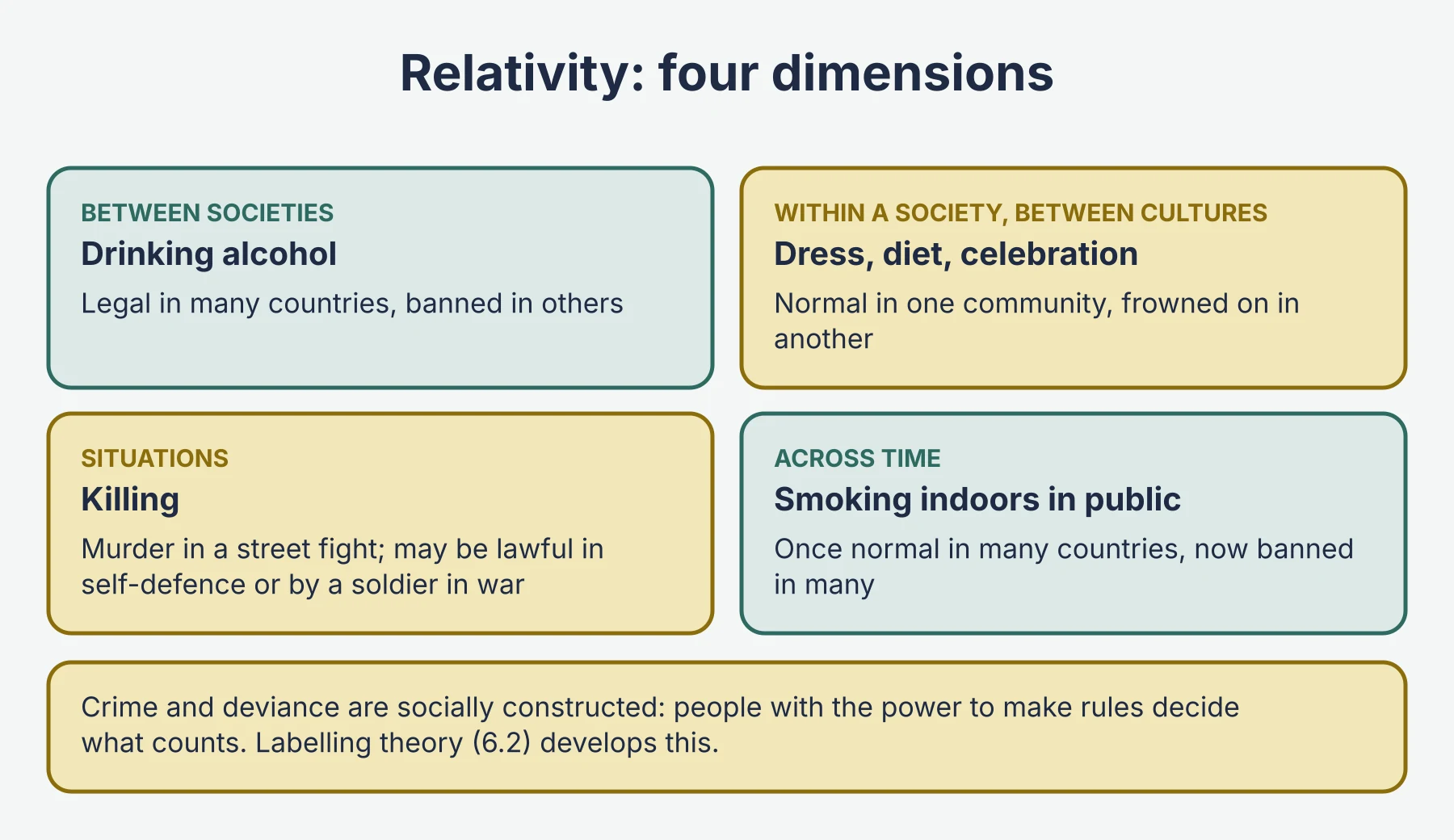
Relativity means what counts as crime or deviance is not fixed. The syllabus names four dimensions:
| Dimension | Example |
|---|---|
| Between societies | Drinking alcohol is legal in many countries and banned in others |
| Within a society, between cultures | Styles of dress, diet or celebration that are normal in one community may be frowned on in another |
| Situations | Killing is murder in a street fight but may be lawful in self-defence or by a soldier in war |
| Across time | Smoking indoors in public places was once normal in many countries and is now banned in many |
Relativity matters because it shows that crime and deviance are socially constructed: people with power to make rules decide what counts. This idea is developed in labelling theory in key question 6.2.
Formal social control (6.1.2)
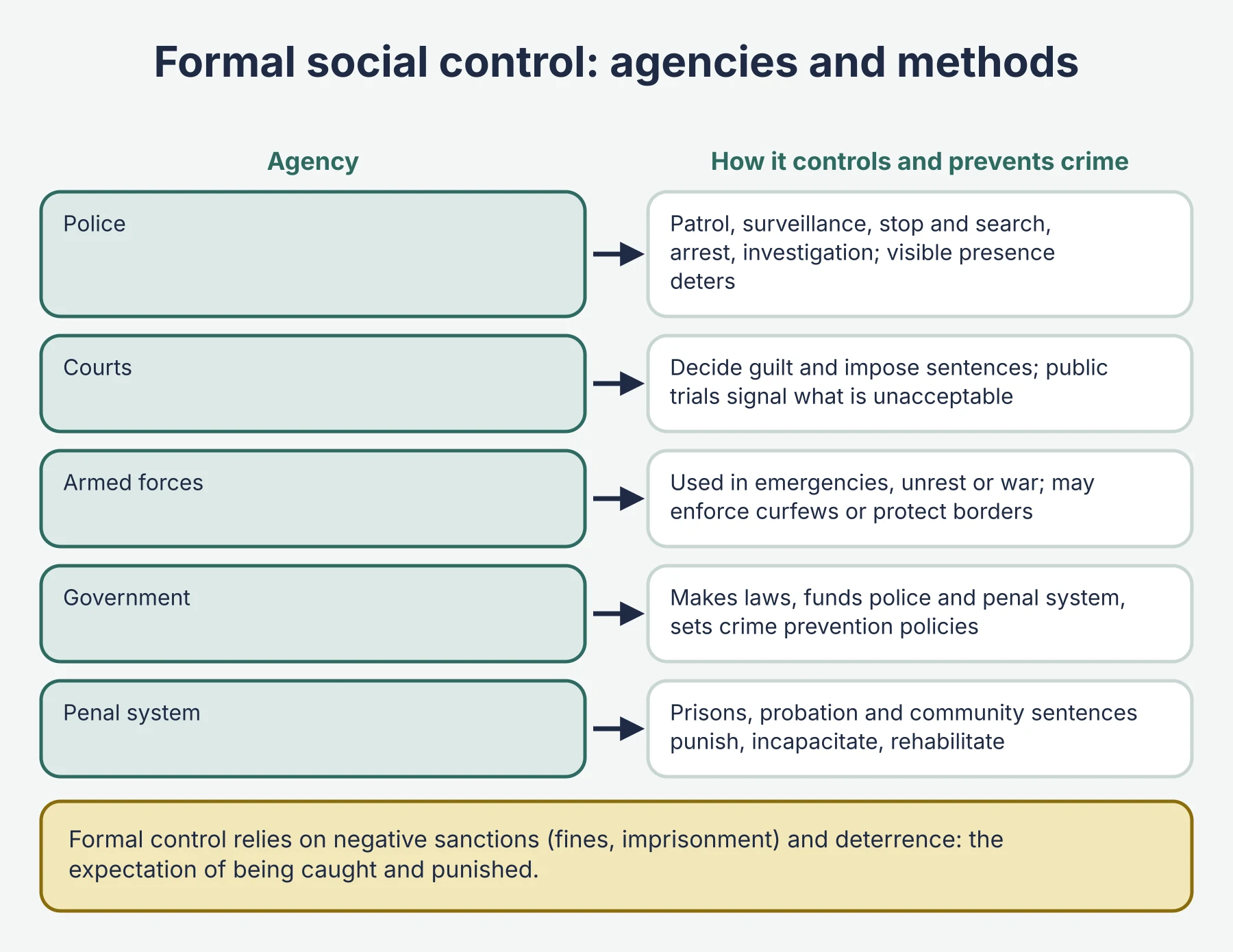
Social control is the set of methods used to make people conform to norms and laws. Formal social control is carried out by official agencies using written rules and legal sanctions.
| Agency | How it controls behaviour and prevents crime |
|---|---|
| Police | Patrol, surveillance, stop and search, arrest and investigation; their visible presence deters |
| Courts | Decide guilt and impose sentences; public trials signal what is unacceptable |
| Armed forces | Used in emergencies, unrest or war, sometimes to enforce curfews or protect borders |
| Government | Makes and changes laws, funds the police and penal system, and sets policies such as crime prevention schemes |
| Penal system | Prisons, probation and community sentences punish, incapacitate and attempt to rehabilitate |
Formal control relies on negative sanctions (fines, imprisonment) and on deterrence: the expectation that offenders will be caught and punished.
Informal social control (6.1.3)
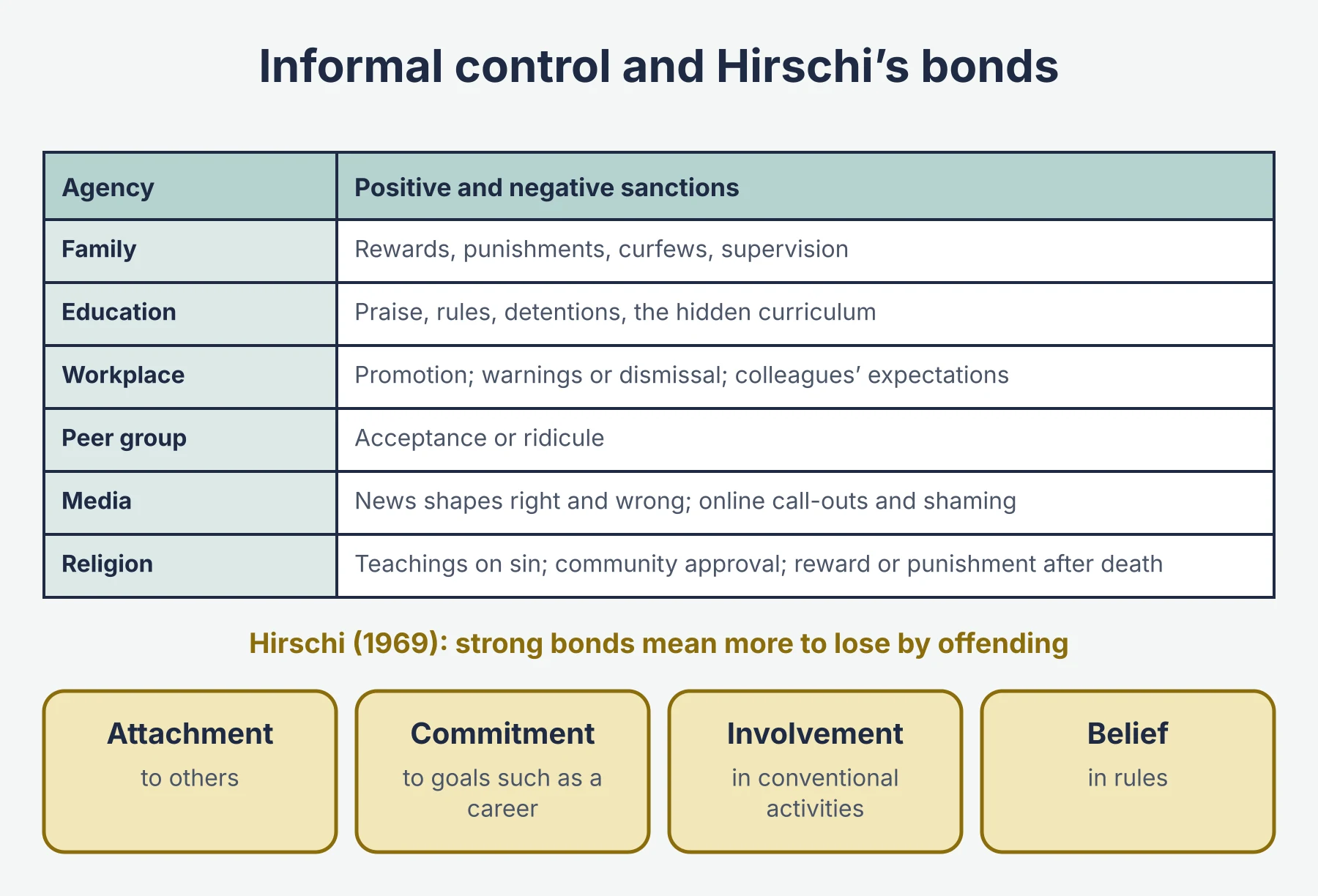
Informal social control works through everyday relationships and unwritten norms. Its sanctions are social: praise and approval (positive sanctions), or disapproval, gossip and exclusion (negative sanctions).
- Family: parents reward and punish, set curfews and supervise; children learn right and wrong.
- Education: rules, detentions, praise and the hidden curriculum teach conformity. Within the school, detention is a formal rule, but at the level of society schools are classed as informal agencies because they do not use the law.
- Workplace: promotion, warnings or dismissal; colleagues’ expectations shape conduct.
- Peer group: acceptance or ridicule; peers can pull members towards or away from deviance.
- Traditional and digital media: news coverage shapes ideas of right and wrong; online “call-outs” and shaming can punish behaviour; media may also spread moral panics.
- Religion: teachings on sin and morality, the approval of a faith community, and beliefs about reward and punishment after death.
Travis Hirschi’s control theory (1969) explains why informal control works: people with strong bonds to society, through attachment to others, commitment to goals such as a career, involvement in conventional activities and belief in rules, have more to lose by offending.
How effective is social control? (6.1.4)
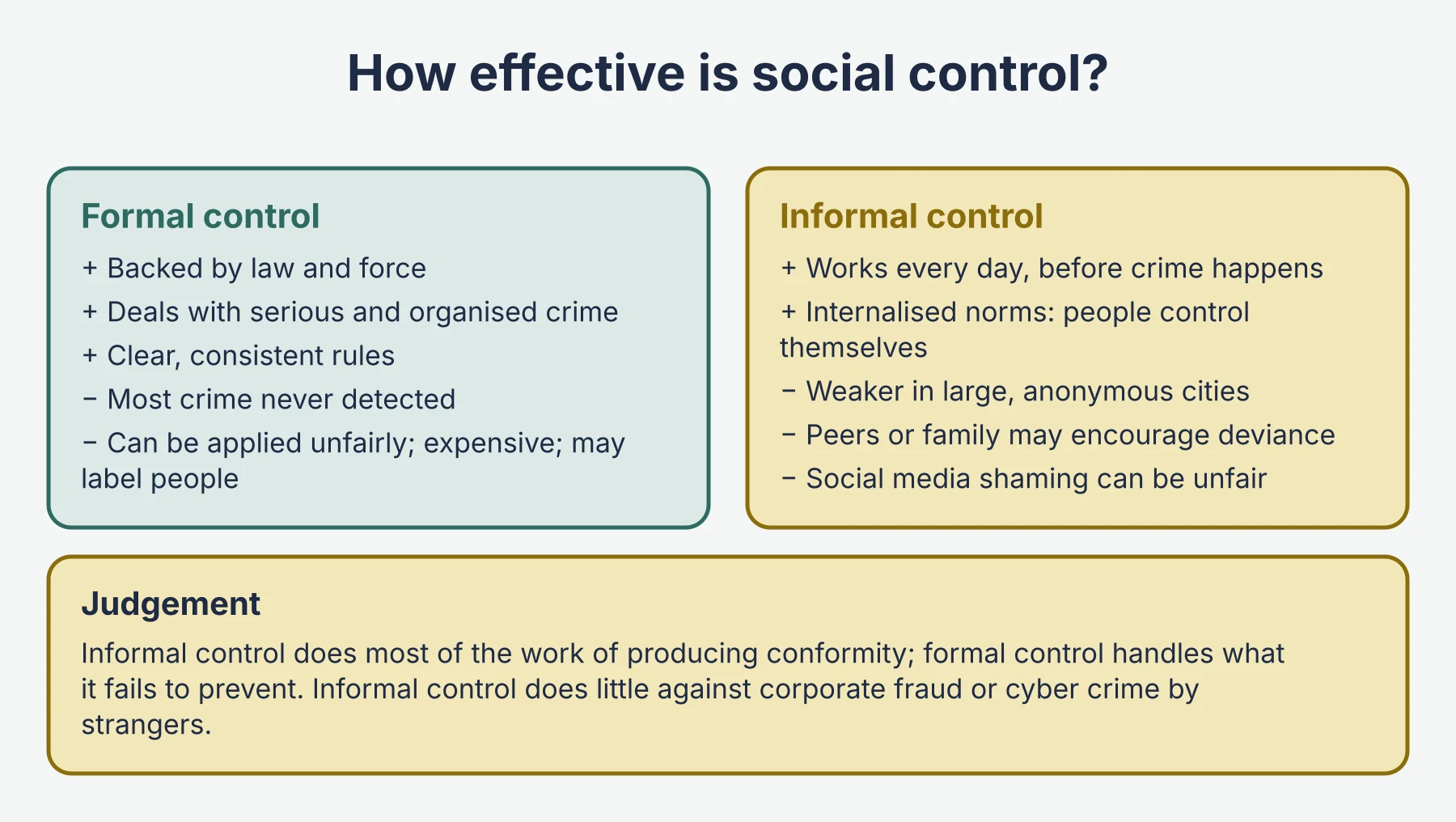
| Formal control | Informal control | |
|---|---|---|
| Strengths | Backed by law and force; can deal with serious and organised crime; clear and consistent rules | Works every day, before crime happens; internalised norms mean people control themselves |
| Limitations | Most crime is never detected; can be applied unfairly to some groups; expensive; may label people | Weaker in large, anonymous cities; peers or family may encourage deviance; social media shaming can be unfair |
A balanced judgement: informal control does most of the work of producing conformity, while formal control handles what informal control fails to prevent. Their effectiveness also depends on the type of crime: informal control does little to stop corporate fraud or cyber crime by strangers.
Types of crime (6.1.5)
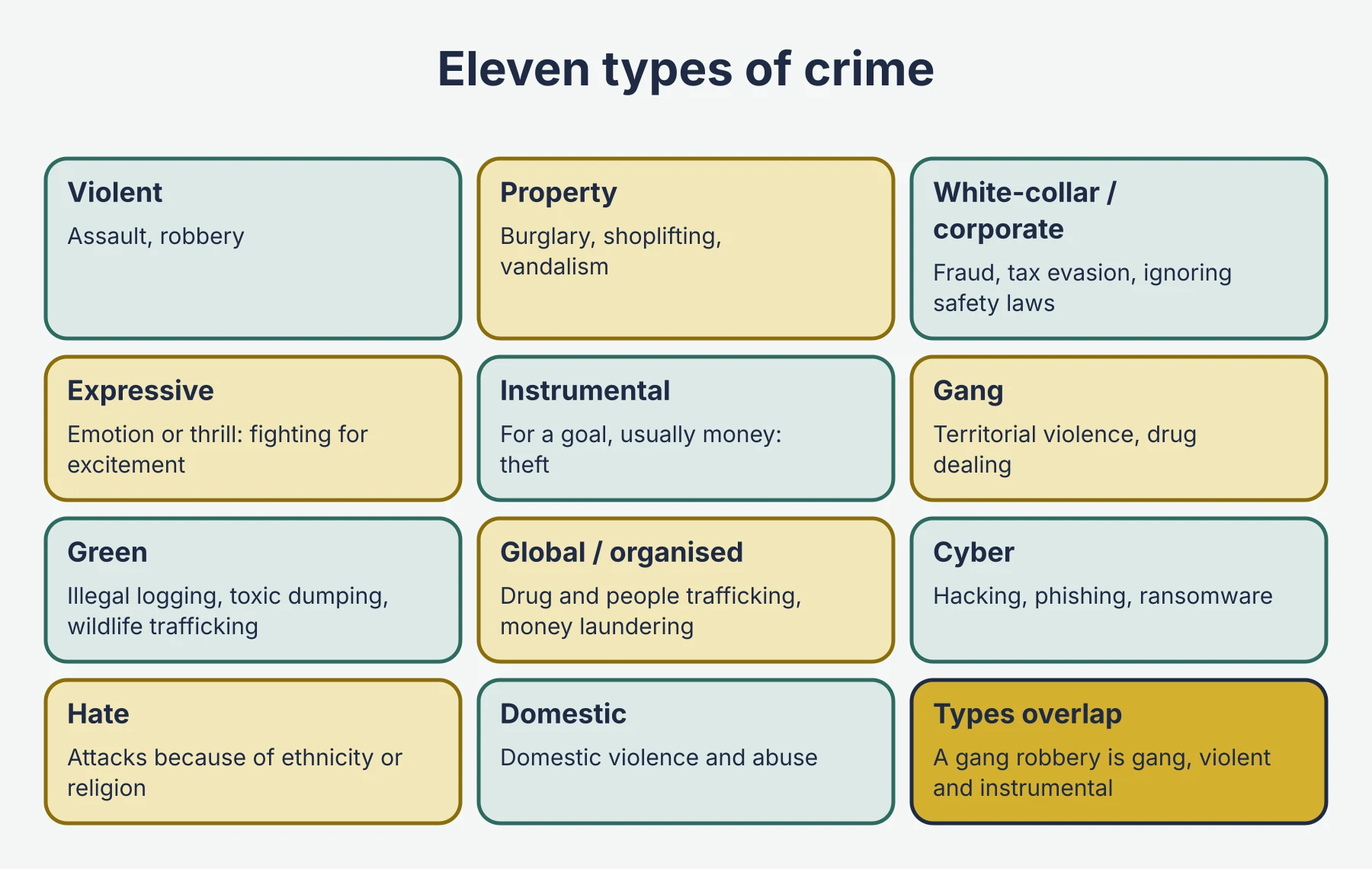
| Type | Meaning | Example |
|---|---|---|
| Violent | Use or threat of physical force | Assault, robbery |
| Property | Theft or damage to property | Burglary, shoplifting, vandalism |
| White-collar / corporate | By middle-class professionals at work (white-collar) or by companies (corporate); term coined by Edwin Sutherland | Fraud, tax evasion, ignoring safety laws; the 1984 Bhopal gas disaster in India is often discussed as corporate harm |
| Expressive | Committed for emotional reasons or thrill, not gain | Vandalism, fighting for excitement |
| Instrumental | Committed to achieve a goal, usually money | Theft, fraud |
| Gang | Committed by organised groups of usually young people | Territorial violence, drug dealing |
| Green | Harm to the environment | Illegal logging, dumping toxic waste, wildlife trafficking |
| Global (e.g. organised) | Crime crossing national borders, often by organised networks | Drug and people trafficking, money laundering |
| Cyber | Crime using computers and the internet | Hacking, phishing, online fraud, ransomware |
| Hate | Crime motivated by hostility to a group identity | Attacks targeted at people because of their ethnicity or religion |
| Domestic | Crime within families or households | Domestic violence and abuse |
Many crimes fit more than one type. A gang robbery is gang, violent and instrumental crime at once.
Measuring crime (6.1.6)
| Method | What it is | Strengths | Limitations |
|---|---|---|---|
| Official statistics | Crimes recorded by the police and convictions in the courts | Cheap, available, show trends over time; useful for serious crimes like murder | Miss unreported and unrecorded crime; reflect police priorities and discretion |
| Self-report studies | Anonymous questionnaires asking people what crimes they have committed | Reveal hidden offending and who commits it; Graham and Bowling (1995) used one for young people’s offending | People may lie, forget or exaggerate; usually focus on minor crimes |
| Victim surveys | Asking people what crimes they have experienced, nationally (e.g. the Crime Survey for England and Wales) or locally (e.g. the Islington Crime Survey, 1986) | Reveal crimes not reported to police; local surveys show crime in particular areas | Miss crimes without an obvious victim, such as corporate crime; memory errors; may not reach the most vulnerable |
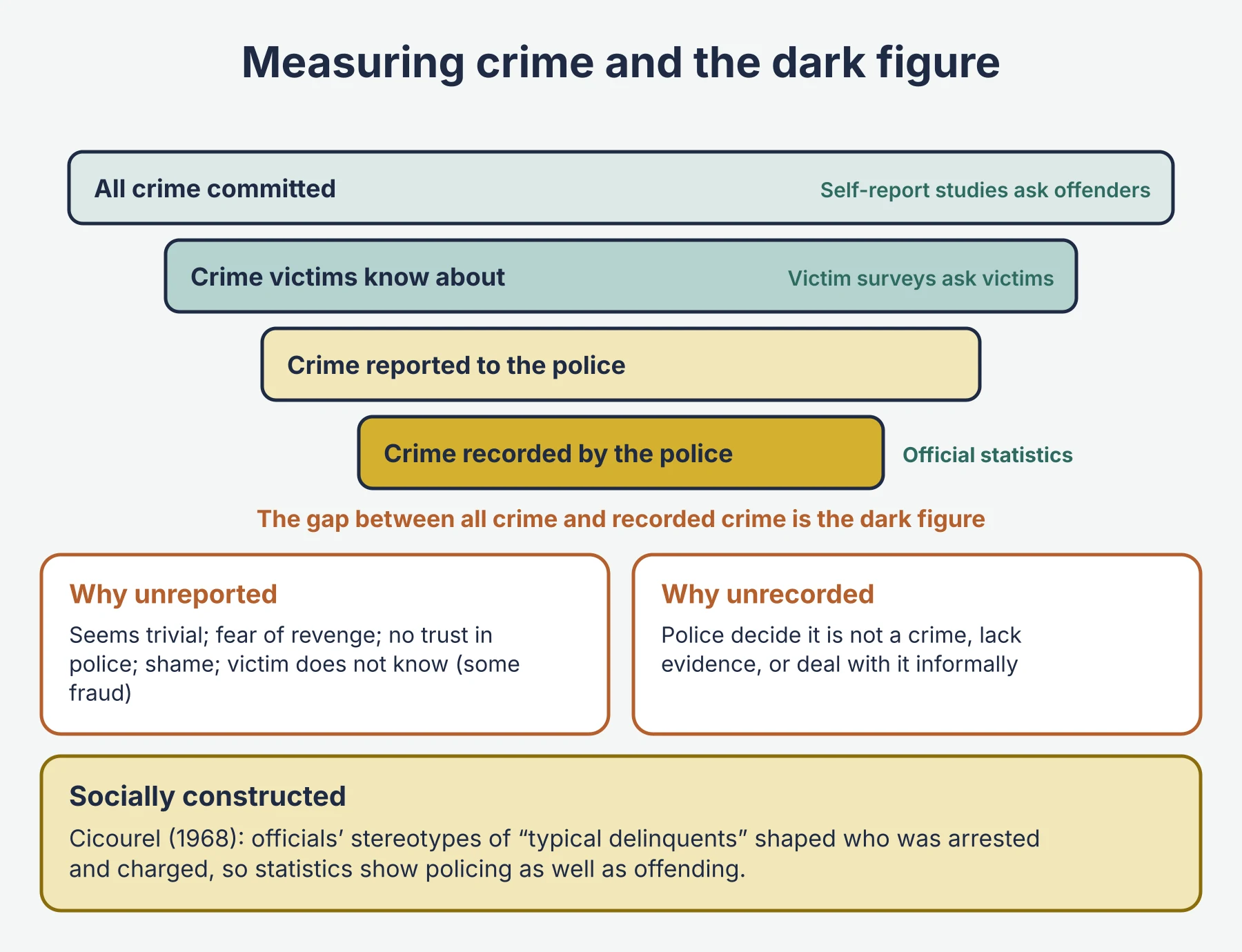
The dark figure of crime is the crime that never appears in official statistics.
- Unreported crime: victims do not report because the crime seems trivial, they fear revenge, they do not trust the police, they are ashamed, or they do not know a crime occurred (as with some fraud).
- Unrecorded crime: police may decide an incident is not a crime, lack evidence, or deal with it informally.
Interpretivists add that statistics are socially constructed: Aaron Cicourel (1968) found that police and officials’ stereotypes of “typical delinquents” shaped who was arrested and charged, so statistics tell us about policing as well as offending.
Worked example: an annotated “explain” answer
Question: Explain two reasons why some crimes are not recorded in official statistics.
“First, victims may not report the crime [point]. A victim of domestic abuse may fear further violence or depend on the abuser financially, so the police never learn of it [mechanism with example]. Second, the police may not record a reported incident [point], for example if they judge it too trivial or lack evidence, which means official statistics reflect police decisions as well as the amount of crime [mechanism and wider significance].”
Common mistakes
- Defining deviance as “bad behaviour”: it is behaviour that breaks norms, which may be positive.
- Giving relativity examples without saying which dimension (society, culture, situation, time) they show.
- Listing agencies without explaining how they control behaviour.
- Mixing up expressive and instrumental crime.
- Treating victim surveys as complete: they miss victimless and corporate crime.
Exam technique for 2251 command words
- Define crime and deviance precisely and separately.
- Give / Identify answers need accurate examples, such as two agencies of formal control.
- Explain each method of control or measurement with a mechanism and example.
- Evaluate the effectiveness of formal against informal control, ending with a judgement.
Keep revising
Related resources
-
Practice questions
Cambridge O Level Sociology (2251): Crime, deviance and social control – What are crime, deviance and social control? – Practice Questions
Original Cambridge O Level Sociology 2251 Crime practice on crime and deviance, social control, types of crime and measuring crime, with full answers.
Sociology · Cambridge · O Level
Try questions -
Revision notes
Cambridge O Level Sociology (2251): Crime, deviance and social control – What are crime, deviance and social control? – Revision Notes
Revision notes for Cambridge O Level Sociology 2251 key question 6.1: crime, deviance, social control, crime types and measuring crime, with a self-test.
Sociology · Cambridge · O Level
Revise topic -
Study guides
Cambridge O Level Sociology (2251): Crime, deviance and social control – What are the patterns of and explanations for crime and deviance?
Cambridge O Level Sociology 2251 key question 6.2 in depth: crime patterns, explanation chains for age, class, gender and ethnicity, and five theories compared.
Sociology · Cambridge · O Level
Read guide
Related articles
Get free revision emails (optional)
Occasional emails with practice questions, worked explanations and links to free resources for the qualification and subjects you choose. No spam, and you can unsubscribe from any email. The free tools on this site never need an email.