
Revision Notes
Cambridge O Level Sociology (2251): Crime, deviance and social control – What are crime, deviance and social control? – Revision Notes
Revision notes for Cambridge O Level Sociology 2251 key question 6.1: crime, deviance, social control, crime types and measuring crime, with a self-test.
- Subject
- Sociology
- Level
- O LEVELS
- Topic
- Paper 2 – Family, Education and Crime
- Author
- Marlbridge Academic Team
- Updated
- Reviewed by
- Naqiya Yousaf (what this means)
Aligned to Cambridge O Level Sociology (2251), 2025-2027. Official specification .
Syllabus page (what it covers and how it is assessed): Cambridge O Level Sociology.
Syllabus points this page covers
2251
- 6.1 Crime, deviance and social control – What are crime, deviance and social control?
Found an error? Report a correction.
Need help with this topic? Request a free trial class for O Level Sociology (2251).
These notes condense key question 6.1 of Cambridge O Level Sociology (2251), What are crime, deviance and social control? The key question has six parts: definitions and relativity, formal control, informal control, effectiveness of control, types of crime, and measuring crime. It is definition-heavy, so precise wording earns credit in the short parts and supports explanation in the longer ones.
Syllabus coverage
- 6.1.1 Definitions of crime and deviance; relativity within and between societies, cultures, situations and across time.
- 6.1.2 Formal agencies: police, courts, armed forces, government, penal system; how they control and prevent crime.
- 6.1.3 Informal agencies: family, education, workplace, peer group, traditional and digital media, religion; how they control and prevent crime.
- 6.1.4 Effectiveness of agencies and methods of control.
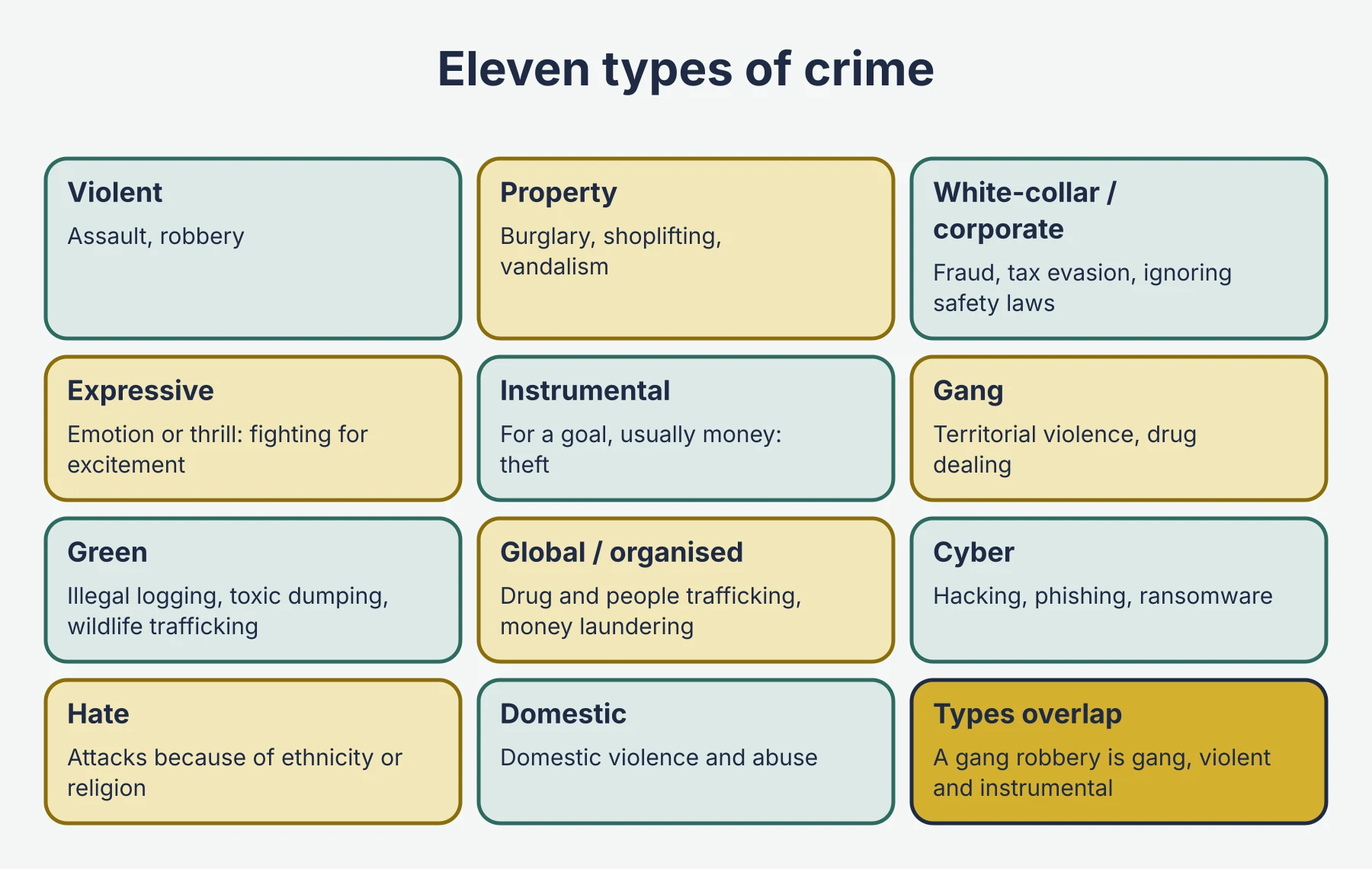
- 6.1.5 Violent, property, white-collar/corporate, expressive, instrumental, gang, green, global (e.g. organised), cyber, hate and domestic crime.
- 6.1.6 Official statistics, self-report studies, victim surveys (local and national); their strengths and limitations; unreported and unrecorded crime.
Key terms
| Term | Meaning |
|---|---|
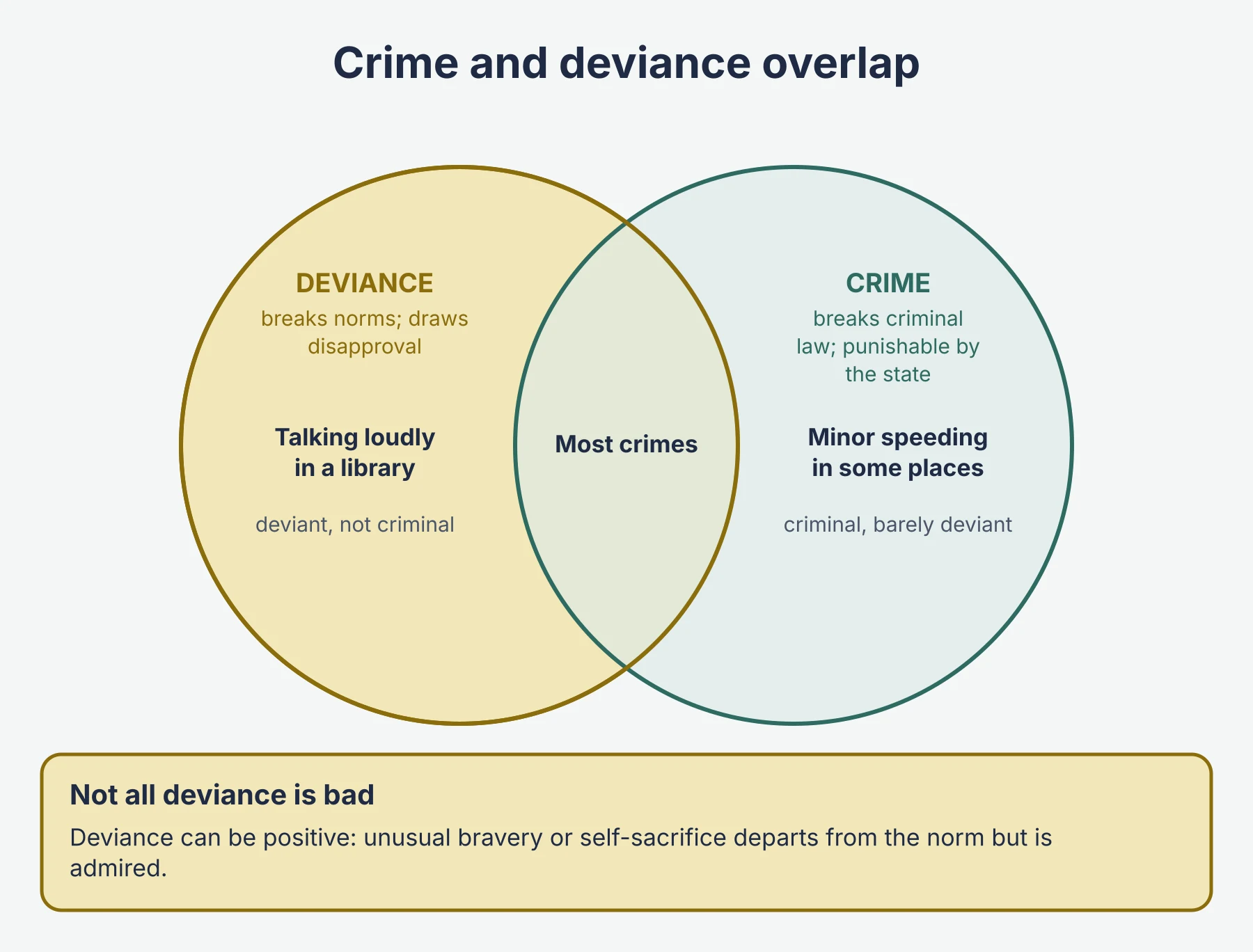
| Crime | Behaviour that breaks the criminal law and can be punished by the state |
| Deviance | Behaviour that breaks the norms of a society or group |
| Relativity | What counts as crime or deviance varies by society, culture, situation and time |
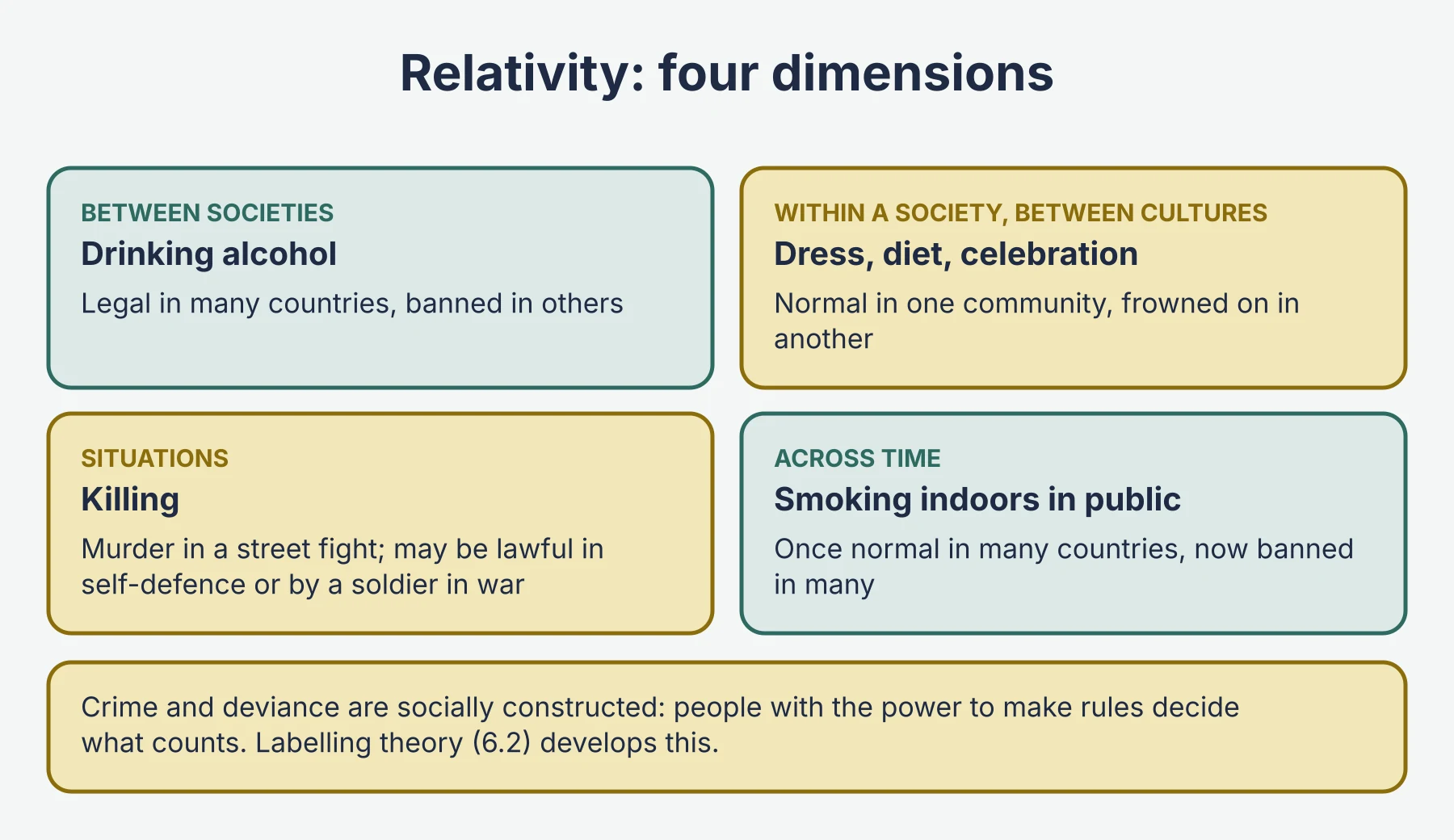
| Social construction | The idea that definitions of crime are made by people, not fixed by nature |
| Social control | Methods used to make people conform to norms and laws |
| Formal social control | Control by official agencies using written rules and legal sanctions |
| Informal social control | Control through everyday relationships and unwritten norms |
| Positive sanction | A reward for conforming, such as praise or promotion |
| Negative sanction | A punishment for deviance, such as a fine or ridicule |
| Expressive crime | Crime for emotional release or thrill |
| Instrumental crime | Crime to achieve a goal, usually money |
| White-collar crime | Crime by middle-class professionals in the course of their work (Sutherland) |
| Self-report study | Anonymous survey asking people about crimes they have committed |
| Victim survey | Survey asking people about crimes they have experienced |
| Dark figure of crime | Crime that never appears in official statistics |
Relativity: four dimensions, one example each
- Between societies: alcohol legal in some, banned in others.
- Within a society: dress or diet normal in one community, frowned on in another.
- Situation: killing in war or self-defence versus murder.
- Time: smoking indoors once normal, now banned in many places.
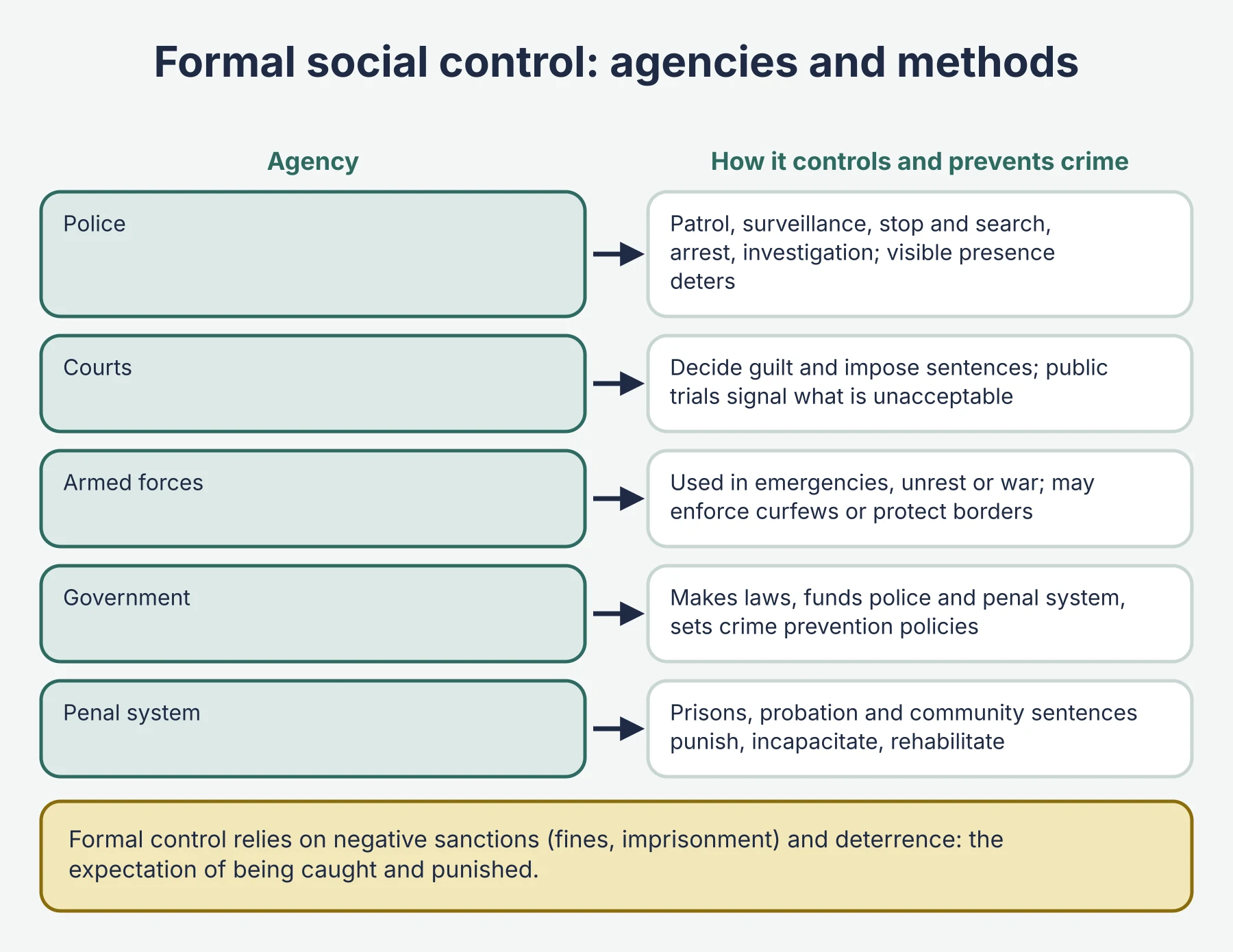
Formal agencies: how they control
- Police: patrol, surveillance, arrest; visible presence deters.
- Courts: decide guilt, impose sentences, signal what is unacceptable.
- Armed forces: emergencies, curfews, borders, unrest.
- Government: makes laws, funds enforcement, sets crime-prevention policy.
- Penal system: prison, probation, community sentences.
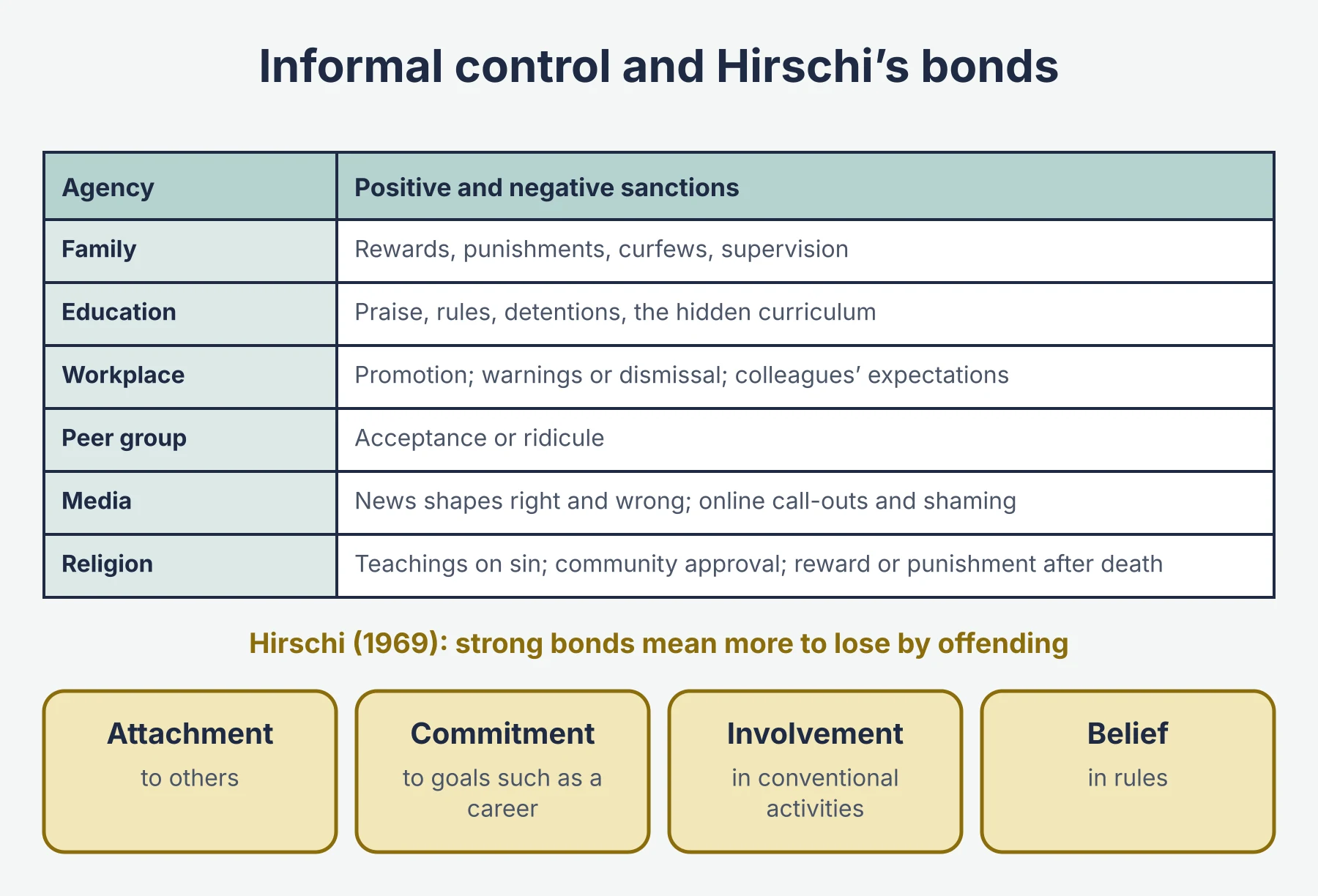
Informal agencies: how they control
- Family: rewards, punishments, supervision, curfews.
- Education: rules, praise, detentions, hidden curriculum.
- Workplace: promotion, warnings, dismissal.
- Peer group: acceptance or ridicule; can also encourage deviance.
- Traditional and digital media: set norms, shame publicly, spread moral panics.
- Religion: morality, sin, approval of the faith community.
Hirschi (1969): bonds of attachment, commitment, involvement and belief keep people from offending.
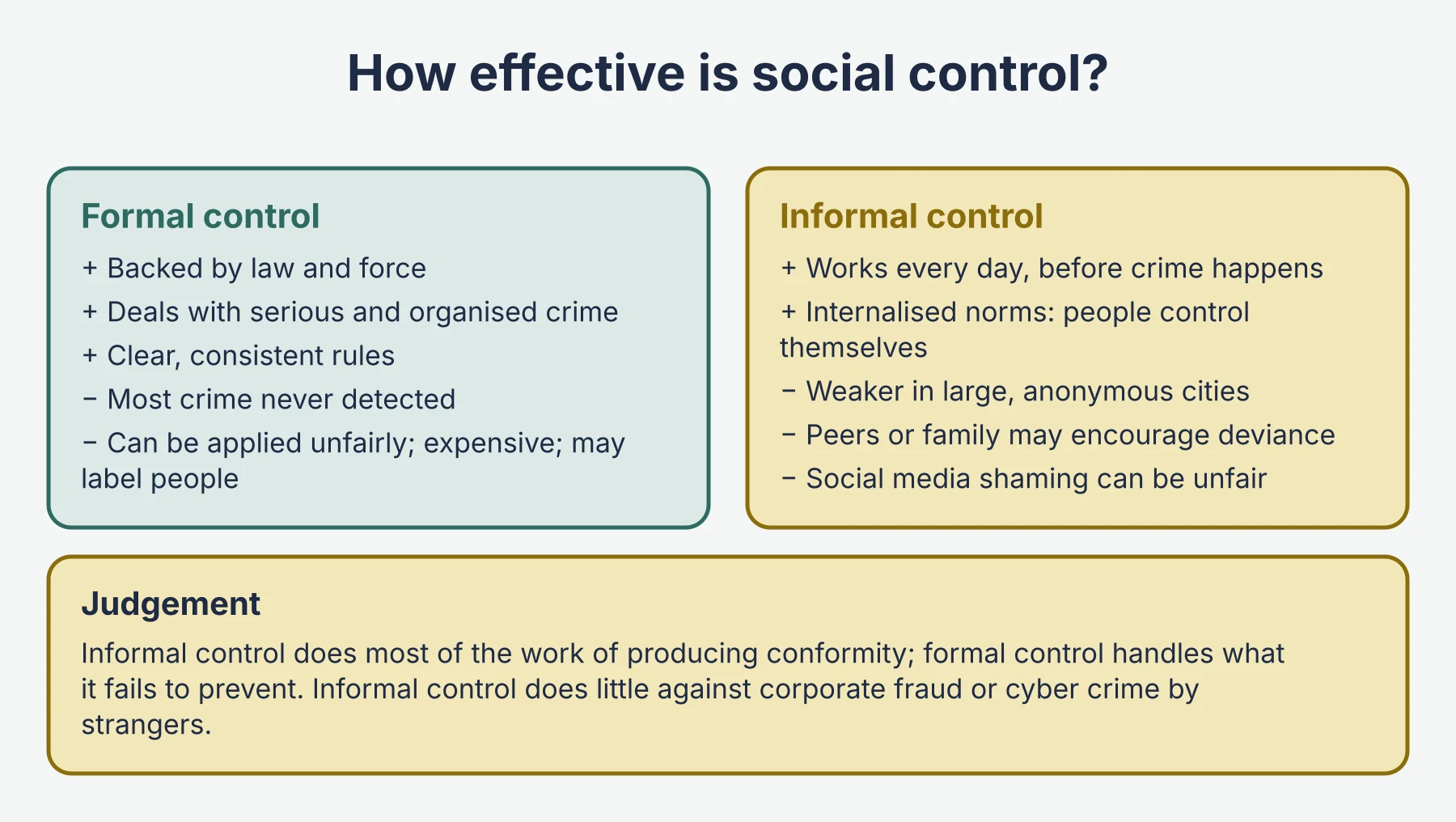
Effectiveness (6.1.4) in brief
- Informal control prevents most deviance day to day, because norms are internalised.
- Formal control is needed for serious, organised and stranger crime.
- Formal control misses most offences and can be applied unfairly.
- Informal control weakens in anonymous urban settings and can push people towards deviance (peer pressure).
- Neither works well against corporate or cyber crime without specialist regulation.
Types of crime: quick sort
- Harm to people: violent, hate, domestic.
- Harm to property or money: property, white-collar/corporate, cyber (much of it), instrumental.
- Motive: expressive (emotion, thrill) versus instrumental (gain).
- Who commits it: gang, organised/global, corporate.
- Harm to the environment: green (illegal logging, toxic dumping, wildlife trafficking).
Measuring crime (6.1.6)
| Method | Best for | Main weakness |
|---|---|---|
| Official statistics | Trends; serious crimes such as murder | Dark figure; police discretion |
| Self-report studies | Hidden offending; who offends (Graham and Bowling, 1995) | Lying, forgetting; minor crimes only |
| Victim surveys (national, e.g. Crime Survey for England and Wales; local, e.g. Islington Crime Survey, 1986) | Unreported crime; local patterns | Miss victimless and corporate crime |
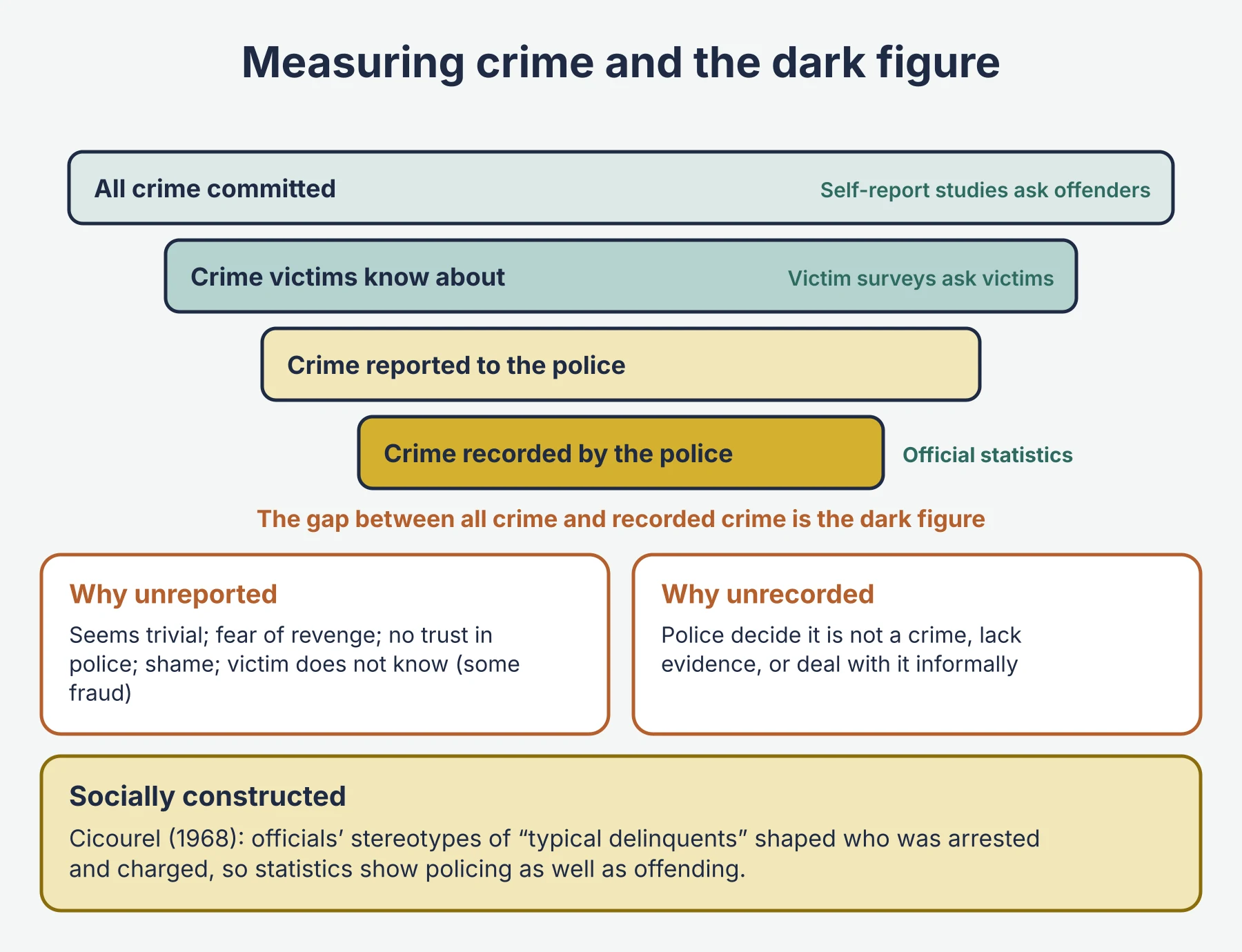
Unreported: trivial, fear of revenge, distrust of police, shame, unaware of being a victim. Unrecorded: police judge it not a crime, lack evidence, or deal with it informally. Cicourel (1968): officials’ stereotypes shape who is arrested and charged.
Exam traps
- Deviance is not always negative; positive deviance exists.
- Name the dimension of relativity your example shows.
- Schools are informal agencies at the level of society, even though they have formal rules.
- Expressive and instrumental refer to motive, not seriousness.
- Victim surveys cannot measure crimes where victims do not know they are victims.
- Official statistics measure recorded crime, not all crime.
Self-test
- Define deviance.
- Give an example of an act that is deviant but not criminal.
- Give an example of relativity across time.
- Name three formal agencies of social control.
- How does the peer group act as an informal agency?
- What are Hirschi’s four bonds?
- Distinguish expressive from instrumental crime.
- Give one example of green crime.
- Who coined the term white-collar crime?
- Give one strength of self-report studies.
- Give two reasons why victims may not report crime.
- What did Cicourel find?
Answers
- Behaviour that breaks the norms of a society or group.
- Any suitable example, such as talking loudly in a library or ignoring a dress code.
- Smoking indoors in public places, once normal and now banned in many countries; or another valid example.
- Any three: police; courts; armed forces; government; penal system.
- Through acceptance and approval of conforming members and ridicule or exclusion of those who break group norms; peers can also encourage deviance.
- Attachment, commitment, involvement and belief.
- Expressive crime is for emotion or thrill; instrumental crime is to achieve a goal, usually money.
- Any one: illegal logging; dumping toxic waste; wildlife trafficking.
- Edwin Sutherland.
- Reveals offending that never reaches the police, and who commits it.
- Any two: trivial; fear of revenge; distrust of police; shame; unaware they are victims.
- Police and officials’ stereotypes of “typical delinquents” shaped who was arrested and charged.
More resources on this topic
Related resources
-
Study guides
Cambridge O Level Sociology (2251): Crime, deviance and social control – What are the patterns of and explanations for crime and deviance?
Cambridge O Level Sociology 2251 key question 6.2 in depth: crime patterns, explanation chains for age, class, gender and ethnicity, and five theories compared.
Sociology · Cambridge · O Level
Read guide -
Practice questions
Cambridge O Level Sociology (2251): Crime, deviance and social control – What are the patterns of and explanations for crime and deviance? – Practice Questions
Original Cambridge O Level Sociology 2251 Crime practice on patterns of crime, explanations by age, class and gender, and five theories, with full answers.
Sociology · Cambridge · O Level
Try questions -
Revision notes
Cambridge O Level Sociology (2251): Crime, deviance and social control – What are the patterns of and explanations for crime and deviance? – Revision Notes
Revision notes for Cambridge O Level Sociology 2251 key question 6.2: crime patterns, explanations by social group, five theories and a self-test.
Sociology · Cambridge · O Level
Revise topic
Related articles
Get free revision emails (optional)
Occasional emails with practice questions, worked explanations and links to free resources for the qualification and subjects you choose. No spam, and you can unsubscribe from any email. The free tools on this site never need an email.