
Revision Notes
Cambridge O Level Sociology (2251): Crime, deviance and social control – What are the patterns of and explanations for crime and deviance? – Revision Notes
Revision notes for Cambridge O Level Sociology 2251 key question 6.2: crime patterns, explanations by social group, five theories and a self-test.
- Subject
- Sociology
- Level
- O LEVELS
- Topic
- Paper 2 – Family, Education and Crime
- Author
- Marlbridge Academic Team
- Updated
- Reviewed by
- Naqiya Yousaf (what this means)
Aligned to Cambridge O Level Sociology (2251), 2025-2027. Official specification .
Syllabus page (what it covers and how it is assessed): Cambridge O Level Sociology.
Syllabus points this page covers
2251
- 6.2 Crime, deviance and social control – What are the patterns of and explanations for crime and deviance?
Found an error? Report a correction.
Need help with this topic? Request a free trial class for O Level Sociology (2251).
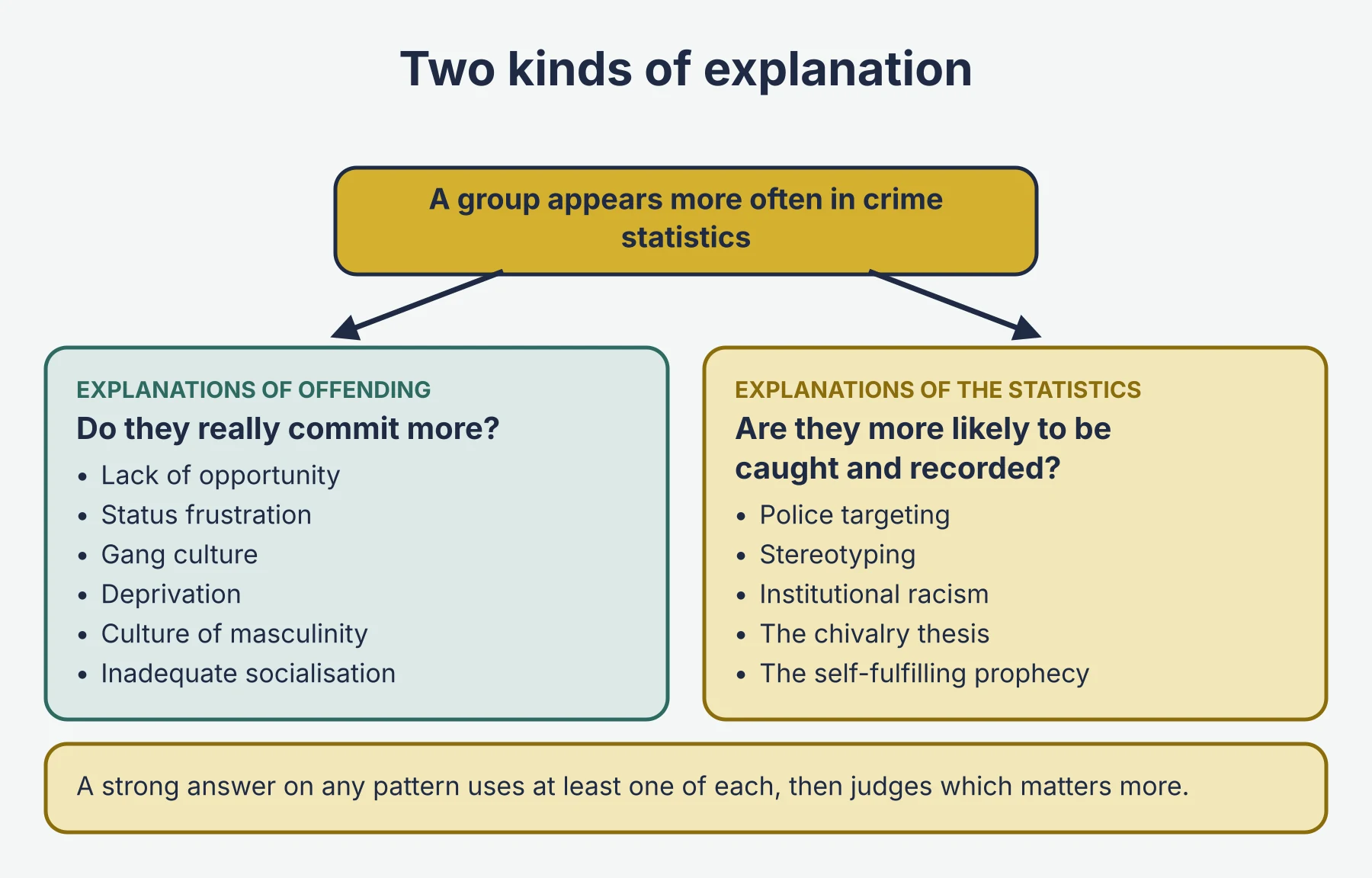
These notes condense key question 6.2 of Cambridge O Level Sociology (2251), What are the patterns of and explanations for crime and deviance? Use one organising question throughout: does this explanation show why a group offends more, or why it appears in the statistics more? Every answer on patterns is stronger when it covers both.
Syllabus coverage
- 6.2.1 Patterns of crime and victimisation by age, social class, gender and ethnicity.
- 6.2.2–6.2.5 Named explanations for each of age, ethnicity, gender and social class.
- 6.2.6 Postmodernism; interactionism (labelling, moral panic); functionalism (New Right, subculturalism, strain); Marxism; feminism.
- 6.2.7 Strengths and limitations of all explanations and theories.
Key terms
| Term | Meaning |
|---|---|
| Victimisation | The experience of being a victim of crime |
| Repeat victimisation | The same people or places being victimised again |
| Status frustration | Frustration at low status, leading to a deviant subculture (A. Cohen, 1955) |
| Relative deprivation | Feeling deprived compared with others (Lea and Young, 1984) |
| Social exclusion | Being cut off from work, education, services and participation in society |
| Anomie | Normlessness: rules no longer guide behaviour (Durkheim; Merton) |
| Innovation | Merton: accepting goals but using illegitimate means |
| Underclass | New Right: a group outside mainstream society, with weak families and welfare dependency |
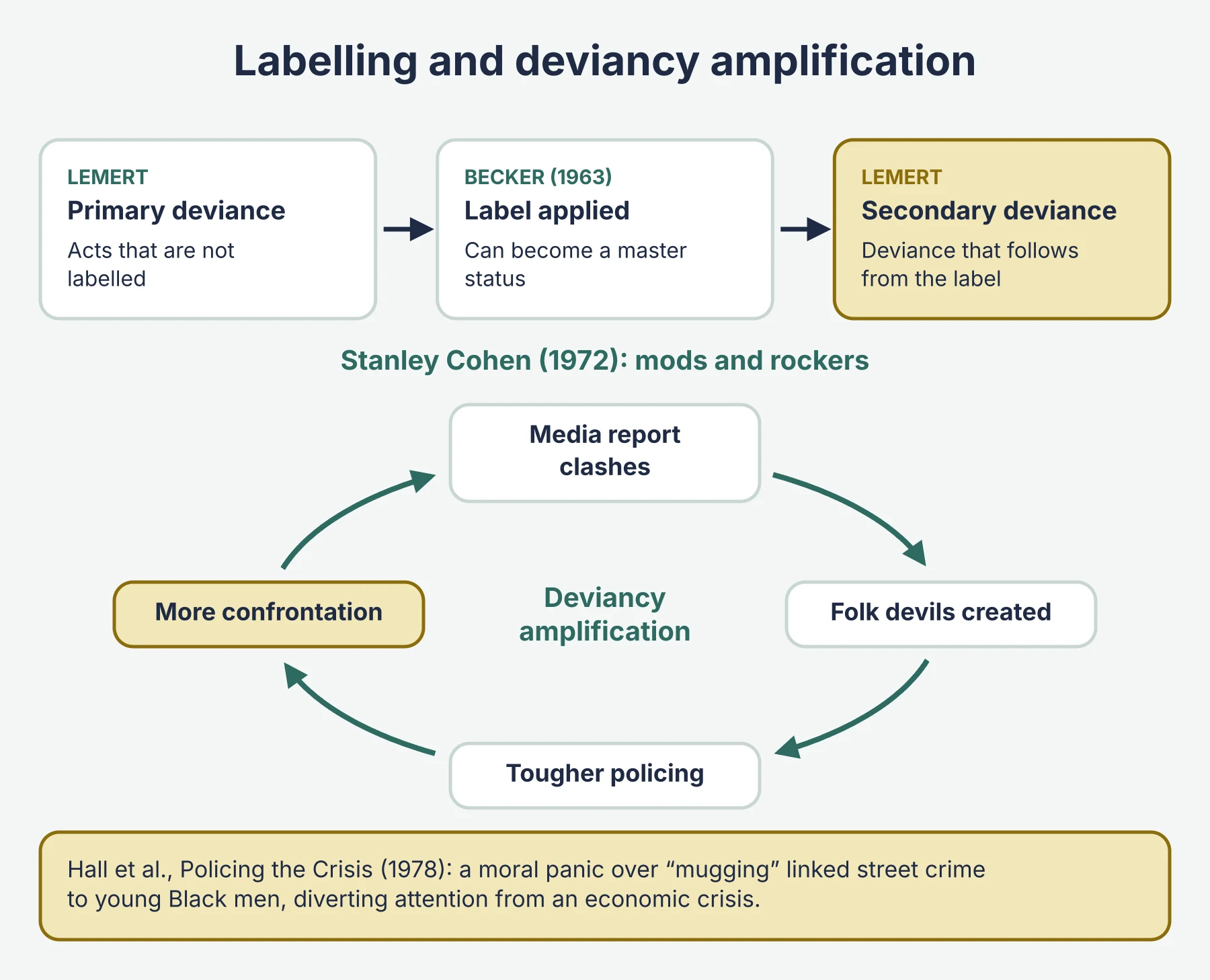
| Primary deviance | Deviant acts that have not been labelled (Lemert) |
| Secondary deviance | Deviance that follows from being labelled (Lemert) |
| Master status | A label that overrides all other identities (Becker, 1963) |
| Deviancy amplification | Reaction to deviance that produces more deviance |
| Folk devil | A group portrayed by the media as a threat (S. Cohen, 1972) |
| Selective law enforcement | Marxist idea that laws are enforced mainly against the working class |
| Edgework | Voluntary risk-taking for excitement (Lyng, 1990) |
Patterns in one breath
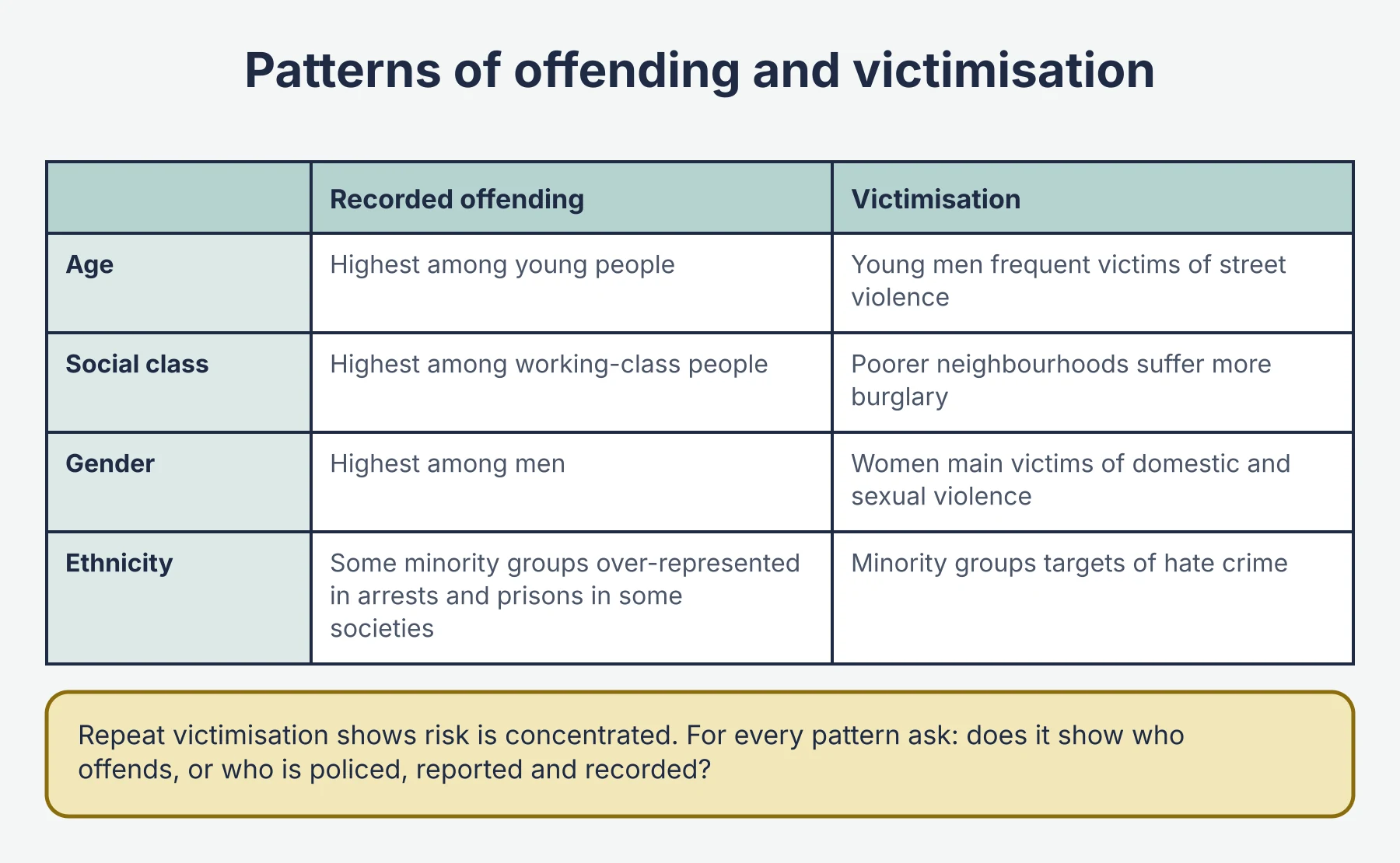
Recorded offending is highest among the young, men, the working class and, in some societies, some minority groups. Victims are often young men (street violence), poorer areas (burglary), women (domestic and sexual violence) and minorities (hate crime).
Explanations by group: offending or statistics?
| Group | Real-offending explanations | Statistical explanations |
|---|---|---|
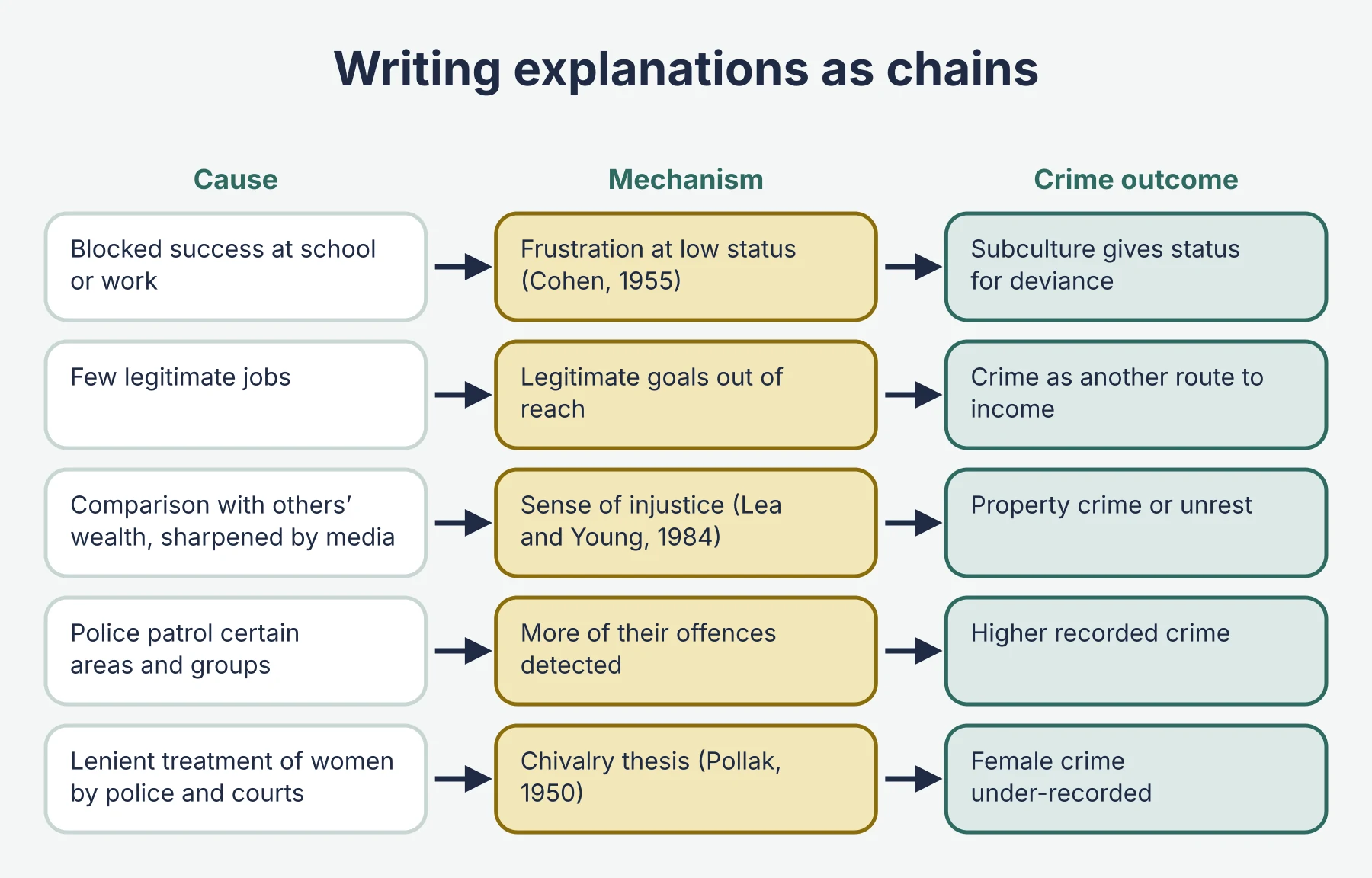
| Age | Lack of opportunity; status frustration; gang culture; weaker social control | Police targeting; stereotyping; self-fulfilling prophecy |
| Ethnicity | Material and relative deprivation; status frustration; gang culture | Institutional racism; prejudice and discrimination; police targeting; stereotyping |
| Gender | Culture of masculinity (Messerschmidt, 1993); misogyny; gang culture; socialisation and control of girls | Chivalry thesis (Pollak, 1950); stereotyping |
| Social class | Social exclusion; deprivation; inadequate socialisation (New Right); lack of opportunity; status frustration | Police targeting; power inequalities (Box, 1983) |
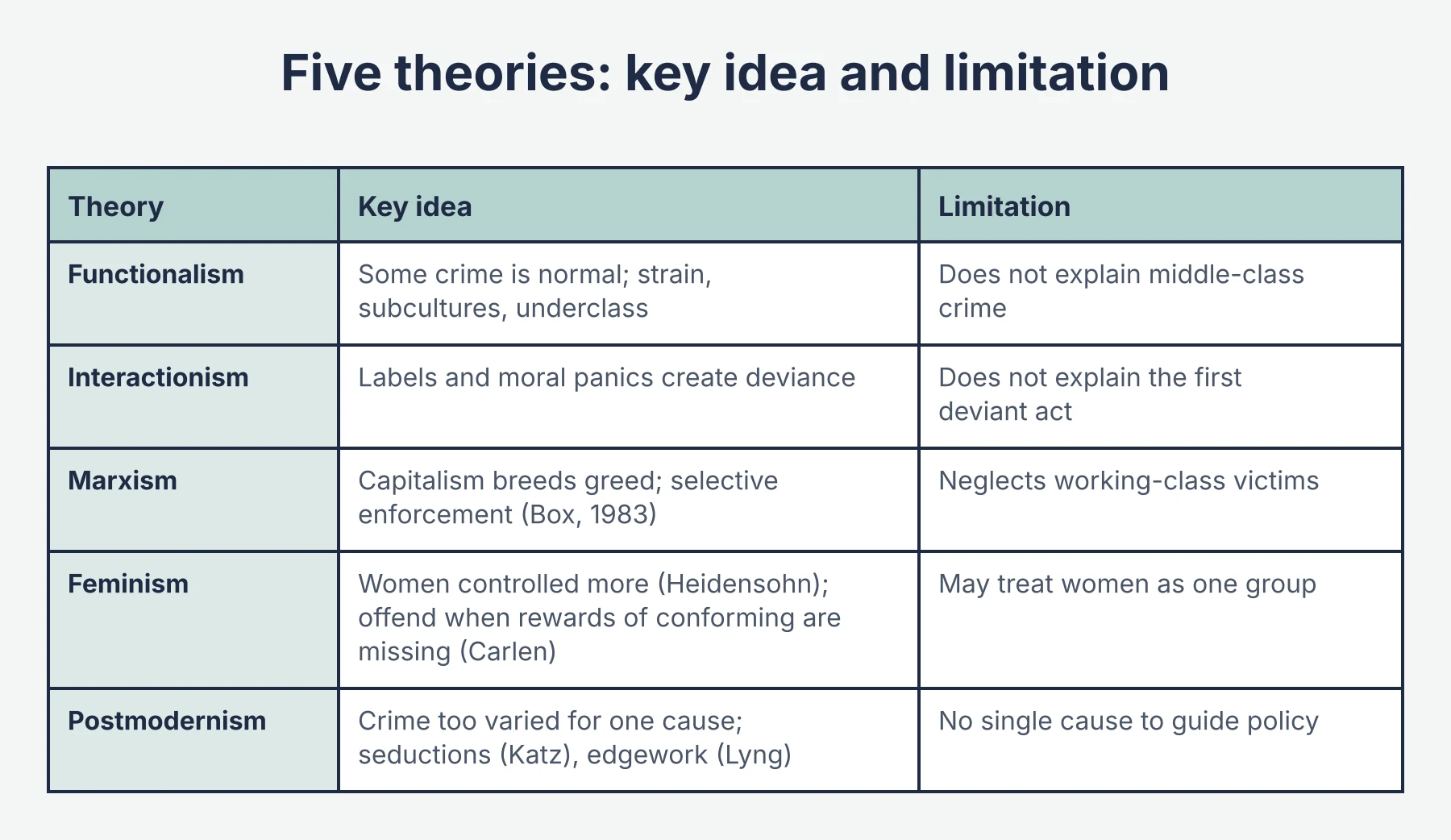
The five theories: core claim, key name, best and worst at
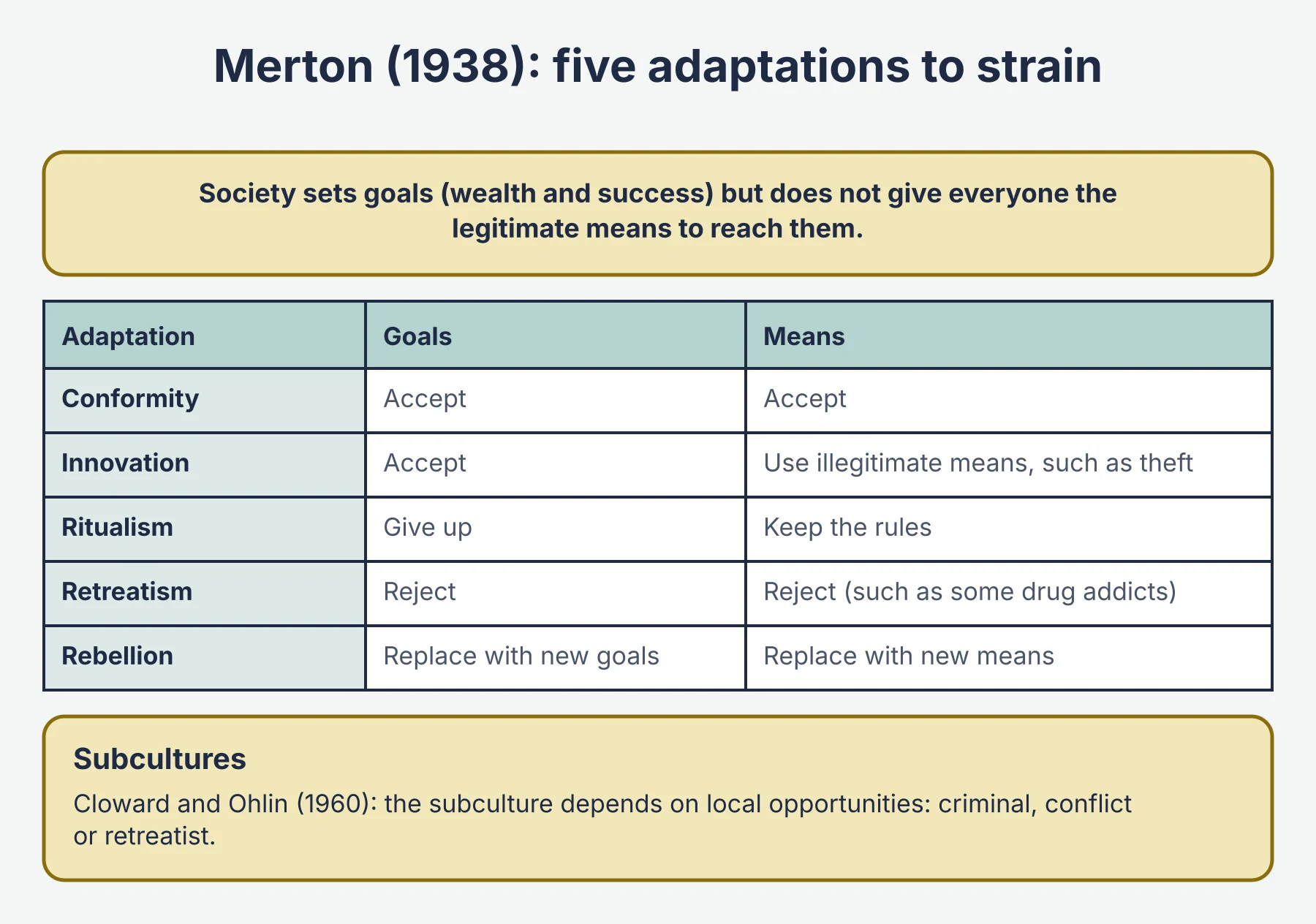
- Functionalism. Durkheim: some crime is normal and maintains boundaries. Merton (1938): strain between goals and means; five adaptations (conformity, innovation, ritualism, retreatism, rebellion). Cloward and Ohlin (1960): criminal, conflict and retreatist subcultures. Best at: working-class property crime. Worst at: middle-class and corporate crime.
- New Right (within functionalism). Murray: an underclass with poor socialisation. Best at: linking family and crime. Worst at: blames the poor, ignores structural causes.
- Interactionism. Lemert: primary and secondary deviance; Becker: master status; S. Cohen (1972): moral panics and folk devils. Best at: how reactions shape statistics and careers. Worst at: explaining the first deviant act.
- Marxism. Capitalism breeds greed; selective enforcement; crimes of the powerful (Box, 1983); Hall et al. (1978) on the mugging panic. Best at: corporate crime and power. Worst at: takes less account of working-class victims and of gender.
- Feminism. Heidensohn (1985): women controlled at home, in public, at work; Carlen (1988): women offend when the class and gender “deals” fail. Best at: the gender gap. Worst at: may treat all women alike.
- Postmodernism. Crime too varied for one cause; Katz (1988) on thrill; Lyng (1990) on edgework. Best at: expressive and new crimes. Worst at: offers no clear policy.
Merton’s adaptations: one example each
- Conformity: working hard for qualifications and a career.
- Innovation: selling stolen goods to afford designer clothes.
- Ritualism: an official who follows rules rigidly but has given up on promotion.
- Retreatism: dropping out of society through drug addiction.
- Rebellion: joining a movement to replace society’s goals.
Exam traps
- Do not confuse Albert Cohen (status frustration, 1955) with Stanley Cohen (moral panics, 1972).
- Strain theory is functionalist, not Marxist.
- The chivalry thesis is about treatment by the system, not about women’s behaviour.
- Labelling does not say labels cause all crime; it says reactions shape further deviance.
- Victimisation is part of 6.2.1: include victims as well as offenders.
- Every pattern question rewards questioning official statistics.
Self-test
- Give two groups who are often victims of crime.
- Define status frustration.
- Name Merton’s five adaptations.
- Which adaptation describes theft to reach financial goals?
- Name Cloward and Ohlin’s three subcultures.
- Distinguish primary from secondary deviance.
- What is a master status?
- What did Stanley Cohen study?
- What is selective law enforcement?
- Name Heidensohn’s three areas where women are controlled.
- What is edgework?
- Give one statistical explanation for high recorded crime among young people.
Answers
- Any two: young men; poorer neighbourhoods; women (domestic and sexual violence); minority groups (hate crime).
- Frustration at low status, often after failure at school, leading to a deviant subculture that gives status (Albert Cohen, 1955).
- Conformity, innovation, ritualism, retreatism and rebellion.
- Innovation.
- Criminal, conflict and retreatist.
- Primary deviance has not been labelled; secondary deviance follows from being labelled.
- A label that overrides a person’s other identities, such as “criminal”.
- Media reporting of mods and rockers in the 1960s and the resulting moral panic.
- The Marxist claim that laws are enforced mainly against the working class while crimes of the powerful are rarely punished.
- Home, public places and work.
- Voluntary risk-taking for excitement (Lyng, 1990).
- Any one: police targeting or stop and search; stereotyping; self-fulfilling prophecy.
More resources on this topic
Related resources
-
Study guides
Cambridge O Level Sociology (2251): Crime, deviance and social control – How is crime dealt with in different societies?
Cambridge O Level Sociology 2251 key question 6.3 in depth: aims of punishment, judging punishments against aims, and policing in different societies.
Sociology · Cambridge · O Level
Read guide -
Practice questions
Cambridge O Level Sociology (2251): Crime, deviance and social control – How is crime dealt with in different societies? – Practice Questions
Original Cambridge O Level Sociology 2251 Crime practice on aims of punishment, types of punishment and policing in different societies, with full answers.
Sociology · Cambridge · O Level
Try questions -
Revision notes
Cambridge O Level Sociology (2251): Crime, deviance and social control – How is crime dealt with in different societies? – Revision Notes
Revision notes for Cambridge O Level Sociology 2251 key question 6.3: aims of punishment, types of punishment and policing strategies, with a self-test.
Sociology · Cambridge · O Level
Revise topic
Related articles
Get free revision emails (optional)
Occasional emails with practice questions, worked explanations and links to free resources for the qualification and subjects you choose. No spam, and you can unsubscribe from any email. The free tools on this site never need an email.