
Study Guides
Cambridge O Level Sociology (2251): Crime, deviance and social control – What are the patterns of and explanations for crime and deviance?
Cambridge O Level Sociology 2251 key question 6.2 in depth: crime patterns, explanation chains for age, class, gender and ethnicity, and five theories compared.
- Subject
- Sociology
- Level
- O LEVELS
- Topic
- Paper 2 – Family, Education and Crime
- Author
- Marlbridge Academic Team
- Updated
- Reviewed by
- Naqiya Yousaf (what this means)
Aligned to Cambridge O Level Sociology (2251), 2025-2027. Official specification .
Syllabus page (what it covers and how it is assessed): Cambridge O Level Sociology.
Syllabus points this page covers
2251
- 6.2 Crime, deviance and social control – What are the patterns of and explanations for crime and deviance?
Found an error? Report a correction.
Need help with this topic? Request a free trial class for O Level Sociology (2251).
Key question 6.2 of Cambridge O Level Sociology (2251) asks What are the patterns of and explanations for crime and deviance? It is the longest key question in the Crime topic and supplies most of the material for the longer answers. The syllabus gives a separate list of explanations for age, ethnicity, gender and social class, then five theories, then asks for the strengths and limitations of all of them. This guide focuses on turning each named explanation into a clear causal chain and on showing how the theories work, so that you can apply them to any pattern a question names.
What the syllabus covers
| Section | Content named in the 2251 syllabus (2025–2027) |
|---|---|
| 6.2.1 Patterns of crime and victimisation | Age; social class; gender; ethnicity |
| 6.2.2 Age | Police targeting / stop and search; self-fulfilling prophecy; stereotyping; gang culture; socialisation and social control; lack of opportunity; status frustration |
| 6.2.3 Ethnicity | Institutional racism; prejudice and discrimination; police targeting / stop and search; material and relative deprivation; stereotyping; gang culture; status frustration |
| 6.2.4 Gender | Chivalry thesis; culture of masculinity; socialisation and social control; misogyny; stereotyping; gang culture; lack of opportunity |
| 6.2.5 Social class | Social exclusion; material and relative deprivation; inadequate socialisation; lack of opportunity; status frustration; power inequalities; police targeting / stop and search |
| 6.2.6 Theories | Postmodernism; interactionism (including labelling and moral panic theory); functionalism (including the New Right, subculturalism and strain theory); Marxism; feminism |
| 6.2.7 | Strengths and limitations of the explanations based on age, ethnicity, gender, social class and the different theories |
Patterns: offending and victimisation (6.2.1)
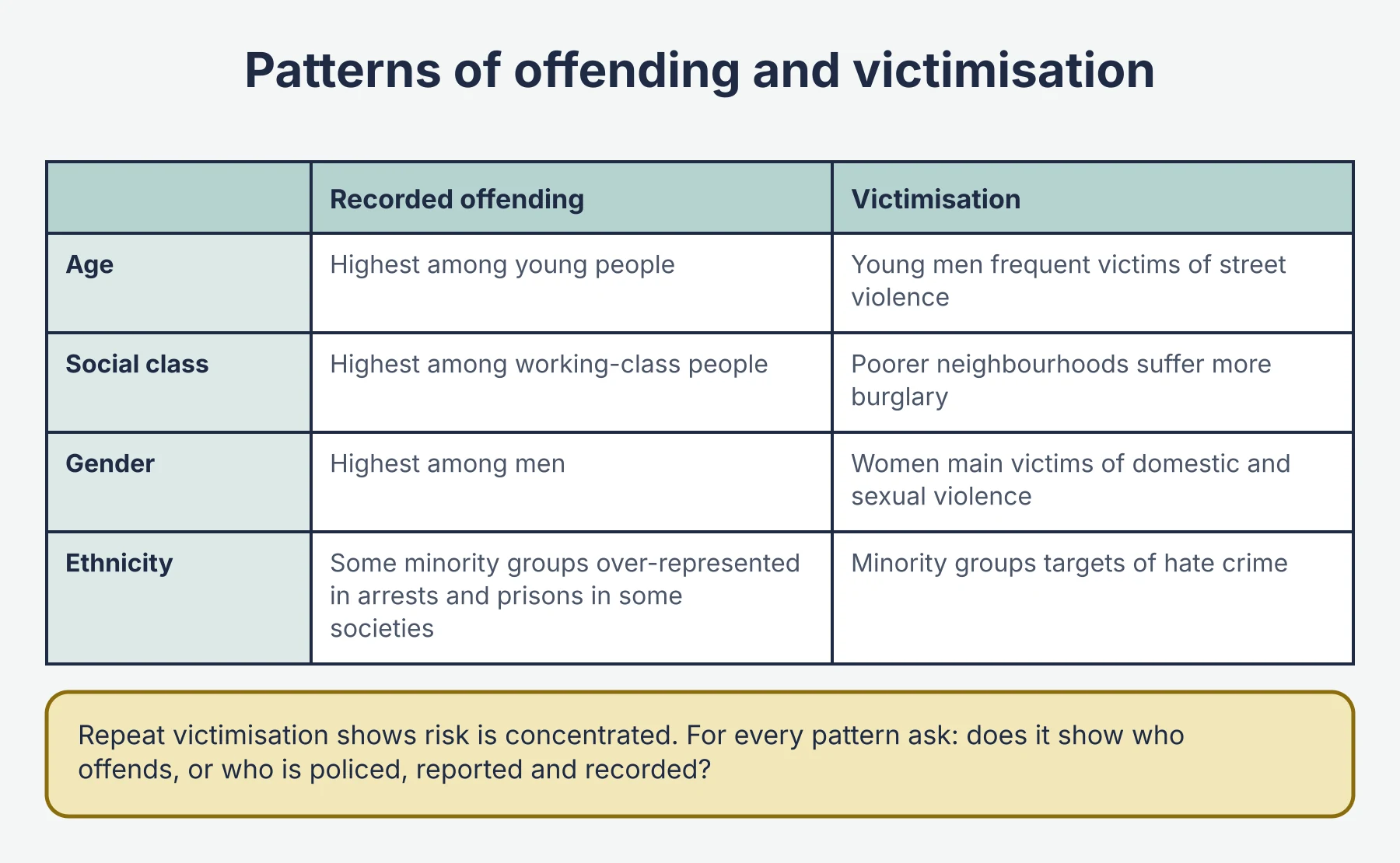
The syllabus says patterns of crime and victimisation, so learn both sides. Recorded offending is highest among young people, men and working-class people, and some ethnic minority groups are over-represented in arrests and prisons in some societies. Victimisation often follows similar lines: young men are frequent victims of street violence, poorer neighbourhoods suffer more burglary, women are the main victims of domestic and sexual violence, and minority groups are targets of hate crime. Repeat victimisation, where the same people or places are victimised again and again, shows that risk is concentrated rather than spread evenly.
Every pattern comes with a question: does it show who offends, or who is policed, reported and recorded? The answer usually involves both, and saying so is the first step of evaluation.
Two kinds of explanation
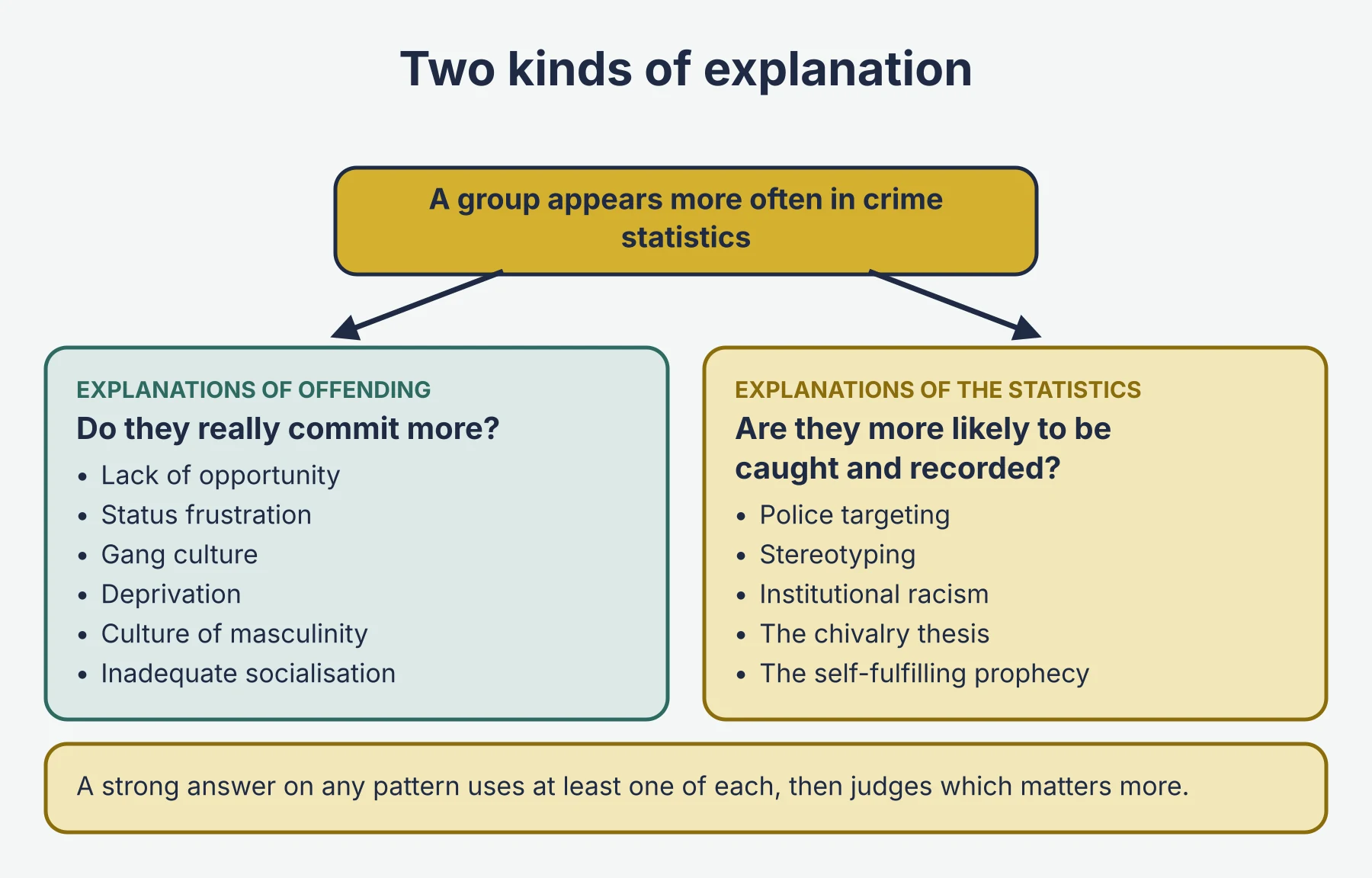
The lists in 6.2.2 to 6.2.5 mix two different kinds of explanation, and sorting them is a useful exam skill:
- Explanations of offending say why a group may actually commit more crime: lack of opportunity, status frustration, gang culture, deprivation, culture of masculinity, inadequate socialisation.
- Explanations of the statistics say why a group may appear to commit more crime because of how others react: police targeting, stereotyping, institutional racism, the chivalry thesis, the self-fulfilling prophecy.
A strong answer on any pattern includes at least one of each, then judges which matters more.
Building explanation chains
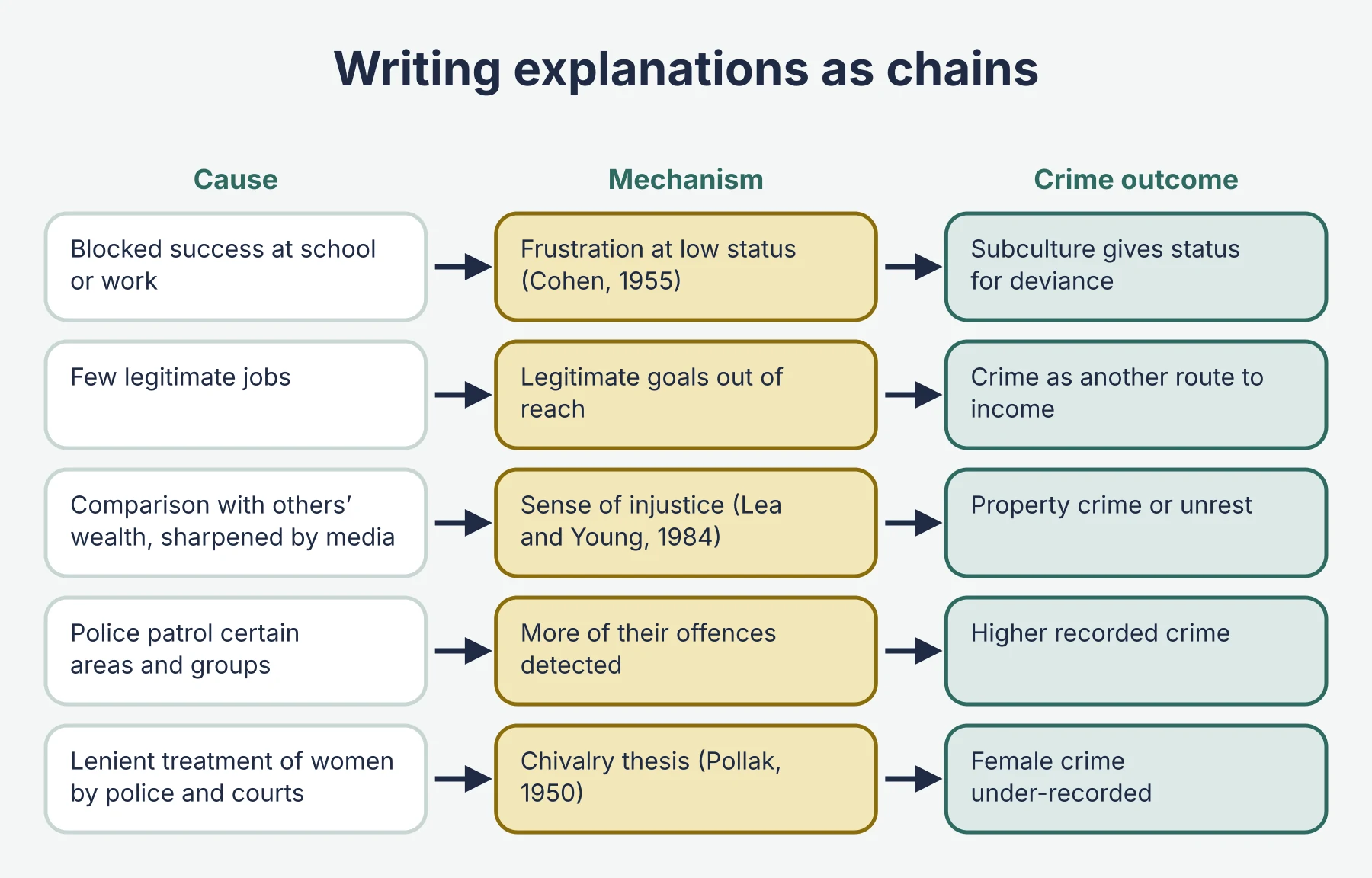
Each named explanation should be written as a chain: cause → mechanism → crime outcome.
| Explanation | Chain |
|---|---|
| Status frustration (age, ethnicity, class) | Blocked success at school or work → frustration at low status → a subculture that gives status for deviance (Albert Cohen, 1955) |
| Lack of opportunity (age, gender, class) | Few legitimate jobs → legitimate goals out of reach → crime as an alternative route to income |
| Relative deprivation (ethnicity, class) | Comparison with others’ wealth, sharpened by media → sense of injustice → property crime or unrest (Lea and Young, 1984) |
| Social exclusion (class) | Cut off from work, education and services → weak stake in society → fewer reasons to conform |
| Inadequate socialisation (class) | New Right: weak families and absent fathers → norms not learned → delinquency (Charles Murray) |
| Socialisation and social control (age, gender) | Girls supervised more closely; young people moving away from family control → different opportunities to offend |
| Culture of masculinity (gender) | Toughness valued → violence used to prove manhood; James Messerschmidt (1993) saw crime as one way of “accomplishing” masculinity |
| Misogyny (gender) | Hostility towards women → violence and harassment directed at women |
| Gang culture (age, ethnicity, gender) | Gang offers belonging, status, protection → territorial violence and drug dealing |
| Police targeting / stop and search (age, ethnicity, class) | Police patrol certain areas and groups → more of their offences detected → higher recorded crime |
| Stereotyping (age, ethnicity, gender) | Image of the “typical criminal” → suspicion and arrest of those who fit → statistics confirm the stereotype |
| Institutional racism (ethnicity) | Routine policies disadvantage minority groups → more stops, charges and harsher sentences |
| Chivalry thesis (gender) | Lenient treatment of women by police and courts → female crime under-recorded (Otto Pollak, 1950) |
| Self-fulfilling prophecy (age) | Young person labelled as trouble → treated as such → accepts the label and offends further |
| Power inequalities (class) | The powerful shape laws and avoid prosecution → working-class crime more visible (Steven Box, 1983) |
The five theories in depth (6.2.6)
Functionalism. Émile Durkheim argued that some crime is normal and even functional: punishing offenders reminds everyone where the boundaries lie (boundary maintenance), and some deviance leads to social change. Too much crime, though, signals anomie, a state of normlessness.
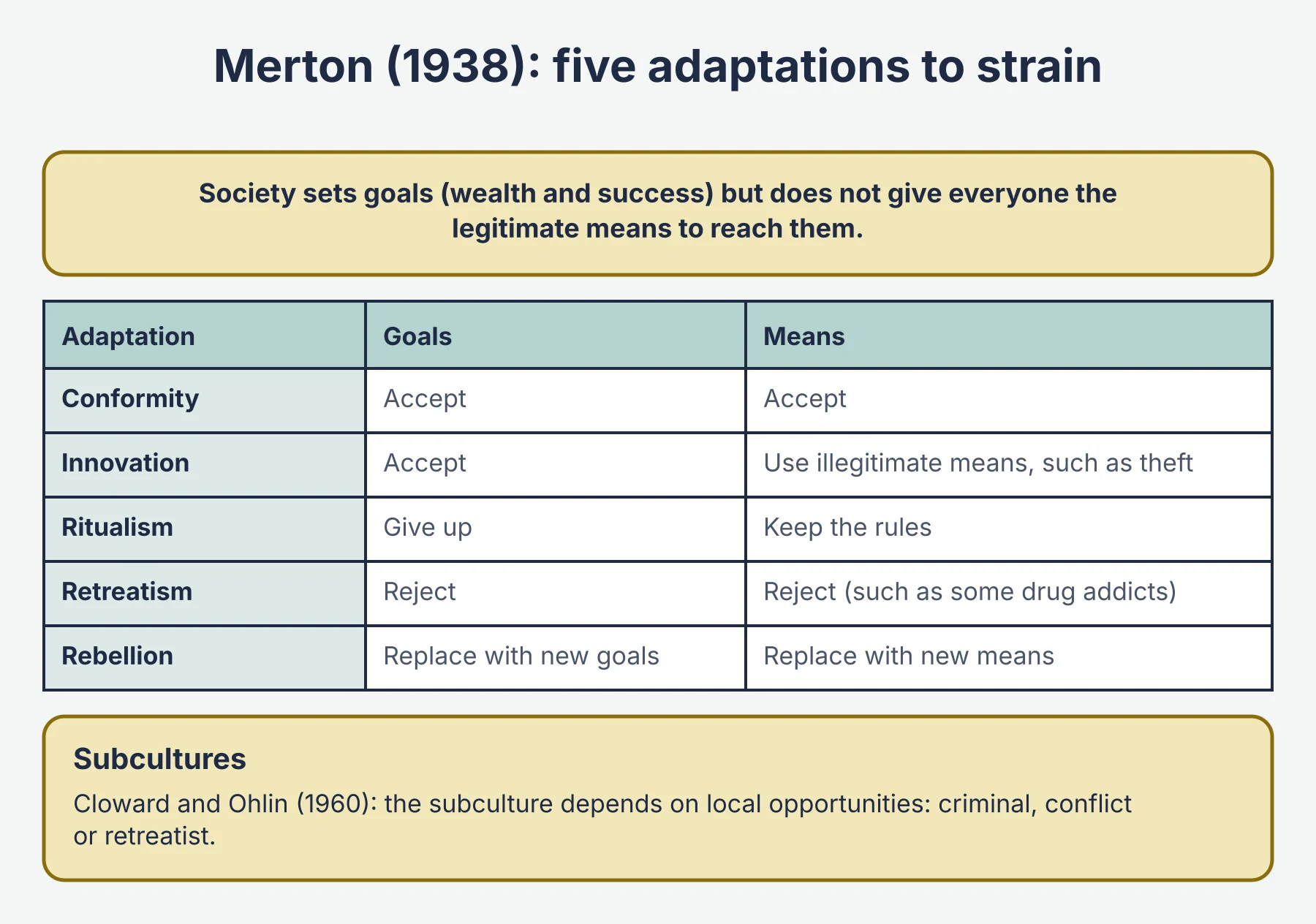
- Strain theory: Robert Merton (1938) argued that society sets goals (wealth and success) but does not give everyone the legitimate means to reach them. People adapt in five ways: conformity (accept goals and means), innovation (accept goals, use illegitimate means such as theft), ritualism (give up the goals but keep the rules), retreatism (reject both, such as some drug addicts) and rebellion (replace both with new goals and means).
- Subculturalism: Albert Cohen (1955) linked status frustration to delinquent subcultures. Richard Cloward and Lloyd Ohlin (1960) argued that the kind of subculture depends on local opportunities: criminal subcultures where adult crime networks exist, conflict subcultures of gang violence where they do not, and retreatist subcultures for those who fail at both.
- New Right: an underclass with weak families and welfare dependency fails to socialise children (Murray).
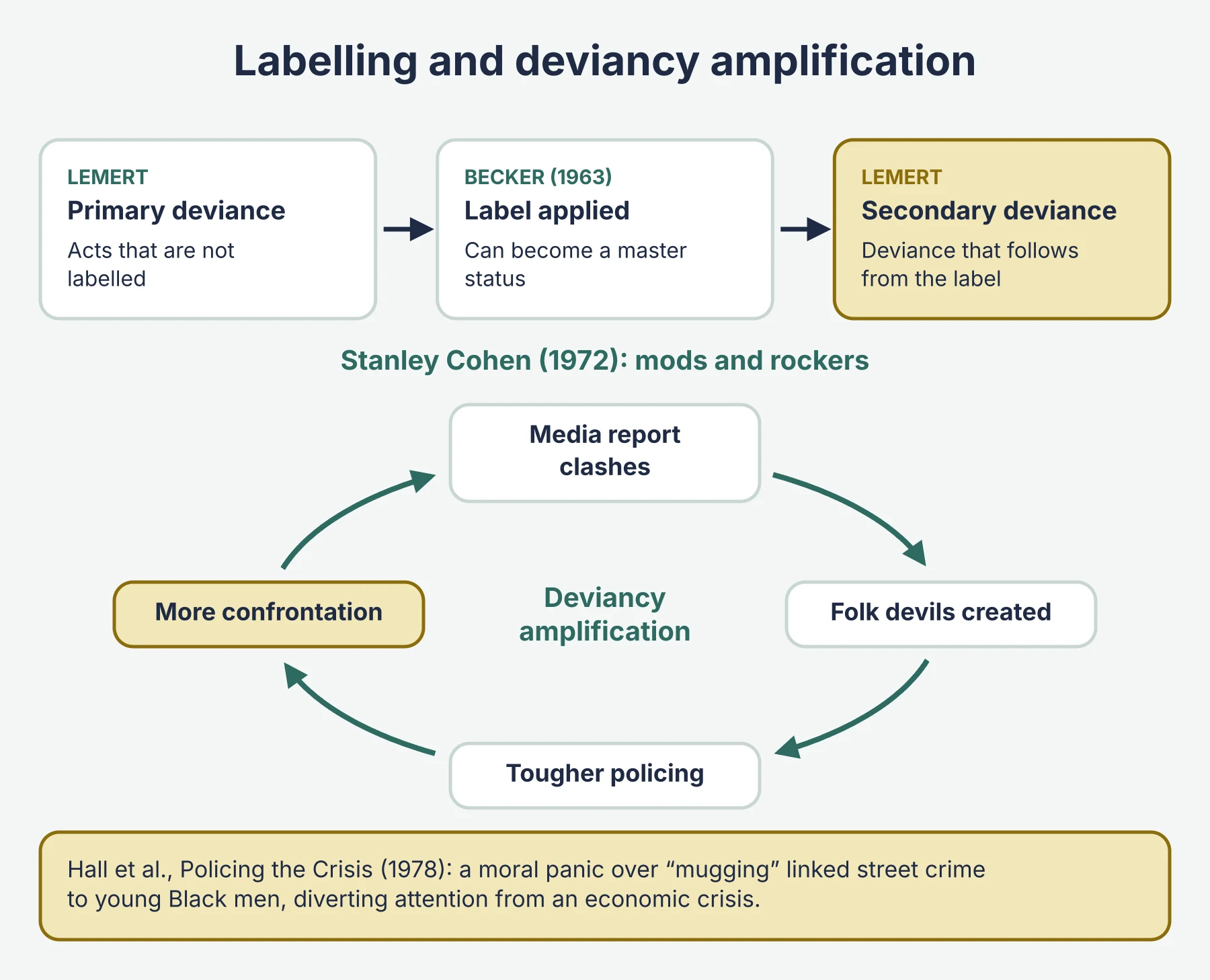
Interactionism. Edwin Lemert distinguished primary deviance (acts that are not labelled) from secondary deviance (deviance that follows from being labelled). Howard Becker (1963) argued that a label can become a master status that overrides other identities. Moral panic theory adds the role of the media: Stanley Cohen (1972) showed how reporting of clashes between mods and rockers in the 1960s created folk devils, leading to tougher policing and more confrontation, a process called deviancy amplification.
Marxism. Capitalism encourages greed and competition, so crime is found in all classes. Laws mostly protect private property, and enforcement is selective: working-class crime is policed heavily while crimes of the powerful are rarely punished (Box, 1983). Stuart Hall and colleagues’ Policing the Crisis (1978) argued that a moral panic over “mugging” in 1970s Britain linked street crime to young Black men, diverting attention from an economic crisis.
Feminism. Frances Heidensohn (1985) argued that women commit less crime because they are controlled more: at home by domestic duties, in public by fear of violence and concern for reputation, and at work by male supervisors. Pat Carlen (1988) argued that women offend when the rewards of conforming, a decent income and a secure family life, are not available. Feminists also highlight male violence against women as a product of patriarchy and misogyny.
Postmodernism. Postmodernists argue that crime is too varied to have one cause. Offending can be about pleasure, identity and risk. Jack Katz (1988) described the “seductions” of crime, the thrill of the act itself, and Stephen Lyng (1990) used the term edgework for voluntary risk-taking that offers excitement in a controlled, routine society. Postmodernists also point to new forms of crime, such as cyber crime and global crime, that older theories did not anticipate.
Strengths and limitations (6.2.7)
- Age explanations: status frustration and lack of opportunity explain youth property crime and gangs, but most young people do not offend, and police targeting may exaggerate youth crime.
- Ethnicity explanations: institutional racism and stereotyping explain over-representation in statistics; relative deprivation explains some real differences. Neither fully explains differences between minority groups, and self-report studies complicate the picture.
- Gender explanations: the chivalry thesis is challenged by evidence that women who break gender norms may be treated more harshly; control theory and masculinity explain the large gap better.
- Class explanations: deprivation explains working-class crime but not crimes of the powerful, which Marxists and Box highlight.
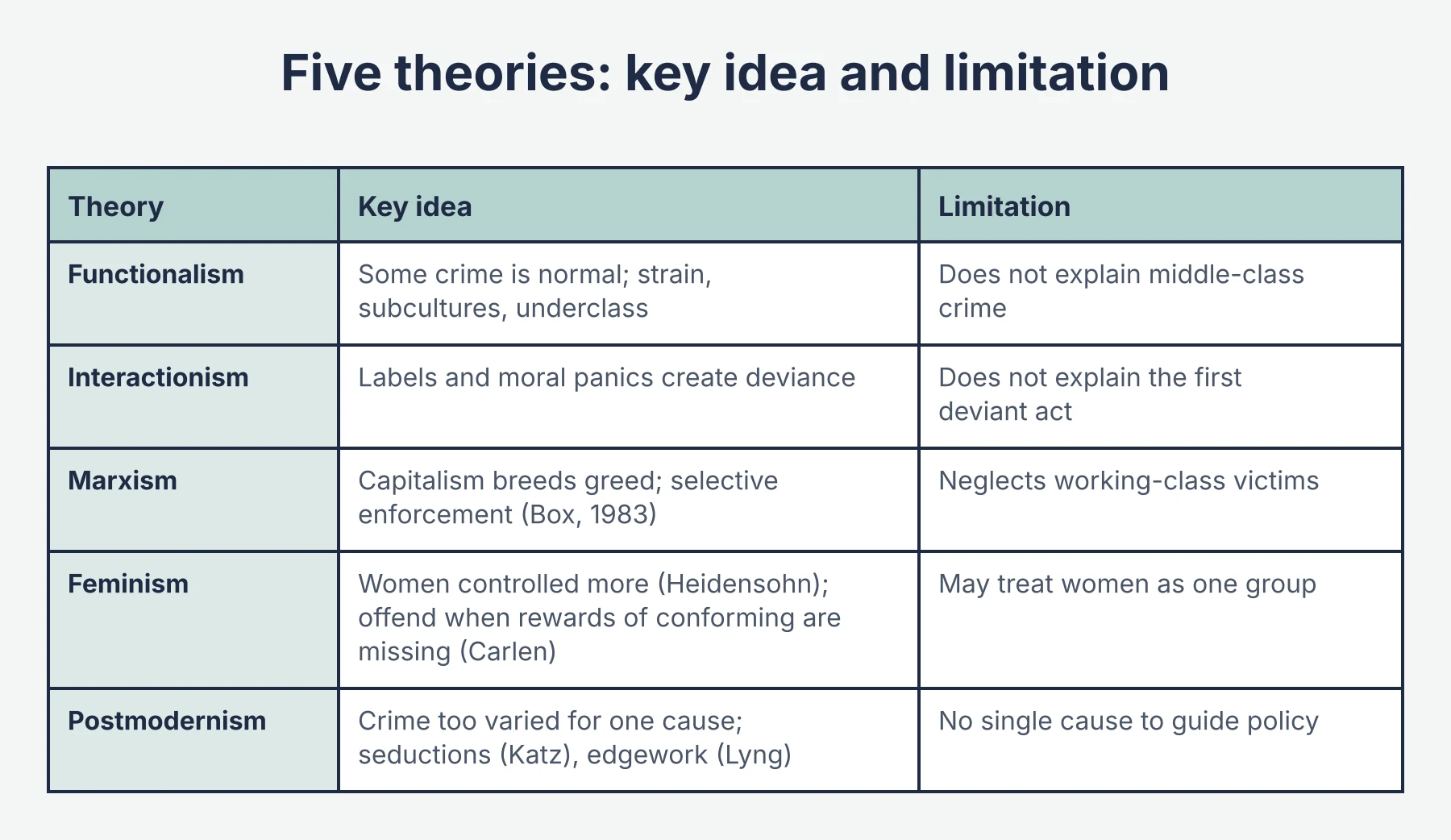
- Theories: functionalism explains patterns but not middle-class crime; interactionism explains reactions but not the first deviant act; Marxism highlights power but neglects working-class victims; feminism explains gender but may treat women as one group; postmodernism captures variety but offers no single cause for policy.
Worked example: an annotated essay plan
Question: Evaluate the view that police targeting is the main reason some groups appear in crime statistics more than others.
- Introduction: the view is interactionist; the alternative is that some groups really offend more. Sets up the debate.
- For: stop and search concentrated on young people and minority groups; stereotyping and institutional racism; Hall et al. (1978) on the mugging panic. Explains how statistics are produced.
- Against: lack of opportunity, status frustration and relative deprivation suggest real differences; victim surveys show working-class areas suffer more crime. Uses real-offending explanations.
- Evaluation: both shape statistics; corporate crime shows the reverse case, where the powerful avoid targeting. Judges.
- Conclusion: targeting explains part of the pattern, but not all. Answers the question.
Common mistakes
- Listing explanations without saying which pattern each explains.
- Treating statistics as proof of who offends without questioning how they are produced.
- Describing Merton without naming at least two adaptations.
- Writing “feminists say men commit more crime” without a mechanism such as Heidensohn’s control.
- Leaving victimisation out entirely.
Exam technique for 2251 command words
- Explain each point as a chain: cause, mechanism, outcome.
- Discuss one explanation or theory with evidence and criticism.
- Evaluate by setting real-offending explanations against statistical ones and ending with a judgement.
Keep revising
Related resources
-
Practice questions
Cambridge O Level Sociology (2251): Crime, deviance and social control – What are the patterns of and explanations for crime and deviance? – Practice Questions
Original Cambridge O Level Sociology 2251 Crime practice on patterns of crime, explanations by age, class and gender, and five theories, with full answers.
Sociology · Cambridge · O Level
Try questions -
Revision notes
Cambridge O Level Sociology (2251): Crime, deviance and social control – What are the patterns of and explanations for crime and deviance? – Revision Notes
Revision notes for Cambridge O Level Sociology 2251 key question 6.2: crime patterns, explanations by social group, five theories and a self-test.
Sociology · Cambridge · O Level
Revise topic -
Study guides
Cambridge O Level Sociology (2251): Crime, deviance and social control – How is crime dealt with in different societies?
Cambridge O Level Sociology 2251 key question 6.3 in depth: aims of punishment, judging punishments against aims, and policing in different societies.
Sociology · Cambridge · O Level
Read guide
Related articles
Get free revision emails (optional)
Occasional emails with practice questions, worked explanations and links to free resources for the qualification and subjects you choose. No spam, and you can unsubscribe from any email. The free tools on this site never need an email.