
Study Guides
Cambridge O Level Sociology (2251): Crime, deviance and social control – How is crime dealt with in different societies?
Cambridge O Level Sociology 2251 key question 6.3 in depth: aims of punishment, judging punishments against aims, and policing in different societies.
- Subject
- Sociology
- Level
- O LEVELS
- Topic
- Paper 2 – Family, Education and Crime
- Author
- Marlbridge Academic Team
- Updated
- Reviewed by
- Naqiya Yousaf (what this means)
Aligned to Cambridge O Level Sociology (2251), 2025-2027. Official specification .
Syllabus page (what it covers and how it is assessed): Cambridge O Level Sociology.
Syllabus points this page covers
2251
- 6.3 Crime, deviance and social control – How is crime dealt with in different societies?
Found an error? Report a correction.
Need help with this topic? Request a free trial class for O Level Sociology (2251).
Key question 6.3 of Cambridge O Level Sociology (2251) asks How is crime dealt with in different societies? It closes the Crime topic and is mostly about effectiveness: how well punishments and policing achieve what they are meant to achieve. The skill this guide builds is judging a punishment or policing strategy against a stated aim, using examples from more than one society, because “effective” means nothing until you say effective at what.
What the syllabus covers
| Section | Content named in the 2251 syllabus (2025–2027) |
|---|---|
| 6.3.1 Aims of punishment | Protection of citizens; deterrence; retribution; incapacitation; rehabilitation |
| 6.3.2 The effectiveness of different types of punishment | Community sentencing; financial penalties; prison; rehabilitation programmes; capital punishment; corporal punishment; exile; ostracism; non-custodial sentencing, e.g. electronic tagging, curfews, restraining orders; probation; police cautions; social media and vigilante groups |
| 6.3.3 The effectiveness of policing and law enforcement | Policing strategies, e.g. targeting and stop and search; surveillance, including digital surveillance; crime prevention; community and military style policing |
The aims of punishment (6.3.1)
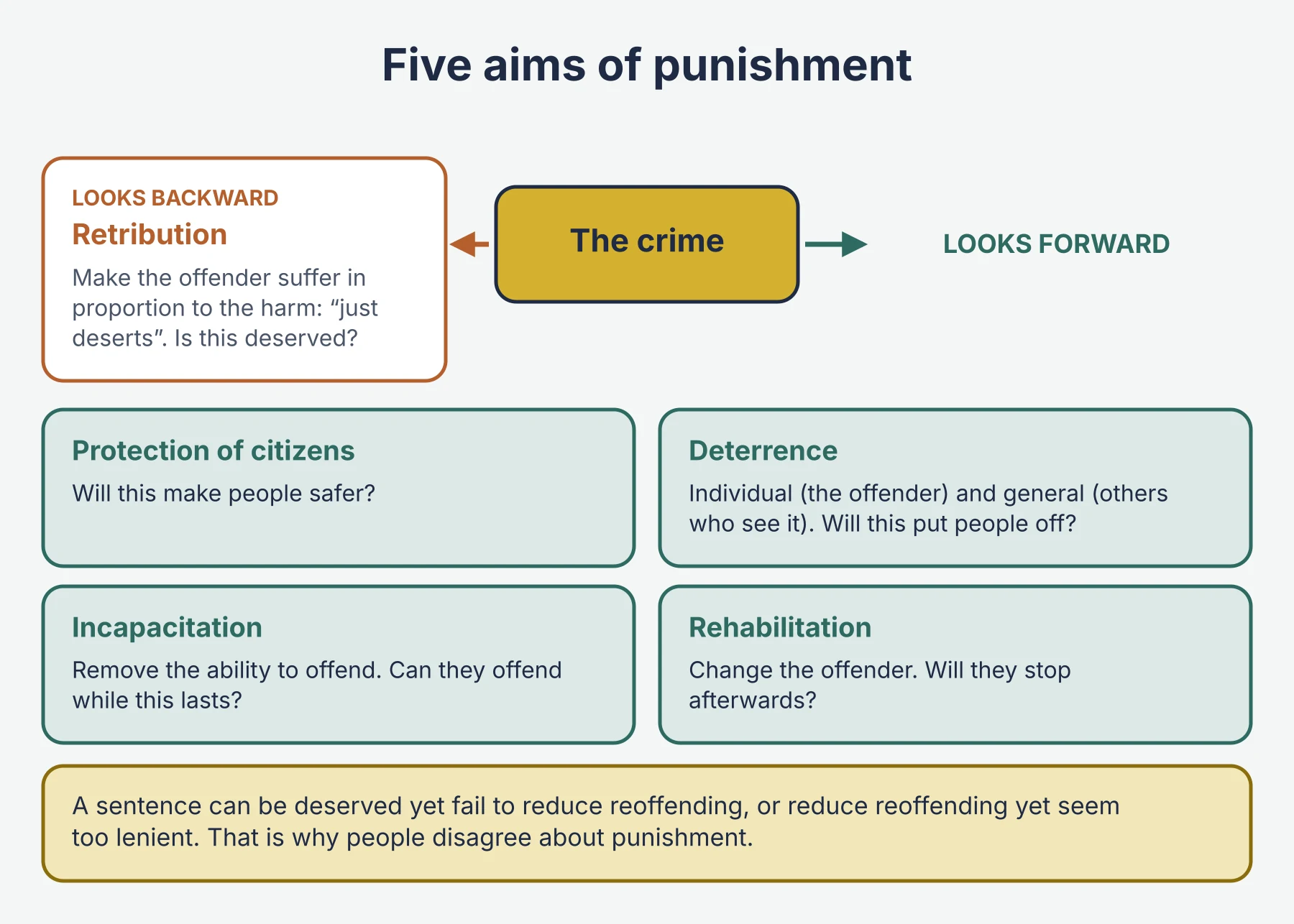
| Aim | Looks | Meaning | Question it asks |
|---|---|---|---|
| Protection of citizens | Forward | Keep the public safe from harm | Will this make people safer? |
| Deterrence | Forward | Discourage crime through fear of punishment, both by the offender (individual deterrence) and by others who see the punishment (general deterrence) | Will this put people off offending? |
| Retribution | Backward | Make the offender suffer in proportion to the harm done (“just deserts”) | Is this deserved? |
| Incapacitation | Forward | Remove the offender’s ability to offend | Can they offend while this lasts? |
| Rehabilitation | Forward | Change the offender so they no longer want or need to offend | Will they stop offending afterwards? |
Retribution is the only aim that looks backward to the crime. The others look forward to preventing future crime. This difference explains why people disagree about punishment: a sentence can be deserved yet fail to reduce reoffending, or reduce reoffending yet seem too lenient.
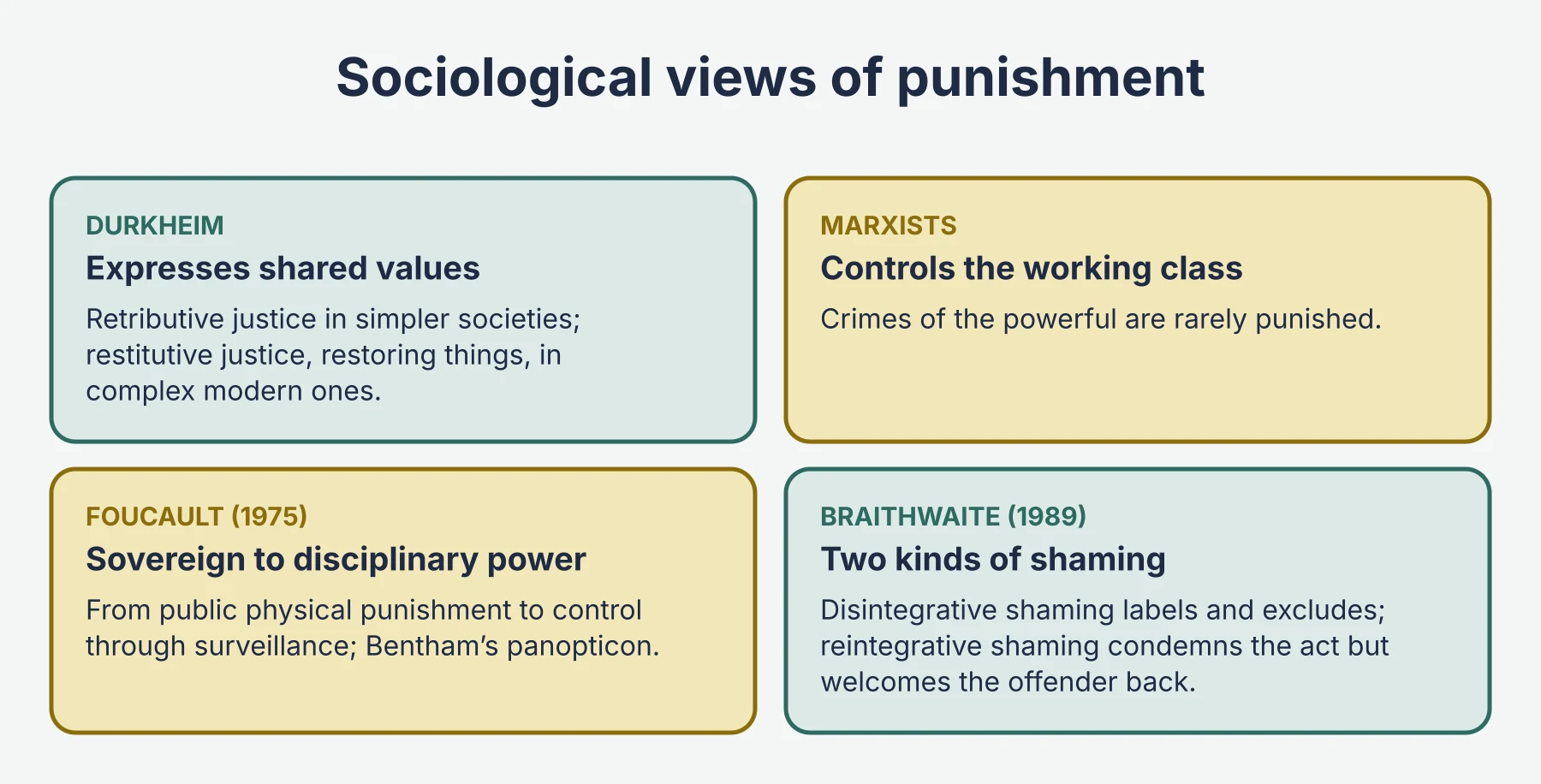
Sociological views of punishment:
- Durkheim argued that punishment expresses society’s shared values and strengthens solidarity. He contrasted retributive justice, typical of simpler societies, with restitutive justice, aimed at restoring things to how they were, which he linked to complex modern societies.
- Marxists argue that punishment mainly controls the working class while the crimes of the powerful are rarely punished.
- Michel Foucault (Discipline and Punish, 1975) described a shift from sovereign power, displayed through public physical punishment, to disciplinary power, which controls people through surveillance. He used Jeremy Bentham’s design for a prison, the panopticon, in which prisoners never know if they are being watched, so they control themselves.
- John Braithwaite (1989) distinguished disintegrative shaming, which labels and excludes the offender, from reintegrative shaming, which condemns the act but welcomes the offender back.
Matching punishments to aims (6.3.2)
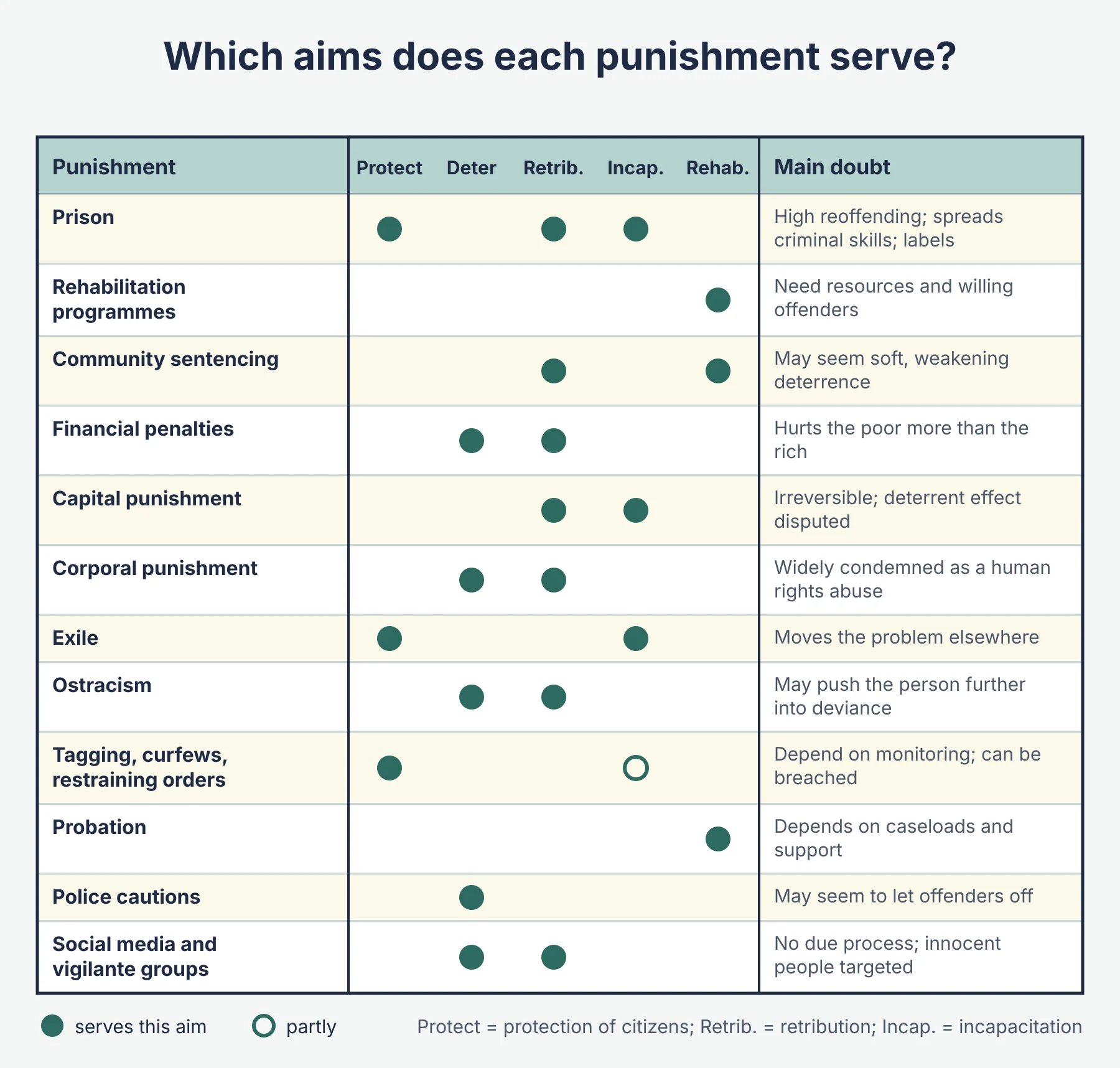
The most useful revision tool for 6.3.2 is to ask which aim each punishment serves best.
| Punishment | Aims it serves | Main doubt about effectiveness |
|---|---|---|
| Prison | Incapacitation; retribution; protection | High reoffending in many systems; spreads criminal skills; labels offenders |
| Rehabilitation programmes | Rehabilitation | Need resources and willing offenders |
| Community sentencing | Retribution (repaying society); rehabilitation | May be seen as soft, weakening deterrence |
| Financial penalties | Retribution; deterrence | Same fine hurts the poor more than the rich |
| Capital punishment | Retribution; incapacitation | Irreversible if the person was innocent; deterrent effect is disputed |
| Corporal punishment | Retribution; deterrence | Widely condemned as a human rights abuse |
| Exile | Protection; incapacitation | Moves the problem elsewhere |
| Ostracism | Retribution; deterrence through shame | May push the person further into deviance |
| Electronic tagging, curfews, restraining orders | Protection; incapacitation (partial) | Depend on monitoring; can be breached |
| Probation | Rehabilitation; supervision | Depends on caseloads and support |
| Police cautions | Individual deterrence; avoiding labelling | May seem to let offenders off |
| Social media and vigilante groups | Retribution; deterrence through public shaming | No due process; innocent people can be targeted |
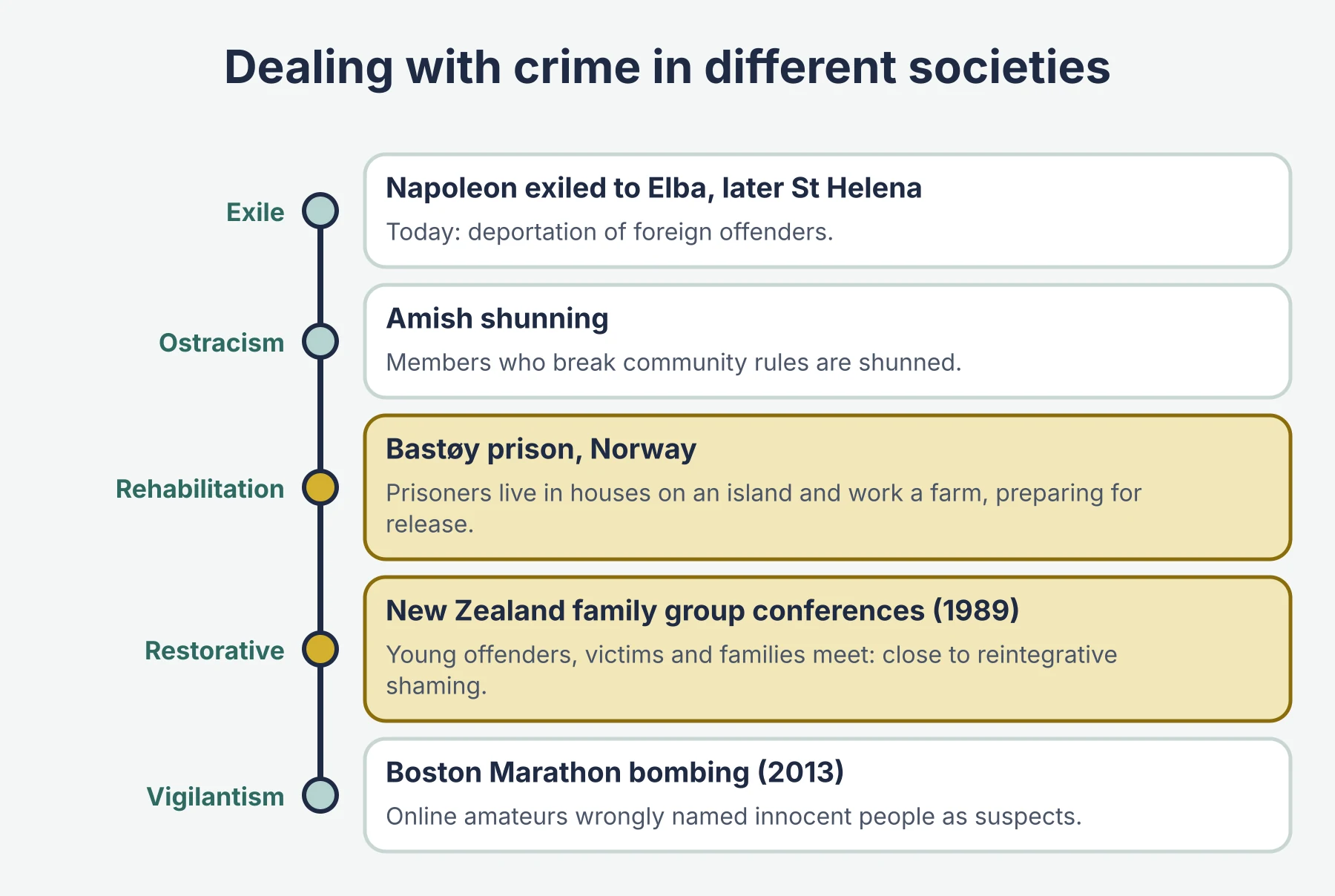
Examples from different societies:
- Exile has a long history: Napoleon was exiled to Elba and later to St Helena. Today, forms of banishment include deportation of foreign offenders.
- Ostracism is used in some close-knit religious communities; for example, Amish communities practise shunning of members who break community rules.
- Rehabilitation-focused prisons: Norway’s Bastøy prison, on an island, lets prisoners live in houses and work on a farm, reflecting a belief that prison should prepare people for life after release.
- Restorative justice: New Zealand introduced family group conferences for young offenders in 1989, bringing offenders, victims and families together, an approach close to Braithwaite’s reintegrative shaming.
- Online vigilantism: after the 2013 Boston Marathon bombing, amateur online investigators wrongly named innocent people as suspects, showing the risk of punishment without due process.
Policing and law enforcement (6.3.3)
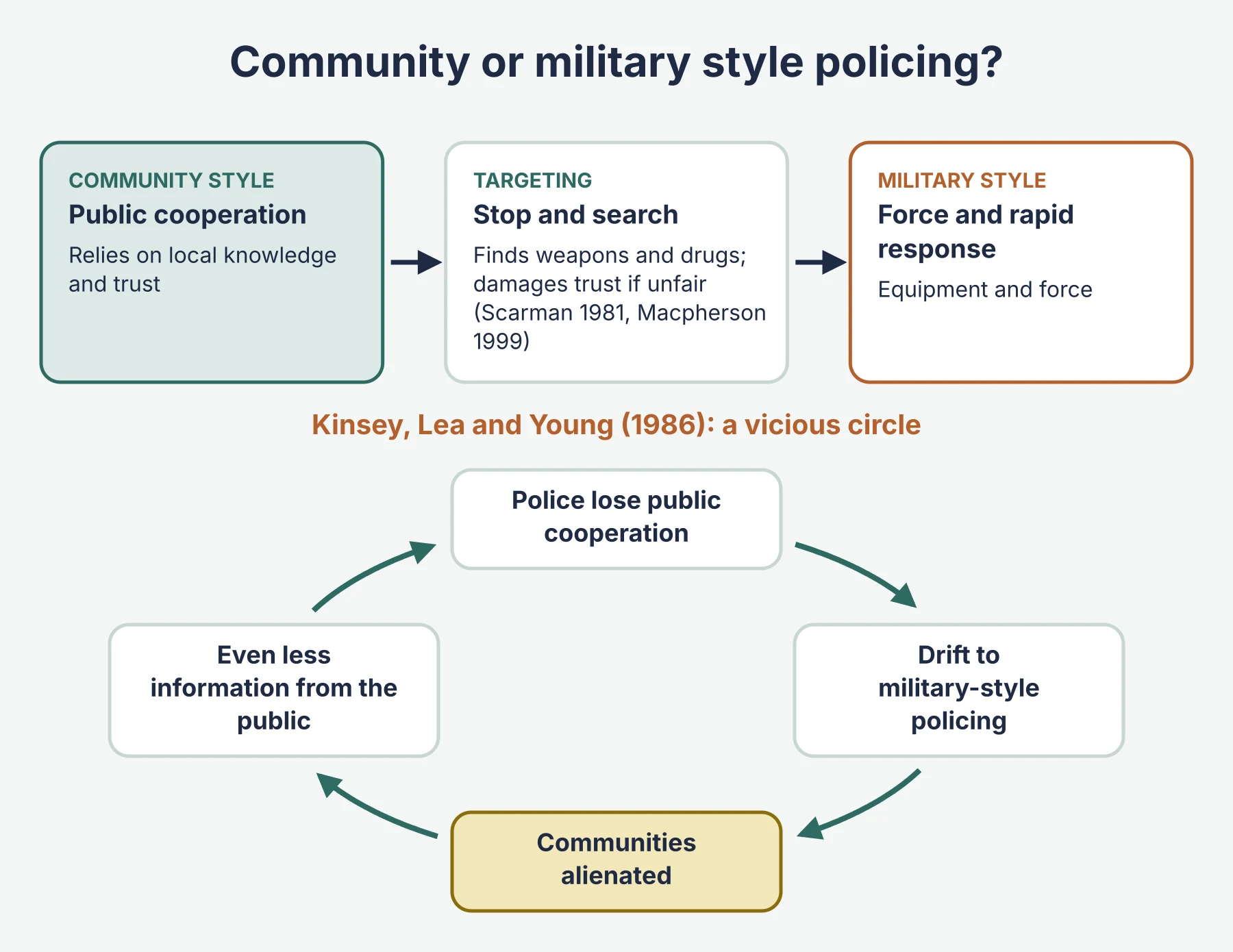
Targeting and stop and search. Police concentrate on people and places thought to be linked to crime. It can find weapons and drugs, but if it is used unfairly it damages trust. In Britain the Scarman Report (1981) followed the Brixton disturbances, which came after an intensive stop-and-search operation, and the Macpherson Report (1999) found the Metropolitan Police to be institutionally racist.
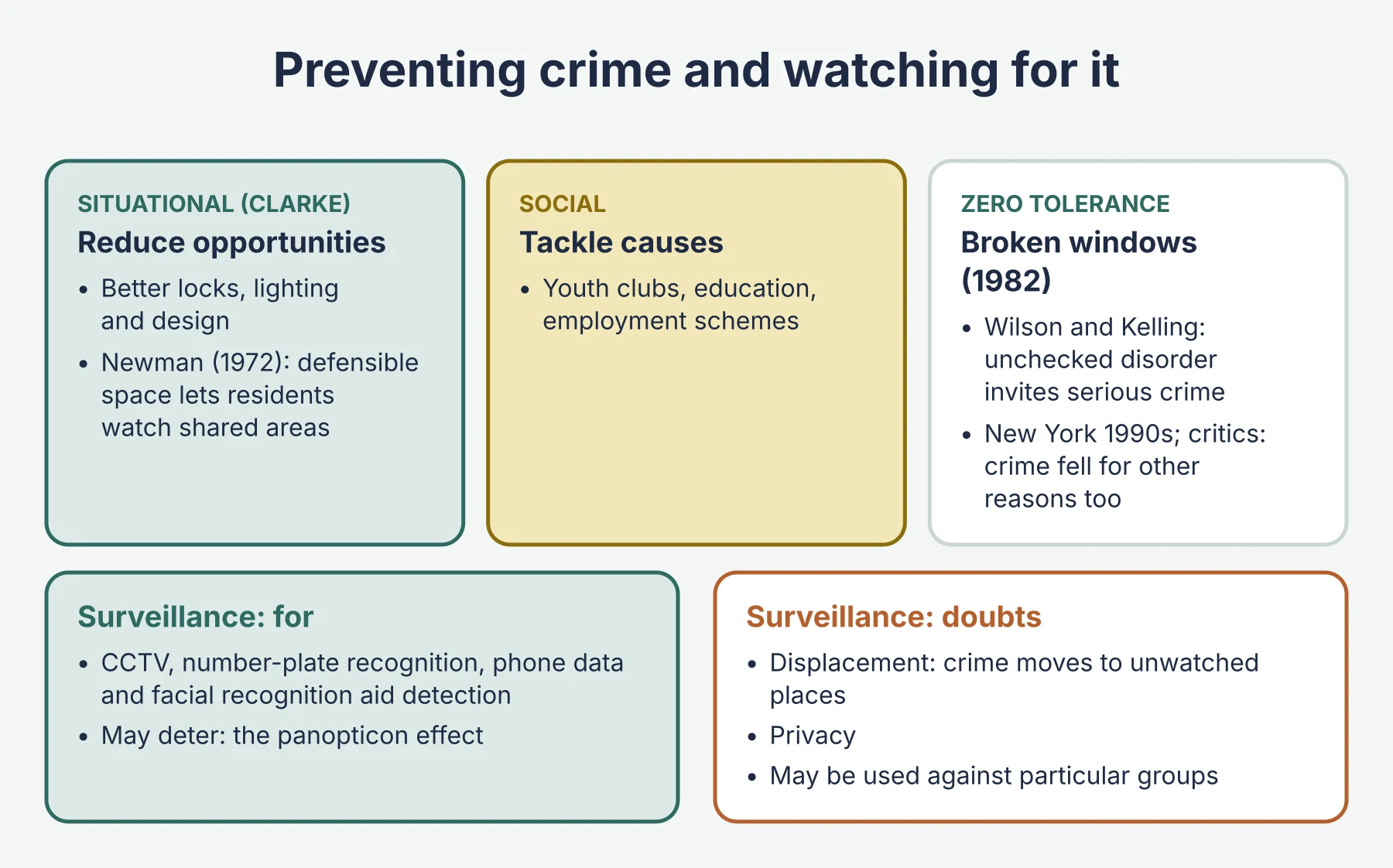
Zero tolerance. James Q. Wilson and George Kelling’s broken windows theory (1982) argued that leaving minor disorder unchecked signals that no one cares, inviting more serious crime. Zero-tolerance policing of minor offences in New York in the 1990s is often linked to the theory, though critics argue crime was also falling for other reasons and that the approach targeted poorer and minority communities.
Surveillance, including digital surveillance. CCTV, number-plate recognition, phone data and facial recognition aid detection and may deter. Foucault’s panopticon helps explain the effect: people who think they may be watched control themselves. Doubts include displacement (crime moves to unwatched places), privacy and the risk that surveillance is used against particular groups.
Crime prevention. Situational crime prevention (Ronald Clarke) reduces opportunities: better locks, lighting and design. Oscar Newman’s defensible space (1972) argued that housing design that lets residents watch over shared areas reduces crime. Social crime prevention tackles causes, such as youth clubs, education and employment schemes.
Community and military style policing. Community policing relies on public cooperation and local knowledge. Military style policing relies on force, equipment and rapid response. Richard Kinsey, John Lea and Jock Young (1986) argued that when police lose public cooperation they drift towards military-style policing, which alienates communities further and leads to even less information from the public: a vicious circle.
Worked example: an annotated essay plan
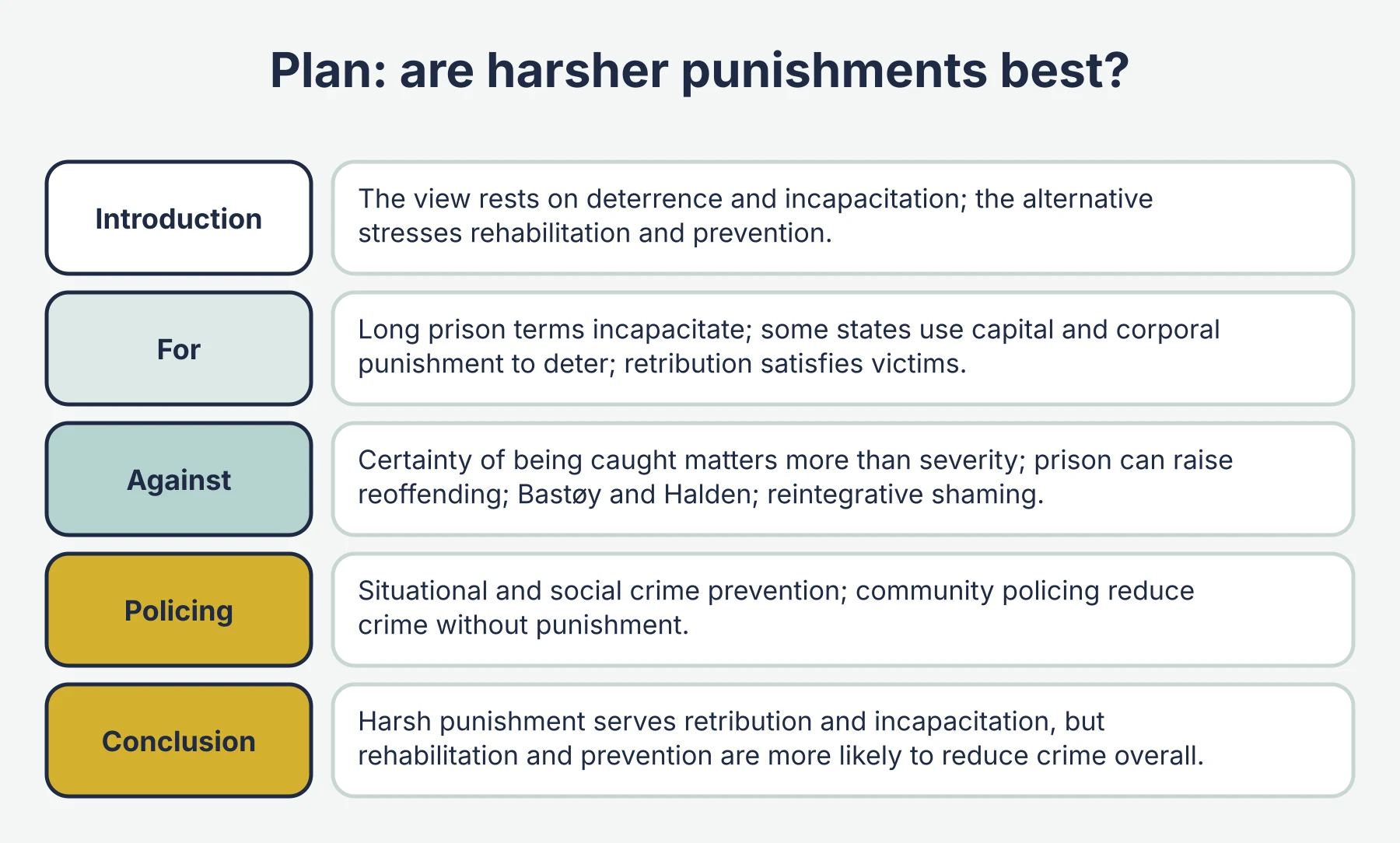
Question: Evaluate the view that harsher punishments are the best way to reduce crime.
- Introduction: the view rests on deterrence and incapacitation; the alternative stresses rehabilitation and prevention. Names the aims.
- For: long prison terms incapacitate; capital and corporal punishment are used by some states for their deterrent message; retribution satisfies victims. Links punishments to aims.
- Against: deterrence depends more on the certainty of being caught than on severity; prison can increase reoffending through labelling and criminal contacts; Bastøy and Halden show a rehabilitative alternative; Braithwaite’s reintegrative shaming. Uses evidence from different societies.
- Policing alternative: situational and social crime prevention; community policing. Shows crime can be reduced without punishment.
- Conclusion: harsh punishment may serve retribution and incapacitation, but rehabilitation and prevention are more likely to reduce crime overall. Judges against the aim in the question.
Common mistakes
- Calling a punishment “effective” without naming the aim it is effective at.
- Treating deterrence as one thing: separate individual and general deterrence.
- Using examples from only one society when the key question asks about “different societies”.
- Confusing incapacitation (preventing offending) with rehabilitation (changing the offender).
- Describing stop and search without considering its effect on trust and on statistics (6.2).
Exam technique for 2251 command words
- Define each aim of punishment in one precise sentence.
- Explain the effectiveness of a punishment by linking it to an aim and giving a reason.
- Discuss a policing strategy by weighing its benefits against its costs.
- Evaluate by comparing punishments or strategies across societies and reaching a judgement.
Keep revising
Related resources
-
Practice questions
Cambridge O Level Sociology (2251): Crime, deviance and social control – How is crime dealt with in different societies? – Practice Questions
Original Cambridge O Level Sociology 2251 Crime practice on aims of punishment, types of punishment and policing in different societies, with full answers.
Sociology · Cambridge · O Level
Try questions -
Revision notes
Cambridge O Level Sociology (2251): Crime, deviance and social control – How is crime dealt with in different societies? – Revision Notes
Revision notes for Cambridge O Level Sociology 2251 key question 6.3: aims of punishment, types of punishment and policing strategies, with a self-test.
Sociology · Cambridge · O Level
Revise topic -
Study guides
O Level Sociology: Patterns of Crime and How Societies Deal With It (Cambridge 2251)
Cambridge O Level Sociology 2251 key questions 6.2 and 6.3: crime by age, class, gender and ethnicity, five theories, punishment and policing.
Sociology · Cambridge · O Level
Read guide
Related articles
Get free revision emails (optional)
Occasional emails with practice questions, worked explanations and links to free resources for the qualification and subjects you choose. No spam, and you can unsubscribe from any email. The free tools on this site never need an email.