
Revision Notes
Cambridge O Level Sociology (2251): Crime, deviance and social control – How is crime dealt with in different societies? – Revision Notes
Revision notes for Cambridge O Level Sociology 2251 key question 6.3: aims of punishment, types of punishment and policing strategies, with a self-test.
- Subject
- Sociology
- Level
- O LEVELS
- Topic
- Paper 2 – Family, Education and Crime
- Author
- Marlbridge Academic Team
- Updated
- Reviewed by
- Naqiya Yousaf (what this means)
Aligned to Cambridge O Level Sociology (2251), 2025-2027. Official specification .
Syllabus page (what it covers and how it is assessed): Cambridge O Level Sociology.
Syllabus points this page covers
2251
- 6.3 Crime, deviance and social control – How is crime dealt with in different societies?
Found an error? Report a correction.
Need help with this topic? Request a free trial class for O Level Sociology (2251).
These notes condense key question 6.3 of Cambridge O Level Sociology (2251), How is crime dealt with in different societies? It has three parts: the aims of punishment, the effectiveness of different punishments, and the effectiveness of policing. The rule for every answer: name the aim before you judge the effectiveness, and use examples from more than one society.
Syllabus coverage
- 6.3.1 Protection of citizens; deterrence; retribution; incapacitation; rehabilitation.
- 6.3.2 Community sentencing; financial penalties; prison; rehabilitation programmes; capital punishment; corporal punishment; exile; ostracism; non-custodial sentencing (electronic tagging, curfews, restraining orders); probation; police cautions; social media and vigilante groups.
- 6.3.3 Targeting and stop and search; surveillance, including digital surveillance; crime prevention; community and military style policing.
Key terms
| Term | Meaning |
|---|---|
| Individual deterrence | Punishment that puts the offender off reoffending |
| General deterrence | Punishment that puts others off offending by example |
| Retribution | Punishment the offender deserves, in proportion to the harm |
| Incapacitation | Removing the offender’s ability to offend |
| Rehabilitation | Changing the offender so they no longer offend |
| Non-custodial sentence | A punishment served outside prison |
| Ostracism | Excluding a person from a group or community |
| Restorative justice | Bringing offender and victim together to repair harm |
| Reintegrative shaming | Condemning the act but welcoming the offender back (Braithwaite, 1989) |
| Panopticon | Bentham’s prison design where inmates may always be watched; used by Foucault |
| Broken windows | Wilson and Kelling (1982): unchecked minor disorder invites serious crime |
| Situational crime prevention | Reducing the opportunity to offend (Clarke) |
| Defensible space | Newman (1972): design that lets residents watch shared areas |
| Displacement | Crime moving to another place, time or target after prevention |
| Military style policing | Policing based on force and equipment rather than public cooperation |
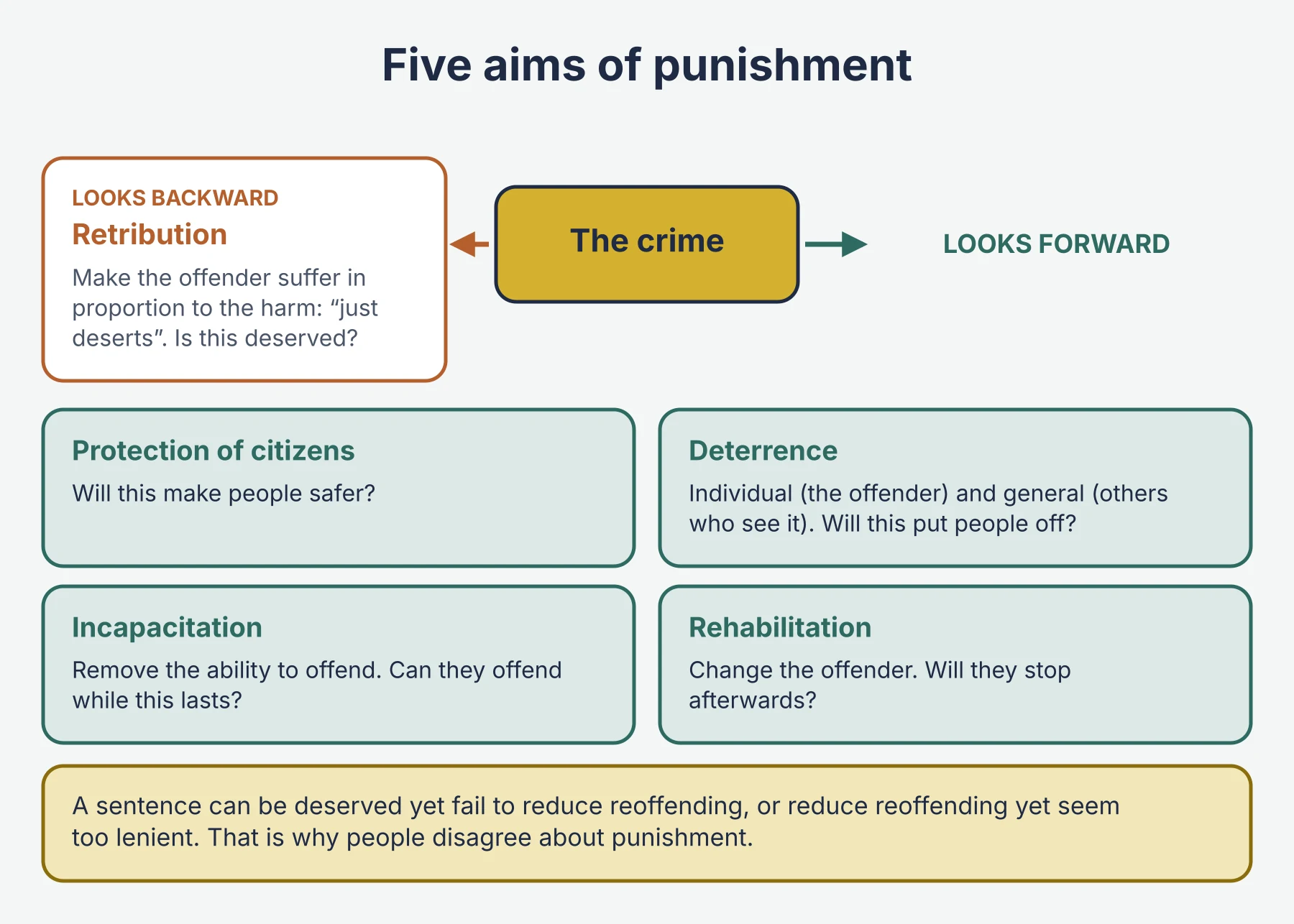
Aims in one line each
- Protection: keep the public safe.
- Deterrence: discourage offending through fear (individual and general).
- Retribution: just deserts; the only backward-looking aim.
- Incapacitation: stop offending while the sentence lasts.
- Rehabilitation: change the offender for the future.
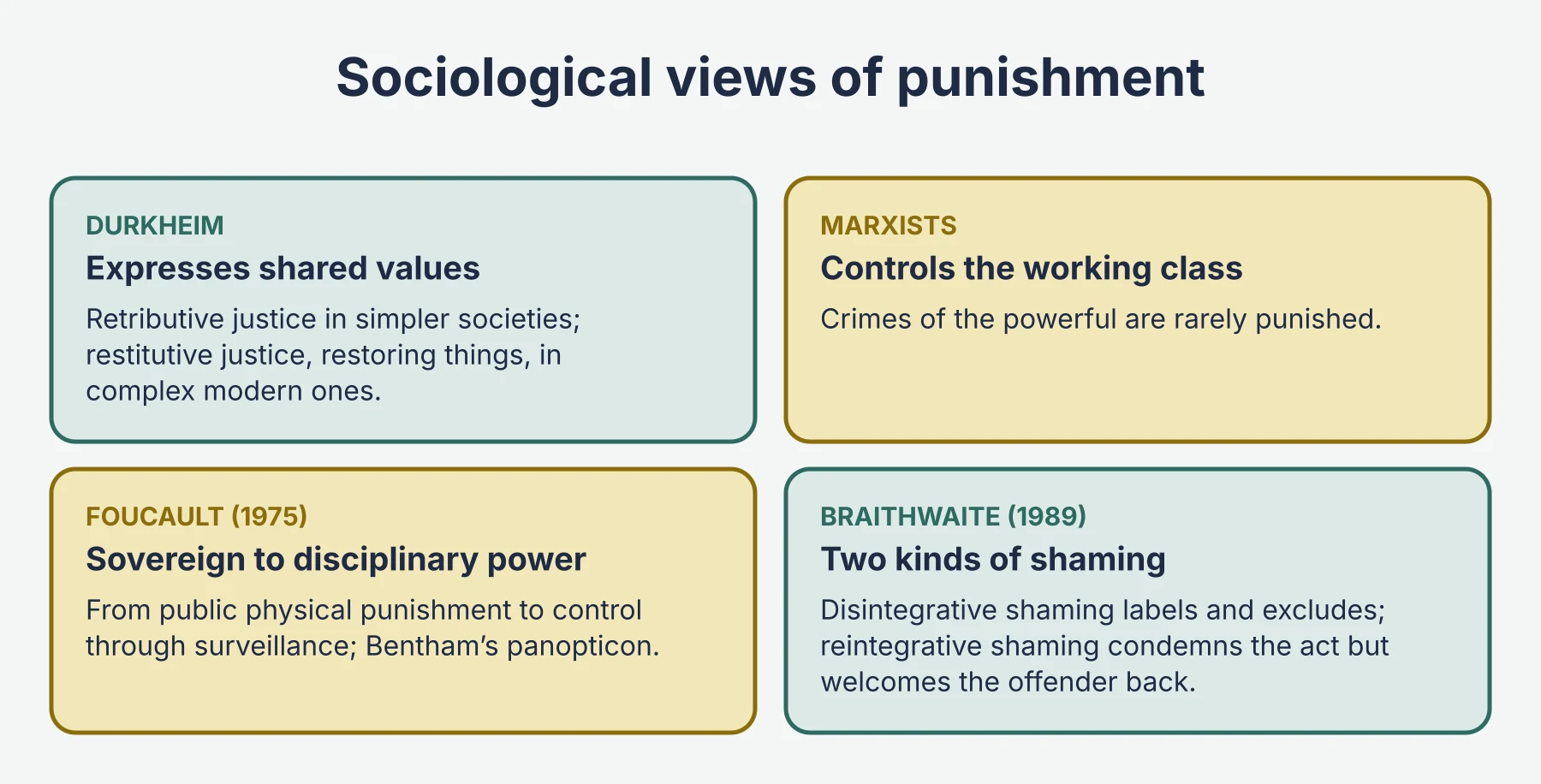
Perspectives on punishment
- Durkheim: punishment reinforces shared values; retributive justice in simpler societies, restitutive justice in complex ones.
- Marxism: punishment controls the working class; the powerful escape.
- Foucault (1975): from sovereign power (public physical punishment) to disciplinary power (surveillance and self-control).
- Braithwaite (1989): reintegrative versus disintegrative shaming.
Punishments sorted by main aim
- Incapacitation / protection: prison; capital punishment; exile; tagging; curfews; restraining orders.
- Retribution: prison; fines; capital and corporal punishment; ostracism; social media shaming.
- Deterrence: fines; corporal punishment; cautions (individual); publicised sentences (general).
- Rehabilitation: rehabilitation programmes; probation; community sentences.
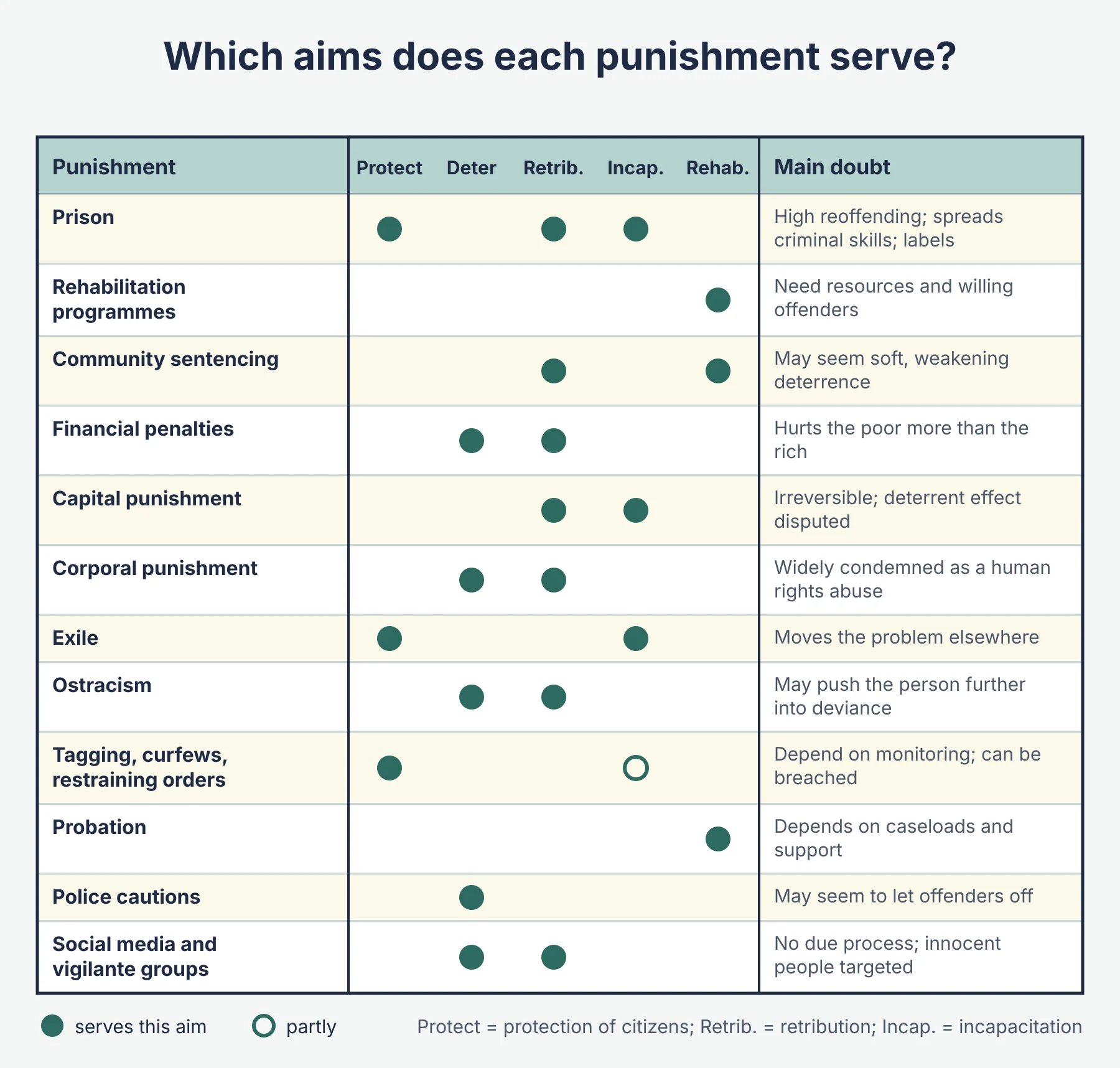
Effectiveness: one strength, one doubt
- Prison: incapacitates; but high reoffending and labelling.
- Rehabilitation programmes: tackle causes; but need resources and willing offenders.
- Community sentencing: repays society cheaply; but seen as soft.
- Fines: simple; but unequal impact on rich and poor.
- Capital punishment: permanent incapacitation; but irreversible errors, disputed deterrence.
- Corporal punishment: quick; but condemned as a human rights abuse.
- Exile: removes the offender; but moves the problem.
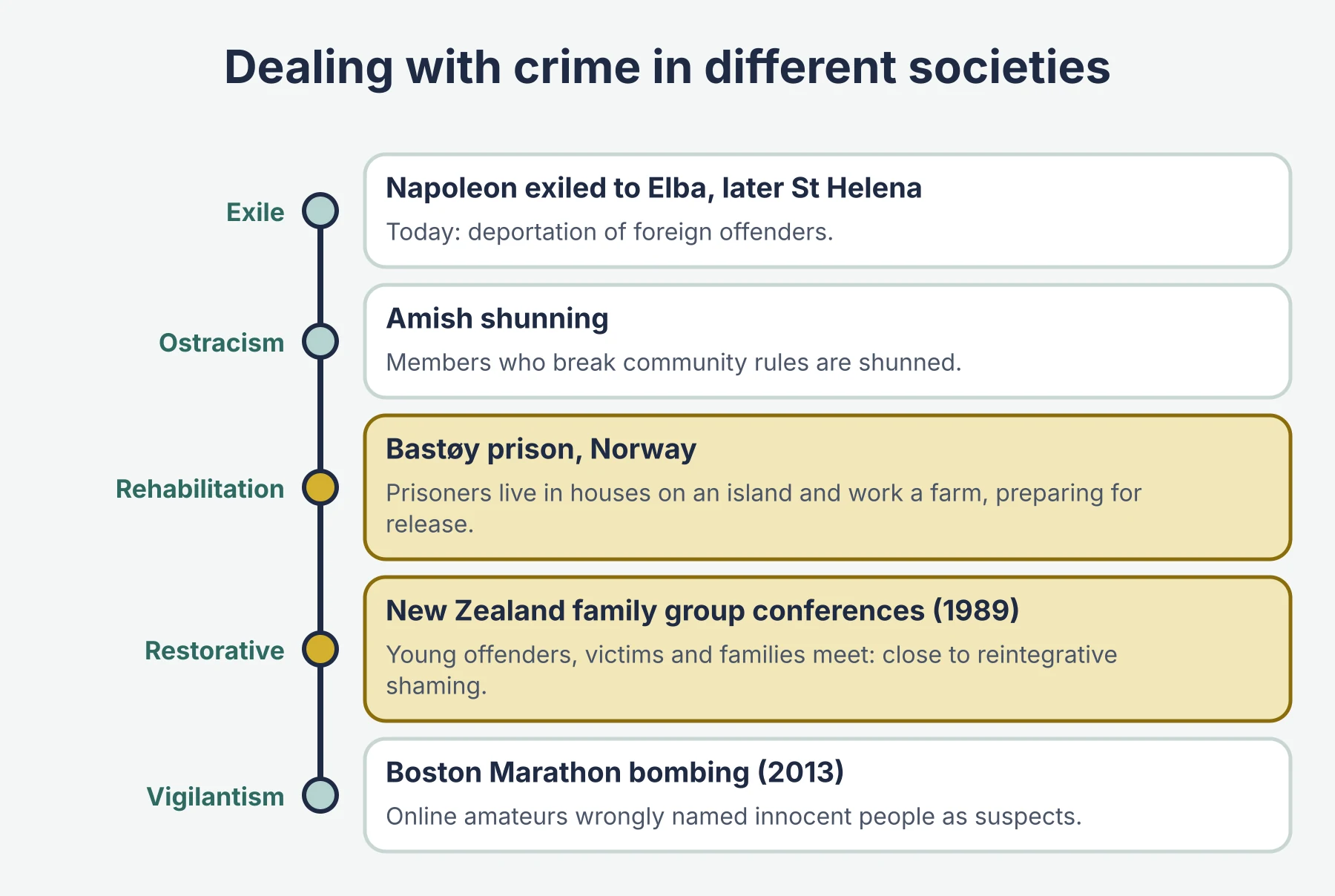
- Ostracism: strong in close-knit groups (e.g. Amish shunning); but may push people further into deviance.
- Tagging, curfews, restraining orders: keep work and family ties; but can be breached.
- Probation: supervision and support; but depends on caseloads.
- Cautions: avoid labelling first-time offenders; but may seem lenient.
- Social media and vigilantes: public pressure; but no due process (innocent people wrongly named after the 2013 Boston Marathon bombing).
Different societies: examples to use
- Norway: Bastøy and Halden prisons focus on rehabilitation.
- New Zealand: family group conferences for young offenders from 1989 (restorative justice).
- Singapore: corporal punishment by caning.
- Historical exile: Napoleon to Elba and St Helena.
Policing (6.3.3)
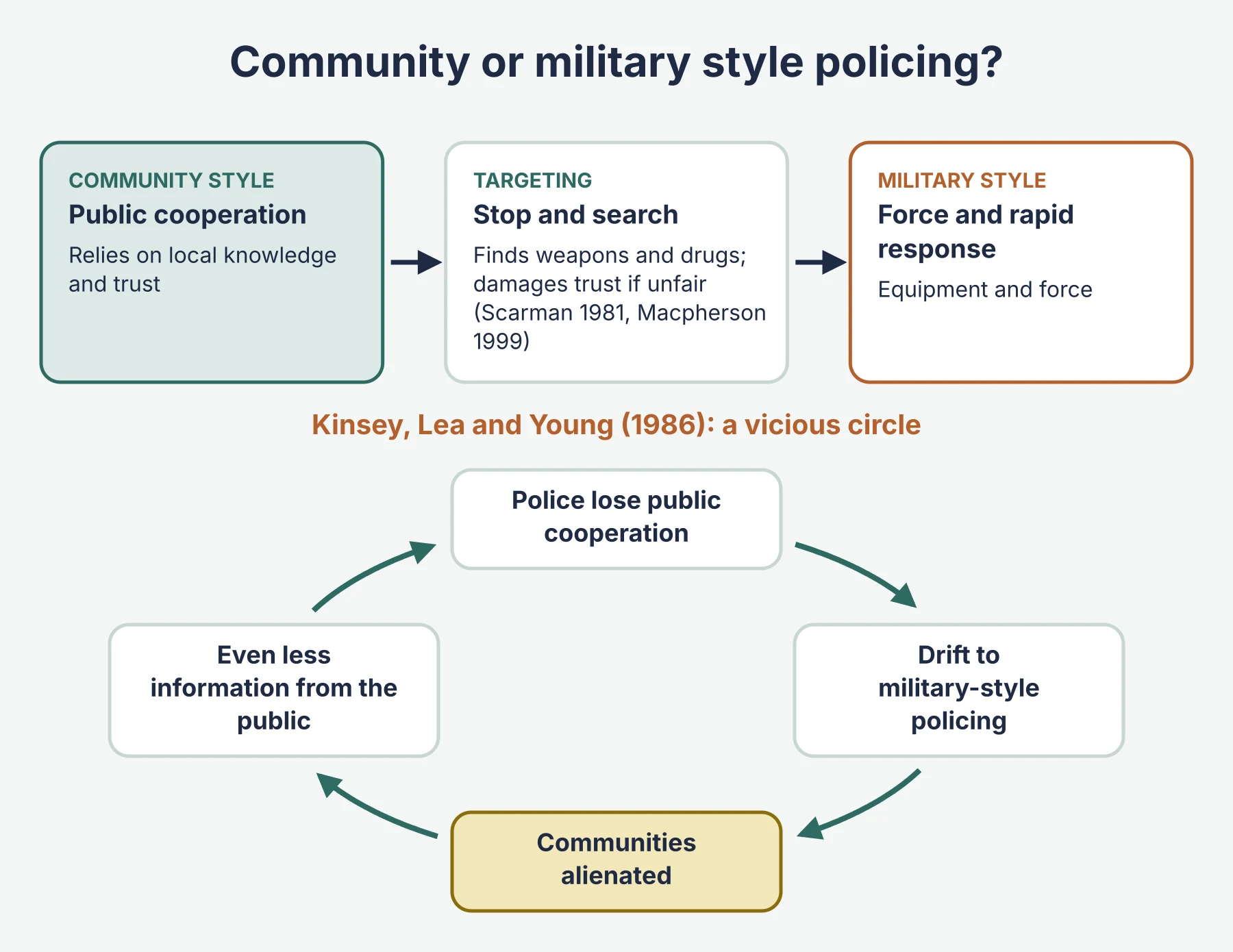
- Targeting / stop and search: finds weapons and drugs; damages trust if unfair (Scarman Report, 1981; Macpherson Report, 1999).
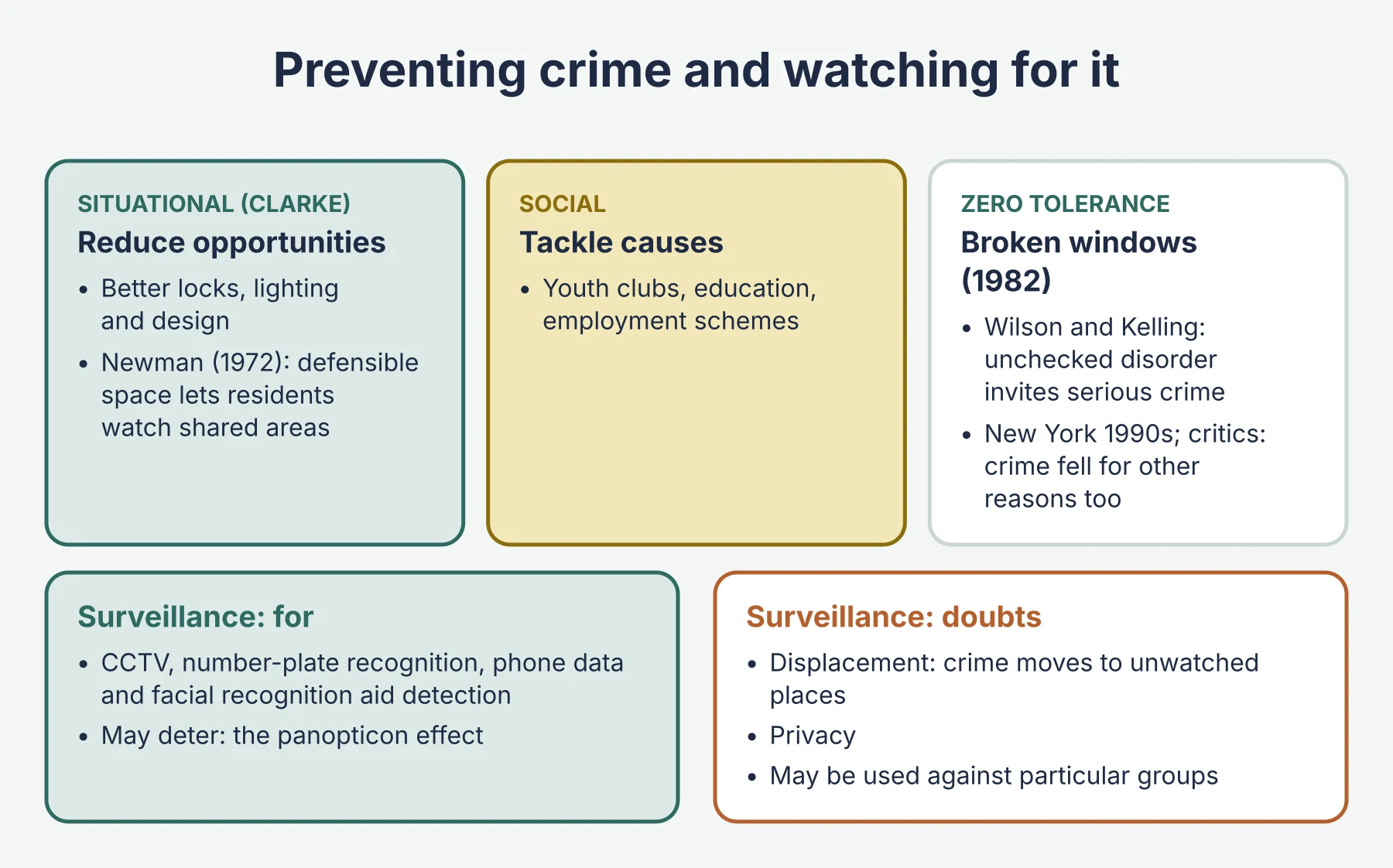
- Zero tolerance: broken windows (1982); linked to 1990s New York; criticised for targeting poorer communities.
- Surveillance: CCTV, number plates, phones, facial recognition; displacement and privacy concerns.
- Crime prevention: situational (locks, lighting, design; defensible space) and social (youth schemes, jobs).
- Community vs military style: Kinsey, Lea and Young (1986): losing public cooperation pushes police towards military style, a vicious circle.
Exam traps
- “Effective” needs an aim: effective at deterring, rehabilitating or protecting?
- Incapacitation is not rehabilitation.
- Deterrence depends more on certainty of being caught than on severity, many criminologists argue.
- A key question on “different societies” rewards comparison.
- Policing strategies affect statistics: link back to 6.2.
Self-test
- Which aim of punishment looks backward?
- Distinguish individual from general deterrence.
- Give two non-custodial sentences.
- Which aim does a restraining order mainly serve?
- Give one criticism of financial penalties.
- What is reintegrative shaming?
- What did Foucault mean by disciplinary power?
- Give one example of a rehabilitative prison.
- What is displacement?
- What is the broken windows theory?
- What is defensible space?
- What vicious circle did Kinsey, Lea and Young describe?
Answers
- Retribution.
- Individual deterrence puts the offender off reoffending; general deterrence puts others off by example.
- Any two: electronic tagging; curfews; restraining orders; community sentences; probation; fines.
- Protection of citizens (by restricting the offender’s contact).
- The same fine hurts poorer people much more than richer people.
- Condemning the act while welcoming the offender back into the community (Braithwaite, 1989).
- Control through surveillance, so that people discipline themselves, rather than through public physical punishment.
- Bastøy or Halden in Norway.
- Crime moving to another place, time or target after a prevention measure.
- Wilson and Kelling (1982): unchecked minor disorder signals no one cares, inviting serious crime.
- Newman’s (1972) idea that design letting residents watch shared areas reduces crime.
- Losing public cooperation leads police towards military-style policing, which alienates people further and reduces cooperation even more.
More resources on this topic
Related resources
-
Study guides
O Level Sociology: Patterns of Crime and How Societies Deal With It (Cambridge 2251)
Cambridge O Level Sociology 2251 key questions 6.2 and 6.3: crime by age, class, gender and ethnicity, five theories, punishment and policing.
Sociology · Cambridge · O Level
Read guide -
Practice questions
O Level Sociology: Patterns of Crime and How Societies Deal With It — Practice Questions (Cambridge 2251)
Original Cambridge O Level Sociology 2251 Crime question practice on gender and ethnic patterns, labelling, punishment, prisons and policing, with answers.
Sociology · Cambridge · O Level
Try questions -
Revision notes
O Level Sociology: Patterns of Crime and How Societies Deal With It — Revision Notes (Cambridge 2251)
Revision notes for Cambridge O Level Sociology 2251 key questions 6.2 and 6.3: who offends and why, Merton, Becker, Box and Katz, punishment aims and policing.
Sociology · Cambridge · O Level
Revise topic
Related articles
Get free revision emails (optional)
Occasional emails with practice questions, worked explanations and links to free resources for the qualification and subjects you choose. No spam, and you can unsubscribe from any email. The free tools on this site never need an email.