
Revision Notes
Cambridge O Level Sociology (2251): Education – What factors help to explain differences in educational achievement and experience? – Revision Notes
Revision notes for Cambridge O Level Sociology 2251 key question 5.3: class, ethnicity, gender and global differences in achievement, with a self-test.
- Subject
- Sociology
- Level
- O LEVELS
- Topic
- Paper 2 – Family, Education and Crime
- Author
- Marlbridge Academic Team
- Updated
- Reviewed by
- Naqiya Yousaf (what this means)
Aligned to Cambridge O Level Sociology (2251), 2025-2027. Official specification .
Syllabus page (what it covers and how it is assessed): Cambridge O Level Sociology.
Syllabus points this page covers
2251
- 5.3 Education – What factors help to explain differences in educational achievement and experience?
Found an error? Report a correction.
Need help with this topic? Request a free trial class for O Level Sociology (2251).
These notes condense key question 5.3 of Cambridge O Level Sociology (2251), What factors help to explain differences in educational achievement and experience? Sort every explanation into one of three boxes: home and community, school or wider society. Then attach one study and one mechanism to each. That structure turns a long list into answers you can build quickly.
Syllabus coverage
- 5.3.1 Patterns by social class, ethnicity, gender and global differences.
- 5.3.2 Class: material, cultural and social factors, cultural capital, home/community, linguistic, compensatory education, in-school factors, selective and private education, labelling, Marxist explanations.
- 5.3.3 Ethnicity: institutional racism, ethnocentric curriculum, role models, linguistic, cultural/material/social, home/community, in-school factors and ethnic sub-cultures, labelling.
- 5.3.4 Gender: gendered socialisation and social control, teacher expectations, cultural and social factors, access, in-school factors and gendered sub-cultures, labelling, feminist explanations.
- 5.3.5 Global: availability of schools, poverty/wealth, girls’ access, class sizes, norms and values, internet and digital resources.
- 5.3.6 Strengths and limitations of all of these explanations.
Key terms
| Term | Meaning |
|---|---|
| Material deprivation | Lack of money and resources needed for education |
| Cultural deprivation | The claim that some groups lack the values, attitudes or language that aid success |
| Cultural capital | Knowledge, tastes and confidence valued by schools (Bourdieu) |
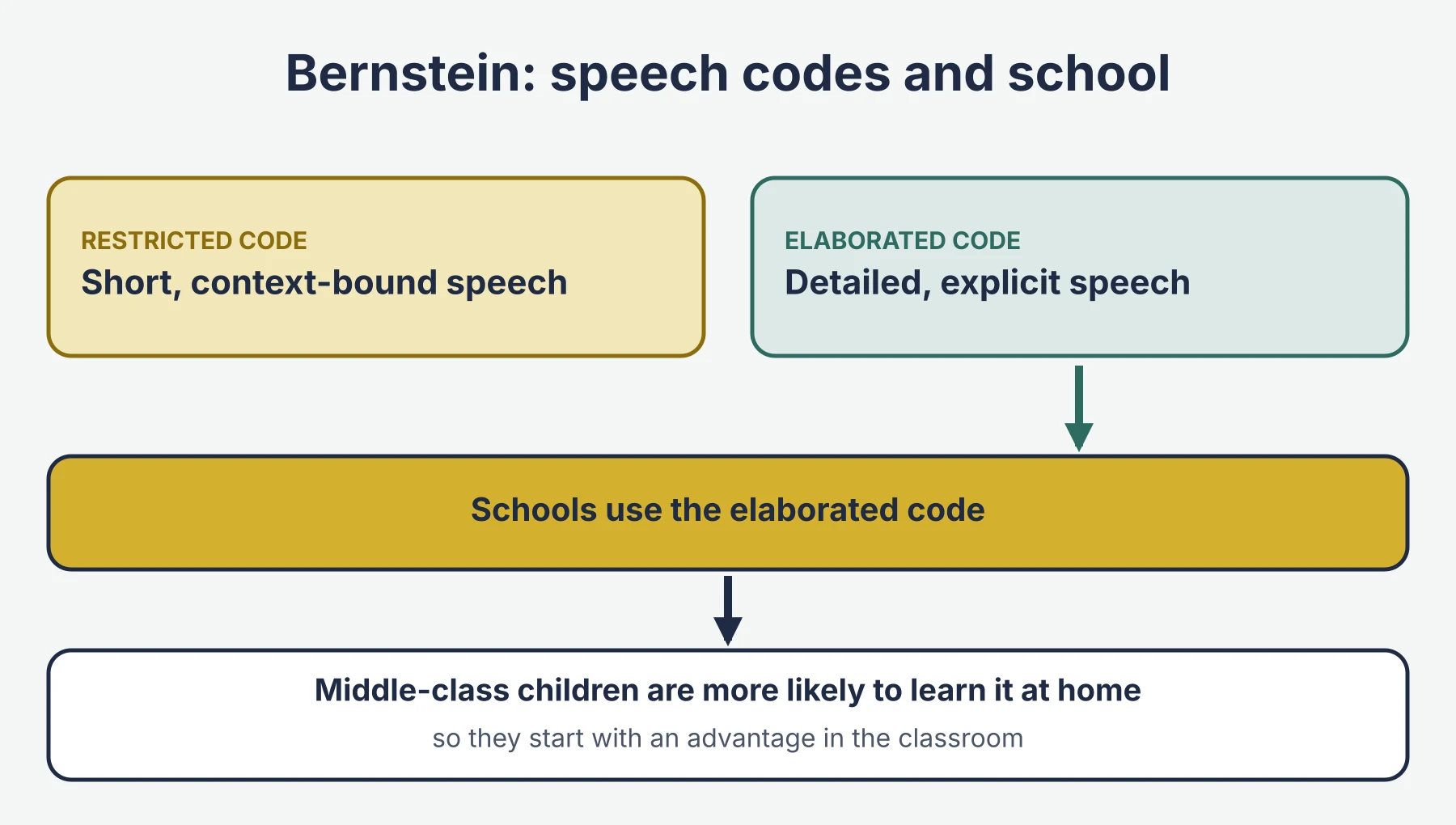
| Restricted code | Short, context-bound speech (Bernstein) |
| Elaborated code | Detailed, explicit speech used in school (Bernstein) |
| Compensatory education | Extra resources to offset disadvantage, e.g. Head Start, Sure Start |
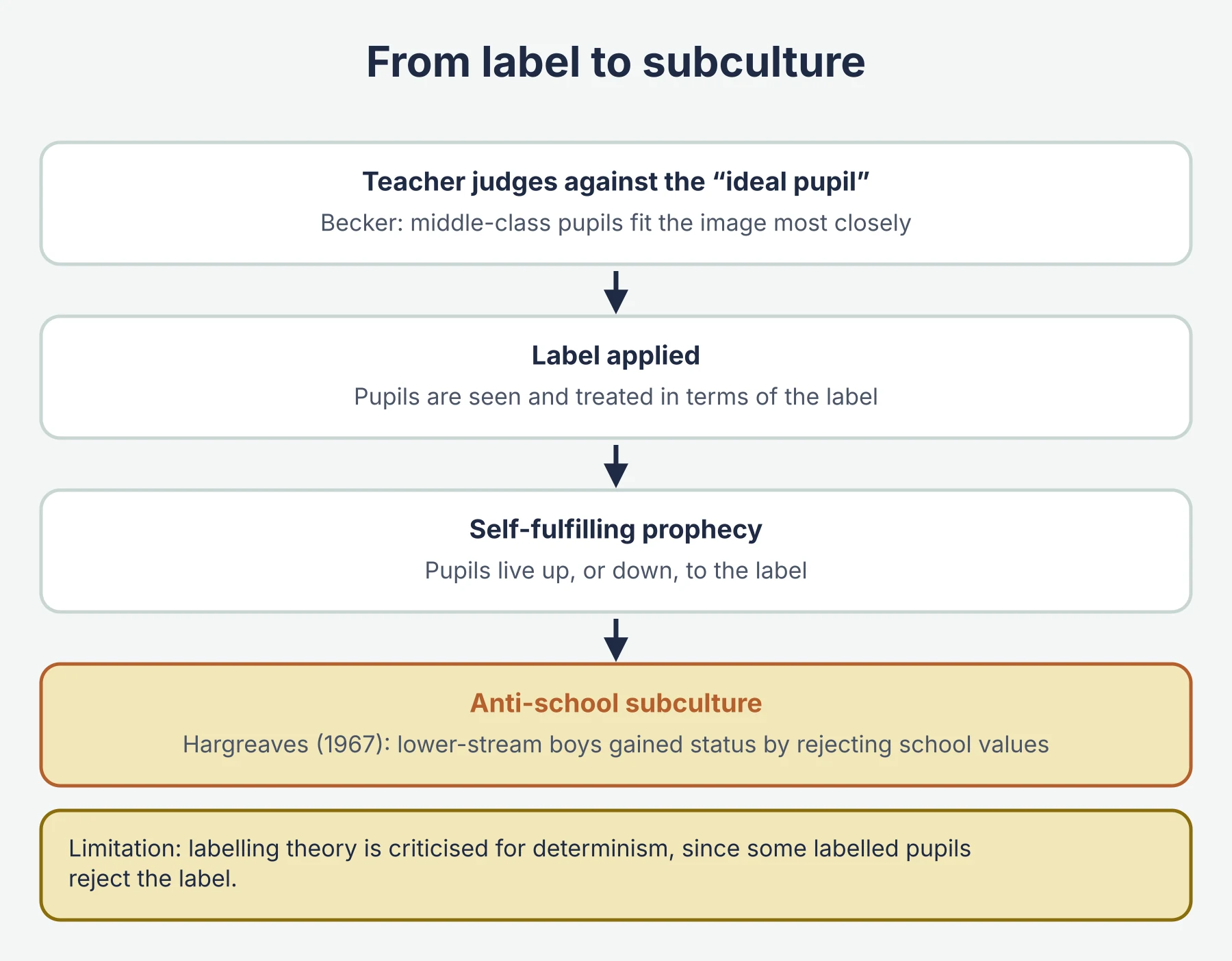
| Ideal pupil | A teacher’s image of the model student (Becker) |
| Self-fulfilling prophecy | A prediction that comes true because people act on it |
| Anti-school subculture | A pupil group that gains status by rejecting school values |
| Institutional racism | Discrimination built into an organisation’s routine policies and practices |
| Ethnocentric curriculum | A curriculum centred on the majority group’s culture and history |
| Educational triage | Gillborn and Youdell: concentrating effort on pupils judged likely to pass |
| Gendered subculture | A pupil group organised around ideas of masculinity or femininity |
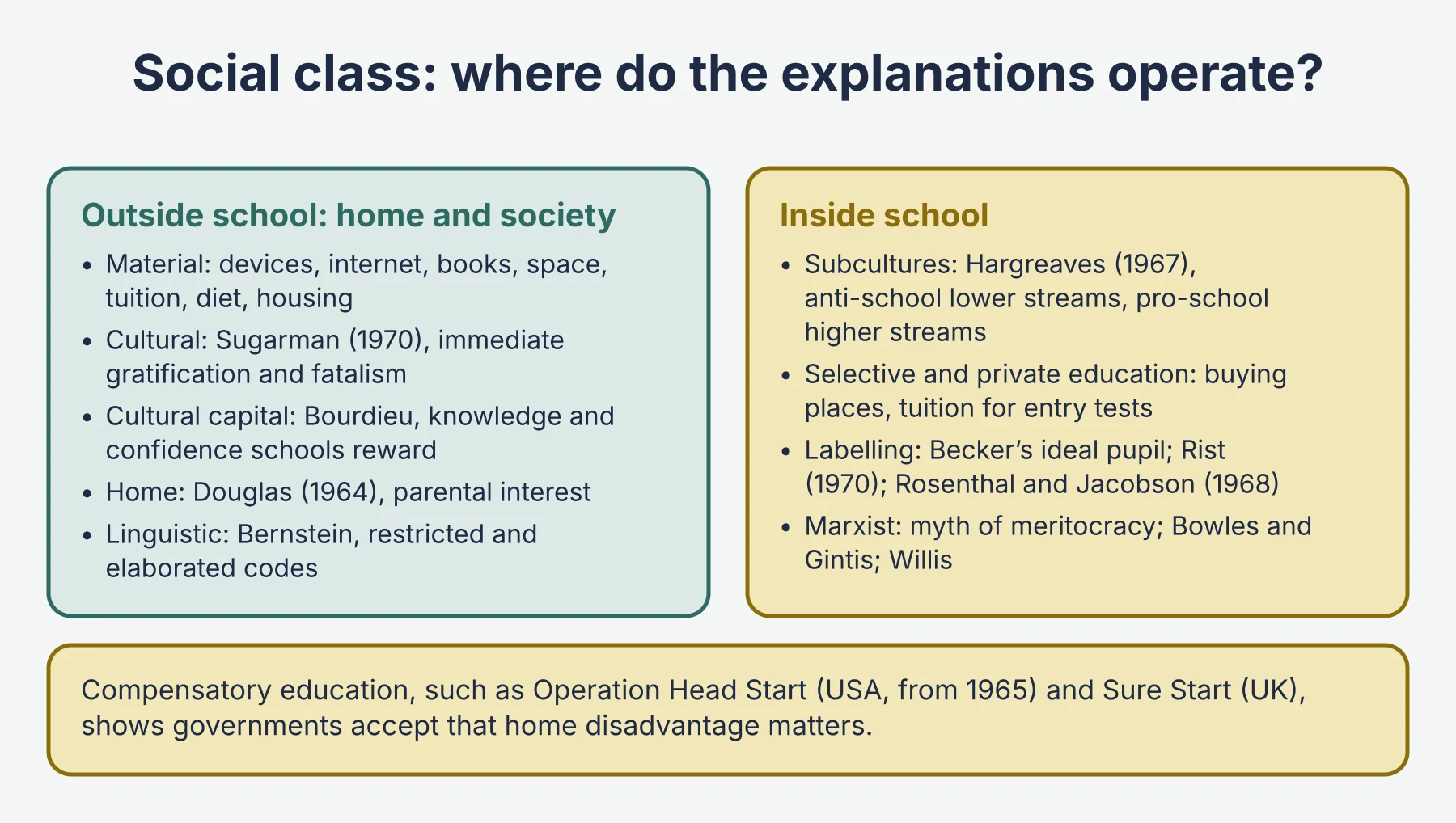
Class: three boxes
- Home and community: material factors (devices, internet, space, diet); Sugarman (1970): immediate gratification and fatalism; Douglas (1964): parental interest; Bernstein: restricted and elaborated codes; Bourdieu: cultural capital.
- School: Becker: ideal pupil; Rist (1970): seating by early judgement; Rosenthal and Jacobson (1968): self-fulfilling prophecy; Hargreaves (1967): anti-school subculture in low streams; selective and private schooling.
- Wider society: Marxist myth of meritocracy; compensatory education as a policy response.
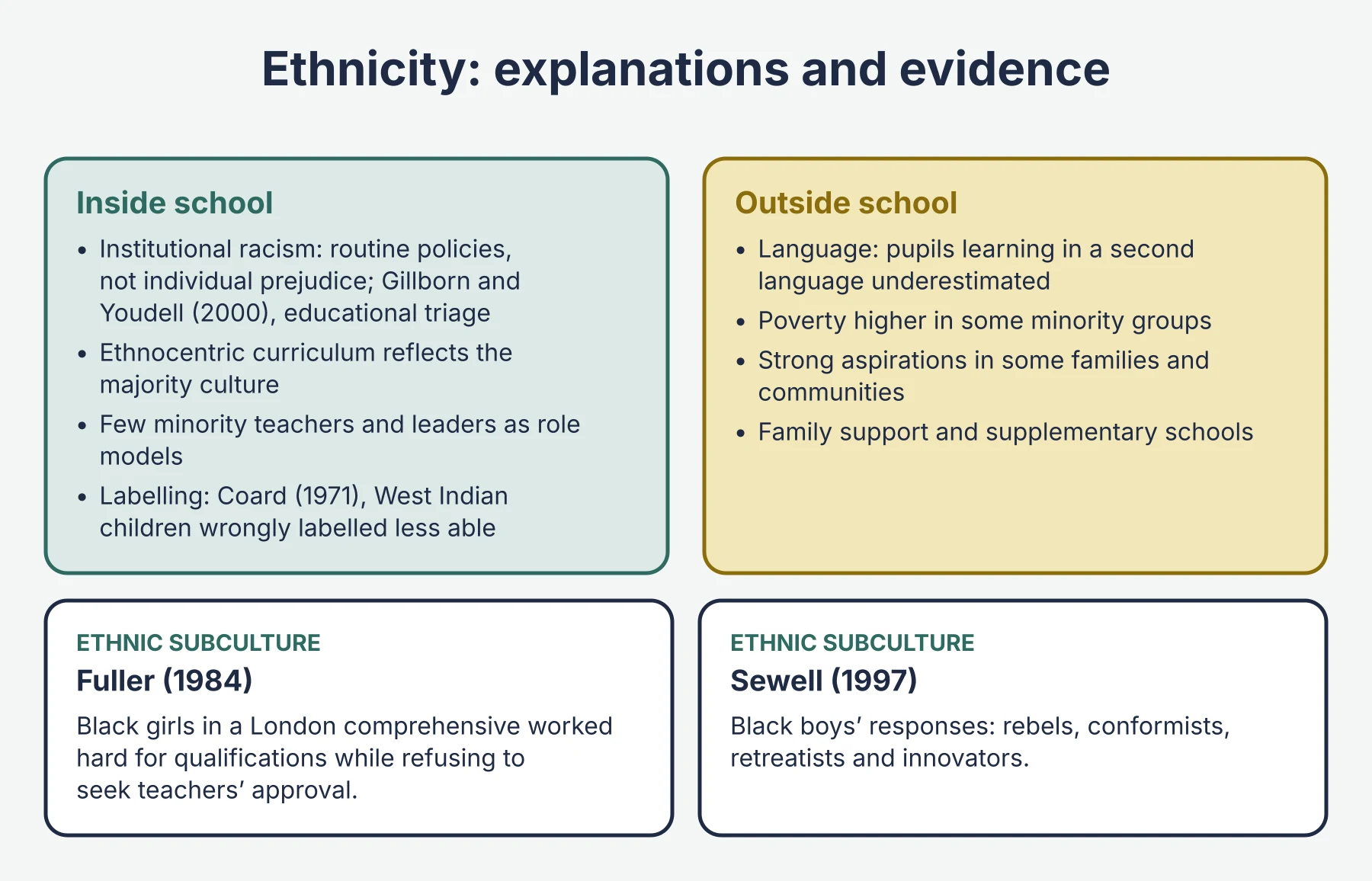
Ethnicity: three boxes
- Home and community: material and social factors; family aspirations and supplementary schools; language spoken at home.
- School: labelling (Coard, 1971); Gillborn and Youdell (2000): educational triage; ethnocentric curriculum; few minority role models; Fuller (1984): Black girls pro-education but not seeking teacher approval; Sewell (1997): rebels, conformists, retreatists, innovators.
- Wider society: institutional racism (term given wide attention by the Macpherson Report, 1999).
Gender: three boxes
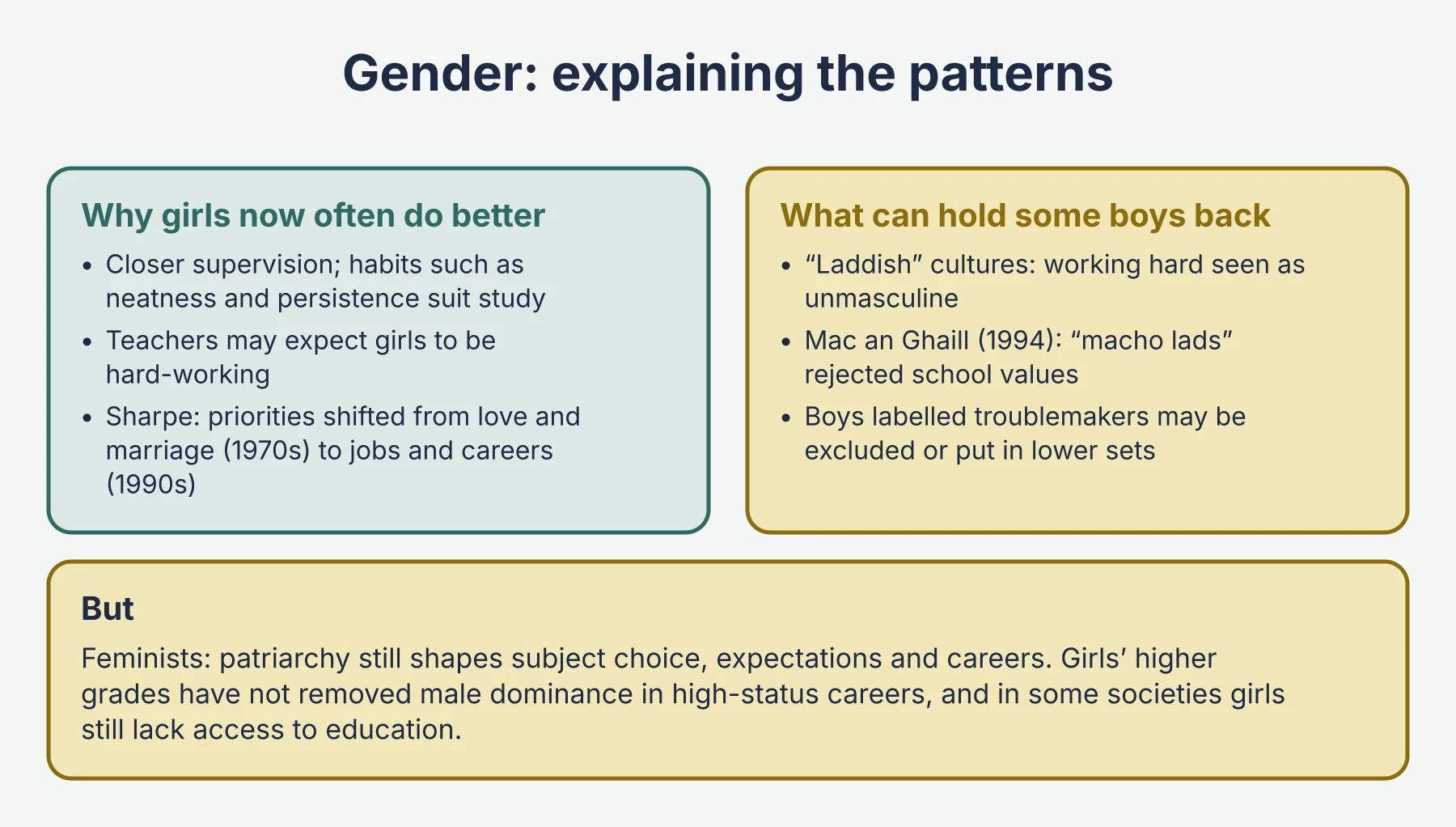
- Home and community: gendered socialisation; closer supervision of girls; Sharpe: girls’ priorities shifted from marriage towards careers between the 1970s and 1990s.
- School: teacher expectations; labelling of boys as troublemakers; laddish subcultures; Mac an Ghaill (1994): macho lads.
- Wider society: changing job opportunities for women; feminist explanations of patriarchy; access barriers for girls in some societies.
Global differences
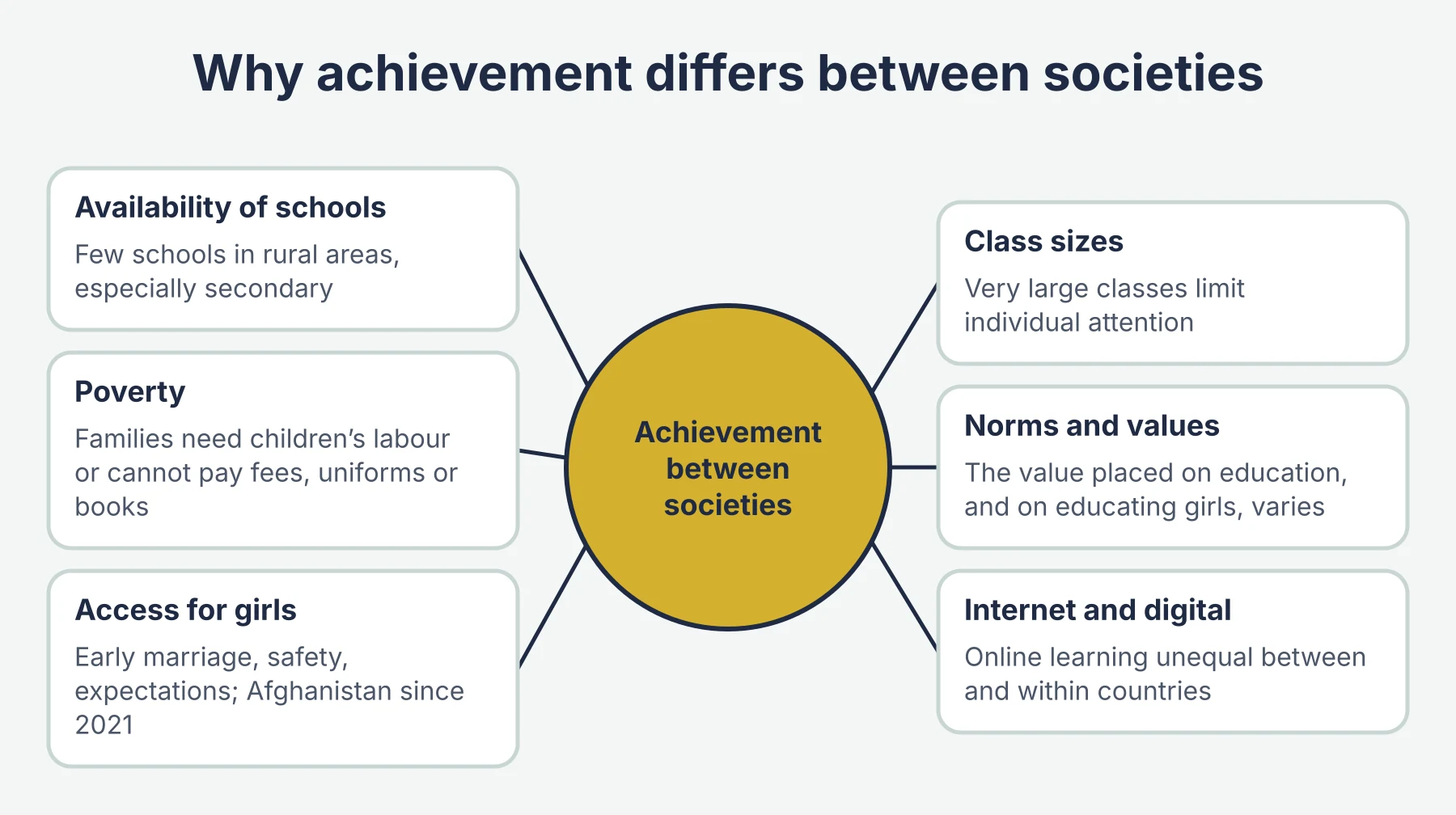
Availability of schools; poverty and child labour; girls’ access (early marriage, safety, law, e.g. restrictions on girls’ secondary schooling in Afghanistan since 2021); class sizes; cultural value placed on education; internet and digital resources.
Strengths and limitations (5.3.6)
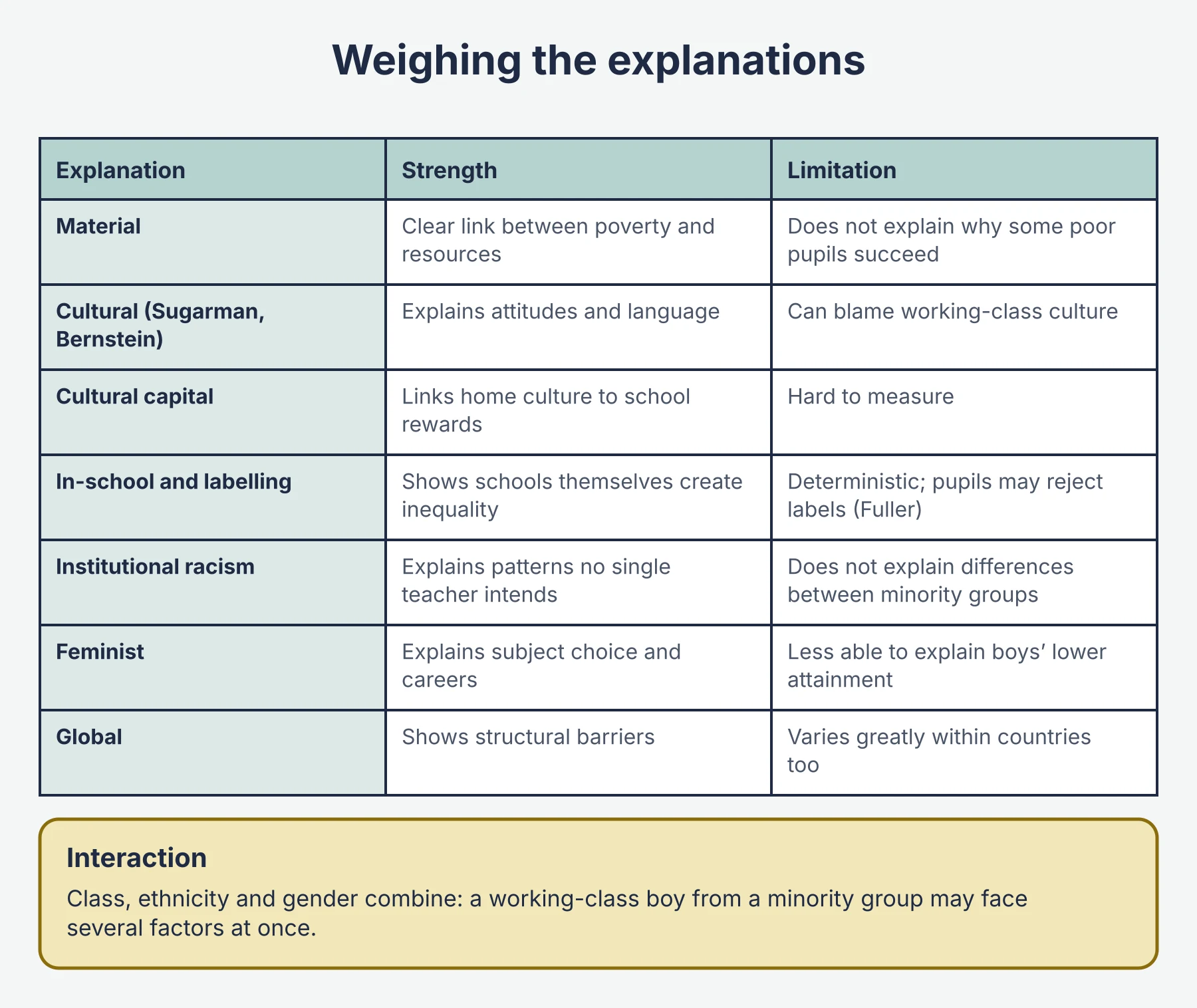
- Material: clear and measurable; but some poor pupils succeed.
- Cultural deprivation: explains attitudes; but blames working-class or minority culture.
- Cultural capital: links home to school rewards; but hard to measure.
- Labelling: shows school’s role; but deterministic, since pupils can reject labels.
- Institutional racism: explains unintended patterns; but cannot explain differences between minority groups.
- Feminist: explains subject choice; but less suited to boys’ lower attainment.
- Global: shows structural barriers; but conditions vary within countries too.
Exam traps
- Material is money and resources; cultural capital is knowledge and tastes. Keep them separate.
- “Ethnic minorities underachieve” is wrong as a generalisation: groups differ.
- Labelling needs a mechanism: label → treatment (set, expectation) → pupil response.
- Experience counts as well as results: exclusions, curriculum, bullying, sets.
- Class, ethnicity and gender interact; show this for higher credit.
Self-test
- Give two material factors that affect achievement.
- What did Sugarman mean by immediate gratification?
- Distinguish Bernstein’s restricted and elaborated codes.
- What did Douglas link achievement to?
- Name one compensatory education programme.
- What is the ideal pupil?
- What did Hargreaves find about lower-stream boys?
- Define institutional racism.
- What is an ethnocentric curriculum?
- What did Fuller find about the Black girls she studied?
- Give two explanations for girls’ improved achievement.
- Give three reasons for global differences in achievement.
Answers
- Any two: lack of devices or internet; no quiet study space; poor diet or housing; cannot afford tuition, books or trips.
- Wanting rewards now rather than saving effort for future rewards, which discourages long study.
- Restricted code is short and context-bound; elaborated code is detailed and explicit, and is the code schools use.
- The level of parental interest in the child’s education.
- Operation Head Start (USA) or Sure Start (UK).
- Teachers’ image of a model student, which middle-class pupils were judged to fit best (Becker).
- Labelled as failures, they formed an anti-school subculture that gave status for breaking rules.
- Discrimination built into the routine policies and practices of an organisation rather than individual prejudice.
- A curriculum centred on the culture and history of the majority group.
- They worked hard for qualifications but refused to seek teachers’ approval.
- Any two: changing job opportunities for women; changing ambitions (Sharpe); equal-opportunity policies; girls’ socialisation into study habits.
- Any three: availability of schools; poverty; girls’ access; class sizes; cultural values; internet and digital access.
More resources on this topic
Related resources
-
Study guides
Cambridge O Level Sociology (2251): Crime, deviance and social control – What are crime, deviance and social control?
Cambridge O Level Sociology 2251 key question 6.1 in depth: crime and deviance, relativity, formal and informal control, types of crime and measuring crime.
Sociology · Cambridge · O Level
Read guide -
Practice questions
Cambridge O Level Sociology (2251): Crime, deviance and social control – What are crime, deviance and social control? – Practice Questions
Original Cambridge O Level Sociology 2251 Crime practice on crime and deviance, social control, types of crime and measuring crime, with full answers.
Sociology · Cambridge · O Level
Try questions -
Revision notes
Cambridge O Level Sociology (2251): Crime, deviance and social control – What are crime, deviance and social control? – Revision Notes
Revision notes for Cambridge O Level Sociology 2251 key question 6.1: crime, deviance, social control, crime types and measuring crime, with a self-test.
Sociology · Cambridge · O Level
Revise topic
Related articles
Get free revision emails (optional)
Occasional emails with practice questions, worked explanations and links to free resources for the qualification and subjects you choose. No spam, and you can unsubscribe from any email. The free tools on this site never need an email.