
Revision Notes
Cambridge O Level Sociology (2251): Family – What are the different types of families? – Revision Notes
Revision notes for Cambridge O Level Sociology 2251 key question 4.1: family structures, diversity, alternatives and marriage types, with a self-test.
- Subject
- Sociology
- Level
- O LEVELS
- Topic
- Paper 2 – Family, Education and Crime
- Author
- Marlbridge Academic Team
- Updated
- Reviewed by
- Naqiya Yousaf (what this means)
Aligned to Cambridge O Level Sociology (2251), 2025-2027. Official specification .
Syllabus page (what it covers and how it is assessed): Cambridge O Level Sociology.
Syllabus points this page covers
2251
- 4.1 Family – What are the different types of families?
Found an error? Report a correction.
Need help with this topic? Request a free trial class for O Level Sociology (2251).
These notes condense key question 4.1 of Cambridge O Level Sociology (2251), What are the different types of families? The key question has five parts: family structures, variation and diversity, sociological views on diversity, alternatives to the family, and types of marriage. Learn the terms precisely first, then one argument and one piece of evidence for each side of the diversity debate.
Syllabus coverage
- 4.1.1 Nuclear; extended (modified, horizontal, vertical/beanpole); reconstituted; lone parent; empty nest; childless; strengths and limitations of each.
- 4.1.2 Variation by culture, social class and ethnicity.
- 4.1.3 New Right views on diversity and dysfunctional families; postmodernist views on the positive aspects of diversity; the extent of diversity and the dominance of the nuclear family.
- 4.1.4 Single person households; shared households; friends as family.
- 4.1.5 Arranged, empty shell and love marriage; monogamy; serial monogamy.
Polygamous and same-sex families may be taught where locally appropriate, but are not assessed.
Key terms
| Term | Precise meaning |
|---|---|
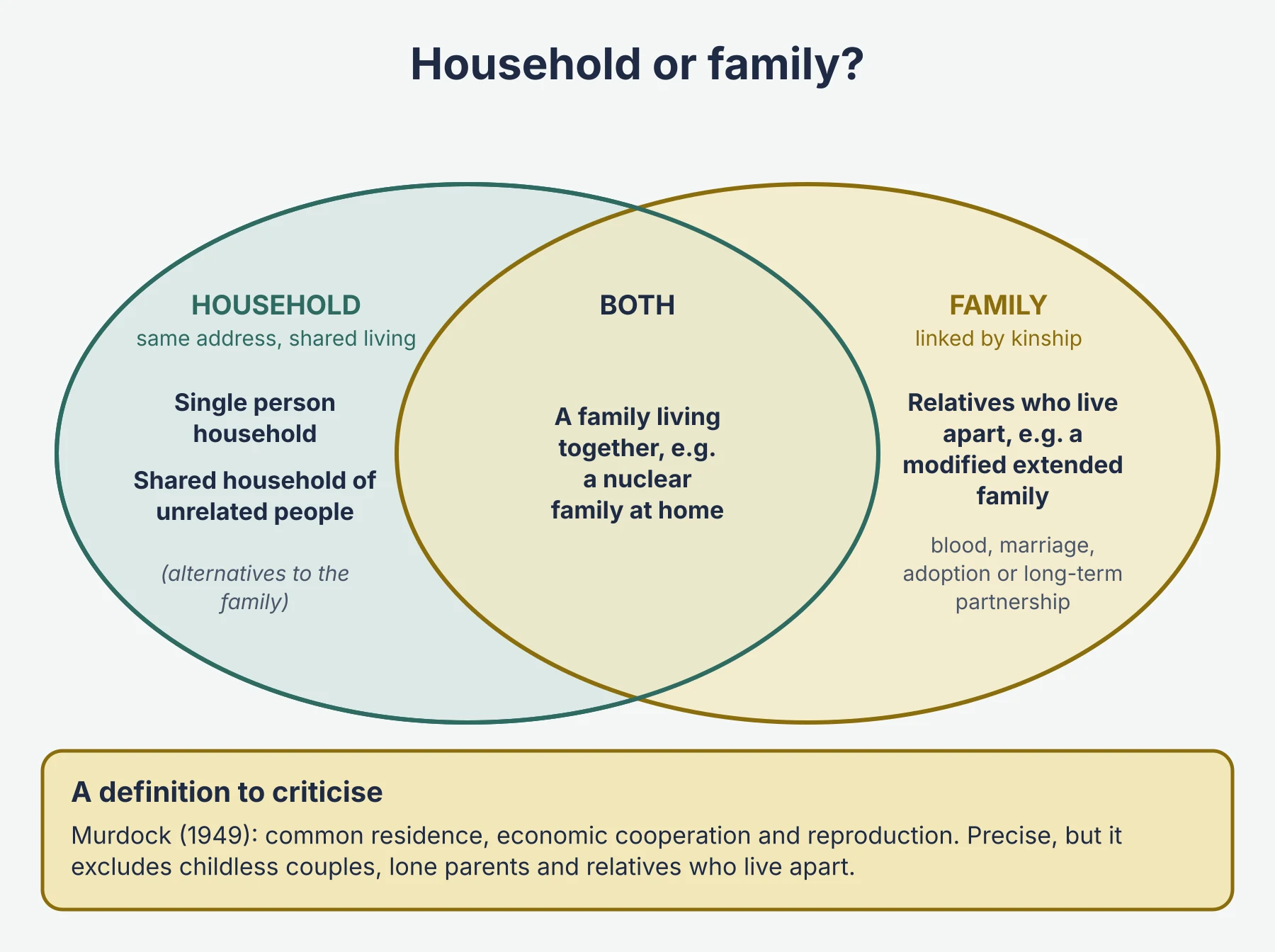
| Household | One person, or a group at one address sharing living arrangements; need not be related |
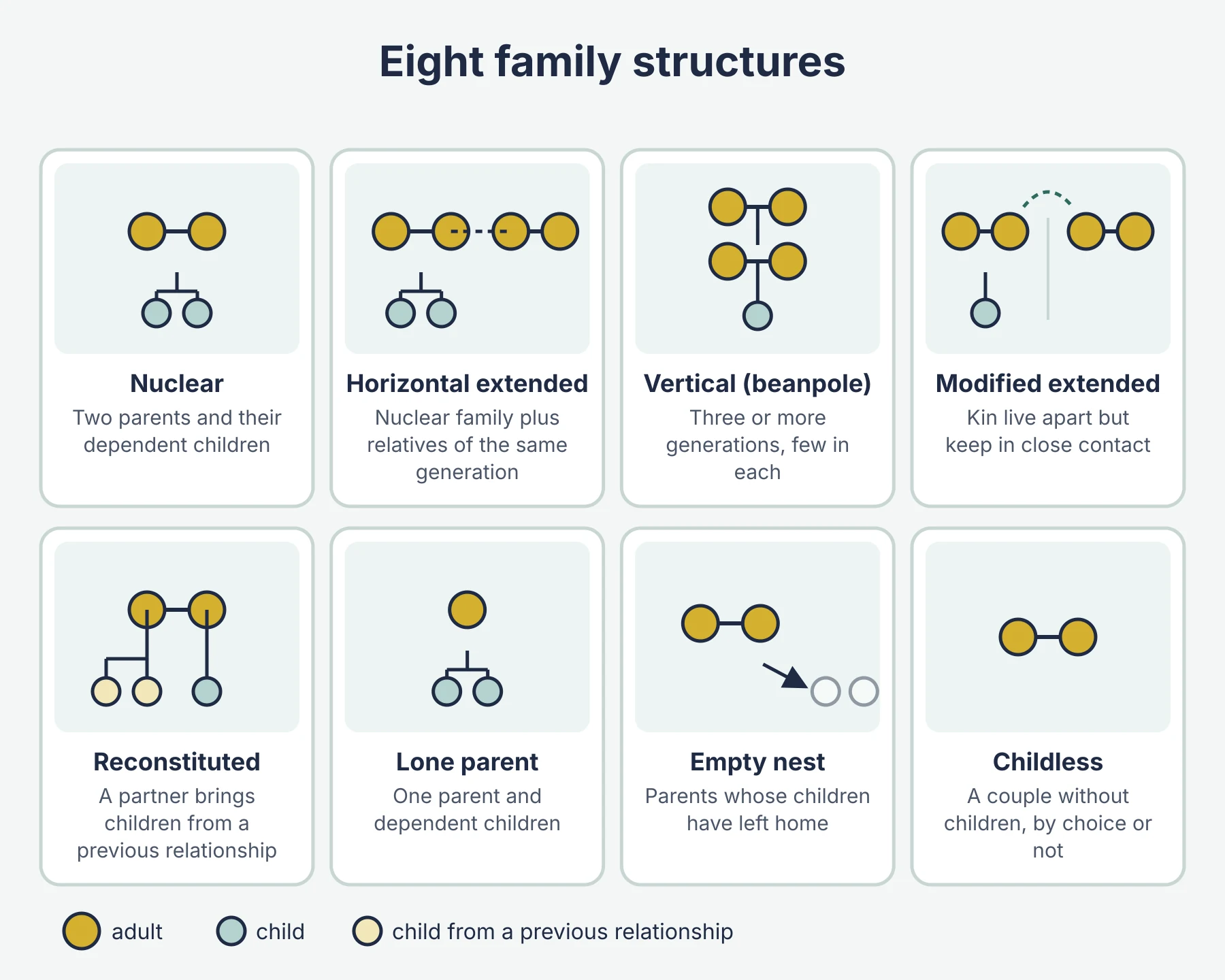
| Nuclear family | Two adults (usually parents) and their dependent children in one household |
| Horizontal extended family | Extended by relatives of the same generation, such as brothers and their wives |
| Vertical / beanpole family | Several generations alive, with few members in each generation |
| Modified extended family | Relatives live apart but keep regular contact and support |
| Reconstituted family | At least one adult brings children from a previous relationship |
| Lone-parent family | One parent living with dependent children |
| Empty nest family | A couple whose children have left home |
| Childless family | A couple without children, by choice or not |
| Dysfunctional family | New Right term for a family that fails to socialise children properly |
| Family diversity | The range of different family types and arrangements in a society |
| Friends as family | Friends providing the support and care once expected from kin |
| Arranged marriage | Families select or introduce partners; the couple consents |
| Empty shell marriage | A marriage that continues legally without love or intimacy |
| Serial monogamy | A sequence of monogamous marriages, one after another |
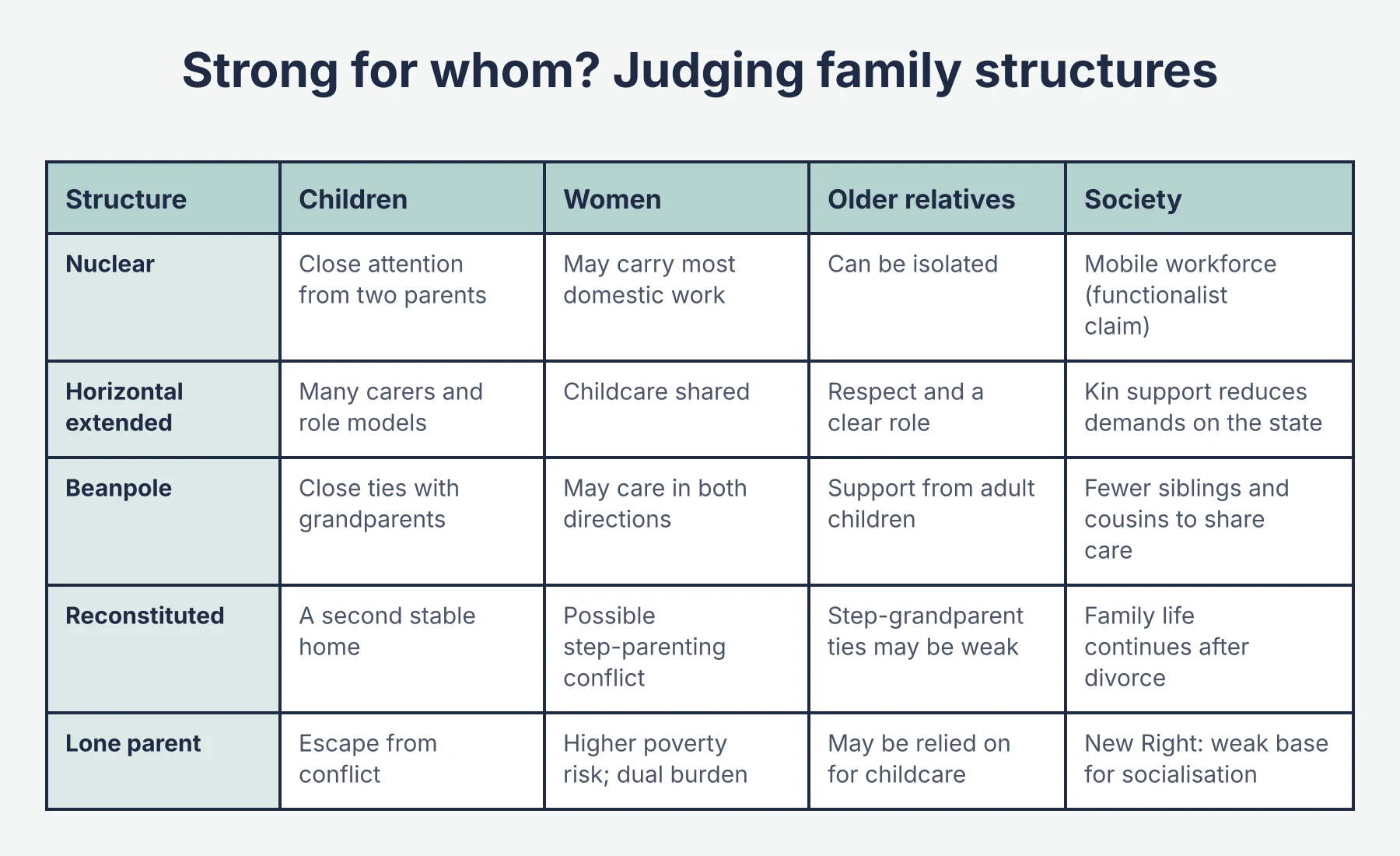
Structures: one strength, one limitation, and who it affects
- Nuclear: geographically mobile and private; but isolated from kin, and the burden of care falls on one or two adults.
- Extended (horizontal): pooled income and childcare; but less privacy and possible conflict over authority.
- Beanpole: grandparents help with childcare; but the middle generation may care for children and elderly parents at once.
- Modified extended: support without crowding; but depends on transport, phones and money.
- Reconstituted: a second chance of a stable home; but step-parent and loyalty tensions.
- Lone parent: escape from conflict; but higher risk of poverty and time pressure.
- Empty nest: freedom for the couple; but loss of the parenting role.
- Childless: time and resources; but stigma in societies that expect parenthood.
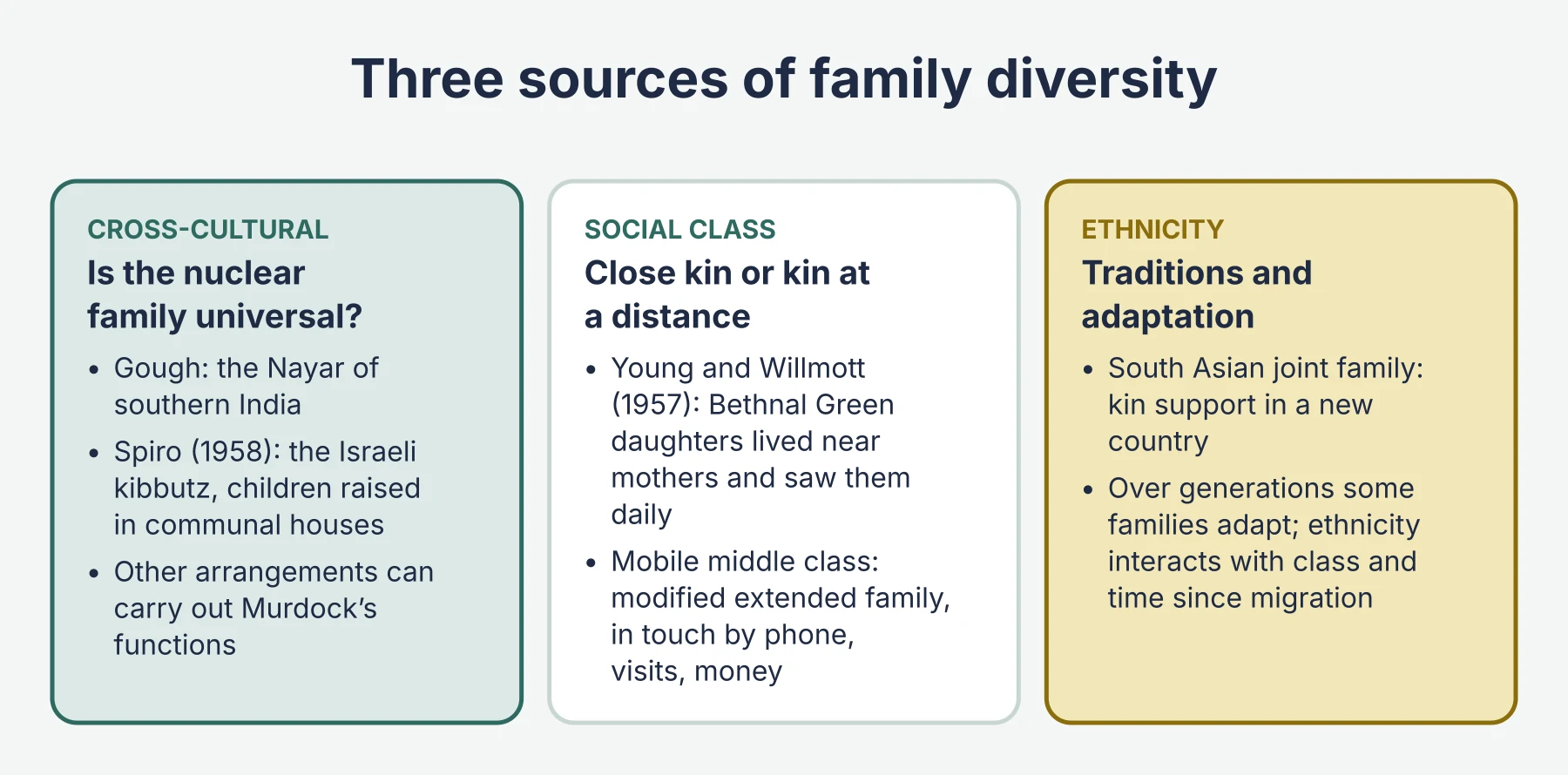
Diversity in three dimensions (4.1.2)
- Cross-cultural: Gough’s study of the Nayar and Spiro’s study of the kibbutz (1958) show children raised without the nuclear unit, challenging Murdock’s (1949) claim that the nuclear family is universal.
- Social class: Young and Willmott’s Bethnal Green study (1957) found close, local working-class kin networks; middle-class mobility makes modified extended families more likely.
- Ethnicity: some migrant families keep extended or joint-family traditions for support; patterns change across generations.
The diversity debate (4.1.3) at a glance
| New Right | Postmodernist | |
|---|---|---|
| Is diversity good? | No: a sign of decline | Yes: a sign of choice |
| Best family? | Married two-parent nuclear family | No single best type |
| Key name | Charles Murray | Judith Stacey |
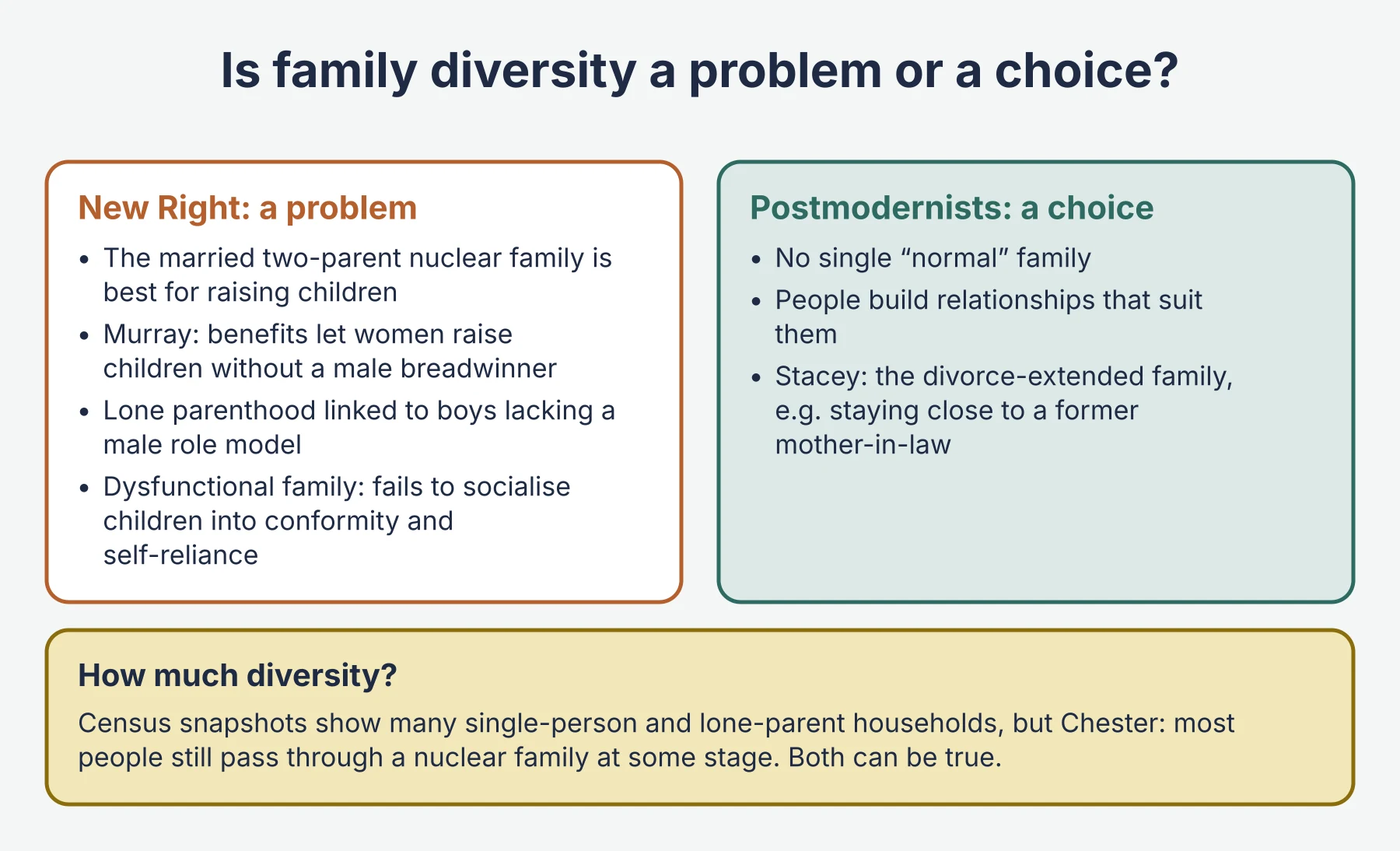
| Key idea | Lone parenthood and welfare dependency produce poorly socialised children | Divorce-extended families; people build families to suit their lives |
| Criticism | Blames individuals; ignores poverty as a cause of poor outcomes | Overstates choice; poverty and law limit options |
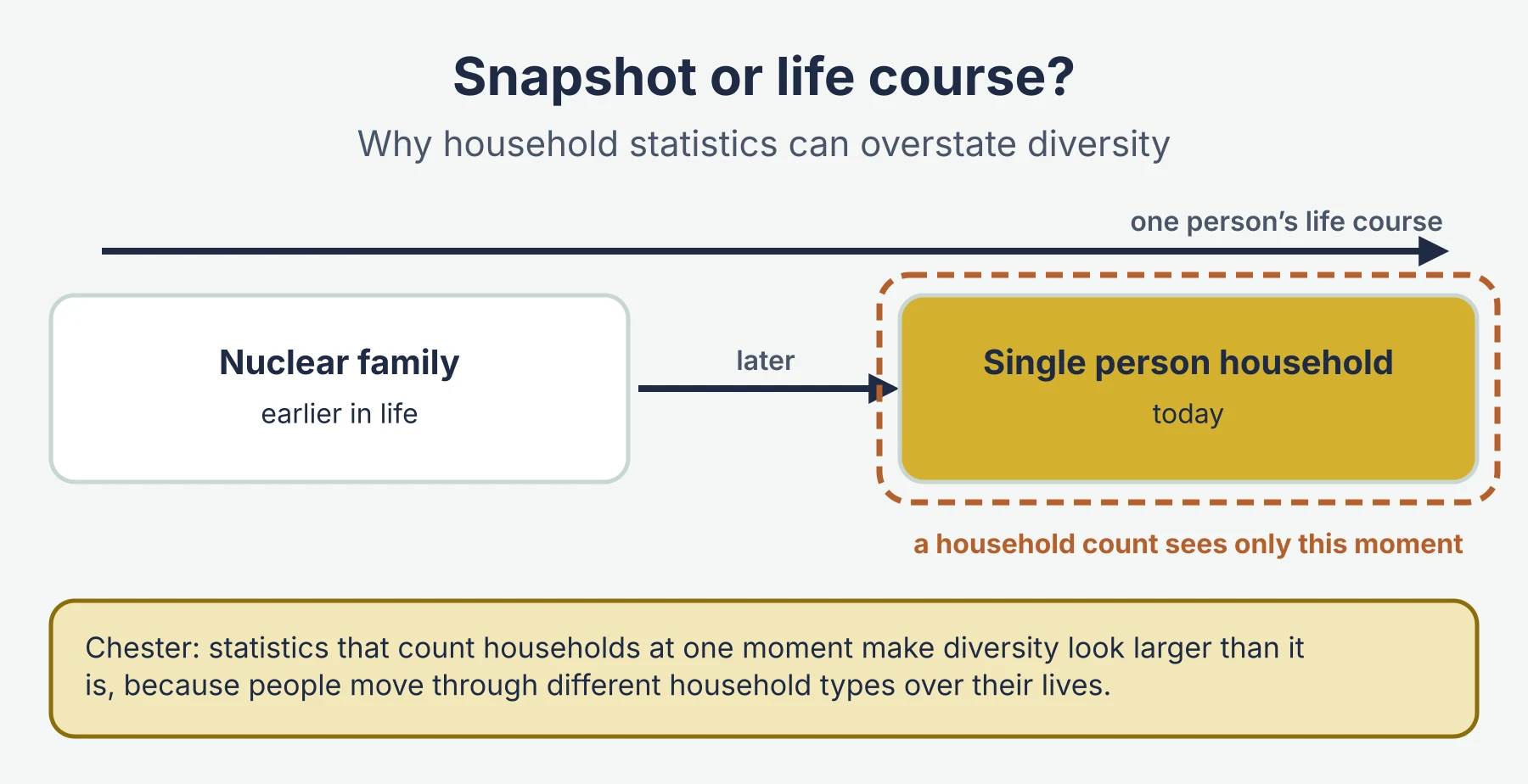
Extent of diversity: household snapshots show many non-nuclear households, but Chester (1985) argued most people live in a nuclear family at some point in their life course.
Alternatives and marriage types (4.1.4 and 4.1.5)
- Single person households: older widowed people, young professionals, people after divorce.
- Shared households: unrelated adults sharing costs and company.
- Friends as family: chosen support networks; fewer legal obligations than kinship.
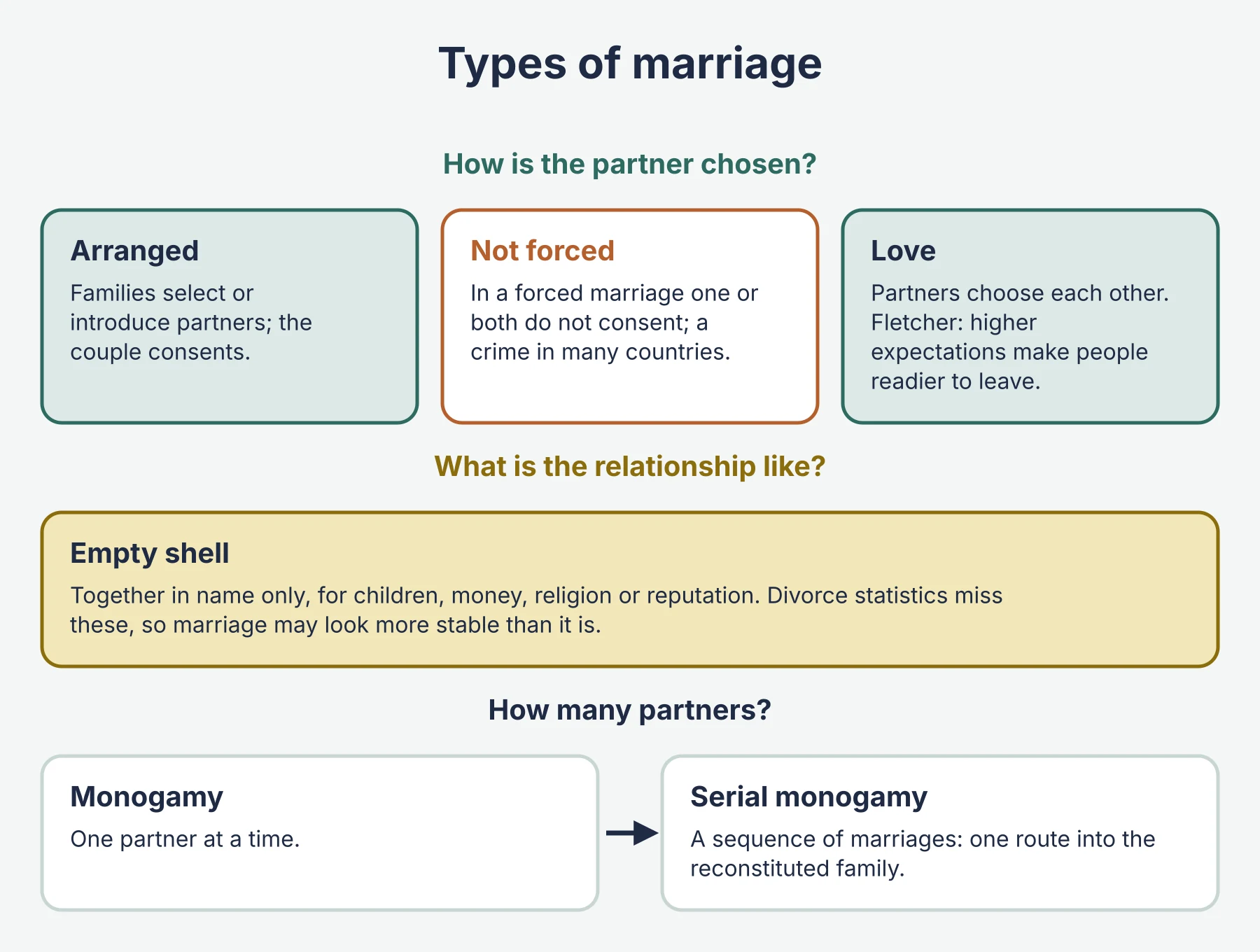
- Arranged marriage requires consent; forced marriage does not and is illegal in many countries.
- Love marriage rests on romantic choice; Fletcher argued higher expectations make couples more willing to divorce when a marriage fails.
- Empty shell marriages hide marital breakdown from divorce statistics.
- Serial monogamy links divorce and remarriage to the growth of reconstituted families.
Exam traps
- A single person household is an alternative to the family, not a family type.
- Beanpole means tall and thin: more generations, fewer people per generation.
- Do not write that the New Right “describe” diversity; they oppose it. Postmodernists welcome it.
- “Step-family” is a synonym for reconstituted family, not a definition.
- An answer on strengths and limitations should say for whom: children, women, older relatives or society.
- Avoid moral language (“broken homes”) unless you are reporting the New Right view.
Self-test
- What is the difference between a family and a household?
- Define a beanpole family.
- Name the three dimensions of variation listed in 4.1.2.
- Which sociologist claimed the nuclear family is universal?
- Give one piece of cross-cultural evidence against that claim.
- What do the New Right mean by a dysfunctional family?
- What is a divorce-extended family, and who described it?
- How does the life-course argument support the dominance of the nuclear family?
- Give two groups who often live in single person households.
- Distinguish arranged marriage from forced marriage.
- Why might empty shell marriages make marriage look more stable than it is?
- How does serial monogamy relate to reconstituted families?
Answers
- A family is linked by kinship; a household is people living at one address, related or not.
- A family with several generations alive at once but few members in each generation.
- Cross-cultural, social class and ethnicity.
- George Murdock (1949).
- The Israeli kibbutz, where children were raised in communal children’s houses (Spiro, 1958), or the Nayar of southern India (Gough).
- A family that fails to socialise children into conformity and self-reliance, often linked by the New Right to lone parenthood.
- A family network kept together by ties formed through former marriages, such as former in-laws; Judith Stacey.
- A snapshot shows many people outside nuclear families, but most people live in one at some stage of their life, such as in childhood or as a parent (Chester).
- Any two: older widowed people; young adults establishing careers; people after divorce or separation.
- In arranged marriage families choose or introduce partners but the couple consents; in forced marriage at least one partner does not consent.
- They are still counted as marriages, so marital breakdown that does not end in divorce is hidden.
- People who divorce and remarry often bring children from earlier relationships, creating reconstituted families.
Frequently asked questions
Do I need to learn polygamous and same-sex families? They are not assessed, but you may use them to support an answer where relevant and where they are taught locally.
Which family structures are most likely to appear in definition questions? Any of the 4.1.1 list can be asked, so learn a one-sentence definition for each.
More resources on this topic
Related resources
-
Study guides
Cambridge O Level Sociology (2251): Family – What is the role of the family for the individual and society?
Cambridge O Level Sociology 2251 key question 4.2 in depth: functionalist, Marxist and feminist views of the family, their limits and its dark side.
Sociology · Cambridge · O Level
Read guide -
Practice questions
Cambridge O Level Sociology (2251): Family – What is the role of the family for the individual and society? – Practice Questions
Original Cambridge O Level Sociology 2251 Family practice on functionalist, Marxist and feminist views of the family's role, with mark-scheme answers.
Sociology · Cambridge · O Level
Try questions -
Revision notes
Cambridge O Level Sociology (2251): Family – What is the role of the family for the individual and society? – Revision Notes
Revision notes for Cambridge O Level Sociology 2251 key question 4.2: functionalist, Marxist and feminist views of the family, with traps and a self-test.
Sociology · Cambridge · O Level
Revise topic
Related articles
Get free revision emails (optional)
Occasional emails with practice questions, worked explanations and links to free resources for the qualification and subjects you choose. No spam, and you can unsubscribe from any email. The free tools on this site never need an email.