
Revision Notes
Cambridge O Level Second Language Urdu (3248): Exercise 4 Translation into Urdu – Revision Notes
Condensed notes for 3248 Paper 2 Exercise 4 translation: task facts, English-to-Urdu tense map, word order, articles, gender, idioms, traps and a self-test.
- Subject
- Urdu Language
- Level
- O LEVELS
- Topic
- Paper 2 – Grammar, Writing and Translation
- Author
- Marlbridge Academic Team
- Updated
- Reviewed by
- Farheen Zehra (what this means)
Aligned to Cambridge O Level Urdu Language (3248), 2027-2029. Official specification .
Syllabus page (what it covers and how it is assessed): Cambridge O Level Urdu Language.
Found an error? Report a correction.
Need help with this topic? Request a free trial class for O Level Urdu Language (3247 / 3248).
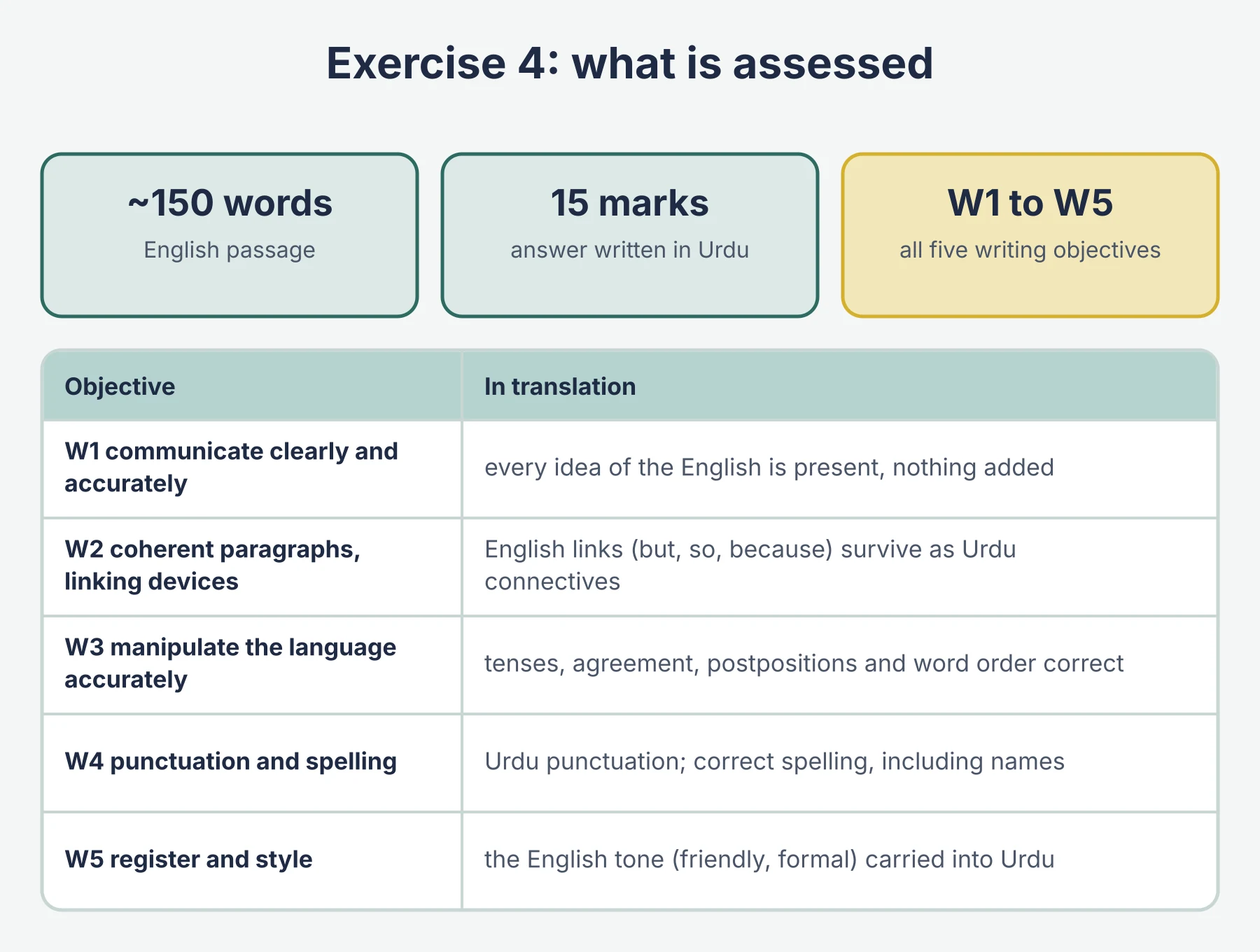
These notes cover Exercise 4, Translation, of 3248 Paper 2: “candidates translate a short passage of approximately 150 words from English into Urdu”. The paper overview is in the Paper 2 Grammar, Writing and Translation study guide; the full method and an annotated translation are in the Exercise 4 Translation study guide.
Task facts
- 15 marks, the second-largest tariff on Paper 2 (Exercise 3 extended writing has 20).
- About 150 words of English, translated into Urdu.
- Question in English, answer in Urdu; no dictionaries.
- Objectives W1–W5.
The objectives in one line each
- W1: all of the meaning, nothing added.
- W2: links kept (but → لیکن، so → اس لیے).
- W3: accurate grammar: tense, agreement, postpositions, word order.
- W4: Urdu punctuation and spelling.
- W5: the tone and register of the original.
Word order
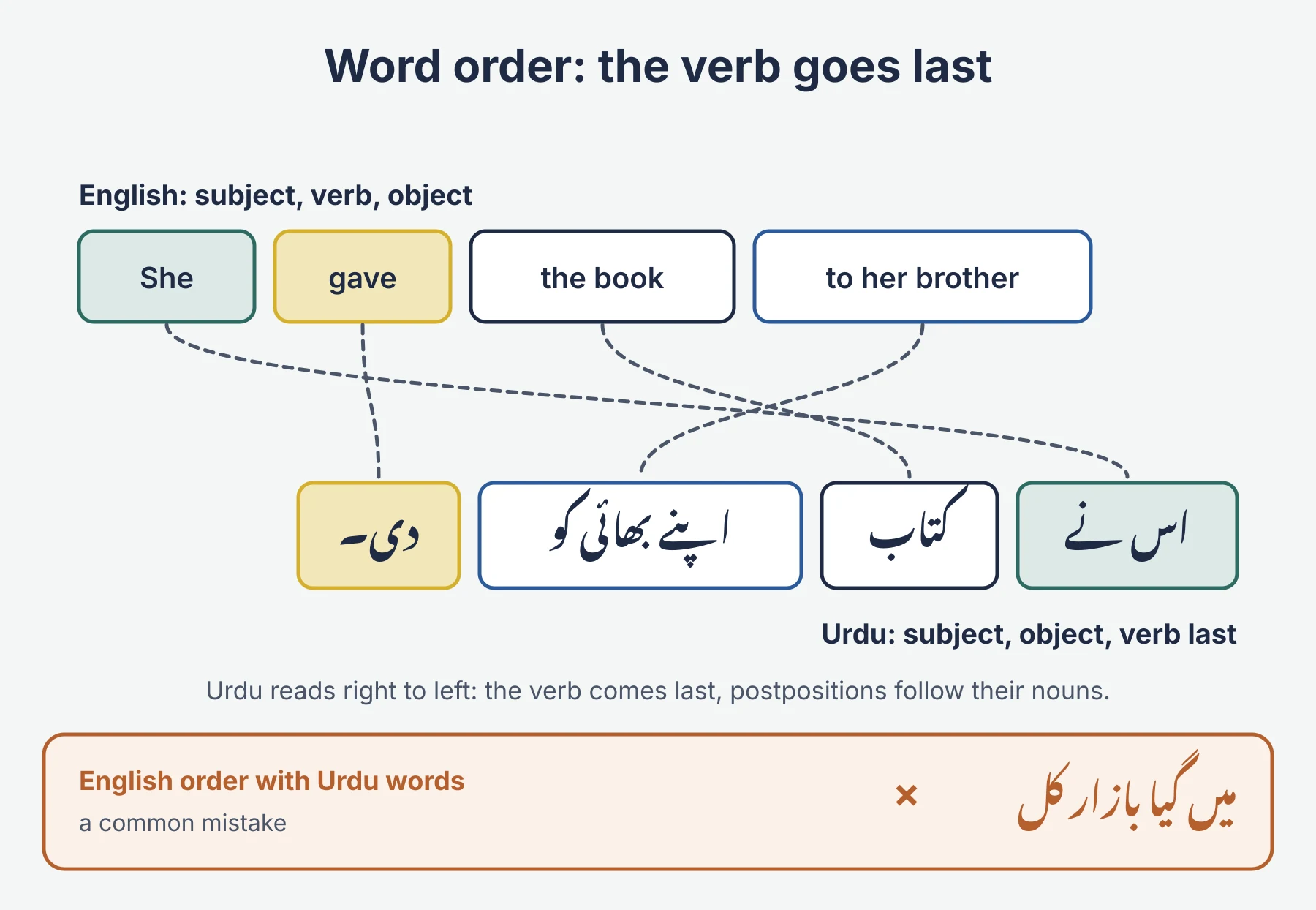
English S V O → Urdu S O V. Postpositions follow nouns. Time and place usually come early: We met him at the station yesterday → ہم کل اسٹیشن پر اس سے ملے۔
Tense map
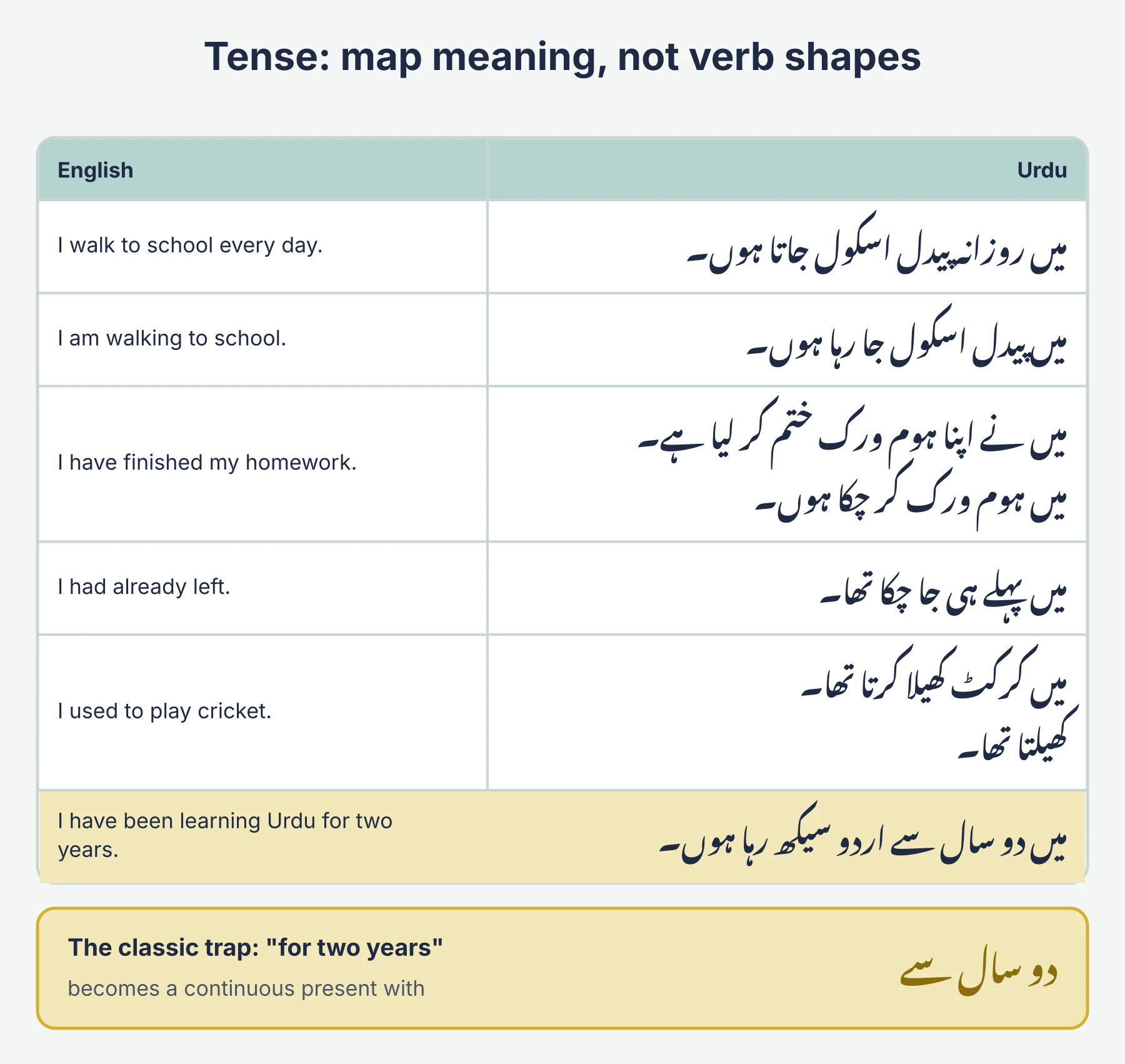
| English | Urdu pattern |
|---|---|
| present simple (habit) | کرتا ہے |
| present continuous | کر رہا ہے |
| past simple | کیا / گیا |
| past continuous | کر رہا تھا |
| present perfect | کر چکا ہے / کر لیا ہے |
| past perfect | کر چکا تھا |
| used to | کیا کرتا تھا / کرتا تھا |
| for + period (still true) | … سے کر رہا ہے |
| future | کرے گا |
| would (conditional) | کرتا / کرے گا (with اگر … تو) |
Articles
| English | Urdu |
|---|---|
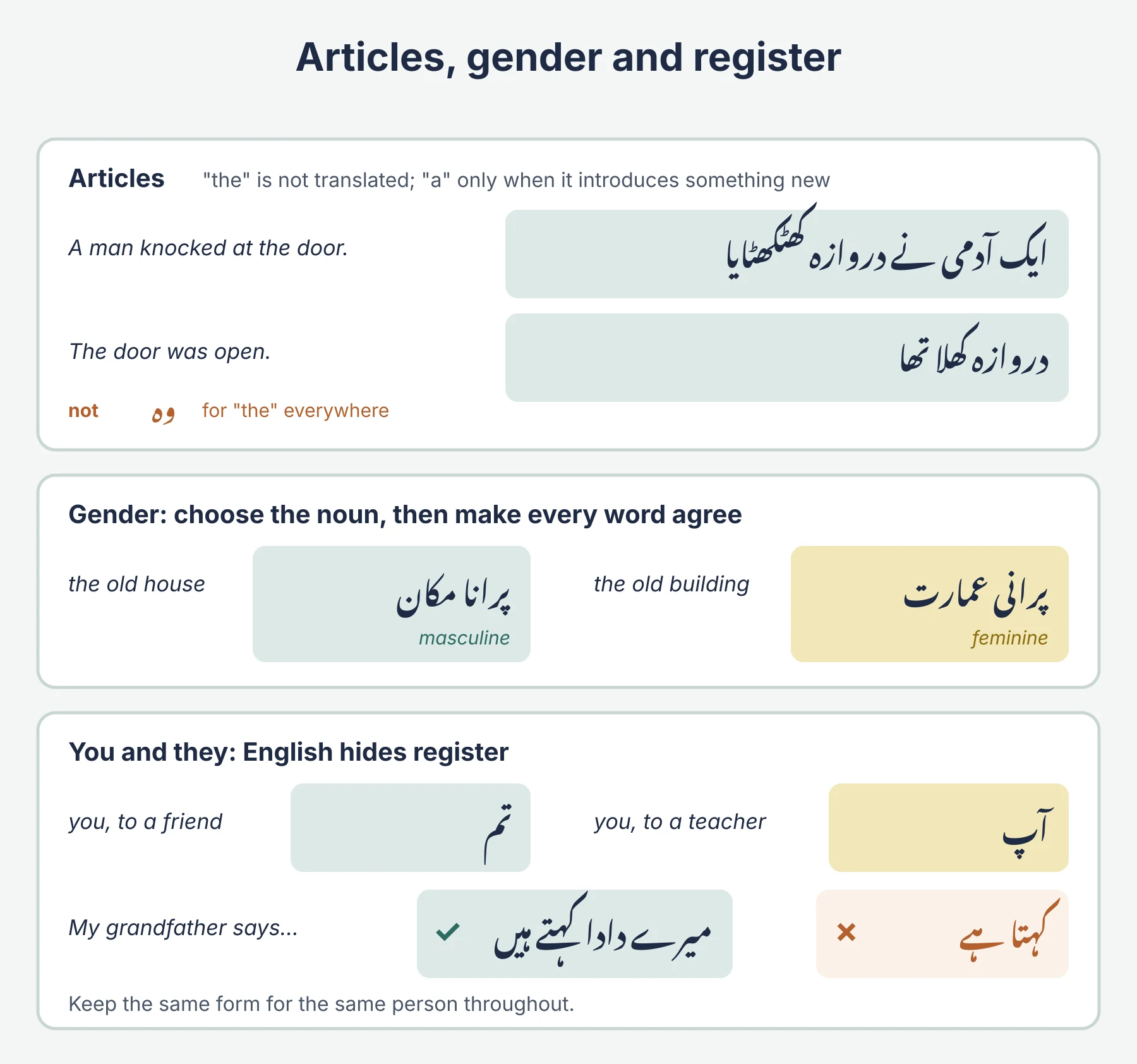
| the | not translated |
| a / an (new, one) | ایک |
| some | کچھ |
| any (questions, negatives) | کوئی |
Gender check
Pick the noun, know its gender, then make every adjective, کا/کی/کے and verb agree. پرانا مکان / پرانی عمارت; نیا قلم / نئی کتاب.
Register
| English | Friend | Teacher, elder, stranger |
|---|---|---|
| you | تم | آپ |
| come | آؤ | تشریف لائیے / آئیے |
| tell me | بتاؤ | بتائیے |
| my grandfather says | — | میرے دادا کہتے ہیں (respect plural) |
Idioms: meaning, not words
| English | Urdu |
|---|---|
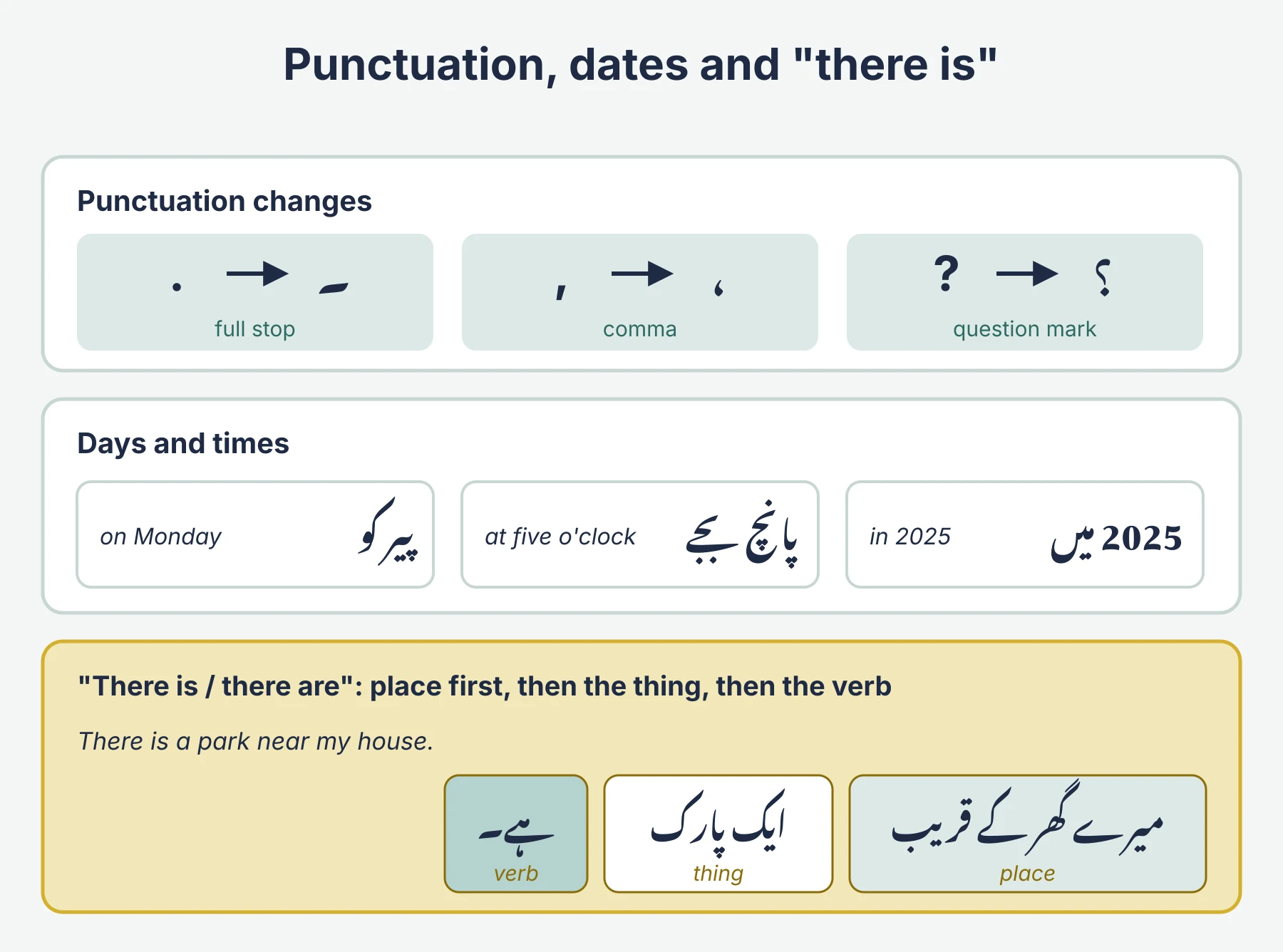
| raining cats and dogs | موسلا دھار بارش |
| over the moon | بے حد خوش |
| kept his word | وعدہ پورا کیا |
| a piece of cake | بہت آسان کام |
| at the last minute | عین وقت پر |
| to make up one’s mind | فیصلہ کرنا |
Six-step process
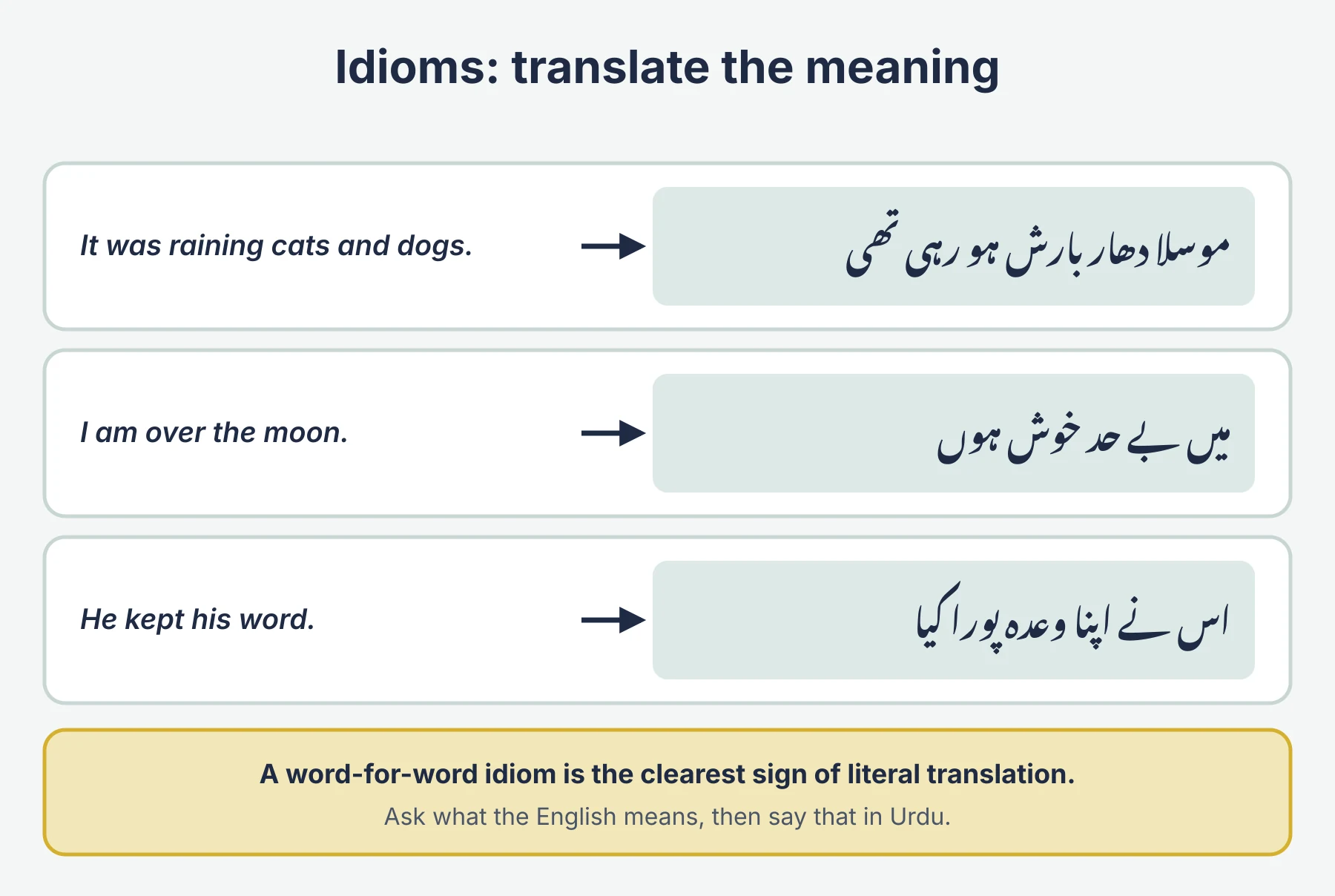
Read all → mark difficulties → translate sentence by sentence → no gaps (paraphrase unknown words) → read the Urdu alone → check names, numbers, punctuation.
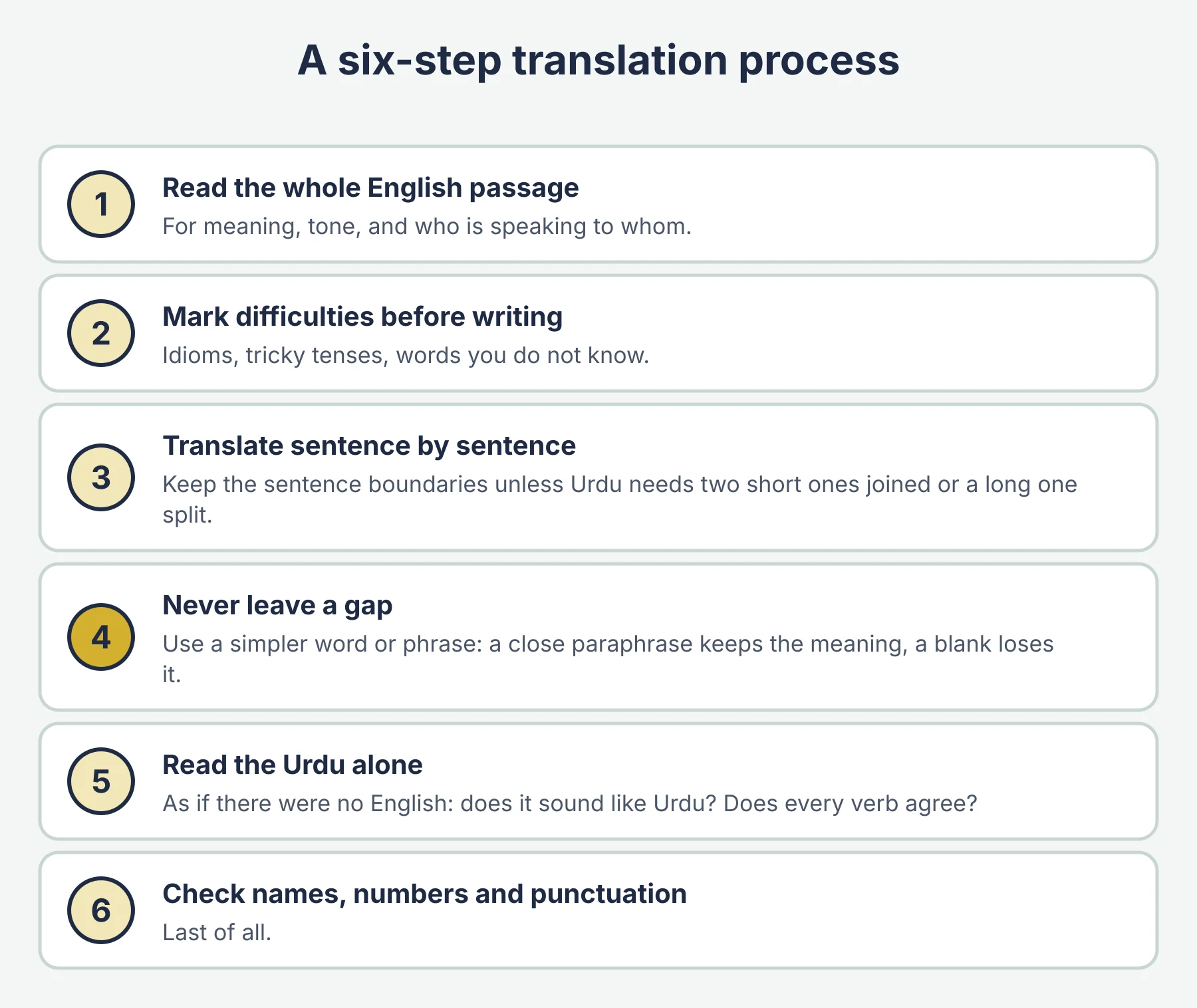
Ordinals agree in gender (دوسری بار، پہلا دن); days take کو (پیر کو); clock times take بجے (پانچ بجے). Names of people and places are written in Urdu script, never translated.
Literal versus natural
| English | Literal (avoid) | Natural |
|---|---|---|
| I am feeling cold. | میں ٹھنڈا محسوس کر رہا ہوں۔ | مجھے سردی لگ رہی ہے۔ |
| She is ten years old. | وہ دس سال پرانی ہے۔ | وہ دس سال کی ہے۔ |
| I have a headache. | میرے پاس سر درد ہے۔ | میرے سر میں درد ہے۔ |
| He made a mistake. | اس نے غلطی بنائی۔ | اس سے غلطی ہوئی۔ / اس نے غلطی کی۔ |
| Take care. | دیکھ بھال لو۔ | اپنا خیال رکھنا۔ |
Notice how often natural Urdu uses مجھے … ہے / لگ رہا ہے where English uses “I have” or “I feel”.
Structures to restructure
- there is / are → place + thing + ہے / ہیں: میز پر دو کتابیں ہیں۔
- passive → keep only if natural (منسوخ کر دیا گیا); otherwise make active.
- long English sentences → split into two Urdu sentences if the verb would come too late to be clear.
Key terms
| Urdu | English |
|---|---|
| ترجمہ | translation |
| لفظی ترجمہ | literal, word-for-word translation |
| بامحاورہ ترجمہ | idiomatic translation |
| مفہوم | meaning, sense |
| محاورہ | idiom |
| ترتیبِ الفاظ | word order |
Exam traps
- English word order kept.
- The translated as وہ.
- Gender chosen wrongly and carried through.
- نے missing with transitive past verbs.
- “for two years” translated as دو سال کے لیے when it means دو سال سے.
- Literal idioms; English words left in.
- Clauses omitted; ideas added that are not in the English.
- آپ and تم mixed.
Self-test
- How many marks is Exercise 4 worth, and about how long is the passage?
- In which language is the question, and in which the answer?
- What is the basic Urdu word order?
- Translate: I have been living here for five years.
- Is “the” translated?
- Translate: The new building is very tall.
- Which form of “you” for a letter to a teacher?
- Translate the idiom: It was a piece of cake.
- What should you do with an unknown English word?
- Translate: She drank the tea.
- What is a لفظی ترجمہ, and why is it risky?
- Which objective covers carrying over the tone of the original?
Answers
- 15 marks; about 150 words.
- Question in English, answer in Urdu.
- Subject–object–verb.
- میں پانچ سال سے یہاں رہ رہا ہوں۔
- No.
- نئی عمارت بہت اونچی ہے۔
- آپ.
- یہ بہت آسان کام تھا۔
- Express the idea with a simpler word or phrase; never leave a gap.
- اس نے چائے پی۔
- A word-for-word translation; it often produces unnatural Urdu and wrong idiom.
- W5.
More resources on this topic
Related resources
-
Study guides
Cambridge O Level Second Language Urdu: Paper 2 Grammar, Writing and Translation (3248)
Sentence transformation, multiple-choice cloze, extended writing and English-to-Urdu translation – Paper 2 Grammar, Writing and Translation of Cambridge O Level Second Language Urdu (3248), 2027-2029 series.
Urdu Language · Cambridge · O Level
Read guide -
Practice questions
Cambridge O Level Second Language Urdu: Paper 2 — Practice Questions
Original exam-technique practice questions with full worked answers on Paper 2's four compulsory exercises, mark allocation, and where marks are typically lost, for Cambridge O Level Second Language Urdu (3248).
Urdu Language · Cambridge · O Level
Try questions -
Revision notes
Cambridge O Level Second Language Urdu: Paper 2 — Revision Notes
Condensed recall notes on sentence transformation, cloze, extended writing and translation for Paper 2 of Cambridge O Level Second Language Urdu (3248), 2027-2029 series.
Urdu Language · Cambridge · O Level
Revise topic
Get free revision emails (optional)
Occasional emails with practice questions, worked explanations and links to free resources for the qualification and subjects you choose. No spam, and you can unsubscribe from any email. The free tools on this site never need an email.