
Revision Notes
Cambridge O Level Second Language Urdu (3248): Exercise 5 Writing Exercise – Revision Notes
Condensed notes on 3248 Paper 1 Exercise 5: task facts, the writing objectives, purpose-format-audience, register tables, connectives and a self-test.
- Subject
- Urdu Language
- Level
- O LEVELS
- Topic
- Paper 1 – Reading and Writing
- Author
- Marlbridge Academic Team
- Updated
- Reviewed by
- Farheen Zehra (what this means)
Aligned to Cambridge O Level Urdu Language (3248), 2027-2029. Official specification .
Syllabus page (what it covers and how it is assessed): Cambridge O Level Urdu Language.
Found an error? Report a correction.
Need help with this topic? Request a free trial class for O Level Urdu Language (3247 / 3248).
These notes cover Exercise 5, the Writing exercise, of 3248 Paper 1: “a short piece of functional prose such as an email, of approximately 150 words”, from “a stimulus of short prompts and/or pictures”, with “a purpose, format and audience” specified. The paper overview is in the O Level Urdu Paper 1 study guide; the full method and a model email are in the Exercise 5 study guide.
Task facts
- 14 marks, the highest tariff on Paper 1.
- About 150 words of functional prose.
- Stimulus: short prompts and/or pictures.
- Purpose, format and audience are always given.
- Objectives W1–W5; how the marks divide is not published.
- Answer in Urdu; no dictionaries.
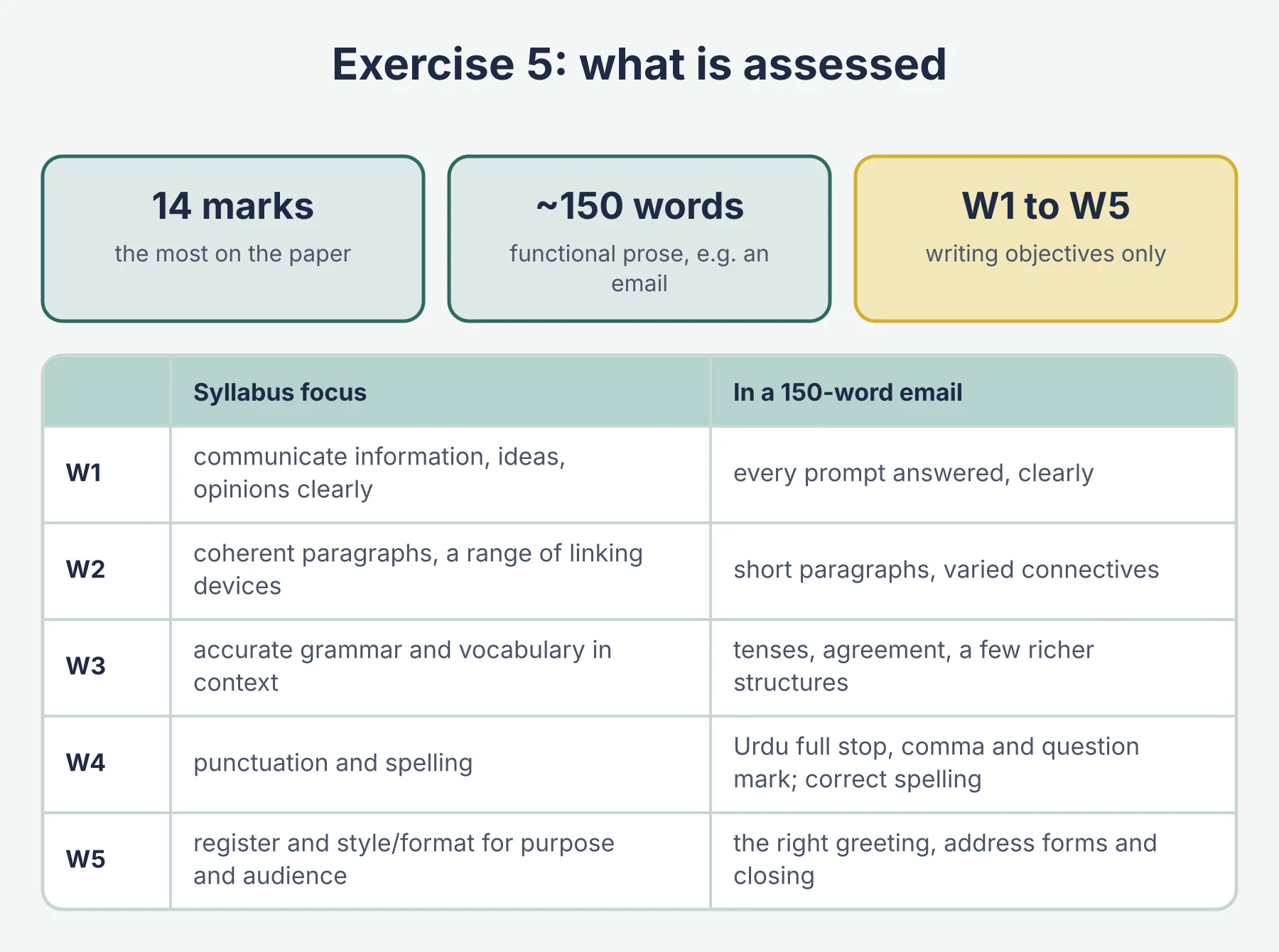
The objectives as a checklist
- W1 every prompt covered, clearly
- W2 paragraphs, with varied linking devices
- W3 accurate grammar and vocabulary in context, with some range
- W4 Urdu punctuation and correct spelling
- W5 register and format right for purpose and audience
Purpose, format, audience
| Ask | Examples |
|---|---|
| Purpose (مقصد) | invite, thank, apologise, inform, request, describe, recommend |
| Format (طرزِ تحریر) | email, letter, blog post, short article |
| Audience (مخاطب) | friend, relative, teacher, principal, website readers |
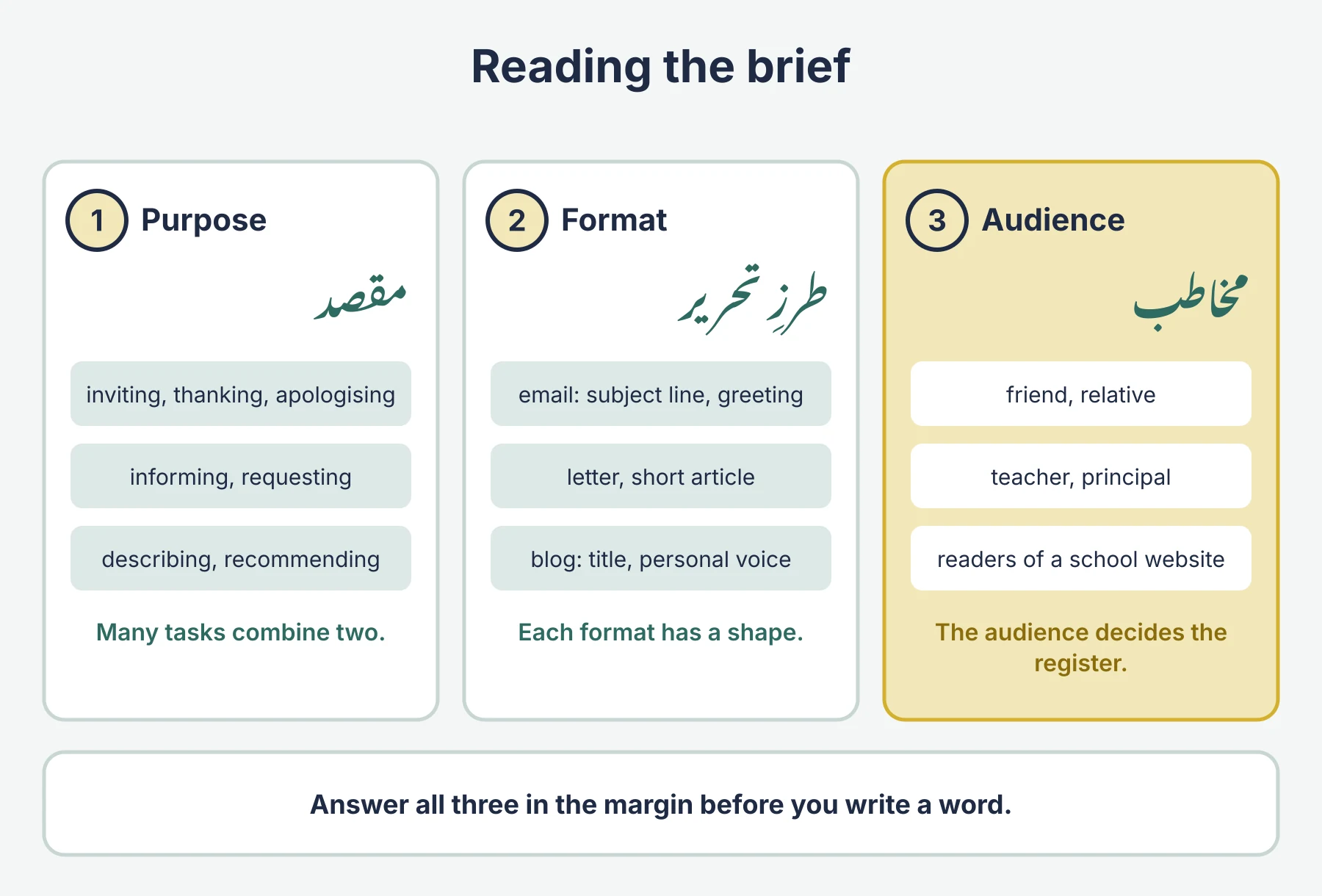
Register tables
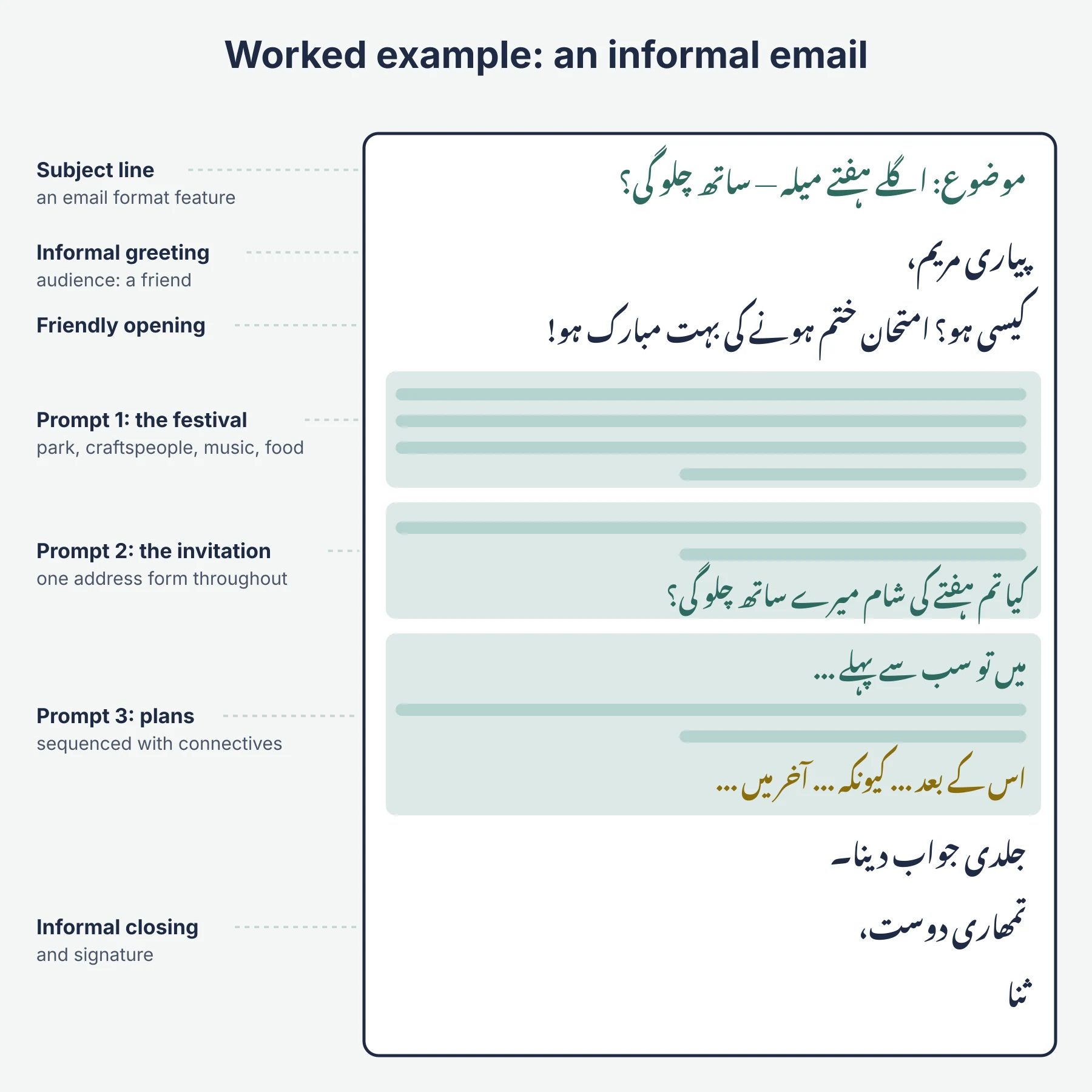
Informal
| Part | Urdu |
|---|---|
| Greeting | پیاری سارہ، / عزیز دوست احمد، |
| Opening | کیسے ہو؟ امید ہے سب خیریت ہے۔ |
| Address | تم، تمھارا، تمھیں |
| Imperative | آؤ، بتاؤ، لکھنا |
| Closing | تمھارا دوست، … / جلد جواب دینا! |
Formal
| Part | Urdu |
|---|---|
| Greeting | محترم استاد صاحب، / محترمہ پرنسپل صاحبہ، |
| Opening | السلام علیکم۔ امید ہے آپ بخیریت ہوں گے۔ |
| Address | آپ، آپ کا، آپ کو |
| Imperative | تشریف لائیے، بتائیے، فرمائیے |
| Closing | والسلام، آپ کا شاگرد … / شکریہ کے ساتھ |
Respectful verbs: فرمانا، تشریف لانا، عنایت کرنا. Use them with آپ, never with تم.
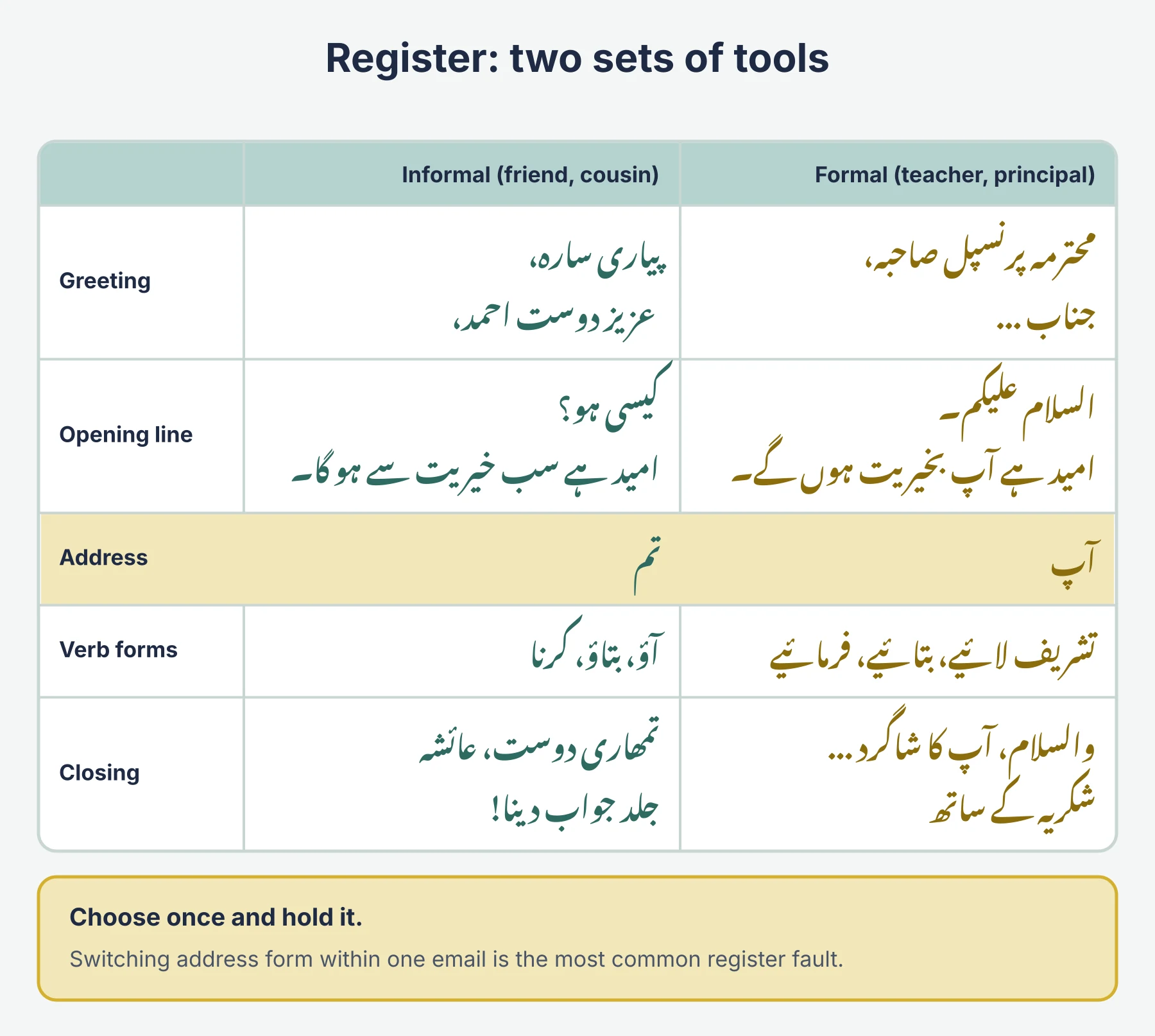
Functional phrases by purpose
| Purpose | Informal | Formal |
|---|---|---|
| invite | کیا تم … آؤ گے؟ | آپ کو … کی دعوت دیتے ہوئے خوشی ہو رہی ہے۔ |
| thank | تمھارا بہت شکریہ! | میں آپ کا تہِ دل سے شکر گزار ہوں۔ |
| apologise | معاف کرنا، میں … | میں … پر معذرت خواہ ہوں۔ |
| request | کیا تم … کر دو گے؟ | گزارش ہے کہ … |
| recommend | تمھیں ضرور … کرنا چاہیے۔ | میری تجویز ہے کہ … |
| give news | ایک خوش خبری سنو! | آپ کو یہ بتاتے ہوئے خوشی ہے کہ … |
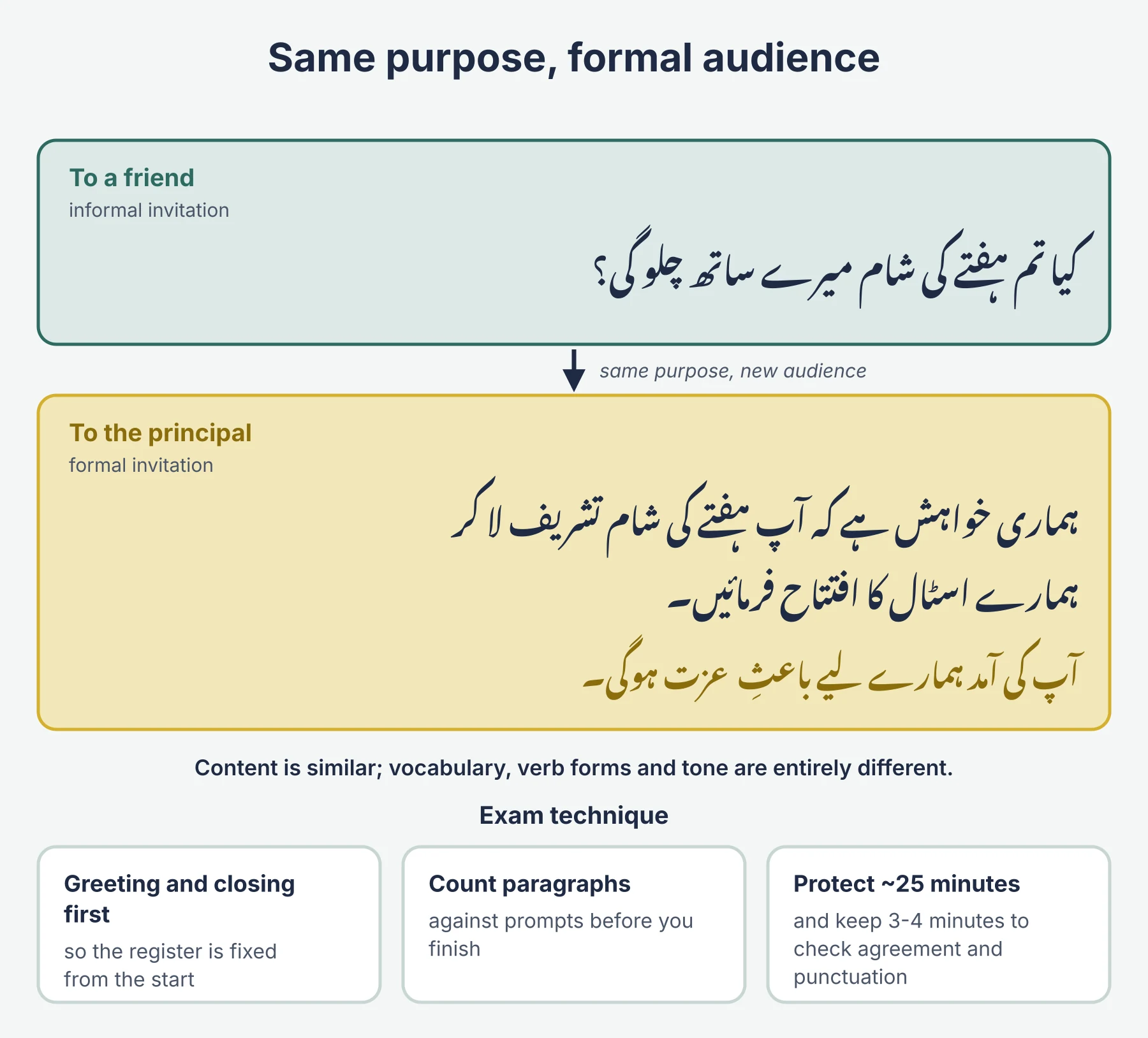
Timing
Paper 1 allows 1 hour 45 minutes for 50 marks. Exercise 5 carries 14, so protect about 25 minutes for it: 3 to plan, about 18 to write, 4 to check. Running out of time here costs more than anywhere else on the paper.
Format features
- Email: subject (موضوع), greeting, paragraphs, closing and name.
- Letter: greeting and closing as above; for a formal letter, a clear statement of purpose early.
- Blog post: a title, a personal voice, perhaps a question to readers at the end.
- Short article: a title, an engaging first sentence, a neutral or semi-formal tone.
- Review: what is being reviewed, what was good, what was weak, and a recommendation, usually in a semi-formal tone for readers who have not yet seen or tried it.
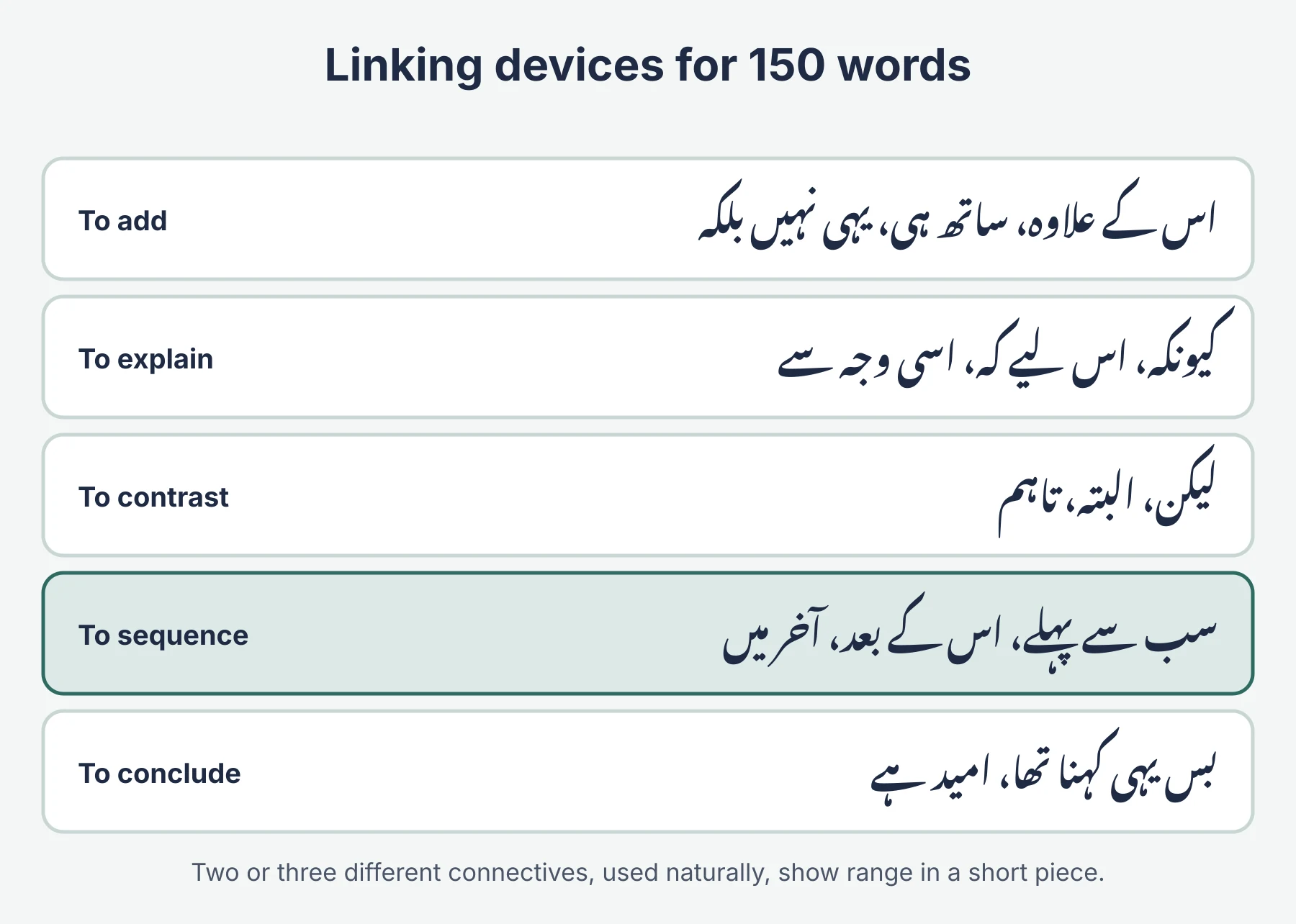
Connectives for a short piece
| Job | Urdu |
|---|---|
| add | اس کے علاوہ، ساتھ ہی، یہی نہیں بلکہ |
| explain | کیونکہ، اس لیے کہ، اسی وجہ سے |
| contrast | لیکن، البتہ، تاہم |
| sequence | سب سے پہلے، اس کے بعد، آخر میں |
| conclude | امید ہے، بس یہی کہنا تھا |
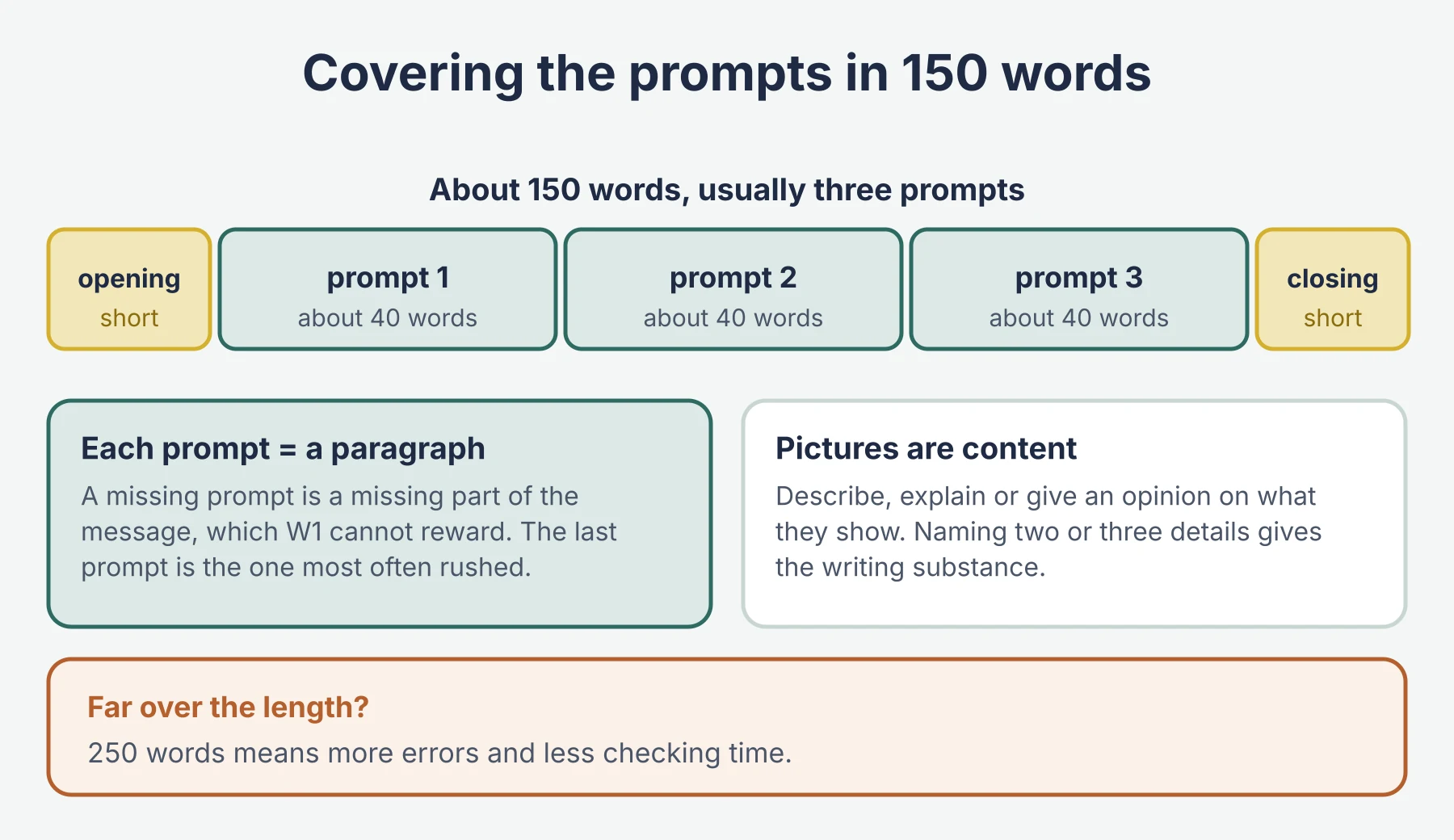
Shape of 150 words (practice guide)
Opening line (10–15 words) · prompt 1 (about 40) · prompt 2 (about 40) · prompt 3 (about 40) · closing (10–15).
Punctuation reminders
| Mark | Urdu form |
|---|---|
| full stop | ۔ |
| comma | ، |
| question mark | ؟ |
| exclamation | ! |
| quotation | “…” |
Exam traps
- Leaving out a prompt, often the last.
- Switching between تم and آپ.
- An email without a greeting or closing; a blog without a title.
- Writing far more than 150 words and leaving no time to check.
- A memorised paragraph that does not fit the task.
- Agreement errors (میلہ لگ رہی ہے), missing نے with transitive past verbs.
- English full stops in Urdu text.
Self-test
- How many marks is Exercise 5 worth, and roughly how many words?
- What three things does the task always specify?
- Which objective covers register and format?
- Which objective covers punctuation and spelling?
- Give an informal and a formal greeting.
- Rewrite formally: کل میرے گھر آؤ۔
- What can pictures in the stimulus be used for?
- Name two features an email should have.
- Give a connective for contrast and one for explanation.
- Correct: ہمارے اسکول میں ایک مقابلہ ہو رہی ہے۔
- What is the Urdu question mark?
- Why is a memorised answer risky?
Answers
- 14 marks; about 150 words.
- Purpose, format and audience.
- W5.
- W4.
- Informal: پیاری سارہ،; formal: محترمہ پرنسپل صاحبہ،.
- کل میرے گھر تشریف لائیے۔
- As content: describing, explaining or giving opinions on what they show.
- Two of: subject line, greeting, paragraphs, closing and name.
- Contrast: لیکن / البتہ / تاہم; explanation: کیونکہ / اس لیے کہ.
- ہمارے اسکول میں ایک مقابلہ ہو رہا ہے۔ (مقابلہ is masculine.)
- ؟
- It may not answer the specific prompts, purpose or audience, so W1 and W5 suffer.
More resources on this topic
Related resources
-
Study guides
Cambridge O Level Second Language Urdu (3248): Exercise 1 Short-answer Questions
How to skim a short Urdu text and give single-word or short-phrase answers in 3248 Paper 1 Exercise 1: question words, answer length and common slips.
Urdu Language · Cambridge · O Level
Read guide -
Practice questions
Cambridge O Level Second Language Urdu (3248): Exercise 1 Short-answer Questions – Practice Questions
Original practice for 3248 Paper 1 Exercise 1: question-word drills, a full short-answer task on a leaflet and a gist question, with answers.
Urdu Language · Cambridge · O Level
Try questions -
Revision notes
Cambridge O Level Second Language Urdu (3248): Exercise 1 Short-answer Questions – Revision Notes
Recall notes for 3248 Paper 1 Exercise 1: task facts, skimming routine, question words, answer length and common slips.
Urdu Language · Cambridge · O Level
Revise topic
Get free revision emails (optional)
Occasional emails with practice questions, worked explanations and links to free resources for the qualification and subjects you choose. No spam, and you can unsubscribe from any email. The free tools on this site never need an email.