
Study Guides
Cambridge O Level Second Language Urdu (3248): Exercise 5 Writing Exercise
Writing the 150-word functional piece in 3248 Paper 1 Exercise 5: reading purpose, format and audience, covering every prompt, register and a model Urdu email.
- Subject
- Urdu Language
- Level
- O LEVELS
- Topic
- Paper 1 – Reading and Writing
- Author
- Marlbridge Academic Team
- Updated
- Reviewed by
- Farheen Zehra (what this means)
Aligned to Cambridge O Level Urdu Language (3248), 2027-2029. Official specification .
Syllabus page (what it covers and how it is assessed): Cambridge O Level Urdu Language.
Found an error? Report a correction.
Need help with this topic? Request a free trial class for O Level Urdu Language (3247 / 3248).
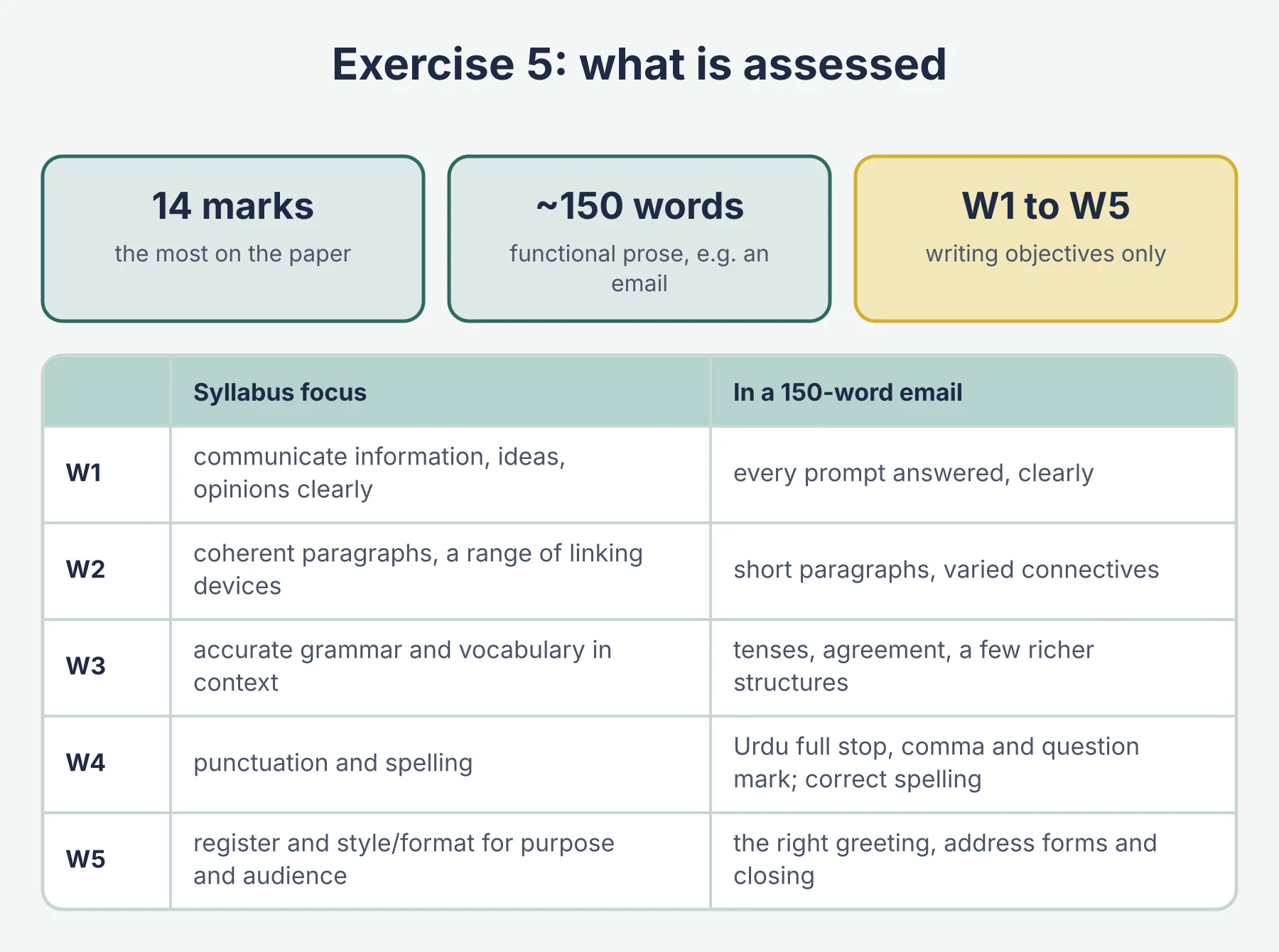
This guide covers Exercise 5 of Cambridge O Level Second Language Urdu 3248 Paper 1 Reading and Writing, the Writing exercise. The syllabus says candidates “write a short piece of functional prose such as an email, of approximately 150 words. A stimulus of short prompts and/or pictures will be printed in the question paper. A purpose, format and audience for the writing will be specified.” It is worth 14 marks, the most of any exercise on the paper. For the paper as a whole, see the O Level Urdu Paper 1 study guide.
What is assessed
Exercise 5 tests all five writing objectives and nothing else:
| Objective | Syllabus wording | In a 150-word email |
|---|---|---|
| W1 | communicate information/ideas/opinions/key points clearly, accurately and effectively | every prompt answered, clearly |
| W2 | organise ideas into coherent paragraphs using a range of appropriate linking devices | short paragraphs, joined with varied connectives |
| W3 | manipulate the target language accurately to use appropriate examples of grammatical structures and vocabulary in context | tenses, agreement, a few richer structures |
| W4 | show control of punctuation and spelling | Urdu full stop (۔), comma (،), question mark (؟); correct spelling |
| W5 | use appropriate register and style/format for the given purpose and audience | the right greeting, address forms and closing |
The syllabus does not publish how the 14 marks divide between these objectives.
Reading the brief: purpose, format, audience
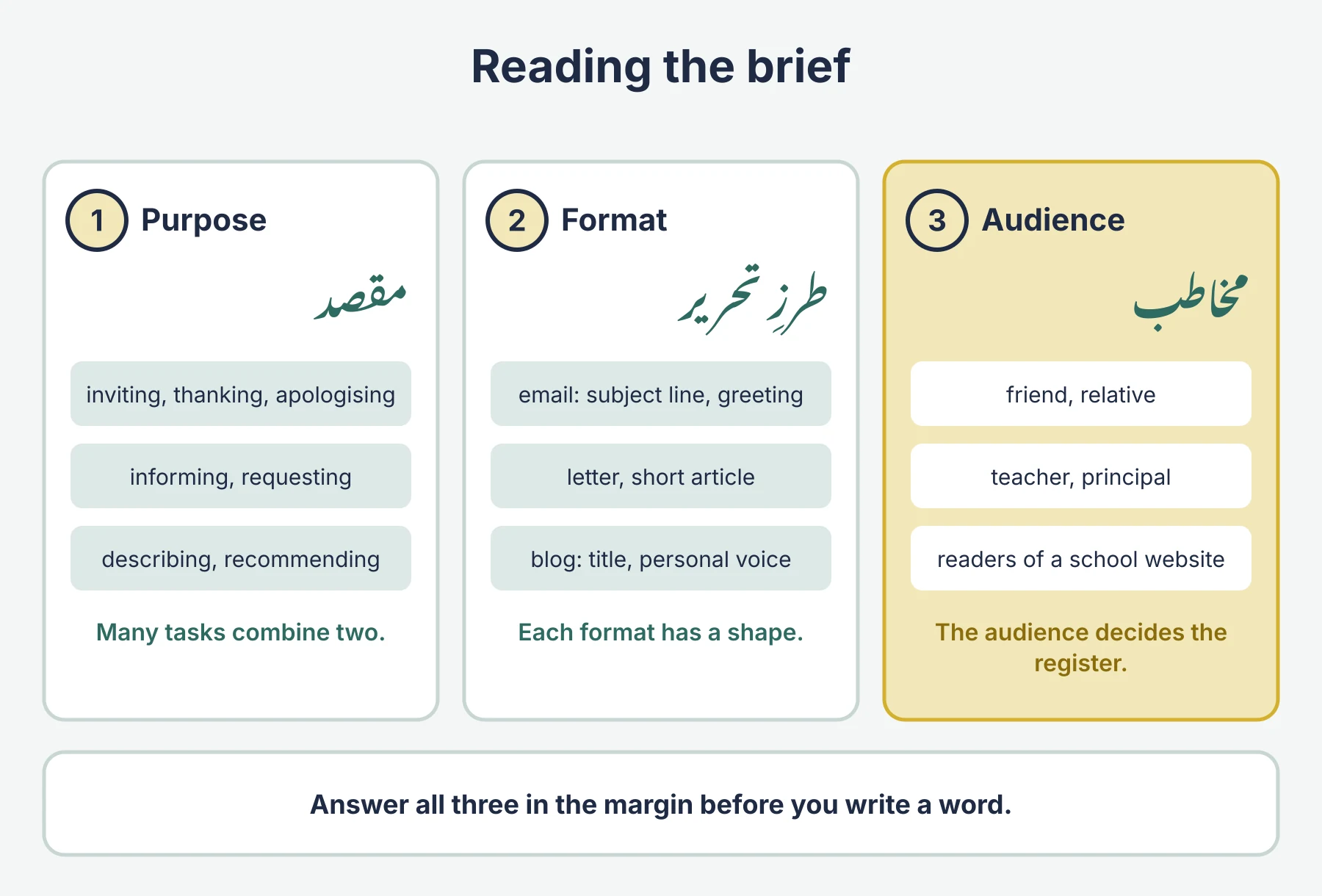
Before writing, answer three questions in the margin.
- Purpose (مقصد): am I inviting, thanking, apologising, informing, requesting, describing or recommending? Many tasks combine two.
- Format (طرزِ تحریر): an email, a letter, a blog post, a short article? Each has a shape: an email has a subject line and a greeting; a blog has a title and a personal voice.
- Audience (مخاطب): a friend, a relative, a teacher, a principal, readers of a school website? The audience decides the register.
The skills content of the syllabus names the range: “a summary, an informal letter/email, an article, a blog, a report or review”. Exercise 5 is the short, functional end of that range.
Covering the prompts
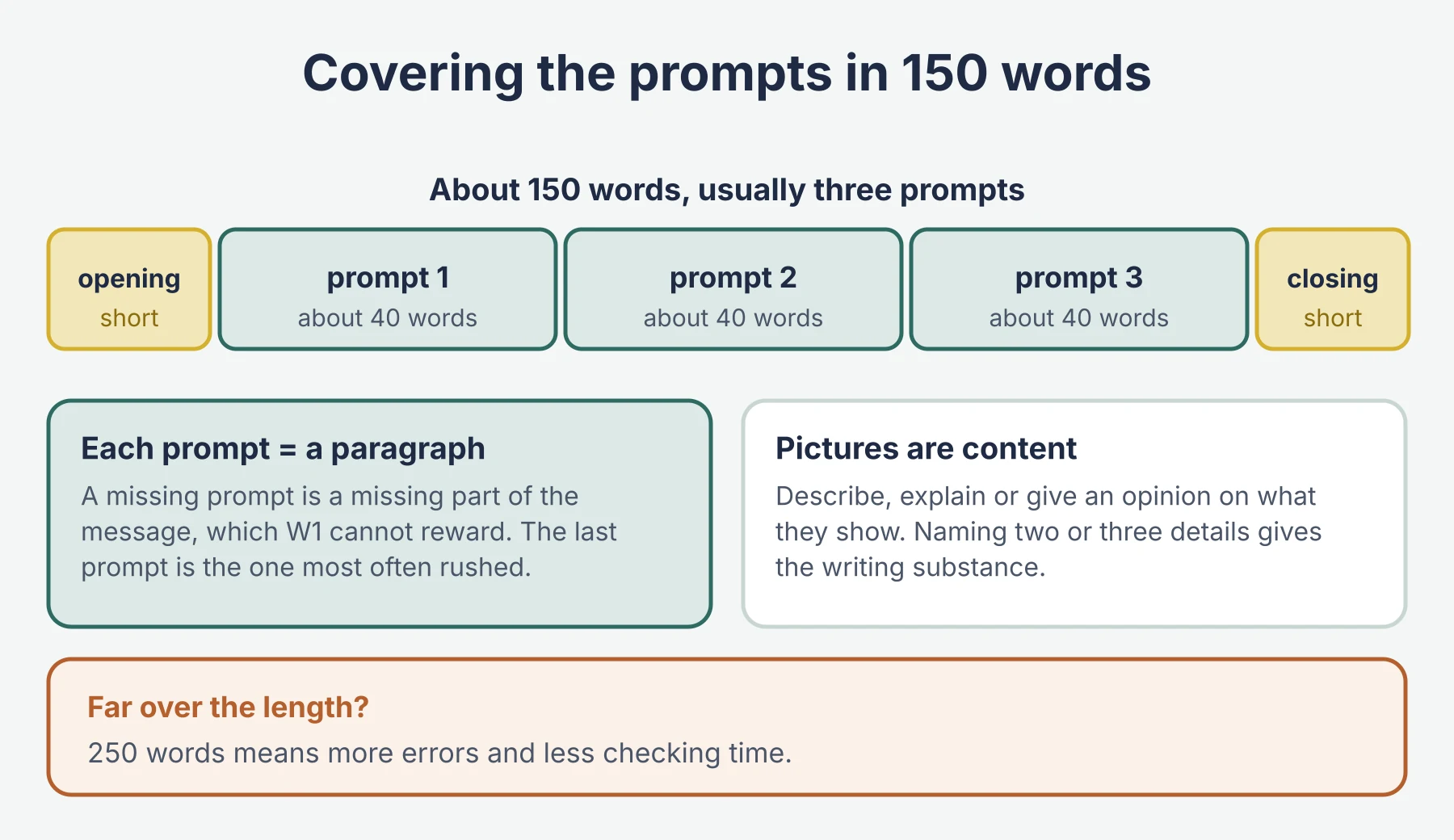
The stimulus gives short prompts and/or pictures. Treat each prompt as a paragraph or a clear section of one. A missing prompt means a missing part of the message, which W1 cannot reward. If there are pictures, use them for content: what they show is an invitation to describe, explain or give an opinion, and naming two or three details from a picture gives your writing substance.
With about 150 words and usually three prompts, aim for roughly 40 words per prompt plus a short opening and closing.
Register: two sets of tools
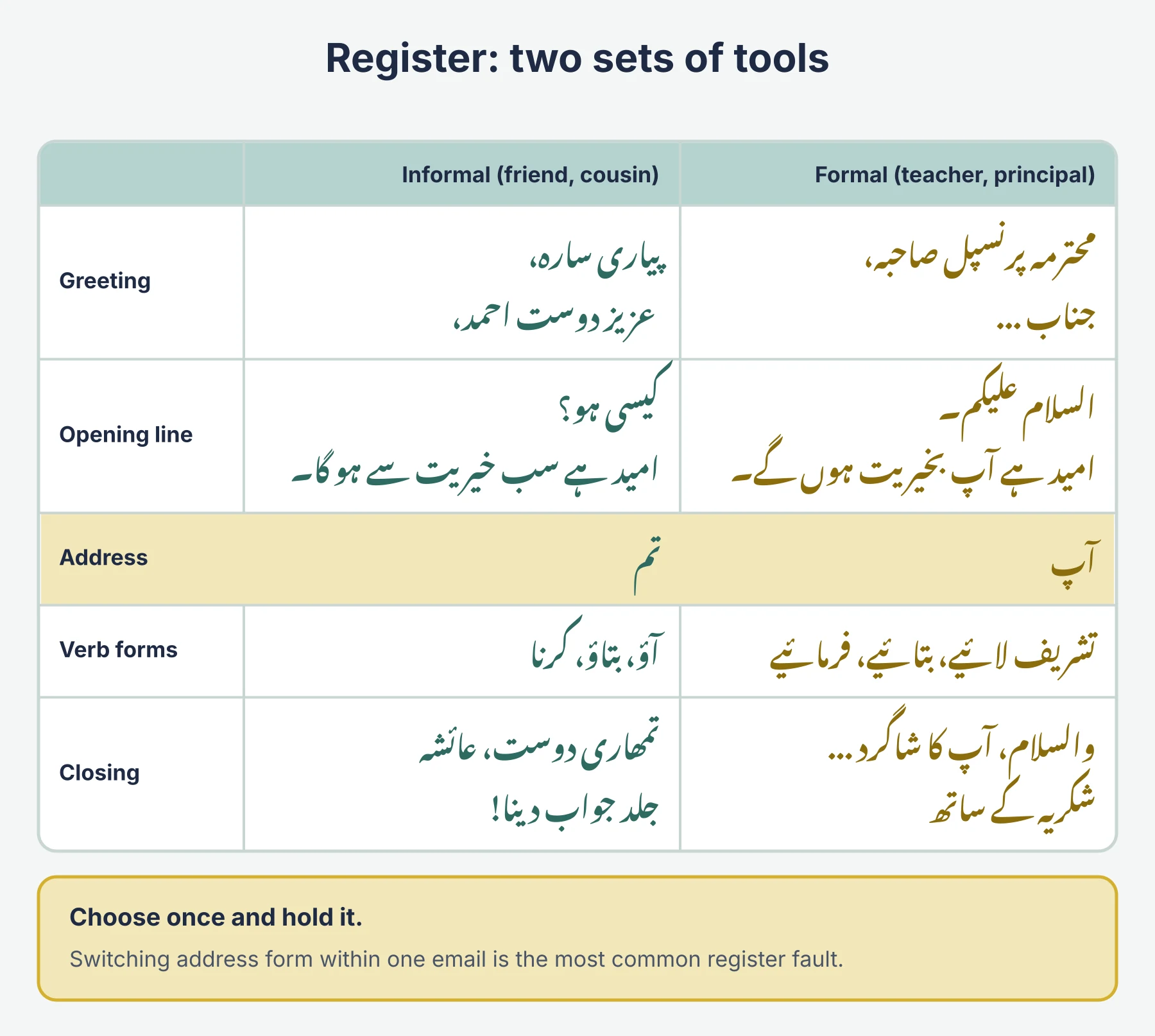
| Informal (friend, cousin) | Formal (teacher, principal, official) | |
|---|---|---|
| Greeting | پیاری سارہ، / عزیز دوست احمد، | محترمہ پرنسپل صاحبہ، / جناب … |
| Opening line | کیسی ہو؟ امید ہے سب خیریت سے ہو گا۔ | السلام علیکم۔ امید ہے آپ بخیریت ہوں گے۔ |
| Address | تم throughout | آپ throughout |
| Verb forms | آؤ، بتاؤ، کرنا | تشریف لائیے، بتائیے، فرمائیے |
| Closing | تمھاری دوست، عائشہ / جلد جواب دینا! | والسلام، آپ کا شاگرد … / شکریہ کے ساتھ |
Choose once and hold it. Moving from تم to آپ within one email is the most common register fault. Informal does not mean careless: spelling and grammar are assessed in the same way.
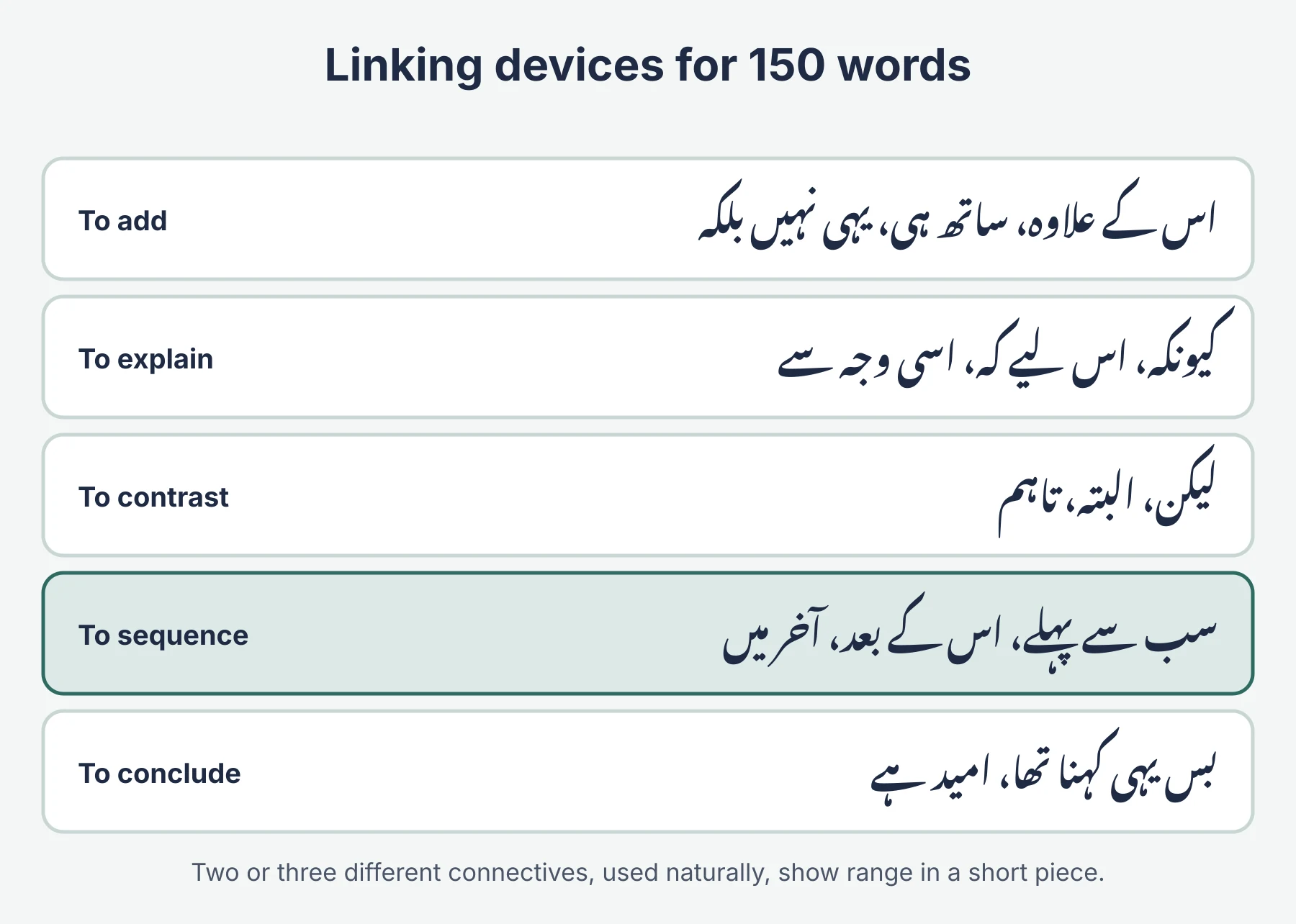
Linking devices that fit 150 words
- To add: اس کے علاوہ، ساتھ ہی، یہی نہیں بلکہ
- To explain: کیونکہ، اس لیے کہ، اسی وجہ سے
- To contrast: لیکن، البتہ، تاہم
- To sequence: سب سے پہلے، اس کے بعد، آخر میں
- To conclude: بس یہی کہنا تھا، امید ہے
Two or three different connectives used naturally are enough to show range in a short piece.
Worked example
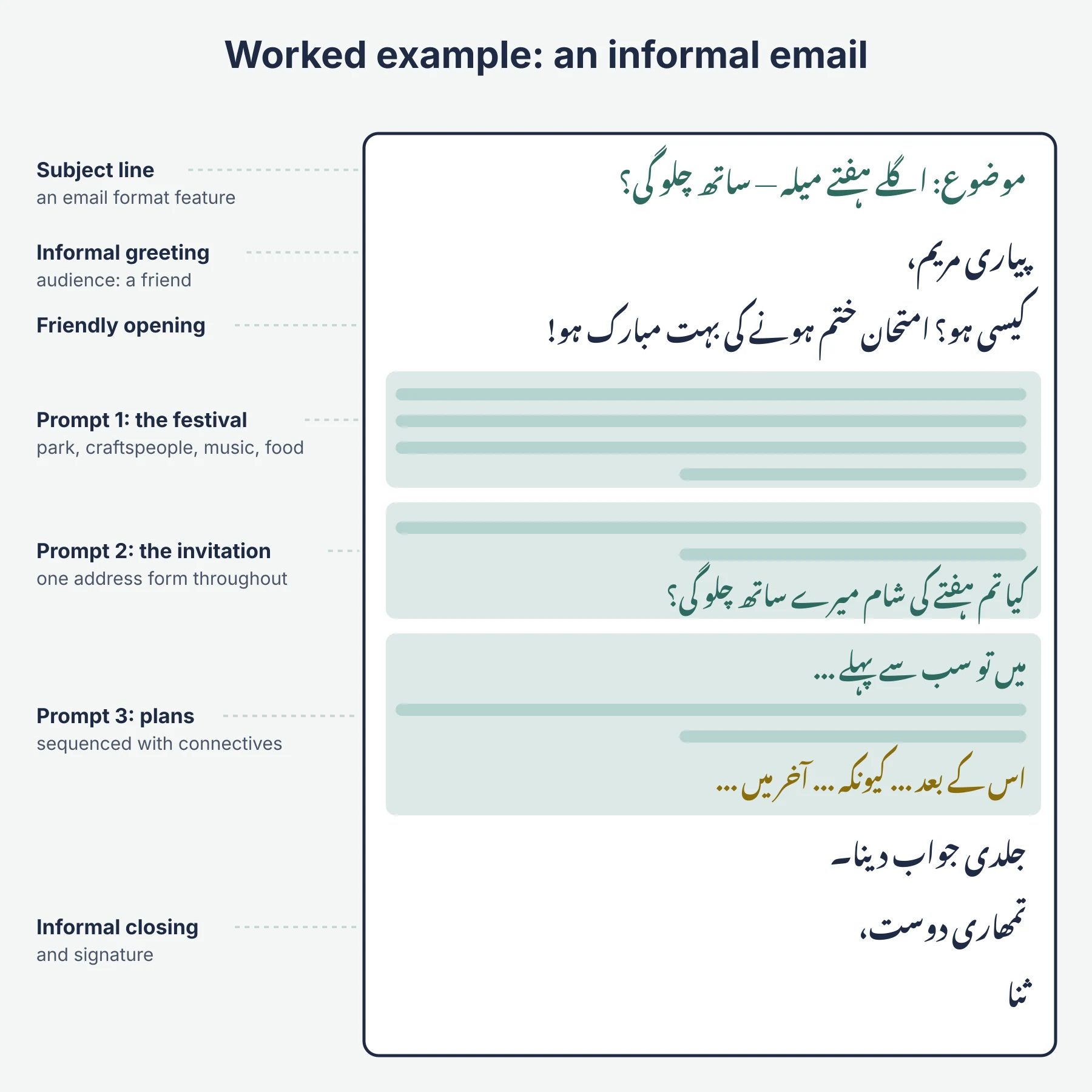
Task (original): آپ کے شہر میں اگلے ہفتے ایک ثقافتی میلہ ہو رہا ہے۔ اپنے دوست کو تقریباً 150 الفاظ کی ای میل لکھیے۔ ای میل میں: میلے کے بارے میں بتائیے؛ اسے ساتھ چلنے کی دعوت دیجیے؛ بتائیے کہ آپ وہاں کیا کرنا چاہتے ہیں۔ (Purpose: inform and invite. Format: email. Audience: a friend, informal.)
موضوع: اگلے ہفتے میلہ — ساتھ چلو گی؟
پیاری مریم،
کیسی ہو؟ امتحان ختم ہونے کی بہت مبارک ہو! اب ذرا آرام اور مزے کا وقت ہے، اس لیے ایک خوش خبری سنو۔ اگلے ہفتے ہمارے شہر کے بڑے پارک میں تین دن کا ثقافتی میلہ لگ رہا ہے۔ وہاں ملک بھر سے دستکار آئیں گے، لوک موسیقی ہو گی اور طرح طرح کے کھانوں کے اسٹال بھی ہوں گے۔
کیا تم ہفتے کی شام میرے ساتھ چلو گی؟ ابو ہمیں گاڑی میں چھوڑ دیں گے اور واپسی پر لے بھی آئیں گے، اس لیے فکر کی کوئی بات نہیں۔
میں تو سب سے پہلے مٹی کے برتن بنانے کی ورکشاپ میں حصہ لینا چاہتی ہوں۔ اس کے بعد ہم سندھی اجرک والے اسٹال پر جائیں گے، کیونکہ امی کے لیے ایک تحفہ خریدنا ہے۔ آخر میں گول گپے تو ضرور کھائیں گے!
جلدی جواب دینا۔
تمھاری دوست، ثنا
Commentary: each prompt has its own paragraph; the subject line and closing fit an informal email; تم is held throughout; اس لیے، سب سے پہلے، اس کے بعد، کیونکہ، آخر میں link and sequence the ideas; the length is close to 150 words.
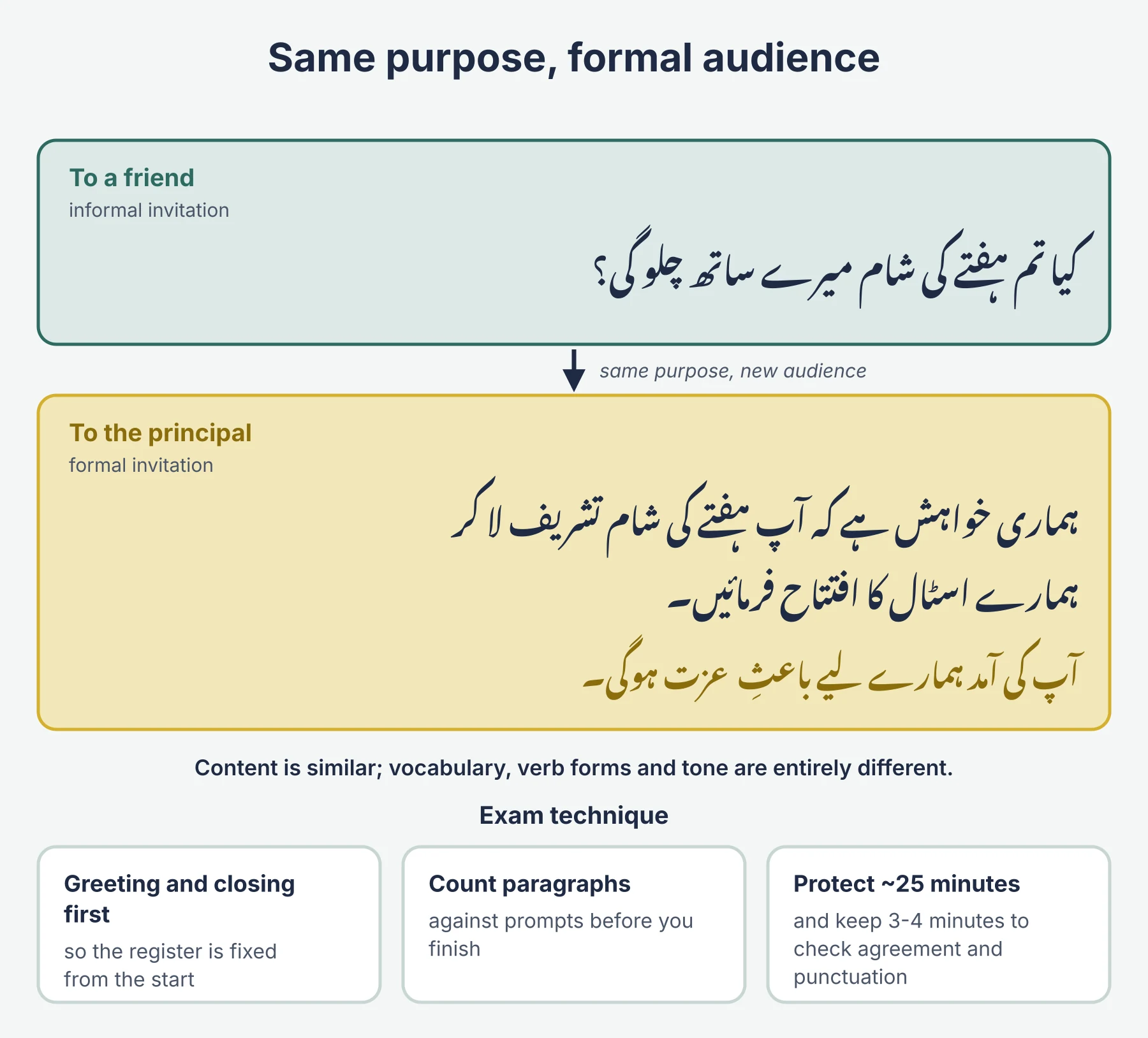
The same purpose, formal audience. If the task asked you to invite the principal to open a school stall at the festival, the paragraph of invitation would change to: ہماری خواہش ہے کہ آپ ہفتے کی شام تشریف لا کر ہمارے اسٹال کا افتتاح فرمائیں۔ آپ کی آمد ہمارے لیے باعثِ عزت ہوگی۔ Content is similar; vocabulary, verb forms and tone are entirely different.
Common mistakes
- Missing a prompt, often the last one, written in a hurry.
- Wrong or mixed register: تم to a teacher, or a formal tone to a close friend.
- No format features: an email with no greeting or closing, a blog with no title.
- Far over the length. “Approximately 150 words” gives a little freedom; 250 words means more errors and less checking time.
- Learned paragraphs that do not fit the task’s details.
- Agreement errors in a short piece stand out: میلہ لگ رہی ہے for لگ رہا ہے.
- English punctuation in Urdu: a full stop dot instead of ۔, or no question mark.
Exam technique
- Spend two minutes on purpose, format, audience and a one-line plan per prompt.
- Write the greeting and closing first so the register is fixed from the start.
- Count paragraphs against prompts before you finish.
- Protect about 25 minutes for this exercise: it carries 14 of the paper’s 50 marks, more than any other, so do not let the reading exercises run over.
- Leave three or four minutes to check gender and number agreement, نے, and punctuation.
More resources on this topic
Related resources
-
Practice questions
Cambridge O Level Second Language Urdu (3248): Exercise 5 Writing Exercise – Practice Questions
Original register, format and accuracy drills plus two full 14-mark Exercise 5 tasks, an email and a blog review, for 3248 Paper 1 with model Urdu answers.
Urdu Language · Cambridge · O Level
Try questions -
Revision notes
Cambridge O Level Second Language Urdu (3248): Exercise 5 Writing Exercise – Revision Notes
Condensed notes on 3248 Paper 1 Exercise 5: task facts, the writing objectives, purpose-format-audience, register tables, connectives and a self-test.
Urdu Language · Cambridge · O Level
Revise topic -
Study guides
Cambridge O Level Second Language Urdu (3248): Exercise 1 Short-answer Questions
How to skim a short Urdu text and give single-word or short-phrase answers in 3248 Paper 1 Exercise 1: question words, answer length and common slips.
Urdu Language · Cambridge · O Level
Read guide
Get free revision emails (optional)
Occasional emails with practice questions, worked explanations and links to free resources for the qualification and subjects you choose. No spam, and you can unsubscribe from any email. The free tools on this site never need an email.