
Revision Notes
Cambridge O Level Second Language Urdu (3248): Exercise 3 Note-making – Revision Notes
Condensed notes on 3248 Paper 1 Exercise 3 Note-making: the task facts, what a good Urdu note looks like, mapping to headings, traps and a self-test.
- Subject
- Urdu Language
- Level
- O LEVELS
- Topic
- Paper 1 – Reading and Writing
- Author
- Marlbridge Academic Team
- Updated
- Reviewed by
- Farheen Zehra (what this means)
Aligned to Cambridge O Level Urdu Language (3248), 2027-2029. Official specification .
Syllabus page (what it covers and how it is assessed): Cambridge O Level Urdu Language.
Found an error? Report a correction.
Need help with this topic? Request a free trial class for O Level Urdu Language (3247 / 3248).
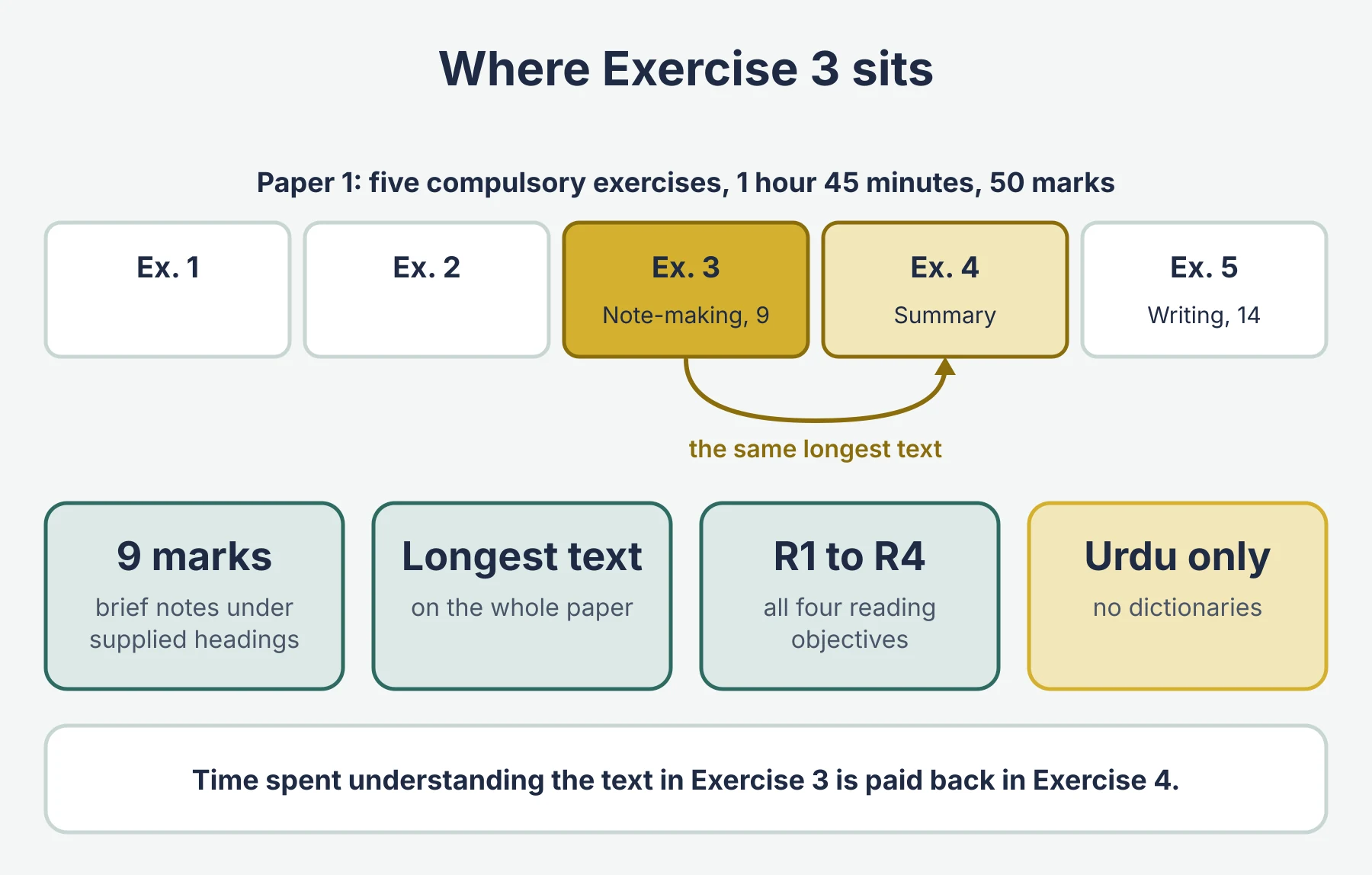
These notes cover Exercise 3, Note-making, of 3248 Paper 1: “candidates read a longer text printed in the question paper and make brief notes under a number of supplied headings”. For the whole paper see the O Level Urdu Paper 1 study guide; for the full method and a worked example see the Exercise 3 Note-making study guide.
Task facts
| Fact | Detail |
|---|---|
| Marks | 9 |
| Objectives | R1, R2, R3, R4 |
| Text | the longest on the paper; also the source for Exercise 4 |
| Task | brief notes under supplied headings |
| Language | questions and answers in Urdu |
| Dictionaries | not allowed |
| Paper | 1 hour 45 minutes, 50 marks, five compulsory exercises |
Text types to expect
The syllabus’s reading content lists blogs, brochures, emails, forms, imaginative writing, letters, magazines, newspapers and web pages, on subjects of contemporary interest such as conservation and environment, culture and history, science and technology, music and arts, and human achievement. That list is not exhaustive.
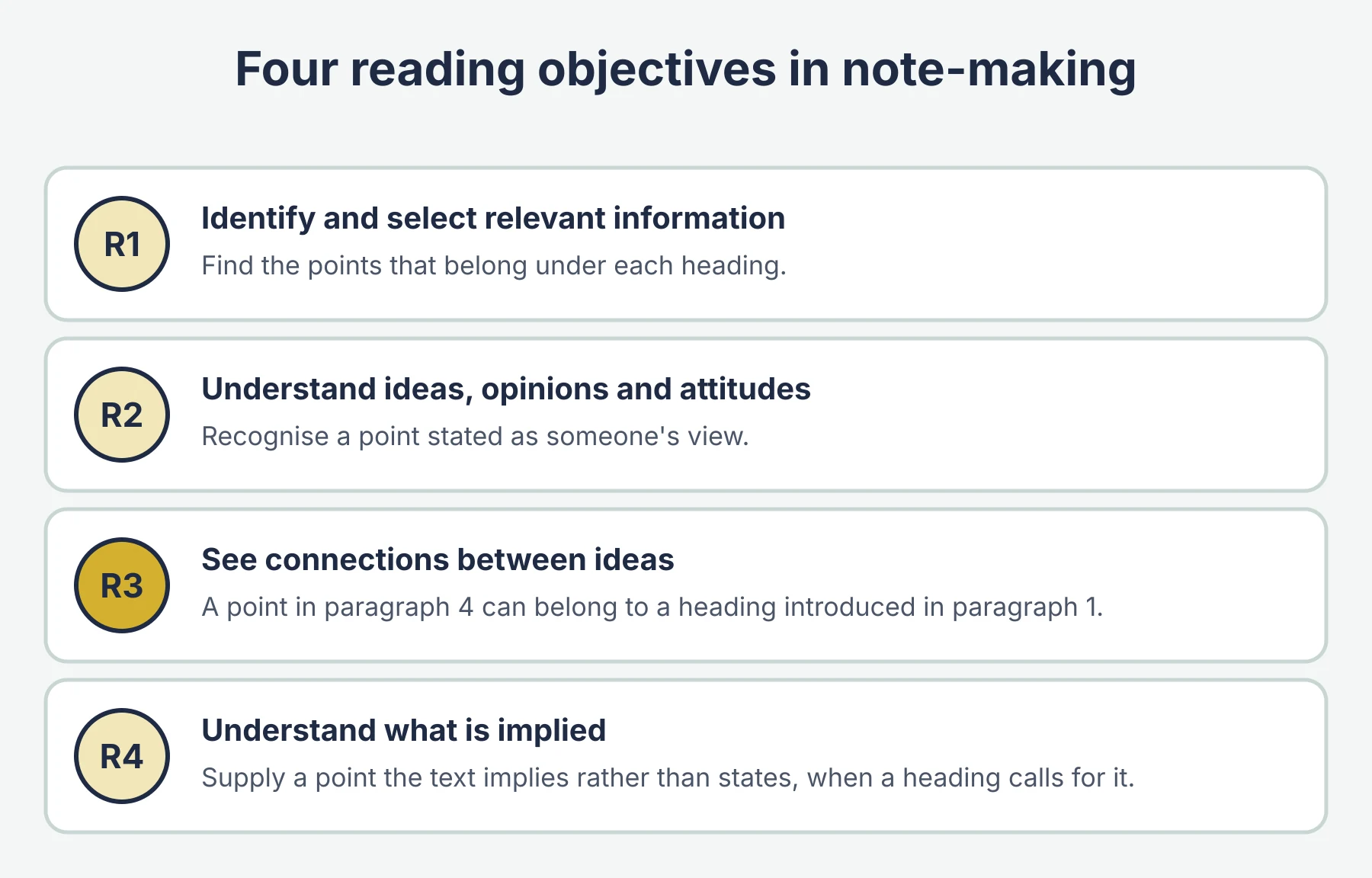
The objectives in one line each
- R1: find the information that belongs under each heading.
- R2: recognise ideas, opinions and attitudes, including a view the writer quotes.
- R3: connect details across paragraphs to the right heading.
- R4: supply what is implied when the heading needs it.
A good note is
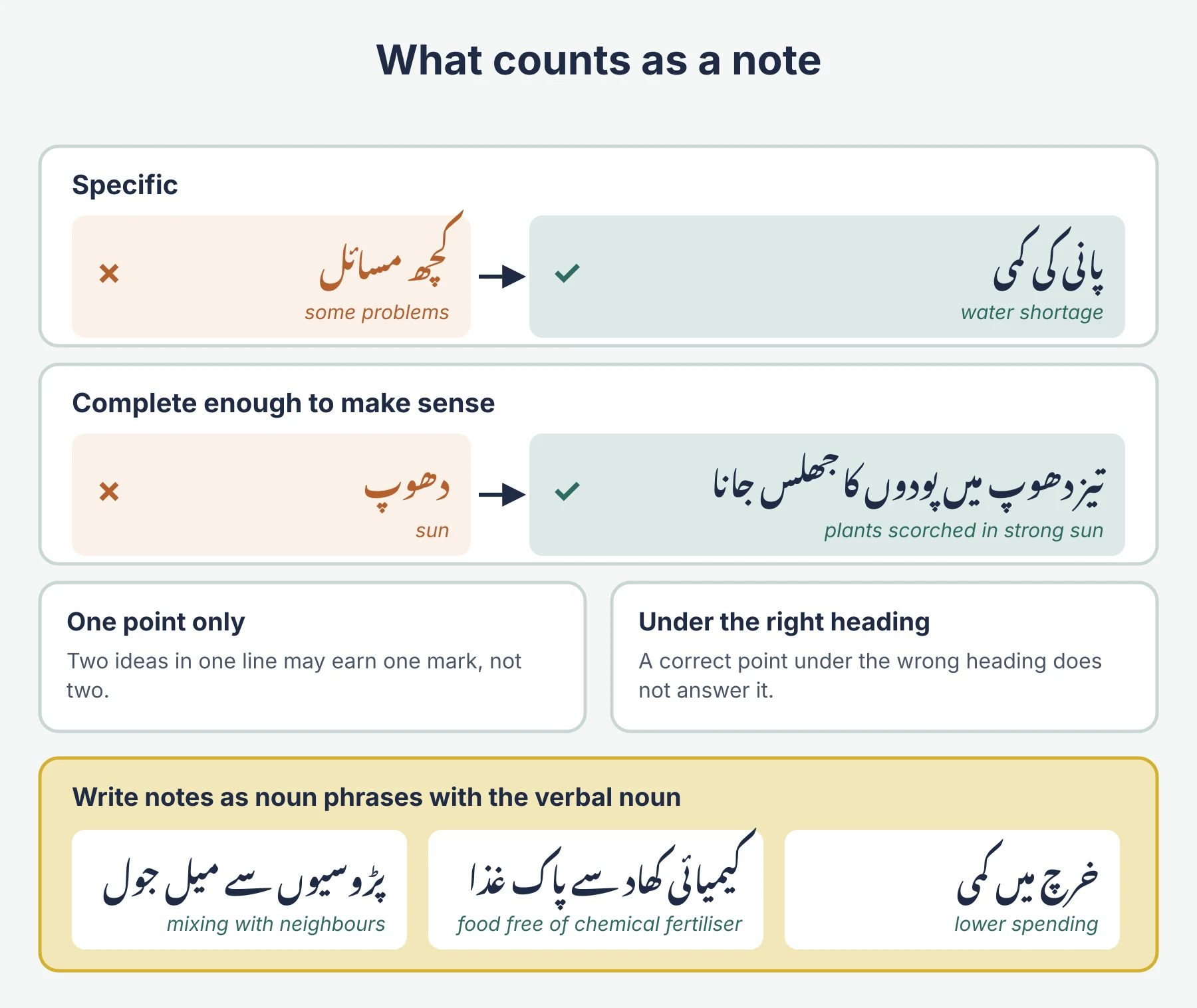
- brief – three to eight words;
- single – one point per line;
- specific – names the actual thing, not a category;
- meaningful alone – an examiner can understand it without the text;
- placed correctly – it answers the heading it sits under.
Urdu note style
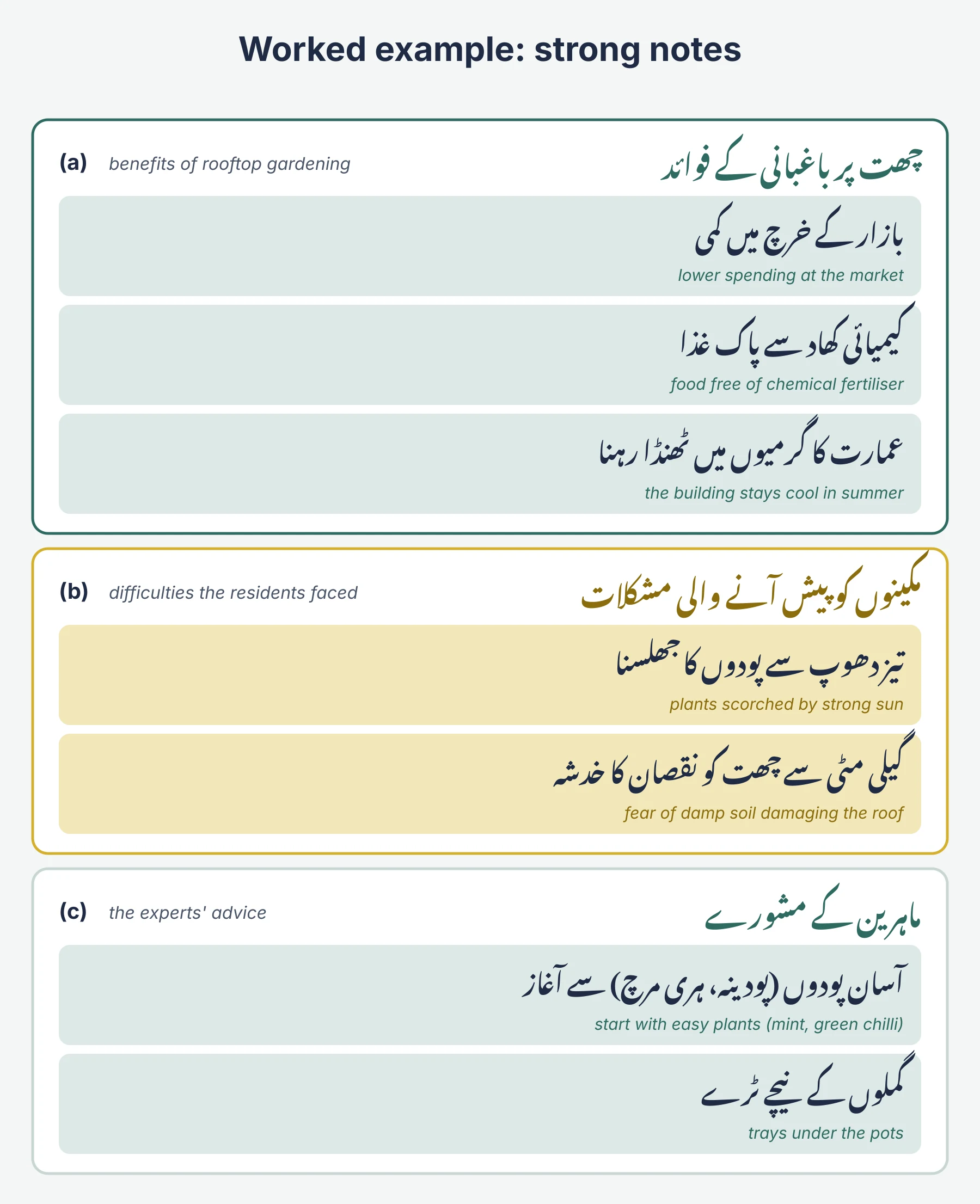
Use noun phrases, often with a verbal noun or میں کمی / میں اضافہ:
| Full sentence in text | Note |
|---|---|
| بازار کا خرچ کم ہوا ہے | خرچ میں کمی |
| پڑوسیوں سے ملاقات ہو جاتی ہے | پڑوسیوں سے میل جول |
| کئی پودے تیز دھوپ میں جھلس گئے | دھوپ سے پودوں کا جھلسنا |
| پہلے سال صرف آسان پودے لگائیں | آسان پودوں سے آغاز |
Brackets for supporting examples are fine: آسان پودے (پودینہ، ہری مرچ).
Heading-mapping routine
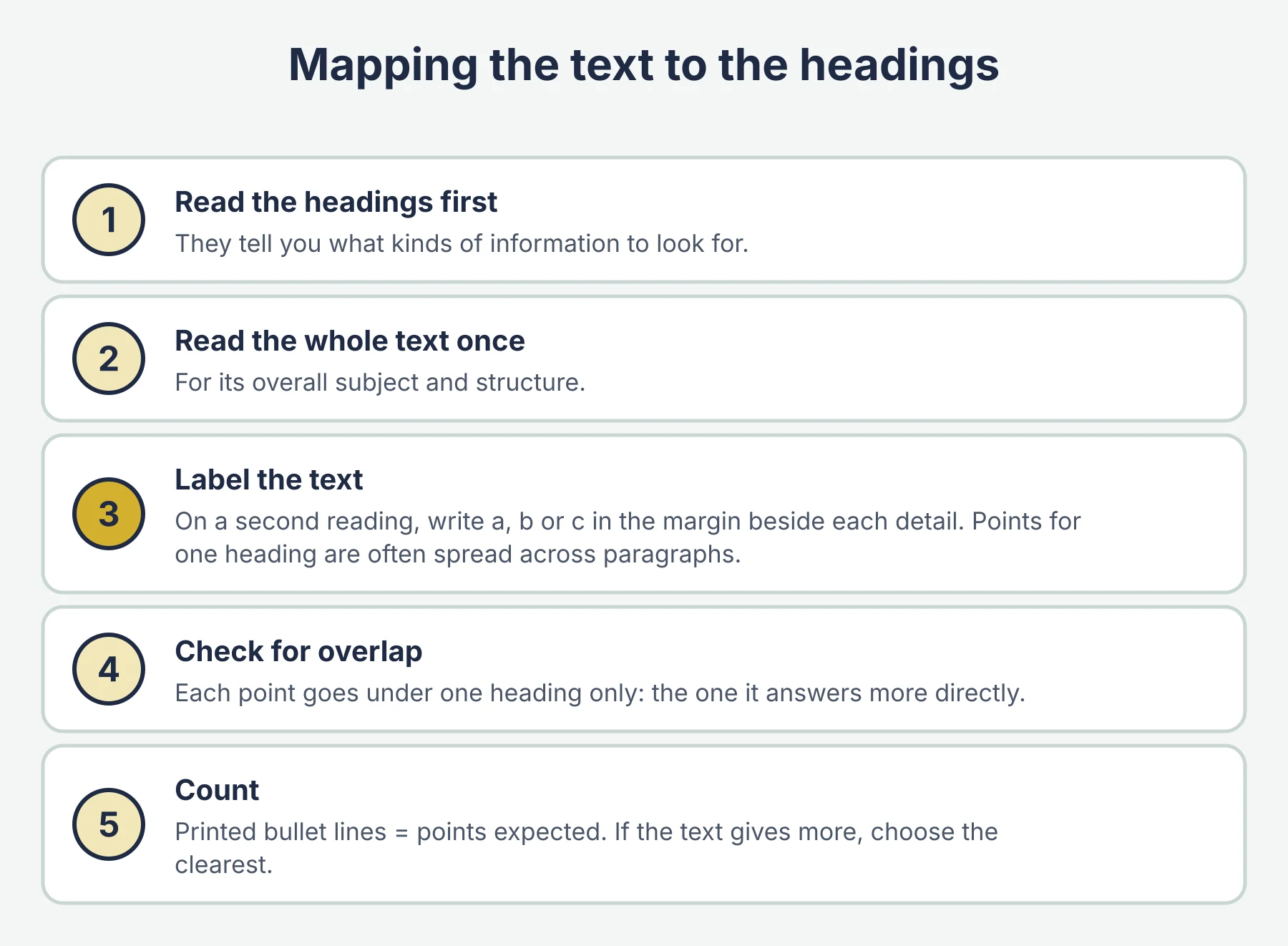
- Headings first.
- Whole text once.
- Second reading: margin letters (a, b, c) beside each relevant detail.
- Remove overlaps: each point under one heading.
- Match the number of points to the printed lines, if any.
Link to Exercise 4
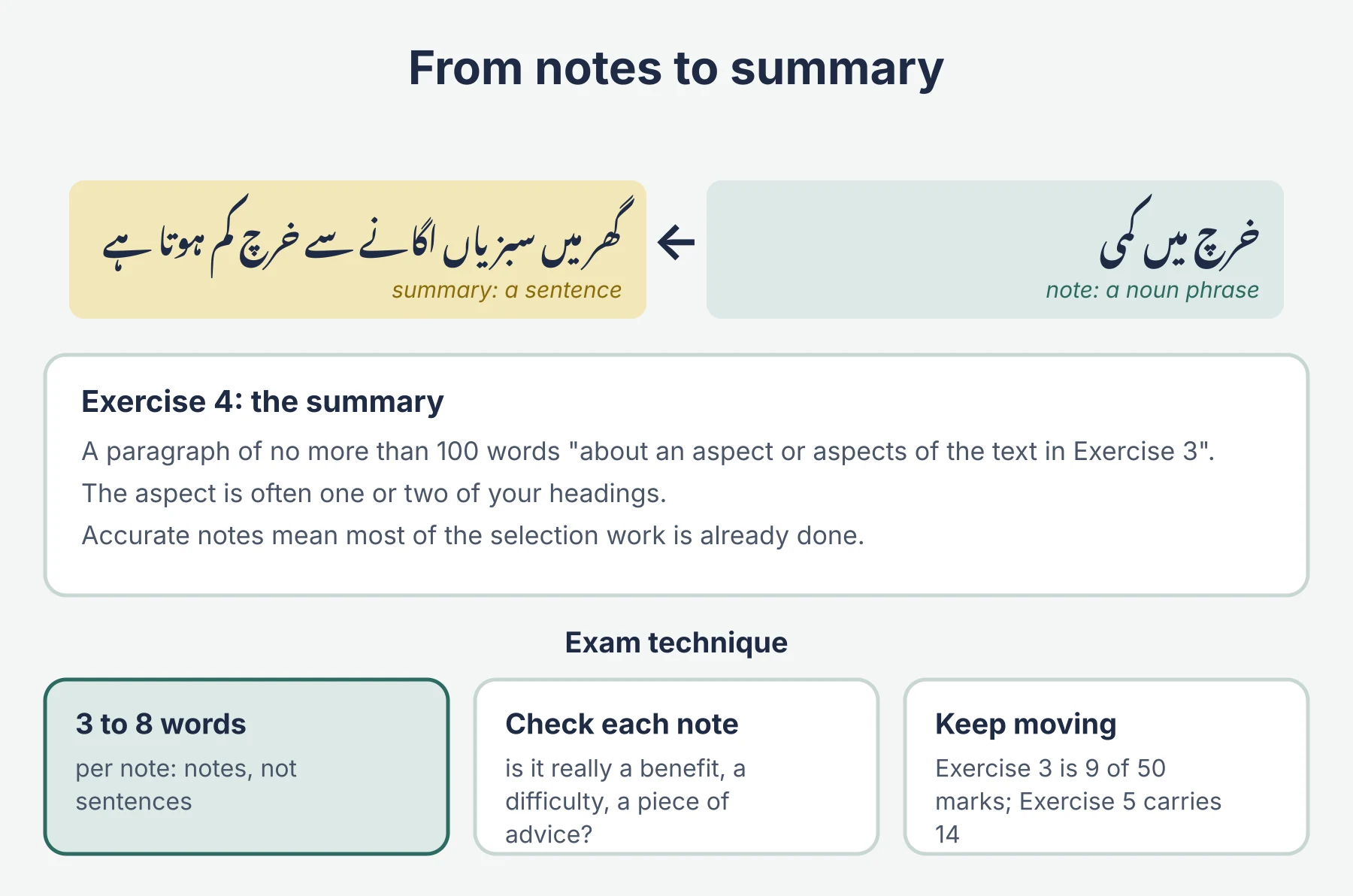
The summary (no more than 100 words, own words as far as possible) is on an aspect or aspects of this text. Accurate notes give you most of its content; turn the noun phrases back into short, linked sentences. Read the Exercise 4 question before you finish Exercise 3: if it names the aspect you will summarise, you can make sure the notes under that heading are complete and precisely worded.
Key terms
| Urdu | English |
|---|---|
| نوٹس | notes |
| عنوان / سرخی | heading |
| نکتہ | point |
| متعلقہ | relevant |
| مثال | example |
| فائدہ / نقصان | advantage / disadvantage |
| وجہ / نتیجہ | cause / result |
| مشورہ / تجویز | advice / suggestion |
Mini example
Text (original): میلے میں اس بار بچوں کے لیے الگ کھیل کا میدان بنایا گیا۔ کھانے کے اسٹال صاف ستھرے تھے، مگر پارکنگ کی جگہ بہت کم تھی اور لوگ گھنٹوں گاڑیوں میں پھنسے رہے۔
Heading: میلے کی خوبیاں
- Good: بچوں کے لیے الگ کھیل کا میدان
- Good: صاف ستھرے کھانے کے اسٹال
- Wrong heading: پارکنگ کی کمی (a drawback, not a strength)
Timing
Paper 1 gives 1 hour 45 minutes for 50 marks, about two minutes a mark. For 9 marks, allow roughly 18 to 20 minutes including the reading of the longest text, knowing that the reading also serves Exercise 4.
Exam traps
- Copying sentences in full.
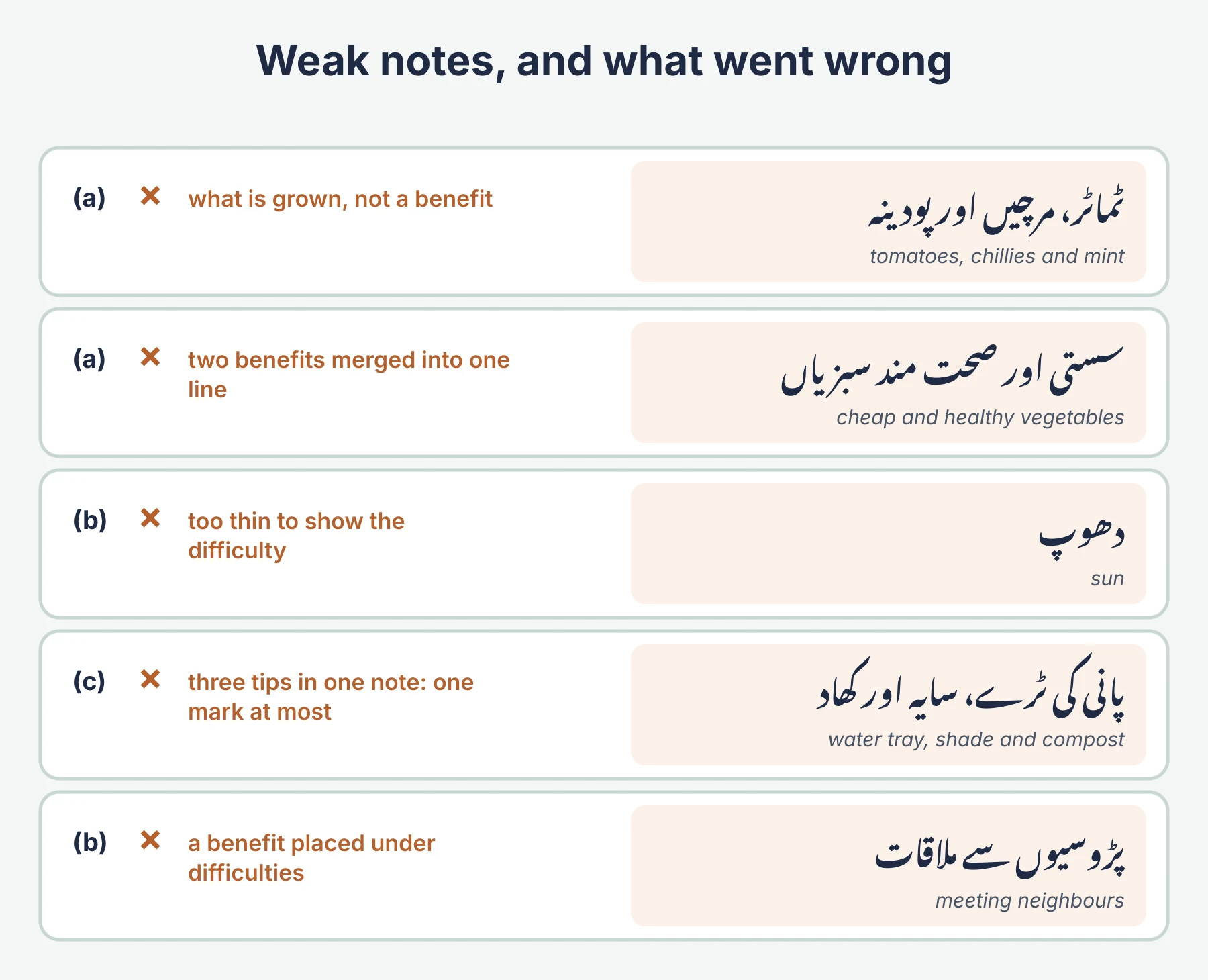
- Two or three points squeezed into one note.
- A category word as a note (فوائد، مسائل).
- The same point twice in different words.
- A correct point under the wrong heading.
- Ignoring points inside quotations from people in the text.
- Missing qualifiers that change meaning (کچھ، شروع میں، اکثر).
- Using knowledge from outside the text.
Self-test
- How many marks is Exercise 3 worth, and which objectives does it test?
- Which later exercise uses the same text?
- Must notes be in full sentences?
- Turn into a note: ماہرین کے مطابق چھت پر پودے عمارت کو ٹھنڈا رکھتے ہیں۔
- Why might سستی اور صحت مند سبزیاں earn only one mark?
- Under which heading would a fear that the roof might be damaged belong: benefits, difficulties or advice?
- What should you do if a point seems to fit two headings?
- What does the number of printed bullet lines under a heading tell you?
- Give two text types the syllabus lists for reading.
- Why is دھوپ alone a weak note?
- Which objective covers recognising connections between ideas across paragraphs?
- Are dictionaries allowed?
Answers
- 9 marks; R1, R2, R3 and R4.
- Exercise 4, the summary.
- No: the syllabus asks for brief notes.
- عمارت کا ٹھنڈا رہنا (or گرمی میں کمی).
- It combines two separate points (cheapness, healthiness) in one note.
- Difficulties: a worry is a difficulty even if nothing has gone wrong yet.
- Put it under the heading it answers more directly, and only once.
- The number of points you are expected to give under that heading.
- Any two of blogs, brochures, emails, forms, imaginative writing, letters, magazines, newspapers, web pages.
- It does not say what the problem is; the note must show the difficulty (plants scorched by sun).
- R3.
- No.
More resources on this topic
Related resources
-
Study guides
Cambridge O Level Second Language Urdu (3248): Exercise 4 Summary
How to write an Urdu summary of at most 100 words in 3248 Paper 1 Exercise 4: choosing points, using your own words, linking ideas and checking length.
Urdu Language · Cambridge · O Level
Read guide -
Practice questions
Cambridge O Level Second Language Urdu (3248): Exercise 4 Summary – Practice Questions
Original practice for 3248 Paper 1 Exercise 4: choosing points, own words, linking, correcting a weak summary and a full 100-word summary task, with answers.
Urdu Language · Cambridge · O Level
Try questions -
Revision notes
Cambridge O Level Second Language Urdu (3248): Exercise 4 Summary – Revision Notes
Recall notes for 3248 Paper 1 Exercise 4: task facts, the summary method, own words, linking devices and common faults.
Urdu Language · Cambridge · O Level
Revise topic
Get free revision emails (optional)
Occasional emails with practice questions, worked explanations and links to free resources for the qualification and subjects you choose. No spam, and you can unsubscribe from any email. The free tools on this site never need an email.