
Revision Notes
Pearson Edexcel International A Level Business (YBS11): Managing Finance – Revision Notes
Revision notes for Edexcel IAL Business 2.3.3: profit, margins, profit versus cash, liquidity ratios, working capital and business failure, with a self-test.
- Subject
- Business
- Level
- AS LEVEL
- Topic
- Managing business activities
- Author
- Marlbridge Academic Team
- Updated
- Reviewed by
- Salman Ahmad (what this means)
Aligned to Pearson Edexcel A Level Business (WBS12/01), Issue 1, September 2017. Official specification .
Syllabus page (what it covers and how it is assessed): Pearson Edexcel A Level Business.
Found an error? Report a correction.
Need help with this topic? Request a free trial class for A Level Business (YBS11).
Condensed recall for section 2.3.3 of Unit 2. For explanations and worked examples, use the Managing Finance study guide. Figures are invented.
Formula sheet
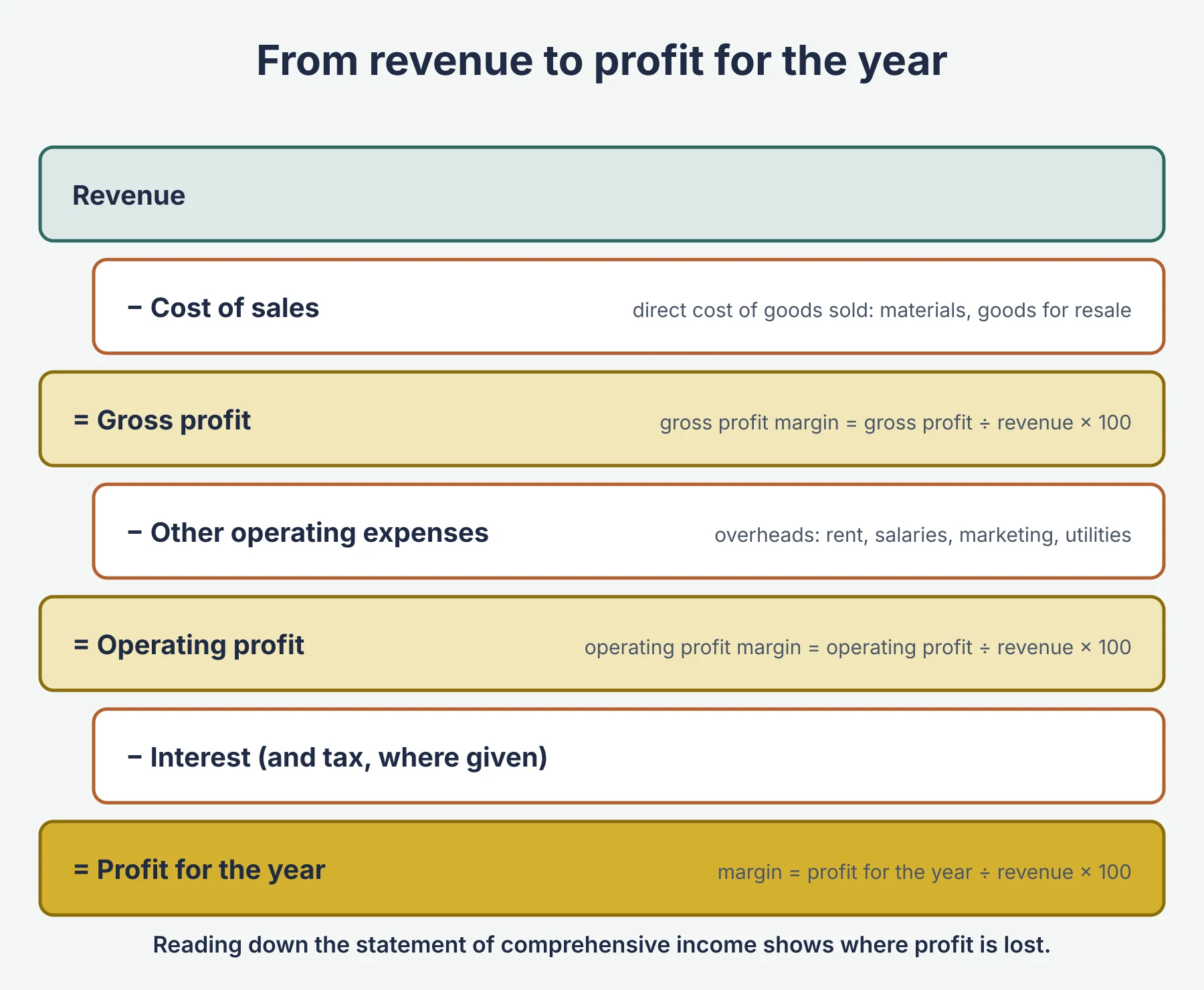
Gross profit              = revenue - cost of sales
Operating profit          = gross profit - other operating expenses
Profit for the year       = operating profit - interest (and tax, where given)
Gross profit margin       = gross profit / revenue x 100
Operating profit margin   = operating profit / revenue x 100
Profit for the year margin = profit for the year / revenue x 100
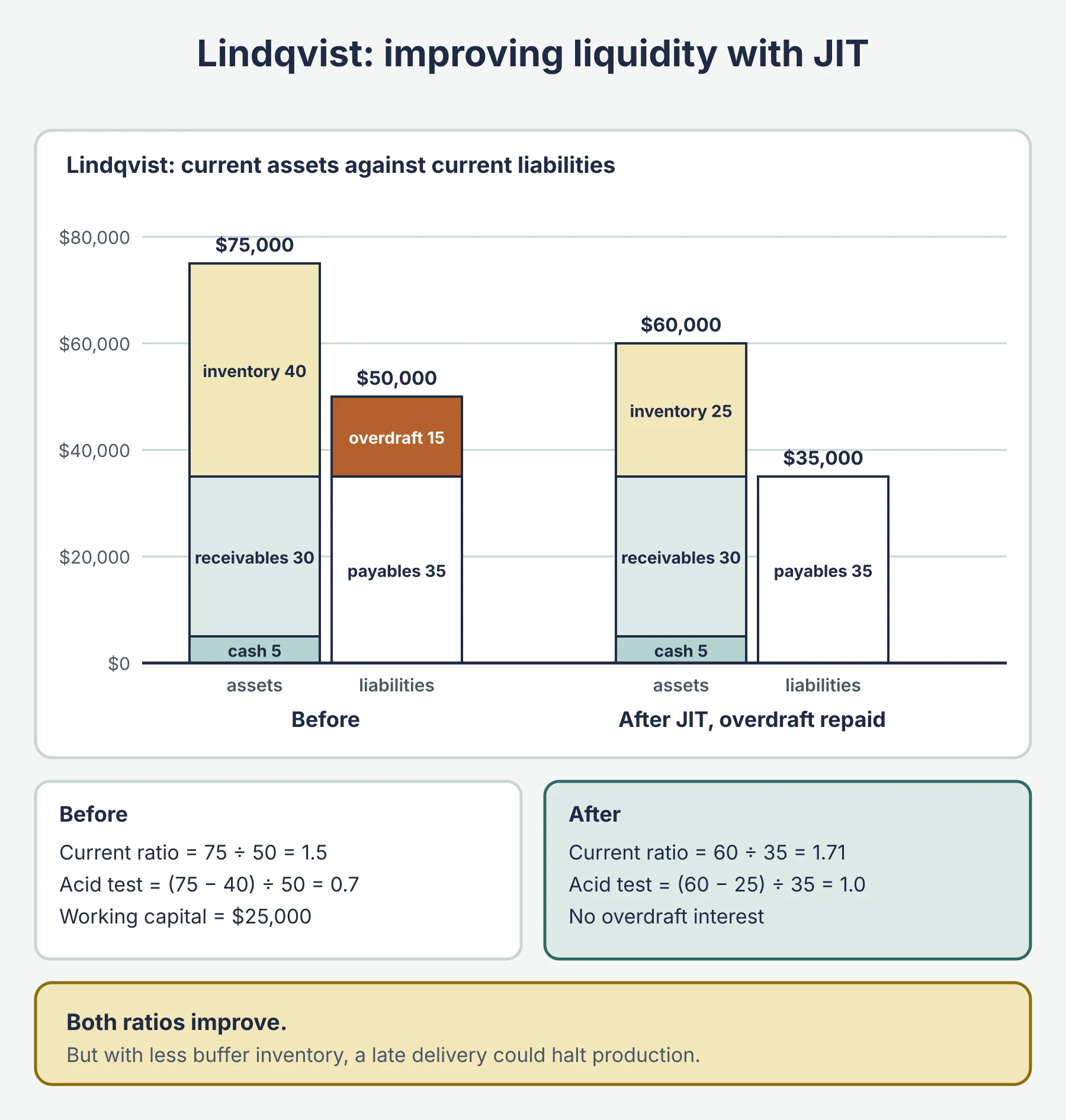
Current ratio             = current assets / current liabilities
Acid test ratio           = (current assets - inventory) / current liabilities
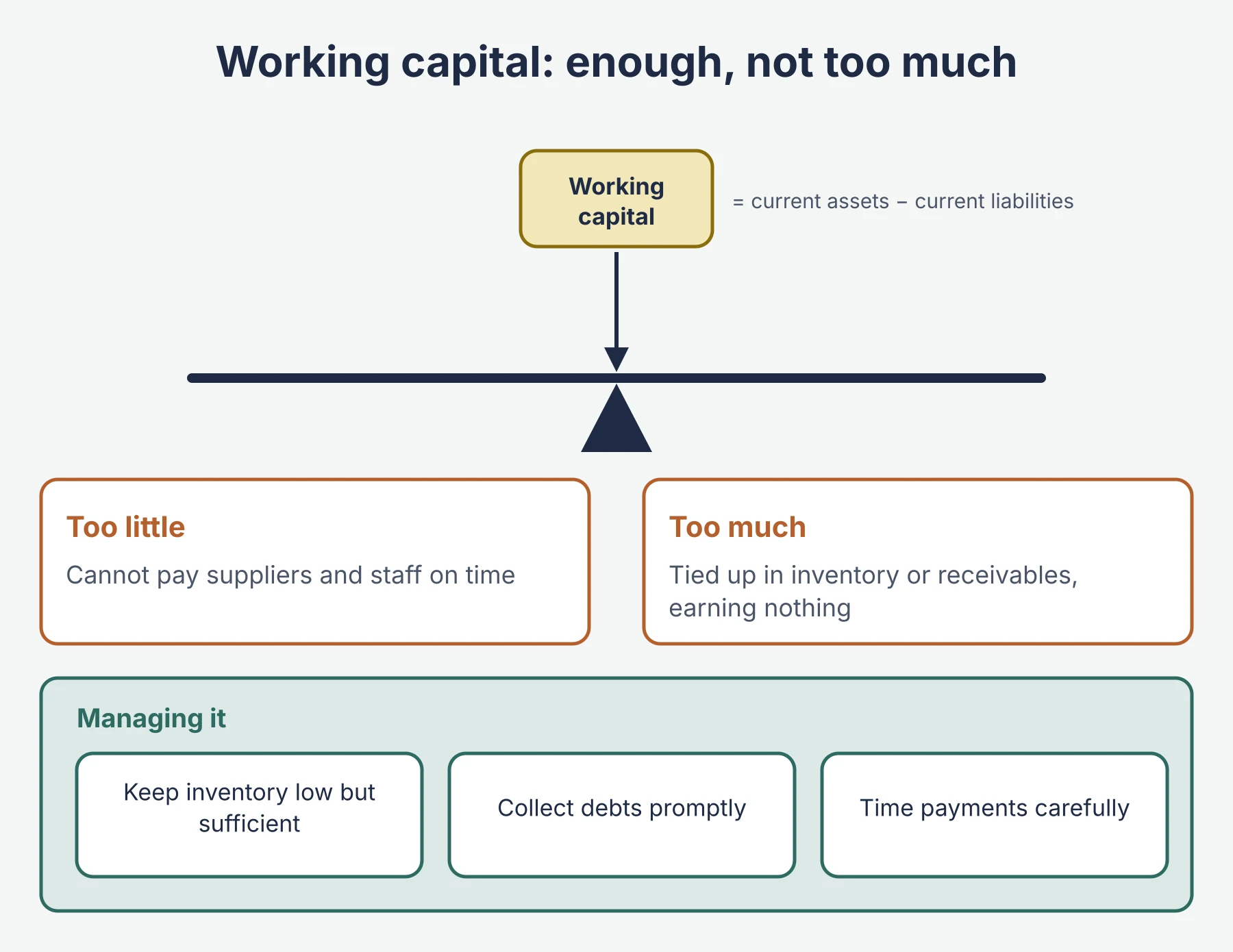
Working capital           = current assets - current liabilities
Reading the statement of comprehensive income
- Revenue → minus cost of sales → gross profit (how well the firm buys or makes and prices each item).
- Minus other operating expenses → operating profit (how well it controls overheads).
- Minus interest → profit for the year (what is left after financing costs).
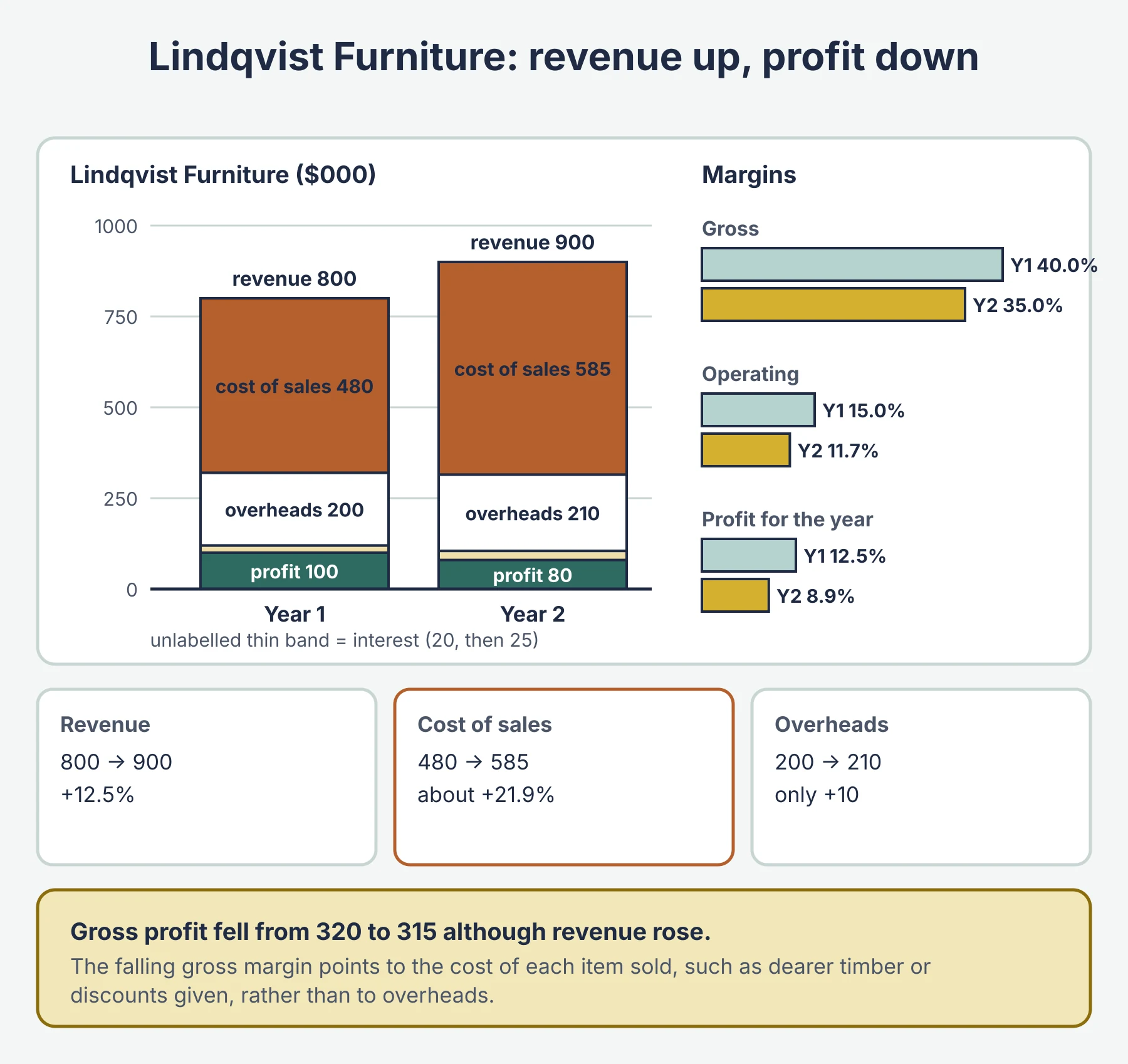
- If the gross margin falls, look at prices and direct costs. If only the operating margin falls, look at overheads. If only the net margin falls, look at interest.
Raising profit and profitability
| Method | Benefit | Risk |
|---|---|---|
| Raise price | More profit per unit | Lost sales if demand is elastic |
| Cheaper suppliers | Lower cost of sales | Lower quality, less reliable delivery |
| Cut waste | Lower cost of sales | Training or new equipment needed |
| Cut overheads | Higher operating margin | Poorer service or morale |
| Raise volume | Fixed costs spread further | Marketing cost; may need discounts |
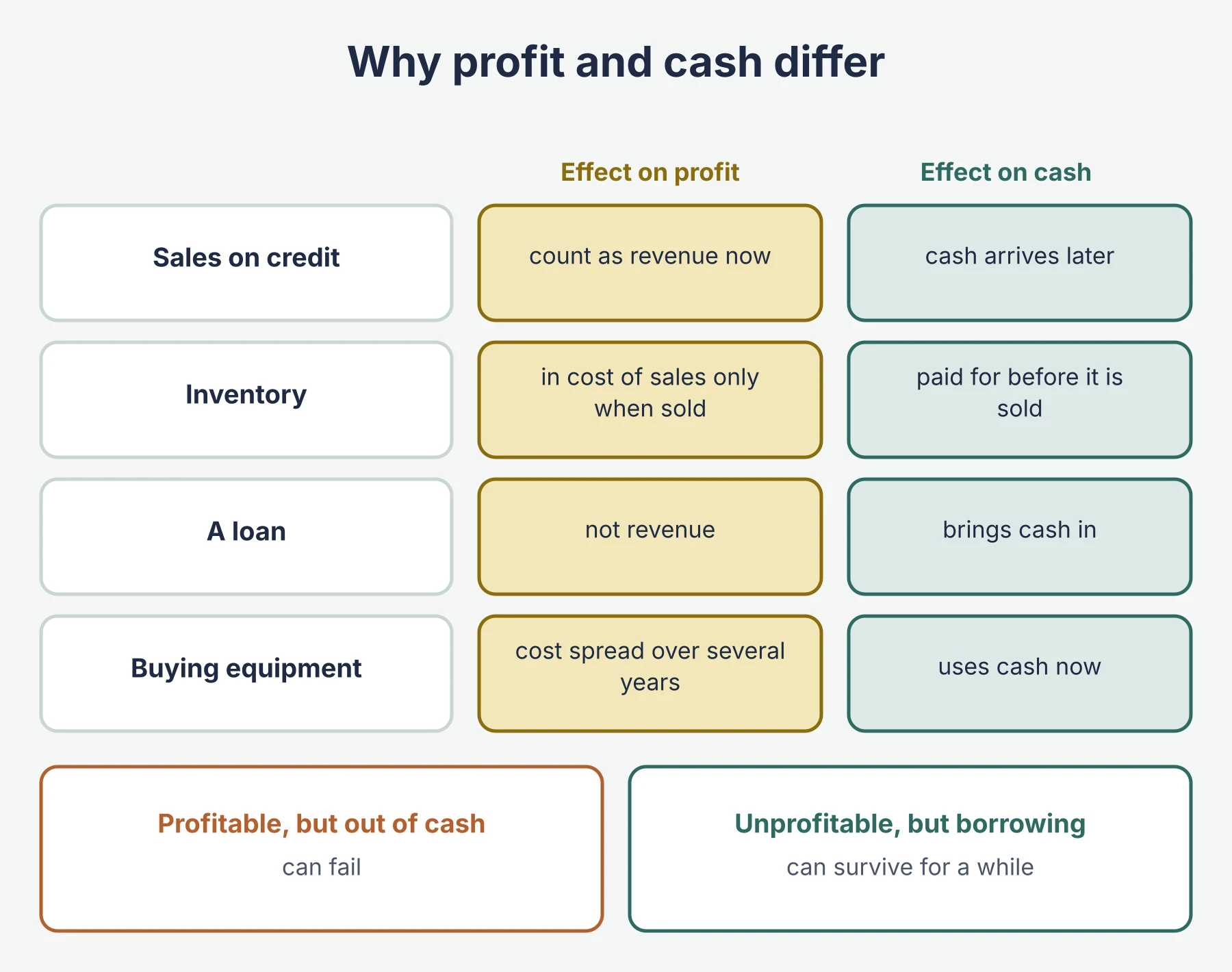
Profit versus cash
- Credit sales: revenue now, cash later.
- Inventory: cash out before the sale.
- Loans: cash in, but not revenue.
- Equipment: cash out at once, cost spread over years.
- So a profitable firm can be short of cash, and a loss-making firm can hold cash for a while.
Liquidity
Current assets: inventory, trade receivables, cash. Current liabilities: trade payables, overdraft, other debts due within a year.
Ways to improve liquidity (specification):
- Assets: sell unused non-current assets for cash.
- Supplier credit terms: longer time to pay keeps cash in the business.
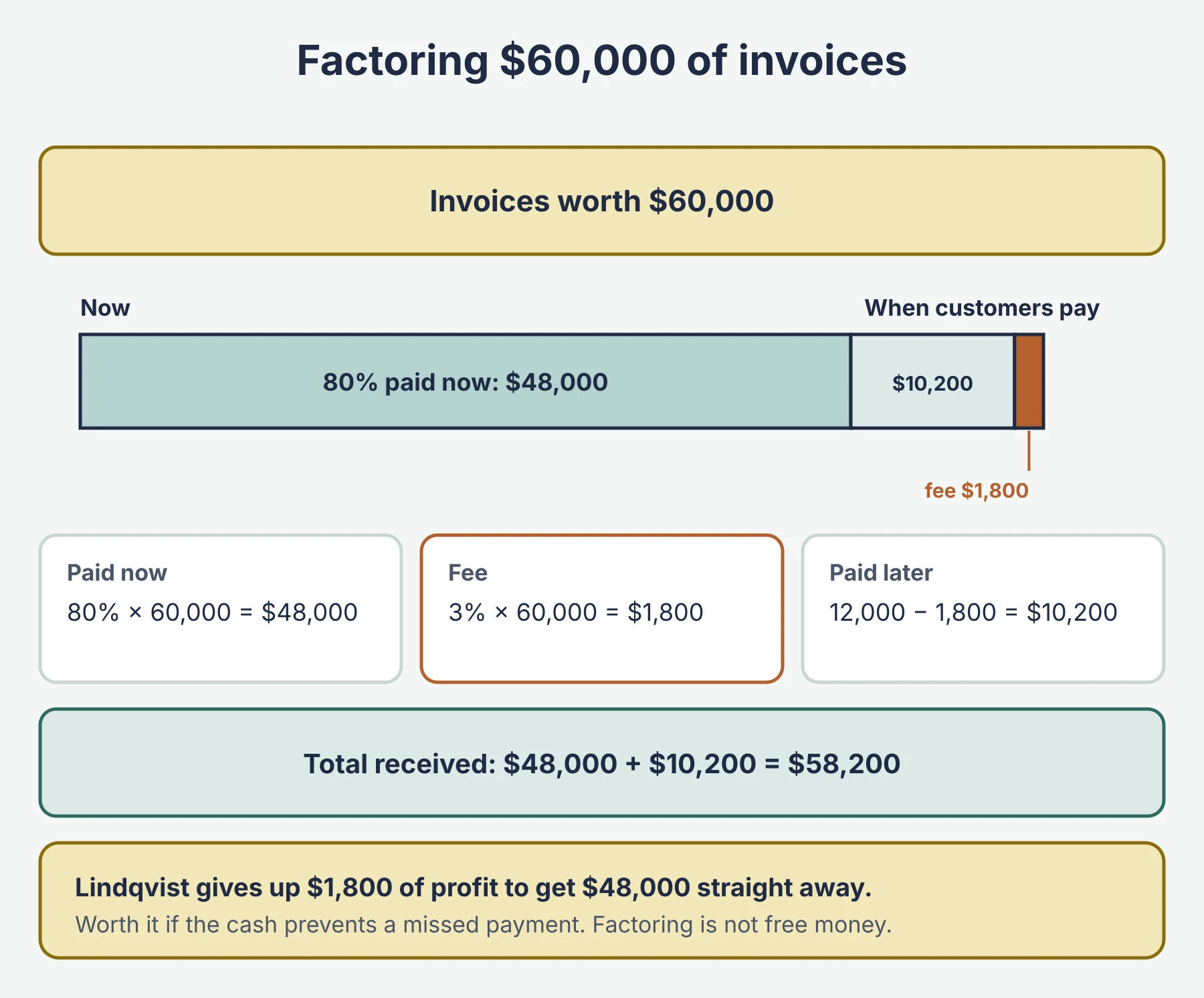
- Factoring: sell invoices for immediate cash, minus a fee.
- Inventory JIT: hold less inventory, releasing cash.
Working capital management: enough inventory but no more; collect debts promptly; time payments carefully; cash is what pays the bills.
Business failure
| Internal | External |
|---|---|
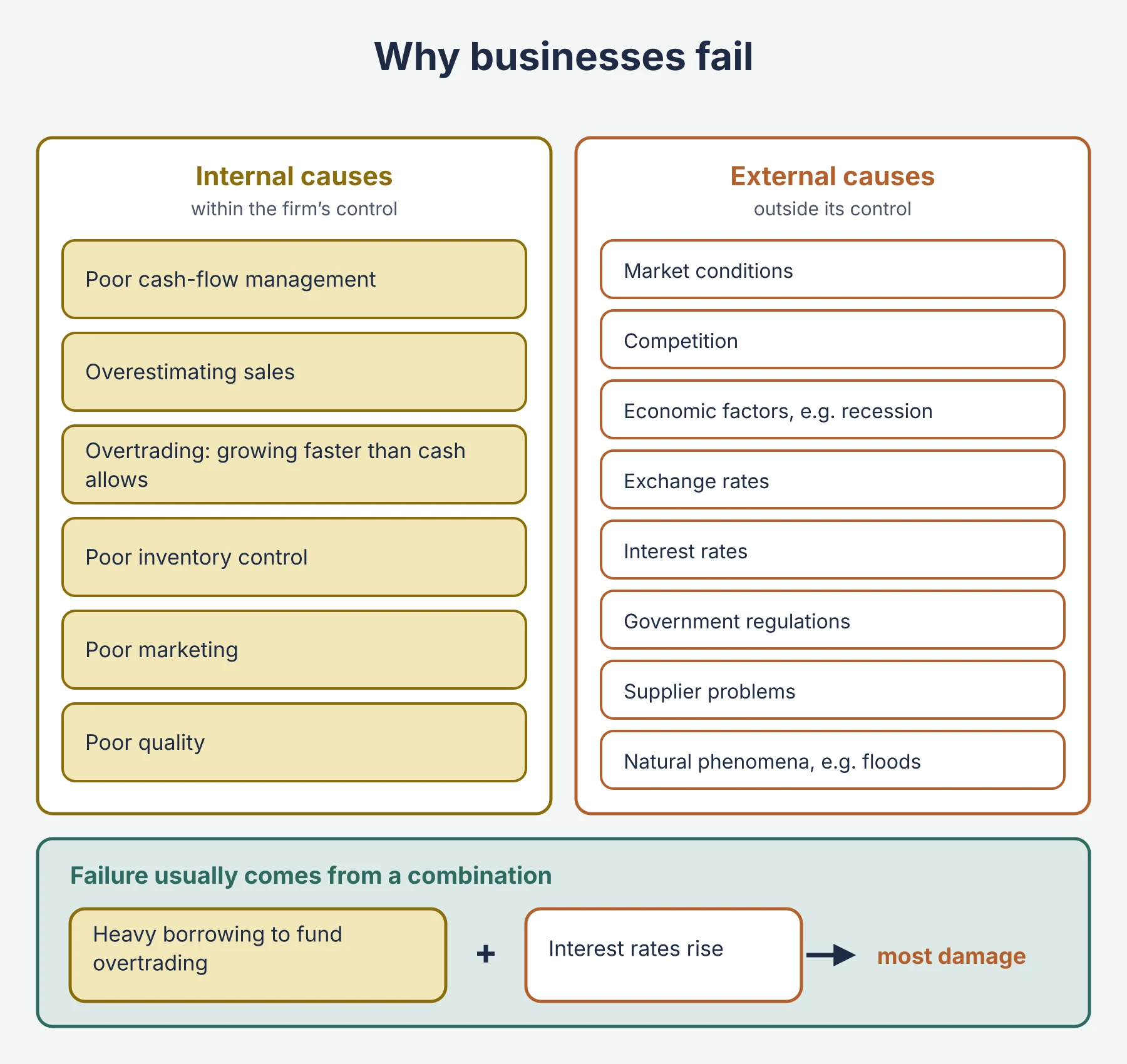
| Poor management of cash flow | Market conditions |
| Overestimation of sales | Competition |
| Overtrading | Economic factors |
| Poor inventory control | Exchange rates |
| Poor marketing | Interest rates |
| Poor quality | Government regulations |
| Supplier problems | |
| Natural phenomena |
Overtrading: expanding faster than the cash available can support, so the business cannot pay for the inventory and staff that growth needs.
Which measure answers which question?
| Question in the source | Measure to use |
|---|---|
| Is each sale earning enough over its direct cost? | Gross profit margin |
| Are overheads under control? | Operating profit margin |
| How much is left after financing costs? | Profit for the year margin |
| Can the firm pay its short-term debts? | Current ratio |
| Can it pay them without selling inventory? | Acid test ratio |
Key terms
| Term | Meaning |
|---|---|
| Cost of sales | Direct cost of the goods sold in the period |
| Gross profit | Revenue minus cost of sales |
| Operating profit | Gross profit minus other operating expenses |
| Profit for the year | Operating profit minus interest (and tax) |
| Liquidity | Ability to pay short-term debts as they fall due |
| Trade receivables | Money owed to the business by customers |
| Trade payables | Money the business owes to suppliers |
| Factoring | Selling unpaid invoices to a specialist for immediate cash |
| Working capital | Current assets minus current liabilities |
| Overtrading | Growing faster than the firm’s cash can support |
Exam traps
- Interest comes after operating profit, not before.
- The acid test excludes inventory; the current ratio does not.
- A ratio means little alone: compare it with last year, rivals or the industry.
- Repaying an overdraft with cash changes both ratios; work them through rather than guessing.
- Factoring raises cash but lowers profit by the fee.
- A higher revenue figure with a lower margin can mean lower profit.
Self-test
- Revenue $500,000; cost of sales $300,000. Calculate gross profit.
- Other operating expenses are $140,000. Calculate operating profit.
- Interest is $10,000. Calculate the profit for the year margin.
- Give two reasons why profit and cash differ.
- Current assets $90,000, including inventory of $36,000; current liabilities $60,000. Calculate the current ratio.
- Calculate the acid test ratio for question 5.
- Calculate working capital for question 5.
- State the four ways to improve liquidity named in the specification.
- Invoices worth $20,000 are factored for a 4% fee. What does the fee cost the business?
- Define overtrading.
- Give three internal causes of business failure.
- Give three external causes of business failure.
Answers
- $500,000 − $300,000 = $200,000.
- $200,000 − $140,000 = $60,000.
- ($60,000 − $10,000) ÷ $500,000 × 100 = 10%.
- Any two: credit sales; inventory bought before it is sold; loans bring cash but not revenue; equipment is paid for at once but its cost is spread.
- $90,000 ÷ $60,000 = 1.5.
- ($90,000 − $36,000) ÷ $60,000 = 0.9.
- $90,000 − $60,000 = $30,000.
- Selling assets, better supplier credit terms, factoring, JIT inventory.
- 4% × $20,000 = $800.
- Expanding faster than the firm’s cash can support, so it cannot pay for the extra inventory and costs that growth needs.
- Any three: poor cash-flow management, overestimation of sales, overtrading, poor inventory control, poor marketing, poor quality.
- Any three: market conditions, competition, economic factors, exchange rates, interest rates, government regulations, supplier problems, natural phenomena.
Related resources
-
Study guides
Pearson Edexcel International A Level Business (YBS11): Resource management
Study guide to Edexcel IAL Business 2.3.4 Resource management: production methods, productivity, efficiency, capacity utilisation, inventory control and quality.
Business · Pearson Edexcel · AS Level
Read guide -
Practice questions
Pearson Edexcel International A Level Business (YBS11): Resource management – Practice Questions
Twelve original source-based questions with full answers on productivity, capacity utilisation, inventory control, JIT and quality for Edexcel IAL 2.3.4.
Business · Pearson Edexcel · AS Level
Try questions -
Revision notes
Pearson Edexcel International A Level Business (YBS11): Resource management – Revision Notes
Revision notes for Edexcel IAL Business 2.3.4: production methods, productivity, efficiency, capacity utilisation, inventory control, JIT and quality, with a self-test.
Business · Pearson Edexcel · AS Level
Revise topic
Get free revision emails (optional)
Occasional emails with practice questions, worked explanations and links to free resources for the qualification and subjects you choose. No spam, and you can unsubscribe from any email. The free tools on this site never need an email.